Correlations of Biomechanical Characteristics with Ball Speed in Penalty Corner Push-In
Comparison and Study of the Bulk Etch Rate of the Detector CR-39 using Two Etching Solutions
Ahmed Abd Ibrahim1 & Wathab Hazim Yousif2
1Department of Physics, College of Sciences, Kirkuk University, Kirkuk, Iraq. 2Department of Physics, College of Sciences, Kirkuk University, Kirkuk, Iraq.
Received 15th January 2018, Accepted 5th February 2018
Abstract
In this research, we studied the effect of two types of etching solutions on the bulk etch rate(VB)of the nuclear track detector CR-39. The first type of solution was prepared from dissolving NaOH in (ethanol+water) by different normalitiesat temperature 55ºC and compared with the second type of the solution prepared from dissolving NaOH in (methanol+water) by different normalities at temperature 55ºC.The method of direct measurement of the thickness of theremoved layer by the chemical etching of the detector was used in finding the bulk etch rate values. It was found the values of the bulk etch rate by using the etching solution NaOH/methanol+water greater than the values of the bulk etch rate by using the etching solution NaOH/ethanol+water, Their values have ranged between (4.48-10.62)um/hr for NaOH/ethanol+water and ( 15.64-35.51)um/hr for NaOH/methanol+water.
Keywords: CR-39;Bulk etch rate;NaOH+ethanol+water;NaOH+methanol+water.
© Copy Right, IJRRAS, 2018. All Rights Reserved.
1. Introduction :
CR-39 detector belongs to organic detectors, it is the most popular member of the SSNTD’s family. This plastic is thermoset, cross-linked, totally amorphous and very sensitive to heavy ion damage [6,7]. CR-39 is prepared by the polymerization of a liquid monomer diethylene glycol bis(allyl carbonate) [29]
Also CR-39 are characterized by being hard, infusible and insoluble in all solvents. In addition to the general thermoset characteristics , CR-39 is a high-grade optical plastic whose refractive index is just slightly less than that glass. It is extremely hard yet brittle, resistance to almost all chemicals except strong bases and highly oxidizing acids[4,10,19].
Chemical etching is the most common method being used in various studies of surfaces and technical applications[15]. The response of the solid state nuclear track detectors(SSNTDs) depends strongly on the
Correspondence
WathabHazim Yousif
E-mail:[email protected], Ph. +9189406 73937
etching condition and etchant characteristics. Since then, efforts have been made to introduce a better etchant
having improved etching parameter such as VT, VB, ET,
EB, etch induction time [1].
The bulk etch rate VB is the rate of removing of
the undamaged surface of the detector due to the chemical reaction between the etching solution and the detector material, Which reduces the thickness with the
progress of the process of etching [25,33]. Since VB is
one of the most important parameters that control the formation and development of tracks, It has been shown
that VB depends on many factors like the purity of the
basic substances. The homogeneity of the detector material and its isotropic, the molecular structures of polymers, polymerization conditions as well as its dependence on a number of environmental factors during detector irradiation. The process of swelling is considered due to the absorption of detector to the solution during the process of etching. one of the important factors that affects the measurement of the bulk etch rate. The etching materials not only remove the general surface, but also cause swelling in the detector. The amount of swelling depends on the type of polymeric detector and its polymerization conditions as well as weather factors such as humidity, dehydration
and temperature change during storage
[30,4,20,24,12,7,22].In addition to the VB is being
detecting parameter, it is also an important etching parameter, It also depends on the type of chemical solution and its normalities and its temperature[3,25,31].
It is known that the value of VB does not depend
on the etching direction under experiment conditions in homogeneous and isotropic materials such as the CR-39,
International
Journal of Recent Research and Applied Studies
(Multidisciplinary Open Access Refereed e-Journal)
19 International Journal of Recent Research and Applied Studies, Volume 5, Issue 2 (4) February 2018
PM-355, LR-115, CN-85, etc., because the VB value is
constant for all etching directions on the general surface of the detectors, have two values depending on the direction of the non-homogenous and non-isotopic detection surface[2].There are different methods have been established for the determination of the bulk etch rate: One of the methods is used in the measurement of
VB is the method of removed thickness from the surface
of the detector. this method is called direct method, and is done by measuring the thickness of the detector before the etching process and after and for successive etching
time, the method is used in this research, VB can be
calculated from the relationship[12].
t h
2 1
VB (1)
Where: h is the removal layer thickness (µm), t is etching time(hr).
There is another method called method of gravimetric, and depends on the measurement of the
detector mass before and after etching, VB can be
calculated from the relationship:
t m
A
21
VB (2)
where Δm is mass difference, A the etched surface area, ρ the density of the detector and t is the etching time.
In addition to that, there are other methods such as the method of fission fragments using the irradiated
source 252Cfand the rate of etching average is high in this
case, VB can be found by direct measurement of fission
fragments Df(µm) at the time of etching t(hr) using the
following relationship[12]:
t Df
2
VB (3)
There is another method to measure the bulk etch rate , It is a method of measuring the track's
diameter-length(Le-D), VB which can be calculated from
the relationship[23,5]:
22
2
4
1
1
4
D
L
L
t
D
V
ee
B (4)
t
B T
B T B
V
V
V
V
V
D
)
(
)
(
2
(5)Where Le is track length, D is the cone
diameter, t is the etching time.
It was found that the bulk etch rate VB and track
etch rate VT are affected by the change in the normality
of the etching solution depending on the
relationship[27]:
𝑉𝐵= 𝑓𝐵𝐶𝑛𝑒(−
𝐸𝑘 𝑘𝑇)(6)
Where fBis the constant depends on the type of material,
C is the concentration of the etchant in the unit of normality, k is the Boltzman’s constant, T is the temperature in K.
2. Methodology
CR-39 detector of 200µm thickness was used from TASKRAK (Track Analysis System Ltd.(TASL), Bristol, UK)and have been prepared in pieces of 1×1
cm2.The edges are fine-polished to get rid of the
scratches and to make them sharp and clear for precise measurements of the detector thickness and then the bulk
etch rate(VB). These detectors were then etched in
NaOH/70% ethanol+30%water and NaOH/70%
methanol+30%water at normality of (1.5 , 2 ,2.5 ,3)N ,at a temperature of 55ºC.The etching was done in a bottle with a tight cover to prevent change in the concentration of the etching solution due to vaporization of ethanol and methanol and absorption of moisture. For an etching process, a water bath (Memmert type W200)of stabilizing temperature with accuracy ±1C was used. After each etching step, detectors were washed with distilled water and dried using a thermal oven type (elektro.mag – M 420)at 50 ° C for a quarter of an hour. To begin the process of microscopic observation to
measure the removal layer thickness with a
magnification of 100× attached to digital camera [MDCE-5A] connected to a computer. The bulk etch rate
VB is measured by the change of the thickness of the
detector(direct measurement) using the relation(1).
3.Results and discussion
The Bulk etch rate (VB)is considered a
fundamental parameter in the formation of the
track, where it is an etching and detecting
parameter ,The final effect of the etching process is the removal of the material from the detector surface[3,15,25]. In our study, we used new etching
solutions NaOH/ethanol+water and
NaOH/methanol+water to reduce etching time
compared to the conventional etching 6 N
NaOH/water at 70ºC and use these solutions in many applications.
3.1.Bulk etch rate of the CR-39 in NaOH/ethanol+water :
Bulk etch rate of CR-39 was determined in
different concentrations of NaOH/ethanol+water
(1.5,2,2.5,3)N at temperature 55ºC.To avoid evaporation of ethanol due to its lower boiling point, etching was carried out at lower temperatures[26].
As previously mentioned, there are
different methods to measure bulk etch rate
(VB),we are used a direct measurement of
thickness, the removal layer thickness was
of the etching solution. A linear relationship was found between the removal layer thickness and
etching time. Increasing the time of etching,
increases the reaction time between the detector and the etching solution and thus increases the amount of degradation of the detector material from the surface, thereby increasing the thickness of the layer removed from the surface of the detector.
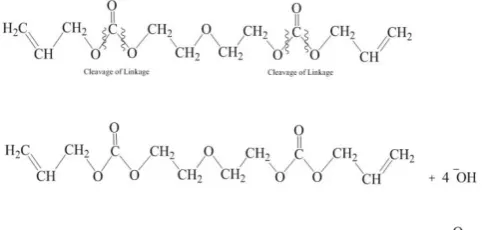
Although both etching solution NaOH/water and NaOH/ethanol+water has the same etching mechanism, The treatment of the nuclear track detector CR-39 with basic solutions leads to scission of the carbonate ester bond by hydroxide ion through hydrolysis of ester, The following reaction shows the position of cleavage by hydroxide ion (OH ˉ)[16,32] :
The large increase in the bulk etch rate using NaOH/ethanol+water solution compared to the bulk etch rate using NaOH/water, this is due to the miscibility of ethanol with the organic products of the CR-39 during the etching solution. Also the production rate of sodium carbonate in NaOH/ethanol+water during the etching process is greater than NaOH/water and a layer of sodium carbonate precipitate was accumulated on the surface of the CR-39 due to the insolubility of sodium
carbonate and saturation in ethanol+water, which increases the amount of removal material from the surface of the detector[9,32,8].
Table 1
VB for CR-39 as a function of normality of NaOH/ethanol+water
Figure II show values of VB increase with the
increasing concentration of the etching
solutionNaOH/ethanol+water and note this increase is exponential follows the equation(6).
3.1.Bulk etch rate of the CR-39 in NaOH/methanol+water :
Bulk etch rate of CR-39 was determined in
different concentrations of NaOH/methanol+water
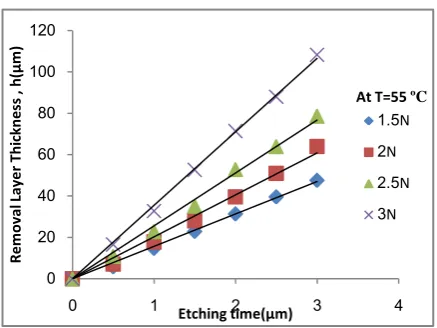
(1.5,2,2.5,3)N at temperature 55ºC, Figure III show the removal layer thickness in NaOH / methanol + water is greater than NaOH / ethanol + water. This can be explained by the polar force, which shows that the methanol polarity (5.1) is greater than the ethanol polarity (4.3) [13].
Normality VB
1.5 4.48
2 5.99
2.5 7.83
3 10.62
0 5 10 15 20 25 30 35
0 1 2 3 4
R
e
m
ov
al
L
aye
r
Thi
cknes
s
, h(µ
m
)
Etching time(µm)
At T=55 ºC
N
1.5
N
2
N
2.5
N
3
Figure I
Change the removal thickness layer with etching time in CR-39 detectors etched in NaOH/ethanol+water at 55°C with different concentration
S = 0.29309113 r = 0.99588082
Normality
B
u
lk
e
t
t
c
h
r
a
t
e
,
(
u
m
/
h
r
)
1.0 1.5 2.0 2.5 3.0 3.5
3.80 5.80 7.80 9.80 11.80
Figure II
21 International Journal of Recent Research and Applied Studies, Volume 5, Issue 2 (4) February 2018
Table 2
VB for CR-39 as a function of normality of NaOH/methanol+water
Normality VB
1.5 15.64
2 20.28
2.5 25.58
3 35.51
Figure IV show values of VB increase with the
increasing concentration of the etching solution
NaOH/methanol+water and note this increase is exponential follows the equation(6).
3.3 Application:
From tables (1) and (2) we find the that values
of the bulk etch rate VB when using
NaOH/ethanol+water and NaOH/methanol+water
solutions are large and can be used in many fields; Clean the detector from the background of radiation before use
in experiments and measurements, especially in the measurement of radon concentrations.It is also used in the process of thinning the detector to thickness less than (h<20μm) in order to be used in experiments to study the growth of biological cells[8].These solutions can be used prior to electrochemical etching to reduce sharp surface defects[17].These solutions are also used to improve the efficiency of the scanning for ultraheavy cosmic ray pathways as well as cleaning the detector from the background of heavy radiation when the detector
exposure to thermal neutrons intensities above 1014 n cm
-2 [4].
Conclusions
Throughout this research, we inferred that using
two etching solutions NaOH/ethanol+water and
NaOH/methanol+water gives good results for bulk etch rate and with greater values in short duration etching and can be used in many fields: Nuclear physics , radiobiological, space physics, cosmic rays.
References
1. Ali, N., Khan, E. U., & Khan, K. (2009). Etch
Induction Time in CR-39 Detectors Etched in Na2CO3 Mixed NaOH Solution. Chinese Physics Letters, 26(9), 092901.
2. Al-jubbori,M.A.A., Thesis, College of Education,
University of Mosul, Iraq (2012).
3. Al-Oʼbedy, A.A.I., MSc. Thesis, College of
Education , University of Mosul, Iraq (2000).
4. Amin, S. A., (1981) . " Etching Properties of the
CR-39 Polymeric Nuclear Track Detector " , Ph.D. Thesis, University of Bristol, UK.
5. Balestra, S., Cozzi, M., Giacomelli, G.,
Giacomelli, R., Giorgini, M., Kumar, A., Mandrioli, G., Manzoor, S., Margiotta, A.R., Medinaceli, E., Partizii, L., Popa, V., Qureshi, I.E., Rana, M.A., Sirri, G., Spurio, M., Togo, V. and Valieri, C., (2007), "Bulk etch rate measurements and calibrations of plastic nuclear track detectors" Nucl. Instr. and Meth., in: Physics Research, B 254 254.
6. Cartwright, B. G., Shirk, E. K., & Price, P. B.
(1978). A nuclear-track-recording polymer of
unique sensitivity and resolution. Nuclear
Instruments and Methods, 153(2-3), 457-460.
7. Cassou, R. M., & Benton, E. V. (1978). Properties
and applications of CR-39 polymeric nuclear track detector. Nuclear Track Detection, 2(3), 173-179.
8. Chan, K. F,; Ng, F. M. F.; Nikezic, D. and Yu, K.
N. )2007( , " Bulk and Track Etch Properties of
CR-39 SSNTD Etched in NaOH/Ethanol " , Nucl. Instr. and Meth. in Physics Research, B 263, pp. 284-289.
9. Chan, K. F., Siu, S. Y. M., McClella, K. E., Tse, A.
K. W., Lau, B. M. F., Nikezic, D., ... & Yu, K. N. (2006). Alpha-particle radiobiological experiments using thin CR-39 detectors. Radiation protection dosimetry, 122(1-4), 160-162.
S = 0.53584456 r = 0.99868474
Normality
B
u
lk
e
t
c
h
r
a
t
e
,
(
u
m
/
h
r
)
1.0 1.5 2.0 2.5 3.0 3.5
13.00 16.00 19.00 22.00 25.00 28.00 31.00 34.00 37.00 40.00 43.00 0 20 40 60 80 100 120
0 1 2 3 4
R
e
m
ov
al
L
aye
r
Thi
cknes
s
, h(µ
m
)
Etching time(µm)
At T=55 ºC
N
1.5
N
2
N
2.5
N
3
Figure III
Change the removal thickness layer with etching time in CR-39 detectors etched in NaOH/methanol+water at 55°C with different concentration
Figure IV
10. Chapiro A. Atomic Radiation and polymers. Pergamon Press, Oxford, 1962
11. Chatry C.; Serbat A.; Laugier J.; Gasiot J. and
Vanderschneren J. (1990), "Energy and Angle Response of CR-39 to Protons", In Proc. 15th Int. Conf. on Particle Tracks in Solids, Hamburg, Germany.
12. Durrani, S.A. and Bull, R.K., “Solid State Nuclear
Track Detection”, (Pergamon Press, Oxford, 987).
13. El Rassi, Z. (Ed.). (1994). Carbohydrate analysis:
high performance liquid chromatography and capillary electrophoresis (Vol. 58). Elsevier.
14. Fews, A. P., &Henshaw, D. L. (1983).
Alpha-particle autoradiography in CR-39: a technique for quantitative assessment of alpha-emitters in
biological tissue. Physics in Medicine &
Biology, 28(5), 459.
15. Fleischer R.L., Price P.B. and Walker
R.M.(1975).Nuclear Tracks in Solids: Principles and Application . University of California Press.
16. GruhnT.A.,Li W.K., Benton E.V., Cassou R.M.
and Johnson G.S. (1980) . " Etching Mechansim and Behaviour of Polycarbonates In Hydroxide Solution: Lexan and CR-39 " .In: Proc. 10th Int. Conf. Solid State Nuclear Track Detectors, Loyn, and Supp1.2, Nucl. Track . Pergaman, Oxford.291.
17. Hassib, G. M. (1979). A pre-electrochemical
etching treatment to improve neutron recoil track detection. Nuclear Tracks, 3(1-2), 45-52.
18. Henshaw, D. L., Amin, S., Clapham, V. M.,
Fowler, P. H., Webster, D. J., Thompson, A., & O'Sullivan, D. (1982). The form of the CR-39 response curve and its effect on particle resolution and areas of application. In Solid State Nuclear Track Detectors(pp. 115-118).
19. Houstoun, S. M., & Jefferies, N. L. (1982). CR-39
α-particle autoradiographs of some radioactive minerals from SW England. In Solid State Nuclear Track Detectors (pp. 621-625).
20. Kobayashi, T., &Fujii, M. (1988). Effect of various
etching solutions on the response of CR-39. International Journal of Radiation Applications and Instrumentation. Part D. Nuclear Tracks and Radiation Measurements, 15(1-4), 175-178.
21. Luszik-Bhadra, M., Alberts, W. G., Dietz, E.,
Piesch, E., & Siebert, B. R. L. (1995). CR-39 track neutron dosemeter/spectrometer: Investigations in the thermal, epithermal and intermediate energy region. Radiation measurements, 25(1-4), 441-444.
22. Malik, F., Khan, E. U., Qureshi, I. E., Husaini, S.
N., Sajid, M., Karim, S., & Jamil, K. (2002). Swelling in CR-39 and its effect on bulk etch-rate. Radiation measurements, 35(4), 301-305.
23. Manzoor, S., "Nuclear Track Detectors for
Environmental Studies and Radiation Monitoring", (Physical Department, University of Bologna, 2006).
24. Ng, C. K. M., Poon, W. L., Li, W. Y., Cheung, T.,
Cheng, S. H., & Yu, K. N. (2008). Study of substrate topographical effects on epithelial cell behavior using etched alpha-particle tracks on PADC films. Nuclear Instruments and Methods in Physics Research Section B: Beam Interactions with Materials and Atoms, 266(14), 3247-3256.
25. Nikezic, D., & Yu, K. N. (2004). Formation and
growth of tracks in nuclear track materials. Materials Science and Engineering: R: Reports, 46(3), 51-123.
26. Rehman, S., &Zaman, W. (2005). Discovery of
new etchants for CR-39 detector. Radiation measurements, 39(3), 337-343.
27. Salih, N. F., Jaafara, M. S., Al-Hamzawi, A. A.,
&Aswood, M. S(2013). The Effects of Alpha Emitters on Powder Blood for Women’s Infertility in Kurdistan–Iraq. International Journal of Scientific and Research Publications, 57.
28. Somogyi, G. and Hunyadi, I., in: Proc. 10th Int.
Conf. “Solid State Nuclear Track Detectors”, Lyon, and Suppl. 2, Nuclear Tracks, Pergamon Press, Oxford (1980) 443.
29. Stejny, J. (1987). The polymer physics of
CR-39-The state of understanding. Radiation Protection Dosimetry, 20(1-2), 31-36.
30. Stejny, J., &Portwood, T. (1986). A study of the
molecular structure in CR-39. International Journal of Radiation Applications and Instrumentation.
Part D. Nuclear Tracks and Radiation
Measurements, 12(1-6), 121-123.
31. Szydlowski, A., Czyzewski, T., Jaskola, M.,
Sadowski, M., Korman, A., Kedzierski, J., &Kretschmer, W. (1999). Investigation of response of CR-39, PM-355 and PM-500 types of nuclear track detectors to energetic carbon ions. Radiation measurements, 31(1-6), 257-260.
32. Tse, K. C. C., Ng, F. M. F., & Yu, K. N. (2006).
Photo-degradation of PADC by UV radiation at various wavelengths. Polymer Degradation and Stability, 91(10), 2380-2388.
33. Yip, C. W. Y., Ho, J. P. Y., Nikezic, D. and Yu, K.
N. (2003), "Study of Inhomogeneity in Thickness of LR 115 Detector with SEM and Form Talysurf". Radiat. Meas.,36, pp. 161-164.