
Method development and validation for the simultaneous estimation of ambroxol Hcl and loratadine in a pharmaceutical formulation by RP-HPLC method
10
0
0
Full text
(2) Dondeti mogili reddy, et al / Int. J. of Pharmacy and Analytical Research Vol-3(4) 2014 [482-491]. Structure of Ambroxol 4 IUPAC name4: trans-4-(2-Amino-3,5-dibrombenzylamino)-cyclohexanol Molecular formula: C13H18Br2N2O Molecular weight: 378.10g/mol Ambroxol is indicated as “secretolytic therapy in broncho pulmonary diseases associated with abnormal mucus secretion and impaired mucus transport. It promotes mucus clearance, facilitates expectoration and eases productive cough, allowing patients to breathe freely and deeply. 3. Mechanism of action Ambroxol is a mucolytic agent. Excessive Nitric oxide (NO) is associated with inflammatory and some other disturbances of airways function. NO enhances the activation of soluble guanylate cyclase and cGMP accumulation. Ambroxol has been shown to inhibit the NO-dependent activation of soluble guanylate cyclase. It is also possible that the inhibition of NO-dependent activation of soluble guanylate cyclase can suppress the excessive mucus secretion, therefore it lowers the phlegm viscosity and improves the mucociliary transport of bronchial secretions. 15. Loratadine 5 Loratadine is a derivative of azatadine and a secondgeneration histamine H1 receptor antagonist used in the treatment of allergic rhinitis and urticaria. Unlike most classical antihistamines (histamine H1 antagonists) it lacks central nervous system depressing effects such as drowsiness. Indication. Structure of Loratidine IUPAC name: ethyl 4-{13-chloro-4-azatricyclo[9.4.0.0^{3,8}] pentadeca-1(11),3,5,7,12,14-hexaen-2-ylidene}piperidine-1carboxylate Molecular formula: C22H23ClN2O2 Molecular weight: 382.883 g/mol . Category . Anti-Allergic Agents Antipruritics Histamine H1 Antagonists, Non-Sedating. 483. Histamine Antagonists.
(3) Dondeti mogili reddy, et al / Int. J. of Pharmacy and Analytical Research Vol-3(4) 2014 [482-491]. Mechanism of action. Materials. Loratadine competes with free histamine and exhibits specific, selective peripheral H1 antagonistic activity. These blocks the action of endogenous histamine, which subsequently leads to temporary relief of the negative symptoms (eg. nasal congestion, watery eyes) brought on by histamine. Loratadine has low affinity for cholinergic receptors and does not exhibit any appreciable alphaadrenergic blocking activity in-vitro. Loratadine also appears to suppress the release of histamine and leukotrienes from animal mast cells, and the release of leukotrienes from human lung fragments, although the clinical importance of this is unknown.. Pharmaceutically pure sample of AMBROXOL HCL and LORATADINE were obtained as gift samples from Chandra Labs, Prashanthinagar, Kukatpally, and Hyderabad, India. The purity of the drug was evaluated by obtaining its melting point and ultraviolet (UV) and infrared (IR) spectra. No impurities were found. The drug was used without further purification. HPLC-grade Acetonitrile was from standard reagents pvt ltd. KH2PO4 (AR grade) was from Merck. A tablet formulation of AMBROXOL HCL and LORATADINE (60 mg and 5 mg label claims) were procured from local market (IROVEL-H, SUN PHARMACEUTICALS, India).. Pharmacodynamics. Chromatographic conditions. Loratadine is a long acting second generation antihistamine that is similar in structure to cyproheptadine and azatadine. The pharmacology of loratadine is similar to other antihistamines, but unlike other H1-blockers, loratidine is shown to exhibit competitive, specific, and selective antagonism of H1 receptors. The exact mechanism of this interaction is unknown, but disposition of the drug suggests that loratadine's prolonged antagonism of histamine may be due to the drug's slow dissociation from the receptor or the formation of the active metabolite, desloratadine. Loratadine does not penetrate the CNS effectively and has a low affinity for CNS H1-receptors.. The sample separation was achieved on a C18 (5 μm, 25 cm Χ 4.6 mm i.d.) INERTSIL column, aided by mobile phase mixture of Phosphate Buffer buffer(30mM) pH: 4.5: Acetonitrile : Methanol (30: 50:20), that was filtered and degassed prior to use, at a flow rate of 1ml/min. Injection volume is 20 μl and detected at 220 nm at ambient temperatures.. Preparation of mobile phase Buffer Preparation Weigh accurately about 4.08 gms of KH2PO4 and dissolve with 500ml of HPLC Grade water than make up to 1000 ml with HPLC grade water then adjust the pH: 4.5 with ortho phosphoric acid or sodium hydroxide.. Indication A self-medication that is used alone or in combination with pseudoephedrine sulfate for the symptomatic relief of seasonal allergic rhinitis. Also used for the symptomatic relief of pruritus, erythema, and urticaria associated with chronic idiopathic urticaria in patients (not for children under 6 unless directed by a clinician).. Mobile phase. EXPERIMENTAL Equipments. A 120 mg of standard Ambroxol HCl and 10 mg Loratadine ware weighed and transferred to 100 ml of volumetric flask and dissolved in mobile phase. The flask was shaken and volume was made up to mark with mobile phase to give a primary stock solution containing 1200 µg/ml Ambroxol HCl and 100 µg/ml of Loratadine. From the above solution 5ml of solution is pipette out into a 50 ml volumetric flask and volume was made up to mark with mobile phase to give a solution containing 1200 µg/ml Ambroxol HCl and 100 µg/ml of Loratadine.. Then add 30 volumes of buffer, 50 volumes of Acetonitrile and 20 volumes of Methanol sonicated for 15 min and filtered through a 0.45 µ membrane filter.. Analysis of formulation Preparation of standard solution. The chromatographic technique performed on a Shimadzu LC20-AT Liquid chromatography with SPD-20A prominence UV-visible detector and Spinchrom software, reversed phase C18 column (INERTSIL 5µ, 250 mm × 4.6 mm) as stationary phase. Thermo electron corporation double beam UV-visible spectrophotometer (vision prosoftware) ,Ultrasonic cleaner, Shimadzu analytical balance AY-220,Vaccum micro filtration unit with 0.45µ membrane filter was used in the study.. 484.
(4) Dondeti mogili reddy, et al / Int. J. of Pharmacy and Analytical Research Vol-3(4) 2014 [482-491]. Preparation of Formulation). sample. solution. 10 mg of the Ambroxol HCl standard drug is taken in a 10 ml volumetric flask and dissolved in methanol and volume made up to the mark, from this solution 0.1ml is pipette out into 10 ml volumetric flask and made upto the mark with the methanol to give a concentration of 10 µg/ml. The above prepared solution is scanned in uv between 200-400 nm using methanol as blank. The λmax was found to be 212nm 10 mg of the Loratadine standard drug is taken in a 10 ml volumetric flask and dissolved in methanol and volume made up to the mark, from this solution 0.1ml is pipette out into 10 ml volumetric flask and made upto the mark with the methanol to give a concentration of 10 µg/ml . The above prepared solution is scanned in uv between 200-400 nm using methanol as blank. The λmax was found to be 291nm. The Isosbestic Point of Ambroxol HCl and Loratadine were found to be 220nm. The U.V Graph shown in Figure: 1. (Tablet. For the estimation of the drug in tablet formulation twenty tablets were weighed and their average weight was determined. The tablets were then finely powdered. Appropriate quantity equivalent to 120mg Ambroxol HCl and 10 mg Loratadine ware accurately weighed and The powder was transferred to 100 ml volumetric flask and shaken vigorously with mobile phase and sonicated for 15 min and volume made up to the mark with mobile phase. The solution was shaken vigorously and filtered by using whatmann filter no.41. from the above filtered clear solution 5ml of sample pipetted out into a 50 ml volumetric flask volume made up to the mark with mobile phase to give a solution containing 120µg/ml Ambroxol HCl and 10µg/ml of Loratadine.. RESULTS AND DISCUSSIONS Determination Of Working Wavelength(λmax). Figure: 1 U.V Graph of Ambroxol HCl and Loratadine After several initial trails with mixtures of methanol, water, ACN and buffer in various combinations and proportions, a trail with a mobile phase mixture of. Phosphate Buffer buffer(30mM) pH: 4.5: Acetonitrile : Methanol (30: 50:20) brought sharp and well resolved peaks. The chromatogram was shown in Figure-2.. 485.
(5) Dondeti mogili reddy, et al / Int. J. of Pharmacy and Analytical Research Vol-3(4) 2014 [482-491]. Figure: 2 Chromatogram of Ambroxol HCl and Loratadine. METHOD VALIDATION. Limit of detection and limit of quantification. Linearity. The limit of detection (LOD) and limit of quantification (LOQ) were separately determined based on standard deviation of the y-intercept and the slope of the calibration curve by using the equations (2) and (3), respectively.. Linearity was studied by analyzing five standard solutions covering the range of 72-168µg/ml for Ambroxol HCl and 6 to 14µg/ml for Loratadine of the drug. From the primary stock solution 0.6ml,0.8ml,1.0ml,1.2ml,1.4 ml of aliquots are pipette into 10 ml volumetric flasks and made up to the mark with the mobile phase to give a concentrations of 72µg/mL ,96µg/mL, 120 µg/mL ,144µg/mL and 168 µg/mL of Ambroxol HCl and 6µg/mL, 8µg/mL 10 µg/mL,12µg/mL ,14µg/mL of Loratadine . Calibration curve with concentration verses peak areas was plotted by injecting the above prepared solutions and the obtained data were subjected to regression analysis using the least squares method.. LOD = 3.3 δ/S ………. (3) LOQ =10 δ/S ……….. (4) Where, σ = the standard deviation of the response S = the slope of the calibration curve The slope S may be estimated from the calibration curve of the analyte.. Accuracy (recovery study) The accuracy of the method was determined by calculating the recoveries of Ambroxol HCl and Loratadine by the standard addition method. Known amounts of standard solutions of Ambroxol HCl and Loratadine were added at 10% concentration to pre quantified sample solutions of Ambroxol HCl (120,144,168/ml) and Loratadine (10, 12, 14µg/ml) (Figure No.5.1 and 5.2). The amount of Ambroxol HCl and Loratadine recovered was estimated by using the following formulas.. Method precision (repeatability) The precision of the instrument was checked by repeated injections and measurement of peak areas and retention times of solutions (n = 6) for, 120 µg/ml of Ambroxol HCl and 10 µg/ml of Loratadine without changing the parameter of the proposed chromatographic method.. 486.
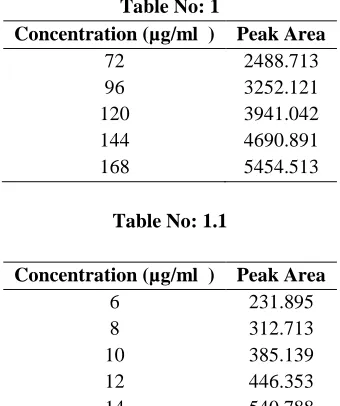
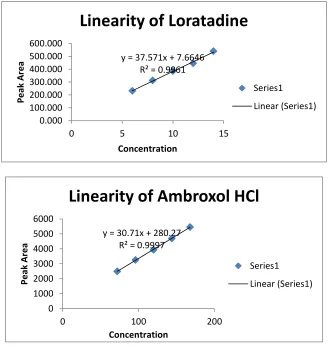
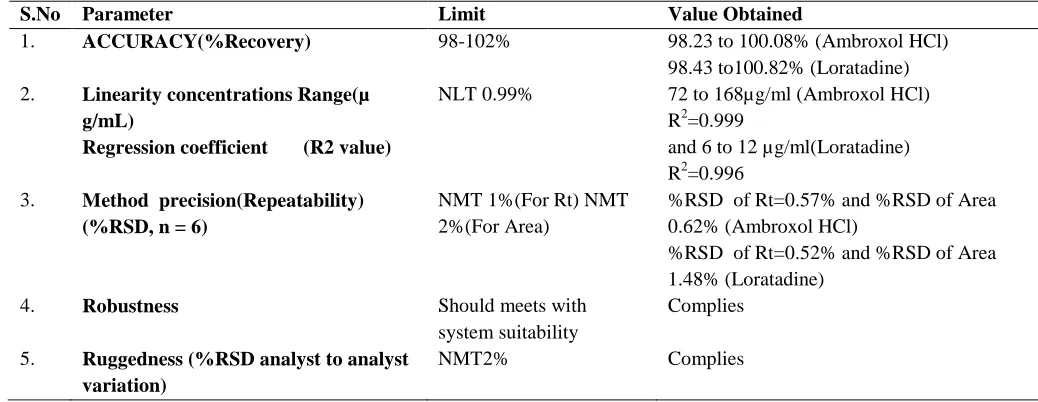
(6) Dondeti mogili reddy, et al / Int. J. of Pharmacy and Analytical Research Vol-3(4) 2014 [482-491]. In RP HPLC method, the primary requirement for developing a method for analysis is that the using different solvents and buffers and columns to get better retention time and theoretical plates, and better cost effective and time saving method than the previously developed methods. . The Isobestic Point of Ambroxol HCl and Loratadine were found to be 220nm (Figure No: 2.3) by scanning in UV region. The chromatographic method was optimized with mobile phase consisting of KH2PO4 Buffer (30mM): Acetonitrile: Methanol (30:50:20) and C18 INERTSIL column. All the validation parameters were studied at a the wavelength 220nm. Accuracy was determined by calculating the recovery (Table No.3) and the results were in acceptable range (limit 98-102%). The method was successfully used to determine the amount of Ambroxol HCl and Loratadine present in the Tablet. The results obtained were in good agreement with the corresponding labeled amount (Table No.3). The method was linear in the concentration range of 72 to 168µg/ml for Ambroxol HCl and 6 to 14µg/ml for Loratadine (Figure no.1, Table No.1). Precision was calculated (% RSD) for the drug (Table No.7 Robustness and ruggedness results were in acceptable range (Table No.4 and Table No.5).Summary of all validation parameters for method is given in Table No.8. By observing the validation parameters, the method was found to be simple, sensitive, accurate and precise. Hence the method can be employed for the routine analysis Ambroxol HCl and Loratadine in tablet dosage form.. Specificity In an assay, demonstration of specificity requires that it can be shown that the procedure is unaffected by the presence of impurities or excipients. In practice, this can be done by spiking the drug substance or product with appropriate levels of impurities or excipients and demonstrating that the assay results are unaffected by the presence of these extraneous materials. There should be no interference of the diluents at retention time of drug substances.. Robustness Robustness is the measure of a method remain unaffected by small, deliberate changes in method parameters like flow rate and detection wavelength on assay of the analyte of interest. Here the detection wavelength varied ±2nm and flow rate was varied ±0.2 ml/min. The results were shown in (Table no.4). Ruggedness The ruggedness of the method was studied by analyzing the sample and standard preparations by two analysts. The %RSD assay values between two analysts was calculated i.e.,(limit <2%). This indicates the method was rugged. The results were shown in Table no.5.. DISCUSSION. Table No: 1 Concentration (µg/ml ) Peak Area 72 2488.713 96 3252.121 120 3941.042 144 4690.891 168 5454.513 Table No: 1.1 Concentration (µg/ml ) 6 8 10 12 14. 487. Peak Area 231.895 312.713 385.139 446.353 540.788.
(7) Dondeti mogili reddy, et al / Int. J. of Pharmacy and Analytical Research Vol-3(4) 2014 [482-491]. Figure No.1&1.1: Linearity (calibration) curve of Ambroxol HCl and Loratadine. Peak Area. Linearity of Loratadine 600.000 500.000 400.000 300.000 200.000 100.000 0.000. y = 37.571x + 7.6646 R² = 0.9961 Series1 Linear (Series1). 0. 5. 10. 15. Concentration. Peak Area. Linearity of Ambroxol HCl 6000 5000 4000 3000 2000 1000 0. y = 30.71x + 280.27 R² = 0.9997 Series1 Linear (Series1). 0. 100 Concentration. 200. Table no.2: LOD and LOQ values Calculated from calibration curve Ambroxol HCl mcg Area LOD 4.078 125.24 LOQ 12.36 379.53. LEVEL I.. II.. III.. S.No 1 2 3 1 2 3 1 2 3. Amount of Sample taken (%) 80 80 80 100 100 100 120 120 120. Loratadine mcg Area 0.28 10.46 0.84 31.69. Table No.3: Recovery data Amount of Standard Spiked (mcg) 24 24 24 24 24 24 24 24 24. 488. %Recovery of Ambroxol HCl 98.23%. %Recovery of Loratadine 100.74%. 99.36%. 98.43%. 100.08%. 100.82%.
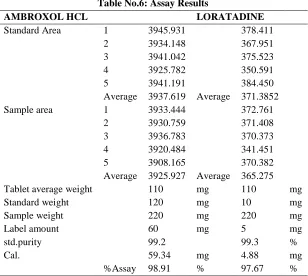
(8) Dondeti mogili reddy, et al / Int. J. of Pharmacy and Analytical Research Vol-3(4) 2014 [482-491]. Table No.4: Results of Robustness study. Ambroxol HCl Parameter Flow Rate(1.0ml) 0.8ml 1.2ml Wave Length220nm±2 218nm 222nm. Rt 2.460 2.653 2.283. Tailing factor 1.667 1.667 1.750. Theoretical plates 4464 5193 4513. 2.460 2.460. 1.611 1.611. 4828 4828. Parameter Flow Rate(1.0ml) 0.8ml 1.2ml Wave Length220nm±2 218nm 222nm. Rt 4.253 4.540 4.013. Tailing factor 1.571 1.556 1.200. Theoretical plates 6589 7507 10243. 4.200 4.183. 1.519 1.538. 7180 7123. Loratadine. Analyst-1 Analyst-2 Analyst-1 Analyst-2. Table No.5: Results of Ruggedness %Assay Loratadine 98.63 99.23 Ambroxol HCl 99.23 96.98. %RSD 0.45% 1.62%. Table No.6: Assay Results LORATADINE 1 3945.931 378.411 2 3934.148 367.951 3 3941.042 375.523 4 3925.782 350.591 5 3941.191 384.450 Average 3937.619 Average 371.3852 Sample area 1 3933.444 372.761 2 3930.759 371.408 3 3936.783 370.373 4 3920.484 341.451 5 3908.165 370.382 Average 3925.927 Average 365.275 Tablet average weight 110 mg 110 Standard weight 120 mg 10 Sample weight 220 mg 220 Label amount 60 mg 5 std.purity 99.2 99.3 Cal. 59.34 mg 4.88 %Assay 98.91 % 97.67 AMBROXOL HCL Standard Area. 489. mg mg mg mg % mg %.
(9) Dondeti mogili reddy, et al / Int. J. of Pharmacy and Analytical Research Vol-3(4) 2014 [482-491]. Table No.7: Method Precision (Repeatability). S.No. 1 2 3 4 5 6 avg stdev %RSD. AMBROXOL HCL Rt Area 2.46 3984.852 2.460 3983.028 2.460 3986.756 2.457 3983.864 2.46 3955.742 2.450 3915.924 2.4578 3968.361 0.0040 28.195 0.16 0.71. LORATADINE Rt 4.253 4.243 4.227 4.210 4.300 4.367 4.267 0.058 1.35. Area 399.316 396.285 397.666 390.391 397.802 385.427 394.481 5.413 1.37. Table No.8: Validation parameters of evaluated method S.No 1.. Parameter ACCURACY(%Recovery). Limit 98-102%. 2.. Linearity concentrations Range(µ g/mL) Regression coefficient (R2 value). NLT 0.99%. 3.. Method precision(Repeatability) (%RSD, n = 6). NMT 1%(For Rt) NMT 2%(For Area). 4.. Robustness. 5.. Ruggedness (%RSD analyst to analyst variation). Should meets with system suitability NMT2%. Value Obtained 98.23 to 100.08% (Ambroxol HCl) 98.43 to100.82% (Loratadine) 72 to 168µg/ml (Ambroxol HCl) R2=0.999 and 6 to 12 µg/ml(Loratadine) R2=0.996 %RSD of Rt=0.57% and %RSD of Area 0.62% (Ambroxol HCl) %RSD of Rt=0.52% and %RSD of Area 1.48% (Loratadine) Complies Complies. and high resolution and shorter retention time makes this method more acceptable and cost effective and it can be effectively applied for routine analysis in research institutions, quality control department in meant in industries, approved testing laboratories.. CONCLUSION From the above experimental results and parameters it was concluded that, this newly developed method for the simultaneous estimation of AMBROXOL HCL and LORATADINE was found to be simple, precise, accurate. REFERENCES [1] ICH, Q2A validation of analytical procedure: Methodology International Conference on Harmonization, Geneva, October 1994. [2] ICH, Q2B Validation of analytical procedure: Methodology International Conference on Harmonization, Geneva, March 1996. [3] Ambroxol -- www.drugbank.ca/drugs/DB06742 [4] http://en.wikipedia.org/wiki/Ambroxol [5] Loratadine : www.drugbank.ca/drugs/db00455. 490.
(10) Dondeti mogili reddy, et al / Int. J. of Pharmacy and Analytical Research Vol-3(4) 2014 [482-491]. [6] http://connection.ebscohost.com/c/articles/65629924/simultaneous-estimation-ambroxol-hydrochloride-loratadinetablet-dosage-form-by-using-uv-spectrophotometric-method [7] http://ijps.aizeonpublishers.net/content/2013/5/ijps370-374.pdf simultaneous estimation of Ambroxol Hydrochloride and Loratadine in tablet dosage form [8] http://ijpbs.net/volume2/issue2/pharma/44.pdf Simultaneous Estimation Of Ambroxol Hydrochloride And Loratadine In Tablet Dosage Form By Using Uv Spectrophotometric Method [9] http://globalresearchonline.net/journalcontents/v22-1/34.pdf Review on Various Quantitative Methods Available To Detect Antihistaminic Drugs Alone and in Combination with Other Drugs in Pharmaceutical Formulation [10] http://www.irjponline.com/admin/php/uploads/1107_pdf.pdf Simultaneous Estimation Of Ambroxol Hydrochloride And Loratadine In Tablet Dosage Form By Using Uv Spectrophotometric Method *******************. 491.
(11)
Figure
Related documents
Higher concentrations of both caspase-cleaved CK18 and total CK18 were measured in bile samples compared to serum samples, suggesting that cell death is prominent in the
In our study, we showed that at 2 weeks after ACLT surgery, rats in the model group had significantly higher serum levels of COMP when compared to rats in the control group
The study ’ s primary objective was to demonstrate the ability of the harmonic scalpel (H) to reduce intra- operative conversion rates compared to the conventional monopolar
• The cattle that showed clinical signs before day 16 (early cases) stayed for a long time in the herd, and were culled only after a few days, while cattle that became sick later
Event-based probabilistic risk assessment of livestock snow disasters in the Qinghai–Tibetan Plateau
It is the basis for any event-based modelling attempts, and is particularly impor- tant for regions where historical records are absent and for future risk assessment where
We explore how the different spans of surface will affect the surface trend and the cloud error, and the reconstruction of cloud data with long and narrow
A substitution is a mapping from term variables to terms, from sequence variables to sequences, from function vari- ables to functors and from context variables to contexts,
In the analyses, the dependent variable was the staining intensity score of H3 Lys-9. The independent variables of interest were 1) the period of diagnosis (before or
