1
INTERNATIONAL JOURNAL OF ADVANCES IN ENGINEERING RESEARCH
STUDIES ON STABILIZATION OF EXAPANSIVE SOIL
USING CEMENT AND FLYASH
*Binu Sukumar, **S.Sudhakar
*Professor, Department of Civil Engineering, R.M.K.Engineering College,
Chennai, Tamilnadu
**Associate Professor, Department of Civil Engineering, R.M.K.Engineering College
Chennai, Tamilnadu
ABSTRACT
Expansive soils possess undesirable engineering behaviour such as low bearing capacity, high shrinkage and swelling characteristics. It forms poor subgrade material due to low CBR values and hence excessive pavement thickness is required for designing flexible pavement. Ground improvement techniques such as soil stabilization are employed to improve the bearing capacity and to control volume change in expansive soils. The most commonly used method is addition of stabilizing agents such as lime or cement to the expansive soil. In developing countries like India, industrialization has led to the generation of large amount of fly ash, which poses a great challenge for its safe disposal without affecting the environment. In addition, the increasing cost of traditional stabilizing agents and the need for the economical utilization of industrial waste has paved way for an investigation into the stabilizing potential of fly ash in expansive soil. Hence, the present study focuses on the assessing the suitability of stabilized expansive soil with cement and fly ash for subgrade in flexible pavement. Cement was added to expansive soil at 0-4%. The percentage of fly ash, which is used in the present study, is varied from 0-8%. Test specimens were subjected to Atterberg limits, Differential free swell, Standard Proctor Compaction and CBR tests. This research helps to assess the behaviour of expansive soil mixed with cement and fly ash independently. Based upon the favourable results obtained, it can be concluded that the expansive soil can be successfully stabilized with cement or fly ash.
Keywords: Expansive soil, Cement, Fly ash, Compaction Characteristics, CBR.
INTRODUCTION
71
INTERNATIONAL JOURNAL OF ADVANCES IN ENGINEERING RESEARCH
content. Geotechnical Engineers can avoid the above said soil problems by three ways (i) Replacing the expansive soil with another soil of superior quality (ii) Modifying the properties of expansive soils with additives (iii) Accepting the limitations of expansive soil and designing the pavement with high factor of safety. Among them, the second method had been proven as the most effective method, which also termed as soil stabilization. Additives such as lime, cement, Ferric chloride, rice husk, Bagasse ash and fly ash are used to improve the strength characteristics and reduce the swell potential characteristics.
CEMENTSTABILIZATION
The interaction of cement with expansive soil is explained in Schaefer et al (1997) as follows: The Portland cement consists of tricalcium silicate (C3S) dicalcium silicate (C2S), tricalcium aluminates (C3A) and tetra calcium alumina ferrite (C4A) as major constituents. Whenever the cement is added to the soil, the pore water in the soil reacts with cement and hydration of cement occurs. The hydration of cement produces hydrated calcium silicates, hydrated calcium aluminates, and hydrated lime. The first two of hydration products are major cementitious products bind the adjacent cement grains together during hardening and form a hardened skeleton matrix, which encloses unaltered soil particles. Further the hydration of cement leads to rise of PH value of water. The soil minerals such as silica and alumina is dissolved in water and the above hydrous minerals gradually react with calcium ions liberated from the hydrolysis of cement (pozzolonic reaction) and form insoluble secondary cementitious products which harden when the soil sample is cured for specified number of days, resulting stabilization of natural soil.
FLYASHSTABILIZATION
Fly ash is a waste material obtained from thermal power plants. It is extracted from flue gases of a furnace fired with coal and it is non-plastic fine silt. Fly ash consists of hollow spheres of silicon, aluminium, iron oxides and unoxidized carbon. Fly ash can provide an adequate array of divalent and trivalent cations (Ca2+, Al3+, Fe3+ etc) under ionized conditions that can promote flocculation of dispersed clay particles. The strength characteristics of fly ash stabilized clays are measured by means of unconfined compressive strength or California Bearing Ratio (CBR) values.
LITERATUREREVIEW
72
INTERNATIONAL JOURNAL OF ADVANCES IN ENGINEERING RESEARCH
that the addition of fly ash to black cotton soils increases CBR up to certain optimum level beyond which there is a decrease in CBR. Addition of fly ash results pozzolonic reactions, which increases the unconfined compressive strength. Phanikumar et al (2004) studied the effect of fly ash on free swell index, swelling pressure, swell potential, plasticity, compaction, strength and hydraulic conductivity in expansive soils by varying its percentage from 0 to 20%. It was concluded that plasticity, hydraulic conductivity and swelling properties are decreased with an increase in fly ash content. However, there is an increase in maximum dry unit weight and undrained shear strength with the addition of fly ash. Gyanen. Takhelmayum (2013) carried out experimental study on combined effect of fine and coarse fly ash mixtures on properties such as compaction characteristics and undrained shear strength in expansive soil. The percentage of fine and coarse fly ash mixtures, which is used in black cotton soil, is varied from 5-30%. It was concluded that the maximum dry density occurs at 95% soil and 5% fly ash mixture. The peak shear strength attained by fine fly ash mixture is 25% more when compared to coarse fly ash mixture.
MATERIALS
The expansive soil used in the present investigation was collected from Velachery in Chennai. The soil is dark grey to black in colour with high clay content. Grain size analysis and Atterberg limit tests were performed to classify the soil. The test results of grain size analysis are presented in Table 1. Based on the grain size distribution and Atterberg limits, soil is classified as CH. The fly ash used in present study was collected from North Madras Power Plant in Ennore, Chennai. The cement used in the present study belongs to Zurai cement 43 grade.
EXPERIMENTALINVESTIGATION
The following tests were conducted on expansive soil and expansive soils stabilized with cement and fly ash of different percentages as per IS: 2720.
i. Atterberg Limit Test
ii. Differential Free Swell Test iii. Standard Proctor Compaction Test iv. CBR Test
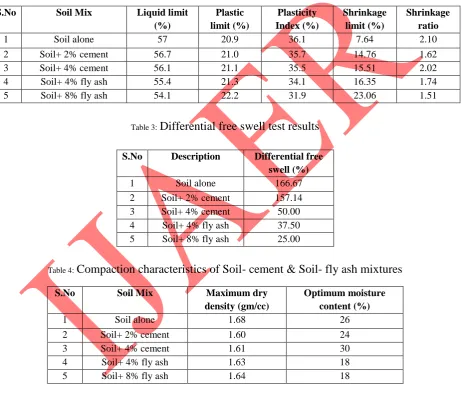
The Atterberg limits such as liquid limit, plastic limit and shrinkage limit of expansive soil with varying percentages of cement and fly ash independently as per standard procedures. The test results are summarized in Table 2.
The differential free swell test was performed on the expansive soil stabilized with cement and fly ash at different percentages. The differential free swell is expressed as follows
Differential free swell (%) W K 100 K
V V
x V
Where Vw and Vk are the volume of soil in water and kerosene respectively. The measured values of differential free swell are shown in Table 3.
73
INTERNATIONAL JOURNAL OF ADVANCES IN ENGINEERING RESEARCH
soaked CBR tests were performed on soil samples prepared at the optimum moisture contents and maximum dry densities obtained from standard proctor compaction tests. The soaked CBR test results are presented in Table 5
RESULTSANDDISCUSSION
The laboratory tests (Atterberg limit, Differential Free Swell, Compaction and Soaked CBR) were carried out on expansive soil. The stabilization of expansive soil with cement and fly ash is carried out by blending the soil with different percentages and the above tests were repeated. The measured characteristics are presented in Figs. 1 and 2.
Effect of cement and fly ash on Atterberg limits
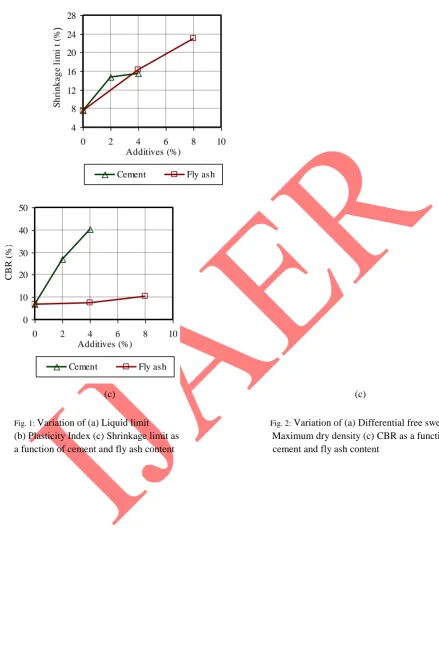
The effect of cement and fly ash on Atterberg limits of expansive soil is presented in Fig. 1. The liquid limit decreases and the plastic limit increases marginally with an increase in both cement and fly ash content. The maximum reduction in plasticity index is about 11.6%, when the added cement content is 4%. The increase in shrinkage limit and shrinkage ratio is 202% and 28.1% respectively with the addition of cement content by 4%. It is observed that the increase in shrinkage limit is marginal beyond the fly ash content of 4%. As the fly ash content increases from 0 to 4%, the shrinkage limit increases by 93%; when the fly ash content was increased to 8%, The shrinkage limit increases only by 103%.
Effect of cement and fly ash on Differential Free swell
The measured values of differential free swell, for blends of different cement and fly ash contents are shown in Fig. 2(a). The differential free swell of expansive clay decreases with an increase in both cement and fly ash. It reaches one-third of the initial differential free swell of the soil at 4% of cement content. A maximum reduction of 85% is observed with the addition of 8% of fly ash.
Effect of cement and fly ash on Compaction characteristics
The variation of maximum dry density with an increase in percentage of cement and fly ash based on standard proctor compaction test is shown in Fig. 2(b). Among the various percentage of cement used, the dry density is found to be maximum for 4% cement in the mix, whereas optimum moisture content increases by 15.4% (Table 3) at 4% cement content.. It can be observed that, the maximum dry density decreases by about 2.5% at 8% fly ash content. The decrease in maximum dry density with the increase in percentage of fly ash can be attributed to the lower value of specific gravity of fly ash in comparison with expansive soil.
Effect of cement and fly ash on CBR
74
INTERNATIONAL JOURNAL OF ADVANCES IN ENGINEERING RESEARCH
content 2% and 4% respectively. The maximum increase in CBR is found to be 47.8% with the addition of 8% fly ash.
CONCLUSIONS
The stabilization of expansive soil with cement and fly ash independently is investigated and the effect of stabilization on the geotechnical properties of expansive soil is presented. The following conclusions can be drawn based on the analysis of results.
The addition of cement and fly ash to expansive soil decreases the maximum dry density of the soil irrespective of their percentages.
The properties such as plasticity index, shrinkage limit and differential free swell of the expansive soil decreases with the increase in percentage of cement and fly ash.
The soaked CBR of the expansive soil increases with increase in cement and fly ash content.
REFERENCES
1. Christensen, A.P., (1969) “Cement Modification of clay soil”- Portland Cement Association, Research and development bulletin.
2. Schaefer, V.R., Abramson, L.W., Drumheller, J.C., and Sharp, K.D., et al (1997) “Ground improvement, ground reinforcement and ground treatment Developments 1987-1997.” Geotech. Spec.Publ. No.69, ASCE, New york..
3. Erda Cokca., (2001) “Use of class C fly ash for stabilization of expansive soil”- Journal of Geotechnical and Geo environmental Engineering, Vol. 127, July, pp 568-573.
4. Pandian, M.S., Krishna, K.C., and Leelavathamma B., (2002) “Effect of fly ash on the CBR behaviour of soils” – Indian Geotechnical Conference, Allahabad, Vol. 1, pp 183-186. 5. Panikumar B.R., and Radhey S.Sharma., (2004)“Effect of fly ash on Engineering properties
of expansive soil”- Journal of Geotechnical and Geo environmental Engineering, Vol. 130(7), July, pp 764-767...
6. Gyanen. Takhelmayum., Savitha, A.L., and KrishnaGudi., (2013), “laboratory study on soil stabilization using fly ash mixtures”, International Journal of Engineering Science and Innovative Technology, Vol .2 January. .
7. IS: 2720 (Part 5) - 1985. Determination of liquid limit and plastic limit, Bureau of Indian Standards.
8. IS: 2720 (Part 40) - 1977. Determination of Free Swell Index, Bureau of Indian Standards. 9. IS: 2720 (Part 7) - 1983. Determination of water content – dry density relation using light
compaction, Bureau of Indian Standards
75
INTERNATIONAL JOURNAL OF ADVANCES IN ENGINEERING RESEARCH Table 1:Basic Components of expansive soil
Table 2:Atterberg limits of Soil- cement & Soil- fly ash mixtures
Table 3:Differential free swell test results
Table 4:Compaction characteristics of Soil- cement & Soil- fly ash mixtures
Table 5:CBR of Soil- cement & Soil- fly ash mixtures
S.No Description Results
1 Gravel 0%
2 Sand 9.6%
3 Silt & Clay 90.4%
S.No Soil Mix Liquid limit (%)
Plastic limit (%)
Plasticity Index (%)
Shrinkage limit (%)
Shrinkage ratio
1 Soil alone 57 20.9 36.1 7.64 2.10
2 Soil+ 2% cement 56.7 21.0 35.7 14.76 1.62
3 Soil+ 4% cement 56.1 21.1 35.5 15.51 2.02
4 Soil+ 4% fly ash 55.4 21.3 34.1 16.35 1.74
5 Soil+ 8% fly ash 54.1 22.2 31.9 23.06 1.51
S.No Description Differential free swell (%)
1 Soil alone 166.67
2 Soil+ 2% cement 157.14
3 Soil+ 4% cement 50.00
4 Soil+ 4% fly ash 37.50
5 Soil+ 8% fly ash 25.00
S.No Soil Mix Maximum dry density (gm/cc)
Optimum moisture content (%)
1 Soil alone 1.68 26
2 Soil+ 2% cement 1.60 24
3 Soil+ 4% cement 1.61 30
4 Soil+ 4% fly ash 1.63 18
5 Soil+ 8% fly ash 1.64 18
S.No Description CBR (%)
1 Soil alone 6.94
2 Soil+ 2% cement 26.84
3 Soil+ 4% cement 40.10
4 Soil+ 4% fly ash 7.5
76
INTERNATIONAL JOURNAL OF ADVANCES IN ENGINEERING RESEARCH
53 54 55 56 57 58
0 2 4 6 8 10
Additives (%) L iq u id l im it ( % )
Cement Fly ash
t (% ) 0 40 80 120 160 200
0 2 4 6 8 10
Additives (%) D if fe re n ti a l fr e e sw e ll ( % )
Cement Fly ash
( %) 30 32 34 36 38
0 2 4 6 8 10
Additives (%) P la st ic it y i n d e x ( % )
Cement Fly ash
( %) 1.56 1.60 1.64 1.68 1.72
0 2 4 6 8 10
Additives (%) M a x im u m d ry d e n si ty ( g m /c c )
Cement Fly ash
(g
m
/c
c
77
INTERNATIONAL JOURNAL OF ADVANCES IN ENGINEERING RESEARCH
4 8 12 16 20 24 28
0 2 4 6 8 10
Additives (%)
S
h
ri
n
k
a
g
e
l
im
it
(
%
)
Cement Fly ash
t
(%
)
0 10 20 30 40 50
0 2 4 6 8 10
Additives (%)
C
B
R
(
%
)
Cement Fly ash
(c) (c)
Fig. 1: Variation of (a) Liquid limit (b) Plasticity Index (c) Shrinkage limit as a function of cement and fly ash content