Views of a Distributed System using
Common Knowledge
Views of a Distributed System using
Common Knowledge
Research Thesis
Submitted in Partial Fulfillment of the
Requirements for the Degree of
Master of Science
in Electrical Engineering
Tal Mizrahi
Submitted to the Senate of
the Technion - Israel Institute of Technology
A/Prof. Yoram Moses in the Department of Electrical Engineering
Acknowledgement
I would like to express my uttermost gratitude to my advisor, A/Prof. Yoram Moses, for his devoted guidance throughout this research. His vision and extraordinary intuition have inspired me in my work.
My warm thanks to my parents, Tsipi and Joe, for their encouragement and support, to my brother, Amit, for all the LaTeX tips, and of course to my lovely wife, Hagit, for putting up with me during these long years in the Technion.
Abstract 1
List of Symbols and Abbreviations 3
1 Introduction 7
1.1 Motivation . . . 7
1.2 Previous Work . . . 8
1.3 Research Goals . . . 8
1.4 Outline . . . 10
2 Preliminaries 11 2.1 The Communication Network . . . 11
2.2 Nature’s Role: Inputs and Failures . . . 12
2.3 Full-Information Protocols . . . 14
2.4 Definition of the Continuous Consensus Problem . . . 15
2.5 Systems and Knowledge . . . 16
2.6 Common Knowledge . . . 19
3 Solving Continuous Consensus 21 3.1 The CC Problem . . . 21
Clean Rounds . . . 21
A Simple Protocol for Continuous Consensus . . . 24
The Horizon . . . 30
CONCON . . . 31
3.2 Continuous Consensus and Common Knowledge . . . 36
3.3 Waste and CONCON . . . 44
Waste . . . 44
A Generalized Definition of Waste . . . 46
3.4 Clean Rounds Revisited . . . 51
3.5 A Run of CONCON . . . 54
ThehorizonRevisited . . . 54
Critical Times Revisited . . . 55
Good and Bad Processes Revisited . . . 56
Local Waste and Destination . . . 57
4 Uniform Continuous Consensus 61 4.1 The UCC Problem . . . 61
A protocol for UCC . . . 62
5 Conclusion 65 5.1 Summary of Results . . . 65
5.2 Future Work . . . 68
A Detailed Proofs 73 A.1 Optimality of CONCONRevisited . . . 73
2.1 An execution graph and i’s viewVi(k+1). . . 14
3.1 The SIMPLECC protocol for process i. . . . 24
3.2 Illustration of the SIMPLECC Protocol. . . 25
3.3 Sets Gi(k)& Bi(k)are based onVi(k+1). . . 29
3.4 The core computed at time k. . . . 30
3.5 The CONCONprotocol for process i. . . . 32
3.6 An instance of Moses and Tuttle’s fixed-point construction by i at time m. 40 3.7 The Horizon vs. k in a run r. . . . 55
3.8 Critical time vs. k in a run r. . . . 56
3.9 Gi(k)and Bi(k)in r. . . . 57
3.10 desti(k)andhorizoni(k)in r. . . . 58
3.11 Local Waste . . . 60
In a distributed system it is often necessary for all processes to maintain a consistent view of the world. However, the existence of communication failures in a system may prevent processes from obtaining a consistent view. Continuous consensus is the problem of having each process i maintain at each time k an up-to-date core Mi[k] of information
about the past, so that the cores at all processes are guaranteed to be identical. Our analysis assumes an unreliable synchronous system, with an upper bound of t failures. The notion of continuous consensus enables a new perspective on classical problems such as the consensus or the Simultaneous Byzantine Agreement (SBA) problems, and allows for simpler analysis. A simple algorithm for continuous consensus in fault-prone systems with crash and sending omission failures called CONCON is presented, based on a knowledge-based analysis. Continuous consensus is shown to be closely related to common knowledge. Via this connection, the characterization of common knowledge by Moses and Tuttle is used to prove that CONCONis optimal—it produces the largest
A(r,m) The set of active processes at(r,m).
Bi(k) Set of bad processes computed by i at time k+1.
bi(k) Number of bad processes computed by i at time k+1.
β Labelling function - determines which messages are successful. C Common knowledge among all processes.
CN Common knowledge among the nonfaulty process.
c Short for criti(k).
DSϕ Distributed knowledge ofϕamong the processes in S.
d(r,k) The difference between
N
(r,k)and k (used in the computation of waste). di(m)(k) The difference betweenN
i(m)(k)and k−m.desti(m) The destination of i at time m.
E Edges of the communication graph. ESϕ Everyone in the set S knowsϕ.
E
Set of monitored events.E
(V) The set of monitored external inputs determined by the viewV. e An event or an external input.F` Set of potentially faulty processes in`th iteration of the fixed-point construction.
ˆ
fm Failure model.
Gi(k) Set of good processes computed by i at time k+1.
g A good process.
h Index of the last iteration in the fixed-point construction. horizoni(k) Thehorizonof i at time k.
I
Set of possible input assignments in the system.i Process name.
j Process name.
Kiϕ Process i knowsϕ.
k Time / round counter.
ˆk The final time in the fixed-point construction.
κ Time / round counter.
L
Logical language.Latesti[k] Process i’s estimation of the critical time for k in CONCON.
Latestxu[k] Process x’s estimation of the critical time for k in UNICONCON.
` Time / round counter.
`w The round in which the waste is reached.
`lw The round in which the local waste is reached.
λ The empty view.
Mi[k] The core of i at time k.
MiC[m] Process i’s core according to CONCON. Mxu[k] Process x’s core according to UNICONCON. m Time / round counter.
N
(r,k) The number of failures discovered up to round k.N
(im)(k) Number of failures discovered by i between rounds m and k.n Number of processes in the system.
P Set of processes in the system.
P Protocol.
Φ The set of primitive propositions in the logical language.
ΦE The set of primitive propositions confined to facts about external inputs. ϕ Fact or proposition.
R System.
r Run.
S` Set of potentially nonfaulty processes in`thiteration of the fixed-point construction.
ˆ
S The fixed-point of S`.
Σi Set of initial local states of i.
t Upper bound on the number of failures in the system. V Set of nodes in the communication graph.
Vi(m) View of process i at time m (subgraph of V ).
W(r) The waste or r.
Wi(m)(k) The local waste at time k w.r.t time m. X Contents of the core.
x An arbitrary (possibly faulty) process. z An arbitrary (possibly faulty) process.
Introduction
1.1
Motivation
Maintaining consistency of the information held by different nodes in an unreliable dis-tributed system is a challenging problem. Whether it is a system whose nodes share resources, or a system in which critical decisions are made according to the most recent data at hand, it is highly important to maintain consistency of the nodes’ information.
A core of identical information maintained at different sites allows decisions per-formed in a distributed manner to be compatible with each other. Moreover, with the rapid growth of the internet over the last two decades, distributed systems operations are no longer restricted to being internal. In many cases, external elements interact concur-rently with different nodes of the system. This places a stronger emphasis on the need to present a consistent view to the world at different nodes at a given time. A core of information that is guaranteed to be identical at all sites at any given time, and contains as much information as possible, is a very desirable tool in implementing such a consis-tent view. This thesis deals with the design of efficient protocols for maintaining such a core.
to be acting on consistent information available to all agents.
1.2
Previous Work
The role of common knowledge for consistent simultaneous actions has been firmly established in the literature [2, 3, 4, 5]. Dwork and Moses [3] presented an optimal1 solution to simultaneous Byzantine agreement in the presence of crash failures, by using the notions of clean rounds and waste. They proved that simultaneous agreement can be reached exactly when the value of at least one agent’s initial vote becomes common knowledge. Moses and Tuttle [4] extended this work to the more complex (sending) omission failure model, and presented optimal solutions for a broader class of simul-taneous choice problems. Implicit in the latter work is the computation of a core of information that characterizes the common knowledge at any given point in time. This computation is based on a subtle fixed-point construction.
Providing an up-to-date consistent picture of the system at different sites can some-times alleviate the need to explicitly activate voting or agreement protocols to handle individual transactions (see, for example, [6]). Weaker guarantees than simultaneous consistency are popular, where consistency is guaranteed over time: If one process can determine that an event has occurred, the others will eventually know this as well [7]. These weaker consistency conditions are essential in some systems since simultaneous coordination requires nontrivial common knowledge, and this is not attainable in truly asynchronous systems [2].
1.3
Research Goals
The current work introduces the continuous consensus problem, in which a core Mi[k]
of information is continuously maintained at every correct process i in the system. All 1Throughout this work we use the term optimal referring to the time it takes to reach agreement or
local copies of the core must be identical at all times k, and every interesting event from a set of possible events,
E
, should eventually enter the core. The continuous consensus problem is studied in synchronous systems with crash and omission failures. We assume an upper bound of t failures in every run of our system. We shall show that the analysis of continuous consensus (CC for short) shown in this work allows for a simple and elegant solution to the problem of maintaining simultaneously consistent views in the system.The continuous consensus problem generalizes many problems having to do with simultaneous coordination. For example, in the distributed firing squad problem [8], the system may receive analarmmessage from the outside world. If a correct process receives such a message, then it is required that at some later point all correct processes “fire” simultaneously. In addition, “firing” is not allowed to occur in different rounds by different processes (hence in a non-simultaneous fashion), nor is it allowed to take place in a run before analarmmessage has been received in the system. Clearly, if the arrival of an alarm message is a monitored event in a continuous consensus protocol, then the presence of analarm in the shared core can be used as a necessary and suffi-cient condition for firing. Continuous consensus can also be used as a generalization of simultaneous versions of Byzantine agreement and the consensus problem (cf. [3]), as well as for the class of simultaneous choice problems of [4].
In this work we present an algorithm called CONCON that solves the CC problem.
CONCON is optimal in providing at any given time the largest and most informative
core possible. The algorithm will provide the most up-to-date consistent picture of the system, without the need to explicitly activate voting or agreement protocols to handle individual transactions.
A variant of the CC problem, which we call uniform continuous consensus (UCC), requires that the core be consistent among all processes in the systems, rather than just among the correct ones. We present UNICONCON, which is a variant of CONCONthat
solves the UCC problem.
connec-tion is shown between continuous consensus and common knowledge: it is shown that the core of shared information, Mi[k]is common knowledge among the correct processes
at time k. Moreover, the optimality of CONCONis proven using the characterization of
common knowledge in the crash and omission failure models given in [4]. Our analysis also aims at extending Dwork and Moses’ analysis of clean rounds and waste [3] to the more complicated omission model.
1.4
Outline
This work is organized as follows. Chapter 2 provides a formal definition of our system, and some technical background to the notions described in later chapters. Chapter 3, which is the heart of this work, presents the continuous consensus problem and its so-lution, CONCON, as well as proving its correctness and optimality. Chapter 4 describes
the uniform continuous consensus problem, and introduces UNICONCON. Finally, a
Preliminaries
Our treatment of the continuous consensus problem will be driven by a knowledge-based analysis. A general approach to modelling knowledge in distributed systems was initi-ated in [2] and given a detailed foundation in [5] (most relevant to the current work are Chapters 4 and 6). The lion’s share of technical analysis in this thesis will be performed with respect to a single protocol, which gives rise to a specific class of systems. For ease of exposition, our definitions will be tailored to this particular setting.
2.1
The Communication Network
detec-tors). Finally, the process may perform local computations based on the messages it has received. The history of an infinite execution of such a network will be called a run.
2.2
Nature’s Role: Inputs and Failures
We think of a solution to the continuous consensus problem as a protocol operating (or playing) against an adversary called nature. Nature determines two central aspects of any given run: inputs and failures.
Inputs. We consider a setting in which every process starts out in an initial local state from some setΣi, and can receive an external input in any given round k (this input is
considered as arriving at time k). The initial local state of each process can be thought of as its external input at time 0. We represent the external inputs in an infinite execution as follows. Define a set V =P×N of process-time nodes (or nodes, for short). An (external) input assignment is a functionζassociating with every (initial) nodehi,0iat time 0 an initial state fromΣi and with each nodehi,ki an input from a set of possible
inputs,
I
. Our analysis is independent of the type or structures of the elements ofI
.misrepresent or lie), and nature determines for every round what subset of its messages will successfully be delivered. We remark that even faulty processes receive all mes-sages sent to them over non-blocked channels. If a message is not delivered, its sender is necessarily faulty. We formally represent the failure pattern in a given run via an edge-labelled graph (V,E,β), where V is the set of process-time nodes defined above, and E ={(hi,ki,hj,k+1i): i6= j,k≥0}. An edge e= (hi,ki,hj,k+1i)∈E stands for the round k+1 communication in the channel from i to j. The labelling function
β: E → {Y,N} captures when such channels are blocked and when they operate cor-rectly. Intuitively,β(e) =Nmeans that e is blocked for communication, whileβ(e) =Y
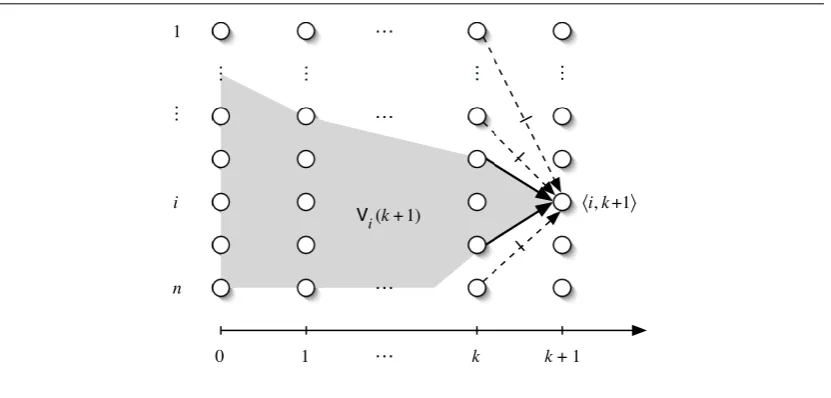
means that it is not blocked. In the latter case, a message on e, if sent, will be delivered. Nature’s combined contribution to a run r is captured by an execution graph. This is a labelled graphGr= (V,E,ζ,β)with labelsζon the vertices giving the input assignment and labelsβon the edges defining the failure pattern.1 Notice that all execution graphs over n processes have the same edge and vertex sets(V,E)— a complete grid of n×N
nodes, with edges from each node u∈V at level k to all nodes of level k+1 with a process name different from u’s. Different execution graphsGdiffer only in the labelling functionsζandβ. Figure 2.1 contains an illustration of the nodes of an execution graph, with some of the edges describing round k+1. Observe that all edges from one time point to the next are in the graph—some are crossed, depicting their being blocked byβ, while the others are available for communication.
We now consider particular subgraphs ofG= (V,E,ζ,β)that will be useful later on. Given a node u=hi,mi ∈V , we denote by Vu the set of nodes containing the nodes
hi, `i ∈V for all`≤m as well as all nodes u0=hj,ki ∈V such that there is a directed path of edges of E from u0 to u , in which all edges are labelled ‘Y’ . Intuitively, Vu
contains all nodes about which u has potentially received information either directly or via a sequence of messages. We define the maximal potential view (or view for short) at node u=hi,mi inG, denoted byVi(m), to be the subgraph ofGgenerated by Vu , i.e.,
1The run r appears in the superscript ofGr. Throughout the thesis, we omit explicit reference to the
Vi(m) = (V0,E0,ζ0,β0) = (Vu,EVu,ζVu,βE0). See Figure 2.1 for an illustration of
a viewVi(m). The viewVS(k)of a set S⊆Pof processes at a time k is defined to be the
union of the graphs Vj(k), over all j ∈S. We say that a viewV is contained in a view
V0if the nodes ofVare a subset of those inV0, andVis the subgraph ofV0generated by these nodes. Thus, every node in Vhas the same external input as inV0, and for every pair of nodes inV, they are connected by an edge inVexactly if they are connected by one inV0. In some cases, it will be convenient to talk about viewsVS(k)at a time k<0.
The view in this case is denoted by λ. It is called an empty view, and is contained in every possible viewVS0(k0).
…
…
…
… … … | | | 1 i n 10 k k + 1
… … … … … …
Vi (k +1) 〈i, k+1〉
Figure 2.1: An execution graph and i’s viewVi(k+1).
2.3
Full-Information Protocols
A full-information protocol (FIP) is one in which processes have perfect recall and
ob-serve all incoming messages and external inputs that they receive. Moreover, in every round, every process sends a message encoding all of its information to all other pro-cesses. It is not hard to show that in any such protocol a process is able to reconstruct
sake of concreteness that the local state of a process is maintained in the form of a view
Vi(k), and the message sent by i in round k+1 isVi(k).
Since in aFIPa message is sent on every channel in every round, the execution graph
describes all aspects of a run: i.e., what inputs are received by the processes, which processes are faulty, and, for every message, whether or not it is delivered. Moreover, the contents of delivered messages can also be derived from the graph G. From now on we shall identify a run r of a FIPwith its execution graph Gr. Since a run ofFIP is
determined by the inputs and failures, we sometimes denote such a run by r=FIP(ζ,β). It is a folk theorem, perhaps first proven formally in a fault-prone setting by Coan [9], that any deterministic protocol can be simulated by aFIP.
Using aFIPas we defined it above may be quite inefficient in terms of communica-tion complexity. However, in practice aFIPmay be implemented quite efficiently (see, for example, [5]). Further discussion of the communication complexity of theFIPin our context appears in Section 3.1.
2.4
Definition of the Continuous Consensus Problem
We now specify the continuous consensus problem formally. With respect to a set
E
of monitored events, we would like each process i to hold a copy of a shared list of events ofE
. An event is defined based on the messages delivered in the run, and on initial states and external inputs that processes have received (and the times at which they were received). The precise definition ofE
will depend on the application. We define a continuous consensus (CC) service to be a distributed protocol that at all times k≥0 provides each process i with a core Mi[k]of events ofE
. In every run of this protocolthe following properties are required to hold, for all nonfaulty processes i and j.
Accuracy: All events in Mi[k]occurred in the run.
Completeness: If an event e∈
E
is known to process j at any point, then e∈Mi[k]musthold at some time k.
The consistency property guarantees that the information in the local lists is in fact shared among the nonfaulty processes at any given time. Since an event is in Mi[k]for
some nonfaulty process i only if it is also in Mj[k]for all other nonfaulty processes j,
it follows that a process i may know of the occurrence of a monitored event e∈
E
long before e is in Mi[k]. In many cases it is, of course, desirable to have the shared listin a continuous consensus application be as up-to-date as possible. A variant of this problem, which we call uniform continuous consensus (UCC), is defined similarly, but Accuracy and Consistency should hold for arbitrary processes and not just for nonfaulty ones. Completeness, however, is still restricted to events that are known to nonfaulty processes: If an event e∈
E
is known to a nonfaulty process j at any point, then e∈Mi[k]must hold (for all processes i, of course) at some time k.
2.5
Systems and Knowledge
Generally speaking, we identify a system with a set R of runs. For a general protocol, a run r is an infinite sequence of states, and there is a well defined local state ri(m)for
every process i and time m. For the FIPwe identify runs with execution graphs, while in general every execution graph will determine a run of a protocol P(cf. [4, 5]). The systems that we study in this thesis are thus parameterized by a tuple(n,t,fm,
I
), where n≥2 is the number of processes, t is a bound on the number of faulty processes in a run (where t ≤n−2), fm∈ {crash,omission} is a failure model, andI
is a nonempty set of (external) input assignments. The exact identity and internal structure ofI
are application-dependent. AFIPsystem R=R(n,t,fm,I
)is defined to be the set of all runsof theFIPwith n processes, at most t of which fail according to the failure model fm, and
where initial states and external inputs conform to one of the input assignments in
I
. Our definitions imply that, in a precise sense, the inputs in aFIP system R are independentruns r,r0∈R where r =FIP(ζ,β) and r0=FIP(ζ0,β0), then R will also contain the run
r00= (ζ0,β).2
Our analysis makes use of the knowledge that processes achieve at different times in various runs. As is standard in the literature, formulas will be considered true or false at a point, which is a pair(r,m)consisting of a run r∈R and a time m∈N. Moreover, since what is known at a point (r,m) may depend on what is true at other points, we define truth with respect to a system R. Let Φ={p,q,p0, . . .}be a set of propositions. Intuitively, a proposition is a basic primitive fact. An example of a relevant proposition in the context of continuous consensus is “ζ(i,k) =e”, stating the arrival of an external input e∈
I
at a given process i at time k. Given a system R, each proposition p∈Φis identified with a set[[p]]of points of R. A proposition p∈Φholds at (r,m), which we denote by(R,r,m)|= p, if(r,m)∈[[p]]. For simplicity, we identify the set of monitored eventsE
with a subset ΦE ⊆Φ, and restrict monitored events to depend only on the external inputs in the current run. Thus, if q∈ΦE then, for all input assignmentsζand runs r=FIP(ζ,β) and r0=FIP(ζ,β0), and times m, we will have that (R,r,m)|=q iff(R,r0,m)|=q. The core maintained by a continuous consensus algorithm consists of a set X⊆ΦE at any given time. We note that in our context the truth value of every q∈ΦE
is independent of the time, m. Thus, in a given system, R, the truth value of q depends only on the run, r. We say that an event q has occurred in a run r if(R,r,m)|=q for all m≥0. The core constructed by our proposed protocols will consist of the monitored events that are determined by a particular view computed at any given point. In order to describe such cores more formally, we denote
E
(V) , {q∈ΦE :(R,r,m)|=q for all points(r,m)whose execution graph containsV}.2Recall that the input assignments inI establishes the initial states of processes as well as the external
inputs they receive. Often, initial states may be independent of external inputs, and the inputs at one
process may be independent of those at another. But our definitions do not require such independence.
Notice that
E
is monotone: IfVis contained inV0, thenE
(V)⊆E
(V0).We construct a logical language
L
by closing Φunder Boolean connectives∧ and¬, and under modal knowledge operators Ki, DS, ES, C and CN where i∈Pand S⊆P
is a set of processes. Here Ki stands for process i’s knowledge, DS corresponds to the
distributed knowledge that is implicit in the set of processes S, ES refers to facts known
to every process in S, C stands for common knowledge, and CN stands for common
knowledge among the nonfaulty processes. The semantics of the Boolean operators is standard; we now review the definitions for Ki and DS. Common knowledge and
“everyone knows” are defined in the next subsection. The formal definitions (cf. [5]) of satisfaction for knowledge and distributed knowledge formulas are briefly stated as follows:
(R,r,m)|=Kiϕiff(R,r0,m0)|=ϕfor all(r0,m0)such that r0∈R and ri(m) =r0i(m0). (2.1)
(R,r,m)|=DSϕiff(R,r0,m0)|=ϕfor all(r0,m0)such that r0∈R and rj(m) =r0j(m0)for all j∈S. (2.2)
A process knowsϕby this definition if its local state (which captures the information it has access to) implies thatϕholds. Distributed knowledge is defined similarly, but is based on the combined information available to the members of a set S of processes. In a full-information protocol, the distributed knowledge of S is equivalent to the knowledge of a process whose local state at a point(r,m)of R is the viewVSr(m).
Knowledge in theFIPhas a number of useful properties. For example, suppose that
process i receives messages in round k+1 from the processes in the set S. Then, by construction,VS(k)is contained in i’s viewVi(k+1)at the end of the round. As a result,
2.6
Common Knowledge
We define ESϕor “everyone in S knowsϕ” as follows:
ESϕ,
^
i∈S
Ki(ϕ) (2.3)
The formula CSϕis true if everyone in S knowsϕ, everyone in S knows that everyone
in S knowsϕ, etc. Define ES1ϕ,ESϕ, and ESmϕ,ESEmS−1ϕ. Thus common knowledge
ofϕamong the processes in S, denoted CSϕ, is defined as the infinite conjunction of ESm:
CSϕ,ϕ∧ESϕ∧ESESϕ∧ · · · ∧EmSϕ∧ · · · (2.4)
Specifically, we have an interest in two particular cases: S=N, or S=P. We de-note common knowledge among the nonfaulty processes by CN. CP stands for common
knowledge among all the processes in our system, and is denoted C for short.
We present an equivalent semantic definition of satisfaction for CN, which will be
more useful in the context of our analysis. Rather than defining common knowledge as an infinite conjunction of “everyone knows”, we define it in term of N-reachability.3 We say that two points(r,m)and(r0,m)are N-neighbors, and write(r0,m)∼N(r,m), if there
is some process j that is nonfaulty in both r and r0for which r0j(m) =rj(m). In this case
we say that the points(r,m) and(r0,m)are indistinguishable by j. The “∼N” relation
is also called the similarity relation. The point(r0,m) is N-reachable from(r,m) in R, if there is a finite sequence of points(r,m) = (r0,m),(r1,m), . . . ,(rk,m) = (r0,m) such that(r`,m)∼N(r`+1,m)holds for every 0≤` <k. Thus, N-reachability is the transitive
closure of the∼N relation. Moreover, it is an equivalence relation that defines a partition
over the points of a system R. Common knowledge among the nonfaulty processes is then formalized by:
3The fact that in our systems a process can always distinguish between points(r,m)and(r0,m0)with
(R,r,m)|=CNϕ iff (R,r0,m) |=ϕfor all points(r0,m)that are N-reachable from(r,m)in R (2.5)
A formal proof for the equivalence of the two definitions of common knowledge, in Equations 2.4 and 2.5 may be found in [5].
In other words, a fact ϕis common knowledge among the processes in N at a point
(r,m) if ϕ is valid in all the points that are N-reachable from (r,m). Very similarly, we can define common knowledge among all processes, C, by replacing the N in the definition of CN byP, the set of all processes in the system. More precisely, we say that
the point(r0,m)is reachable from(r,m)in R if there is a finite sequence of points of R
(r,m) = (r0,m),(r1,m), . . . ,(rk,m) = (r0,m)such that for every 0≤` <k there is some j= j`for which r`j(m) =r`j+1(m). Then
Solving Continuous Consensus
3.1
The CC Problem
The continuous consensus problem was formally defined in Section 2.4. In this section we present our solution to this problem, which is the CONCON algorithm. We start
by presenting a simple protocol which solves the CC problem, after which we present CONCONand prove its correctness. In the following subsection we provide some
back-ground which enables us to present the SIMPLEalgorithm immediately afterwards.
Clean Rounds
As mentioned in the introduction, the concept of clean rounds played a critical role in the analysis of Simultaneous Byzantine Agreement (SBA) by Dwork and Moses [3] in the crash model. In this model, a round of communication is clean if no new failure is discovered in the round. Following a clean round, all processes can have the same information about the past. Once it is common knowledge that a round was clean, the information available to nonfaulty processes before this round becomes common knowl-edge. We shall now present a formal definition of clean rounds.
that did not fail in the first k rounds of r.1 We say that the failure of process p is discovered in round k of r if k is the first time at which p’s faulty behavior is distributed knowledge, i.e., k is the first time at which (r,k)|=D(“p is f aulty”) holds. In this context D(·)refers to distributed knowledge among the active processes, i.e., DA(r,k)(·). Formally, a clean round is a round in which no process failure is discovered by the active processes. A round which is not clean is referred to as dirty. Notice that it is possible that the failure of a process p will be discovered in round k (which is thus a dirty round), whereas some of the processes may learn of p’s failure in round k+1. Even so, if no other failures are discovered in round k+1, it is a clean round, since p’s failure was discovered in round k.
An important property of a clean round, presented in [3], is the following: If round k of r is clean, then every fact of which there is distributed knowledge in k−1, becomes known to everyone at the end of round k. It is an inherent property of the crash failure model, that in a round in which process p fails, it may successfully send information to any subset of the other processes. As a result, information sent by p in round k may be known to some of the processes in k, and not known to others. On the other hand, the importance of clean rounds lies in the fact that all active processes successfully send their messages, and thus at the end of this round they have consistent views of the system. This property is phrased in the following theorem.
Theorem 3.1 (Dwork and Moses) Let (r,k−1)|=Dϕ. If round k of r is clean, then
(r,k)|=Eϕ.
Once again, by Eϕwe mean everyone among the active processes knowsϕ.
We say that a factϕ is a fact about the initial configuration of the run r if its truth value is uniquely determined by the set of initial statesΣin r. Similarly, we say that a factϕis about the first m rounds of r if its truth depends on the first m rounds of r. An 1The set of nonfaulty processes in the run is a subset of the active processes at time k. While the term
nonfaulty refers to the entire run, the term active refers to a specific time, and thus a process j who is
important connection between clean rounds and common knowledge is presented in a theorem which was shown in [3] and is quoted below:
Theorem 3.2 (Dwork and Moses) Let clean be the fact “a clean round has occurred”,
and letϕbe a fact about the initial configuration. If(r,k)|=C(clean) then
(r,k)|=Dϕ i f f (r,k)|=Cϕ
The theorem implies that once it becomes common knowledge that a clean round has occurred between times 0 and k, all information about the initial configuration becomes common knowledge.
A direct corollary of Theorem 3.2 generalizes the result, and shows that if the ap-pearance of a clean round in the time interval [m,k] is common knowledge at time k, then all information about the first m rounds becomes common knowledge.
Corollary 3.3 Letϕ be a fact about the first m rounds. Let clean(m,k) be the fact “a clean round occurred between times m and k”. If(r,k)|=C(clean(m,k)) then
(r,k)|=Dϕ i f f (r,k)|=Cϕ
A Simple Protocol for Continuous Consensus
Before proceeding to present the CONCONprotocol, we shall first present a very simple
protocol for Continuous Consensus. In the scope of this subsection, we assume the crash failure model.
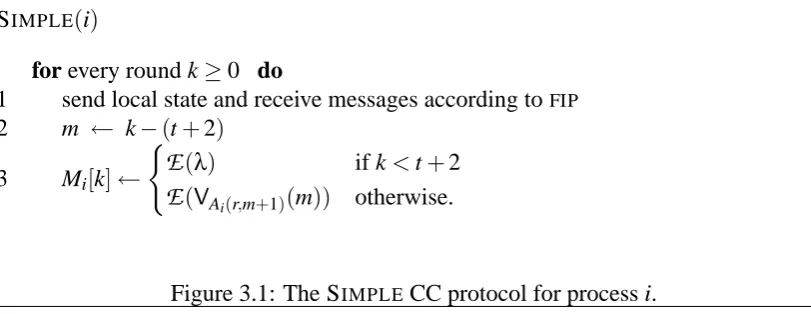
SIMPLE(i)
for every round k≥0 do
1 send local state and receive messages according to FIP
2 m ← k−(t+2)
3 Mi[k]←
(
E
(λ) if k<t+2E
(VAi(r,m+1)(m)) otherwise.Figure 3.1: The SIMPLECC protocol for process i.
In the protocol, every process i computes the core in time k as the view of the active processes t+2 rounds before time k. On line 1 every process sends and receives mes-sages according to a full information protocol. On line 3, i computes the core by assign-ing the view of the active processes t+2 rounds beforehand. We denote by Ai(r,m+1)
the set of active processes at time m+1 according to i’s view at time k=m+t+2, i.e., the processes not known to have dropped any messages up to round m+1:
Ai(r,m+1),{ j :(r,m+t+2)|=¬Ki(j crashed up to round m+1)} (3.1)
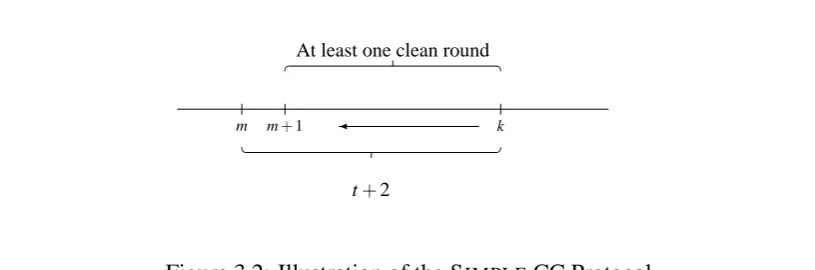
Note that there are t+1 rounds between m+1 and k, during which there must occur a clean round. Intuitively, by Theorem 3.1 we have that all facts that are distributed knowledge to the nonfaulty processes at time m+1 become known to all processes by time k, and in particular every nonfaulty i can compute Ai(r,m+1)andVAi(r,m+1)(m)on
line 3.
m m+1 k
t+2
At least one clean round
Figure 3.2: Illustration of the SIMPLECC Protocol.
Proof: In order to prove that SIMPLEis a CC protocol, we have to prove that the three properties of CC hold.
Since Mi[k]is defined as
E
(V)for some view Vin the run, all events in Mi[k]haveoccurred, and thus the Accuracy property holds. For completeness, assume that an event e∈
E
is known to a nonfaulty process j at time m, and is thus included in j’s view at time m. Since j is nonfaulty, in particular it is active at time m+1, and thus from line 3 in Simple, the event e will appear in the core of every nonfaulty process i no later than time m+t+2; completeness follows. Finally, for consistency, we have to prove that if i and j are nonfaulty, then for all k we have Mi[k] =Mj[k]. Since at time k, both i andj produce the same m in line 2, all we have to prove is that Ai(r,m+1) =Aj(r,m+1),
and thatVA(r,m+1)(m)is available to i and j at time k. Since there is a bound of t failures in the system, during a time interval of t+1 rounds, there must be a clean round. From Theorem 3.1, we deduce that any fact which is distributed knowledge among the active processes at time m+1, is known to every correct process at time k. In particular, there is distributed knowledge at m+1 about the identity of the processes in Ai(r,m+1), and
thus at time k every correct process will have a copy of Ai(r,m+1), and specifically
Ai(r,m+1) =Aj(r,m+1) =A(r,m+1). Moreover, since there is distributed knowledge
Mi[k] =Mj[k]. The consistency property follows, and we are done.
Notice that process i’s computation of
E
(VAi(r,m+1)(m)) on line 3 of the protocol uses the set of active processes, Ai(r,m+1), at m+1=k−(t+1), while the joint viewVAi(r,m+1)(m) of this set refers to round m= k−(t+2). This follows from the fact that if an event e occurs at a process z at time m, in order for e to appear in the core, the protocol requires that z is active for at least one round after m, so that z will be able to notify the correct processes of e’s occurrence. More formally, the contents of
VA(r,m+1)(m)is distributed knowledge among the correct processes at time m+1, since all processes in A(r,m+1)are guaranteed to have successfully sent their messages to the correct processes in round m+1. On the other hand,VA(r,m+1)(m+1)is not necessarily distributed knowledge among the correct processes at m+1, since if a faulty process z∈A(r,m+1) fails to send all of its messages in round m+2, then any event e that occurs at z at time m+1 (and thus e∈VA(r,m+1)(m+1)) is not distributed knowledge among the correct processes at m+1, and in fact, since we are dealing exclusively with crash failures in this subsection, no correct process will ever learn of e.
Good and Bad Processes
the omission model, defining the set of processes known to have failed may need a bit of fine tuning as well, compared to our characterization of this set in the crash model.
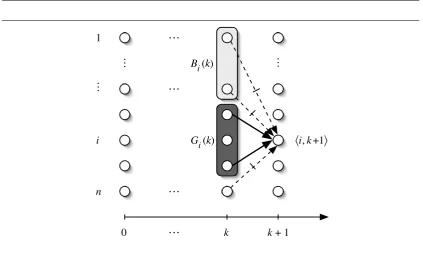
The crux of our protocol, CONCON, which we present for the omission model, de-pends on finding the appropriate replacement for the role played in the crash model for the number of failures known to i. This is suitably generalized by the following two definitions of sets of good and bad processes for i with respect to time k. Process i de-termines the identity of these sets one round later, at time k+1. The first set, which we denote Gi(k), consists of the processes that appear to i to have been nonfaulty at time k
(and so, in particular, behaved correctly in round k+1):
Gri(k) , { j :(R,r,k+1)|=¬Ki(j is faulty)} (3.2)
As usual, we drop the superscript r from terms when it is clear from context. Intu-itively, Gi(k)is the set of processes who have not presented a faulty behavior up to round
k, and furthermore, have managed to pass their messages in round k+1, allowing them to share the information they know at time k with the other processes. Notice that Gi(k)
is defined in terms of i’s knowledge at the end of the following round k+1. In the crash failure model, Gi(k)is the set of processes that i receives messages from in round k+1,
while in the omissions model it is a possibly strict subset of these processes, since i can exclude j from Gi(k) based on a report that j failed to send a message to a different
process i0. The G stands for good. We associate Gi(k)with time k rather than k+1
be-cause the view of the members of Gi(k)at time k turns out to be especially important. It
serves a central role in determining the contents of the shared core. In addition, this view facilitates the computation of the core, by allowing the definition a set of bad processes associated with time k, which we denote by Bi(k). This set consists of the processes that
are distributedly known at time k to the members of Gi(k)to be faulty:
Thus, every process in B is necessarily faulty (while processes in G are not necessarily nonfaulty). Recall that i receives messages from all members of Gi(k)in round k+1.
Hence, every member of Bi(k)is known by i at time k+1 to be faulty. It follows that
Bi(k)∩Gi(k) = /0for all i∈P. Notice, however, that while Bi(k)and Gi(k)are disjoint,
they are not necessarily complements. There are a number of different scenarios that may cause these sets not to be complements. For example, consider a process j that behaves correctly for the first k rounds and fails to send a message to i in round k+1. Process j is then excluded from Gi(k), since i knows that j is faulty. Moreover, j∈/Bi(k)
because no process could have observed faulty behavior of j in the first k rounds; hence j∈/Gi(k)∪Bi(k)and the sets are not complements.
There is a close connection between the identity of Bi(k) and the sets Gj(k−1).
Observe that, by definition of Gj, a process j knows, at time m that another process j0is
faulty exactly if j0∈/Gj(m−1). In the crash and omission models, the set of processes
distributedly known to be faulty by a set S of processes is simply the union of those known to be faulty by the members of S. It thus follows that
Bi(k) =
[
j∈Gi(k)
(P\Gj(k−1)). (3.4)
We denote by bi(k)the cardinality of Bi(k). Since Bi(k)consists of faulty processes,
necessarily bi(k)≤t. Figure 3.3 illustrates the sets Bi(k) and Gi(k) in theFIP given a
particular execution graph.
The Core
By definition, a Continuous Consensus task maintains at any given time a core of shared information. As defined in Chapter 2, the core Mi[k]is a subset of
E
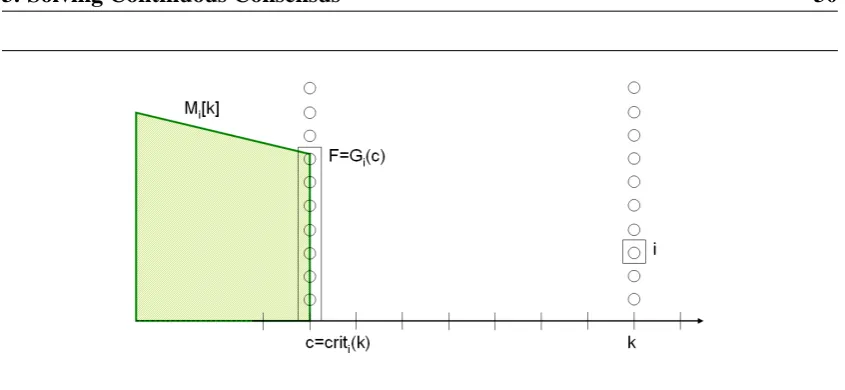
(V)w.r.t. a viewV. In our solution to the CC problem, which is described in the following sections, the core is represented by a time c<k, and a set F, such that Mi[k]is uniquely determined
…
|
1
i
n
0 k k + 1
…
…
…
…
…
…
〈i, k+1〉
Bi (k)
Gi (k)
|
|
Figure 3.3: Sets Gi(k)& Bi(k)are based onVi(k+1).
the critical time of k, denoted c=criti(k), and F the critical set of k. In the context
of CONCON, we define the critical set, F, as the set of good processes at time c, i.e.
F =Gi(c). The challenge in CONCON is to compute at each time, k, the appropriate
critical time, criti(k). In the following subsections we shall prove that by choosing the
core as Mi[k] =
E
(VGi(c)(c)), we obtain an optimum solution for CC.We define i’s destination at time c, denoted desti(c), as the first time, k, at which
E
(VGi(c)(c))⊆Mi[k] holds. Intuitively, desti(c) is the first time at which facts whichare distributed knowledge at time c join the core. In particular, if c=criti(k), then
desti(c) =crit−i 1(c) =k, however, it is also possible that for some c0<criti(k)we will
also have desti(c0) =k. Formally, we say that desti(m) =k exactly if criti(k)≥m, and
Figure 3.4: The core computed at time k.
The Horizon
The analysis of simultaneous agreement in the crash failure model in [3] showed that knowing that a clean round occurred within a certain time interval enables processes to obtain a consistent view of information about earlier times. Thus a key goal in CONCON
will be to compute, in every round, a margin of time in which a clean round is guaranteed to have occurred.2
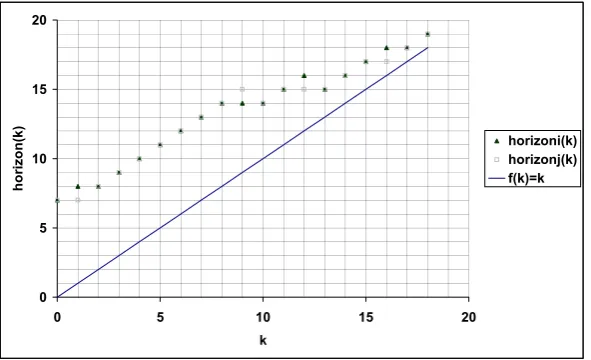
The analysis in the following subsections will show that if at time k+1, process i knows that at least f processes failed before time k, then it knows that at least one clean round must happen between time k and time hi(k) =k+t+1−f . We think of hi(k)as i’s
horizon for time k, denotedhorizoni(k). It turns out that if i is a good process, thenVi(k)
will be common knowledge by timehorizoni(k). Intuitively, the properties of the
crash-failure model show that there will be a latest (critical) time c with k≤c<horizoni(k)
such that round c+1 is clean, and after which all nonfaulty processes can predict the same horizon (i.e.,horizoni(c) =horizonj(c) for all processes i and j). We shall show that the same holds in the omission model as well. Moreover, we shall show that at time `=horizoni(c), every nonfaulty process knows that c is the critical time (for `).
2At this point this is an intuitive description of our motivation in CONCON. A formal definition of
This makes it common knowledge that round c+1 was clean, allowing for an efficient solution to simultaneous agreement. (Continuous consensus is a strict generalization of simultaneous agreement.) Finally, it will then follow that the core information at time`
is the view of the good processes in the critical time, c. Formally, we define i’s horizon for time m as:
horizoni(m) =m+t+1−bi(m) (3.5)
The value ofhorizoni(m)is defined for all m≥0. Recall that bi(m)is i’s estimation
for the number of “bad” processes, whose failure has been discovered up to round m. Since no failures are known initially, we have that bi(0) =0. Thus, by definition of
horizoni(m), we have thathorizoni(0) =t+1. The facts that the processes communicate according to the full-information protocol, and that the number of failures is bounded from above by t, imply that bi(m)≤bi(m+1)≤t for all m. The following observation
immediately follows.
Observation 3.5 For all m≥0: (i) horizoni(m)≥m+1, and
(ii) horizoni(m+1)≤horizoni(m) +1.
Notice from (ii) that the horizon cannot move forward by more than one at every round. It can move backwards more rapidly, however. If bi(m+1) =bi(m) +d+1 then
horizoni(m+1) =horizoni(m)−d. This happens when d+1 new failures are discovered
in round m by processes that are still trusted by i at time m+1.
C
ONC
ONThe CONCONprotocol, shown in Figure 3.5, is run by each process i individually. CON
-CON is used in both the crash and the omission failure model. Observe, however, that
turn, is based on the knowledge of process i as well as on that of other processes. This knowledge is evaluated with respect to different systems R for each of the failure models.
The analysis presented in [4] is, roughly speaking, “backward looking”: at any point in the execution, a process computes what it knows to be common knowledge. On the other hand, the analysis in [3] takes a “forward looking” approach: every process computes at what time facts about the initial configuration of the run become common knowledge. Our approach in CONCONis hybrid — both forward and backward looking. At the end of every round k of the protocol, each process i performs two tasks: One is to update a current estimate (upper bound) for when events in the viewVGi(k−1)(k−1) of Gi(k−1) will be part of the shared core view (forward looking). The other is to
determine the shared core at time k, at the end of the current round. For this purpose, the value in criti(k),Latesti[k] is considered the critical time for the core at time k
(backward looking). In the protocol text, we use the termhorizoni, which is defined in
Eq.3.5. Notice thathorizoni(m)is easily computable based onVi(m+1).
CONCON(i)
0 Latesti[`]← −1 for all`≥1
for every round k≥1 do
1 send local state and receive messages according to FIP
2 compute Gi(k−1), Bi(k−1)andhorizoni(k−1)
3 Latesti[horizoni(k−1)]← k−1
4 c←Latesti[k] cis the critical time for k, denoted criti(k)
5 Mi[k]←
(
E
(λ) if c=−1E
(VGi(c)(c)) otherwise. endforFigure 3.5: The CONCONprotocol for process i.
consists of communicating according to the full-information protocol on line 1. In the next part, on line 2, process i computes an upper bound on the time at which a view of time k will become included in the core. Finally, on lines 4 and 5 it records in Mi[k]the
view which is the core information at the current time k. We denote by criti(k)the value
of c that i sets in round k on line 4.
To compute the value of the indexhorizoni(k−1)used on line 2 of CONCON,
pro-cess i needs to know the value of bi(k−1)at the end of round k. Since a process j is in
Gi(k−1)if i does not know that j is faulty at time k, it follows that i receives round k
messages from all members in Gi(k−1). Thus, i has a copy of VGi(k−1) at time k. In
particular, i can compute Bi(k−1)and bi(k−1), as desired. Observe that steps 2 and 3
of the CONCONprotocol depend only on the failures that occur in the run. As a result, the nodes inVGi(c)(c)are independent of the (external) input assignment of the run. Fi-nally, observe that, for all m<k, process i has a copy ofVGi(m)(m). Thus, process i is able to compute
E
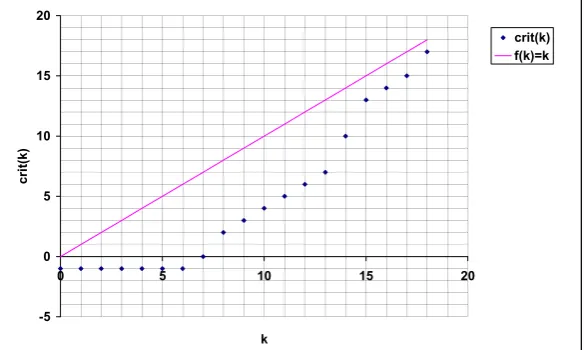
(VGi(c)(c),k)on line 5 of CONCON.We now state two useful properties of CONCON. The first says that the horizon is an upper bound on the time at which current round information is contained in the shared core. Indeed, given Observation 3.5(i) above this will imply that every round’s information will become common knowledge within a fixed bound of roughly t− f rounds, where f is the number of failures discovered. The second says that once the core is not empty, the critical time increases by at least one in every time step. Moreover, every round is assigned a critical time.
Proposition 3.6 For all nonfaulty processes i and times m and`:
(a) ifhorizoni(m)≤`then criti(`)≥m, and
(b) if criti(`)6=−1 then criti(`)<criti(`+1).
Lemma 3.7 If k<k0andhorizoni(k)≤` <horizoni(k0), then there exists a time ˆk with
k≤ˆk<k0such that (a)horizoni(ˆk) =`and (b)horizoni(ˆk+1) =`+1.
Proof: Assume that k<k0andhorizoni(k)≤` <horizoni(k0). By Observation 3.5(ii),
the functionhorizonican advance only in steps of one. Hence,horizoni(k00) =`for some
intermediate time k≤k00<k0, establishing part (a) of the claim. Let ˆk=max{k00: k00<
k0 andhorizoni(k00) =`}. We claim thathorizoni(ˆk+1)>horizoni(ˆk). By definition of
ˆk, we have that horizoni(ˆk+1)6=`. Recall that horizoni(k0)> ` and ˆk<k0. Hence, if
horizoni(ˆk+1)< `then ˆk+1<k0. We can now apply part (a) to ˆk+1<k0 to obtain
thathorizoni(h) =`for some h such that ˆk+1≤h< `. This contradicts the maximality
of ˆk. It follows thathorizoni(ˆk+1)> `. Finally, sincehorizoni(ˆk+1)>horizoni(ˆk), we
have by Observation 3.5(ii) thathorizoni(ˆk+1) =horizoni(ˆk) +1, and we are done.
Proof of Proposition 3.6: For part (a), assume thathorizoni(m)≤`. Sincehorizoni(`)>
`we have by Lemma 3.7(a) thathorizoni(ˆk) =`for some ˆk such that m≤ˆk< `. In
par-ticular, Latesti[`] =ˆk≥m after line 3 is executed in round ˆk+1. Since ˆk< `, we have
that ˆk+1≤`. Moreover, since the value of Latesti[`]is nondecreasing in time, it
fol-lows that Latesti[`]≥ˆk when line 4 is reached in round`. It now follows by line 4 that
criti(`)≥ ˆk≥m, proving part (a). For part (b), assume that criti(`) =m6=−1. Then,
from the definition ofhorizoni(m), we have thathorizoni(m) =`. Sincehorizoni(`)> `,
we have by Lemma 3.7(b) that there exists ˆk such that m≤ˆk< `andhorizoni(ˆk+1) =
`+1. Applying part (a) we obtain that criti(`+1)≥ˆk+1. Since m≤ˆk, we have that
ˆk+1>m, and thus criti(`+1)>m=criti(`), which completes the proof.
between executions of different processes in the same run. The following theorem shows the main correctness claim for CONCON, namely that all cores agree at all times.
Theorem 3.8 The CONCONprotocol solves the continuous consensus problem.
Proof: Since Mi[`] is a view of the run, all events in Mi[`] have occurred, and thus
the Accuracy property holds. Completeness requires every q∈ΦE that is known to a nonfaulty process j will eventually appear in Mi[`]. Suppose that Kjq holds no later
than time k. Notice that j∈Gi(k)for every nonfaulty process i, since j is nonfaulty. By
definition,horizoni(k)≤k+t+1, and Proposition 3.6(a) implies that criti(k+t+1)≥k.
It follows that
E
(Vj(k)) will be contained in Mi[k+t+1]. In particular, we have thatq∈Mi[k+t+1], and we have Completeness.
Finally, for Consistency, we need to show that Mi[`] =Mj[`]for all times`≥0 and
nonfaulty processes i and j. The variable criti(`) is assigned the value of Latesti[`] in
round` by line 4. Lines 0 and 3 guarantee that Latesti[m]≥ −1 and Latestj[m]≥ −1
holds for all indices m at all times. It follows that criti(`)≥ −1. We distinguish two
cases. First suppose that criti(`) =critj(`) =−1. In this case we have by line 5 and
the fact that criti(`) =critj(`) =−1 that Mi[`] =Mj[`] =λas desired. Second,
sup-pose without loss of generality that m=criti(`)6=−1. We claim that Gj(m)⊇Gi(m)
and critj(`)≥criti(`). If Gj(m)6⊇Gi(m), then j knows at time m+1 of some z∈Gi
that is faulty. Since j is nonfaulty, j∈Gi(m+1), and hence z∈ Bi(m+1) so that
bi(m+1)>bi(m) and horizoni(m+1)≤horizoni(m) = `. It follows from
Proposi-tion 3.6(a) that criti(`)≥m+1, contradicting the assumption that criti(`) =m. Since
Gj(m)⊇ Gi(m) it follows that VGi(m)(m) is contained in VGj(m)(m) and hence that
Bj(m)⊇Bi(m). This implies that bj(m)≥bi(m), and thushorizonj(m)≤horizoni(m).
Again by Proposition 3.6(a) we can conclude that critj(`)≥m=criti(`), and the claim is
established. Moreover, since criti(`)>−1, it follows that critj(`)6=−1. Applying this
argument to j instead of i, we obtain also that Gj(m)⊆Gi(m)and critj(`)≤criti(`). We
we have by line 5 that Mi[`] =VGi(m)(m) =VGj(m)(m) =Mj[`]and we are done.
More efficient implementations. The CONCON protocol sends messages according
to FIP, so that messages get larger over time. In many cases it is possible to derive
a more space- and communication-efficient implementation of CONCON. In order to
simulate the CONCONprotocol a process i must in particular have enough information about (knowledge regarding) failures to enable the computation of the horizoni at all
points. The value of horizoni(k) depends on bi(k) which, in turn, can be computed
once i knows the sets Gj(k−1)for all j∈Gi(k)(see Eq.3.4). This can be achieved if, in
every round k+1 each process i sends Gi(k−1)to all other processes. The set Gi(k−1)
consists of the processes that i does not know to be faulty at time k, which is when the round k+1 message is prepared. This set can be encoded as a string of n bits. Initially, process i knows of no failures. At every time k>0, it can compute Gi(k−1)by detecting
a process as faulty exactly if it is either reported as faulty in one of the Gj(k−2)it has
received in round k, or if the process in question has failed to deliver a message to i. It can be checked that the sets Gi(k−1) computed under this scheme are the same as
they are usingFIP. In order to carry out step 4 of CONCON, we must also guarantee that
all information about monitored events from
E
be passed to everyone. In applications in which there are only a few interesting events (e.g., fire alarms) then representing the relevant data regarding them can be done succinctly. It follows that there is a protocol for continuous consensus that is equivalent to CONCON, but sends short messages anduses little space beyond that needed for the shared core Mi[k]and the aspects of the view
needed to determine the events ofΦE.
3.2
Continuous Consensus and Common Knowledge
We have developed the CONCON protocol using intuitions obtained from the analysis
related to the problem of computing common knowledge. We now formalize this con-nection, and use it in order to prove the optimality of CONCON.
The continuous consensus problem is specified in terms of the behavior of the non-faulty processes, and does not require correct action from non-faulty ones. It was shown in [4] (see also [10, 5]) that the appropriate variant of common knowledge correspond-ing to such a situation is common knowledge among the nonfaulty processes, for which our language has the operator CN.
We say that a formulaϕis valid in R, and write R|=ϕ, if(R,r,m)|=ϕfor all points
(r,m) with r∈R. Recall that, by Theorem 3.8, Mi[k] =Mj[k] holds for every pair of
nonfaulty processes i and j. For every possible state X ⊆
E
of the core, we define a proposition Core=X that is true at a point(r,m)exactly if Mir[m] =X for all nonfaulty processes i in r. We can now show a strong connection between common knowledge and continuous consensus:Proposition 3.9 LetPbe a protocol for continuous consensus and let RP be the set of
all runs ofPwith execution graphs in R=R(n,t,fm,
I
). Then for all X we have RP|= ((Core=X)≡CN(Core=X)) .Proof: We shall prove that Core=X holds iff CN(Core=X)). The ‘if’ direction is
trivial, since every fact that is common knowledge is necessarily true. For the ‘only if’ direction assume that Mri[m] =X for all nonfaulty processes i in r. Define the propo-sition p as “Core=X ”. It suffices to show that, for all r,r0∈R, if (R,r,m)|= p and
(r,m)∼N (r0,m) then (R,r0,m)|= p, and the claim will follow by induction. Assume
that (R,r,m)|= p and (r,m)∼N (r0,m). Thus, rj(m) =r0j(m) for some process j that
is nonfaulty in both runs. Since (R,r,m)|= p we have that Core=X holds at (r,m); since j is nonfaulty it follows that, in particular, Mrj[m] =X . Since rj(m) =r0j(m), we
have that Mrj0[m] =X as well. Finally, sincePsolves continuous consensus, we have by Consistency that Mir0[m] =X for all nonfaulty i in r0, and hence(R,r0,m)|= p.
Proposition 3.9 implies that the contents of the core in any protocolPfor continuous consensus (e.g., CONCON) are common knowledge among the nonfaulty processes at
every point. Hence, an event can be entered into the local copies of the core only once its occurrence has become common knowledge. We shall now argue that the CONCON
protocol places events in the cores Mi[m] as early as possible. This will establish that
CONCONis an optimum protocol for continuous consensus. More formally, we prove the following
Theorem 3.10 If R is aFIPsystem, r∈R, i is nonfaulty in r, Pis a correct protocol for
continuous consensus, i’s core at(r,m)under CONCONis MiC[m], and i’s core underP
is MiP[m], then MiP[m]⊆MiC[m].
In Theorem 3.10 we assume, without loss of generality, thatPis aFIP. As Lemma A.2
in the appendix shows, the same argument holds for the general case, when Pis an ar-bitrary protocol. Theorem 3.10 shows that CONCONis optimal in terms of recording events in the core as early as possible. We prove the theorem by showing that the core MiC[m] produced by CONCON is precisely the view of the run that is common knowl-edge at(r,m). Moses and Tuttle [4] completely characterized the connected components of the N-reachability relation systems for FIP in crash and omission models, thereby
characterizing common knowledge as well. To set up the necessary background for the proof, we now briefly review their fixed-point construction and related characterization of common knowledge. The construction is performed individually by every process i based on its view Vri(m) at a given point (r,m). It defines a sequence of pairs (k`,S`)
consisting of a time and set of processes, for`≥0. In the construction, F`denotes the set {j :(R,r,k`)|=DS`(j is faulty)}of processes known at time k`to be faulty by processes
in S`. The sets S`and F`are analogous to, but in general distinct from, to the sets Gi(k)
and Bi(k)in CONCON. The construction proceeds inductively as follows.
Step: Set k`+1=m−(t+1− |F`|)and S`+1=P\F`.
As Moses and Tuttle show, the F`’s form a nonincreasing sequence of sets of
pro-cesses. As a result, the S`’s form a nondecreasing sequence of sets of processes, and
the k`’s form a descending sequence of indices. Since |F`| ≤t, for some index h we
must have that Fh=Fh−1. When this happens for the first time, the construction reaches a fixed-point because Sh+1=Sh and kh+1=kh. We use ˆk =ˆk