Volume 3, Issue 2 (2014) pp. 138-145
138 | Page Original Article
Cloud Computing: Banking Operations on the Cloud
Farhad Karimkhani
*, Farshid Nematzadeh
Young Researchers and Elite Club, Maku Branch, Islamic Azad University, Maku, Iran *Corresponding Author E-mail:[email protected]
Received: 19 March 2014, Revised: 18 April 2014, Accepted: 25 April 2014
ABSTRACT
Today, technology is changing rapidly and what we have so far implemented as a smart solution is now part of the past. Cloud computing (CC) opens up new horizons for various business sectors and also the banking sector. Cloud knowledge has been made through many years of research in distributed systems, network computing, parallel computing, etc. and can provide an extremely positive change in present systems. Today, CC is changing the scenario and method of processing. With the help of CC, even the computing capabilities of high level performance are also entering the budgets. CC decreases concerns about running and updating which was hence the customer's responsibility, which decreases initial project costs for organizations with small scalability. At present, any possibility advancing toward payment goes to the consumption rate. The harder the technology seems, it will be put under the umbrella of cloud and presented to the user as service, which provides reliability, interests, results and required trust levels for its users, that truly end up in a "cloud revolution".
Keywords: Banks, Cloud, Data Center, Services, Virtualization.
Introduction
The cloud is in the process of virtualization of different things. Anything on the cloud is controlled by the third party that offers any service based on demand. Today, especially due to the financial crisis which has greatly influenced the world economy, more organizations are turning to CC as a low cost device to offer quick delivery solutions to the market for operations and critical services to missions, like the banking sector. With the advent of CC, there is no need for the user to buy heavy and costly software. All these are hosted by the giants of the IT industry and are done as a service to the user and by payment based on the usage rate. The cloud
is one step beyond virtualization. The cloud puts one more virtual layer between the user and the physical components used for computing. Virtualization lies hidden at the core of CC and is used in designing the data centers. This paper examines the various pros and cons of CC in the banking sector and also, discusses the various features of this technology in relation to the banking sector.
Research Literature An Introduction to CC
139 | Page
computer. Design of applications is based on the use and integration of services. In contrast, in more traditional approaches like
network computing, provision of
performances depends on this use and integration of services rather than depending on the process or algorithm concept. The main idea beyond this is that the network
computing mostly concentrates on
computing with high performance, whereas CC offers both standard and also concentrated computing. Furthermore, the cloud offers more services compared with network computing, such as network hosting, multiple operating systems, supporting database and more. Eventually, networks tend to be connected by a weak link, be heterogeneous and be spatially dispersed and they are less so, against common cluster computing systems.
Obviously, this will have benefits for CC, from different aspects, such as scalability, reliability, etc. In the peak of asking for resources, due to the increase of users or the increase of data which have to be presented, an application may answer promptly, because it can receive more samples of a specific service. This same thing may happen when the demands go down and in that case, resources can be freed and all these actions occur in a manner transparent to the user.
Cloud Computer Layers
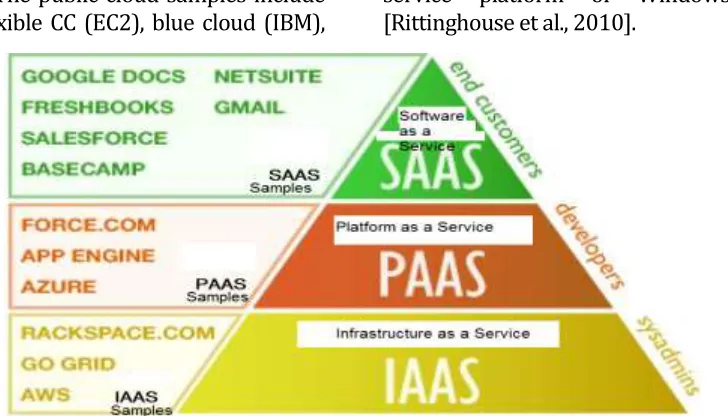
There are different categories where service-oriented services can be classified. One of the many criteria used for classifying these systems, is the abstraction level that suggests to the user system. In this method, three different levels are mostly diagnosed which can be observed in Fig.1. Next, we firstly describe any of the three levels which include features that define any one of them, and we present samples of very famous systems of each kind. In the following, we will present some technical challenges that must be considered for developing a CC system
(Al-Zoube, 2009).Infrastructure as a Service (IaaS): is the provision of hardware as a service which includes servers, network technology, storage or computing and also basic features like operating systems and
virtualization of hardware resources
[Hurwitz et al., 2010]. Compared with a single computer system, IaaS refers to the hardware of such a computer with an operating system that watches the hardware resources management and facilitates access to them. Platform as a Service (PaaS): In the PaaS level, the provider offers more than the infrastructure. In other words, an integrated set of software with all the things a developer needs to make applications both for development and also implementation of the processes. In this method, a PaaS provider doesn't directly provide the infrastructure, but it uses the services of an IaaS. IaaS illustrates the tools which a developer is in need of and by this, provides an indirect access to IaaS services and eventually gains access to the infrastructure [T. A. Horakh et
al., 2008].
Software as a Service (SaaS): in the end, we study SaaS, which stands for software as a service. SaaS was one of the basic cloud services implementations. Its roots could be found in the hosting operations that were carried out by the service providers of the applications, from where come companies presented applications to other companies that are known as "relationship management with the customer".
Cloud Model Types
140 | Page
shared by all required facilities and be accessible. The public cloud samples include Amazon flexible CC (EC2), blue cloud (IBM),
sun cloud, Google motor explorer, and the service platform of Windows Azores [Rittinghouse et al., 2010].
Figure 1. display of layers for service-based architecture
Private cloud: this cloud infrastructure specifically operates for a separate organization. This infrastructure, offers hosted services that are specifically for a limited number of accessible people that are
the accepted users dependent on
organizations beyond a firewall. These services are hosted either internally or externally and are managed internally or by a third person, and are presented via a private network.
Society cloud: here, this infrastructure is shared among organizations of a certain society with mutual concerns (such as security, compliance, jurisdiction, etc.). This infrastructure has the multiple rentedness capacity and is managed internally or by a third party and is hosted internally or externally on a private cloud.
Integrated cloud: an integrated cloud, composed of two or more clouds includes the public, private and society clouds. This cloud offers the benefits of many deployment models. In this CC environment, an organization offers and manages some resources at home and provides others outside the organization.
Why is CC needed for banks?
CC can help financial institutions to improve on the performance by many methods [J. Deng et al., 2010].
A) Cost savings and accounts based on usage rate
With CC, financial institutions can turn a big capital cost to a smaller one and turn it into the present operating cost. There is no need for heavy investments in the new hardware and software. Additionally, the unique nature of CC allows financial institutions to choose the required services based on payment when shopping.
B) Business continuity
With CC, the provider is responsible for
managing the technology. Financial
companies can attain a higher level of data protection, tolerance of errors and return from crisis. CC also provides a higher level of redundancy and backup with a lower cost, compared with the common managed solutions [Kumar, 2011].
141 | Page
The flexibility of cloud-oriented operating models, allows the financial institutions to experience smaller development cycles for the new products. This results in the more optimal and quicker responding to the needs of banking customers. As the cloud is
accessible based on demand, less
infrastructure investments are required and the required primary time for running is saved. CC also allows the development of the new product to move forward without investment in the capital. CC, also allows the businesses to transmit non-critical services to the clouds, such as software packages, protection and other computing problems. As a result, companies can focus more on the business issues of financial services, rather than IT. [J. Deng et al., 2010]
D) Green IT
Organizations can use CC to transmit their services to a virtual environment that decreases the energy consumption and Carbon footprint which springs from launching a physical infrastructure. Also, it causes a more optimal use of computing power and less wasted time [Kumar, 2011].
Offering Cloud-Based Services to the Banks
When we want to achieve this technology, we must choose whether we want to run it on our locations or we have the software that could be used as a service or we want to have an integration of both possibilities at our service. This deployment model, has the freedom to change, when the request for services is changed [7].
Infrastructure as a Service (IaaS): here, the services offered to the customers, are hardware assets (like storage) and computing facilities.
Software as a Service (SaaS): here, there is no need for the customer to provide software packages instead of these software
applications, since the services on the Internet are offered to the customer for use. Platform as a Service (PaaS): to protect the complete cycle of the explosive growth such as drawing, bug prevention, testing, operations, and support of powerful network-based applications and services on the Internet, PaaS meets all the present requirements.
Demand for the cloud platform
IT needs to focus on under process operations, in addition to installations and other initial costs. Sometimes, the first installation costs are far more than its operating costs, specifically for projects with small size. IT focuses on more reception in exchange for low investment, while CC is the best option due to its facilities and benefits, which could be described as below [Alabbadi, 2011]:
CC features include:
Multiple-rentedness: CC allows organizations to use hardware resources on the cloud, with the help of a separate software sample. Using the clouds, there would be no need to employ separate software samples for each organization or the user who makes use of the infrastructure.
Self-provisioning: with the self-provisioning CC, the end user can be helped to use the cloud services without the intrusion of the service provider. The provider places many of the self-provisioning services on the user's portal, in the same place that different services may exist with different security levels and work policies. This makes it possible for CC services to be at the user's service for 24 hours and 7 days of the weak [9].
142 | Page
computing resources and this, decreases the negative effects on the environment.
Flexibility: CC provides flexibility in services. With flexibility, the user will be able to use services less or more than they require. Flexibility optimizes the cloud services resources [10].
Is the cloud model reliable for the banks?
Most of CC infrastructures include completely reliable and tested in time services which are built on servers with different levels of virtualized technologies and act through large data centers under service level agreements (SLAs) and in such agreements, the services need to be at the service of the customers and under process in 99.99% of the times or even better than this. Business suggestions have developed so as to help customers meet the requirements related to the quality of services and usually, to offer such agreements related to the level of services to their customers. From the users' viewpoint, where are the banks in this case, the cloud emerges as an access point separate from all of their computing requirements. Regardless of the geographical location, these cloud-based services are accessible as long as there is an Internet connection. Open standards and open source software are important factors in the growth of CC.
Potential Benefits of CC for The Banks
A banking institution doesn't need the deployment of computer and hardware resources for storage and also, doesn't need to separately install software applications or pay any costs for them, as all these cases are presented via the provider of services. Similarly, CC makes it possible for contents and other services to be implemented on mobile devices, Ipads, tablets and other devices. Therefore, CC has a tremendous influence on the banks, regardless of its cost savings.
better cash flow and more financial transparency
fast provision and flexible measuring of services
makes it possible for IT sectors to focus on capabilities that are central for business benefits concerning the environment
data ownership and intellectual property (IP) points and warnings regarding the regulations of data privacy
Searching about inappropriate and illegal activity may not be economical.
limited speed and access
risks of business continuity and disaster recovery
bandwidth and other service costs
limited guarantee regarding service levels complex models of offering license and charging services
limited ability to customize and upgrade
The Challenges Faced By the Cloud for The Banks
A major problem with this cloud is connection, which is getting better each day and now we have achieved the 4G technology.
Interpretability capacity is still an obstacle in deployment, since there exists a set of standards which is globally confirmed or interfaces that have yet to be defined and leads to the high risk in the trapping of the provider.
143 | Page
The Mobile Phone Virtualization for the Banks
Smartphones with open and powerful operating systems, are gaining an increasing popularity which leads to us witnessing lots off innovations and changes in the market. Pressure for decreasing the costs of development and faster delivery of phones to the market, has doubled the competition pressure for presenting phones with powerful facilities, so as to move from exclusive operating systems to open operating systems unbothered with the security of reliable services. As mobile phones have become more powerful, beyond their initial phone calls, phones also offer song, video and internal functions of GPS now. Powerful applications are every day made by a vibrant developing society that uses open operating systems. As these capabilities have developed, the capability of the mobile phone user for applications, images, videos, music, e-mails, bank and Credit Card information, and personal information management have all combined to present a richer and more valuable experience to people which has displacement capacity and at the time of upgrade, can be transmitted to the new phone without any trouble. The ability to protect people and transmit them will turn into an important shopping decision. The risk of security and managing the devices available to the
employees, if they be confidential
information, is a lot and the management of the number and many kinds of devices is a complex issue in terms of cost and security. Virtualization is a providing technology for answering such issues for the banks. Two samples of virtualization software that are used on smartphones, include [11]:
KVM: Kernel-based tract machine that is open and full source software of virtualization solutions for Linux on the x96
software and includes virtualization ranges (Intel VT or AMD-V).
VMware: virtualization platform of VMware mobile is a thin layer of software that sits on a mobile phone in order to separate applications and data from the related hardware. This platform has been prepared for optimization on mobile phones with low power and low memory. VMwarMVP benefits the end users by enabling them to run many profiles (e.g. one for personal consumption and the other for business use) on a device.
Movement toward the Cloud, Where Should We Start?
144 | Page
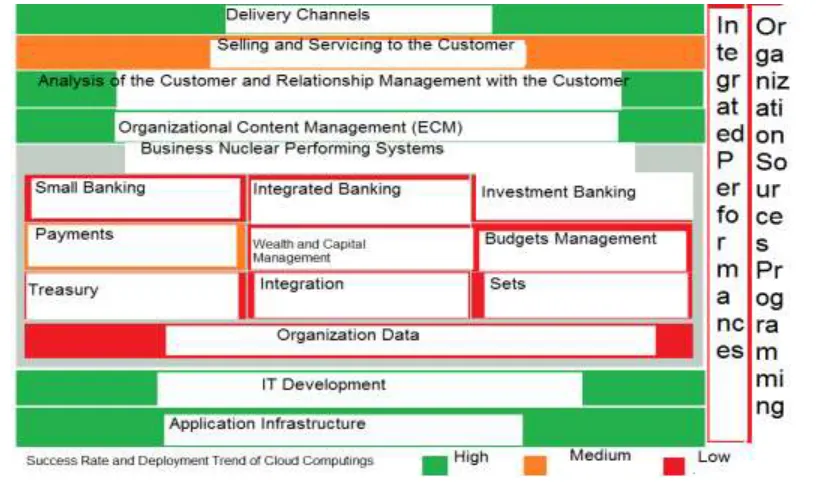
Figure 2. Spheres, which are suitable for the cloud Conclusion
The main value of CC is that it can make available the software and the data in a clear way and in any location, which also includes the mobile phone environment. One of the key elements of the computing environment regardless of location is that it is a networking storage system that provisions world access to the software and turns the cloud into an ideal environment which helps the smart mobile phone users to have access also to the powerful computing power from far. CC is at its most powerful growth but cloud technology is still partly immature and needs a few more years for its complete maturity and growth. Like any other technology which reaches the quick growth level, in this case also, the more powerful players remain and the weak ones are put aside. Thus, the demand for implementing operations with one another and integration probably results in encouraging a framework completely supported by interfaces of intracloud programming, which will be developed for linking cloud-based systems in the providing platforms. This integration and mingling will develop request for CC, along
with upgraded security, privacy and management upgrades and will win the customers' trust, as a result of which customers will increasingly transmit a huge bulk of their IT infrastructure to third parties including SaaS providers. Many banks, consumers and companies are losing the CC benefits, since they don't have the required trust in the CC. A good opportunity has arisen for banks to enter the CC and provision better and more optimal services to their customers.
References
Al-Zoube, M. (2009). E-learning on the cloud. Intl. Arab Journal of e-Technology 1(2), 58– 64.
Hurwitz, J., Bloor, R., Kaufman, M., Halper, F. (2010). Cloud Computing for Dummies. Wiley.
145 | Page
John W. Rittinghouse & Ransome. J.F. (2010). CRC Press, Taylor & Francis Group. Cloud Computing –Implementation, Management and Security.
J. Deng, S. C-H. Huang, Y. S. Han, Deng. J.H. (2010). Fault Tolerant and Reliable Computation in Cloud Computing.
Deepak Kumar Bora An Overview of Cloud Computing with specialreference to financial sectorOct. 2011.
Michael M. (2008). Pearson Education Inc. Cloud Computing – Web-based Applications that change the Way You Work and Collaborate.
M. M. Alabbadi. M.M. (2011).
14thInternational Conference on Interactive
Collaborative Learning
(ICL)-11thInternational Conference Virtual
University (vu’11). Slovakia. Cloud
Computing for Education and Learning: Education and learning as a service. 2011.
The Economic Times Banking Technology
Conclave 2009 CloudComputing
http://www.in.kpmg.com/services/btc/pdf/ 11_Cloud_Computing.pdf
Banking 2.0: Money Management Moves to
The
Cloud-http://www.readwriteweb.com/archives/ba nking_20_money_management_in_the_cloud. php
Http://computinginthecloud.wordpress.com
/2008/09/25/utility-cloud- computingflashback-to-1961-prof-john-mccarthy, retrieved 5 Jan 2009.
How to cite this article: Farhad Karimkhani, Farshid Nematzadeh, Cloud
Computing: Banking Operations on the Cloud. International Journal of Advanced
Studies in Humanities and Social Science, 2014, 3(2), 138-145.