Simultaneous and Anonymous Mobile Network Authentication
Scheme Based on Chaotic Maps
Wen-Chung Kuo
1, Chi-Sheng Lin
2, Chen-Tsun Chuang
2, Ming-Chih Kao
31 National Yunlin University of Science & Technology, Department of Computer Science and Information Engineering No.123 University Road, Section 3, Douliou, Yunlin 64002, Taiwan, R.O.C
e-mail: [email protected]
2 Department of Computer Science and Information Engineering, National Formosa University
No.64, Wunhua Rd., Huwei Township, Yunlin County 632, Taiwan, R.O.C.
3 System Integration Depart, Internet Technology Software Division, Computational Intelligence Technology Center,
Industrial Technology Research Institute, Taiwan, R.O.C.
http://dx.doi.org/10.5755/j01.itc.45.2.8875
Abstract. Wireless network authentication schemes have been researched for about a decade, and associated security problems explored by many researchers. In 2004, Zhu and Ma proposed an authentication scheme for wireless environments. Afterwards other researchers proposed improvements according to Zhu-Ma scheme. Mutual authentication is one of the most important issues. To the best of our knowledge, there is no scheme that allows a foreign agent to authenticate the home agent and mobile user at the same time. Towards this purpose, we propose a simultaneous authentication scheme based on chaotic maps, and describe how our proposed scheme addresses various security problems while maintain anonymity.
Keywords: Authentication; Mutual authentication; Chaotic-maps; security.
1. Introduction
Wireless communication is ubiquitous and the number of people who use wireless network services is increasing massively. This leads to situations on the network where a server which offers network service has to authenticate a mobile user (𝑀𝑈) in a wireless environment. However, the security landscapes of wireless networks have been studied for about a decade and research is still maturing.
In 2004, Zhu and Ma [12] proposed an authentication scheme with anonymity for the wireless environment, taking into account the limited network resources and a higher channel error rate in wireless communication environment. There are two major advantages in their scheme: 1) it takes only one round of message exchange between the mobile user and the foreign network, and another round of message exchange between the foreign network and the home network; 2) a one-time key is used between the mobile user and the foreign network. Then, in 2006, Lee et al.
[5] pointed out that there are security weaknesses in the Zhu-Ma scheme such as not achieving mutual authentication or providing backward secrecy of session key. In response, they provided an enhanced protocol (LHL-scheme) to Zhu-Ma’s scheme. In 2008, Wu et al. [8] found another security issue that affects the Zhu-Ma and LHL schemes since they only use a one-way hash function to hide the user’s real identity. An attacker could easily obtain 𝐼𝐷𝑀𝑈 by off-line
authentication scheme (HMZCB-scheme) using smart card for wireless environments. It focuses on the situation of smart card breach, even if the adversary extracts the information stored in smart card, he cannot derive the password of the user. In 2011, Lee and Kwon [6] provided the property of untraceability for the user. They used random nonce to make each session requests from a particular user unidentifiable, so the adversary cannot tell if the message is from the same user or not. To the best of our knowledge, there is no scheme that allows a foreign agent to authenticate the home agent and mobile user at the same time using only one function. Towards this purpose, we propose a simultaneous authentication scheme and describe how our proposed scheme addresses various security problems in this paper.
Recently, cryptosystems [1, 2, 9, 10] based on chaotic-maps theory (nonlinear dynamic) have been studied widely because the operations of chaotic-maps use recurrence characteristics. For example, Chain and Kuo [1] proposed a new identity feature based on the chaotic maps for digital signature scheme. We now extend this identity feature for an anonymous wireless communication authentication scheme. The major contribution of this proposed scheme is authentication of the foreign agent (𝐹𝐴) to the mobile user (𝑀𝑈) and the 𝐹𝐴 to the home agent (𝐻𝐴), in other words, 𝐹𝐴
can authenticate 𝐻𝐴 and 𝑀𝑈 simultaneously, which is a unique approach not applied in previous schemes.
The rest of our paper is organized as follows: In Section 2, we briefly introduce Chebyshev chaotic-maps and their characteristics. In Section 3, we present our proposed scheme. The analysis of our scheme is presented in Section 4. Concluding remarks are given in Section 5.
2. Preliminaries
In this section, first we will briefly introduce Chebyshev chaotic maps and their properties [1].
2.1. Chebyshev Chaotic Maps
Let 𝑛 be an integer and 𝑥 be a variable within the interval [−1,1]. The Chebyshev polynomial 𝑇𝑛(𝑥) is
defined as:
𝑇𝑛(𝑥) = cos(𝑛cos−1(𝑥)). (1)
With Eq.(1), the recurrence relation 𝑇𝑛(𝑥) is
defined as:
𝑇𝑛(𝑥) = 2𝑥𝑇𝑛−1(𝑥) − 𝑇𝑛−2(𝑥), (2)
where 𝑛 >= 2, 𝑇0(𝑥) = 1 and 𝑇1(𝑥) = 𝑥. One of the
most important properties of Chebyshev polynomials is the semi-group property which establishes the following:
𝑇𝑟(𝑇𝑠(𝑥)) = cos(𝑟cos−1(cos(𝑠cos−1(𝑥)))) (3)
= cos(𝑟𝑠cos−1(𝑥)) = 𝑇
𝑠𝑟(𝑥) = 𝑇𝑟(𝑇𝑠(𝑥)).
2.2. Chaotic Maps Problems [1]
Let 𝑃 and 𝑄 be integers and 𝑝 be a prime number. The general second-order linear recurrence relation is as follows:
𝑇𝑛(𝑀) = 𝑃 × 𝑇𝑛−1(𝑀) + 𝑄 × 𝑇𝑛−2(𝑀)mod𝑝,(4)
where 𝑛 >= 2, 𝑇𝑛(𝑀) ∈ 𝐺𝐹(𝑝) , 𝑇0(𝑀) = 1 and
𝑇1(𝑀) = 𝑀.
Theorem 1: Let 𝑓(𝑀) = 𝑡2− 2𝑀𝑡 + 1 and 𝛼, 𝛽 be
the roots of 𝑓(𝑀). If 𝑀 =1
2(𝛼 + 𝛽), then
the number of solutions is:
𝑇𝑛(𝑀) =
(𝑀+√𝑀2−1)𝑛+(𝑀−√𝑀2−1)𝑛
2 mod𝑝. (5)
Theorem 2: If 𝑎 and 𝑏 are integers, and 𝑎 > 𝑏 (𝑎, 𝑏 ∈ 𝑍+), then
𝑇𝑎+𝑏(𝑀) + 𝑇𝑎−𝑏(𝑀) = 2𝑇𝑎(𝑀)𝑇𝑏(𝑀). (6)
Theorem 3: If 𝑎 = 𝑏 + 𝑐, then
(𝑇𝑎(𝑀)𝑇𝑏(𝑀)𝑇𝑎(𝑀) + 1)mod𝑝 = ([𝑇𝑎(𝑀)]2+
[𝑇𝑏(𝑀)]2+ [𝑇𝑐(𝑀)]2)mod𝑝. (7)
3. The Proposed Scheme
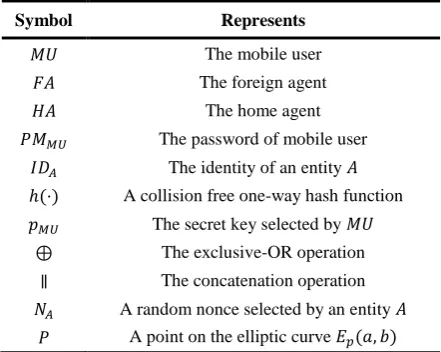
In this section, we will introduce our proposed scheme in detail. Our scheme is composed of the following three phases: Registration phase, Authentication phase, and Session key update phase. Before we introduce our proposed scheme, the notations and symbols used in the proposed scheme are as shown Table 1.
Table 1. Notations
Symbol Represents
𝑀𝑈 The mobile user 𝐹𝐴 The foreign agent 𝐻𝐴 The home agent 𝑃𝑀𝑀𝑈 The password of mobile user
𝐼𝐷𝐴 The identity of an entity 𝐴 ℎ(⋅) A collision free one-way hash function 𝑝𝑀𝑈 The secret key selected by 𝑀𝑈
⊕ The exclusive-OR operation ∥ The concatenation operation 𝑁𝐴 A random nonce selected by an entity 𝐴
𝑃 A point on the elliptic curve 𝐸𝑝(𝑎, 𝑏)
3.1. Registration Phase
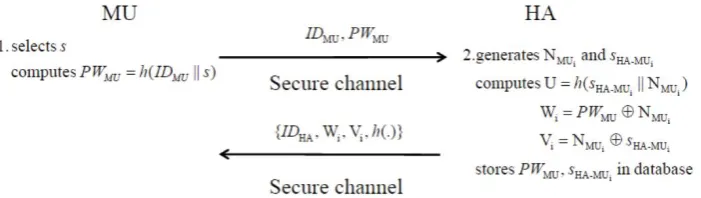
As shown in Fig. 1, 𝑀𝑈 selects a secret key 𝑠, and computes 𝑃𝑊𝑀𝑈= ℎ(𝐼𝐷𝑀𝑈∥ 𝑠). Then 𝑀𝑈 sends
Figure 1. The Registration phase
𝐻𝐴 receives the message, it generates random nonce
𝑁𝑀𝑈𝑖 and 𝑠𝐻𝐴−𝑀𝑈𝑖 , and then computes 𝑈 =
ℎ(𝑠𝐻𝐴−𝑀𝑈𝑖 ∥ 𝑁𝑀𝑈𝑖), 𝑊𝑖= 𝑃𝑊𝑀𝑈⊕ 𝑁𝑀𝑈𝑖 and 𝑉𝑖=
𝑁𝑀𝑈𝑖⊕ 𝑠𝐻𝐴−𝑀𝑈𝑖. 𝐻𝐴 stores 𝑃𝑊𝑀𝑈 and 𝑠𝐻𝐴−𝑀𝑈𝑖 into
its database and uses 𝑈 as an entry of 𝑀𝑈. Then 𝐻𝐴
stores 𝐼𝐷𝑀𝑈, 𝑊𝑖, 𝑉𝑖, ℎ(⋅) in the smart card and sends
the smart card to 𝑀𝑈 via secure channel.
3.2. Authentication phase
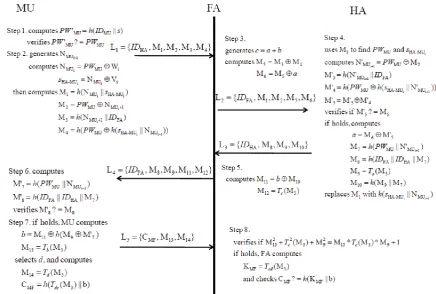
Step A1: 𝑀𝑈 computes 𝑃𝑊𝑀𝑈= ℎ(𝐼𝐷𝑀𝑈∥ 𝑠).
Step A2: 𝑀𝑈 → 𝐹𝐴: 𝐿1= {𝐼𝐷𝐻𝐴, 𝑀1, 𝑀2, 𝑀3, 𝑀4}
After user verification, 𝑀𝑈 generates a random nonce 𝑁𝑀𝑈𝑖+1 and extracts 𝑁𝑀𝑈𝑖 and 𝑠𝐻𝐴−𝑀𝑈𝑖 from
𝑁𝑀𝑈𝑖= 𝑃𝑊𝑀𝑈⊕ 𝑊𝑖 and 𝑠𝐻𝐴−𝑀𝑈𝑖 = 𝑁𝑀𝑈𝑖⊕ 𝑉𝑖 . Then 𝑀𝑈 computes 𝑀1= ℎ(𝑠𝐻𝐴−𝑀𝑈𝑖 ∥ 𝑁𝑀𝑈𝑖), 𝑀2= 𝑃𝑊𝑀𝑈⊕ 𝑁𝑀𝑈𝑖+1, 𝑀3= ℎ(𝑁𝑀𝑈𝑖+1∥ 𝐼𝐷𝐹𝐴) , 𝑀4= ℎ(𝑃𝑊𝑀𝑈⊕ ℎ(𝑠𝐻𝐴−𝑀𝑈𝑖 ∥ 𝑁𝑀𝑈𝑖+1)), and attaches 𝐼𝐷𝐻𝐴 to form 𝐿1. The 𝑀𝑈 sends the authentication message
𝐿1 to 𝐹𝐴.
Step A3: 𝐹𝐴 → 𝐻𝐴: 𝐿2= {𝐼𝐷𝐹𝐴, 𝑀1, 𝑀2, 𝑀5, 𝑀6}
𝐹𝐴 first generates three variables 𝑎, 𝑏, 𝑐, where
𝑐 = 𝑎 + 𝑏. Next, 𝐹𝐴 computes 𝑀5= 𝑀3⊕ 𝑀4 and
𝑀6= 𝑀5⊕ 𝑎 , then 𝐹𝐴 stores 𝐼𝐷𝐻𝐴 and sends
message 𝐿2 to 𝐻𝐴.
Step A4: 𝐻𝐴 → 𝐹𝐴: 𝐿3= {𝐼𝐷𝐻𝐴, 𝑀8, 𝑀9, 𝑀10}
𝐻𝐴 uses 𝑀1 as an entry to extract 𝑃𝑊𝑀𝑈 and
𝑠𝐻𝐴−𝑀𝑈𝑖 stored in its database. Then 𝐻𝐴 computes
𝑁𝑀𝑈′ 𝑖+1 = 𝑃𝑊𝑀𝑈⊕ 𝑀2 , 𝑀3′ = ℎ(𝑁𝑀𝑈′ 𝑖+1∥ 𝐼𝐷𝐹𝐴) ,
𝑀4′ = ℎ(𝑃𝑊𝑀𝑈⊕ 𝐻(𝑠𝐻𝐴−𝑀𝑈𝑖 ∥ 𝑁𝑀𝑈′ 𝑖+1)) , 𝑀5′=
𝑀3′⊕ 𝑀4′, and checks if 𝑀5′ equals 𝑀5. If it is true,
𝐻𝐴 computes 𝑎 = 𝑀6⊕ 𝑀5′ , 𝑀7= ℎ(𝑃𝑊𝑀𝑈∥
𝑁𝑀𝑈𝑖+1
′ ), 𝑀
8= ℎ(𝐼𝐷𝐹𝐴∥ 𝐼𝐷𝐻𝐴∥ 𝑀7), 𝑀9= 𝑇𝑎(𝑀3),
𝑀10= ℎ(𝑀9∥ 𝑀7). Finally, 𝐻𝐴 sends the message 𝐿3
to 𝐹𝐴 and replaces 𝑀1 with ℎ(𝑠𝐻𝐴−𝑀𝑈𝑖∥ 𝑁𝑀𝑈𝑖+1) as a
new entry of 𝑀𝑈.
Step A5: 𝐹𝐴 → 𝑀𝑈: 𝐿4= {𝐼𝐷𝐹𝐴, 𝑀8, 𝑀9, 𝑀11, 𝑀12}
After receiving message 𝐿3 , 𝐹𝐴 verifies the
identity of 𝐻𝐴. If it is verified, 𝐹𝐴 computes 𝑀11=
𝑏 ⊕ 𝑀10, 𝑀12= 𝑇𝑐(𝑀3), and then sends message 𝐿4
to 𝑀𝑈. 𝑀𝑈 receives message 𝐿4 and computes 𝑀7′=
ℎ(𝑃𝑊𝑀𝑈∥ 𝑁𝑀𝑈𝑖+1) and 𝑀8
′ = ℎ(𝐼𝐷
𝐹𝐴 ∥ 𝐼𝐷𝐻𝐴∥
ℎ(𝑃𝑊𝑀𝑈∥ 𝑁𝑀𝑈𝑖+1)) and verifies if 𝑀8
′ = 𝑀 8.
Step A6: 𝑀𝑈 → 𝐹𝐴: 𝐿5= {𝑀13, 𝑀14, 𝐶𝑀𝐹}
If the verification holds, 𝑀𝑈 computes 𝑏 = 𝑀11⊕
ℎ(𝑀9⊕ 𝑀7′), 𝑀13= 𝑇𝑏(𝑀3) and selects a variable 𝑑
then computes 𝑀14= 𝑇𝑑(𝑀3) , the session key
ℎ(𝑇𝑑𝑐(𝑀3)) and 𝐶𝑀𝐹= ℎ(𝑇𝑑𝑐(𝑀3) ∥ 𝑏). Then 𝑀𝑈
sends message 𝐿5 to 𝐹𝐴.
After receiving message 𝐿5 sent from 𝑀𝑈, 𝐹𝐴
verifies if 𝑀132 + 𝑇𝑐2(𝑀3) + 𝑀92= 𝑀13× 𝑇𝑐(𝑀3) ×
𝑀9+ 1. If it holds, 𝐹𝐴 then computes the session key
𝐾𝑀𝐹′ = 𝑇𝑐(𝑀14) = 𝑇𝑐𝑑(𝑀3) and checks whether 𝐶𝑀𝐹
is equal to ℎ(𝐾𝑀𝐹′ ∥ 𝑏) or not. If it holds, then the
session key between 𝐹𝐴 and 𝑀𝑈 is 𝑇𝑐𝑑(𝑀3) ;
otherwise 𝐹𝐴 rejects the 𝑀𝑈’s request. The detailed process is shown in Fig. 2.
3.3. Session key update phase
Step S1: 𝑀𝑈 first selects 𝑑𝑖, and computes 𝑇𝑑𝑖(𝑀3), then sends {𝑇𝑑𝑖(𝑀3), 𝐶𝑀𝐹𝑖−1} to 𝐹𝐴.
Step S2: After receiving the message, 𝐹𝐴 extracts
𝑇𝑐𝑖−1 by 𝐶𝑀𝐹𝑖−1 from its database. 𝐹𝐴
computes 𝐾𝑀𝐹𝑖= 𝑇𝑐𝑖𝑑𝑖(𝑀3) , 𝐶𝑀𝐹𝑖= ℎ(𝐾𝑀𝐹𝑖∥ 𝑇𝑑𝑖(𝑀3)) , and calculates ℎ1= ℎ(𝐶𝑀𝐹𝑖∥ 𝑇𝑐𝑖−1(𝑀3)) . Then 𝐹𝐴 sends {𝑇𝑐𝑖(𝑀3), ℎ1} to 𝑀𝑈 and replaces 𝑇𝑐𝑖−1(𝑀3), 𝐶𝑀𝐹𝑖−1 with 𝑇𝑐𝑖(𝑀3) and 𝐶𝑀𝐹𝑖.
Step S3: 𝑀𝑈 computes 𝐾𝑀𝐹𝑖 = 𝑇𝑑𝑖𝑐𝑖(𝑀3) , 𝐶𝑀𝐹𝑖= ℎ(𝐾𝑀𝐹𝑖∥ 𝑇𝑑𝑖(𝑀3)) and ℎ1′ = ℎ(𝐶𝑀𝐹𝑖 ∥
𝑇𝑐𝑖−1(𝑀3)), and 𝑀𝑈 verifies if ℎ1′ = ℎ1. If
true, 𝑀𝑈 stores 𝑇𝑐𝑖(𝑀3) and 𝐶𝑀𝐹𝑖.
3.4. Modify Password Phase
Generally, 𝑀𝑈 can safely modify his password with 𝐻𝐴 through public channels. The procedure of the password change phase is described as follows.
Step M1: 𝑀𝑈 → 𝐻𝐴: 𝑈, ℎ𝑛𝑒𝑤1, ℎ𝑛𝑒𝑤2
𝑀𝑈 selects a new random number 𝑠𝑛𝑒𝑤 and
Figure 2. The Authentication phase
ℎ𝑛𝑒𝑤2= ℎ(𝑃𝑊𝑀𝑈𝑛𝑒𝑤 ∥ 𝑠𝐻𝐴−𝑀𝑈𝑖). Then, 𝑀𝑈 sends 𝑈, ℎ𝑛𝑒𝑤1, and ℎ𝑛𝑒𝑤2 to 𝐻𝐴.
Step M2: 𝐻𝐴 → 𝑀𝑈: ℎ𝑛𝑒𝑤3
𝐻𝐴 extracts the corresponding 𝑃𝑊𝑀𝑈 and 𝑠𝐻𝐴−𝑀𝑈𝑖 from its database using 𝑈 and calculates 𝑃𝑊𝑀𝑈𝑛𝑒𝑤
′ =
𝑃𝑊𝑀𝑈⊕ ℎ𝑛𝑒𝑤1 and ℎ𝑛𝑒𝑤2′ = ℎ(𝑃𝑊𝑀𝑈𝑛𝑒𝑤
′ ∥
𝑠𝐻𝐴−𝑀𝑈𝑖). If ℎ𝑛𝑒𝑤2 is equal to ℎ𝑛𝑒𝑤2′ , then 𝐻𝐴 can
compute ℎ𝑛𝑒𝑤3= ℎ(𝑃𝑊𝑀𝑈∥ 𝑠𝐻𝐴−𝑀𝑈𝑖) and replace
𝑃𝑊𝑀𝑈 with 𝑃𝑊𝑀𝑈𝑛𝑒𝑤. 𝐻𝐴 also sends ℎ𝑛𝑒𝑤3 to 𝑀𝑈. Otherwise, 𝐻𝐴 stops this password modification request.
Step M3: 𝑀𝑈 calculates ℎ𝑛𝑒𝑤3′ = ℎ(𝑃𝑊𝑀𝑈∥
𝑠𝐻𝐴−𝑀𝑈𝑖) and checks whether ℎ𝑛𝑒𝑤3 is equal
to ℎ𝑛𝑒𝑤3′ . If so, then 𝑀𝑈 updates 𝑊𝑖 with
𝑃𝑊𝑀𝑈𝑛𝑒𝑤⊕ 𝑁𝑀𝑈𝑖. Otherwise, 𝑀𝑈 rejects
this modified option.
4. Security analysis
4.1. Anonymity
In our proposed scheme, the identity of 𝑀𝑈 is contained in these messages: 𝑃𝑊𝑀𝑈, 𝑀2, 𝑀4, 𝑀5, 𝑀6,
𝑀8 and 𝑀10. We assume that the adversary can
intercept these messages and try to extract the identity of 𝑀𝑈. In this scenario, without knowing 𝑁𝑀𝑈𝑖+1 and
𝑠𝐻𝐴−𝑀𝑈𝑖, the adversary cannot calculate the identity of
𝑀𝑈. Some of the messages are protected by one-way
hash which increases computation for guessing-attack. As a result, our proposed scheme can effectively keep anonymity.
4.2. Man in the middle attack
The man-in-the-middle attack (abbreviated as MITM) is a kind of wireless network attack via connection eavesdropping, impersonation or both. We assume the channel is eavesdropped bidirectionally by the adversary between 𝑀𝑈 and 𝐹𝐴, i.e. the adversary can receive messages 𝐿1, 𝐿4 and 𝐿5. However, the
adversary doesn’t know 𝑁𝑀𝑈𝑖+1 and 𝑃𝑊𝑀𝑈, and we
use hash to process sensitive information. So the password of the user would be safe since the adversary cannot extract it from those messages.
4.3. Secrecy of the session key
In our proposed scheme, 𝑀𝑈 and 𝐹𝐴, respectively, use 𝑇𝑑(𝑀3) and 𝑇𝑐(𝑀3) as public keys, and compute
𝐾𝑀𝐹= 𝑇𝑑𝑐(𝑀3) as their session key. We assume the
adversary can intercept both public keys and try to calculate the session key. Since 𝑑 and 𝑐 are secret variables only known by 𝑀𝑈 and 𝐹𝐴, respectively, it is very difficult to calculate the session key. In the session key update phase, our scheme changes 𝑑 and 𝑐
4.4. Replay attack
Each time 𝑀𝑈 sends an authentication request,
𝑀𝑈 will generate a new random nonce 𝑁𝑀𝑈𝑖+1 to
compute the request message. When receiving the request message, 𝐻𝐴 will use 𝑀1 to find the
corresponding entry of the user in its database. After successful authentication, 𝐻𝐴 will replace 𝑀1 with a
new entry computed with 𝑁𝑀𝑈𝑖+1. If an adversary
intercepts the authentication request and tries to resend it, 𝐻𝐴 will recognize this message as a replayed message and reject it. In the session key update phase,
𝑀𝑈 generates a new 𝑑𝑖 to compute 𝑇𝑑𝑖(𝑀3) each
time, and 𝐹𝐴 uses 𝐶𝑀𝐹𝑖 to find the entry of the user in its database. After every successful update, 𝐹𝐴 will replace 𝐶𝑀𝐹𝑖 with 𝐶𝑀𝐹𝑖+1. If an adversary intercepts the message and resents it, 𝐹𝐴 will recognize this message as a replay message and reject it. As a result, our proposed scheme can prevent replay attack.
4.5. Untraceability
To achieve this property, we have to achieve two things: 1.the identity of user needs to be hidden; 2.the temporary identity of user needs to be changed at each session. In our proposed scheme, we issue a temporary identity instead of the real identity for 𝑀𝑈 during authentication. For each session, 𝑀𝑈 generates a new random nonce 𝑁𝑀𝑈𝑖+1 to compute the authentication
request message. Since the message changes at every session, even if the request message is intercepted, an adversary discerns if the message is sent from a particular 𝑀𝑈. Meanwhile, our proposed scheme keeps users untraceable.
4.6. Mutual authentication
This subsection discusses mutual authentication between the three parties of 𝑀𝑈, 𝐹𝐴 and 𝐻𝐴. First, for mutual authentication between 𝑀𝑈 and 𝐻𝐴 , 𝐻𝐴
authenticates 𝑀𝑈 by verifying 𝑀5 in Step A4, and 𝐻𝐴
uses 𝑁𝑀𝑈𝑖+1 and 𝑃𝑊𝑀𝑈 to compute 𝑀8, then 𝑀𝑈
computes 𝑀8′ to authenticate 𝐹𝐴 in Step A6. Next, for
authentication from 𝑀𝑈 and 𝐻𝐴 to 𝐹𝐴 . 𝑀𝑈
authenticates 𝐹𝐴 by verifying 𝑀8 , and 𝐻𝐴 can
authenticate 𝐹𝐴 by verifying 𝑀5.
4.7. Simultaneous authentication
The proposed scheme provides the special pro-perty of simultaneous authentication. In other words, the foreign agent 𝐹𝐴 is able to authenticate the home agent 𝐻𝐴 and the mobile user 𝑀𝑈 at the same time by using one function. The following explains how simultaneous authentication occurs. In Step A3, 𝐹𝐴
generates 𝑐 = 𝑎 + 𝑏, and sends 𝑎 and 𝑏 attached to the computed messages to 𝐻𝐴 and 𝑀𝑈, respectively. Then 𝐻𝐴 and 𝑀𝑈 sends 𝑇𝑎(𝑀3), 𝑇𝑏(𝑀3) back. We
apply the identity property of chaotic maps, where
𝑇𝑎2 (𝑀3) + 𝑇𝑏2 (𝑀3) + 𝑇𝑐2 (𝑀3) = 𝑇𝑎 (𝑀3) 𝑇𝑏 (𝑀3) 𝑇𝑐
(𝑀3) + 1. Hence, 𝐹𝐴 verifies 𝐻𝐴 and 𝑀𝑈 as 𝑀132 +
𝑇𝑐2(𝑀3) + 𝑀92= 𝑀13𝑇𝑐(𝑀3)𝑀9+ 1. If the equation
holds, FA successfully authenticates 𝐻𝐴 and 𝑀𝑈
simultaneously. Therefore, our proposed scheme has 3-party simultaneous authentication for the 𝐹𝐴’s side, in which if an adversary intercepts the message between 𝑀𝑈 and 𝐹𝐴 to get the value 𝑏 from 𝑀11=
𝑏 ⊕ 𝑀10, he/she still does not know 𝑀10 which is
computed in hash-function. Accordingly, our scheme can provide secure and thorough authentication.
4.8. Smartcard loss attack
In our proposed scheme, even if an attacker obtains a legitimate user’s smartcard, he only can extract 𝐼𝐷𝐻𝐴, 𝑊𝑖, 𝑉𝑖 and ℎ(⋅). However, the legitimate
user’s 𝑃𝑊𝑀𝑈 is not stored in this smartcard directly.
So, the password 𝑃𝑊𝑀𝑈 is protected because 𝑃𝑊𝑀𝑈 is
included in the 𝑊𝑖 and calculated with 𝑁𝑀𝑈𝑖. It is not
feasible to obtain the 𝑃𝑊𝑀𝑈 from 𝑊𝑖. Therefore, our
proposed scheme prevents unauthorized use of lost smartcards.
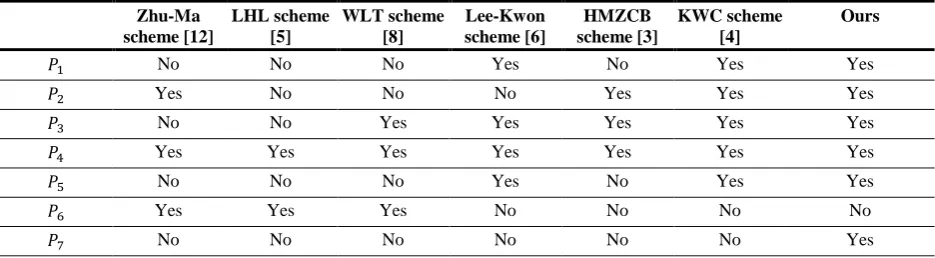
Finally, we compare our proposed scheme with previous schemes [3, 4, 5, 6, 8, 12] in terms of security and show the comparison results in Table 6(`)@. According to Table 6(`)@, there are six major characteristics:
1. User anonymity. User anonymity is not
established in schemes [3, 5, 8, 12]. An attacker can obtain a user’s real identity by intercepting packets.
2. The schemes in [5, 8, 12] cannot prevent
impersonation or man-in-the-middle attack.
3. Session key secrecy. The schemes [5, 12] do
not provide secrecy of the session key. The other schemes, including ours, do provide session key protection.
4. Untraceability. Both our scheme and
Lee-Kwon’s scheme can achieve untraceability and prevent the disclosure of the user’s whereabouts. They both generate a different random nonce for each authentication phase.
5. Lost smartcard protection. Similar to [4], our
proposed scheme prevents smartcard loss attack because the 𝑃𝑊𝑀𝑈 is not saved on the
smart card, i.e., the attacker cannot obtain user’s 𝑃𝑊𝑀𝑈 from smart card when it is
lost/stolen.
6. Authentication. In the KWC scheme[4], the
validation of 𝐼𝐷𝐻𝐴 is used for mutual
authen-tication between 𝐹𝐴 and 𝐻𝐴. In comparison, the proposed method authenticates 𝐹𝐴 with 𝐻𝐴 and 𝑀𝑈 simultaneously.
5. Conclusion
against various security attacks while maintaining
anonymity.
Acknowledgement
This work was supported in part by the Ministry of Science and Technology of the Republic of China under Contract No. MOST 104-2221-E-224-023.
Table 2. Comparison of security issues
Zhu-Ma scheme [12]
LHL scheme [5]
WLT scheme [8]
Lee-Kwon scheme [6]
HMZCB scheme [3]
KWC scheme [4]
Ours
𝑃1 No No No Yes No Yes Yes
𝑃2 Yes No No No Yes Yes Yes
𝑃3 No No Yes Yes Yes Yes Yes
𝑃4 Yes Yes Yes Yes Yes Yes Yes
𝑃5 No No No Yes No Yes Yes
𝑃6 Yes Yes Yes No No No No
𝑃7 No No No No No No Yes
𝑃1: Achieve Anonymity; 𝑃2: Prevent Man-in-the-middle attack; 𝑃3: Secrecy of session key; 𝑃4: Prevention of Replay attack; 𝑃5: Achieve Untraceability; 𝑃6: Smart card loss attack; 𝑃7: Simultaneous authentication.
References
[1] K. Chain, W.C. Kuo. A new digital signature scheme based on chaotic maps. Nonlinear Dynamics, 2013, Vol.74, No.4, 1003-1012.
[2] C. Guo, C.C. Chang, C.Y. Sun. Chaotic maps-based mutual authentication and key agreement using smart cards for wireless communications. Journal of
Information Hiding and Multimedia Signal Processing,
2013, Vol.4, No.2, 99-109.
[3] D. He, M. Ma, Y. Zhang, C. Chen, J. Bu. A strong user authentication scheme with smart cards for wireless communications. Computer Communications, 2011, Vol.34, No.3, 367-374.
[4] W.C. Kuo, H.J. Wei, J.C. Cheng. An efficient and secure anonymous mobility network authentication scheme. Journal of Information Security and
Applications, 2014, Vol.19, No.1, 18-29.
[5] C.C. Lee, M.S. Hwang, I.E. Liao. Security enhancement on a new authentication scheme with anonymity for wireless environments. IEEE Trans.
Industrial Electron., 2006, Vol.53, No.5, 1683-1687.
[6] J.H. Lee, T.Y. Kwon. Secure authentication scheme
with improved anonymity for wireless environments.
IEICE Trans. Commun., 2011, Vol.E94-B, No.2,
554-557.
[7] J.S. Lee, J. Chang, D. Lee. Security flaw of authentication scheme with anonymity for wireless communications. IEEE Communications Letters, 2009, Vol.13, No.5, 292-293.
[8] C.C. Wu, W.B. Lee, W.J. Tsaur. A secure authentication scheme with anonymity for wireless communications. IEEE Communication Letters, 2008, Vol.12, No.10, 722-723.
[9] D. Xiao, X. Liao, S. Deng. One-way hash function construction based on the chaotic map with changeable parameter. Chaos Solitons&Fractals, 2005, Vol.24, No.1, 65-71.
[10] D. Xiao, X. Liao, S. Deng. A novel key agreement protocol based on chaotic maps. Information Sciences, 2007, Vol.177, No.4, 1136-1142.
[11] P. Zeng, Z. Cao, K. Choo, S. Wang. On the anonymity of some authentication schemes for wireless communications. IEEE Communications
Letters, 2009, Vol.13, No.3, 170-171.
[12] J. Zhu, J. Ma. A new authentication scheme with anonymity for wireless environments. IEEE Trans.
Consumer Electron., 2004, Vol.50, No.1, 231-235.