This is an open access journal, and articles are distributed under the terms of the Creative Commons Attribution-Non Commercial-ShareAlike 4.0 License, which allows others to remix, tweak, and build upon the work non-commercially, as long as appropriate credit is given and the new creations are licensed under the identical terms.
© 2019 Journal of Advanced Pharmacy Education & Research | Published by SPER Publication
7
The international experience study of organization of medical
and pharmaceutical care to the population in emergency
situations
Alla A. Kotvitska
1, Inna V. Kubarieva
2, Iaroslav B. Lekhmak
3, Liliya A. Karpenko
2*, Nataliya B.
Havrysh
2, Irina V. Zhirova
21 Rector of the National University of Pharmacy (NUPh), Doctor of Pharmaceutical Sciences, Professor, 4, Valentinovskaya street, Kharkov, Ukraine. 2 PhD, Ass. Prof., 4,
Valentinovskaya street, Kharkov, Ukraine. 3 Postgraduate Student, Department of Social Pharmacy, NUPh, Ukraine.
Correspondence:Liliya A. Karpenko, 4, Valentinovskaya street, National University of Pharmacy, Kharkov, Ukraine. Email: socpharm @ nuph.edu.ua
ABSTRACT
Introduction: One of the types of state social assistance to the population in emergency situations is medical-pharmaceutical care. A global experience on the management of emergency medical and pharmaceutical forces for rapid response to emergencies is of considerable interest. Materials and Methods: The research was based upon results of the same developed countries with extensive experience namely USA, 8 European countries and 7 Asia-Pacific countries. In our research we used methods of information retrieval, techniques of historical analysis, content analysis, comparison, and generalization. Results and Discussion: The article presents a comparative description of the organization of emergency medical services of different countries at the present stage. The study of foreign experience has shown that each country has its own characteristics in the creation of protection systems and rescue of the population in emergencies. Taking into account the experience of accidents and catastrophes consequences liquidation, experts highlight training, early implementation of measures to ensure the material-technical base, communication and interaction between different emergency services, as well as international cooperation. Conclusion: the analysis of foreign literature has shown that still there is not a single developed system of medical and pharmaceutical care disaster organization. In different countries this problem is solved differently depending on the organizational structure of health care, the availability of certain public organizations, laws and directives in case of mass disasters.
Keywords:Disaster medicine, emergency medical service, emergency medicine, emergency medical care.
Introduction
According to WHO in recent years the number and severity of emergency situations (ES) has dramatically increased worldwide
[1]. In this case, the trauma is an important and ever increasing
health hazard worldwide, taking the lives of thousands of individuals each day [2]. One of the types of state social
assistance to the population in such situations is emergency medical care (EMC). It is a key link in the overall system of protection of population and territories from emergency situations. In this regard, in many countries such kind of medicine as extreme medicine is formed and is actively being developed [3].
Taking into account significant negative consequences of the emergency situations for the state and for society as a whole, a global experience on the management of emergency medical and pharmaceutical forces for rapid response to emergencies is of considerable interest.
In this regard, the aim of this work is the analysis of international experience of organization of EMC including pharmaceutical care for the population in case of emergencies.
Materials and Methods
Access this article online
Website: www.japer.in E-ISSN: 2249-3379
How to cite this article:Alla A. Kotvitska, Inna V. Kubarieva, Iaroslav B. Lekhmak, Liliya A. Karpenko, Nataliya B. Havrysh, Irina V. Zhirova. The international experience study of organization of medical and pharmaceutical care to the population in emergency situations. J Adv Pharm Edu Res 2019;9(3):7-12.
8 Journal of Advanced Pharmacy Education & Research | Jul-Sep 2019 | Vol 9 | Issue 3 The research was based upon results of some developed
countries with extensive experience namely USA, 8 European countries and 7 Asia-Pacific countries.
In our research we used methods of information retrieval, techniques of historical analysis, content analysis, comparison, and generalization.
Results and Discussion
The year of establishment of the EMC in the global context is considered to be 1975, when the international society of disaster medicine was organized at the summit in Geneva, in which about 30 states were accepted. At this summit, for the first time there was discussion about the need to combine efforts of countries to improve the system of provision of EMC in case of accidents and disasters. In 1976 "Club of Mainz" of international society for emergency and catastrophe medicine was created, which in 1983 was transformed into the world association of emergency medicine and disaster medicine (WAEDM). Since 1986 European research center for disaster medicine has worked in San Marino [3].
As a result of major chemical accidents of the XX century (disaster in Seveso, Italy, July 10, 1976; an accident at a chemical plant in the Indian city Bhopal on December 3, 1984, etc.) so-called systems of rapid emergency response began to establish everywhere, parts of which are the EMC service and the medical service of civil defense (CD). So, in the US in the second half of the 80's of XX century such a rapid response system for chemical accidents APELL (Awareness and Preparedness for Emergencies at the Local Level) was created. APELL is designed to prepare coordinated emergency response plans and actions in industrial accidents and contains a number
of recommendations to improve awareness of the local population to potentially hazardous enterprises [3].
Two models of emergency medical care exist in the world. This is an Anglo-American model, i.e. when the patient is taken to the hospital, and the Franco-German model, i.e. bringing the hospital to the patient [4]. There is a mixed type of emergency
medical care model in many countries today.
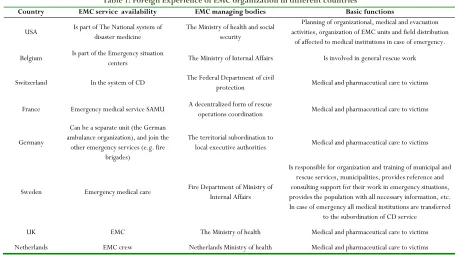
The next step of our research was the implementation of scientific generalization of foreign experience of medical-pharmaceutical care, the results of which are given in Table 1. Based on the results of the study, in the United StatesEMC is regulated at the most basic level by the federal government, which sets the minimum standards that all states' EMC providers must meet.
Currently, the American Society of Healthcare Systems Pharmacists (ASHP) operates in the United States, which legally approves the responsibilities of pharmaceutical personnel in response to emergency situations at federal, regional, territorial and local levels [5].
Federal Emergency Management Agency (FEMA) is the main agency responsible for the action plan and the definition of a common policy in the field of prevention and response to accidents and disasters [6]. It reports directly to the president.
The main responsibility of the agency is to plan and organize measures to protect the population in the event of a nuclear war, as well as coordinating effective interaction between various ministries, departments and agencies responsible for preventing and combating the consequences of natural disasters and catastrophes in peacetime. FEMA pays special attention to the training of medical personnel in rendering medical assistance in the disaster zone.
Table 1: Foreign Experience of EMC organization in different countries
Country EMC service availability EMC managing bodies Basic functions
USA Is part of The National system of disaster medicine The Ministry of health and social security
Planning of organizational, medical and evacuation activities, organization of EMC units and field distribution
of affected to medical institutions in case of emergency.
Belgium Is part of the Emergency situation centers The Ministry of Internal Affairs Is involved in general rescue work
Switzerland In the system of CD The Federal Department of civil protection Medical and pharmaceutical care to victims
France Emergency medical service SAMU A decentralized form of rescue operations coordination Medical and pharmaceutical care to victims
Germany
Can be a separate unit (the German ambulance organization), and join the
other emergency services (e.g. fire brigades)
The territorial subordination to
local executive authorities Medical and pharmaceutical care to victims
Sweden Emergency medical care Fire Department of Ministry of Internal Affairs
Is responsible for organization and training of municipal and rescue services, municipalities, provides reference and consulting support for their work in emergency situations, provides the population with all necessary information, etc. In case of emergency all medical institutions are transferred
to the subordination of CD service
UK EMC The Ministry of health Medical and pharmaceutical care to victims
Journal of Advanced Pharmacy Education & Research | Jul-Sep 2019 | Vol 9 | Issue3 9 Poland Ratownictwo Medyczne EMC Service public health Medical and pharmaceutical care to victims
Asia-Pacific countries
EMC systems are public (vs private)
and fire-based EMC systems are single-tiered Fire safety measures and ambulance services
In 1981, a special medical system to assist victims of national disasters (National Disaster Medical System NDMS) was created [7]. The system is entrusted with the task of planning
organizational, medical and evacuation measures.
EMC service in the United States as in most countries is staffed predominantly by paramedics. Training of paramedics (emergency medicine technicians) in this country began in 1966, and in 1970 specialists of the paramedics were included in the official list of medical specialties. Paramedics usually attend programs exceeding 1000 hours in length and consisting of between 250 and 500 hours of classroom training and another 250 to 500 hours of hospital-based clinical training [3].
In Belgium the response system in the event of emergencies includes 5 centers of crisis situations staffed by professionals. The Ministry of Internal Affairs of the country directs them. The centers are equipped with necessary technical means of locating accidents and rescue people. Management of forces and means of potentially dangerous objects, as well as crisis centers, is carried out in a single information management system. Preparation of the emergency departments and specialists of enterprises is organized on the basis of a special centre equipped with the necessary equipment and staffed with qualified teachers. It has a ground, training ground for emergency practicing [3].
In Belgium a serious legal basis in the field of prevention of emergency situations and protection of population has created. Only in this country the law on the taxation of operating high-risk industrial companies is adopted. Insurance system of Belgium has its own distinctive features, being the effective economic lever that encourages managers of firms to ensure the safety of its facilities.
In Switzerland the deployment of 444 points and 1520 posts of ambulance with 150 thousand beds is provided. Ambulance post is designed for 5,000 residents, it includes premises for the care provision and 32 beds for bedridden patients. The emergency room is designed for 15-16 thousand residents and serves as an ambulance station. It has a room for sorting the victims, the outpatient clinic, operating, plaster, as well as places for 128 bedridden patients. The station is equipped with pharmacy, clinical laboratory and sterilization [3].
In France each department and major town has its own special system of forces and means for liquidation of natural disaster or accident consequences which lead to the emergence of a large number of victims. For the organization of the assistance the Prime Minister of the country is directly responsible at the national level, the prefect of the defense zone - at the zonal level, the prefect of one of the involved departments of the regions - at the regional level, the prefect of the department - at the departmental level.
For the first time the decision on the need to create an organizational system for providing emergency medical care in emergency situations in France was made in the early 50's XX century [8]. The Operational Center of the Civil Security
Management (Centre Operational du Seсoure Civil - CODISC) is the main working body for the management and coordination of forces and means that take part in overcoming the consequences of emergencies at the national level. This Center is subordinated to the Ministry of Internal Affairs and functions continuously 24 hours a day [9].
In 1956 emergency medical service SAMU (Service Aide Medicale d'urgence) is established. The task of this service is to provide medical and pharmaceutical care to the population in emergency situations. In France the signal about the disaster goes to the police first, and then it is transmitted to the SAMU. Doctors and nurses are around the clock on duty at each station. In addition, SAMU is staffed with people constantly working with other institutions (medical, police, fire, transportation, etc.) and specially trained for the 400-hour program. The formation of voluntary rescuers (secourisme) plays an important role in the provision of emergency to people affected by a disaster. The mass movement to provide first aid in France is constantly evolving. The government pays great attention to the creation of groups of rescue workers and provides assistance and support in every possible way. A certified lifeguard must be able to bring people out of critical condition. Well-trained rescuers are involved in rescue efforts in major disasters [8-10].
In Germany the EMC system in emergencies is one of the key objectives of public safety and includes elements of disaster medicine of USA and France. In case of a disaster all of the Federal and municipal services, fire stations and support services and charity unions are involved to assist the police. Thus, EMC in Germany can be provided by both local fire department and St. John’s German organization ambulance, the German National Red Cross Society, the German Foundation for life saving, by private companies such as AMBU-TRANS. Ground based EMC in Germany is provided by local towns and municipalities. EMC is governed by legislation separately in each of Germany’s 16 Federal States. Since EMC is not entirely on the national level, this prevents EMS suggested practices in Germany from being entirely homogenous. However, emergency medical vehicles are generally expected to arrive at the scene within 15 minutes of a dispatcher receiving a call [3, 8].
10 Journal of Advanced Pharmacy Education & Research | Jul-Sep 2019 | Vol 9 | Issue 3 hospital sends mobile medical team to provide medical
assistance to the victims at the scene [11].
The Central body that coordinates the actions of emergency rescue service in the country is Home Office. Also the relevant Ministry is involved in coordinating the preparation and conduct of rescue operations, it is in charge of the area or object caught in the disaster zone. At major disasters, the leading ministry evaluates the nature and magnitude of the catastrophe and the Cabinet of Ministers develops tactics of action in the current situation.
In 1975, the Swedish Association of ЕМС was formed. The enhanced rate for emergency services and rescuers is held with the help of specialists of the association. The purpose of training is to develop skills to provide care to the victims of the fires and the explosions, landslides, floods and storms, road accidents, radioactive contamination, spills of hazardous chemicals. Later in 1986, the national office of the emergency services was established in Sweden, which leads emergency rescue work of the local authorities. In case of emergency, all medical institutions can take up to 200,000 victims (with total population about 10 million people). For this purpose, corresponding stocks of medicines, medical equipment and other medical supply have been established in state, municipal warehouses and warehouses of communes.
Emergency medical services (EMS) in the Netherlands are in different stages of development. However, the presence of emergency physicians is increasing and more EMS will be staffed by emergency physicians. In case of emergencies, the national plan comes into effect, which involves the use of 20 hospitals, each with a team of EMC, consisting of a surgeon, an anesthesiologist and two nurses. If necessary, these teams are sent to the crash site and assist the victims (up to 200 people per hour) [12].
EMC Service in Poland (Ratownictwo Medyczne, RM) is part of the service of public health and it includes the division of emergency medical service administrative areas [13]. Starting
from 2010 the majority of emergency calls is serviced by teams of paramedics [14]. Thus, the structure of the EMC systems of
Poland includes station ambulance (Pogotowie Ratunkowe) and EMC air station (Pogotowie Ratunkowe employees) and fire service (crew) [15-17].
WHO, together with the UN Refugee Committee and the London School of Hygiene and Tropical Medicine, developed the Emergency Health Kit, a standard medicine and clinical equipment kit, which includes 2 lists of essential medicines (Essential Drugs) and of essential medical equipment (Who Emergency Health Kit). These lists have eliminated the difficulty of sending non-priority medicines, heterogeneous and expensive drugs, spoiling goods. Currently, this set is accepted by organizations and government authorities as a reliable, standard, low-cost, appropriate source of top-priority medicines and medical equipment that are urgently needed in extreme situations. The content of this kit is designed for 10 thousand people when used within 3 months. Materials are
packed in such a way that they are ready to be sent at any time and end of the world [18].
Asia-Pacific countries (Thailand, Malaysia, Singapore, Taiwan, Japan, Korea) have unique prehospital emergency care or EMS systems, which are different from European or Anglo-American models (Table 1). Ambulance personnel are primarily emergency medical technicians and paramedics, except for Thailand and Turkey, whose personnel include nurses and physicians. Personnel are trained to use automated external defibrillators and have basic cardiac life support certification. The service capability of each EMS system in terms of dispatch, airway management and medications, for example, are varied greatly [19]. In the Republic of Kazakhstan, forensic medical
service is also part of medical units [20].
Simultaneously with the formation of a rapid reaction force for disasters, the military medical units to provide humanitarian aid are established in the health systems of various countries. An example of specialized staff structure of the military-medical service designed to work during disasters is the military medical formation of quick response (EMMIR) in France. This formation of 78 people, created in 1982, includes the management group, two surgical, one medical, two hospital groups (50 beds per each), as well as support group for air evacuation, transport and communication. The formation can act both as a stand-alone at full strength and as a composition of individual groups.
In Norway, the formation of military-medical service has been functioning since 1965. It includes pre-operational, operational, shock, anesthesia, radiology and the care office for 30 victims. The entire staff of the formation is 20 people.
The decisive factor in the timeliness of EMC provision is the collection and quick transfer of information from the crash site. Therefore, most countries introduced a single telephone number by which you can get in touch with any division of the system of rapid response in emergencies. In the US, for example, it is the number "911". Any subscriber can simultaneously contact the police, fire or ambulance service. Belgium has the number "900". Calling this number is registered in one of the 16 centers of the EMC. There is also the national frequency of "1" common to all first responders’ country: ambulance, fire, etc. It is designed for communication between the centers and the evacuation of casualties.
In Ukraine this number is the number of the central control room, "112", allowing to call rescuers of the emergency service, EMC service or experts of accident medicine service, depending on the specific situation.
EU directives, issued in 1991 and 2002, define the number 112 as the European emergency call number. The directives demand that each EU country ensures that citizens, apart from being able to call other emergency numbers, can activate an emergency response by calling 112 [21].
Journal of Advanced Pharmacy Education & Research | Jul-Sep 2019 | Vol 9 | Issue3 11 with centralized leadership, the French experience suggests
otherwise. Taking into account the experience of accidents and catastrophes consequences liquidation, experts highlight training, early implementation of measures to ensure the material-technical base, communication and interaction between different emergency services, as well as international cooperation.
Conclusion
Currently the world has accumulated extensive experience in providing EMC to the victims of the disasters. However, the analysis of foreign literature has shown that still there is not a single developed system of EMC disaster organization. In different countries this problem is solved differently depending on the organizational structure of health care, the availability of certain public organizations, laws, and directives in case of mass disasters. However, the basis of disaster medicine is an effective ambulance service everywhere.
Competing interests
The authors thereby declare no related financial interests with any company or organization in regard to this article and that there is no conflict of interest in this study.
References
1. WHO: Official website of the World Health Organization [Internet]. [Cited 2019 Mar 15].
Available from: https://www.who.int/emergencies/en/
2. Jarineshin H, Estabraghnia H, Feizi A, Fekrat F. Correlation between Glasgow coma score and bispectral index in patients with mild and moderate traumatic brain injury. J Adv. Pharm. Edu Res. [serial on the Internet]. 2018 [cited 2019 Mar 15];
8(4):62-66. Available from: https://japer.in/storage/models/article/7s3uUcMAA
DSzv05T3078s7RkxzgR1H970mSx1d8qfcAhqQyxsLd ZgZQLlu7B/correlation-between-glasgow-coma- score-and-bispectral-index-in-patients-with-mild-and-moderate-tra.pdf .
3. Nigmedzyanov R, Glaznikov L. Victims in Emergency Situations. Bloomington: Xlibris; 2014.
4. [Public Authority for Civil Defense and Ambulance. Analysis of Emergency Medical Systems Across the World] [Internet]. Muscat: MIRAD Laboratory; 2013. [Cited 2019 Mar 15]. Available from: http://pacdaoman.gov.om/images/pdf/research/MQ FIQP2809.pdf. Arabic.
5. Waugh WL, Tierncy KJ. Emergency Management: Principles and Practice for Local Government. 2nd ed. Washington: СМA Press, International City Management Association; 2007.
6. FEMA: Official website of the Department of Homeland Security [Internet]. Washington: Federal Emergency Management Agency. [Cited 2019 Mar 15]. Available from: https://www.fema.gov/
7. Public Health Emergency. National Disaster Medical System [Internet]. Washington: U. S. Department of Health and Human Services. [Cited 2019 Mar 15].
Available from: https://www.phe.gov/Preparedness/responders/nd
ms/Pages/default.aspx.
8. Huriev SO, Shevchenko RA. [An analysis of the experience of the operation of emergency medical services in emergency situations in some European countries]. Ukrainian Journal of Extreme Medicine. 2011;12(3):7-13. Ukrainian.
9. Roshcin GG, Voloshyn VO, Matsydonska GF. [The organization of emergency medical care for victims in an emergency in France. Tutorial]. Kyiv: Ministry of Health Care of Ukraine; 1999. Ukrainian.
10. Urgences de France [Internet]. Paris: Samu-Urgences de France. [Cited 2019 Feb 5]. Available from: http://www.samu-urgences-de-france.fr/fr. 11. The National Health Service. NHS choices: Your
health, your choices [Internet]. The NHS in England [cited 2019 Feb 6]. Available from: http://www.nhs.uk/NHSEngland/thenhs/about/Pag es/authoritiesandtrusts.aspx#q05.
12. Thijssen WAMH, Giesen PHJ, Wensing M. Emergency departments in The Netherlands. Emerg Med J [Internet]. 2012 [cited 2019 Mar 15];29:6-9. Available from: https://www.nvsha.nl/files/67/emergency-departments-in-the-netherlands-2012-thijssen.pdf. 13. Defense-aerospace.com [Internet]. Neuilly Sur Seine:
Briganti et Associés; 2008. Poland’s Ministry of Health orders 23 Eurocopter EC135s for Nationwide Emergency Medical Services [cited 2019 Feb 6]. Available from: http://www.defense- aerospace.com/article-view/release/95664/poland-orders-23-ec135-helos-for-ems.html.
14. [Polish Society for Emergency Medicine] [Internet]. Wroclaw: Polskie Towarzystwo Medycyny Ratunkowej. [Cited 2019 Mar 15]. Available from: http://www.medycynaratunkowa.wroc.pl/. Polish. 15. [Air ambulance] [Internet]. Warsaw: Lotnicze
Pogotowie Ratunkowe. [Cited 2019 Mar 15]. Available from: https://www.lpr.com.pl/en/home-page/. Polish.
16. [The National Headquarters of the State Fire Service of Poland] [Internet]. Warsaw; 2019. [Cited 2019 Mar 15]. Available from: http://www.straz.gov.pl/. Polish.
12 Journal of Advanced Pharmacy Education & Research | Jul-Sep 2019 | Vol 9 | Issue 3 18. WHO: Official website of the World Health
Organization [Internet]. Who emergency health kit [Cited 2019 Mar 15]. Available from: https://www.who.int/emergencies/kits/en/
19. Ong ME, Cho J, Ma MH, Tanaka H, Nishiuchi T, Al Sakaf O, et al. Comparison of emergency medical services systems in the pan-Asian resuscitation outcomes study countries: Report from a literature review and survey. Emerg Med Australas [Internet]. 2013 [cited 2019 Mar 15];25(1):55-63. Available from: https://www.ncbi.nlm.nih.gov/pubmed/23379453. 20. Derbisbekova A, Polyakova T, Zhakupova T, Osipov
V, Kolosov Yu, Mesheleva-Bekh R. Emergencies with
Human Casualties and Defects In The Provision of Medical Care In The Republic of Kazakhstan. Asian J of Pharmaceutics [Internet]. 2018;12(1):38-42. Available from:
https://www.asiapharmaceutics.info/index.php/ajp/a rticle/view/1916/800.