This is an open access journal, and articles are distributed under the terms of the Creative Commons Attribution-Non Commercial-ShareAlike 4.0 License, which allows others to remix, tweak, and build upon the work non-commercially, as long as appropriate credit is given and the new creations are licensed under the identical terms.
© 2018 Journal of Advanced Pharmacy Education & Research | Published by SPER Publication 39
Effect of vestibular rehabilitation on stability functions in
patients with remitting relapse multiple sclerosis; A
Randomized Controlled Trial
Nawal Abdelraouf Abou Shady
1, Nevin M. Shalaby
2, Neveen M. El Fayoumy
3, Khaled H. Youssef
1*,
Hassan M. Ibrahim Abou Salem
11 Department of Neuromuscular Disorder, Faculty for Physical Therapy, Cairo University, Cairo, Egypt, 2 Department of Neurology, Faculty of Medicine, Cairo
University, Cairo, Egypt, 3 Clinical Neurophysiology Unit, Faculty of Medicine, Cairo University, Cairo, Egypt.
Correspondence: Khaled Hussein Youssef Mahmoud, Assistant Lecturer at the Department of Neuromuscular Disorder, Faculty for Physical Therapy, Cairo University. Address: 7 Ahmed El-Zayat Street, Dokki, Giza, Egypt. Email: [email protected]
ABSTRACT
Background: Most patients with multiple sclerosis are not only suffering from musculoskeletal symptoms (muscle weakness and/or tone disorders, ROM affections, joint pains, and postural deformities), but also from a variety of neurological and vestibular-based symptoms (Vertigo, Disequilibrium, Unsteadiness of gait, Headaches, tinnitus, and nausea), which increases their risk of falling and impedes their recovery. The aim: to determine the influence of vestibular rehabilitation therapy on stability functions in patients with remitting relapse multiple sclerosis, and to explain this influence from functional and neurophysiological points of view. Methods: Forty-five medically-referred patients participated in this study, who were selected from multiple sclerosis unit, Faculty of medicine, Cairo University. The patients were divided into two groups; (CG) was a control group, receiving a selected physical therapy program consisting of muscle strengthening, weight bearing exercises and Postural reeducation, and (SG) was a study group and was treated through vestibular rehabilitation therapy methods. The physical therapy program was conducted three times per week, for six weeks. Biodex balance master indices were used to assess and establish the patients’ results. The results: Before starting the treatment, there was a non-significant difference in the mean values of all variables in SG&CG. At the end of the treatment, there were significant improvements in antero-posterior, medio-lateral, dynamic, and limits of stability indices in study group (SG) (p<0.05). In the Control group (CG) there was only a significant improvement in Antero-Posterior stability index, with no significant difference in other variables. Conclusion: Vestibular rehabilitation therapy (VRT) has positively improved the stability functions in patients with remitting relapsing multiple sclerosis.
Keywords: Vestibular rehabilitation therapy, Biodex Balance Master, Multiple sclerosis, Risk of falling.
Introduction
The MS disease has different symptoms such as failure of steadiness, fatigue, and foggy vision, numbness of hands and feet and muscle spasms that among the mentioned symptoms, the lack
of equilibrium is the most frequent sign of this disorder, so that 78 percent of females and 62 percent of men have recognized the failure of balance as the most demanding symbol of this affection that has been estimated as the first agent of walking and stumbling disorder in these persons [1].
Patients with definite multiple sclerosis have been known to report symptoms related to the vestibular disorders in the course of their illness. Vestibular symptoms (i.e. vertigo, unsteadiness, visuospatial disorientation, nausea, and difficult eye fixation) often occur at the onset of the disease. In these patients, it was found that vestibulo-occular, vestibulo-colic reflexes are commonly involved [2].
Balance is the capability of keeping the body position on the reliance surface. During the static and dynamic balance, the body position is controlled by mass center displacement and the start of appropriate responds for returning the body to a stable Access this article online
Website:www.japer.in E-ISSN: 2249-3379
How to cite this article: Nawal Abdelraouf Abou Shady, Nevin Mohieldin Shalaby, Neveen M. El Fayoumy, Khaled H. Youssef, Hassan M. Ibrahim Abou Salem. Effect of vestibular rehabilitation on stability functions in patients with remitting relapse multiple sclerosis: A Randomized Controlled Trial. J Adv Pharm Edu Res 2018;8(4):39-44.
Source of Support: Nil, Conflict of Interest: None declared.
position, a process which plays an important role in visual, sensory - somatic, vestibular, skeletal system and muscular senses. The body's center of gravity is shifted continuously even while standing consistent [3]
Vestibular rehabilitation therapy (VRT) as a special kind of physical therapy, has been created to habituate the symptoms, and improve the adaptation to and substitution for different aspects of deficits caused by the various balance disorders. VRT is practical in promoting the functional deficits and subjective symptoms caused by the unilateral and bilateral peripheral vestibular hypo-function as well as the central balance disorders. [4]
This study was designed to determine the influence of the vestibular rehabilitation therapy on the stability functions in patients with remitting relapse multiple sclerosis, and to explain this influence from functional points of view.
Patients and Methods
Study design
The study was a randomized, open-labeled, pre–post-test, controlled trial. It was approved by the official ethical committee at the Faculty of Physical Therapy, Cairo University, and it followed the Guidelines of Declaration of Helsinki on the conduct of human research.
Participants
Thirty medically referred patients participated in this study, who were selected from the multiple sclerosis unit, Faculty of medicine, Cairo University, according to the following criteria: Age from 25-49 years, both genders participated. Patients with Remitting Relapsing multiple sclerosis, accompanied with vertigo and unilateral and bilateral vestibular symptoms (i.e. Nausea, tinnitus). Patients having an acute episode of vestibular Syndrome, with the incidence of vertigo lasting days to weeks, coupled with nausea or vomiting, nystagmus, head motion intolerance, and gait disturbance compromising their normal daily function, and happening at least once a week prior to the assessment. Patients` vertigo symptom scale subset (VSS) was less than 12/60. [5]. Patient’s Expanded Disability Score (EDSS) was equal or less than 6/10. Intermittent or unilateral constant assistance (cane, crutch, brace) was required to walk about 100 meters with or without resting [6]. Patient’s Modified Fatigue Impact score (MFIS) was equal or less than 38/84 [7].
Exclusion criteria were: the patients with other neuromuscular, musculoskeletal lesions i.e. Congenital abnormalities, space occupying lesions, otological and/or cerebellar disorders, the cognitively impaired patients, progressive and/or unstable courses of multiple sclerosis, unstable vertigo, Osteoporosis and bone density disorders, C1-C3 Structural integrity problems, vertebro-basilar insufficiency syndrome, the individuals who have not benefited from the vestibular therapies , such as Transient ischemic attacks, unstable blood pressure, exaggerated medication reactions, and Migraine associated vertigo
Randomization
Informed consent was obtained from all the patients after the detailed explanation of the study. The participants were also informed about the privacy of all the obtained information and their right to refuse or withdraw at any time. All data were coded to ensure the anonymity. The patients were randomly assigned to Two groups; study group (n=15) and control group (n=15). Randomization was performed by a blinded and an independent research assistant using a computer-generated randomization cards saved in sealed envelopes.
Physical therapy intervention:
One experienced physical therapist having 12 years of clinical experience in the field of neuro-rehabilitation treated all the patients. All patients were treated for 30-45 minutes, 3 days per week for the successive six weeks.
The study group: was treated by medications, in addition to a specific vestibular rehabilitation technique (VOR stimulation, Ocular motor Exercises, and Particle repositioning maneuver). The control group received the intensive physical therapy program only which included: the active resisted strengthening exercises for weak limb muscles, stretching exercises for tight muscles of the affected limbs, postural reeducation, and balance training,
Methods and procedures
Through interviewing the patients, each point of EDSS, MFIS, and VSS questionnaires were explained carefully by the therapist before addressing its points for scoring. Total scores were summed and interpreted before undergoing the rest of the procedures, as it may cause the exclusion of the patients from delimitation conditions
During the Biodex balance master interventions. The participants were asked to step onto the BBS platform with bare feet and assume a comfortable position. The exact position of the feet was detected by the graded surface of the platform, and was recorded in the software for further correction. The participants were asked to maintain their foot positions on the platform throughout the test session. Before conducting the test procedure, the patients were taught for 1 minute to learn the test procedure. The patients performed the test in dynamic conditions, with eyes open.
Vestibular rehabilitation exercises, combined with the particle repositioning maneuver (Epley’s Maneuver) were prescribed for the study group, focusing on the gaze stability and the reduction of the postural unsteadiness, and improving gait stability. Gait stability includes both the static and dynamic balance exercises. The Vestibulo-ocular training (VOR) and Ocular motor training (OCT) helped to maintain the stable gaze and the visual focus during the active and passive head motion.As function improved, VOR and OCT exercises were advanced to moving the visual stimuli opposite to the head movement.
Results
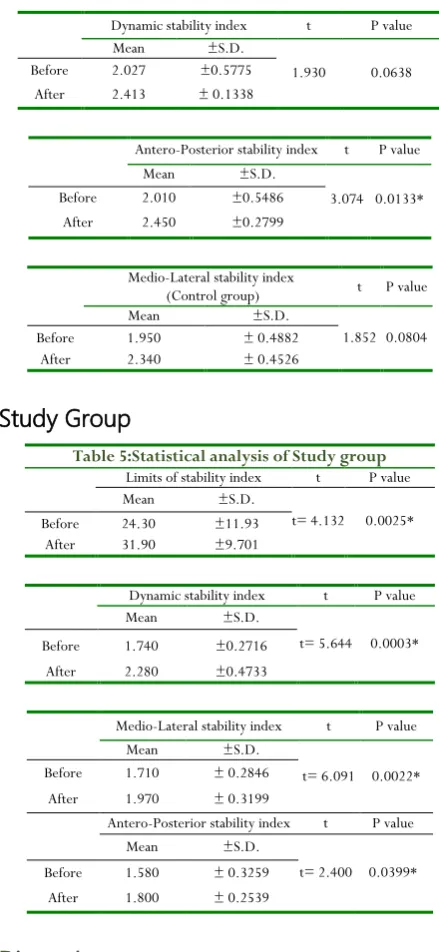
There were no significant differences between age, weight, or height variables between the two groups. Control group didn’t show significant differences in any stability indices except for the antero-posterior stability index, while the study group showed significant improvements in all indices.
Table 1:Statistical analysis of age
Statistical analysis of Age Minimum Maximum Mean ±S.D.
Control 29.07 ±9.091 20 48 Study 30.73 ±8.506 21 49
SS DF MS t P value Treatment (between columns) 30.18 2 15.09 0.2193 t = 0.8040 P =
Residual (within columns) 2890 42 68.80 Total 2920 44
Table 2:Statistical analysis of weight
Statistical analysis of Weight Minimum Maximum Mean ±S.D.
Control 66.07 ±15.27 68 100 Study 65.53 ±11.51 62 82 SS DF MS t P value Treatment (between
columns) 141.5 2 70.76 0.4183 t = 0.6609 P = Residual (within columns) 7104 42 169.2
Total 7246 44
Table 3:Statistical analysis of height
Statistical analysis of Height Minimum Maximum Mean ±S.D.
Control 160.8 ±6.014 150 170 Study 166.8 ±8.108 147 179 SS DF MS t P value Treatment (between
columns) 327.6 2 163.8 3.225 t = 0.0498 P = Residual (within columns) 2133 42 50.79
Total 2461 44
Control group
Table 4:Statistical analysis of Control group Limits of stability index t P value Mean ±S.D.
0.7135 0.4873 Before 9.4 ±3.738
After 10.07 ±4.877
Dynamic stability index t P value Mean ±S.D.
1.930 0.0638 Before 2.027 ±0.5775
After 2.413 ± 0.1338
Antero-Posterior stability index t P value Mean ±S.D.
3.074 0.0133* Before 2.010 ±0.5486
After 2.450 ±0.2799
Medio-Lateral stability index
(Control group) t P value Mean ±S.D.
1.852 0.0804 Before 1.950 ± 0.4882
After 2.340 ± 0.4526
Study Group
Table 5:Statistical analysis of Study group Limits of stability index t P value Mean ±S.D.
t= 4.132 0.0025* Before 24.30 ±11.93
After 31.90 ±9.701
Dynamic stability index t P value Mean ±S.D.
t= 5.644 0.0003* Before 1.740 ±0.2716
After 2.280 ±0.4733
Medio-Lateral stability index t P value Mean ±S.D.
t= 6.091 0.0022* Before 1.710 ± 0.2846
After 1.970 ± 0.3199
Antero-Posterior stability index t P value Mean ±S.D.
t= 2.400 0.0399* Before 1.580 ± 0.3259
After 1.800 ± 0.2539
Discussion
significant interference of perceptual, social, and cognitive disability,or dealing with the rapid fatigability, unstable vertigo, allowing more effective measurement of the dysfunctional causes of the participated patients.
The results of the present study claimed that the control group, who received a conventional physical therapy program consisting of muscle strengthening, weight bearing exercises and Postural reeducation, showed only a significant improvement of dynamic stability indices after finishing the designed program, while the study group, receiving vestibular rehabilitation program showed more significant improvement of dynamic stability indices and Limits of stability testing. This came into agreement with [9] that examined the influence of the balance exercises on MS patients in 14 samples during 6 weeks of the balance exercises and then, they were evaluated by Berg, Smart and Balance master stability test. The obtained findings indicated that doing the balance exercises would optimize the balance in MS people with the average disability level.
In the survey on the effects of balance exercises on MS patients, it was found that the rehabilitation of balance has been an appropriate tool to reduce the falls, and improve the balance skills in the people with MS. Also, practicing in different sensory fields would lead to an optimization in dynamic balance. It was introduced that the dynamic balance has been a sensitive index for assessing the rehabilitation and avoiding from falling risk in MS patients. In this study, 18 MS patients were presented with EDSS (expand disability state scale) lower than 5. The achieved results from this study showed the positive effect of balance training exercises on the static balance (0.3), dynamic balance optimization (0.6) and movement speed optimization (0.6), which agreed with [10, 11].
The results of the current study also came into the agreement with [12] who surveyed the effect of the home workout programs on MS patients and their falling risk decrement. The aim of this study was to determine the possibility of having safe and effective home exercises to reduce the risk of falling in patients with multiple sclerosis. The achieved results of this study showed that the balance exercises at home can lead to a decrement of the falling risk in MS patients. it was also reported that there was a significant improvement in the Scale of activities of daily living in EG in relation to CG after the intervention [13]. Authors also reported asignificant improvement in single leg stance with opened eyes, forward, backward and fast gait, in addition to the increase of timing in one leg stance with opened eyes [14]. More reports concluded the vertigo symptoms and instability significantly improved in EG, Posturography-related measures also significantly improved, and it was reported that one leg stance with closed eyes significantly improved in EG in relation to CG after 6 weeks of the vestibular rehabilitation. - After 3 months, single leg stance tests significantly improved in EG in relation to CG [15].
Another study surveyed the effect of one period treatment exercise on the balance of persons with MS; and reached the conclusion that the treatment exercise was effective in balance
optimization of patients with MS. People with MS had lower balance than the ordinary people and in this regard, according to the complications and problems resulted from MS disease in patients, the evaluation of the balance for those that were infected by MS in order to early detection of the problems with balance and also surveying the effect of the interventions for curing these problems and patients with MS seemed essential [16].
More researches demonstrated the efficacy ofthe vestibular rehabilitation therapy (VRT) in promoting the compensation of balance loss, utilizing the principles of habituation, adaptation, and substitution, and can incorporate gait and balance training as well as canalith repositioning maneuvers [17]. They also stated that the specific exercises given to the patients with vestibular impairments can be refined to become more individualized and tailored to each patient’s unique goals and complaints. It wasconcluded that the moderate to strong evidence for vestibular rehabilitation therapy (adaptation, substitution, and habituation) can be the effective and safe means of treating patients with unilateral vestibular hypo function [18].
A significant improvement was also been reported in gait parameters and stability measures in the experimental group after the treatment, with the moderate improvement in the provocation of vertigo (inclined head with opened eyes and inclined head with fixed eyes), which indicated good results for VRT on vertigo and walking balance in those patients [19].In another examination, the authors suggested strong, level I evidence supporting vestibular rehabilitation therapy (VRT) for the people with acute, sub-acute, and chronic unilateral hypo-function. The results showed reduced symptoms, improved balance, improved functional status with the activities of daily living (ADLs), and reduced fall risk, and also improved symptoms and function in some patients with bilateral vestibular hypo-function (BVH) [20].
[21] agreed with the current results, and with a moderate
evidence stated that vestibular rehabilitation therapy (VRT) helps to improve the gaze stability of those with bilateral vestibular hypo-function (BVH). They also found that although the improvements were demonstrated in the majority of outcome measures examined, 38–86% (depending on the outcome measure) were found to be meaningful improvements. Clinical practice guidelines suggested the strong level I support, for VRT (balance and gaze stability exercises) in patients with BVH for the reduction of the symptoms and improved functions.
Further agreements were demonstrated by concluding that the addition of vestibular rehabilitation therapy (VRT) focusing on the balance training ,combined with the canalith repositioning maneuver in the treatment of the patients with vestibular dysfunctions, helped the patients to display better results in dynamic balance than those who had other treatment exercises or received the canalith repositioning maneuver only, also they showed improvements in all groups after the acute and compensatory phases [23, 24].
Conclusion
From the current results of this study, it can be concluded that, vestibular rehabilitation therapy (VRT) has positively improved the stability functions in the patients with remitting relapsing multiple sclerosis.
Acknowledgment
The authors would like to thank all the patients who participated in the study.
Financial support and sponsorship
Nil.
Conflicts of interest
There were no conflicts of interest.
References
1. Georg W, Alpers A. The impact of visual flow stimulation on anxiety, dizziness, and body sway in individuals with and without fear of heights. Behavior Research and Therapy 2009, 47:345-352
2. Dario Alpini, Luigi Pugnetti Domenico Caputo, and Antonio Cesarani, Vestibular Evoked Myogenic Potentials in Multiple Sclerosis: A Comparison Between Onset and Definite Cases (2005), International Tinnitus Journal, Vol. 11, No.1, 48-51
3. Cameron MH, Wagner JM Gait abnormalities in multiple sclerosis: pathogenesis, evaluation, and advances in treatment. Curr Neurol Neurosci Rep (2011)11: 507-515 4. Han BI, Song HS, Kim JS. Vestibular rehabilitation
therapy: review of indications, mechanisms, and key exercises. J Clin Neurol. 2011 Dec. 7(4):184-96
5. Yardley L, Donovan-Hall M, Smith HE, Walsh BM, Mullee M, Effectiveness of primary care-based vestibular rehabilitation for chronic dizziness. Bronstein AM Ann Intern Med. 2004 Oct 19; 141(8):598-605
6. Meyer-Moock S., Feng YS., Maeurer M., Dippel FW., & Kohlmann T. Systematic literature review and validity evaluation of the Expanded Disability Status Scale (EDSS) and the Multiple Sclerosis Functional Composite in patients with multiple sclerosis. BMC Neurol. 2014 Mar 25; 14:58.
7. Tellez N, Rio J, Tintore M, Nos C, Galan I, Montalban X. Does the Modified Fatigue Impact Scale offer a more comprehensive assessment of fatigue in MS? Mult Scler. 2005; 11:198–202
8. Maes L, Dhooge I, D'haenens W, Bockstael A, Keppler H, Philips B, Swinnen F, the effect of age on the sinusoidal harmonic acceleration test, pseudorandom rotation test, velocity step test, caloric test, and vestibular-evoked myogenic potential test. Vinck BM Ear Hear. 2010 Feb; 31(1):84-94
9. Jackson k, Janet A. home balance training intervention for people with multiple sclerosis. Int J Ms care 2007, 9:111-117
10. Cattaneo D, Jonsdottir J, Zocchi M, Regola A. Effects of balance exercises on people with multiple sclerosis: a pilot study. Clin Rehabil 2007, 21(9): 771-781.
11. Hilfiker R, Vaney C, Gattlen B, Meichtry A, Deriaz O. Local dynamic stability as a responsive index for the evaluation of rehabilitation effect on fall risk in patients with multiple sclerosis: a longitudinal study. BMC research notes 2013, 6:260-269.
12. Sosnoff J, Finlayson M, Mcauley E, Morrison S, Motl R. Home-based exercise program and fall-risk reduction in older adults with multiple sclerosis: phase 1 randomized controlled trial. clinical rehabilitation 2014., 28(3):254-263.
13. Resende CR, Taguchi CK, Almeida JG, Fujita RR. Reabilitação vestibular em pacientes idosos portadores de vertigem posicional paroxística benigna. Rev Bras Otorrinolaringol. 2003;69(4):34-8.
14. Kammerlind AS, Håkansson JK, Skogsberg M. Effects of balance training in elderly people with nonperipheral vertigo and unsteadiness. Clin Rehabil. 2001;15(5):463-70.
15. Hånsson EE, Mansson NO, Håkansson A. Effects of specific rehabilitation for dizziness among patients in primary health care. A randomized controlled trial. Clin Rehabil. 2004;18(5):558-65
16. Yazdani M, Hemayattalab R, Sheikh M, Etemadifar M. the effect of a selected aquatic exercise on balance in subject with multiple sclerosis. J Res Rehabil Sci 2013., 9(2):143-52 (Persian).
17. Joanna Burzynski 1 & Shaleen Sulway1 & John A. Rutka1Vestibular Rehabilitation: Review of Indications, Treatments, Advances, and Limitations, Curr Otorhinolaryngol Rep (2017) 5:160–166 DOI 10.1007/s40136-017-0157-1
18. McDonnell MN, Hillier SL. Vestibular rehabilitation for unilateral peripheral vestibular dysfunction. Cochrane Database Syst Rev. 2015; Jan 13;1:CD005397. doi: 10.1002/14651858.CD005397.pub4.
in older people. Otolaryngol Head Neck Surg. 2001;125(3):151-6.
20. Hall CD, Herdman SJ, Whitney SL, Cass SP, Clendaniel RA, Fife TD, Vestibular rehabilitation for peripheral vestibular hypofunction: an evidence-based clinical practice guideline. J Neurol Phys Ther. 2016;40(2):124– 55
21. Arnold SA, Stewart AM, Moore HM, Karl RC, Reneker JC. The effectiveness of vestibular rehabilitation interventions in treating unilateral peripheral vestibular disorders: a systematic Review. Physiother Res Int. 2017 Jul;22(3). doi: 10.1002/pri.1635. Epub 2015 Jun 25.
22. Lesley A, Brown M. A. (2006). The effect of anxiety on the regulation of upright standing among younger and older adults. Gait & Posture. 24: 397–405 review. Physiother Res Int. 2015.
23. Bressi F, Vella P, Casale M, Moffa A, Sabatino L, Lopez MA, Vestibular rehabilitation in benign paroxysmal positional vertigo: reality or fiction? Int J Immunopathol Pharmacol. 2017;30(2):113– 22.