Dr. (Mrs.) Sadhana J. Rajput The M.S. University of Baroda, Fatehgunj, Vadodara-390002 E-mail: [email protected]
Address for correspondence
Access this article online www.japer.in
RPHPLC method for Simultaneous Estimation of Lansoprazole and
aspirin in Bulk and Laboratory Mixture
INTRODUCTION:
Aspirin, also known as acetylsalicylic acid is one of the most widely used analgesic and anti-inflammatory drugs.[1] Chemically, Aspirin is 2-(acetyloxy) benzoic acid (Figure 1). Aspirin also has an antiplatelet effect by inhibiting the production of thromboxane, which under normal circumstances binds platelet molecules together to create a patch over damaged walls of blood vessels.[2] As the platelet patch can become too large and can block blood flow, locally and downstream, aspirin is also used long-term, at low doses, to help prevent heart attacks, strokes, and blood clot formation in people at high risk of developing blood clots.[3] Aspirin is official in Indian Pharmacopeia[4], British Pharmacopoeia[5] and United States Pharmacopoeia[6] which describe acid-base titration for assay of Aspirin. Lansoprazole as shown in Figure 2 is chemically ({[3-methyl-4-(2, 2, 2-trifluoroethoxy) pyridin-2-yl] methane} sulfinyl)-1H-1, 3-benzodiazole. It is a potent Proton Pump Inhibitor used in acidity, ulcers, Gastro-esophageal Reflux
Disease, etc. Its mechanism of action is to selectively inhibit the membrane enzyme H+/K+ ATPase in gastric parietal cells. BP 2009 includes potentiometric estimation of Lansoprazole while USP 2007 and IP 2014 have a Liquid chromatographic method for assay of Lansoprazole. [7] Aspirin in low dose acts as a platelet-aggregation inhibitor.
The number of patients taking low-dose aspirin for prevention of the recurrence of cerebral infarction or myocardial infarction is increasing. But administration of low-dose aspirin may cause gastric or duodenal ulcers, thus preventing the onset of ulcers in that patient population is important. Takeda Pharmaceuticals launched Takelda® combination tablets, a fixed-dose combination (“FDC”) of low-dose aspirin (ASP) with Lansoprazole (LANSO), a proton pump inhibitor. [8] Such a combination is useful for risk reduction of thrombosis and embolism in patients with a history of gastric ulcer or duodenal ulcer, which have had angina, myocardial infarction, coronary artery bypass grafting or percutaneous transluminal coronary angioplasty.
Survey of literature revealed that several methods have been reported for the individual analysis of Aspirin and Lansoprazole by UV spectrophotometric and RP-HPLC method. Suresh Kumar et al have reported RP-HPLC method for Aspirin. [9] Deepak Re
ReRe
Researchsearchsearchsearch ArticleArticleArticleArticle
A simple, rapid, accurate and precise isocratic RP-HPLC method was developed for simultaneous estimation of Aspirin and Lansoprazole in bulk and prepared laboratory sample. Chromatographic separation was performed on Kromasil C-18 column (Column dimensions: 250 mm x 4.6 mm, 5 μm) using 10mM Phosphate buffer pH 3: Acetonitrile= 55:45 as mobile phase at a flow rate of 1 mL/min. Retention time for Aspirin and Lansoprazole was 4.3min and 6.1 min respectively. The reliability and analytical performance of the proposed RP-HPLC method was statistically validated with respect to linearity, precision, accuracy, robustness, specificity, limit of detection and quantification as per ICH Q2 (R1) guidelines. The mean percentage recovery for Aspirin and Lansoprazole was found to be 100.49 % and 100.5 % respectively. The proposed RP-HPLC method was successfully applied for analysis of laboratory mixture. The mean percentage assay values for Aspirin and Lansoprazole was reported to be 100.73 % and 99.5 % respectively. The developed and validated RP-HPLC method was used for estimation of Aspirin and Lansoprazole in a run time less than 10 minutes.
Keywords: Aspirin, Lansoprazole, Validation, Laboratory sample
ABSTRACT ABSTRACT ABSTRACT ABSTRACT
Sadhana Rajput* Suraj Fanse
Quality Assurance Laboratory, Centre of Relevance and Excellence in Novel Drug Delivery System, Pharmacy Department, G. H. Patel Building, Donor’s Plaza, The Maharaja Sayajirao University of Baroda, Fatehgunj, Vadodara – 390002, Gujarat, India
Kumar Jain et al have reported RP-HPLC method for binary mixture of Aspirin and Prasugrel. [10] Bharati DV et al reported chromatographic method for estimation of Lansoprazole with other Proton pump inhibitors. [11] Several UV spectrophotometric, RP-HPLC, HPTLC, UPRP-HPLC, GC and Spectrofluorimetric methods have been reported for Aspirin and Lansoprazole individually or in combination with other drugs. [12- 19]
However, to best of our knowledge, no reported RP-HPLC method have ever been reported in literature for the simultaneous estimation of Aspirin (ASP) and Lansoprazole (LANSO). The aim of the present work was to develop easy, economic, accurate, specific and precise RP-HPLC method for simultaneous estimation of Aspirin and Lansoprazole in bulk and synthetic mixture, and validation of the newly developed analytical method.
MATERIAL AND METHODS:
RP-HPLC equipment: Chromatographic separation was performed on Shimadzu (Shimadzu Corporation, Kyoto, Japan) LC system equipped with Shimadzu LC-20AT pump and Shimadzu SPD-20AV detector and Rheodyne 7725 injector with fixed loop of 20 μL. Data acquisition and integration was performed using Spinchrome software (Spincho biotech, Vadodara). Stationary Phase used was Kromasil C-18 column, (Column dimensions: 250 mm x 4.6 mm, 5 μm) Chemicals and Reagents: Lansoprazole and Aspirin bulk drugs were obtained as gift samples from Sun Pharmaceuticals, Vadodara and Zydus Cadila, Ahmedabad respectively. HPLC grade Acetonitrile was procured from Spectrochem Pvt. Ltd., Mumbai. Potassium dihydrogen phosphate was purchased from Loba Chemicals Pvt. Ltd. (Mumbai, India). All the required solutions were prepared in HPLC grade water. Unless otherwise specified, all solutions were filtered through a 0.2 µm Ultipor® N66® Nylon 6, 6 membrane filter (Pall Life Sciences, USA) prior to use. Chromatographic conditions: The mobile phase
comprised of Acetonitrile and Phosphate buffer
(10mM). Phosphate buffer (10 mM) was prepared by dissolving 0.68 gm of anhydrous potassium dihydrogen orthophosphate in 500 ml of double distilled water and adjusted to pH 3.0 using ortho-phosphoric acid which was finally filtered with 0.2 μm Nylon membrane filter. The elution was carried out with a mixture of Acetonitrile and 10mM phosphate buffer pH 3 in the proportion of 45:55. Resulting solution was degassed by ultrasonication for 5 minutes.
Preparation of Standard Stock solutions: 25mg of
ASP and LANSO were separately weighed accurately and transferred into two 25 mL volumetric flasks. Acetonitrile was added into the volumetric flasks to dissolve the standards and finally volume was made upto the mark with acetonitrile to obtain standard solutions of ASP (1000μg/mL) and LANSO (1000μg/mL) respectively.
Preparation of Calibration Standards of ASP and
LANSO: From standard stock solution of ASP (1000μg/mL), aliquots of 0.65mL, 1.3 mL, 1.95mL, 2.6 mL, 3.25 mL and 3.9 mL were withdrawn and transferred to 10mL volumetric flasks. Volume was made upto the mark with acetonitrile to produce 65μg/mL, 130μg/mL, 195μg/mL, 260μg/mL, 325 μg/mL and 390 μg/mL of ASP respectively. From the standard stock solution of LANSO (1000μg/mL), aliquots of 0.1mL, 0.2mL, 0.3 mL, 0.4 mL, 0.5 mL and 0.6mL were transferred to 10mL volumetric flasks and volume was made upto the mark with acetonitrile to produce 10μg/mL, 20μg/mL, 30μg/mL, 40μg/mL, 50μg/mL and 60μg/mL of LANSO respectively. Mixed standard solutions of ASP and LANSO were prepared in ratio of 6.5:1 as present in the marketed formulation.
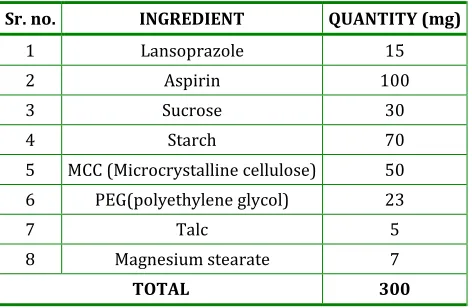
Preparation of Laboratory Sample Solution: The
used to prepare laboratory sample are shown in Table 1. 100mg of prepared synthetic mixture was accurately weighed and transferred to a 100mL volumetric flask. 50mL acetonitrile was added and sample was sonicated for 5 minutes. Finally volume was made upto the mark with acetonitrile and filtered through Whatman Filter Paper 41. Suitable aliquots were withdrawn to obtain the final solutions in the concentration range from 65 to 390 μg/mL of ASP and 10 to 60 μg/mL of LANSO for Recovery studies and assay of synthetic mixture.
Stability of solutions: Prepared stock solutions of LANSO and ASP were stored at Room temperature for 24 hours. After 24 hour, samples were re-injected in HPLC. The chromatogram showed no additional peaks and the %Relative Standard Deviation of peak areas for both drugs was lower than 1%. This shows that solutions of LANSO and ASP were stable in Acetonitrile.
VALIDATION OF PROPOSED RP-HPLC METHOD: [22]
Developed spectrophotometric method and RP-HPLC method were validated according to ICH Q2 (R1) guidelines and data complying with the standards were obtained. [22]
Linearity: The calibration curve was constructed by
plotting concentrations of ASP and LANSO versus peak areas, and the regression equations were calculated. The linearity of the method was investigated by using concentrations in the range 65-390 μg/ml for ASP and 10-60 μg/ml for LANSO. Retention time for ASP and LANSO was found to be 4.3 min and 6.14 min respectively.
Accuracy: Accuracy of the method was studied using
standard addition method at three different levels (80, 100, and 120%) by recovery experiments. Known amounts of standard solutions containing ASP (78, 97.5 and 117 μg/ml) and LANSO (12, 15 and 18 μg/ml) were added to a prequantified laboratory mixture sample solutions to reach 80%, 100% and 120% levels. Percentage Recovery was the mean of three determinations at each standard addition level.
Precision: To demonstrate agreement among results,
a series of measurements were done with ASP and LANSO. Three replicate injections of specific standard at various time intervals on the same day were injected into system for intraday precision and were repeated on three different days for interday precision. The % RSD (Relative Standard Deviation) of the results was calculated.
Sensitivity:
The limit of detection (LOD) and limit of quantification (LOQ) which determine the sensitivity of method are calculated by equation 1 and 2.
LOD =3.3 σ/S ……….. (1) LOQ =10 σ/S ……... (2)
Where ‘σ ‘is the standard deviation of intercepts and ‘S’ is the slope of response.
Robustness:
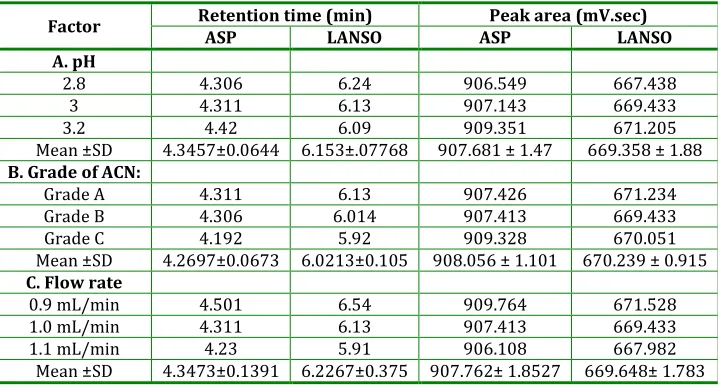
Robustness of the method was demonstrated by deliberately changing the chromatographic conditions like pH, grade of acetonitrile used and flow rate. Specificity:
Specificity of the method was demonstrated by injecting the blank solution, standard solution, sample solution prepared from laboratory mixture with excipient and responses were determined. There was no interfering peak of any excipient in the chromatogram.
System suitability parameters:
System suitability testing was carried out on freshly prepared standard solutions (n=6) containing ASP and LANSO. System suitability parameters obtained with 20μl injection volumes are summarized in Table 2.
RESULTS AND DISCUSSION:
Optimization of chromatographic conditions:
asymmetric and eluted too early. It was observed that ASP remained in unionized form at pH 3.0 and 3.5. So its retention could be controlled and a sharp, symmetric peak was observed. At this pH, LANSO also showed a sharp and symmetric peak. Combination of buffer along with methanol increased the retention time of LANSO unnecessarily. Hence, acetonitrile and phosphate buffer was employed as the mobile phase. In presence of acetonitrile, both ASP and LANSO eluted as sharp and symmetrical peaks. Therefore, Phosphate buffer pH 3: Acetonitrile in ratio of 55:45 was used as mobile phase. Optimized chromatographic conditions are shown in Table 3 and Figure 3 displays the overlain chromatogram of ASP and LANSO for given chromatographic conditions. Linearity data are summarized in Table 3 which depicts a good linear response between concentration of drugs and their peak areas in range of 65- 390 µg/mL for ASP and 10- 60 µg/mL for LANSO. The correlation coefficient for both the drugs was found to be 0.999. Calibration graph for ASP and LANSO is shown in Figure 4 and 5 respectively. The method was found to be very precise. Intraday precision in terms of percentage Relative Standard Deviation for ASP and LANSO was 0.933 % and 0.822 % respectively, while interday precision data revealed percentage Relative Standard Deviation of 1.078 % and 1.346 % for ASP and LANSO respectively. The Limit of Detection (LOD) and Limit of Quantification (LOQ) was found to be 2.56 µg/mL and 7.78 µg/mL respectively for ASP while for LANSO, the values were 0.915 µg/mL and 2.775 µg/mL respectively. Summary of validation parameters is indicated in Table 4.
High percentage recovery values showed that the methods were free from interference of the excipients used in the formulation. No interfering peaks were found in the chromatogram indicating that the excipients used in formulation did not interfere with the estimation of drug by the proposed RP-HPLC method. Results of recovery studies (Accuracy) are displayed in Table 5.
Moreover, the proposed method was found to be quite robust. When changes were induced in Flow rate, pH and grade of Acetonitrile used, Retention time and peak areas for both the drugs were within acceptable limits. Standard Deviation in all the above cases was less than 2. Results for robustness study are indicated in Table 6.
The prepared laboratory synthetic mixture was effectively analyzed by the developed HPLC method with mean %assay values of 100.728 % and 99.501 % for ASP and LANSO respectively. Table 7 shows the results of assay of prepared laboratory sample. Data obtained is the mean of six determinations. (n=6)
CONCLUSION:
The proposed RP-HPLC method was simple, rapid, accurate, precise and inexpensive. The proposed method was successfully validated according to ICH Q2 (R1) guidelines. The sample recovery was in good agreement with the respective label claim, which suggested non-interference of formulation additives in its estimation. Hence, the developed RP-HPLC method could be successfully applied for estimation of Aspirin and Lansoprazole in bulk and laboratory mixture.
ACKNOWLEDGEMENTS:
The authors express their sincere thanks to Sun Pharmaceuticals, Vadodara and Zydus Cadila, Ahmedabad for providing gift samples of Lansoprazole and Aspirin required for the study.
Sr. no. INGREDIENT QUANTITY (mg)
1 Lansoprazole 15
2 Aspirin 100
3 Sucrose 30
4 Starch 70
5 MCC (Microcrystalline cellulose) 50 6 PEG(polyethylene glycol) 23
7 Talc 5
8 Magnesium stearate 7
TOTAL 300
Parameter Data obtained*
ASP LANSO
Retention time ± SD 4.3 ± 0.0513 6.13 ± 0.02107 Theoretical plate ± SD 4032 ± 217.56 3940 ± 235.96 Tailing factor ± SD 1.102 ± 0.023 0.946 ± 0.0764 Capacity factor ±SD 2.315± 0.0116 3.695 ± 0.0158
Resolution ± SD 5.48 ± 0.296
Table 2: System Suitability Parameters for ASP and LANSO (*Data shown is the average of six replicates.
SD= Standard Deviation)
Method parameter Optimized condition Column Kromasil C-18 (250 mm x 4.6 mm, 5
μm)
Mobile phase Phosphate buffer pH 3: ACN= 55:45 Retention time
(min) 4.3min for ASP; 6.14 min for LANSO Detection
wavelength 284 nm
Flow rate 1 ml/min
Temperature Ambient
Table 3: Optimized chromatographic conditions
Parameter ASP LANSO
Detection wavelength 284 nm
Beer’s range 65- 390 µg/mL 10- 60 µg/mL Retention time 4.31 min 6.1 min Regression equation
(y=mx+c)
Y=5.0841x-62.8805
y = 23.335x -9.963 Correlation coefficient 0.999 0.999
Intraday precision
(%RSD) 0.93321 % 0.8212%
Inter day precision
(%RSD) 1.0782 % 1.3463 %
LOD (µg/ml) 2.56 0.9156
LOQ (µg/ml) 7.78 2.775
Table 4: Summary of validation parameters of ASP and LANSO by RP-HPLC
% spiking
Concentration ACTUAL (µg/mL)
Concentration ADDED (µg/mL)
Concentration RECOVERED (µg/mL)
% Recovery*±Standard Deviation
ASP LANSO ASP LANSO ASP LANSO ASP LANSO
80 97.5 15 78 12 79.105 12.174 101.415
±0.6042 101.45 ±0.456
100 97.5 15 97.5 15 97.548 14.834 100.0503
±0.3497 98.891 ±0.573
120 97.5 15 117 18 117.01 18.209 100.0113
±0.2058
101.1643 ±0.7476
Table 5: Results of Recovery studies (for accuracy) of ASP and LANSO (*n=3)
Factor Retention time (min) Peak area (mV.sec)
ASP LANSO ASP LANSO
A. pH
2.8 4.306 6.24 906.549 667.438
3 4.311 6.13 907.143 669.433
3.2 4.42 6.09 909.351 671.205
Mean ±SD 4.3457±0.0644 6.153±.07768 907.681 ± 1.47 669.358 ± 1.88 B. Grade of ACN:
Grade A 4.311 6.13 907.426 671.234
Grade B 4.306 6.014 907.413 669.433
Grade C 4.192 5.92 909.328 670.051
Mean ±SD 4.2697±0.0673 6.0213±0.105 908.056 ± 1.101 670.239 ± 0.915 C. Flow rate
0.9 mL/min 4.501 6.54 909.764 671.528
1.0 mL/min 4.311 6.13 907.413 669.433
1.1 mL/min 4.23 5.91 906.108 667.982
Mean ±SD 4.3473±0.1391 6.2267±0.375 907.762± 1.8527 669.648± 1.783
Table 6: Robustness data for ASP and LANSO by proposed RP-HPLC method
Synthetic MixtureLabelled Claim : LANSO: ASP= 15mg:100mg
Sr. no. % ASSAY
ASP* ± Standard Deviation LANSO* ± Standard Deviation
1 100.728 ± 0.348 99.501 ± 0.619
Figure 1: Structure of Lansoprazole Figure 2: Structure of Aspirin
Figure 3: Overlain chromatogram of ASP (65- 390 µg/mL) and LANSO (10- 60 µg/mL)
Figure 4: Calibration graph of ASP (65- 390 µg/mL)
Figure 5: Calibration graph of LANSO (10- 60 µg/mL)
REFERENCES:
1. F. Aspirin in the treatment of acute myocardial infarction in elderly Medicare beneficiaries, Patterns
of use and outcomes.
2. Julian D.G., Chamberlain D.A., Pocock S.J. A comparison of aspirin and anticoagulation following thrombolysis for myocardial infarction: a multicentre unblinded randomised clinical trial. BMJ (British Medical Journal) 1996; 313 (7070): 1429– 1431.
3. Krumholz H. M., Radford M. J., Ellerbeck E.F., Hennen J., Meehan T. P., Petrillo M., Wang Y., Kresowik T. F., Jencks S.. Circulation. 1995; 92 (10): 2841–2847. 4. Indian Pharmacopoeia. Indian Pharmacopoeia
Commission. Ghaziabad. 2007; volume 2: 127-129. 5. British Pharmacopoeia, London: The stationary
office. 2004, volume 2: 176.
6. The United States Pharmacopeia 29, The National Formulary 24, The Official Compendia of Standards, Asian Edition. 2006: 196- 200.
7. Indian Pharmacopoeia. Indian Pharmacopoeia Commission. Ghaziabad: 2014; volume 2: 2067-70. 8. https://www.takeda.com (Accessed on 3 Sept, 2014) 9. Kumar S., Jamadar L., Bhat K., Musmade P., Udupa N. Analytical method development and validation of Aspirin. International Journal of Chemtech research 2010; 2(1): 389-399.
10. Jain D. K., Jain N., Verma J. RPHPLC method for simultaneous estimation of Aspirin and Prasugrel in binary combination. International journal of Pharmaceutical sciences and drug research. 2012; 4(3): 218-221
11. Bharati D. V., Hotha KK, Jagadeesh B., Chatki P.K., Thriveni K., Mullangi R., Naidu A. Simultaneous estimation of four proton pump inhibitors--lansoprazole, omeprazole, pantoprazole and rabeprazole: development of a novel generic HPLC-UV method and its application to clinical pharmacokinetic study. Biomedical Chromatography 2009; 23(7): 732-9.
12. Sinha P. K., Damle M.C., Bothara K.G. A Validated Stability Indicating HPTLC Method for Determination of Aspirin and Clopidogrel Bisulphate in combined dosage form. Eurasian Journal of Analytical Chemistry 2009; 4(2): 152-160.
13. Nikelly J. G. Gas Chromatographic Determination of Acetylsalicylic Acid. Analytical Chemistry 1964; 36(12): 2248- 2250.
14. Rahman N., Bano Z., Najmul S., Azmi H. , Kashif M. A Kinetic spectrophotometric method for the determination of Lansoprazole in pharmaceutical
formulations. Journal of Serbian Chemical Society 2006; 71 (10); 1107–1120.
15. Basavaiah K., Ramakrishna N., Anilkumar U.R., Kumar U. Spectrophotometric and High Performance Liquid Chromatographic Determination of Lansoprazole in Pharmaceuticals. Indian Journal of chemical Technology 2006: 549-554.
16. Karim M.M., Jeon C.W., Lee H.S., Alam S.M., Lee S.H., Choi J.H., Jin S., Das A. Simultaneous Determination of Acetylsalicylic Acid and Caffeine in pharmaceutical formulation by first order derivative synchronous fluorimetric method. Journal of Fluorescence 2006; 16: 713-721.
17. Yeniceli D., Dogrukol-Ak D., Tuncel M. Determination of Lansoprazole in pharmaceutical capsules by flow injection analysis using UV-detection. Journal of Pharmaceutical and Biomedical Analysis 2004; 36(1): 145-148.
18. Katsuki H., Hamada A., Nakamura C., Arimori K., Nakano M. High-performance liquid chromatographic assay for the simultaneous determination of Lansoprazole enantiomers and metabolites in human liver microsomes. Journal of Chromatography B: Biomedical Sciences and Applications 2001; 757(1): 127-133.
19. Patel B., Dedania Z., Dedania R., Ramolia C., VidyaSagar G. , Mehta R.S. Simultaneous Estimation of Lansoprazole and Domperidone in Combined Dosage Form by RP-HPLC. Asian Journal of Research in Chemistry 2009; 2(2): 210-212.
20. http://www.rxlist.com/prevacid-drug.htm (Accessed on 8 September, 2014)
21. Lachmann et al: The Theory & Practice of Industrial Pharmacy, special Indian edition. CBS Publishers. 2009: 320 – 329.
22. ICH Q2 (R1): Validation of analytical procedure, Text and methodology, Geneva, International conference on Harmonization, 2005.
How to cite this article: Sadhana Rajput* Suraj Fanse; RPHPLC method for Simultaneous Estimation of Lansoprazole and aspirin in Bulk and Laboratory Mixture; J. Adv. Pharm. Edu. & Res. 2015: 5(2): 87-93.