*Corresponding author
E-mail address: [email protected] Received November 28, 2019
Available online at http://scik.org
J. Math. Comput. Sci. 10 (2020), No. 2, 359-383 https://doi.org/10.28919/jmcs/4399
ISSN: 1927-5307
PERFORMANCE ANALYSIS OF A COMPLEX REPAIRABLE SYSTEM WITH TWO SUBSYSTEMS IN SERIES CONFIGURATION WITH AN IMPERFECT
SWITCH
VIJAY VIR SINGH1,*, PRAVEEN KUMAR POONIA2 AND AMEER HASSAN ADBULLAHI3 1Department of Mathematics, Yusuf Maitama Sule University, Kano State, Nigeria
2Department of General Requirement, Sur College of Applied Sciences, Oman
3Department of Mathematics, Kano University of Science & Technology Wudil, Kano State, Nigeria Copyright © 2020 the author(s). This is an open access article distributed under the Creative Commons Attribution License, which permits unrestricted use, distribution, and reproduction in any medium, provided the original work is properly cited.
Abstract: This paper presents the study of reliability measures of a complex system consisting of two subsystems, subsystem-1, and subsystem-2, in a series configuration with switching device. The subsystem-1 has five units that are working under 2-out-of-5: G policy and the subsystem-2 has two units that are working under 1-out-of-2: G policy. Moreover, the switching device in the system is unreliable, and as long as the switch fails, the whole system fails immediately. Failure rates of units of subsystems are constant and assumed to follow the exponential distribution. Still, their repair supports two types of distribution, namely general distribution and Gumbel-Hougaard family copula distribution. Using the supplementary variable technique, Laplace transformations, and copula approach differential equations developed. Important reliability characteristics such as availability of the system, reliability of the system, MTTF, profit analysis, and sensitivity analysis for MTTF have computed for fixed values of failure and repair rates. Particular cases corresponding to the switching device have also considered. Graphs demonstrate results, and consequently, conclusions have done.
Keywords: k-out-of-n: G system; availability; reliability; MTTF; cost analysis; Gumbel-Hougaard family-copula distribution.
1. INTRODUCTION
Complicated systems such as computers, automobiles industry, telephone networks, and various
electronic networks are becoming a prevalent feature and essential requirements of our society.
The systems are built with multiple components/ parts to perform specified tasks adequately. It is
often difficult to assure that the systems will perform particular tasks efficiently for which they
designed. Due to various causes, it is difficult to anticipate the failure of a component and
sometimes impossible to prevent the failure of the entire system. Reliability is a vital need for
proper uses and repair of any engineering system. Achieving a high or required level of reliability
and availability of the system is often an essential requisite based on system designed structure.
The importance and utility of a system depend on its successful performance, and its performance
depends on its design. The availability and reliability of an industrial system may be enhancing
using a highly reliable structural design of the system or subsystem of higher reliability. The best
way to improve system reliability is to add redundant components in the design. A constructive
and common form of redundancy is a k-out-of-n configuration. Many researchers have brought
their attention to the study of k-out-of-n: G systems and k-out-of-n: F systems. The k-out-of-n: G
system is good if and only if at least k of its n components is good, while k-out-of-n: F system fails
if and only if at least k of its n components fails. For example, an airplane with four engines can be
modeled as a 3-out-of-4: G system. Furthermore, consider a large truck with ten tires is an example
of 6-out-of-10: G system. Although the system performance may be degraded if less than ten tires
are operational, rearrangement of the tire configuration will result in adequate performance as long
as at least six tires are operational. In nuclear power plant system 2-out-of-4: G; system can
perform adequate power supply. Conclusively a k-out-of-n system plays a very crucial role in
system reliability theory to the proper operation of the system.
In the past decade, many researchers have focused on k-out-of-n-type systems mainly because
such systems are more general than pure parallel or pure series systems, and they frequently come
across in practice. There is an extensive literature available for reliability analysis of
k-out-of-n-type systems under various situation such as [10], repairable systems with different
failure modes [25], three-unit series system under warm standby [15], consecutive k-out-of-n
system using standby with multiple working vacations [19], generalized block replacement policy
with respect to a threshold number of failed components and risk costs [13], non-identical
components subject to repair priorities [1] and non-identical components considering shut-off
PERFORMANCE ANALYSIS OF A COMPLEX REPAIRABLE SYSTEM
satellites, transmission systems, or computer systems where some new equipment groups need to
add because of the requirement for better output of the system. Realizing this fact, authors like
Alka and Singh [3] analyzed reliability analysis of a complex repairable system composed of two
2-out-of-3: G subsystems connected in a parallel configuration. They analyzed the system by using
the supplementary variable technique and obtain various measures such as mean time to failure,
steady-state probability, availability, and cost analysis. Yusuf et al. [7] focus on the comparative
study of 2-out-of-3: G system for the different situations under the concept of general repair
analyzed using Kolmogorov's forward equations method. The objective of this study is to see the
effect of preventive maintenance and system design of 2-out-of-3. In addition, Yusuf et al. [8, 9]
developed an explicit expression for mean time to system failure for a 3-out-of-5 warm standby
system involving common cause failure and ensured the maximum overall MTSF of the system.
Considering one type of repair/general repair to a totally failed system may cause a massive loss
due to the non-operation of the system, and the industry/organization may drop its market
reputation. Several authors, including El-Said and EL-Sherbeny [11], Bulama et al. [12], Gupta et
al. [16, 17] and Malik et al. [20] examined the reliability characteristics under the presumption that
the failed unit can be repaired by employing only one type of repair. There are many situations in
real life where more than one repair is possible between two adjacent transition states for quick
repair of the failed system. When such type of possibility exists, the system is repaired using the
Gumbel-Hougaard family copula; it couples the two distributions, namely general distribution and
exponential distribution. Therefore, in contrast to this, authors have considered models in which
they tried to address a problem where two different repair facilities are available between adjacent
states, i.e., the initial state and totally failed state. Ram and Singh [14] have studied availability and
cost analysis of a parallel redundant complex system with two types of failure under preemptive-
resume repair discipline using the Gumbel-Hougaard family copula in repair. Singh et al. [21]
have studied cost analysis of an engineering system involving two subsystems in a series
configuration with controllers and human failure under the concept of k-out-of-n: G policy using
Gumbel-Hougaard family copula distribution. Also, in [22, 23], Singh et al. have studied the
performance analysis of the complex system in the series configuration under different failure and
repair disciplines using copula and controllers. Bona et al. [5] have discussed the reliability
allocation based integrated factor method (IFM) approach to the aerospace system. The
consequence of the study of reliability allocation method Di, Bona, Forcina, A, and Silvestri, A,
thermonuclear system. Recently Lado et al. [2] analyzed two subsystems connected in a series
configuration and operated by a human operator. In this study, they concluded that copula repair is
more reliable compared to general repair. Also, Babu et al. [4] studied a δ-shock maintenance
model for a deteriorating system with an imperfect delayed repair under partial process. In
addition, Singh and Poonia [24] studied two units parallel system with correlated lifetime under
inspection using regenerative point technique.
Authors who studied k-out-of-n systems have put attention toward the operation of units in parallel/series configuration or in a circular arrangement with catastrophic failure and preventive maintenance but did not consider transfer switch and its failure. Therefore, realizing the fact and necessity of such type of configuration, we in the present analyzing a complex system having two subsystems viz. subsystem-1 and subsystem-2 under k-out-of-n: G configuration. Both subsystems connected in series, and each linked with a switching device for the proper functioning of the system, which may be perfect or imperfect at the time of need. The subsystem-1 follows 2-out-of-5: good configuration, and subsystem-2 follows 1-out-of-2: good configuration. All the units in both the subsystems are in a parallel configuration. The system has three possible transition states: Good, partially failed and complete failed. The system may move to the failed state as per the following options:
(i) More than three units of subsystem-1 fail, but both units of subsystem-2 are in good
working condition.
(ii) Both of the units of the subsystem-2 fail.
(iii) The switching device of the subsystem-1 / subsystem-2 fails.
In addition to this, the system will be in a partially failed state in the following situations:
(i) At least one and maximum up to 3 units of subsystem-1 failed, and all the units of
subsystem-2 are good.
(ii) All units of subsystem-1 are good, and anyone unit of subsystem-2 fails.
PERFORMANCE ANALYSIS OF A COMPLEX REPAIRABLE SYSTEM
the proposed design. Section 2 to 6 covers the state description, assumptions, nomenclature of notation used for the study of a mathematical model, and transition diagram. Section 7 and 8 cover the analytical part of the paper in which some particular cases are taken for discussion and elaboration. Section 8 describes the conclusion of the study with results.
2. STATE DESCRIPTION
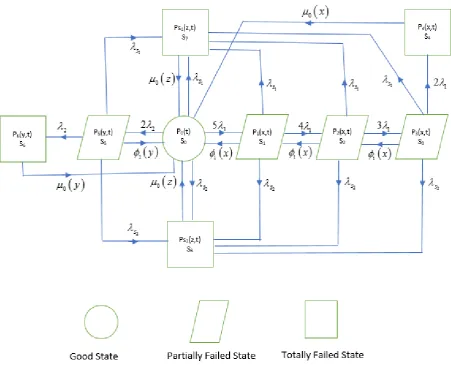
The description of the various possible state of the model after failing the units in both the subsystems, including transfer switch failure, is given in Table 1. The states {S0, S1, S2, S3, and S5} are operative states, and {S4, S6, S7, and S8} are inoperative states of the system.
Table 1 State Description of the model
State State description
S0 This is a perfect state, and all units of subsystem-1 and subsystem-2 are in good working condition.
S1
The indicated state represents that the system is degraded but is in operational mode after the failure of any one unit in subsystem-1, but both units of subsystem-2 are in a good operational state. The system is under repair.
S2
The indicated state represents that the system is degraded but is in operational mode after the failure of any two units in subsystem-1, but both units of subsystem-2 are in a good operational state. The system is under repair.
S3
The indicated state represents that the system is degraded but is in operational mode after the failure of any three units in subsystem-1. Still, both units of subsystem-2 are in a good operational state. The system is under repair.
S5
The indicated state represents that the system is degraded but is in operational mode after the failure of anyone unit in subsystem-2, but all the units of subsystem-1 are in a good operational state. The system is under repair.
S4 The states represent that the system is in totally failed mode after failing more than three units in the
subsystem 1. The system is under repair using the Gumbel-Hougaard family copula distribution. S6 The states represent that the system is in a complete failed state after failing both units in subsystem
2. The system is under repair using employing copula distribution. S7 It is a complete failed state due to switch failure in the subsystem-1.
3. ASSUMPTIONS
The following assumptions have been made throughout the study of the model:
1. Initially, the system is in the stateS0, and all the units of subsystem-1 and subsystem-2 are in
good working conditions.
2. The subsystem-1 works successfully until three or more than three units are in good working
condition, i.e., 2-out-of-5:Gpolicy.
3. The subsystem-2 works successfully if one or both units are in good working condition, i.e.,
1-out-of-2:Gpolicy.
4. Both the subsystems having switching devices, which may be unreliable at the time as long
as the switch fails, the whole system fails immediately.
5. The units in both the subsystems are in parallel mode and hot standby and ready to start
within a negligible time after the failure of any unit in the subsystems.
6. Repairperson is available to full time with the system and maybe called as soon as the system
reaches to partially or totally failed state.
7. All failure rates are constant and follow the exponential distribution.
8. The complete failed system needs repair immediately. For this, copula can be employed to
restore the system.
9. No damage reported due to the repair of the system.
PERFORMANCE ANALYSIS OF A COMPLEX REPAIRABLE SYSTEM
4. NOTATIONS
t, s Time scale and Laplace transform variable
1/ 2
The failure rate of each unit in the subsystem-1/subsystem-2.
1/ 2
s s
The failure rate of the switching devices between the units for subsystem-
1/subsystem-2.
( ) ( )
1 x / 1 y
The Repair rate of each unit in the subsystem-1/subsystem-2.
( )
0 z
Repair rate of the switching device for both the subsystems.
( )
0
P t The state transition probability that the system is in stateSi at an instanti=0.
( )
P s Laplace transformation of the state transition probabilityP t
( )
.( )
, iP x t The probability that the system is in the stateSi for i=1 to 8and the system is
under repair with elapsed repair time is ,x t. x is repaired variable and t is
time variable.
( )
p
E t Expected profit in the interval. [0, t)
1, 2
K K Revenue generated and service cost per unit time, respectively.
( )
0 x
An expression of the joint probability from failed state Si to good state S0
according to Gumbel-Hougaard family copula, is given
( )
( )
1 0 x exp x log x
= + whereu x1
( ) ( )
= x and 2( )
xu x =e . Here is the parameter1 .
5. SYSTEM CONFIGURATION AND STATE TRANSITION DIAGRAM
System configuration is shown in Fig 1 (a) while the transition diagram in Fig 1 (b). In transition diagram, S0 is perfect state, S1, S2, S3, and S5 partial failed/degraded and S4, S6, S7, and S8 are
complete failed states. Due to failure in any unit in the subsystem-1 and in subsystem-2, the transitions approach to partially failed states S1, S2, S3, and S5, respectively. The state S4 and S6
are complete failed states due to the failure of units in both the subsystems. The states S7 and S8
Figure 1 (a) System configuration
PERFORMANCE ANALYSIS OF A COMPLEX REPAIRABLE SYSTEM
6. FORMULATION OF THE MODEL
By a probability of considerations and continuity arguments, we can obtain the following set of difference-differential equations associated with the present mathematical model:
( )
( ) ( )
( ) ( )
1 2
1 2 0 1 1 2 5
0 0
5 2 s s P t x P x t dx, y P y t dy,
t
+ + + + = +
( ) ( )
( ) ( )
0 4 0 6
0 0
, ,
x P x t dx y P y t dy
+
+
( ) ( )
1( ) ( )
2
0 0
0 0
, ,
s s
z P z t dz z P z t dz
+
+
(1)( ) ( )
1 2
1 1 1
4 s s x P x t, 0
t x
+ + + + + =
(2)
( ) ( )
1 2
1 1 2
3 s s x P x t, 0
t x
+ + + + + =
(3)
( ) ( )
1 2
1 1 3
2 s s x P x t, 0
t x
+ + + + + =
(4)
( )
1 4( )
exp x log x P x t, 0
t x
+ + + =
(5)
( ) ( )
1 2
2 s s 2 y P y t5 , 0
t y
+ + + + + =
(6)
( )
1 6( )
exp y log y P y t, 0
t y + + + =
(7)
( )
1 1( )
exp z log z Ps z t, 0
t z + + + =
(8)
( )
1 2( )
exp z log z Ps z t, 0
t z
+ + + =
(9)
Boundary conditions
( )
( )
1 0, 5 1 0
( )
( )
2( )
2 0, 4 1 1 0, 20 1 0
P t = P t = P t (11)
( )
( )
3( )
3 0, 3 1 2 0, 60 1 0
P t = P t = P t (12)
( )
( )
4( )
4 0, 2 1 3 0, 120 1 0
P t = P t = P t (13)
( )
( )
5 0, 2 2 0
P t = P t (14)
( )
( )
2( )
6 0, 2 5 0, 2 2 0
P t = P t = P t (15)
( )
( )
( )
( )
( )
( )
1 0, 1 0 1 0, 2 0, 3 0, 5 0,
s s
P t = P t +P t +P t +P t +P t (16)
( )
( )
( )
( )
( )
( )
2 0, 2 0 1 0, 2 0, 3 0, 5 0,
s s
P t = P t +P t +P t +P t +P t (17)
Initials conditions
( )
0 0 1
P = , and other state probabilities are zero att=0 (18)
Solution of the model
Taking Laplace transformation of equations (1) to (17) and using equation (18), we obtain
( )
( ) ( )
( ) ( )
1 2
1 2 0 1 1 2 5
0 0
5 2 s s 1 , ,
s P s x P x s dx y P y s dy
+ + + + = + +
( ) ( )
( ) ( )
0 4 0 6
0 0
, ,
x P x s dx y P y s dy
+
+
( ) ( )
1( ) ( )
2
0 0
0 0
, ,
s s
z P z s dz z P z s dz
+
+
(19)where
( )
( )
0
, st ,
i i
P x s e P x t dt
−
=
( ) ( )
1 2
1 1 1
4 s s , 0
s x P x s
x
+ + + + + =
(20)
( ) ( )
1 2
1 1 2
3 s s , 0
s x P x s
x
+ + + + + =
(21)
( ) ( )
1 2
1 1 3
2 s s , 0
s x P x s
x
+ + + + + =
PERFORMANCE ANALYSIS OF A COMPLEX REPAIRABLE SYSTEM
( )
1 4( )
exp log , 0
s x x P x s
x
+ + + =
(23)
( ) ( )
1 2
2 s s 2 5 , 0
s y P y s
y
+ + + + + =
(24)
( )
1 6( )
exp log , 0
s y y P y s
y + + + =
(25)
( )
1 1( )
exp log s , 0
s z z P z s
z
+ + + =
(26)
( )
1 2( )
exp log s , 0
s z z P z s
z
+ + + =
(27)
( )
( )
1 0, 5 1 0
P s = P s (28)
( )
( )
2( )
2 0, 4 1 1 0, 20 1 0
P s = P s = P s (29)
( )
( )
3( )
3 0, 3 1 2 0, 60 1 0
P s = P s = P s (30)
( )
( )
4( )
4 0, 2 1 3 0, 120 1 0
P s = P s = P s (31)
( )
( )
5 0, 2 2 0
P s = P s (32)
( )
( )
2( )
6 0, 2 5 0, 2 2 0
P s = P s = P s (33)
( )
( )
( )
( )
( )
( )
1 0, 1 0 1 0, 2 0, 3 0, 5 0,
s s
P s = P s +P s +P s +P s +P s
(
)
( )
1
2 3
1 1 1 2 0
1 5 20 60 2
s P s
= + + + + (34)
( )
( )
( )
( )
( )
( )
2 0, 2 0 1 0, 2 0, 3 0, 5 0,
s s
P s = P s +P s +P s +P s +P s
(
)
( )
2
2 3
1 1 1 2 0
1 5 20 60 2
s P s
= + + + + (35)
Laplace transformation of boundary conditions after repair
( )
( )
( ) ( )
1 1 0 1 2
0
0, 5 ,
P s P s x P x s dx
= +
( )
( )
( 1 1 2) 1( )( )
0
3
1 0 1 2
0
5 0,
x
s s
s x x dx
P s x e P s dx
( )
(
)
( )
1 1 2
1 0 1 2
5P s S s 3 s s P 0,s
= + + + +
( )
(
)
( )
1 1 2
1 0 1 1 1
5P s S s 3 s s 4P 0,s
= + + + +
( )
(
)
( )
1 1 2
1
1 0
1 1
5 0,
1 4 3 s s
P s P s
S s
=
− + + + (36)
Similarly
( )
(
)
( )
1 1 2
2 1 2 0 1 1 20 0,
1 3 2 s s
P s P s
S s
=
− + + + (37)
( )
( )
(
)
( )
1 1 2
3 1
3 1 2 0
1 1
60
0, 3 0,
1 3 2 s s
P s P s P s
S s
= =
− + + + (38)
( )
( )
(
)
( )
1 1 2
4 1
4 1 3 0
1 1
120
0, 2 0,
1 3 2 s s
P s P s P s
S s
= =
− + + + (39)
( )
( )
5 0, 2 2 0
P s = P s (40)
( )
( )
2( )
6 0, 2 5 0, 2 2 0
P s = P s = P s (41)
( )
(
)
( )
1 1
2 3
1 1 1 2 0
0, 1 5 20 60 2
s s
P s = + + + + P s (42)
( )
(
)
( )
2 2
2 3
1 1 1 2 0
0, 1 5 20 60 2
s s
P s = + + + + P s (43)
Now solving all the equations with the boundary conditions, one may get
( )
( )
0 1 P s D s = (44)( )
( )
(
)
(
1 21)
1(
1 2 1 2)
1 1
1
1 1 1
1 4
5
4 1 4 3
s s
s s s s
S s
P s
D s s S s
− + + + =
+ + + − + + + (45)
( )
( )
(
)
(
1 21)
1(
1 2 1 2)
2
1 1
2
1 1 1
1 3
20
3 1 3 2
s s
s s s s
S s
P s
D s s S s
− + + + =
+ + + − + + + (46)
( )
( )
(
)
(
1 21)
1(
1 2 1 2)
3
1 1
3
1 1 1
1 2
60
2 1 3 2
s s
s s s s
S s
P s
D s s S s
− + + + =
PERFORMANCE ANALYSIS OF A COMPLEX REPAIRABLE SYSTEM
( )
( )
( )
(
)
0
1 1 2
4 1 4 1 1 1 120
1 3 2 s s
S s P s
D s s S s
− =
− + + + (48)
( )
( )
(
2(
1)
2)
1 2 2 2 5 2 12 s s
s s
S s P s
D s s
− + + +
=
+ + + (49)
( )
( )
0( )
2 2 6
1
2 S s
P s
D s s
−
= (50)
( )
1(
( )
)
0( )
12 3
1 1 1 2 1
1 5 20 60 2
s s
S s
P s
D s s
+ + + + −
= (51)
( )
2(
( )
)
0( )
22 3
1 1 1 2 1
1 5 20 60 2
s s
S s
P s
D s s
+ + + + −
= (52)
where
( )
1 2
4
2
1 1
1 2 2 2
1 1
5 120
5 2 2 2
1 4 1 3
s s
P T
D s s S T
Q R = + + + + − − − − − −
(
1 2)
(
)
2 3
1 1 1 2
1 5 20 60 2
s s T
− + + + + +
and
(
)
1 1 2
1 2 1 1 1 1 4 4 s s s s
P S s
s = + + + = + + + +
(
)
1 1 2
1 2 1 1 1 1 3 3 s s s s
Q S s
s = + + + = + + + +
(
)
1 1 2
1 2 1 1 1 1 2 2 s s s s
R S s
s = + + + = + + + +
(
)
2 1 2
1 2 2 2 2 2 s s s s
S S s
s = + + + = + + + +
( )
0 0 0 T S ss
= =
+
Sum of Laplace transformations of the state transitions, where the system is in operational mode and failed state at any time, is as follows.
( )
0( )
1( )
2( )
3( )
5( )
up
( )
(
)
(
)
(
)
(
)
(
)
(
)
(
)
(
)
(
)
(
)
1 1 2
1 2 1 1 2
1 1 2
1 2 1 1 2
1 1 2
1 2 1 1 2
2 1 2
1 1
1 1 1
2
1 1
1 1 1
3
1 1
1 1 1
2 2
5 1 4
1
4 1 4 3
20 1 3
3 1 3 2
1
60 1 2
2 1 3 2
2 1
s s
s s s s
s s
s s s s
s s
s s s s
s s
S s
s S s
S s
s S s
D s S s
s S s
S s s − + + + + + + + − + + + − + + + + + + + − + + + = − + + + + + + + − + + + − + + + + +
(
2 s1 s2)
+ + (53)
( )
1( )
down up
P s = −P s (54)
7. ANALYTICAL STUDY
7.1 Availability Analysis
When repair follows general and Gumbel-Hougaard family copula distribution, we have
( )
( ) ( )
( )
( )
1 0 1 1 exp log exp log exp log x x x xS s S s
s x x
+ + = = + +
setting
( )
, 1, 2i
i i
S s i
s
= + = andS
( )
s s = +Here we have considered the following three cases on switching device for the availability of the system:
Case I: When both the subsystems have switching device, the availability of the system by taking the values of different parameters as
1 2
1 0.03, 2 0.02, s 0.025, s 0.022, 1, 1,
= = = = = = x=1,y=1,z=1,i =1
(
i=1, 2)
, in (53),then taking the inverse Laplace to transform, we obtain,
1.1370 2.7829 1.3118 1.0638
0.01070 1.1070 1.0670
( ) 0.003240 0.022538 0.035199 0.098452
1.012130 0.000578 0.094103
up
t t t t
t t t
P t e e e e
e e e
− − − −
− − −
=− + − +
+ − − (55)
Case II: When subsystem-2 does not have switching device, then the availability of the system
by taking the values of different parameters as
1 2
1 0.03, 2 0.02, s 0.025, s 0, 1, 1,
PERFORMANCE ANALYSIS OF A COMPLEX REPAIRABLE SYSTEM
1, 1, 1,
x= y= z= i =1
(
i=1, 2)
, in (53), then taking the inverse Laplace to transform, we obtain,1.1150 1.0850 2.7532 1.2960
1.0421 0.0119 1.0450
( ) 0.003268 0.0005880 +0.012383 0.031792
0.109886 +1.018479 0.105102
up
t t t t
t t t
P t e e e e
e e e
− − − −
− − −
=− − −
+ − (56)
Case III: When subsystem-1 and two both do not have switching device, the availability of the system by taking the values of different parameters as
1 2
1 0.03, 2 0.02, s 0, s 0, 1, 1,x 1,y 1,
= = = = = = = = z=1,i =1
(
i=1, 2)
, in (53), then takingthe inverse Laplace to transform, we obtain,
2.7193 1.2785 1.0175 0.0131
1.0900 1.0200 1.0600
( ) 0.000365 0.027264 0.125983 1.025501
0.003298 0.1206870 0.000598
up
t t t t
t t t
P t e e e e
e e e
− − − −
− − −
= − + +
− − − (57)
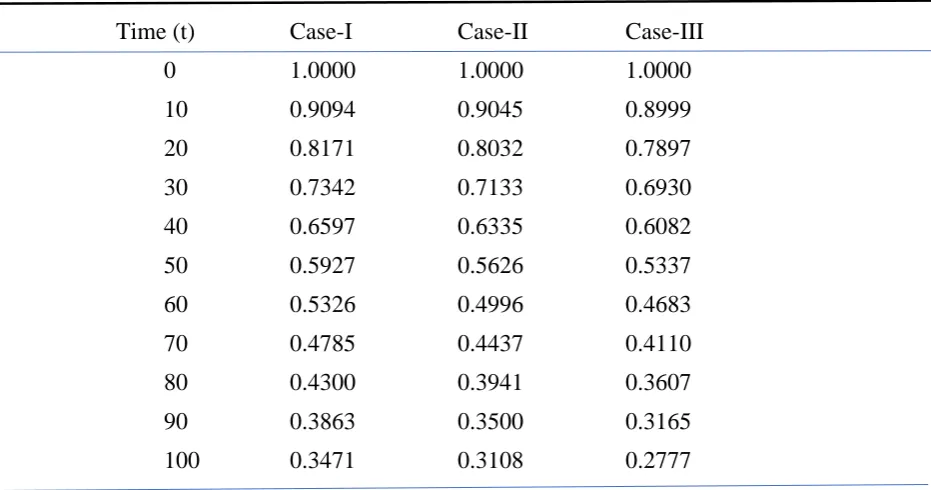
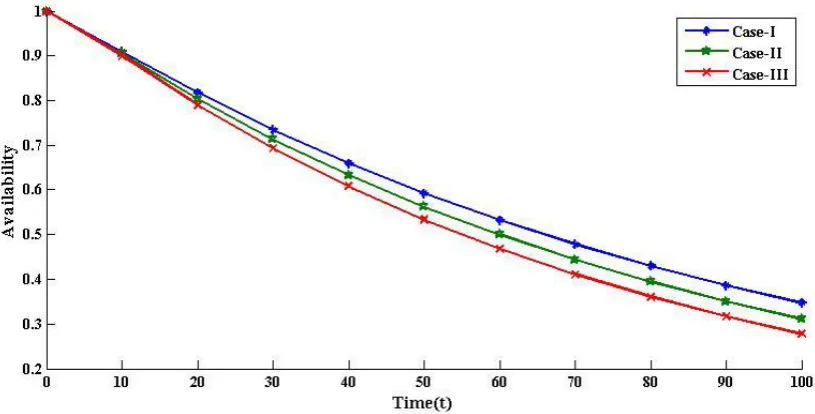
For t=0,10, 20,30, 40,50, 60, 70,80,90 and 100units of time, one may get different values
( )
up
P t with the help of (55-57), as shown in table-2 and figure-2.
Table 2 Variation of availability with respect to time in various cases
Time (t) Case-I Case-II Case-III
0 1.0000 1.0000 1.0000
10 0.9094 0.9045 0.8999
20 0.8171 0.8032 0.7897
30 0.7342 0.7133 0.6930
40 0.6597 0.6335 0.6082
50 0.5927 0.5626 0.5337
60 0.5326 0.4996 0.4683
70 0.4785 0.4437 0.4110
80 0.4300 0.3941 0.3607
90 0.3863 0.3500 0.3165
Figure 2 Availability as a function of time
7.2 Reliability Analysis
In order to obtain system reliability, consider repair rates equal to zero. Like availability, the same three cases are discussed here.
Case I: When both the subsystems have a switching device, the reliability of the system by
taking the values of different parameters as
1 2
1 0.03, 2 0.02, s 0.025, s 0.022
= = = = in (53),
we obtain,
0.1070 0.2370 0.1370 0.1670
0.0670
( )
0.235294
0.012465 t 1.570613 t 0.180000 t 2.142857 t
t
R t e e e e
e
− − − −
−
= +
− + +
(58)
Case II: When subsystem-2 does not have a switching device, the availability of the system by
taking the values of different parameters as
1 2
1 0.03, 2 0.02, s 0.025, s 0
= = = = in (53), we
obtain,
0.2150 0.1150 0.1450 0.0450
0.0850
( ) 1.570613
0.012462
0.180000 2.142857 0.235294
t t t t
t
R t e e e e
e
− − − −
−
= − +
+ + +
(59)
Case III: When subsystem-1, as well as the subsystem-2, do not have a switching device, the availability of the system by taking the values of different parameters as
1 2
1 0.03, 2 0.02, s 0, s 0
PERFORMANCE ANALYSIS OF A COMPLEX REPAIRABLE SYSTEM
0.1900 0.1200 0.0900 0.0600
0.0200
( ) 1.570613 2.142857
0.235294
0.180000 0.012462
t t t t
t
R t e e e e
e
− − − −
−
= − +
+
+ +
(60)
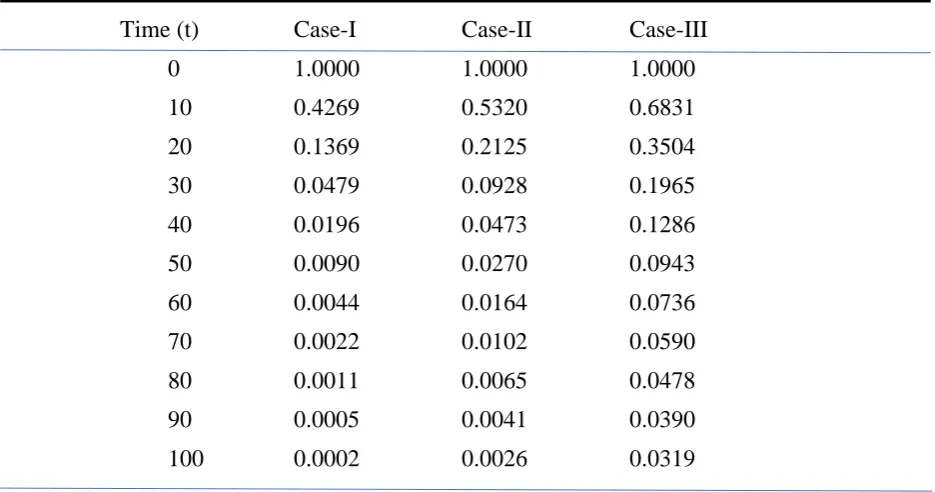
For t=0,10, 20,30, 40,50, 60, 70,80,90 and 100units of time, one may get different values R t( )
with the help of (58-60), as shown in table-3 and figure-3.
Table 3 Computed values of reliability corresponding to the different cases
Time (t) Case-I Case-II Case-III
0 1.0000 1.0000 1.0000
10 0.4269 0.5320 0.6831
20 0.1369 0.2125 0.3504
30 0.0479 0.0928 0.1965
40 0.0196 0.0473 0.1286
50 0.0090 0.0270 0.0943
60 0.0044 0.0164 0.0736
70 0.0022 0.0102 0.0590
80 0.0011 0.0065 0.0478
90 0.0005 0.0041 0.0390
100 0.0002 0.0026 0.0319
7.3 Mean Time to Failure (MTTF)
Taking all repair rate to zero and the limit as s tends to zero in (53) for the exponential distribution; we can obtain the MTTF as:
2 3
1 1 1 2
1 1 1 2
5 20 60 2
1 1
4 3 2
MTTF
= + + + +
+ + + +
(61)
where
1 2
1 2
5 2 s s
= + + + and
1 2
s s
= +
Now taking the values of different parameters as
1 2
1 0.03, 2 0.02, s 0.025 and s 0.022
= = = =
and varying
1 2
1, 2, s and s
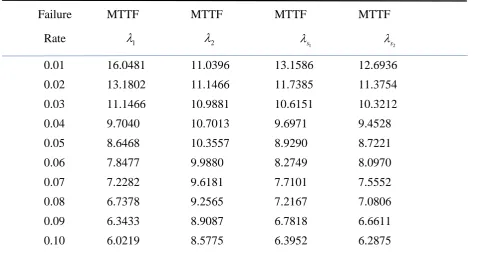
one by one respectively as0.01, 0.02, 0.03, 0.04, 0.05, 0.06, 0.07,
0.08, 0.09, 0.10 in (61), the variation of MTTF, with respect to failure rates, can be obtained in
table-4 and figure-4.
Table 4 Computation of MTTF corresponding to the failure rates
Failure MTTF MTTF MTTF MTTF
Rate 1 2
1
s
2
s
0.01 16.0481 11.0396 13.1586 12.6936
0.02 13.1802 11.1466 11.7385 11.3754
0.03 11.1466 10.9881 10.6151 10.3212
0.04 9.7040 10.7013 9.6971 9.4528
0.05 8.6468 10.3557 8.9290 8.7221
0.06 7.8477 9.9880 8.2749 8.0970
0.07 7.2282 9.6181 7.7101 7.5552
0.08 6.7378 9.2565 7.2167 7.0806
0.09 6.3433 8.9087 6.7818 6.6611
PERFORMANCE ANALYSIS OF A COMPLEX REPAIRABLE SYSTEM
Figure 4 MTTF as a function of failure rates
7.4 Cost Analysis
Let the service facility be always available, then expected profit during 0,t
)
is( )
1( )
2 0t
p up
E t =K P
t dt−K t (62)For the same set of parameters defined in (53), one can obtain (63). Therefore,
1.1370 2.7829 1.3119 1.0638
1
0.0107 1.1070 1.0670
2
( )
94.57792
{0.002850 0.008099 0.026831 0.092545
94.595676 0.000523 0.088194 }
p
t t t t
t t t
E t K e e e e
e e e K t
− − − −
− −
=
+
− + −
− + + − (63)
Setting K1=1 K2 =0.6, 0.5, 0.4, 0.3, 0.2 and 0.1respectively, and varying t=0,10, 20,30, 40,
50, 60, 70,80,90 and 100units of time, the results for expected profit can be obtained as per
Table 5 Profit computation for different values of time
Time
( )
t K2 =0.6 K2 =0.5 K2 =0.4 K2 =0.3 K2 =0.2 K2 =0.10 0.0000 0.0000 0.0000 0.0000 0.0000 0.0000
10 3.5808 4.5808 5.5808 6.5809 7.5809 8.5809
20 6.2056 8.2056 10.2056 12.2056 14.2056 16.2051
30 7.9551 10.9551 13.9551 16.9551 19.9551 22.9551
40 8.9182 12.9182 16.9182 20.9182 24.9182 28.9182
50 9.1748 14.1748 19.1748 24.1748 29.1748 34.1748
60 8.7966 14.7966 20.7966 26.7966 32.7986 38.7966
70 7.8479 14.8479 21.8479 28.8479 35.8479 42.8479
80 6.3867 14.3867 22.3867 30.3867 38.3867 46.3867
90 4.4649 13.4649 22.4649 31.4649 40.4649 49.4649
100 2.1293 12.1293 22.1293 32.1293 42.1293 52.1293
Figure 5 Expected profit as a function of time
7.5 Sensitivity Analysis corresponding to MTTF
PERFORMANCE ANALYSIS OF A COMPLEX REPAIRABLE SYSTEM
1
1 0.3, 2 0.2, s 0.25
= = = and
2 0.22
s
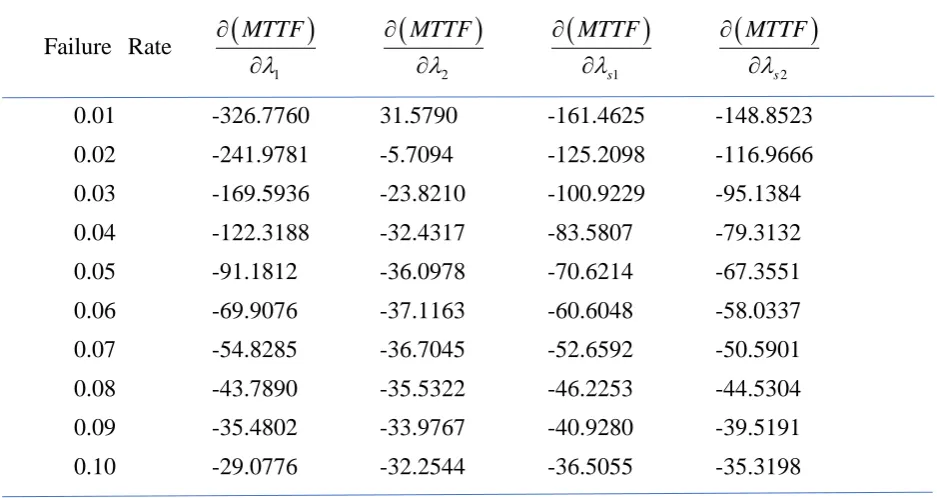
= in the partial differentiation of MTTF, one can
calculate MTTF sensitivity, as shown in table-6 and figure-6.
Table 6 MTTF sensitivity as a function of failure rates
Failure Rate
(
)
1
MTTF
(
)
2
MTTF
(
)
1
s
MTTF
(
)
2
s
MTTF
0.01 -326.7760 31.5790 -161.4625 -148.8523
0.02 -241.9781 -5.7094 -125.2098 -116.9666
0.03 -169.5936 -23.8210 -100.9229 -95.1384
0.04 -122.3188 -32.4317 -83.5807 -79.3132
0.05 -91.1812 -36.0978 -70.6214 -67.3551
0.06 -69.9076 -37.1163 -60.6048 -58.0337
0.07 -54.8285 -36.7045 -52.6592 -50.5901
0.08 -43.7890 -35.5322 -46.2253 -44.5304
0.09 -35.4802 -33.9767 -40.9280 -39.5191
0.10 -29.0776 -32.2544 -36.5055 -35.3198
8. CONCLUSION
In this paper, the reliability analysis of a complex system consisting of two subsystems, subsystem-1 and subsystem-2 in a series configuration with the switching device, is studied. The subsystems have five and two units, respectively. Furthermore, the switching device in the system is unreliable, and the function of the switch is: "as long as the switch fails, the whole system fails immediately." Using the supplementary variable technique and the Laplace transform various measures like availability of the system, reliability of the system, MTTF, profit analysis, and sensitivity analysis for MTTF are derived in this model.
Table-2 and corresponding figure-2 give the analysis of availability in three different cases on the
switching device. In case I,
1 0.025, 2 0.022
s s
= = i.e., both subsystems have a switching device,
in case II,
1 0.025, 2 0
s s
= = i.e., only the first subsystem has switching device, while in case III,
1 0, 2 0
s s
= = i.e., no subsystem have switching device. It reveals from the graph that availability
constantly decreases as time increases in all the three cases. The reliability of the system is evaluated in three different cases, like availability and shown in table-3 and figure-3. It concludes that reliability decreases significantly in the beginning, and thereafter it decreases approximately in a constant manner. Thus, both the availability and reliability decrease with an increase in time. Investigation through figure 2 and figure 3 concludes that availability values are greater than reliability for the same values of failure rates. Thus, one can understand the need for repair for repairable systems for better performance.
Table-4 and figure-4 yield the MTTF of the system with respect to variation in failure rate
1 2
1, 2, s and s
, respectively, when other parameters have been kept constant. MTTF of the
system is decreasing concerning different failure rates. MTTF of the system is highest for the failure rate of subsystem-1 and is lowest concerning the failure rate of subsystem-2. The MTTF of switching devices and subsystem-1 are almost the same on failure rate variation value after 0.03.
When revenue cost per unit time fixed atK1 =1and service costs atK2 =0.6, 0.5, 0.4, 0.3,
0.2 and 0.1, the expected profit has been calculated (Table 5), and the results are demonstrated by the graph (Figure 5). It reveals that expected profit increased as time increased for lower
PERFORMANCE ANALYSIS OF A COMPLEX REPAIRABLE SYSTEM
the profit is higher as compared to the high service cost. The sensitivities of the system MTTF
concerning the system parameter
1 2
1, 2, s and s
s shown in table-6 and figure-6. The sensitivity
of MTTF for system parameters becomes constant for higher values. Thus, in general, with the study, the behavior of such systems can be analyzed and prognosticate in advance. This paper may be important to engineers, maintenance managers, and plant management for proper maintenance analysis, decision, and for the safety of the system as a whole.
CONFLICT OF INTERESTS
The author(s) declare that there is no conflict of interests.
REFERENCES
[1] A. Khattab, N. Nahas, and M. Nourelfath. Availability of k-out-of-n: G systems with non-identical components subject to repair priorities, Reliab. Eng. Syst. Saf. 94(2)(2009), 142–151.
[2] A. Lado and V.V. Singh. Cost assessment of complex repairable system consisting of two subsystems in the series configuration using Gumbel Hougaard family copula, Int. J. Quality Reliab. Manage. 36(10)(2019), 1683-1698.
[3] A. Munjal and S. B. Singh. Reliability analysis of a complex repairable system composed of two 2-out-of-3: G subsystems connected in parallel, J. Reliab. Stat. Stud. 7(S)(2014), 89-111.
[4] D. Babu, P. Govindaraju, and U. Rizwan. A δ-Shock maintenance model for a deteriorating system with an imperfect delayed repair under partial product process, J. Math. Comput. Sci. 9(5)(2019), 571-581.
[5] Di Bona., G., Forcina, A., Petrillo, A., De Felice, F. A- IFM reliability allocation model based on multicriteria approach. Int. J. Quality Reliab. Manage. 33(5) (2016), 676-698.
[6] Di Bona., G., Forcina, A., Silvestri, A. Critical flow method: A new reliability allocation approach for a thermonuclear system. Quality Reliab. Eng. Int. 32(5)(2016), 1677-1691.
[7] I. Yusuf, and N. Hussaini. A comparative analysis of three redundant unit systems with three types of failures, Arab. J. Sci. Eng. 39(4)(2014), 3337-3349.
[8] I. Yusuf, A, S. Halilu, and N.G. Khalil. Reliability modeling and analysis of a non-repairable series-parallel system, J. Math. Comput. Sci. 6(2) (2016), 247-253.
[9] I. Yusuf, B. Yusuf, and S.I. Bala. Meantime to system failure analysis of a linear consecutive 3-out-of-5 warm standby system in the presence of common cause failure, J. Math. Comput. Sci. 4(1) (2014), 58-66.
[11]K.M. El-Said and M. S. EL-Sherbeny. Evaluation of reliability and availability characteristics of two different systems by using linear first-order differential equations, J. Math. Stat. 1(2)(2005), 119–123.
[12]L. Bulama, I. Yusuf, and S.I. Bala. Stochastic modeling and analysis of some reliability characteristics of a repairable warm standby system, Appl. Math. Sci. 7(2013), 5847-5862.
[13]M. Park and H. Pham. A generalized block replacement policy for a k-out-of-n system with respect to a threshold number of failed components and risk costs, IEEE Trans. Syst. Man Cybern. Part A: Syst. Humans, 42(2)(2012), 453–463.
[14]M. Ram and S. B. Singh. Availability and Cost Analysis of a parallel redundant complex system with two types of failure under preemptive- resume repair discipline using Gumbel-Hougaard family copula in repair, Int. J. Reliab. Quality Safety Eng. 15(4)(2008), 341–365.
[15]N. Goyal, M. Ram M, S. Amoli, and A. Suyal A. Sensitivity analysis of a three-unit series system under k-out-of-n redundancy, Int. J. Quality Reliab. Manage. 34(6)(2017), 770-784.
[16]R. Gupta and A. Tyagi. Stochastic analysis of a two-unit warm standby system with two-phase repair and geometric distributions of the events, J. Math. Comput. Sci. 3(6)(2013), 1586-1600.
[17]R. Gupta, A. Chaudhary, and S. Jaiswal. Stochastic analysis of a three-unit complex system with active and passive redundancies and correlated failures and repair times, J. Math. Comput. Sci. 5 (5)(2015), 694-707. [18]R. Moghaddass, M.J. Zuo, and W. Wang. Availability of a general k-out-of-n: G system with non-identical
components considering shut-off rules using quasi-birth-death process, Reliab. Eng. Syst. Safety, 96(4) (2011), 489–496.
[19]R. Sharma and G. Kumar. Availability improvement for the successive k-out-of-n machining system using standby with multiple working vacations, Int. J. Reliab. Safety, 11(3)(2017), 256-267.
[20]S. C. Malik and S. Deswal. Reliability modeling and profit analysis of a repairable system of non-identical units with no operation and repair in abnormal weather, Int. J. Computer Appl. 51(11)(2012), 43–49.
[21]V. V. Singh, M. Ram, and D. K. Rawal. Cost Analysis of an Engineering System involving subsystems in Series Configuration, IEEE Trans. Autom. Sci. Eng. 10(1)(2013), 1124-1130.
[22]V. V. Singh, S. B. Singh, M. Ram, and C. K. Goel. Availability, MTTF, and cost analysis of a system having two units in a series configuration with the controller, Int. J. Syst. Assur. Manage. 4(4)(2013), 341–352.
[23]V. V. Singh, J. Gulati, D. K. Rawal, and C. K. Goel. Performance analysis of the complex system in the series configuration under different failure and repair disciplines using a copula, Int. J. Reliab. Quality Safety Eng. 23(2)(2016), 1-21.
PERFORMANCE ANALYSIS OF A COMPLEX REPAIRABLE SYSTEM