Message-Optimal Algorithm for Detection and Resolution of
Generalized Deadlocks in Distributed Systems
Selvaraj Srinivasan and R. Rajaram Department of Information Technology Thiagarajar College of Engineering Madurai, 625015, India
E-mail: [email protected], [email protected]
Keywords:distributed deadlock, generalized model, deadlock detection, wait-for graph, deadlock resolution Received:October 15, 2010
In this paper, we present a new algorithm to detect and resolve generalized deadlocks in distributed systems. The algorithm constructs a distributed spanning tree by diffusing probes along the edges of the Wait-For Graph (WFG) and collects a reply that carries the dependency information of processes to determine a deadlock. Unlike the previous algorithms, it performs reduction whenever it receives a reply from an active process. Moreover it isolates termination detection from deadlock detection, and terminates the execution once it detects a deadlock. It has a worst-case time complexity of d+2 and message complexity of e+2n; where n is the number of nodes, e is the number of edges and d is the diameter of the WFG. Correctness proof and performance analysis for the algorithm are also provided. Furthermore, it minimizes the message length and message overhead associated with deadlock resolution as compared with the existing algorithms.
Povzetek: Članek preučuje problem smrtnega objema v porazdeljenih sistemih.
1
Introduction
In a distributed computing environment, if a process needs a resource on the remote site for its computation, it sends a request message to the desired site. If the resource is available, it will be granted to the requesting process immediately; otherwise, the requesting process waits indefinitely until its request is granted. This will lead to a deadlock in distributed systems where a set of processes wait indefinitely for each other to satisfy their requests. Since deadlock reduces the resource availability and throughput, it should be detected and resolved promptly. However, deadlock is very difficult to detect as well as resolve in distributed systems due to the presence of multiple sites. In general, the interdependency among the distributed processes is modeled by a directed graph known as the Wait-For Graph (WFG) [1,2]; where each node represent a process and an edge from a node ‘i’ to node ‘j’ indicates that process ‘i’ is requested a resource from process ‘j’ and process ‘j’ is not granted a resource
to process ‘i’. A deadlock is defined differently
depending upon the underlying resource request model such as Single-Resource model, AND model, OR model and P out-of Q model [1,7]. In the Single Resource and AND model, a process needs all requested resources to continue its execution. Hence, the presence of cycle in the WFG implies a deadlock. In the OR model, a process proceeds the execution only if any of the
requested resource is granted. Therefore, the
presence of knot is necessary to determine OR deadlock. In the P out-of Q model, a process makes requests for Q resources and remains blocked until it is granted any P resource. Since AND and OR model are the special case
of P out-of Q model, it is also referred as generalized request model. A generalized deadlock corresponds to a deadlock in the generalized request model. The generalized request model is quite common in many domains such as resource management in distributed operating systems, communicating sequential processes and quorum consensus algorithms in distributed databases [11,12,16]. A cycle in the WFG is necessary but not sufficient condition whereas a knot is sufficient but not necessary condition for a generalized deadlock. Since detection of generalized deadlock requires the detection of a complex topology in the WFG, only few generalized deadlock detection and resolution algorithms
[4,5,7,8,10,12,15,16] have been proposed in the
literature. Most of them have used the diffusion
computing technique [1] in which a distributed computation is initiated by a single node and joined by other nodes only after receiving a message. The generalized deadlock detection algorithms are grouped into two categories namely centralized and distributed algorithms based on the existence of the WFG. In the centralized algorithms, the initiator maintains the entire information to determine a deadlock whereas in the distributed algorithm the information is spread across multiple sites.
1.1
Literature survey
WFG and performs reduction later to determine a deadlock. The algorithm proposed by Bracha and Toueg [4] consists of two phases. In the first phase, the initiator records a snapshot by propagating the probes along the edges of the WFG. In the second phase, the algorithm simulates the granting of resources to determine a deadlock. The second phase is nested within the first phase. It exchanges 4e messages in 4d time units, where e is the number of edges and d is the diameter of the WFG. By following the approach in [4], Wang.et.al [5] developed another algorithm in which an explicit termination technique is used to detect the end of the first phase. The second phase begins only after the first
phase is finished. Although it reduces the time
complexity of [4] into 3d+1, it needs 6e messages to detect a deadlock. Moreover, both [4] and [5] have failed to resolve deadlocks. The algorithm in [10] records as well as reduces the WFG simultaneously to determine a deadlock. It records a consistent snapshot of distributed WFG in the outward sweep and reduces in the inward sweep in a single phase. It uses 4e-2n+4l messages in 2d time units to find out whether the initiator is deadlocked, where n is the number of nodes and l is the number of leaf nodes in the WFG. However it deals with the complications introduced because the reduction of node in the inward sweep can begin much before the state of all WFG edges incident at that node have been recorded in the outward sweep. And it needs O(e) messages to resolve deadlocks. The algorithm in [11,12] uses lazy evaluation technique by which the reduction of a process in a snapshot is delayed until the initiator detects the termination. Although it minimizes the message complexity into 2e as with the previous algorithms, it uses variable sized messages with the length of O(e) . Since the initiator knows the resource requirement of all deadlocked processes, it minimizes the message overhead associated with deadlock resolution unlike in [10]. The algorithm in [19] achieves the time and message complexity of [12] with fixed sized messages. Unlike [12], it performs the reduction before the initiator terminates the execution of the algorithm. In general, distributed algorithms require two or more rounds of message transfer along the entire edges of the WFG. Hence, they need at least 2d time units to detect deadlock in the worst case.
In the centralized algorithms [8,15,16], the initiator maintains the Local Wait-For Graph (LWFG) to detect a deadlock. The initiator of the algorithm in [8] collects a reply from each process in its reachable set exactly once. Based on the information in replies, it incrementally constructs the WFG locally to determine a deadlock. It needs only 2n messages with the length of O(n) to find out deadlock. However, it has a time complexity of 2d like the distributed algorithms. In addition, it may abort nodes that are not deadlocked and needs O(n) messages to resolve deadlocks. The algorithm in [15] constructs the LWFG by using the ancestor-descendent relationship between the processes in replies. It uses less than 2e messages in 2d time units to detect a deadlock. It reduces the message length into O(e-n+m) where m indicates the number of nodes that
are not associated with any non-tree edges in the spanning tree induced by the algorithm. However, it needs additional technique to assign a unique path string to each node in the WFG and to interpret the path strings for constructing LWFG at the initiator. In contrast to [8], it resolves all deadlocks reachable from the initiator. The initiator of the algorithm in [16] collects the dependency information of all nodes to determine the deadlocked processes. It has almost half the time complexity of previous algorithms to detect a deadlock. It needs less than 2e messages in d+2 time units for detecting all deadlocked processes. However it needs additional technique to optimize the message length at each node and requires messages with the length of O(d) in the worst case. Hashemzadeh proposed an algorithm [17,18] based on history based edge chasing technique in which the initiator declares a deadlock once it finds its existence in the message. However, it significantly minimizes the message overhead associated with the executions of concurrent instances and deadlock resolution. We do not consider the algorithms based on edge chasing techniques [17,18] in this paper.
We propose a new centralized algorithm to detect and resolve distributed deadlock in generalized model. Our algorithm improves the message complexity and message size of previous algorithms. The initiator of the algorithm constructs the distributed spanning tree (DST) by propagating probes (CALL messages) along the edges of the WFG. Once a process receives the probe, it sends a reply that carries its dependency information directly to the initiator. However, the initiator performs reduction immediately after receiving a reply from an active process and receives a reply at most twice from each node in its reachable set unlike the earlier algorithms. At the end of termination, it declares all the nodes whose resource requirements are not met as deadlocked. We have formally proved the correctness of the proposed algorithm. It has a worst-case time complexity of d+2 time units and message complexity of less than e+2n, where d is the diameter, n is the number of nodes and e is the number of edges in the WFG. Further, it has a data traffic complexity of O(n) in the worst case. Since it selects a victim without using additional messages, it considerably simplifies deadlock resolution.
Although the proposed algorithm have some similarities with [16], it differs from Lee’s algorithm [16] and pervious centralized algorithms [8,15] in the following aspects:
1. The algorithm performs reduction whenever it receives a reply form an active node whereas Lee’s algorithm [15,16] performs reduction only after it detects the termination.
2. The algorithm in [15,16] uses an explicit mechanism to reduce the message length, whereas the proposed algorithm does not require any additional techniques. 3. The initiator of the proposed algorithm builds a
4. Unlike in [16], the initiator of the proposed algorithm receives a reply from all nodes in its reachable set at most twice.
The rest of this paper is divided into five main sections. In Section 2, we describe the key definitions and assumptions about the system model and the problem definition. In Section 3, we present the algorithm along with an example. In Section 4, we prove the correctness of the algorithm. In Section 5, we analyze the performance of the algorithm and compare it with that of previous algorithms. Finally, we conclude the paper in section 6.
2
System Model
Although we follow the computation model in [4, 8, 10, 12, 16], we describe it for completeness of this paper. The system has ‘n’ processes and each one has a unique identity. There is a logical channel between any two processes. The processes can communicate only by message passing. The message delays are arbitrary but finite. The messages are delivered to the destination in the same order as the sender sends them. The messages are neither lost nor duplicated and the entire system is fault-free. The messages are grouped into namely computation and control messages in the system. The
computation messages including
REQUEST, REPLY, CANCEL and ACK
are generated as a result of application’s execution. However, the control messages including CALL, REPORT and WEIGHT, which will be discussed in the section 3, are generated by the execution of the deadlock detection algorithm. Both computation and control messages are time stamped based on the requesting process’s logical lock [3]. Thus the time stamp of ACK or REPLY should be matched exactly with the corresponding REQUEST message.
A process state is active or blocked at any instant. When a process ‘i’ makes a generalized request and blocks, the unblocking condition of its request is denoted
as a function Fi. For example, Fi=A∧(B∨C) denotes that
process ‘i’ requires a resource from process A and a
resource from either process B or C. Function Fi is
evaluated in the following manner: substitutes true for a
node id in Fi if it has received a REPLY, indicating
granting of that request from that node; otherwise,
substitutes false for it. Then, evaluate the function Fi. A
process unblocks when a sufficient number and
combination of its requests to make Fitrue are granted.
An active process can send both computation and control messages whereas the blocked process can send either control messages or ACK. When process ‘i’
blocks on pi out-of qi requests, it sends REQUEST
message to qi processes in OUTi. Therefore, OUTi
gives the domain of Fi. Upon receiving a REQUEST
message from ‘i’, process ‘j’ records <i, t_blocki> in INj
and sends an ACK message to the sender of the message. If process ‘j’ is active, it sends a REPLY message to
process ‘i’ and subsequently removes <i, t_blocki> from
INj. Once a node is unblocked, it withdraws the remaining
requests it had sent earlier but not yet granted.
Each process ‘i’ maintains the following variables to keep track of its state in the WFG. The initial value of each variable is given within parenthesis.
parenti : the process identifier from which ‘i’ has
received the first probe (NULL)
INi: the set of processes which are directly blocked on ‘i’
(φ)
OUTi : the set of processes for which ‘i’ is waiting (φ)
Fi : the condition for unblocking a process ‘i’
We denote the set of processes in INi as
predecessors and the set of processes in OUTi as
successors of process ‘i’. A blocked process cannot withdraw any one of its requests spontaneously. And it could not abort any requests abnormally. These two assumptions are essential to ensure that the algorithm records a consistent snapshot. We use the terms process and node interchangeably throughout this paper.
2.1
Problem statement
A generalized deadlock exists in the system if the requesting conditions of one or more processes can never be satisfied. The formal description of deadlock is provided as in [16].
Definition 1: Let evaluate(Fi) be a recursive
operation evaluated based on the following: 1. evaluate (i) = evaluate (Fi),
2. evaluate (Fi) = true, for active node ‘i’,
3. evaluate (P∨Q) = evaluate (P)∨evaluate (Q)
4. evaluate (P∧Q) = evaluate (P)∧evaluate (Q)
where P and Q are nonempty AND/OR expressions of node identifiers. A generalized deadlock exists in the system if and only if the following topology exists in the WFG.
Definition 2: A generalized deadlock is a sub graph
(D,K) of WFG (V,E) where
∀i∈D(≠ φ), evaluate (Fi) = false,
No message for computation is under transmission between any nodes in D
Therefore, all processes in D are blocked forever and the resource requirement of processes that do not belong to D can be satisfied at any instant. It should be necessary to abort a node in D to resolve a deadlock.
A distributed deadlock detection algorithm should satisfy the following two correctness conditions:
Liveness: If a d e a d l o c k e x i s t s , t h e
a l g o r i t h m wi l l detect it within finite time.
Safety: The algorithm does not report any false deadlock.
3
The Proposed Algorithm
3.1
The description
We assume that the initiator ‘i’ initiates the deadlock detection algorithm. It includes the unblocking function
(Fi) in the set UCinit and sends CALL message to each
one of its successor ‘j’ in outi. If node ‘j’ receives the first
CALL message, it becomes the child of the sender and sends REPORT message that carries the unblocking
function (Fj) to the initiator directly. Further, it
propagates the CALL message to its own successors. However, if a node that has already joined the execution of current instance receives the second and subsequent CALL message, it does send a reply immediately. Those nodes send a WEIGHT message to the initiator only after receiving CALL messages from all its predecessors. Hence, it minimizes the message overhead to detect a deadlock.
Whenever the initiator receives a REPORT message from a blocked node ‘i’, it includes a tuple (i,
Fi, num_predi) in the set UCinit. At the same time, if it
receives a REPORT message from an active node ‘i’, it
includes ‘i’ in the set Ainit and attempts to evaluate all
unblocking functions in the set UCinit. It performs the
evaluation in the following manner: Select a tuple (i, Fi,
num_predi) from the set UCinit and check if the node
identifiers in the set Ainitare sufficient to make Fias true.
If it happens, it includes ‘i’ in the set Ainitand removes
the corresponding tuple from the set UCinit. This process
is repeated continuously until there is no more unblocking
function in the set UCinitcan be simplified as true. If the
algorithm unblocks all nodes in the set UCinit during
evaluation, it terminates the execution immediately; otherwise, it continues the execution until it detects the termination based on weight distribution technique. Once the algorithm terminates the execution, it declares all the
nodes that have not been reduced in the set UCinit as
deadlocked.
The algorithm detects the termination based on the weight distribution method like in [10,17]. According to the method, the initiator distributes a weight of one to its successors through CALL messages. When a node receives the first CALL message, it distributes the weight in the message among its successors. However, it accumulates the weight in all subsequent CALL messages until it receives the CALL messages from all its predecessors. It then returns the weight to the initiator through a WEIGHT message. It is accomplished as
follows. Each node ‘i’ has a variable ‘num_predi’ that
counts its predecessors. Whenever it receives a CALL message, it decreases the count by one. Hence, the
num_prediat a node becomes zero signifying that it receives
the CALL message from all its predecessors. Whenever the initiator receives a WEIGHT message, it sum ups the weights. The algorithm terminates when the weight at the initiator becomes one.
In a dynamic environment, the algorithm may report a false deadlock due to the presence of phantom edges. Let us consider a phantom edge from node ‘i’ to node ‘j’. This implies that when node ‘j’ receives a CALL message from node ‘i’, node ‘j’ has sent a REPLY to
node ‘i’. In the proposed algorithm, it is resolved by as follows. Whenever node ‘j’ receives the CALL message
from node ‘i’, it checks whether node ‘i’ is in INj. If i
INj, it sends an ALERT message to the initiator. Upon
receiving the ALERT message, the initiator evaluates fi
by substituting j as true. If node ‘i’ unblocks during the
evaluation, it is included in the set Ainitand initiates the
evaluation of other nodes in the set UCinit.
3.2
Formal specification
A formal description of the proposed algorithm executed at node ‘i’ is presented below. The initial value is given inside the parenthesis.
Data Structure of a node ‘i’
parenti : node id (NULL); /* a node from which a
CALL has been first received */
weighti : float (0); /* the weight value of ‘i’ */
ini : set of nodes (INi); /*the set of predecessors of ‘i’ */
outi: set of nodes (OUTi); /*the set of successors of ‘i’ */
fi: AND-OR Expression (Fi); /*the condition for ‘i’ to be
active */
num_predi: integer (|INi|); /* the number of predecessors
of ‘i’ */
Additional Data Structures at initiator
UCinit a set of unblocking functions which contains
tuples of the form (i, fi, num_predi) where fi denotes
the unblocking condition of a node ‘i’ (φ).
Ainit a set of active nodes (φ)
weightinitthe accumulated weight value (0)
victiminitthe node identifier to be aborted to resolve
the deadlock (φ).
Message Formats
CALL(initiator, sender, weight): Sent by node ‘sender’ carrying the identifier of the initiator and the weight value for the receiver of this message.
REPORT( sender, fsender, num_predsender): Sent by node
‘sender’ as a response to first CALL message carrying the unblocking condition and its number of predecessors.
WEIGHT(sender, weightsender):Sent by node ‘sender’
after receiving CALL messages from all its predecessors.
ALERT (sender, weightsender): Sent by node ‘sender’ after
receiving CALL messages through a phantom edge.
I. When a node ‘i’ initiates the algorithm
initiatori:= i; parenti:=i;
UCinit:= UCinit∪{(i, fi, num_predi)};
send CALL(initiator, i, 1 / |outi|) to each j∈outi
II. Upon receipt of CALL(initiator, j, weightj) from j
num_predi --;
if (parenti= NULL∧j∈ini)then
/* Step II.1 */ parenti:=j;
initiatori:= initiator;
send REPORT(i, fi, num_predi) to initiatori
if (|outi| >0 ) then /* Step II.1.1 */
send CALL(initiatori,i,weightj/|outi|) to each
k∈outi
else if (parenti≠NULL∧ j∈ini)then/* Step II.2 */ if (i=initiator)then /* Step II.2.1 */
weightinit= weightinit+ weightj;
else if (num_predi= 0)then/* Step II.2.2*/
send WEIGHT(i, weighti) to initiatori else
weighti:= weighti+ weightj; else if (j∉ini)then /* Step II.3*/
send ALERT(i, weightj) to initiatori
end
III. Upon receipt of REPORT(i, fi,num_predi) from i :
begin if (fi= φ)then
Ainit:= Ainit∪{i}; evaluation();
else
UCinit:= UCinit∪{(i, fi, num_predi)}; end
IV. Upon receipt of WEIGHT(i, weighti) from i :
begin
weightinit:= weightinit+ weighti; if (weightinit=1UCinit != φ) then
resolution(); // Declare a Deadlock
end
V. procedureevaluation() begin
for each i∈UCinitdo begin
if (evalvate(i.fi) = true ) then
Ainit:=Ainit∪{i};
UCinit:= UCinit– { i ,fi, num_predi} if ( UCinit= φ) then
No deadlock; exit; else
evaluation();
end for end
VI. procedureresolution() begin
count:=0;
repeat
for each i∈UCinitdo
begin
if (i.num_pred count)then
count:= i.num_pred; victiminit:= i.id;
end for
send ABORT to victiminit;
UCinit:=UCinit–{(victiminit,fvictim,num_predvictim)};
Ainit:=Ainit∪{victiminit};
evaluation() ;
until (UCinit = φ) end
VII. Upon receipt of ALERT(i, j, weighti) from i : begin
for each k∈UCinit do if ( k.id= i) then
k. fi:= k. fi | j = true;
// Substitutes j by true
if(evaluate (k. fi ) = true ) then
UCinit:= UCinit - {k};
Ainit: = Ainit {k.id};
evaluation(); weightinit:= weightinit+ weighti;
if (weightinit=1UCinit != φ) then
resolution(); // Declare a Deadlock
end
3.3
Example execution
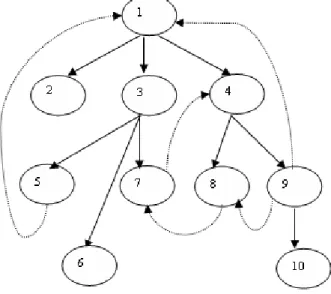
Figure 1: The Wait-For Graph
We illustrate the idea behind our algorithm with the help of an example. Figure 1 shows a distributed WFG that spans 10 nodes labelled from 1 to 10. All the nodes except 2, 6 and 10 are blocked initially. The unblocking
conditions of these nodes are as follows:
F1=(2∧3)∨4, F3=(5∧6)∨7, F4=8∧9, F5=1, F7=4, F8=7 and
F9=(810)1)
and nontree edges are indicated by solid and dashed lines respectively.
Figure 2: The Distributed Spanning Tree
1. When node 1 initiates the algorithm, it sends CALL(1,1,1/3) to nodes 2,3 and 4 respectively.
2. When node 2 receives the CALL from
1, it sends REPORT(2,,1) and
WEIGHT(2,1/3) to 1.
3. When node 3 receives the CALL from
1, it sends REPORT(3,(56)7,2) to 1 and
CALL (1,3,1/9) to nodes 5,6 and 7 respectively.
4. When node 4 receives the CALL from 1, it
sends REPORT(4,8∧9,2) to 1 and
CALL(1.4,1/6) to nodes 8 and 9
respectively.
5. When node 5 receives the CALL from 3, it sends REPORT(5,1,1) and CALL (1,5, 1/9) to 1
6. When node 6 receives the CALL from
3, it sends REPORT(6,,1) and
WEIGHT(6,1/9) to 1.
7. When node 7 receives the CALL from 1, it sends REPORT(7, 4,2) to 1 and CALL(1,7,1/9) to 4.
8. When node 8 receives the CALL from 4, it sends REPORT(8, 7,2) to 1 and CALL(1,8,1/6) to 7.
9. When node 9 receives the CALL from 4, it
sends REPORT(9, (8∧10)1,1) to 1 and
CALL(1,9,1/18) to nodes 1,8 an 10 respectively.
10. When node 1 receives the CALL from 5
through a back edge, it updates weightinit
11. When node 4 receives the CALL from 7, it sends WEIGHT (4, 1/9) to 1.
12. When node 7 receives the CALL from 8, it sends WEIGHT (7, 1/6) to 1.
13. When the initiator 1 receives the CALL from 9 through a back edge, it updates weightinit.
14. When node 8 receives the CALL from 9, it sends WEIGHT (8, 1/18) to 1.
15. When node 10 receives the CALL from
9, it sends REPORT(10,φ,1) and
WEIGHT(10,1/18 ) to 1.
Figure 3 shows the flow of control messages across the WFG.
Figure 3: The Message Flow
Whenever the initiator receives the REPORT from nodes 2, 6 and 10, it simplifies the unblocking functions in
the set UCinit. Finally, it declares the nodes 1,3,4,5,7,8 and
9 as deadlocked nodes.
3.4
Properties of the Algorithm
In this section, we prove the correctness of our algorithm by using several observations (observations 1 - 9) and lemmas (Lemmas 1-4) about the properties of the algorithm.
Observation 1: When the initiator diffuses the CALL
messages, it is eventually received by all nodes in its reachable set.
Observation 2: The diffusion of CALL message induces
a distributed spanning tree of the WFG.
Observation 3: Whenever a node receives the first
CALL message, it propagates the message to each one of its successor.
Lemma 1: If node ‘i’ receives the CALL message, the
unblocking function Fiis sent to the initiator.
Proof:From observation 1, each node that is reachable
from the initiator receives the CALL message. Upon receiving the first CALL message, node ‘i’ sends its
unblocking function Fito the initiator through REPORT
message after the execution of Step II.1. Thus, the lemma is proved.
Observation 4:Once a num_predihas been recorded in
Observation 5:Whenever a node ‘i’ receives the CALL
message through any one of its incoming edge, it
decrements num_prediby one.
Lemma 2: If a node ‘i’ sends a WEIGHT message to the
initiator then it must have received CALL messages from all its predecessors.
Proof: By observation 5, upon receiving the CALL
message from each node jini, node ‘i’ decreases
num_predi by one. At the time node ‘i’ receives the
CALL message, if num_prediis decremented to 0 then its
weight is sent to the initiator through a WEIGHT message by Step II.2.2. Hence, the lemma holds.
Observation 6: Whenever an initiator receives the
REPORT message from an active node, it evaluates the
unblocking functions in the set UCinit.
Definition 3: The initiator reduces a node ‘i’ iff it has
sufficient active nodes in the set Ainit to simplify Fi as
true.
Observation 7:Node ‘i’ can belong to the set Ainitonly
if any one of the following holds.
The initiator receives a REPORT message from node ‘i’ that contains Fias true
At the time the initiator evaluates Fias true during
reduction, node ‘i’ is added to the set Ainit.
Definition 5: If the initiator is reduced during the
evaluation, the algorithm stops the execution.
Observation 8: The weight in a CALL and WEIGHT
message is always in transit until they reach the initiator
and added to weightinit.
Definition 3: The algorithm is said to be terminated
when weightinit=1
Observation 9: When the algorithm terminates the
execution, all nodes that is reachable from the initiator either in the set UCinitor Ainit.
Lemma 3: If a deadlock exists in the system, the
algorithm will detect it in finite time.
Proof : Assume that a deadlock D exists in the system.
The initiator declares a deadlock only if a set UCinit
after the execution of Step V. Thus, it is sufficient to prove that the initiator has all information about the nodes and their associated edges in D. Let us consider node ‘i’ in D. It implies that node ‘i’ has sent Fi to the
initiator through a REPORT message by lemma 1. Since
node ‘i’ is blocked forever, the initiator evaluates Fi as
false during the execution of Step V at the end of termination. Thus, all nodes in D exist in the set UCinit.
Let us now assume a edge e = (i,j) and eD. By lemma
1, node ‘i’ sends this information to the initiator only after sending a CALL message to node ‘j’. Before sending the CALL message, node ‘i’ must send a REQUEST message to node ‘j’. If node ‘i’ has received a REPLY message from node ‘j’, an edge e has not been
included in Fi. Since both nodes ‘i’ and ‘j’ are in D, edge
e can not reduced during the execution of Step V in the
algorithm. Therefore, UCinitcontains a deadlock D after
the algorithm has terminated. Consequently, the initiator
sends an ABORT message to a victim until to resolve a deadlock by Step VI. Thus, the lemma holds.
Lemma 4:If a deadlock is declared, the deadlock exists
in the system
Proof: The proposed algorithm reports a deadlock only
when UCinit=. Assume a contrary that the algorithm
does not detect a deadlock D. So, it is sufficient to prove
that UCinit= after the execution of Step V. This reflects
the fact that a deadlock D exists in the system and the
nodes of D in the set UCinit are reduced during the
execution of Step V. Let node ‘i’ be one of such nodes
that unblocks first in the set UCinit. According to the
definition of deadlock, node ‘i’ is removed from the set
UCinit only if the unblocking function Fiis simplified as
true. It can be possible only when node ‘i’ had received at least one REPLY from its successors in D at some
time Ti. By observation 7, it should happen only before it
sends Fi to the initiator. Let node ‘j’ be one such
successor in D that unblocks node ‘i’. And node ‘j’ sends a REPLY to node ‘i’ only if it has received the
REPLY from some of its successors in D before Ti. That
is in contradiction with the assumption that node ‘i’ is the
first node that unblocks in the set UCinit. Thus is proved.
Theorem 1:The initiator of the algorithm terminates the
execution in finite time.
Proof: By step I, the initiator distributes the weight of
one to all nodes that are reachable from it through CALL messages. The messages are neither lost nor duplicated according to our network assumptions. From observation 5, for each node ‘i’ that is reachable from the initiator sends a WEIGHT message that carries the weight value to the initiator after the execution of step II.4. The initiator executes the Step II.2.1 or IV upon receiving the CALL or WEIGHT messages and stops the execution once its weight becomes one. Since the messages transmission takes finite time, the initiator terminates the execution in finite time.
Theorem 2: The algorithm records a consistent snapshot
at the initiator.
Proof: Let S be the last snapshot computed by the
algorithm, and it contains a edge (p,q). This implies that
this dependency relation was included in Fp which has
sent by p to the initiator through a REPORT message. Before sending a REPORT message, node ‘p’ sends a CALL message to all its successors, including node ‘q’ during the execution of Step I or II. This is so because node ‘p’ had sent a REQUEST message to node ‘q’ and pinq. This reflects the fact that the edge from p to q indeed exists in the WFG at the time of execution. Hence, the theorem holds.
Theorem 3:The algorithm detects a deadlock if and only
if it exists in the system
3.5
Concurrent executions
Since several nodes may block simultaneously, each one of them invokes the deadlock detection algorithm independently. If this happens, a node can be involved in the execution of more than one instance and several initiators may report the same deadlock. In such situations, each instance may select different victims even though a single victim is sufficient to resolve a deadlock. Nevertheless, few instances of the algorithm might be engaged in false deadlock resolution. The various issues associated with the concurrent execution of the algorithm are addressed in [8,11,12,16]. Since the method in [8] needs more messages and prone to useless aborts, we follow the priority based technique in [11,12,16] to handle concurrent executions. According to the method, the algorithm assigns a unique priority to each instance based on its identifier, which comprises the initiator’s identifier and the block time / sequence numbers. Since the control messages of every instance carries this label, each instance can be distinguished from others.. When a node involves in the execution of multiple instances, it will support the execution of only high priority instance and suspends the execution of low priority instances.
3.6
Deadlock resolution
The initiator selects a victim that unblocks as many as
deadlocked nodes in the set UCinitto resolve a deadlock.
Then, it sends an ABORT message to the victim directly.
It includes the victim into Ainit and removes the
corresponding tuple from the set UCinit. It then evaluates
the unblocking functions of all nodes in the set UCinitand
removes the nodes whose unblocking function is simplified as true. If a victim is insufficient to make
UCinit as empty, it selects another victim. This process
continues until UCinit is empty. Upon receiving the
ABORT message, a node aborts its execution and releases all resources it had acquired earlier. An aborted process restarts its execution as in [11,13]. Thus the proposed algorithm simplifies the deadlock resolution by minimizing the messages and the nodes to be aborted.
4
Performance Analysis
We discuss the performance of the proposed algorithm with respect to time, message and data traffic complexities. The message complexity is the total number of messages exchanged by the algorithm. The time complexity of the algorithm is the time required by the initiator to detect a deadlock. The data traffic complexity defines the total length of data transmitted by the algorithm. The measurements are based on the assumption that the message transmission between any two nodes takes one time unit. We assume that n is the number of nodes, e is the number of edges and d is the diameter of the WFG.
Theorem 4: The algorithm terminates the execution in
d+2 time units.
Proof: Whenever a node initiates the algorithm, it sends
CALL message to its successors which in turn propagates the message to its own successors. Therefore, the CALL message must travel to the farthest node
reachable from the initiator. Let dmax d be the
maximum diameter of the WFG. Then, the latest time the leaf node of spanning tree receives the CALL message is
dmax+1. Since the leaf node sends a WEIGHT message to
the initiator directly, the algorithm will receive all replies
at most dmax+2 time units. Thus the time complexity of
the proposed algorithm is d+2 in worst-case.
Theorem 5: The algorithm detects a deadlock using
e+2n messages.
Proof:To compute the message complexity, we consider
separately each message type.
CALL messages are sent once over any edge of the WFG. Thus, at most e messages are sent totally.
REPORT messages are sent to the imitator over a communication channel directly. Since there is no more than ‘n’ node, the total number of REPORT messages is bounded by n.
WEIGHT messages are sent to the initiator once by the leaf nodes of spanning tree and thus no more than n-1 of such messages can be sent.
From above, we can conclude that the message complexity at worst case is O(e+2n) messages.
Let us consider the message length of proposed algorithm. Since CALL and WEIGHT messages are fixed sized, we now analyse the length of REPORT message. A REPORT message delivers the unblocking function of a node to the initiator. In the generalized model, the unblocking function of a node ‘i’ is a
AND-OR expression that involves |outi| node identifiers. In the
best case, the unblocking condition can be true and Fiis
. In the worst case, Fi comprises the set of |outi| node
identifiers.
For computational complexity at the initiator, we need to determine computational complexity of two procedures namely evaluation and resolution. The evaluation procedure is executed whenever an initiator receives the REPORT message from an active node. In the worst case, when all nodes are deadlocked, the
unblocking functions of all n nodes are in the set UCinit
and Ainit=. At the time, the algorithm declares the
deadlock without evaluating the unblocking conditions and invokes the procedure resolution. In the procedure
resolution, a victim is selected, inserted into the set Ainit
and removed from the set UCinit. Therefore, the number
of processes in the set UCinit is reduced at least by one at
each execution of resolution. Hence, in the worst case the computational complexity at the initiator is O(n) steps. In
contrast, the algorithm in [16] requires O(n2) steps and
the algorithm in [12] needs O(t2) steps, where t is the
number of nodes in the induced spanning tree by those
algorithms. However, in the best case (UCinit=), the
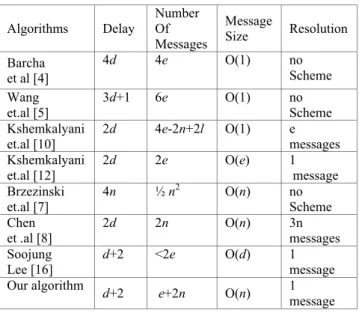
Table 1: Performance Comparison
Table 1 compares performance of different generalized deadlock detection algorithms. The message length of O(n) indicates that it consists of all node identifiers in the algorithms [7,8]. And the message used in the algorithms [12,15,16] and the proposed algorithm carries the unblocking functions to the initiator. However, the message length of these algorithms is differed due to the following reason. In the algorithm [16] the unblocking functions of nodes are merged as well as distributed during propagation of probes outward from the initiator whereas in [17], the unblocking function of each node is merged during the propagation of replies backwards to the initiator. As a result, the number of unblocking function in a reply grows as the message goes up in the spanning tree induced by the algorithm [12]. Similarly, if a node has exactly one successor, the number of unblocking conditions in a reply message is at most n-1 in the worst case in [16]. In contrast to [12, 16], the proposed algorithm sends an unblocking function of a node to the initiator disrespect the presence of deadlock and the number of successors of nodes in the WFG. In this conjuncture, the message length of proposed algorithm is a constant.
5
Conclusion
We presented a new algorithm to detect and resolve generalized deadlocks in distributed systems. The initiator of the algorithm collects the unblocking functions of all nodes in its reachable set exactly once. Then it arbitrarily simplifies the unblocking conditions depends on the reply from an active to determine deadlock. We proved the correctness of the algorithm. It has a time complexity of d+2 time units and worst case message complexity of e+2n messages hops delay to detect a deadlock. In addition, it finds out all nodes that are in deadlock with the initiator only if the initiator is deadlocked unlike the earlier algorithms. The performance of the proposed algorithm is better or
comparable with the existing algorithms in terms of time, message and data traffic complexities. Furthermore, it simplifies the deadlock resolution by minimizing the additional round of messages. The proposed algorithm is applicable to detect deadlocks in different domains of distributed systems design such as resource management in distributed operating systems, store and forward communication networks, communicating processes and replicated databases.
References
[1] E.Knapp. (1987), Deadlock Detection in Distributed
Database Systems, ACM Computing Surveys,
Vol.19, No. 4 pp.303-327.
[2] M,Singhal.(1989), Deadlock detection in distributed
systems. IEEE Computer, Vol.22, pp. 37–48.
[3] L.Lamport. (1978), Time, Clocks, and the ordering
of events in a distributed systems, ACM
Communications, vol 21, pp. 558-565.
[4] G.Bracha, and S.Toueg. (1987), A distributed algorithm for generalized deadlock detection,
Distributed Computing, Vol.2, pp.127–138.
[5] J.Wang, S.Huang, and N.Chen.( 1990), A distributed algorithm for detecting generalized deadlocks, Tech. Rep., Dept. of Computer Science, National Tsing-Hua Univ.
[6] W.K.Ng, and C.V.Ravishankar.(1994), On-Line Detection and Resolution of Communication
Deadlocks, Proc. 27th Ann. Hawaii Int’l Conf.
System Science, pp.524-533.
[7] J.Brzezinski, J.M.Helary, M.Raynal, and M.Singhal. (1995), Deadlock Models and a General
Algorithm for Distributed Deadlock Detection, J.
Parallel and Distributed Computing, Vol.31, pp.112-125.
[8] S.Chen, Y.Deng, P.C.Attie, and W.Sun.(1996), Optimal deadlock detection in distributed systems
based on locally constructed wait-for graphs,Proc.
Int’l Conf. Distributed Computing Systems, pp.613– 619.
[9] M.Roesler, and W.A.Burkhard.(1989), Resolution of Deadlocks in Object-Oriented Distributed
Systems, IEEE Trans. Computers, Vol. 38, No. 8,
pp.1212-1224.
[10] A.D.Kshemkalyani, and M.Singhal. (1989),
Efficient detection and resolution of generalized
distributed deadlocks, IEEE Transactions on
Software Engineering, Vol.20, pp. 43–54.
[11] A.D.Kshemkalyani, and M.Singhal.(1997),
Distributed detection of generalized deadlocks.
Proc. 17th Int’l Conf. Distributed Computing Systems, pp.553–560.
[12] A.D.Kshemkalyani, and M.Singhal. (1999), A One-Phase Algorithm to Detect Distributed Deadlocks in
Replicated Databases, IEEE Trans. Knowledge and
Data Eng., vol. 11, No. 6, pp. 880-895.
[13] S. Lee. and J.L. Kim.(1995), An Efficient
Distributed Deadlock Detection Algorithm,Proc. of
the 15th Int. Conference on Distributed Computing System, pp.169–178.
Algorithms Delay Number Of Messages
Message
Size Resolution Barcha
et al [4]
4d 4e O(1) no
Scheme Wang
et.al [5]
3d+1 6e O(1) no
Scheme Kshemkalyani
et.al [10] 2d 4e-2n+2l O(1) e messages Kshemkalyani
et.al [12] 2d 2e O(e) 1message
Brzezinski et.al [7]
4n ½ n2 O(n) no
Scheme Chen
et .al [8] 2d 2n O(n) 3n messages
Soojung Lee [16]
d+2 <2e O(d) 1
message
Our algorithm d+2 e+2n O(n) 1
[14] S.Lee, and J.L.Kim.(2001), Performance Analysis of Distributed Deadlock Detection Algorithms,
IEEE Trans. Knowledge and Data Eng., vol. 13, no. 4,pp. 623-636 .
[15] S.Lee.(2001), Efficient Generalized Deadlock Detection and Resolution in Distributed Systems,
Proc. 21st Int. Conference on Distributed
Computing Systems, pp. 47-54.
[16] S.Lee(2004), Fast, Centralized Detection and Resolution of Distributed Deadlocks in the
Generalized Model, IEEE Trans. on Software
Engineering, Vol. 30, No.9,pp.561-573.
[17] Nacer Farajzadeh, Mehdi Hashemzadeh, Morteza Mousakhani, Abolfazl T. Haghighat. (2005), An Efficient Generalized Deadlock Detection and
Resolution Algorithm in Distributed Systems,Proc
of the Fifth Int.Conference on Computer and Information Technology
[18] Hashemzadeh, M. Farajzadeh, N. Haghighat, A.T. (2006)., Optimal detection and resolution of distributed deadlocks in the generalized model,
Proc of th 14th Euromicro International Conference on Parallel, Distributed, and Network-Based Processing
[19] Srinivasan. S., Rajan Vidya, Rajaram Ramasamy. (2009), An Optimal, Distributed Deadlock
Detection and Resolution Algorithm for
Generalized Model in Distributed Systems, CCIS