Turkish Journal of Fisheries and Aquatic Sciences 10: 161-167 (2010)
www.trjfas.org ISSN 1303-2712 DOI: 10.4194/trjfas.2010.0201
© Published by Central Fisheries Research Institute (CFRI) Trabzon, Turkey in cooperation with Japan International Cooperation Agency (JICA), Japan
Sampling Efficiency of Gerking Sampler and Sweep Net in Pond Emergent
Littoral Macrophyte Beds – a Pilot Study
Jan Sychra1,*, Zdeněk Adámek2
1 Masaryk University, Faculty of ScienceKotlářská, Department of Botany and Zoology, 611 37 Brno, Czech Republic. 2 University of South Bohemia in České Budějovice, Faculty of Fisheries and Protection of Waters, Research Institute of Fish
Culture and Hydrobiology Vodňany, Laboratory Brno, Květná 8, 603 65 Brno, Czech Republic.
* Corresponding Author: Tel.: +420.532 146342; Fax:-;
E-mail: [email protected] Accepted 16 October 2009 Received 16 October 2008
Abstract
Modified Gerking box sampler is one of devices used for the collection of aquatic phytophilous macroinvertebrates. The presented modification consists of a metallic frame box and a movable cutter. It was constructed for sampling in hard emergent littoral macrophyte beds. In this pilot study, its efficiency was compared with a frequently used sweep net. Comparative sampling was performed in the same mesohabitat of hard emergent vegetation in littoral zones of three carp ponds during one season (late summer). Sampling with the frame box sampler was more labour consuming, but significantly (P<0.05) more effective in capturing slow-moving or sedentary animals such as gastropods, oligochaetes, leeches, water mites, and chironomid larvae. In contrast, fast-moving invertebrates (water bugs, chaoborid larvae) were significantly (P<0.05) less abundant in samples taken by the frame box compared with sweep net samples. The composition of macroinvertebrate fauna and total numbers of captured individuals varied between methods and among sampling sites. The results showed that the modified Gerking sampler is able to collect all principal higher taxa and, therefore, it is suitable for quantitative monitoring of macroinvertebrates in littoral zones of standing water bodies. Complementary sampling with a sweep net at the same localities is recommendable for better biodiversity assessment.
Keywords: Sampling methods, phytophilous macroinvertebrates, pond littoral.
Durgun Su Littoral Makrofit Bölgesinde Modifiye edilmiş Gerking Örnek Toplayıcı ve Swept netin (Trap) Örnekleme Etkinliği Üzerine Pilot Bir Çalışma
Özet
Modifiye edilmiş Gerking örnek toplayıcı, sucul fitofiloz makroomurgasızların toplanması amacıyla kullanılan bir alettir. Sistem, metal kasalı kutu ve hareketli bıçaklardan oluşmaktadır. Su üstü litoral makrofit yataklarında örneklem alınması için yapılmıştır. Bu çalışmada, Gerking örnek toplayıcının etkinliği ile sık kullanılan Trap’ın örneklem etkinliği ile karşılaştırılmıştır. Örneklemeler üç sazan havuzunun litoral bölgesinde bir mevsim boyunca (yaz sonu) su üstü vejetasyona ait mezohabitatta gerçekleştirilmiştir. Gerking örnek toplayıcı ile örnek toplamak için daha çok emek harcanmıştır. Bu örnek toplayıcı karındanbacaklılar, solucan, sülük, su kenesi ve kayronomid larvası gibi ağır hareket eden veya sedenter hayvanları
yakalamada daha etkin olmuştur (P<0,05). Trap ile alınan örneklerle karşılaştırıldığında hızlı hareket eden omurgasızlar (su böceği, chaoboridae larvası gibi) daha az yakalanmıştır (P<0,05). Makroomurgasız fauna kompozisyonu ve yakalanan bireylerin toplam sayısı, metotlar ve örneklem yerleri bakımından farklı bulunmuştur. Sonuç olarak Gerking örnek toplayıcı
ile yeterince örnek toplanabilmektedir. Durgun su kütlelerinin litoral kuşaklarında makroomurgasızların kantitatif olarak izlenmesi için uygundur. Daha iyi biyo-çeşitlilik değerlendirmesi yapmak için aynı bölgede Trap örneklemesi yapılması
gerekmektedir.
Anahtar Kelimeler: Örnekleme yöntemleri, sucul makroomurgasızlar, durgunsu kıyısal zonu.
Introduction
Phytophilous macroinvertebrates are an important component of standing water ecosystems and are usually associated with both submersed and emergent reed and other macrophyte beds in littoral zones. They are an important link in pond food chains
and their quantity and diversity can indicate the water body status (e.g., Dvořák and Imhof, 1998).
Studies of phytophilous invertebrates have focused mainly on communities linked to submersed plants [Elodea canadensis Michx., Potamogeton spp.
L., Myriophyllum spp. L., Ceratophyllum demersum
Kajak (1971), Dromgoole and Brown (1976), Downing (1984), Downing and Cyr (1985), Kornijów (1987)], while research on invertebrates associated with hard emergent macrophytes (Phragmites australis (Cav.) Steud., Typha angustifolia L., Typha
latifolia L.), which are very common in fishpond
littoral zones, is lacking (e.g., Kornijów and Kairesalo, 1994).
The shortage of such studies is perceived to be due to their labour and time consuming nature and the lack of standardized sampling methods. Taking samples of these aquatic plants can be extremely difficult because of problems connected with cutting hard stems from the substratum and because of the necessity for rapid capture of invertebrates (Kuflikowski, 1970). The majority of methods used for sampling of this habitat permit only semi-quantitative sampling (e.g., hand nets; Macan, 1977), or the sampling devices are overly complex (Gillespie and Brown, 1966; Kajak, 1971; Downing, 1984). Combining technical simplicity and ease of use with maximal quantitative accuracy, the Gerking frame box sampler with a movable cutter (Gerking, 1957) seems to be a suitable device. However, it was originally devised for soft aquatic plants. Many modifications of this sampler have been applied in studies on aquatic invertebrates, especially in America (e.g., Mittelbach, 1981). Most of them were used for sampling of zoobenthos (Zimmer et al., 2001), invertebrates associated with soft submersed macrophytes (Gates et al., 1987; Olson et al., 1995; Dibble and Harrel, 1997) or for sampling of nektonic animals outside of vegetation (Kaminski and Murkin, 1981). Only a few studies exist about Gerking frame box sampling in hard emergent macrophytes (Burton et al., 2002).
Detailed comparisons of efficiency among various types of samplers were reported (Gillespie and Brown, 1966; Kaminski and Murkin, 1981; Downing and Cyr, 1985; Muzaffar and Colbo, 2002; O´Connor et al., 2004; García-Criado and Triado, 2005) but most of these studies were conducted only on soft submersed macrophytes or sediments.
Although sweep net sampling is typically qualitative or semi-quantitative, the use of this method is common for research in aquatic habitats (e.g., García-Criado and Trigal, 2005). Hence, it is appropriate to compare the sampling efficiency of frame box sampling with commonly used sweep net sampling. The importance of quick and simple sampling methods is evident, especially in connection with the recent implementation of the Water Framework Directive (Directive, 2000/60/EC). For this purpose, the aim of this pilot study was to compare sampling efficiency of a modification of the Gerking sampler for macroinvertebrate sampling in hard reed beds, which is not commonly used in central Europe, to a sweep net.
Material and Methods
Sampler Description
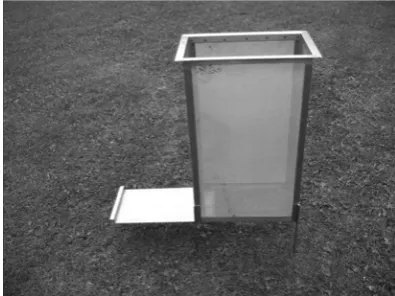
The modified Gerking frame box comprises of an open metal frame (height 75 cm, base 25X45 cm inside dimensions) and a movable cutter. Three sides are fitted with 500 μm mesh; the fourth is a sheet metal. The base frame corners are fitted with sharpened poles for fixing the sampler into the substratum. Slots for the movable cutter are positioned along the long edges of the base (Figure 1).
Sampling Procedure
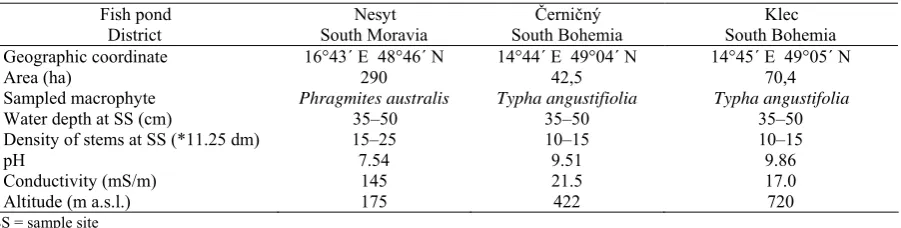
Sampling was performed in marginal macrophyte bed areas of the littoral zones of three carp ponds in Czech Republic (Nesyt, Černičný and Klec ponds; for characteristics of sampled ponds see Table 1). Sample sites with identical water depth (35– 50 cm) and density of macrophyte stems (Table 1) were chosen. Five samples were taken from each of the ponds. Only one sampling season was chosen for this pilot study. Sampling was performed in late summer (August, 2006) when the biomass of both the macrophyte beds and macroinvertebrate communities
is usually high (Květ and Westlake, 1998; Dvořák and Imhof, 1998; Fishar and Williams, 2006). Comparative sampling (n = 15) was conducted using the frame box sampler (25X45 cm) and a sweep net (25X35 cm) in areas of the same size (25X45 cm) and in an identical mesohabitat of submersed parts of emersed macrophytes in the water column (excluding the root zone).
At each sample site, the upper, emersed, parts of the sampled macrophyte bed were first cut off, to allow positioning of the box. This had to be performed cautiously to avoid escaping of fast-moving animals. Then, the frame box sampler was immersed to the substratum (with the cutter blade retracted). The cutter blade was then quickly pushed into place at the pond substratum level. It was often necessary to kick the cutting blade into position. Where necessary, for more effective cutting of the vegetation, sharp shears were used inside the sampler. The cut reed stems were broken apart, the sampler was removed from the water and the contents poured out over the sheet metal side into a stainless steel 500 μm mesh sieve. Samples were sieved to remove fine organic and inorganic particles and the retained animals and organic debris transferred to a sample bottle and fixed in 4% formaldehyde. The complete procedure with the frame box sampler took approximately 15–20 min per sample. Sweep net sampling was performed among reed stems in comparable area and it took about 30 seconds for each sample. Samples taken by the sweep net were processed in the same way as samples taken by the frame box.
In the laboratory, macroinvertebrates were sorted and grouped into higher taxonomic categories. Dominant invertebrates were identified to species (e.g., Rozkošný, 1980). Only higher taxa were used for statistical analysis.
Statistical Analysis
Mann–Whitney U test was used for the detection of significant differences between sampling efficiencies of the two methods. All samples were evaluated paired for each taxon. Numbers of collected animals were considered in relative proportions. The total number of individuals of taxon i from samples
F1 (frame box) and N1 (sweep net) from the same sampling site corresponded to 100%, and taxon i percentages in each sample were used for the analysis.
Results
Thirteen higher invertebrate taxa were captured by both sampling methods (Table 2). The most numerous were gastropods (e.g., Gyraulus spp.,
Lymnaea stagnalis L., Radix peregra O.F.Müller,
Acroloxus lacustris L.), oligochaetes (especially
Stylaria lacustris L.), leeches (e.g., Helobdella
stagnalis L., Erpobdella octoculata L.), water mites (Hydrachnellae), mayfly nymphs (Cloeon dipterum
L., Caenis spp.), caddisfly larvae (e.g.,
Limnephillidae), water bugs (e.g., Sigara spp., Micronecta scholtzi Fieber, Plea minutissima Leach), and chaoborid and chironomid larvae.
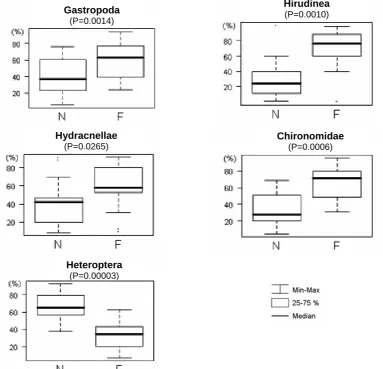
Mann–Whitney U test on percentages of nine main recorded macroinvertebrate groups confirmed that the frame box sampler collected significantly more gastropods, oligochaetes, leeches, water mites and chironomid larvae (P<0.05 in all groups; see Figure 2 and Figure 3) than the sweep net. Oligochaetes were significantly (P<0.05) more abundant in frame box samples at Nesyt pond, whilst at the other ponds they were almost absent. On the contrary, there were significantly (P<0.05) fewer water bugs and chaoborid larvae (these were present in appreciable numbers only at Černičný pond) in frame box samples compared to sweep net samples (Figure 2 and Figure 3). The numbers of captured animals from the remaining macroinvertebrate groups (Ephemeroptera, Trichoptera) were comparable for both sampling devices (P>0.05).
The composition of macroinvertebrate fauna and the total number of individuals captured varied between the two sampling methods, and also among the sampled ponds (Table 2). The number of animals caught was comparable for both sampling devices only at Klec fishpond, which was relatively poor in macroinvertebrates. Conversely, at Nesyt fish pond, the frame box was more effective, especially regarding the numbers of oligochaetes and chironomid larvae in samples. At Černičný fish pond, chaoborid larvae were dominant, and the sweep net Table 1. The main characteristics of sampled fish ponds
Fish pond District
Nesyt South Moravia
Černičný South Bohemia
Klec South Bohemia Geographic coordinate 16°43´ E 48°46´ N 14°44´ E 49°04´ N 14°45´ E 49°05´ N
Area (ha) 290 42,5 70,4
Sampled macrophyte Phragmites australis Typha angustifiolia Typha angustifolia
Water depth at SS (cm) 35–50 35–50 35–50
Density of stems at SS (*11.25 dm) 15–25 10–15 10–15
pH 7.54 9.51 9.86
Conductivity (mS/m) 145 21.5 17.0
Altitude (m a.s.l.) 175 422 720
Table 2. Composition of the macroinvertabrate fauna (%) and number of individuals captured by frame box and sweep net-mean from 5 sample sites at each pond
Nesyt
Mean % from 5 SS Mean % from 5 SS Černičný Mean % from 5 SS Klec Taxonomic Group
F N F N F N
Gastropoda 5.7 3.4 9.2 2.6 12.9 10.3
Oligochaeta 34.1 13.3 0.2 0.7
Hirudinae 1.8 1.2 23.1 2.0 15.7 2.4
Isopoda 1.1 1.7 0.2 0.5
Hydrachnellae 4.1 1.6 10.2 1.9 7.7 9.0
Ephemeroptera 5.2 11.2 11.8 4.0 5.8 2.8
Odonata 0.4 0.7 0.3 0.1 0.8 1.5
Heteroptera 11.1 39.5 12.3 6.7 22.7 61.5
Coleoptera 0.1 1.7 0.3 1.0 1.0
Trichoptera 3.0 2.7 0.1 0.1 4.8 5.1
Chironomidae 33.6 26.3 1.4 0.5 27.3 4.9
Chaoboridae 23.4 8.15 0.2 0.5
Other diptera 4.2 <0.1 0.7 0.5
Total no of individuals 2369 1547 1801 6003 607 613 SS: Sample sites, F: Frame box sampler, N: Sweep net
Figure 2. Comparison of percentage of individuals in each macroinvertebrate group caught by sweep net (N) and by modified Gerking frame box sampler (F) at identical sampling points in littoral zones of three fishponds (n = 15); Mann-Whitney U Test.
Heteroptera (P=0.00003)
Chironomidae (P=0.0006) Hydracnellae
(P=0.0265) Gastropoda
(P=0.0014)
was more successful. Oligochaetes and chaoborid larvae were more abundant only at one sample site each (Table 2).
Discussion
Macroinvertebrates living in association with aquatic macrophytes in wetlands and fishponds often create more diversified assemblages than other assemblages in these ecosystems, such as those of benthic or planktonic organisms (Gerking, 1957; Dvořák, 1978; Dvořák and Imhof, 1998). Our sampling of the mesohabitat of hard emergent macrophyte beds by two different methods recorded high diversity of macroinvertebrates. Although the collected animals were not identified to species, 13 groups of higher taxa were recorded. Identical groups were captured by the frame box and the sweep net. Similarly, García-Criado and Trigal (2005) found nearly no differences in terms of macroinvertebrate taxonomic composition between samples taken by quantitative and semi-quantitative methods used in submerged macrophytes.
In samples from both sampling devices, the captured macroinvertebrates were probably inhabitants of both reed stems and a surface layer of sediments. This was due to quick manipulation with the frame box and the sweep net, and due to difficult separation of these fractions by both used devices. However, the separation of benthic and epiphytic animal communities was the original idea of using Gerking sampler (Gerking, 1957).
Differences among sampled ponds were probably the result of variations in physico-chemical characteristics and mesohabitat conditions of each pond. Higher diversity of invertebrates at Nesyt and Černičný ponds could be connected with more extensive littoral emergent plant beds at these two
ponds (Butler and de Maynadier, 2008). However, these aspects were not the subject of this study.
Analysis of sampling efficiency on separate groups of invertebrates showed significant differences between the two methods. The Gerking frame box sampler was more successful in capturing slow-moving or sedentary animals. This was enhanced by cutting off and rinsing of the whole reed stalks during the sampling procedure, since their surface (gastropods, leeches, water mites) and interior (oligochaetes, chironomid larvae) represent a typical habitat of these phytophilous invertebrates (Ward, 1992; Dvořák and Imhof, 1998). Many important and commonly dominant taxa of aquatic macroinvertebrate communities, such as oligochaetes and chironomid larvae, are among those living in and on reeds (e.g., Downing and Cyr, 1985). Hence, the use of the frame box sampler in studies in emergent macrophyte beds in aquatic mesohabitats seems appropriate.
Due to their ability to escape during the initial cutting of emersed parts of reed stalks, fast-moving animals, especially corixids, occurred in lower numbers in the frame box samples. The same result stated also by O´Connor et al. (2004) in Irish turloughs. This can influence the assessment of macroinvertebrate diversity at investigated localities. The comparison between Gerking frame box and the sweep net sampling of nektonic invertebrates was performed by Kaminski and Murkin (1981) and revealed similar efficiency. Cheal et al. (1993) found that core samplers were less effective in capturing fast-swimming invertebrates when compared with tow and sweep nets. The same authors documented the importance of nekton, in which category belong also corixids and chaoborid larvae, within the shallow wetland macroinvertebrate communities. O´Connor et al. (2004) stated that the box method captured more Figure 3. Comparison of percentages of individuals in each macroinvertebrate group caught by sweep net (N) and by modified Gerking frame box sampler (F) at identical sampling points in littoral zones of the Nesyt (Oligochaeta) and the
Černičný (Chaoboridae) fishponds (n = 5); Mann-Whitney U Test.
Oligochaeta
(P=0.0090)
taxa than a pond-net and it was successful especially in sampling aquatic beetles in dense vegetation. Other additional suitable method for capturing fast-moving invertebrates (e.g., corixids, beetles) is activity traps (Hyvönen and Nummi, 2000; Becerra Jurado et al., 2008), which are more successful especially in dense stands of emergent vegetation and enable better estimation of biodiversity at study sites (Becerra Jurado et al., 2008). Using activity traps in fishpond littorals together with both compared methods seems to be very recommendable.
Gerking frame box sampler demonstrated its suitability for quantitative sampling in hard emergent vegetation of pond littorals, although it is a more labour consuming method compared to sweep netting (also O´Connor et al., 2004). Sweep net is usually recommended as a better sampling method for capture more macroinvertebrate taxa than other techniques (Cheal et al., 1993, García-Criado and Trigal, 2005). In present study, both the frame box and sweep net captured identical higher taxa of macroinvertebrates and, moreover, the frame box sampler was able to provide quantitative data. However, comparison between these two methods requires further research targeted on lower invertebrate taxa.
The partial under-reporting of free swimming macroinvertebrates can be reduced by adopting a careful and rapid procedure for positioning the frame box, cutting the stems, and closing the sampler. When properly performed, quantitative sampling with the frame box sampler combined with qualitative sampling by a sweep net and with semi-quantitative sampling by activity traps eventually, fully covers the requirements for evaluation of phytophilous aquatic macroinvebrate assemblages in hard emergent macrophyte beds (similarly also O´Connor et al., 2004).
Generally, disadvantages of frame box methods are more labourious sampling, the destruction of sampled macrophyte beds and lower success at capture of fast-moving invertebrates. Also the cutting of reed stalks above the substratum is relatively difficult and sampling is more effective in open stands. The other limiting factor of the investigated method is water depth, since its use in deeper water sites is precluded.
On the other hand, the advantage of the modified Gerking frame box sampler with movable cutter lies in the acquisition of quantitative samples of phytophilous aquatic macroinvertebrates in hard emergent vegetation using relatively simple equipment. This method is comparable to currently used sweep netting with regard to the capture of all principal higher macroinvertebrate taxa, with better capability for slow-moving or sedentary animals capturing. Further research targeted on lower taxa of captured invertebrates and seasonal differences is necessary.
Acknowledgements
This study was supported by the grants FRVŠ no. 648/2006, GA ČR 524/05/H536, SP/2d3/209/07 and by the Ministry of Education of the Czech Republic (projects no. MSM 6007 665 809 and MSM 0021 622 416).
References
Becerra Jurado, G., Masterson, M., Harrington, R. and Kelly-Quinn, M. 2008. Evaluation of sampling methods for macroinvertebrate biodiversity estimation in heavily vegetated ponds. Hydrobiologia, 597: 97– 107.
Burton, T.M., Stricker, C.A. and Uzarski, D.G. 2002. Effects of plant community composition and exposure to wave action on invertebrate habitat use of Lake Huron coastal wetlands. Lakes and Reservoirs: Research and Management, 7: 255–269.
Butler, R.G. and de Maynadier, P.G. 2008. The significance of littoral and shoreline habitat integrity to the conservation of lacustrine damselflies (Odonata). J. Insect Conserv., 12: 23–36.
Cheal, F., Davis, J.A., Growns, J.E., Bradley, J.S. and Whittles, F.H. 1993. The influence of sampling method on the classification of wetland macroinvertebrate communities. Hydrobiologia, 257: 47–56.
Dibble, E.D. and Harrel, S.L. 1997. Largemouth bass diets in two aquatic plant communities. J. Aquat. Plant Manage., 35: 74–78.
Directive 2000/60/EC. Establishing a framework for community action in the field of water policy. European Commission PE-CONS 3696/1/100 Rev 1. Luxembourg.
Downing, J.A. 1984. Sampling the benthos of standing waters. In: J.A. Downing and F.H. Rigler (Eds.), A Manual on Methods for the Assessment of Secondary Productivity in Fresh Waters, IBP Handb. No. 17, 2nd
edition, Blackwell Scientific Publications, Oxford: 87–130.
Downing, J.A. and Cyr, H. 1985. QuantitativeEstimation of Epiphytic Invertebrate Populations. Can. J. Fish. Aquat. Sci., 42: 1570–1579.
Dromgoole, F.I. and Brown, J.M.A. 1976. Quantitative grab sampler for dense beds of aquatic macrophytes. N. Z. Journal of Marine and Freshwater research, 10: 109– 118.
Dvořák, J. 1978. Macrofauna of invertebrates in helophyte communities. In: D. Dykyjová and J. Květ (Eds), Pond Littoral Ecosystems. Structure and Functioning. Ecological Studies, Springer Verlag, New York: 28: 389–392.
Dvořák, J. and Imhof, G. 1998. The role of animals and animal communities in wetlands. In: D.F. Westlake, J. Květ and A. Szczepański (Eds), The Production Ecology of Wetlands. The IBP Synthesis, Cambridge University Pres, Cambridge: 211–318.
Fishar, M.R. and Williams, W.P. 2006. A feasibility study to monitor the macroinvertebrate diversity of the River Nile using three sampling methods. Hydrobiologia, 556: 137–147.
different habitats of a North Iberian pond. Hydrobiologia, 545: 103–115.
Gates, T.E., Baird, D.J., Wrona, F.J. and Davies, R.W. 1987. A device for sampling macroinvertebrates in weedy ponds. J. N. Am. Benthol. Soc., 6: 133–139. Gerking, S.D. 1957. A method of sampling the littoral
macrofauna and its application. Ecology, 38: 219– 226.
Gillespie, D.M. and Brown, C.J.D. 1966. A quantitative sampler for macroinvertebrates associated with aquatic macrophytes. Limnol. Oceanogr., 11: 404– 406.
Hyvönen, T. and Nummi, P. 2000. Activity traps and the corer: complementary methods for sampling aquatic invertebrates. Hydrobiologia, 432: 121–125.
Kajak, Z. 1971. Benthos of standing water. In: W.T. Edmondson and G.G. Winberg (Eds.), A Manual on Methods for the Assessment of Secondary Productivity in Fresh Waters. IBP Handb. 1st Edn.,
Blackwell Scientific Publications, Edinburgh: 25–65. Kaminski, R.M. and Murkin, H.R. 1981. Evaluation of two
devices for sampling nektonic invertebrates. J. Wildl. Manage., 45: 493–496.
Kornijów, R. 1987. Nowy typ aparatu do pobierania próbek fauny zasiedlajacej elodeidy. [New type of apparatus for sampling fauna inhabiting the elodeids]. Wiadomośći ekologiczne, 33: 175–178. (In Polish with English summary)
Kornijów, R. and Kairesalo, T. 1994. A simple apparatus for sampling epiphytic communities associated with emergent macrophytes. Hydrobiologia, 294: 141–143. Kořínková, J. 1971. Sampling and distribution of animals in submerged vegetation. Věstník Českoslov. Spol. Zool., 35: 209–221.
Kuflikowski, T. 1970. Fauna in vegetation in carp ponds at Goczalkowice. Acta Hydrobiol., 12: 439–456.
Květ, J. and Westlake, D.F. 1998. Primary production in wetlands. In: D.F. Westlake, J. Květ and A. Szczepański (Eds), The Production Ecology of Wetlands. The IBP Synthesis, Cambridge University Pres, Cambridge: 78-168.
Macan, T.T. 1977. A twenty-year study of the fauna in the vegetation of a moorland fishpond. Arch.Hydrobiol., 81: 1-24.
Mittelbach, G.G. 1981. Patterns of invertebrate size and abundance in aquatic habitats. Can. J. Fish. aquat. Sci., 38: 896-904.
Muzaffar, S.B. and Colbo, M.H. 2002. The effects of sampling technique on the ecological characterization of shallow, benthic macroinvertebrate communities in two Newfoundland ponds. Hydrobiologia, 477: 31-39. O´Connor, A.O., Bradish, S., Reed, T., Moran, J., Regan,
E., Visser, M., Gormally, M. and Skeffington, M.S. 2004. A comparison of the efficacy of pond-net and box sampling methods in turloughs - Irish ephemeral aquatic systems. Hydrobiologia, 524: 133-144. Olson, M.H., Mittelbach, G.G. and Osenberg, C.W. 1995.
Competition between predator and prey: resource-based mechanisms and implications for stage-structured dynamics. Ecology, 76: 1758-1771. Rozkošný, R. (Ed.) 1980. Klíč vodních larev hmyzu. (The
determination key on aquatic insect larvae.) ČSAV, Academia, Praha, 521 pp.
Ward, J.V. 1992. Aquatic Insect Ecology. 1. Biology and Habitat. John Wiley and Sons, Inc., New York, Chichester, Brisbane, Toronto, Singapore, 456 pp. Zimmer, K.D., Hanson, M.A., Butler, M.G. and Duffy,