Copyright © 2013 IJECCE, All right reserved
Enhancing the Search Results through Web Structure
Mining Using Frequent Pattern Analysis and Linear
Correlation Method
M. Krishna Kumar
PG, M.E-Software Engineering, Department of IT Rajalakshmi Engineering College Email: [email protected]
Dr. S. Poonkuzhali
Professor & Head, Department of ITRajalakshmi Engineering College Email: [email protected]
Abstract – In this e-world, information is growing at an enormous rate due to voluminous amount of data is updated every day on the WWW. Moreover the popularity of web grows immensely as it covers wide spectrum in all domains ranging education, business, health, retail and surveillance. As the web serves as a connected medium to propagate information quickly with less cost, everyone depends on the WWW for retrieving relevant information for strategic decision making as well for their day to day operations. During these information retrieval, most of the users loss temper in navigating more number of links without getting the exact information catering to their needs. These issues create an interest among researchers to work on the area of Web mining. Generally, web mining is categorized into web content mining, web structure mining and web usage mining. This research work mainly focuses on web structure mining to retrieve the relevant links through frequent pattern analysis and linear correlation method. In this proposed work, based on the user query adjacency matrix is constructed for the extracted documents (links) and then parent document(link)) among these input documents is found out using frequent pattern analysis . Then statistical algorithm based on linear correlation is applied between the parent document and the remaining input document to rank the relevant links. The experimental results revealed that the performance of proposed approach in terms of precision and accuracy is high which improves the quality of search results..
Keywords – Adjacency Matrix, Correlation Coefficient, Frequent Pattern, Linear Correlation, Ranking, Relevant Links.
I. I
NTRODUCTIONIn recent years, the development of WWW is tremendous due to its dynamic nature and heterogeneous. Therefore all types of users ranging from novice to experts make use of this web repository for publishing as well as retrieving information. But in this process, most of their precious time is wasted in navigating several links to get their required information. Thus developing effective algorithm for retrieving the relevant links without accessing the complete data on the outset has become an important concern among the Web mining research communities. Web mining consists of Web usage mining, Web structure mining, and Web content mining. Web usage mining refers to the discovery of user access patterns from Web usage logs. Web structure mining tries to discover useful knowledge from the structure of hyperlinks which helps to investigate the node and connection structure of web sites. Hyperlinks are very
important components of Web documents. In hard copy documents in a library, the documents are usually structured (e.g. books) and they have been catalogued by cataloguing experts. No linkage between these documents is identified except that two documents may have been catalogued in the same classification and therefore deal with similar topics. However, getting website to rank for specific keywords can be tricky. There are essentially 3 elements that a search engine considers when determining where to list a website on the Search Engine Rank Pages (SERP): rank, authority, and relevance.
The World Wide Web (WWW) is the set of all the nodes which are interconnected by hypertext links. A link expresses one or more relationships between two or more resources. Links may also be establishes within a document by using anchors. A Web page is a collection of information, consisting of one or more Web resources, intended to be rendered simultaneously, and identified by a single URL. A directed graph as a set of nodes (pages) denoted by V and edges (links) denoted by E. Thus a graph is (V,E) where all edges are directed, just like a link that points from one page to another, and may be considered an ordered pair of nodes, the nodes that thy link. An undirected graph also is represented by nodes and edges (V, E) but the edges have no direction specified. Therefore an undirected graph is not like the pages and links on the Web unless we assume the possibility of traversal in both directions. The structure of a typical Web graph consists of Web pages as nodes, and hyperlinks as edges connecting related pages. Web Structure Mining is the process of discovering structure information from the Web.
This paper structured as follows, section2 present related works on web mining and web structure mining, section3 Materials and methods of the proposed system, section4 present result and discussion, section5 present performance evaluation, finally section6 presents conclusion.
II. R
ELATEDW
ORKSlarge amount of structured data; graph mining has become an active and important theme in data mining. Bogdanov [12] studied Graph searching, indexing, mining and modeling for Bioinformatics, chemo informatics and Social network.
Lam and Chan [13] developed graph data mining algorithm MIGDAC (Mining graph data for classification) which is applied to biological graph data set.
Hung-yu et al[2] proposed an intra page informative structure mining system called WISDOM (Web Intra page Informative Structure Mining Based on Object Model) which applies Information Theory to DOM tree knowledge in order to build the structure.
S.Jeyalatha and B.Vijayakumar [4] proposed Web Structure Mining, using the Breadth First Search strategy. Hung-yukao et al[3] developed entropy based analysis for analysing the entropy of anchor text and links to eliminate the redundancy of the hyperlink structure so that the structure of website can be distilled.
Sekharbabuboddu et al [9] reviewed two popular method HITS and Page Rank based on the availability of the information in the www as becoming one of the most valuable resources for information retrieval and knowledge discovery’s using web mining technologies.
Chun-hung Li and Chui-chunKitOn[1]implemented web structure mining algorithm through automative extraction of navigational structure from a web site based on the usage instead of HyperText analyses. YongheNiu et al [14] developed webkiv tool for visualizing the web mining result.
Ling Wan and Si-XueBai[7] proposed the traditional PageRank algorithm for calculating the degree of the Web pages using sub-curve fitting through studying and changing the time activity curve of web sources.
Lili yan et al[5] proposed a web structure mining algorithm which computes a set of PageRank vectors, biased using a set of representative topics in order to provide more accurate search results. They also gave a brief introduction to the relationship between Hyperlinks and page content. Huan et el. developed a new algorithm which mines only maximal frequent subgraphs[10] that is subgraph, that are not a part of any other frequent subgraphs. This algorithm can achieve a five-fold speed up over the current state-of-the-art subgraph mining algorithms. This mining method is based on a novel graph mining framework in which they first mine all frequent tree patterns from a graph database and then construct maximal frequent sub graphs from trees.
III. A
RCHITECTURE OFT
HEP
ROPOSEDS
YSTEMIn the proposed system, first user query is pre-processed and its root keywords are stored in the domain dictionary. Based on the user query, input documents (web links) are extracted from the Google search engines. Next, all the extracted links are pre-processed namely stop words removal, stemming and tokenization. For each document, words that are matched with keywords stored in domain dictionary alone are taken for constructing adjacency
matrix. Then frequent pattern analysis is done on these adjacency matrix using strong association rules with the minimum support threshold of 75% to find the parent document (Dp).
Followed by that, linear correlation is done with parent document with the remaining input documents. If the correlation coefficient value (Ri) is equal to ‘1’ then Diis
strongly relevant, if the Ri is greater than 0.5 then Di is
relevant to user query. If the correlation coefficient value (Ri) is less than 0.5 then Diis weakly relevant or irrelevant
to user query. All the documents whose correlation coefficient value greater than 0.5 are ranked by sorting them in descending order.Finally, top ‘n’ relevant documents (links) are returned to user.
A. Query processing
The query processing is where the user gives the input query. Based on that query the documents are retrieved from the search engine. Most of the documents retrieved from the search engine may or may not be relevant to the user query.
B. Pre-processing
This process includes various sub processes like stop word elimination, stemming process, key term selection.
1) Stop word elimination
First we remove all stop words. Stop words are the words which don’t have meaning with respect to the classification. So these words are removed when the key term is created for the classification purpose. In short the words are removed from the documents which are not necessary for the next stage. Stop words are “a”, “an”, “the”, “was”, “were” etc. Along with all removed prepositions, conjunction and articles from the data set D.
2) Stemming process
After stop words elimination, the stemming process will be applied. The stemming process is elimination of prefixes and suffixes. The objective is to remove the variation that arises from the amount of different grammatical forms of the similar word. The stanching process helps to decrease the size of the data dictionary file.
3) Key term selection
Key term selection is the process of breaking a stream of text up into words, phrases, symbols, or other meaningful elements called key term. The list of key term becomes input for further processing.
C. Term frequency
Copyright © 2013 IJECCE, All right reserved Fig.1 Architecture design of the proposed system
Algorithm for Web Structure Mining Input : User Query, Domain Dictionary
Method : Frequent Pattern Analysis & Linear Correlation Output : Relevant Links
Step 1: Extract input document (links) based on user query.
Step 2: Pre-process the user query and store its root word Wkin a separate file.
Step 3: Pre-process all the extracted input Links and store in the Hash table.
Step 4: Construct Adjacency Matrix.
4.1 (a) Let Dibe the document andWj
Be the words. (1<=i<=n , 1<=j<=m) ntotal no. of documents,
mtotal no. of words.
(b)TF[Wj] represents Term Frequency of Wj.
M [Di, Wj] represents the adjacency
matrix.
4.2 If Wiequals Wkthen // Wk– words in user
query.
M [Di,Wj] =TF[Wj]
Else
M [DiWj]=0;
Repeat step 4.2 for all documents. Step 5: Extract the parent document (Dp)
Using the frequent itemsets analysis From the M[DiWj] based on minimum
Step 6: Compute linear correlation coefficient (Ri) between the parent document
(Dk) with the remaining input
Documents Di.
= ( ) ( )( )( )( ) ( )
Where x represents the parent documents Dk
y represents the Input documents Di
n represents the number of documents. Step 7: If Ri==1 then
Diis strongly relevant
Else if Ri>= 0.5 then
Diis relevant document.
Else if Ri< 0.5 then
Di is irrelevant or weakly relevant Step 8: Rank the documents in descending
Order whose correlation coefficient (Ri) value is greater than 0.5
Step 9: Display the top “n” relevant
Documents (links) based on user query
IV. R
ESULT ANDD
ISCUSSIONLet us consider the user query “web structure mining using graph theory”. After pre-process the user query contains 5 root words Wknamely, W1-Web, W2-structure,
W3-mining, W4-graph and W5- theory. The top ten web
links is extracted from Google search engine based on this user query are listed in Table 1.
Table 1: Input web links based on user query Documents
No.
Input Web Links
D1 Web mining - Wikipedia, the free encyclopedia
D2 Analyzing web layout structures using graph
mining
D3 Web Mining - IASRI
D4 Web Structure Mining - Zhe's Reaction Blog
D5 Model-Based Classification of Web Documents
Represented by ...
D6 Web Data Identification and Extraction
-International Journal of ... D7 Graph structure in the web
D8 Web Mining using Semantic Data Mining
Techniques
D9 Web Mining Functions in an Academic Search
Application
D10 Web site structure mining using social network
analysis | DeepDyve
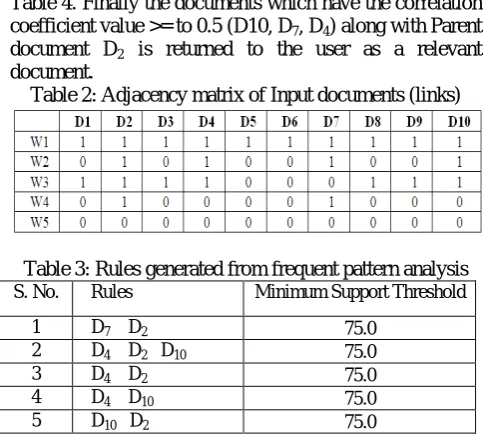
After pre-processing these extracted links, each word is indexed and its corresponding term frequency is calculated. Then the adjacency matrix n x m matrix is computed, where ‘n’ represents root words taken from user query and ‘m’ represents the number of web links and is given in Table 2. Then frequent pattern algorithm is applied on this adjacency matric to retrieve the parent document which is found in most of the association rules having support count equal or greater than 75%.
Here, after frequent pattern analysis, 593 rules have been generated with the support count of 50%. From these rules, 5 rules have been filtered after applying minimum support threshold of 75% and is listed in Table 3. Among
these 5 rules document D2is considered as frequent item
set as it appears in 4 rules. Hence D2is taken as the parent
document for performing Linear Correlation with the remaining input documents and its ranking is given in Table 4. Finally the documents which have the correlation coefficient value >= to 0.5 (D10, D7, D4) along with Parent
document D2 is returned to the user as a relevant
document.
Table 2: Adjacency matrix of Input documents (links)
Table 3: Rules generated from frequent pattern analysis
S. No. Rules Minimum Support Threshold
1 D7 D2 75.0
2 D4 D2 D10 75.0
3 D4 D2 75.0
4 D4 D10 75.0
5 D10 D2 75.0
Table 4: Ranking of input documents based on correlation coefficient
Doc. No.
Correlation Coefficient(R)
Rank Ranked Web documents
D10 0.6124 1 Web site structure mining using
social network analysis | DeepDyve D7 0.6124 2 Graph structure in the web
D4 0.6124 3 Web Structure Mining - Zhe's
Reaction Blog
D1 0.4082 4 Web mining - Wikipedia, the free
encyclopedia
D8 0.4082 5 Web Mining using Semantic Data
Mining Techniques D3 0.4082 6 Web Mining - IASRI
D9 0.4082 7 Web Mining Functions in an
Academic Search Application D5 0.2500 8 Model-Based Classification of Web
Documents Represented by ... D6 0.2500 9 Web Data Identification and
Extraction - International Journal of
A. Performance analysis
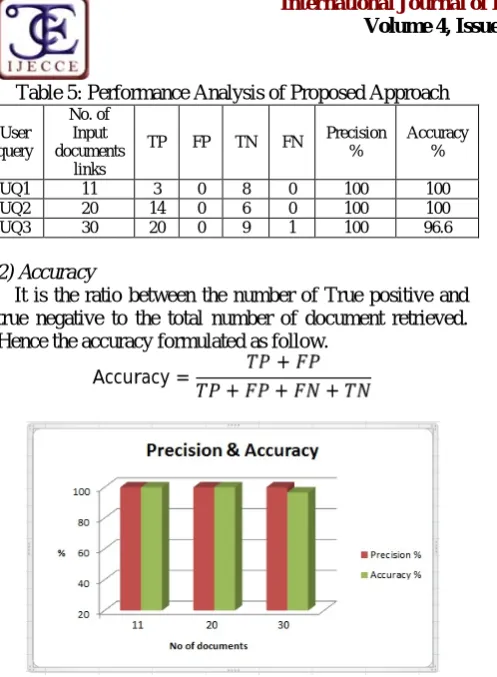
The performance analysis is done to evaluate the proposed approach in terms of precision and accuracy. For this evaluation purpose documents extracted using three user queries(UQ) namely, UQ1 “ web structure mining using graph theory “, UQ2 “web content outlier mining “ and UQ3“image processing application in remote sensing “ from the Google search engines is analyzed and its results are presented in Table 5 and in Fig. 2.
1) Precision
It is the ratio between the number of relevant documents returned originally and the total number of retrieved documents returned after eliminating irrelevant documents. Here the relevant documents indicate the required documents which satisfy the user needs.
Copyright © 2013 IJECCE, All right reserved Table 5: Performance Analysis of Proposed Approach
User query
No. of Input documents
links
TP FP TN FN Precision %
Accuracy %
UQ1 11 3 0 8 0 100 100
UQ2 20 14 0 6 0 100 100
UQ3 30 20 0 9 1 100 96.6
2) Accuracy
It is the ratio between the number of True positive and true negative to the total number of document retrieved. Hence the accuracy formulated as follow.
Accuracy = + ++ +
Fig.2. Performance evaluation of proposed approach
V. C
ONCLUSIONThe popularity of World Wide Web has received a tremendous attention by majority of the people to find and retrieve relevant information for various purposes. Therefore, most of the researchers pay attention to web structure mining for extracting relevant links. The Proposed approach gives far better results compared with search-result ranking. However, more fine tuning process to be needed to bring the best result. Proposed methodology focus only on keyword based mining to rank the relevancy of the web links where nowadays relevant information may be available in any format like images, audio and video files. Forth coming research work will focus on all types of data sets.
R
EFERENCES[1] Chun-hung Li and Chui-chun Kit “Web Structure Mining for Usability Analysis” ACM International Conference on Web Intelligence(WI’05), IEEE, 2005.
[2] Hung-Yu Kao, and Jan-Ming Ho” WISDOM: Web Intrapage Informative Structure Mining Based on Document Object Model”IEEE Transactions on knowledge and data engineering, Vol. 17, No. 5, 2005.
[3] Hung-Yu Kao, and Shian-Hua Lin “Mining Web Informative Structures and Contents Based on Entropy Analysis” IEEE Transactions on knowledge and data engineering, Vol. 16, No.1, pp. 44-55, 2004.
[4] Jeyalatha.S, and Vijayakumar Design. B “Implementation of a Web Structure Mining Algorithm using Breadth First Search Strategy for Academic Search Application” 6th International
Conference on Internet Technology and Secured Transactions, Abu Dhabi, United Arab Emirates,pp648-654,2011.
[5] Lili Yan and Yingbin Wei and ZhanjiGui “Research on PageRank and Hyperlink-Induced Topic Search in Web StructureMining”IEEE, 2011.
[6] Padre Tomás and, Av., Taipa, Macao, S.J andS.A.R., China” Web Structure Mining: An Introduction” International Conference on Information Acquisition, pp.590-595, 2005. [7] Ramesh Prajapati, “A Survey Paper onHyperlink‐Induced Topic
Search (HITS) Algorithms for Web Mining” International Journal of Engineering Research and Technology (IJERT), ISSN: 2278-0181, Vol. 1 Issue 2, pp. 13-20, 2012.
[9] Rajput, D.S ,R.S. Thakur and G.S. Thakur “Rule Generation from Textual Data by using Graph based Approach” International Journal of Computer Applications, Volume 31– No.9, 2011.
[10] Sekhar Babu Boddu, V.P et al “Knowledge Discovery and Retrieval on WorldWide Web Using Web Structure Mining” Fourth Asia International Conference on Mathematical, Analytical Modelling and Computer Simulation, pp.532-537, 2010.
[11] TANAGRA1.4.48: data mining with open source machine learning software.
[12] Winnie W.M. Lam and Keith C. C. Chan, “Analyzing Web Layout Structures usingGraph Mining” IEEE, 2010.
[13] Xifeng Yan, Philip S. Yu and Jiawei Han“Graph Indexing: A Frequent Structure- based Approach” ACM, SIGMOD, Paris, France, 2004.