in the population sciences published by the Max Planck Institute for Demographic Research Konrad-Zuse Str. 1, D-18057 Rostock · GERMANY www.demographic-research.org
DEMOGRAPHIC RESEARCH
VOLUME 27, ARTICLE 5, PAGES 121-152
PUBLISHED 19 JULY 2012
http://www.demographic-research.org/Volumes/Vol27/5/ DOI: 10.4054/DemRes.2012.27.5
Research Article
Untraditional caring arrangements among
parents living apart: The case of Norway
Ragni Hege Kitterød
Jan Lyngstad
© 2012 Ragni Hege Kitterød & Jan Lyngstad.
This open-access work is published under the terms of the Creative Commons Attribution NonCommercial License 2.0 Germany, which permits use, reproduction & distribution in any medium for non-commercial purposes, provided the original author(s) and source are given credit.
1 Introduction 122
2 The Norwegian policy context 124
3 Previous research 126
4 Factors and hypothesis in the current analysis 130
5 Data and measurements 132 5.1 Dependent variable: The child’s permanent dwelling 133 5.2 Independent variables 135
6 Results 138
7 Discussion 142
8 Acknowledgements 146
References 147
Untraditional caring arrangements among parents living apart:
The case of Norway
Ragni Hege Kitterød1
Jan Lyngstad2
Abstract
BACKGROUND
In spite of quite symmetric parental roles in Norway, shared residence and father sole custody are still rare when parents split up. Several countries have witnessed an increase in shared residence for children recently, and this is also the case in Norway.
OBJECTIVE
We wish to add to the literature on untraditional caring arrangements among parents living apart by examining the determinants of shared residence and sole father custody in Norway, a country with high gender-equality ambitions.
METHODS
Based on a survey from 2004 with a unique sample of former couples, we ran multinomial logistic regressions estimating the odds of shared residence rather than mother sole custody, and the odds of father sole custody rather than mother sole custody.
RESULTS
Shared residence is particularly likely when the father has a reasonable income, the mother is highly educated, the mother is currently married, and the parents have no other children in their households. Father sole custody is most likely when the mother’s income is low and the father’s high, the child is a boy and at least ten years old, the father is single and there are other children in the mother’s household.
CONCLUSIONS
Despite more equal parental roles in couples in recent decades, most children still live mainly with their mother when parents split up in Norway. However, visiting arrangements with fathers are extensive. More parents will probably opt for shared residence in the years to come.
1. Introduction
More active fathering is high on the political agenda in many Western countries, and encouraging contact between fathers and children is an important priority. Attention has mainly been given to married and cohabiting fathers, but with rising divorce rates in recent decades there is also considerable focus on the child-care practices and economic contributions of non-resident fathers (for instance, Seltzer and Bianchi 1988; Stephens 1996; Manning and Smock 1999; Manning, Steward and Smock 2003; Cashmore, Parkinson, and Taylor 2008; Amato, Meyers and Emery 2009). While most children still remain in the physical custody of their mothers when parents break up, several countries have recently witnessed a slight increase in shared residence for children (Smyth and Moloney 2008; Lundström 2009; Fehlberg et al. 2011), which is often linked to more equal parenting roles when parents live together (Smyth, Qu and Weston 2004). There is now a growing literature on the determinants and dynamics of shared residence and also on father sole custody (for instance, Cancian and Meyer 1998; Juby, Le Bourdais and Marcil-Gratton 2005).
29, 2002-2003). However, researchers also point out that, from the perspective of the child, a two-home solution can be both a pleasure and a burden (Haugen 2010; St.meld No. 29, 2002-2003; Skjørten, Barlindhaug and Lidén 2007).
In spite of a growing literature on the determinants of non-resident fathers’ contact with their children in Norway (for instance, Jensen and Clausen 1997; Kitterød 2006; Skevik 2006) there has been less systematic research on the prevalence and correlates of shared residence and father sole custody, although some studies of shared residence do exist. Both Lunde’s (2001) qualitative study of parents who divorced in the early 1990s and who had shared residence for their children and Skjørten, Barlindhaug and Liden’s (2007) survey of shared-residence parents are valuable contributions. However, the former study is now quite dated, and the latter may not be representative for all parents with shared residence.3
According to the Norwegian population registers, the percentage of children in non-intact families that lives with their father has increased in recent years, reaching 16% in 2010 compared with 12% in the early 1990s (Statistics Norway’s Children statistics).4 However, people can only be registered at one domestic address in Norway,
and surveys with added register information reveal that a significant proportion of the children registered at their father’s address actually had shared residence (Jensen 2005). Hence, the residential solution for children with parents living apart cannot be identified from the official population registers, a fact that is also pointed out in other countries (Toulemon and Pennec 2010).
The current paper uses representative survey data from 2004 to investigate the prevalence and characteristics of untraditional caring arrangements among parents living apart in Norway, such as shared residence and father sole custody, by means of a multinomial logistic regression analysis. The sample comprises both the mother and father of the same child, which provides much information on both parents. We explore the importance of factors that capture the parents’ economic resources, their attitudes towards gender equality, their current family commitments, and some aspects of their life together.
The paper is organized as follows: in section 2, we give an account of the Norwegian policy context, while previous research is discussed in section 3. Section 4 presents the hypothesis and expectations in the current analysis. Data and measurements are accounted for in section 5 and results are presented in section 6, followed by a discussion in section 7.
3 Since there is no official register of parents with shared residence in Norway, Skjørten, Barlindhaug and
Lidén (2007) drew their sample from a National Insurance Administration register of parents who share the children’s allowance between them. It is probable that this register does not cover all parents with shared residence.
2. The Norwegian policy context
As in other social-democratic countries, the dual-earner/dual-carer family has in recent decades been a central political ambition in Norway. The combination of children and employment was initially framed as a challenge for women, with high-quality public child-care and generous parental leave rights as the most important policy measures. Fathers are also now expected to balance work and child-care. Leira (2002) argues that the concept of the "caring father" was politically institutionalized in the Scandinavian countries well before it was made a political topic elsewhere. Norway was the first country to implement a father’s quota in the parental leave scheme, with the intention of promoting fathers' involvement with their children both during the leave and beyond. When the quota was introduced in 1993, four weeks out of the total paid leave of approximately one year were reserved for the father. The quota is now extended to twelve weeks. Because of the incentives for active fathering, some researchers argue that we have a father-friendly welfare state in Norway (Brandth and Kvande 2003). Combined with a significant rise in women’s employment, more involved fathering has brought about more equal parenting roles. The employment rate of mothers is now almost as high as that of fathers, although in a significant proportion of couples men still work more for pay than women, whereas women spend more time on family work (Kitterød and Lappegård 2010).
Fathers are encouraged to continue their involvement with their children when parents separate, and organizations of non-resident fathers have campaigned at the political level for more support for father-child contact. It is increasingly emphasized that parents with separate homes are equally responsible for the practical care and economic provision for children. Since 2002 parents living apart have been obliged to share the children’s travelling expenses between them in order for the fathers’ contact costs to be reduced. In 2003 a new formula for regulating child maintenance was introduced, allowing the cost of contact to be deducted from the child maintenance payment (St.meld. No. 19, 2006-2007; Lyngstad 2010). In both cases it was an explicit objective to facilitate and stimulate father-child contact across households.
tax deduction. When parents opt for shared residence, neither of them qualifies for transitional benefits or support for child-care costs or for their own education. However, the additional children’s allowances may be divided between the parents and each of them may have a tax deduction every second year. In spite of a normative climate for shared residence following partnership dissolution, parents, and particularly mothers, may hesitate to agree on such an arrangement if they lose out economically compared to being a single parent. However, compared to being a non-resident parent, shared residence may be economically beneficial (St.meld. No. 29, 2002-2003).
In Norway, The Children Act distinguishes between joint parental responsibility and shared residence. The parent with whom the child lives permanently must have parental responsibility, which is the right and obligation to make decisions for the child in personal matters, such as the child’s upbringing, where the child is to live, which kind of school she/he should attend, etc. It is now quite common that parents living apart have joint parental responsibility in Norway; parents who agree to have shared residence must also have joint parental responsibility. In Norway, shared residence implies that the child lives with each parent for about half of the time, and also gives both parents an equal say concerning the child’s daily life.5 The parent with whom the
child lives permanently, or half of the time, has greater power to decide on matters regarding the overall well-being of the child than what is warranted by parental responsibility alone, such as, for instance, whether the child is to attend a day care institution or be cared for by a professional child-minder.
Parents who split up are obliged to see a mediator in order to agree on the children’s living arrangements. When children become able to form their own points of view, parents also need to listen to the children’s opinions. When the child reaches the age of seven, she/he is allowed to voice her/his opinion before any decisions are made about which of the parents she/he is to live with. When the child reaches the age of twelve, her/his opinion carries significant weight.
Until recently, a Norwegian court could not pass a judgement on shared residence if parents failed to agree on custody arrangements for their children, but from 2010 courts have had the power to rule that the child shall live permanently with both parents when special reasons so indicate (The Children Act, section 36). However, this rule did not apply when the survey used in this paper was conducted.
Fathers have traditionally gained legal rights to their children through marriage in Norway, and even if cohabiting fathers have had the opportunity to apply to the
authorities for joint parental responsibility, Jensen and Clausen (2003) argue that until recently cohabiting fathers faced more obstacles than married fathers if they wanted shared residence or father sole custody for their children following partnership dissolution. However, fathers in consensual unions have acquired stronger legal ties to their children in recent years (Noack 2010), and so shared residence may have become a more likely option for cohabiting couples that split up. This is important in a country like Norway, where more than 40% of children are now born to cohabiting parents. The application procedures for joint parental responsibility were simplified in 1998, and new rules applying to children born after January 1, 2006 state that parents living together when paternity is established shall have joint parental responsibility for common children. Since cohabiting fathers now automatically gain parental responsibility, they face few legal obstacles if they want shared residence for their children following the dissolution of a consensual union. Moreover, whereas for a long time only formally married parents were obliged to see a mediator in order to agree on child-care arrangements when they split up, from 2007 these rules have also applied to cohabiting parents with common children. As the survey used in the present paper was conducted in 2004 the respondents were not affected by the rules implemented at a later stage. However, many respondents had their children before the application procedures for joint parental responsibility were simplified in 1998.
3. Previous research
Even though shared residence has increased in many countries in recent years, such a solution still tends to be practised by a quite small and rather select group of parents (Smyth, Qu and Weston 2004). Father sole custody appears to be even rarer and, in contrast to shared residence, does not seem to be on the rise. In spite of a growing international literature on these issues, it is not easy to draw firm conclusions on the prevalence and determinants of such arrangements since samples, methodologies, and terms vary across studies (Fehlberg et al. 2011), although some researchers do discuss variation between countries based on standardized cross-national data (Bjarnason and Arnarsson 2011).
arrangement whereby children are with each parent at least 30% of the time (Bjarnason and Arnarsson 2011), whereas in other surveys, for instance in Norway, shared residence means approximately 50/50 timeshare arrangements (Skjørten, Barlindhaug and Lidén 2007). The definition used obviously affects the prevalence of reported shared residence, with higher proportions found with a broad rather than a narrow definition (Masardo 2009). Another reason why it is difficult to make comparisons across studies is that some researchers look at the custody arrangements put in place at the time of separation (for instance, Cancian and Mayer 1998; Juby, Le Bourdais and Marcil-Gratton 2005), while others focus on the practices at a later stage (for instance, Smyth, Qu and Weston 2004; Skjørten, Barlindhaug and Lidén 2007). In addition, reports from mothers and fathers on the children’s living arrangements may disagree. In general, studies of non-resident fathers’ involvement with their children find that the fathers tend to depict themselves as somewhat more involved carers than do the resident mothers (Seltzer and Brandreth 1994).
Studies of shared residence and father sole custody also vary in terms of the determinants included in the analyses, depending on the theoretical interest of the researchers and the information available in their data (compare, for instance, Cooksey and Craig 1998; Manning, Steward and Smock 2003, Skevik 2006). However, important factors in many studies include the parents’ socioeconomic resources, their former and current family obligations, their health, and also more practical considerations, such as the distance between their homes and the father’s work flexibility. The factors that promote father sole custody seem to differ from those that promote shared residence, and father sole custody appears to be practised by a more heterogeneous group of parents (Cancian and Mayer 1998; Juby, Le Bourdais and Marcil-Gratton 2005).
transitional benefits and support for child-care and their own education. As for father sole custody, the association with the parents’ income is more indefinite, with some studies reporting a negative association (Cancian and Meyer 1998) and some a positive association (Juby, Le Bourdais and Marcil-Gratton 2005) with household income.
Studies also suggest that shared residence is most widespread among highly educated parents (Smyth, Qu and Weston 2004; Skjørten, Barlindhaug and Lidén 2007), and the mother’s education seems to be of particular importance (Juby, Le Bourdais and Marcil-Gratton 2005). This may be so because highly educated parents tend to have more egalitarian gender role attitudes than the less educated, and paid and unpaid work were also probably more equally distributed between them when they lived together. Shared residence is shown to be more likely when both parents were in the labour force prior to splitting up (Cancian and Mayer 1998; Smyth, Qu and Weston 2004; Juby, Le Bourdais and Marcil-Gratton 2005), and when the father was highly involved in child-care while the parents lived together and when he was regarded as a competent carer by the mother (Lunde 2001). As for father sole custody, the relationship with the parents’ educational attainment is less clear. Based on a survey of parents living apart in Norway in the mid 1990s, Jensen and Clausen (1997) found that sole-custody fathers tended to have plenty of resources in terms of education and employment.
Caring arrangements for children among parents living apart also seem to be associated with characteristics of their common household prior to splitting up. Some studies indicate that father sole custody is more common among previously married than previously cohabiting parents, and more common among parents who had been married for a long time than those who had been married for a shorter time (Cancian and Meyer 1998; Juby, Le Bourdais and Marcil-Gratton 2005). However, the relationship between shared residence and the parents’ marriage is less clear, although some studies suggest that non-resident fathers who were formally married to the child’s mother spend more time with them after break-up than those who were cohabiting (Cooksey and Craig 1998). In Norway, Jensen and Clausen (1997, 1999) found that, on average, previously cohabiting non-resident fathers spent less time with their children than those who had been formally married, while Skevik (2006) discovered no such association and concluded that cohabitation appears to bind men to their children as much as marriage does.
and that father sole custody is more likely for older than for younger children (Juby, Le Bourdais and Marcil-Gratton 2005). This latter pattern was observed in Norway in the mid 1990s as well, and it also appears that sole-custody fathers often had older children than non-resident and shared-residence fathers (Jensen and Clausen 1997).
The association between parents’ new family obligations and fathers’ involvement with biological children from a previous union has been much debated by researchers (for instance, Furstenberg and Nord 1985; Cooksey and Craig 1998; Manning and Smock 1999; Manning, Steward and Smock 2003; Skevik 2006), particularly whether so-called “serial parenting” is the rule for men, implying that fathers tend to invest in new families at the expense of children from former relationships (Furstenberg and Nord 1985; Manning and Smock 1999). Using longitudinal data, Juby, Billette, Laplante and Bourdais (2007) found that a father’s new union formation reduced his visitation with non-resident children, but only when it closely followed separation, that is, before the father had established a structured relationship with his non-resident children. Looking at Australian parents living apart, Smyth, Qu and Weston (2004) found that shared-residence fathers were more often single than other fathers. Skjørten, Barlindhaug and Lidén (2007) observed a similar pattern in Norway. Hence, a new relationship, and perhaps also new children, may require time and attention from the father and leave less room for children from a previous relationship. Both shared residence and father sole custody may therefore be less likely.
As for the mother’s new household commitments, Juby, Le Bourdais and Marcil-Gratton (2005) found that both shared residence and father sole custody were more likely when the mother lived with a new partner shortly after the separation. They take this to indicate that the mother was the one who had caused the break-up and therefore had given greater concessions to the father when child-care arrangements were settled. Such mothers may also want to spend sole time with their new partners. Skjørten, Barlindhaug and Lidén (2007) observed that shared-residence mothers had re-partnered more often than those with sole custody, which may indicate that their new household obligations leave less time for children from a former relationship. The children themselves may also prefer to spend more time with their father when the mother has settled with a new partner. However, studies investigating the amount of contact between non-resident fathers and children suggest that the mother’s re-partnering is linked to less contact between biological fathers and children (Seltzer 1991; Seltzer and Bianchi 1988; Juby, Billette, Laplante and Bourdais 2007). The father may feel that he is less needed when the child has a stepfather, or that his own role is less clear, but other mechanisms may also be at play.
Weston 2004; Juby, Le Bourdais and Marcil-Gratton 2005; Skjørten, Barlindhaug and Lidén 2007). Moreover, both shared-residence and sole-custody fathers tend to work fewer evenings and weekends and have greater work flexibility than non-resident fathers (Juby, Le Bourdais and Marcil-Gratton 2005). This suggests that active involvement in the children’s daily life is more compatible with a daytime work schedule than with non-standard hours, although it is unclear whether children’s residential arrangements have caused or resulted from the fathers’ work schedule. Shared residence has also been found to be more likely when the mother has depressive symptoms (Juby, Le Bourdais and Marcil-Gratton 2005), which indicates that she may not have the energy for a mother sole custody solution. The father’s health may also be an important factor, but to our knowledge this has been less studied.
4. Factors and hypothesis in the current analysis
The aim of this paper is to examine the prevalence and determinants of shared residence and father sole custody in Norway. Using a sample of parents living apart in 2004 we explore the importance of factors that have been argued in the literature to be linked to parents’ custody practices, with a particular focus on the parents’ economic and educational resources and on more practical considerations linked to their current household commitments. Parents with shared residence and father sole custody may very well have different characteristics in Norway than in other countries, since Norway has a longer tradition of policies promoting gender equality in couples. Norwegian policies regarding parents living apart also differ in certain ways from those in many other countries, which is also the case for the definition of shared residence. Moreover, some of the studies referred to in the literature review are based on old data. This is particularly the case for the work of Cancian and Meyer (1998), which uses data from the period 1986-1992.
We look at the association with the partners’ socioeconomic resources, with characteristics of their common children and of their life together, and with their current family commitments. We would also have liked to have information on the partners’ health and their allocation of paid and unpaid duties prior to the split-up, but unfortunately such information is not available in our data.
the relationship with the mother’s income. Since mothers are entitled to fewer economic benefits in Norway with a shared-residence or a father sole custody solution compared with a mother sole custody solution, we may expect a lower income for mothers with such untraditional arrangements. However, shared residence or father sole custody may also be chosen by career-oriented women who want to spend a lot of time in the labour market. If this is the case, a higher income may be expected.
In accordance with previous research, we expect shared residence to be more common among highly educated than among less educated parents, since it is likely that they hold more gender-equal attitudes, and also shared family work and employment more equally between them when they lived together. Moreover, highly educated mothers have higher employment rates and longer working hours than the less educated in Norway (Kitterød and Lappegård 2010) and may need more help with the children from the father. In addition, since flexible working hours are most common among the highly educated in Norway (Bø 2004), highly educated fathers may have better opportunities than the less educated to practise shared residence or father sole custody.
Concerning the parents’ life together prior to the split-up, we expect that a longer lasting relationship and a formal marriage promote both shared residence and father sole custody. It is probable that fathers have invested more in their children in a long lasting relationship compared with a short one. Although cohabiting parents have long been culturally accepted in Norway (Noack 2010), and fathers in consensual unions have acquired stronger legal ties to their children, the decision to marry may still signal a greater commitment to family life than a consensual union (Wiik et al. 2009). Moreover, many fathers in our sample had their children before the strengthening of cohabiting fathers’ rights.
We expect a lower incidence of shared residence for couples that separated a long time ago than for those that separated more recently. As shared residence has become more common in recent years and is also being discussed more at the public level, this has become a more viable option for couples that have recently split up. A sizable proportion of the parents in our sample broke up eight or more years ago (see Table 2), which means that they separated in the early or mid-1990s when shared residence was still uncommon and less debated in the media and by politicians.
Regarding the current family commitments of parents, we expect that shared residence and father sole custody are more likely when the father is single and has no children in his household, whereas the opposite associations are assumed for mothers.
5. Data and measurements
Our empirical analysis is based on the survey Contact arrangements and child maintenance2004, conducted by Statistics Norway on commission from the Ministry of Children and Gender Equality6 in order to assess the effects of a new formula for
calculating child maintenance introduced in 2003.7 This is a representative survey with
added register information on the parents’ income and education and some other factors.
The sample was drawn from the population of parents with children below 18 years of age on December 31, 2004, with both parents residing in Norway and only one parent registered living with the child. First, the children were defined, and then the population of parents was defined as parents of these children. The sample consisted of two parts: (1) persons who were registered as living with the child(ren), but not with the other parent (so-called “resident parents”), and (2) persons registered as residing neither with their child(ren) nor with the other parent (so-called “non-resident parents”). Every non-resident parent had one child or more with a resident parent. The registered address of the child was used to distinguish between the two groups of parents. Data were collected by telephone interviews, but a postal follow-up and register data were added. The youngest child in the relationship was selected as the focal child. Non-resident parents reported on their own involvement with this child, and resident parents reported on the non-resident parents’ involvement.
Out of a gross sample of 3,582 parents, 2,692 parents were interviewed. The overall response rate was 75%: 79% and 71% from the resident and the non-resident parents, respectively. In a significant number of cases only one of the parents participated in the interview. There were 1,020 complete couples of resident and non-resident parents in the net sample. A weight was calculated to correct for the over-representation of certain groups in the sample, and for the disproportionate
non-6 The ministry is now called the Ministry of Children, Equality and Social Inclusion.
7 According to the old set of rules, the maintenance payment constituted a fixed percentage of the
response rates in certain groups. The survey is documented in Skaare and Fodnesbergene (2005).
The survey sample covered all parents living apart, but in this paper we include only those who have lived together (882 ex-couples), either as formally married or in a consensual union, since it is very unlikely that fathers who have never lived with the child’s mother have shared residence or father sole custody. The 26 observations with missing data on one or more variables included in the analysis were omitted from the sample, which leaves us with an analysis sample comprising 856 ex-couples of resident and non-resident parents.
5.1 Dependent variable: The child’s permanent dwelling
Our dependent variable is where the focal child lives: with the mother (mother sole custody), with both parents (shared residence), or with the father (father sole custody). The following interview question was used to construct this variable: “We would like to know who (name of child) lives permanently with now, that is, who has the day-to-day care for the child now. Is it you, the other parent, both or others?” The question was followed by an explanation of the juridical meaning of “live permanently with” and “day-to-day care of the child”, which the interviewer was supposed to read for the respondent upon request. Both parents were asked this question, and based on their answers we constructed the variable “child’s permanent dwelling”, with three categories: (1) mother sole custody (2) shared residence (3) father sole custody. In most couples there was agreement between the two partners’ answers, but some parents disagreed (see the Appendix). When the parents agreed, the dependent variable was based solely on interview information. This was the case for 755 of the 856 couples in the analysis. When the parents gave divergent answers, the parent where the child was registered as living was decisive: if the child was registered at the mother’s residence (74 couples) the mother’s answer was relied upon; if the child was registered at the father’s residence (27 couples) the father’s answer was recorded.
In the vast majority of couples (81%) the child lived mainly with the mother (mother sole custody); in 8% of the couples, the child lived mainly with the father (father sole custody); and 11% of the couples had shared residence.8
To check that our dependent variable, the child’s permanent dwelling, captures the data intended, we cross-tabulated it with the geographical distance between parents’ residences and child visitation frequency (Table 1). Since the mother and the father
sometimes gave divergent answers, we include information from both partners. We use the number of days in the previous month that the child saw the parent not registered as living with the child (the other parent in cases of shared residence) to capture visitation frequency and present the average of the parents’ answers. We present both parents’ answers for travelling distance.
Table 1: Travelling time between the mother’s and the father’s residence and number of father-child contact days, among couples with different living arrangements for their children (percentages)
Mother sole custody
Shared residence
Father
sole custody All Total (number of
observations in parentheses) 100 (N=687) 100 (N=99) 100 (N=70) 100 (N=856) Travelling time between the
parents (mother’s answer)
Walking distance 21 49 24 24
Less than ½ hour, but not
walking distance 42 49 43 43
More than ½ hour, but less than
2½ hours 20 2 13 17
2½ hours or more 16 0 20 15
No response 1 0 0 1
Travelling time between the parents (father’s answer)
Walking distance 20 53 22 24
Less than ½ hour, but not
walking distance 43 45 42 43
More than ½ hour, but less than
2½ hours 21 2 19 18
2½ hours or more 17 0 17 15
No response - 0 0 -
Number of days with the child in the previous month
0 days 13 0 11 12
1-4 days 15 0 19 14
5-8 days 34 1 22 30
9-12 days 26 9 22 24
13 days + 10 87 24 19
Most parents with shared residence lived quite close to each other. 49% of the mothers reported being within walking distance of the other parent’s home, and 49% reported being within less than half an hour of travelling time, but not walking distance. The corresponding figures for the fathers were 53% and 45%, respectively. Geographical proximity between the parents’ homes was less common when the child lived permanently with either the mother or the father. Moreover, in couples with shared residence, both parents spent a significant amount time with the child. 87% reported that the non-resident parent saw the child on at least thirteen days in the previous month, which is a significantly higher proportion than for parents with mother or father sole custody. However, a considerable proportion of parents with mother or father sole custody also reported extended visitation between non-resident parents and children; this means that if we had used a broader definition of shared residence, in accordance with the practices in some other countries, we would have found a higher share of shared-residence parents in Norway.
5.2 Independent variables
We ran a multinomial logistic regression to examine the characteristics of parents with shared residence and those with father sole custody, with mother sole custody (the child lives with the mother) as the reference. The independent variables were defined as follows:
- Mother’s/father’s disposable (net) income. Information on income was mainly taken from official registers. The income measure used included wages and salaries, net income from self-employment, various pensions and social security benefits including child-related benefits, and net capital income. We ranked mothers and fathers by the size of their income and divided it into quintiles, where the first quintile comprises those with the lowest income. The third quintile is used as a reference. There are different quintile limits for mothers’ and fathers’ incomes, since fathers’ incomes are usually higher (see Table 2).
- Mother’s/father’s educational attainment. Information on parents’ education was linked to the survey data from official registers. Level of education was defined as the highest level completed at the time of the survey, measured as the accumulated standard number of years it takes to attain a certain level. We distinguished between (1) high school or less; (2) university 1-4 years; and (3) university 5 years or more, which implies at least a master’s degree.
Three variables regarding the relationship between the former partners were incorporated:
- Civil status at break-up (cohabiting, married)
- Time since break-up (measured in years)
These variables were based on survey information. If the parents’ answers disagreed, which was sometimes the case, we used the answer from the parent registered at the same address as the child. In the few cases where this parent had not answered the questions, the other parent’s answer was used.
We included three variables regarding the partners’ common children, mainly based on register information.
- Number of common children
- Age of the focal child (the youngest common child of the parents) - Sex of the focal child
Concerning the current households of the parents, we used four variables, based on survey questions.
- Mother’s current family situation (single, cohabiting, married) - Father’s current family situation (single, cohabiting, married)
- Other child(ren) in mother’s current household (own or new partner’s) - Other child(ren) in father’s current household (own or new partner’s)
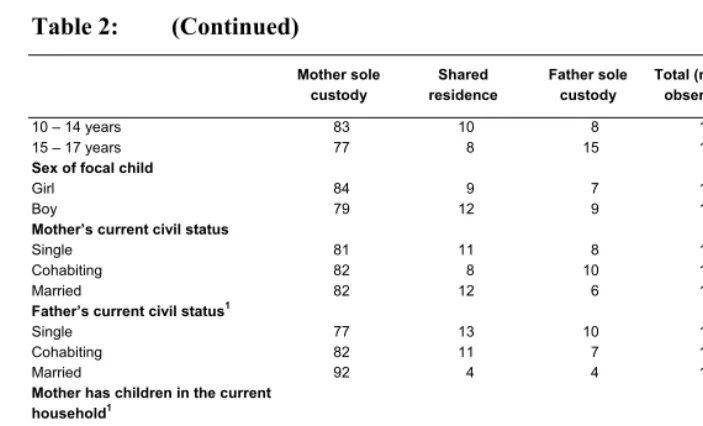
Table 2: The child’s living arrangements among various groups of parents living apart, and the percentage distribution for the independent variables. Mother sole custody Shared residence Father sole custody Total (number of observations) Percentage of couples in each
group
All 81 11 8 100 (856) 100
Mother’s net income1
1st quintile (less than 193,000 NOK) 77 8 15 100 (155) 20
2nd quintile (193,000 – 232,999 NOK 74 12 13 100 (156) 20
3rd quintile (233,000 – 265,999 NOK) 83 12 5 100 (155) 19
4th quintile (266,000 – 298,999 NOK) 85 11 4 100 (178) 20
5th quintile (299,000 NOK +) 86 11 3 100 (212) 20
Father’s net income1
1st quintile (less than 174,000 NOK) 96 3 1 100 (149) 19
2nd quintile (174,000 – 227,999 NOK) 91 6 3 100 (172) 21
3rd quintile (228,000 – 266,999 NOK) 76 14 9 100 (167) 20
4th quintile (267,000 – 333,999 NOK) 68 17 15 100 (175) 20
5th quintile (350,000 NOK +) 74 13 13 100 (193) 20
Mother’s education1
High school or less 82 9 9 100 (596) 75
University 1- 4 years 81 14 5 100 (229) 22
University 5 years + 65 33 2 100 (31) 3
Father’s education
High school or less 81 10 9 100 (656) 80
University 1 - 4 years 80 13 7 100 (142) 14
University 5 years + 80 15 5 100 (58) 6
Duration of relationship1
0 – 5 years 90 6 5 100 (234) 36
6 – 10 years 81 11 8 100 (275) 30
11 – 15 years 73 13 13 100 (216) 20
16 years + 72 18 10 100 (131) 14
Civil status at break-up1
Cohabiting 87 8 5 100 (356) 49
Married 75 13 11 100 (500) 51
Time since break-up1
0 – 1 years 78 18 4 100 (132) 14
2 – 4 years 77 14 9 100 (223) 23
5 – 7 years 77 11 11 100 (204) 24
8 years + 87 6 7 100 (297) 40
Number of children in relationship
1 child 83 9 8 100 (384) 64
2 children 78 14 8 100 (369) 31
3 children + 81 8 11 100 (103) 6
Age of focal child1
0 – 5 years 86 11 2 100 (127) 14
Table 2: (Continued)
Mother sole custody
Shared residence
Father sole custody
Total (number of observations)
Percentage of couples in each
group
10 – 14 years 83 10 8 100 (350) 39
15 – 17 years 77 8 15 100 (152) 22
Sex of focal child
Girl 84 9 7 100 (420) 49
Boy 79 12 9 100 (436) 51
Mother’s current civil status
Single 81 11 8 100 (526) 60
Cohabiting 82 8 10 100 (179) 21
Married 82 12 6 100 (151) 19
Father’s current civil status1
Single 77 13 10 100 (512) 57
Cohabiting 82 11 7 100 (191) 24
Married 92 4 4 100 (153) 19
Mother has children in the current household1
No 79 13 8 100 (554) 61
Yes 84 7 9 100 (302) 39
Father has children in the current household1
No 78 13 9 100 (557) 64
Yes 87 6 6 100 (299) 36
Notes: 1 Chi-Square >=0.05.
6. Results
The bivariate associations between the child’s residence and each of the independent variables are reported in Table 2.9 Irrespective of the parents’ socioeconomic resources,
their former and current family situation, and the number and ages of their common children, the majority of parents opted for a solution where the child lived permanently with the mother. Nevertheless, there is some variation between groups. For instance, shared residence seems to be most common when the father has a reasonably high income, when the mother is highly educated, and when the parents were married rather than cohabiting and have lived together for a long time (at least six years) before the break-up. Father sole custody seems to be particularly common when the mother has a low income, when the father has a high income, when the parents have been formally married and lived together for many years, and when the child is quite old.
To gain a better understanding of the factors associated with untraditional residential arrangements for children we ran a multinomial logistic regression with all the independent variables included. We estimated the odds of shared residence rather
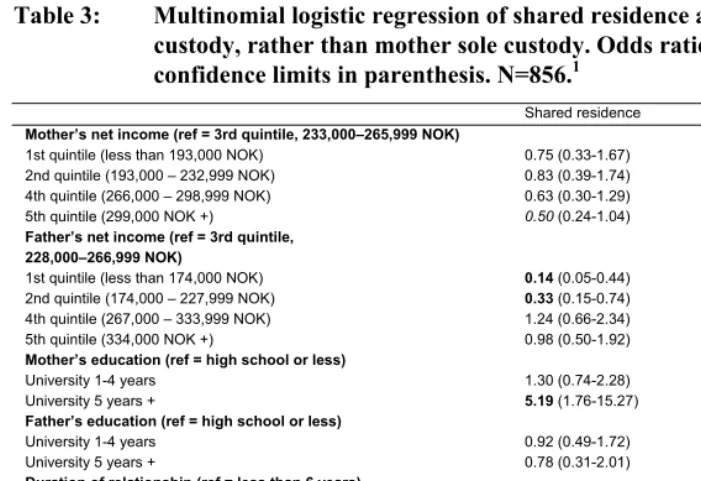
than mother sole custody, as well as the odds of father sole custody rather than mother sole custody. All estimates are reported as odds ratios. This means that the reference group of a categorical variable is set to one, while coefficients above one indicate a positive association, and coefficients below one indicate a negative association. Results are reported in Table 3. Coefficients that are significant at the 0.05 level and 0.10 level are indicated in bold and italics, respectively.
Table 3: Multinomial logistic regression of shared residence and father sole custody, rather than mother sole custody. Odds ratios. 95% Wald confidence limits in parenthesis. N=856.1
Shared residence Father sole custody
Mother’s net income (ref = 3rd quintile, 233,000–265,999 NOK)
1st quintile (less than 193,000 NOK) 0.75 (0.33-1.67) 7.25 (2.54-20.66)
2nd quintile (193,000 – 232,999 NOK) 0.83 (0.39-1.74) 3.28 (1.17-9.20)
4th quintile (266,000 – 298,999 NOK) 0.63 (0.30-1.29) 0.93 (0.30-2.93)
5th quintile (299,000 NOK +) 0.50 (0.24-1.04) 0.62 (0.20-1.99)
Father’s net income (ref = 3rd quintile, 228,000–266,999 NOK)
1st quintile (less than 174,000 NOK) 0.14 (0.05-0.44) 0.05 (0.01-0.38)
2nd quintile (174,000 – 227,999 NOK) 0.33 (0.15-0.74) 0.30 (0.09-0.92)
4th quintile (267,000 – 333,999 NOK) 1.24 (0.66-2.34) 1.73 (0.77-3.91)
5th quintile (334,000 NOK +) 0.98 (0.50-1.92) 1.69 (0.74-3.88)
Mother’s education (ref = high school or less)
University 1-4 years 1.30 (0.74-2.28) 0.72 (0.33-1.57)
University 5 years + 5.19 (1.76-15.27) 0.92 (0.09-9.12)
Father’s education (ref = high school or less)
University 1-4 years 0.92 (0.49-1.72) 1.02 (0.56-2.28)
University 5 years + 0.78 (0.31-2.01) 0.48 (0.12-1.77)
Duration of relationship (ref = less than 6 years)
6 – 10 years 1.13 (0.53-2.41) 1.13 (0.42-3.07)
11 – 15 years 1.08 (0.43-2.71) 1.40 (0.45-4.40)
16 years + 1.86 (0.64-5.39) 0.40 (0.10-1.60)
Civil status at break-up (ref = cohabiting)
Married 1.49 (0.83-2.65) 1.65 (0.79-3.45)
Time since break-up (ref = less than 2 years)
2 – 4 years 0.59 (0.30-1.15) 2.19 (0.68-7.08)
5 – 7 years 0.52 (0.23-1.17) 1.34 (0.37-4.79)
Table 3: (Continued)
Shared residence Father sole custody
Number of children in relationship (ref = one child)
Two children 1.06 (0.59-1.88) 1.18 (0.56-2.48)
Three children + 0.51 (0.20-1.32) 1.15 (0.38-3.48)
Age of focal child (ref = 0-5 years)
6 – 9 years 1.45 (0.64-3.33) 2.81 (0.67-11.85)
10 – 14 years 1.19 (0.42-3.33) 5.58 (1.18-26.49)
15 – 17 years 0.94 (0.26-3.47) 23.25 (4.14-130.75)
Sex of focal child (ref = girl)
Boy 1.26 (0.79-2.00) 1.80 (1.00-2.23)
Mother’s current civil status (ref = single)
Cohabiting 1.01 (0.52-1.96) 0.73 (0.35-1.54)
Married 1.97 (0.99-3.92) 0.47 (0.19-1.16)
Father’s current civil status (ref = single)
Cohabiting 1.06 (0.57-1.97) 0.43 (0.19-0.97)
Married 0.71 (0.29-1.74) 0.18 (0.06-0.57)
Mother has children in current household (ref = no)
Yes 0.56 (0.31-1.02) 1.89 (0.98-3.64)
Father has children in current household (ref = no)
Yes 0.35 (0.18-0.65) 0.86 (0.41-1.82)
Notes: 1 Coefficients significant at the 0.05 level are written in bold and those significant at the 0.10 level are written in italics.
In line with expectations, shared residenceis less likely among fathers in the two lowest income quintiles than those in the middle and upper quintiles. However, it is less common among mothers in the highest income quintile than among those in the middle-income quintile. As expected, the most highly educated mothers have shared residence more often than others. Compared with those with high school education or less, the estimated odds ratio of shared residence is 5.19 for mothers with a longer university education (5 years +). However, it should be noted that only 3% of the mothers in our sample have such a university education (Table 2, right column). Contrary to expectations, the father’s educational level does not seem to matter. Moreover, and also at odds with expectations, there is no association between the couple’s former civil status and the duration of their relationship, on the one hand, and shared residence on the other. The bivariate association between the relationship duration and shared residence observed in Table 2 disappears when we control for other factors. However, time since breakup is important, in that those who split up several years earlier are less prone to have shared residence than those who split up more recently.
significance, but the small number of couples with at least three children in our sample (6% according to Table 2) makes it hard to reach statistical significance at conventional levels. There is no association between the focal child’s age and sex, on the one hand, and shared residence on the other.
As expected, shared residence is more likely when the mother is presently married rather than single, but it does not matter whether she is cohabiting or not. The father’s current civil status is not important. New children in the parents’ households (either biological or stepchildren) reduce the odds of shared residence. The estimated odds ratio is 0.56 for the mother and 0.35 for the father. For the fathers this result is in line with assumptions, while for the mothers it is not. We expected divided residence to be more likely when the mother lived with new children.
The analysis presented in Table 3 suggests that the factors related to father sole custody differ from those related to shared residence. As expected, father sole custody is less likely among fathers in the lowest income quintiles compared with those in the middle and upper quintiles. However, there is a strong negative association with the mother’s income. Shared residence is less likely among mothers in the two lowest income quintiles than among those in the middle and upper quintiles. Neither the mother’s nor the father’s educational attainments seem to be of importance. The estimated odds ratio for fathers with a long university education is strongly negative, but does not reach statistical significance.
Contrary to expectations, father sole custody is not more common among previously married than previously cohabiting parents, not more common among parents who had been married or cohabiting for a long period than for those who had stayed together for a shorter period, and not more common among those who broke up recently than among those who broke up many years earlier.
As expected, there is a positive association between father sole custody and the age of the focal child. Compared with those with a child below 6 years of age, the estimated odds ratio of father sole custody is 5.58 when the child is in the age group 10-14 years and 23.25 when the child is 15-17 years old. Father sole custody is also more likely when the child is a boy rather than a girl, but the number of children makes no difference.
7. Discussion
In spite of more equal parental roles in couples in recent decades, in Norway most children still live mainly with their mother when parents split up. Visiting arrangements with non-resident fathers have become more extensive, however, and there has also been an increase in shared residence following partnership dissolution. A number of legal and policy initiatives have been adopted to motivate the involvement of fathers in their children’s lives following parental break-up, and parents are urged to collaborate in their children’s upbringing. Some even argue that shared residence for children should be the recommended solution in most cases and that it is important to abolish policies implying that parents, and particularly mothers, may lose out economically if they have shared residence, compared with being a single parent. Others warn that shared residence may not always be in the best interests of the child.
The analysis in the present paper shows that in 2004 11% of previously married or cohabiting parents with children 0-17 years of age had shared residence, and 8% had father sole custody. Compared with the definitions used by researchers in many other countries we used a rather narrow definition of shared residence: a wider definition would obviously produce other results. A multinomial logistic regression of the characteristics of parents with these untraditional caring arrangements revealed both expected and unexpected associations.
For shared residence, the partners’ socioeconomic resources as well as their current family obligations and societal norms seem to be important. Shared residence is less likely when the father has a low income, compared with a modest or high income, which is consistent with the presupposition that it is expensive to run two separate homes for children, particularly for fathers. Similar patterns are also found in other countries (for instance, Smyth, Qu and Weston 2004; Juby, Le Bourdais and Marcil-Gratton 2005).
There is, however, a negative association between shared residence and the mother’s income, which is at odds with research from some other countries (Smyth, Qu and Weston 2004; Juby, Le Bourdais and Marcil-Gratton 2005) but agrees with a prior study from Norway (Skjørten, Barlindhaug and Lidén 2007). The negative relationship with the mother’s income in Norway may be related to the fact that shared-residence mothers are entitled to fewer social benefits than sole-custody mothers. However, further analysis is needed to disentangle the link between mothers’ incomes and choice of child-care arrangements among parents living apart.
working hours and therefore may need to share the child-care with their former partner. It may be that they link their identity more to their role in the labour market than mothers with less education do, and that they are therefore more willing to reduce their involvement with their children. In her study of parents in Norway who divorced in the early 1990s, Lunde (2001) found that shared residence was usually initiated by the fathers, while the mothers were more hesitant and felt that they gave away some of “their” child-care time; however such attitudes may be less prevalent today, particularly among highly educated mothers.
The non-association between the father’s educational attainment and shared residence in our study is surprising, because such a relationship is documented in some other countries (Smyth, Qu and Weston 2004) and because highly educated men tend to support gender equality. In Norway the father’s income is more important than his education when it comes to shared residence, which suggests that the child’s living arrangements are more strongly linked to the father’s economic resources than to his attitudes towards mothers’ and fathers’ parenting practices.
The fact that shared residence is more likely when parents have split up recently, rather than many years earlier, suggests that the political discourse and normative climate at the time of separation may play a role in the choice of residential arrangements. The negative relationship between shared residence and the father having other children in his current household suggests that new children require extensive time investment and leave less time for children from a previous union. Somewhat surprisingly, shared residence is less likely when the mother has other children in her current household, and we are not sure how to explain this pattern. The finding that shared residence is positively related to the mother being married to a new partner, rather than being single, could indicate that the mother prioritizes time alone with her current husband. It may also be the case that she is more willing to let the child spend time with the father when she has settled with a new partner, and also that the child prefers to spend more time with his/her biological father under such circumstances.
Unexpectedly, shared residence is unrelated to the parents’ former civil status. It seems that cohabiting fathers in Norway not only have gained stronger legal ties to their children but also are as strongly involved in their children’s lives as married fathers. Shared residence is also unrelated to the duration of the parents’ relationship and the number and sex of their common children. We would expect fathers who have lived together with the child’s mother for a long time to be more involved in their children’s lives than those with a shorter relationship, but this does not seem to be the case, at least not as far as shared residence is concerned.
attainments. This suggests that father sole custody may result from pragmatic considerations of the parents’ possibilities to provide for and take care of the child, more than from ideals of equal sharing. In particular, the strong negative association with the mother’s income indicates that these mothers may not be able to afford to have the child stay with them. A lower income may be a result of health problems that limit the mother’s participation in paid work and also her ability to take care of the child, but unfortunately our data do not contain adequate information on the mother’s health. However, it is important to remember that even though the child may reside with the father, most mothers spend a considerable amount of time with her/him (Table 1).
Father sole custody is unrelated to the parents’ former civil status, the duration of the relationship, time since break-up, and the number of common children, but is more likely when the child is quite old and a boy rather than a girl. The latter association is consistent with international studies indicating that fathers in couples spend more time with boys than with girls, and that untraditional caring arrangements following break-up are most likely for boys (Cancian and Meyer 1998). This finding may be more surprising in a country like Norway, with its strong expectations of gender equality and fathers’ involvement with both girls and boys.
The finding that father sole custody is more likely when the father is presently single compared with when he is married or cohabiting corroborates the proposition that father sole custody is often brought about by pragmatic concerns, since the father may have more time for a child when he has not settled with a new partner. The same is true for the positive association between a mother having other children in her current household and father sole custody. The mother may be more willing to let the child live with the father because her current family commitments demand her time and energy, or the child herself/himself may prefer to live with the father under such circumstances. However, the non-association with the father having other children in his current household is surprising.
carers. Moreover, rising educational investment in younger generations implies that mothers may need additional help with the children in order to pursue their careers, and therefore that they may increasingly opt for shared residence following partnership dissolution, or agree on a father sole custody solution.
The strong focus on shared residence at the political level as well as among the general population in Norway has led to much debate on the preconditions for this solution to work in the best interests of the child. In line with international research, Norwegian scholars stress the importance of parental co-operation and flexibility, low levels of conflict, both parents living in the same community, and the child herself/himself preferring this arrangement. It is also advantageous if the parents have some flexibility in their paid working hours (Skjørten, Barlindhaug and Lidén 2007; Haugen 2010). Interviewing children with shared residence, Skjørten, Barlindhaug and Lidén (2007) found that they were usually very loyal to their parents’ decision on divided residence and tended to emphasize the fairness of this arrangement. Even though most children were quite satisfied with shared residence, they experienced much tension when parents had serious conflicts.
Thus, it has been suggested by Norwegian researchers that frequent contact with both parents may not benefit the child if the parents have strong disagreements (Skjørten, Barlindhaug and Lidén 2007). Finding a modest negative association between close geographical proximity between non-resident fathers and children and the children’s long-run educational attainments in Norway, Kalil et al. (2011) argue that the father’s relocation to a more distant place may sometimes shelter the child from parental conflicts and the demanding task of moving between different households. The strong focus on preconditions for shared residence to be a successful arrangement for children may make parents more sensitive to their children’s wishes and less insistent on fairness and gender equality for their own sake when they split up. Moreover, some mothers may still oppose shared residence because in Norway this may be less economically beneficial than mother sole custody.
Data on the parents’ work flexibility would provide more insight into the preconditions for various custody practices. It would also be advantageous to have longitudinal information on flexibility and changes in various practices, since custody arrangements may change over time (Smyth and Moloney 2008).
New surveys are needed to assess the trends in various living arrangements for children following partnership dissolution in Norway, and to gain a better understanding of the mechanisms that promote and hinder untraditional practices such as shared residence and father sole custody. If such arrangements become more widespread and practised by new groups of parents the associations with the independent variables discussed in the present paper may change. Moreover, in future analysis a wider definition of shared residence would allow comparisons with other countries.
8. Acknowledgements
We have benefited from constructive discussions with participants at the 25th
References
Amato, P.R., Meyers, C.E., and Emery, R.E. (2009). Changes in nonresident father-child contact from 1976-2002. Family Relations 58(1): 41-53.
doi:10.1111/j.1741-3729.2008.00533.x.
Bjarnason, T. and Arnarsson, A.M. (2011). Joint physical custody and communication with parents: A cross-national study of children in 36 western countries. Accepted for publication in the Journal of Comparative Family Studies.
Bø, T.P. (2004). One in three works flexible hours. Labour force survey. Ad hoc module on work organisation and working time arrangements, 2nd quarter 2004. http://www.ssb.no/vis/english/magazine/art-2004-11-23-01-en.html.
Brandth, B. and Kvande, E. (2003). Fleksible fedre: maskulinitet, arbeid, fleksibilitet. Oslo: Universitetsforlaget.
Cancian, M. and Meyer, D.R. (1998). Who gets custody? Demography 35(2): 147-157.
doi:10.2307/3004048.
Cashmore, J., Parkinson, P., and Taylor, A. (2008). Overnight stays and children’s relationships with resident and nonresident parents after divorce. Journal of Family Issues 29(6): 707-733. doi:10.1177/0192513X07308042.
Cooksey, E.C. and Craig, P.H. (1998). Parenting from a distance: The effects of paternal characteristics on contact between nonresidential fathers and their children. Demography 35(2): 187-200. doi:10.2307/3004051.
Fehlberg, B., Smyth, B., Maclean, M. and Roberts, C. (2011). Caring for children after parental separation: Would legislation for shared parenting help children? Oxford: University of Oxford, Department of Social Policy and Intervention (Family policy briefing No. 7).
Furstenberg, F.F. Jr. and Nord, C.W. (1985). Parenting apart: Patterns of childrearing After marital disruption. Journal of Marriage and the Family 47(4): 893-904.
doi:10.2307/352332.
Haugen, G.M.D. (2010). Children’s perspectives on everyday experiences of shared residence: Time, emotions and agency dilemmas. Children and Society 24(2): 112-122. doi:10.1111/j.1099-0860.2008.00198.x.
Jensen, A.-M. and Clausen, S.-E. (2003). Children and family-dissolution in Norway.
The impact of consensual unions. Childhood 10(1): 65-81.
doi:10.1177/0907568203010001004.
Jensen, A.-M. and Clausen, S.E. (1997). Samvær og fravær. Foreldres kontakt med barn de ikke bor sammen med. Oslo: Norsk institutt for by- og regionsforskning (Notat 1997:103).
Jensen, A.-M. and Clausen, S.E. (1999). Samboerskap som foreldreskap. In NOU
1999:25: Samboerne og samfunnet, appendix 4. Oslo: Statens
forvaltningstjeneste.
Juby, H., Billette, J.-M., Laplante, B., and Le Bourdais, C. (2007). Nonresident fathers and children. Parents’ new unions and frequency of contact. Journal of Family Issues 28(9): 1220-1245. doi:10.1177/0192513X07302103.
Juby, H., Le Bourdais, C., and Marcil-Gratton, N. (2005). Sharing roles, sharing custody? Couples' characteristics and children's living arrangements at separation. Journal of Marriage and Family 67(1): 157-172. doi:10.1111/j.0022-2445.2005.00012.x.
Kalil, A., Mogstad, M., Rege, M., and Votruba, M. (2011). Divorced fathers’ proximity and children’s long run outcomes: Evidence from Norwegian registry data.
Demography 48(3): 1005-1027. doi:10.1007/s13524-011-0046-z.
Kitterød, R.H. (2005). Når mor og far bor hver for seg. Ansvar og omsorg for barna før og etter bidragsreformen. Oslo: Statistics Norway (Rapporter 2005/22).
Kitterød, R.H. (2006). Stor avstand - lite samvær? Samværsfedres tid med barn per måned og i ferier. Tidsskrift for velferdsforskning 9(2): 100-115.
Kitterød, R.H. and Lappegård, T. (2010). A typology of work-family arrangements among dual-earner couples in Norway. Oslo: Statistics Norway, Research department (Discussion Papers No. 636).
Leira, A. (2002). Working Parents and the Welfare State. Family Change and Policy Reform in Scandinavia. Cambridge:Cambridge University Press.
Lunde, E.S. (2001). Hvem velger delt omsorg? In: Moxnes, K., Kvaran, I., Kaul, H., and Levin, I. (eds): Skilsmissens mange ansikter. Om barnas og foreldrenes erfaringer med skilsmisse. Kristiansand: Høyskoleforlaget: 137-152.
Lundström, K. (2009). Växelvis boande ökar bland skilsmässobarn. Välfärd (4): 3-5. Lyngstad, J. (2010). Hvorfor betaler så få samværsmødre bidrag? Tidsskrift for
Manning, W.D. and Smock, P.J. (1999). New families and nonresident father-child visitation. Social Forces 79(1): 87-116. doi:10.1093/sf/78.1.87.
Manning, W.D., Stewart, S.D., and Smock, P.J. (2003). The complexity of fathers' parenting responsibilities and involvement with nonresident children. Journal of Family Issues 24(5): 645-667. doi:10.1177/0192513X03024005004.
Masardo, A. (2009). Managing shared residence in Britain and France: questioning a default “primary carer” model. In: Rummery, K., Greener, I., and Holden, C. (eds). Social Policy Review 21: Analysis and debate in social policy. Bristol: Policy Press: 197-214.
Noack, T. (2010). En stille revolusjon. Det moderne samboerskapet i Norge. Oslo: University of Oslo, Faculty of Social Sciences. (Doctor Philos thesis No. 228). Oftung, K. (2010). Farskap etter samlivsbrudd: Rekonstruksjon av det hverdagslige.
Sosiologi i dag 40(1): 129-150.
Raley, S. and Bianchi, S. (2006). Sons, daughters and family processes: Does gender of children matter? Annual Review of Sociology 32(1): 401-421. doi:10.1146/ annurev.soc.32.061604.123106.
Seltzer, J.A. (1991). Relationships between fathers and children who live apart: The fathers' role after separation. Journal of Marriage and the Family 53(1): 79-101.
doi:10.2307/353135.
Seltzer, J.A. and Bianchi, S.M. (1988). Children's contact with absent parents. Journal of Marriage and the Family 50(3): 663-677. doi:10.2307/352636.
Seltzer, J.A. and Brandreth, Y. (1994). What fathers say about involvement with children after separation. Journal of Family Issues 15(1): 49-77. doi:10.1177/ 019251394015001003.
Skaare, S. and Fodnesbergene, G. (2005). Undersøkelsen om samvær og bidrag 2004. Dokumentasjonsrapport. Oslo: Statistics Norway (Notater 2005/41).
Skevik, A. (2006). “Absent fathers” or “reorganized families”? Variations in father-child contact after parental break-up in Norway. The Sociological Review 54(1): 114-132. doi:10.1111/j.1467-954X.2006.00604.x.
Skevik, A. and Hyggen, C. (2002). Samværsfedrenes situasjon. Rapport fra en spørreundersøkelse. Oslo: NOVA – Norwegian Social Research (Report 15/02). Skjørten, K., Barlindhaug, R., and Lidén, H. (2007). Delt bosted for barn. Oslo:
Smyth, B., Qu, L., and Weston, R. (2004). The demography of parent-child contact. In: Smyth, B. (ed). Parent-child contact and post-separation parenting arrangements. Melbourne: Australian Institute of Family Studies. (Research Report No. 9). Smyth, B. and Moloney, L. (2008). Changes in patterns of post-separation parenting
over time: A brief overview. Journal of family Studies 14(1): 7-22. doi:10.5172/ jfs.327.14.1.7.
Statistics Norway’s Children statistics. http://www.ssb.no/english/subjects/02/01/20/ barn_en/, http://statbank.ssb.no/statistikkbanken/?PLanguage=1
Stephens, L.S. (1996). Will Johnny see Daddy this week? An empirical test of three theoretical perspectives of post-divorce contact. Journal of Family Issues 17(4): 466-494. doi:10.1177/019251396017004003.
St.meld. No. 29. (2002-2003). Om familien – forpliktende samliv og foreldreskap. Oslo: Barne- og likestillingsdepartementet (Minsitry Children and Gender Equality).
St.meld. No. 19 (2006-2007) Evaluering av nytt regelverk for barnebidrag. Tilråding fra Barne- og likestillingsdepartementet av 22. desember 2006. Oslo: Barne- og likestillingsdepartementet (Ministry of Children and Gender Equality).
Sætre, A. (2004). Foreldreansvar, daglig omsorg og samvær: Far er blitt viktigere, men mor er fortsatt viktigst. Samfunnsspeilet 18(2): 38-46.
The Children Act (Act No. 7 of 8 April 1981 relating to Children and Parents).
http://www.regjeringen.no/en/dep/bld/Documents/Laws-and-rules.html?id=276069
Toulemon, L. and Pennec, S. (2010). Multi-residence in France and Australia: Why count them? What is at stake? Double counting and actual family situations.
Demographic Research 23(1): 1-40. doi:10.4054/DemRes.2010.23.1.
Vaage, O. (2012). Tidene skifter. Tidsbruk 1971-2010. Oslo: Statistics Norway (Statistical Analyses 125).
Wiik, K.A., Bernhardt, E., and Noack, T. (2009). A study of commitment and relationship quality in Sweden and Norway. Journal of Marriage and Family
Appendix
Defining “The child’s permanent dwelling”
Of the 856 couples in our sample, the focal child was registered at the mother’s address in 742 cases and at the father’s address in 114 cases. Since a person may only be registered in the population register at one address in Norway, children with parents living apart are registered either at the mother’s or the father’s address, even though they actually live permanently with both parents, i.e., have shared residence. In any case, children may have moved from one parent to the other, without any change of registered address.
In the survey both parents were asked where the child lived. Their answers were not always in accordance. For example, of the 697 cases where the mother claimed that the child lived with her (in 684 cases, the child was registered living with the mother, in 13 cases with the father), the father disagreed in 65 cases, claiming either that the child lived with both (41 + 5), with him (10 + 7), or with others (2) (see Table A1). Moreover, the survey data were not always in accordance with the register data.
We constructed our dependent variable, i.e., “the child’s permanent dwelling”, by using a combination of the mothers’ answers, the fathers’ answers, and register data. When the parents agreed on where the child lived, the dependent variable was based solely on the interview information. When the parents disagreed, the parent where the child was registered as living (usually the mother) was decisive. When the parents disagreed and the child was registered as living with the father, his word was decisive. According to this definition, 99 couples had shared residence for their children (in bold in Table A1), 70 couples had father sole custody (in italics in Table A1), and 687 couples had mother sole custody.
Table A1: Whether the child was registered as living at the mother’s or the father’s address and the parents’ answers on the question tapping the child’s livings arrangement.
Registered at mother’s address Registered at father’s address
Father’s answer
Mother’s
answer The child lives with The child lives with
The child
lives with mother both father other All mother both father other All
mother 631 41 10 2 684 1 5 7 0 13
both 18 37 2 0 57 1 33 9 0 43
father 0 1 0 0 1 1 4 53 0 58
other 0 0 0 0 0 0 0 0 0 0