journal homepage: http://jac.ut.ac.ir
Snakes and Caterpillars in Graceful Graphs
Christian Barrientos
∗1and Sarah Minion
†21,2Department of Mathematics, Valencia College, Orlando, FL, 32825, USA.
ABSTRACT ARTICLE INFO
Graceful labelings use a prominent place among differ-ence vertex labelings. In this work we present new fam-ilies of graceful graphs all of them obtained applying a general substitution result. This substitution is ap-plied here to replace some paths with some trees with a more complex structures. Two caterpillars with the same size are said to be analogous if the larger stable sets, in both caterpillars, have the same cardinality. We study the conditions that allow us to replace, within a gracefully labeled graph, some snakes (or paths) by anal-ogous caterpillars, to produce a new graceful graph. We present five families of graphs where this replacement is feasible, generalizing in this way some existing results: subdivided trees, first attachment trees, path-like trees, two-point union of paths, and armed crowns.
Article history:
Received 12, February 2018 Received in revised form 19, July 2018
Accepted 11 September 2018 Available online 30, December 2018
Keyword: α-labeling, graceful labeling, snake, caterpillar.
AMS subject Classification: 05C78.
1
Introduction
A graceful labeling of a graph G of size n is an injective assignment of integers from the set{0,1, ..., n}to the vertices ofGsuch that, when each edge has assigned aweight, given the absolute value of the difference of the labels of its end vertices, all the weights are
∗Corresponding author: C. Barrientos. Email: chr [email protected] †[email protected]
distinct. From this definition it is possible to conclude that the order of a graceful graph
G of size n, is at most n+ 1. A graceful labeling is called an α-labeling when the graph
G is bipartite, with stable sets A and B, and the labels assigned to the vertices in A are smaller that the labels assigned to the vertices of B.This last type of labeling have been used to construct graceful or α-labelings of larger graphs. Most of these constructions are based by the method used by Stanton and Zarnke [20], where the authors used an
α-labeled tree S and a graceful treeT, with a distinguish vertexw, to form an α-labeled treeGby attaching to every vertex ofS the vertexwof a tree that is a copy ofT. Several generalizations of this technique are known nowadays, in particular, we must mention here, the results of
Koh et al. [10] (see also [9], [11] and [12]). Burzio and Ferrarese [4] extended some of these results to prove that the subdivision of all edges of a graceful tree is a graceful tree, that is, they replaced every edge of a graceful tree by a path on lengthk.Sethuraman and Selvaraju [17] replaced every edge of a path by the complete bipartite graphK2,m,where
m may change from edge to edge; they called this replacement, supersubdivision. More general results about super subdivisions can be found in [2], [3], and [18]. In Section 3 we analyze this concept in more detail. There, we introduce a replacement theorem that allows us to replace, within a graceful labeled graph, some specific labeled subgraphs by some analogous graphs.
In Section 4 we present some applications of the replacement theorem, each of these applications produces new families of graceful graphs, extending in this way, the number of known graceful graphs.
The reader interested in graph labelings and, in particular, methods to construct labeled graphs, is refered to Gallian’ survey [6]. In this paper we follow the notation and termi-nology used in [5] and [6].
2
Essential Tools
A difference vertex labeling, or simply a labeling, of a graph G of size n is an injective mapping f from V(G) into a set N of nonnegative integers, such that every edge uv of
G has assigned a weight defined by |f(u)−f(v)|. All labelings considered in this work are difference vertex labelings. A labeling is called graceful when N = {0,1, ..., n} and the induced weights are 1,2, ..., n. IfG admits such a labeling, then it is called agraceful graph.
Let G be a bipartite graph where {AG, BG} is the natural bipartition of V(G), we refer
to AG and BG as the stable sets of V(G). Without loss of generality, we assume that
|AG| ≤ |BG|. A bipartite labeling of G is an injection f : V(G) → {0,1, ..., t} for which
there is an integerλ,named the boundary value off, such thatf(u)≤λ < f(v) for every (u, v)∈AG×BG, that inducesn different weights. This is an extension of the definition
given by Rosa and ˇSir´aˇn in [15]; there, they focussed on bipartite labelings of trees. From the definition we may conclude that t ≥ |E(G)|, furthermore, the labels assigned by f
If t = n, the bipartite labeling f is an α-labeling. By an α-graph we mean a graph that admits an α-labeling. IfG is an α-graph,λ is the smaller of the two vertex labels of the edge of weight 1. In the rest of this work, we assume that the vertex labeled λ is in AG.
Thus, ifG is an α-tree, then λ =|AG| −1.
Letf :V(G)→ {0,1, ..., t}be a labeling of a graph G of size n,n ≤t:
• f : V(G) → {0,1, ..., t}, defined for every v ∈ V(G) as f(v) = t −f(v), is the complementary labeling of f. If f is graceful, f is also graceful. Moreover, if f is an α-labeling with boundary value λ, then f is an α-labeling with boundary value
t−λ−1.
• g : V(G) → {c, c+ 1, ..., c+t}, defined for every v ∈ V(G) and c ∈ Z as g(v) =
c+f(v),is theshifting of f incunits. Note that this labeling preserves the weights induced by f.
• h: V(G)→ {0, κ, ..., tκ}, defined for every v ∈V(G) and κ ∈Z+ as h(v) =κf(v),
is the amplification of f in κ units. If w1, w2, ..., wn are the weights induced by f,
then the weights induced byh are κw1, κw2, ..., κwn.
Suppose now thatf :V(G)→ {0,1, ..., t}is a bipartite labeling with boundary value λ.
• fr:V(G)→ {0,1, ..., t},defined for everyv ∈V(G) as,fr(v) = λ−f(v) iff(v)≤λ,
and fr(v) = t+λ+ 1−f(v) if f(v)> λ,is the reverse labeling of f. Note that if f
is an α-labeling, then fr is also an α-labeling with boundary value λ.
• fk : V(G) → {0,1, ..., t+ k − 1}, defined for every v ∈ V(G) and k ∈ Z as,
fk(v) = f(v) if f(v) ≤ λ and fk(v) = f(v) +k −1 if f(v) > λ, is the bipartite
k-labeling of G obtained from f. This labeling uses labels from {0,1, ..., λ} ∪ {λ+
k, λ+k+ 1, ..., t+k −1} and induces the weights k, k+ 1, ..., t+k −1. In other terms, this labeling shifts the weights induced byf ink−1 units. Thus, if f is an
α-labeling of G and k is a positive constant, then fk is the, well-known, k-graceful labeling of G.
Letf be anα-labeling of a caterpillar Ω of sizen with boundary valueλ. Suppose thatf
is transformed into a k-graceful labeling shifted c units. Then the stable set AΩ receives
the labels c, c+ 1, ..., c+λ and the stable set BΩ receives the labelsc+λ+k, c+λ+k+
1, ..., c+n+k−1.
3
The Main Result
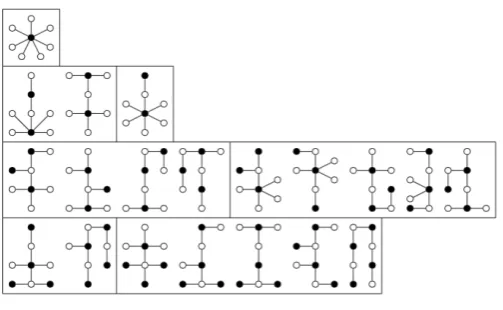
Suppose that Γ and Ω are two caterpillars of ordern. We say that Γ and Ω areanalogous if |AΓ|=|AΩ| and their diameters have the same parity. Following this definition, in Figure
Figure 1: A classification of the caterpillars of size 7.
IfU is a nonempty subset of the vertex setV(G) of a graphG,then the subgraph hUiof
Ginduced byU is the subgraph having vertex setU and whose edge set consists of those edges of G incident with two elements of U. A subgraph H of G is called vertex-induced or induced, denoted H ≺ G, if H ∼= hUi for some subset U of V(G). If G is a labeled graph, every element of U is identified with its label in G.
Let Ω be a caterpillar. Suppose that u and v are vertices of Ω such that d(u, v) = diam Ω. Rosa[14] shown the existence of an α-labeling f of Ω, where f(u) = 0 and f(v) = λ
when diam Ω is even, or f(v) = λ+ 1 when diam Ω is odd. Therefore, for any caterpillar Γ, analogous to Ω, there exists an α-labeling g such that g(u0) = f(u) and g(v0) = f(v) where u0v0 ∈E(Γ) and dist(u0, v0) = diam Γ.
Theorem 1. LetGbe a gracefully labeled graph of sizen. If a caterpillar Ω is an induced subgraph of G which induced labeling is a bipartite k-labeling shifted c units, then the graphG0,obtained by replacing Ω by any other caterpillar Γ analogous to Ω,is a graceful graph.
Proof. Since Ω and Γ are analogous caterpillars, the existence of a bipartite k-labeling shiftedcunits of Ω, implies the existence of a bipartitek-labeling of Γ shiftedcunits. So, the labelings of Ω and Γ use the same labels and induce the same weights. Therefore, if we delete from Gall the edges of Ω and introduce all the edges of Γ,we obtain a graceful graph.
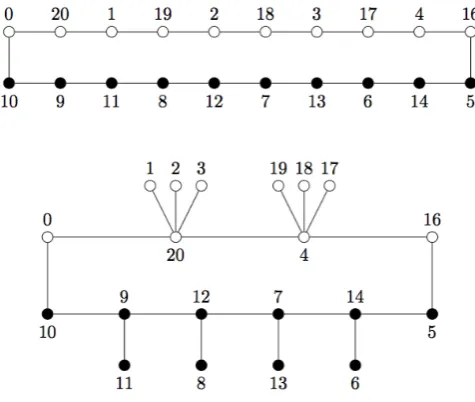
In Figure 2 we show an example of this result, where two subpaths in C20 have been
replaced by analogous caterpillars.
In order to see the potential of this theorem, we have identified 14 caterpillars of order 10 analogous to P10, each of them can be used to replace any of the two distinguished copes
Figure 2: α-labeling of a hairy cycle obtained with the replacement theorem.
4
Using Analogous Caterpillars
In this section we use Theorem 1 to prove the existence of graceful orα-labelings of several families of graphs. We use five families of graceful graphs that have subgraphs isomorphic to a path whose induced labeling satisfies the conditions of the theorem. In this way, the new results correspond to generalizations of the existing ones.
4.1
The Subdivison Tree
Burzio and Ferrarese [4] proved that when every edge of a graceful tree is replaced by a path of length k >1,the resulting graph is a graceful tree.
Proposition Let Sn(T) be the nth subdivision graph of a tree T,i.e., the tree obtained
by inserting n new vertices into each edge of T. Then if T is graceful, Sn(T) is also a
graceful tree.
Within the proof of this proposition, the authors used as T(n) a path of order n with a graceful labeling that assigns the label 0 on a leaf. (Note that their definition of a graceful labeling uses labels from 1 ton.) There is only one graceful labeling of a path that assigns the label 0 to a leaf, this is the well-known α-labeling given by Rosa [14]. Therefore, the tree Sn(T) contains multiple induced subgraphs isomorphic to a path of length n, whose
induced labelings are of the kind described in Theorem 1. Hence, as a consequence of Theorem 1 and Proposition 2, we have the following theorem.
Theorem 2. Let T be a tree of orderm with edges e1, e2, ..., em−1,and Γ1, Γ2, ...,Γm−1
be a list of caterpillars analogous to Pn. Then the graph obtained by replacing eachei by
Γi is a graceful tree.
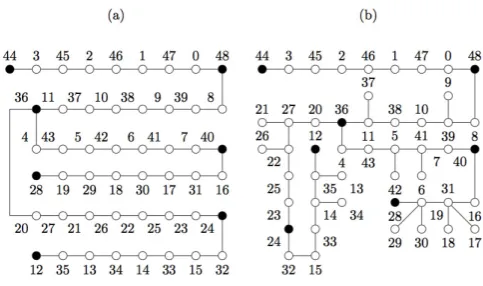
the directions in [4]. In part (b) we exhibit the graceful labeling obtained by replacing some of the edges of T(7) with caterpillars analogous to the path P8.
Figure 3: Graceful tree obtained from a subdivided graceful tree.
4.2
The First Attachment Tree
In [19], Sethuraman and Venkatesh used a variation of the ∆-construction to create a new variety of α-trees. Let G be a graph with r vertices of degree at least two and H
be any graph with a chosen vertex. Consider r copies of H; G⊕H denotes the graph obtained by merging (via vertex amalgamation) the chosen vertex of each copy ofH with every vertex of degree at least two of G. Let T0 and TA1 by any two caterpillars. They
defined the first attachment tree as T1 =T0⊕TA1. Fori ≥2, the ith attachment tree Ti,
is defined recursively as the treeTi =Ti−1⊕TAi,here the chosen vertex ofTAi must have
eccentricity equal to diam TAi −1.
Proposition 2. For i≥1, the ith attachment tree Ti admits an α-labeling.
Within the proof of this proposition, Sethuraman and Venkatesh use ak-graceful labeling ofTAishiftedcunits; the values ofkandcchange from copy to copy, obviously. Therefore,
each copy of TAi can be replaced by any caterpillar Γ analogous to TAi and the result
still holds. Thus, using Theorem 1 and Proposition 4 we can prove the following result.
Theorem 3. SupposeGis a caterpillar andv1, v2, ..., vr are the vertices of degree at least
two in G. Let Γ1,Γ2, ...,Γr be analogous caterpillars, where the chosen vertex of each Γi
is a vertex with eccentricity diam Γi −1. Then the graph obtained by merging, for all
1≤i≤r, the chosen vertex of Γi with vi, is an α-tree.
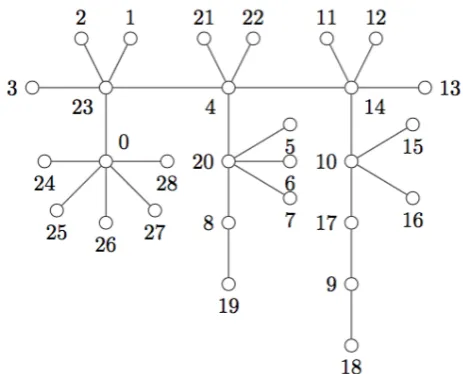
In Figure 4 we show an example with an α-labeled tree obtained using a caterpillar Gof size 6 and r= 3, and three analogous caterpillars of size 7.
4.3
The Path-Like Trees
Figure 4: α-labeled tree.
(a) shows such an embedding of P36 with an α-labeling. Given such an embedding, we
consider the ordered set of subpaths L1, L2, ..., Lk which are maximal straight segments
in the embedding and such that the end ofLi is the beginning ofLi+1.In the example of
Figure 5 (a), L1 ∼= L3 =∼L5 ∼= L7 ∼=P9 and L2 ∼= L4 ∼=L6 ∼= P2. Suppose that for some
i, Li ∼= P2, and that some vertex u of Li−1 is at distance one, in the grid, from a vertex
v inLi+1.An elementary transformation of the path Pn consists in replacing the edge of
Li by a new edge uv. We say that a tree T of order n is a path-like tree when it can be
obtained from some embedding of Pn in the grid, by a set of elementary transformations.
Figure 5 (b) shows a path like tree obtained from the embedding of P36 in part (a). Prpposition 3. All path-like trees are graceful.
As a consequence of this result and Theorem 1, we can prove the following theorem.
Theorem 4. If T is a path-like tree, then any group of subpaths that are straight segments in the embedding of T can be replaced by an analogous caterpillar, to obtain a graceful tree T0.
Note that in fact, the labelings of T and the final tree T0, are α-labelings. In Figure 5 (c) we show an α-labeling obtained using this procedure.
4.4
The Connected Paths
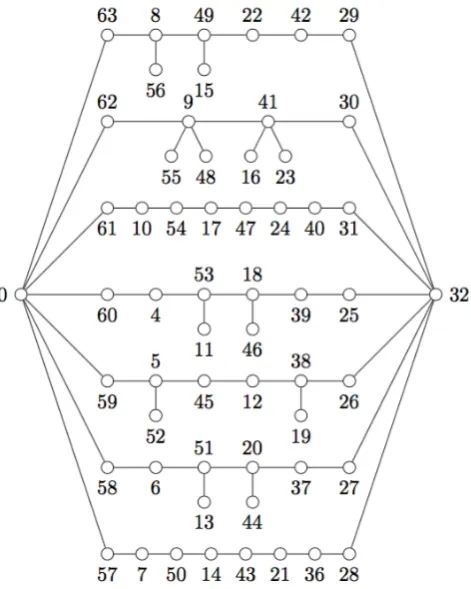
The following family of graphs was introduced by Kathiresan [8]. Letuandv be two fixed vertices. The graph obtained by connectinguandvby means ofbinternally disjoint paths, of lengtha each, is denoted Pa,b. Kathiresan proved that the graphs P2r,2m+1 are graceful
for all values of rand m. He conjectured thatPa,b is graceful except whena= 2r+ 1 and
b = 4m+ 2. Note that under these conditions, Pa,b is an Eulerian graph with the wrong
Figure 5: α-tree obtained from a path-like tree.
and b = 4m+ 1, a = 4r and b = 2m, a = 4r+ 2 and b = 2m for all values of r and m,
proving that all these cases correspond to graceful graphs. For r ≥m, Sekar [16] proved that Pa,b is graceful when a = 4r+ 1 and b = 4m, as well as the case where a = 4r−1
and b = 4m.
Proposition 4 P2r,2m+1 is graceful for all values of r and m. Proposition 5 P2r+1,2m+1 is graceful for all values of r and m.
The proofs of both results are quite similar. For each 1 ≤ i ≤ 2m+ 1, let Pi
a−1 denote
the ith copy of the subpath Pa−1 of length a−2 (the vertices u and v of the definition
are not in these paths.) They start with an α-labeling of Pai−1 which is transformed into a 2-graceful labeling. This labeling is amplified by a factor κ= 2m+ 1. LetYPi
a−1 be the
stable set of Pi
a−1 that contains the vertices with the largest labels, from every label of
the vertices in YPi
a−1. Kathiresan and Sekar used the same technique, both subtract the
constantd=i−1.In the case ofP2r,2m+1,Kathiresan shifted the labeling ofPai−1, c= 2i−1
units and label u and v, 0 and r(2m+ 1), respectively. When Pa,b = P2r+1,2m+1, Sekar
shifted the labeling of Pi
a−1, c=m+ (i+ 1)/2 units when i is odd, and c= 2m+ 1 +i/2
units when i is even. In this case, the vertices u and v are labeled 0 and r(2m + 2),
respectively.
Since the starting labeling of each Pi
a−1 is an α-labeling, we can replace each of them by
an analogousα-labeled caterpillar and the resulting graph is still graceful. Thus, we have the following result.
Theorem 5. Let Γ1,Γ2, ...,Γ2m+1 be analogous caterpillars whose stable sets have the
same cardinality or differ by one unit. For each 1 ≤ i ≤ 2m+ 1, let ui, vi ∈ V(Γi) such
thatd(ui, vi) = diam Γi.Then the graph obtained by connecting all theui to a new vertex
u and all the vi to a new vertexv, is a graceful graph.
In all the other cases proved by Sekar, it is possible to replace b−1 of the paths Pa−1
with analogous caterpillars, the remaining path Pa−1 contains two subpaths that can be
In Figure 6 we show an example of these replacements on the starting graph P9,7.
Figure 6: α-graph obtained from a graceful labeling of P9,7.
4.5
The Armed Crowns
The last family of graceful graphs that we want to consider in this work, is based in the following result of Sekar [16]. He defined an armed crown as a cycle with paths of equal lengths attached at each vertex of the cycle. Sekar used the symbol CnPm to denote
this graph; instead, we use Cn~Pm, to avoid any confusion with the corona of Cn and
Pm.
Proposition 6 Cn~Pm is graceful for all m and n.
Once again, Sekar started withα-labelings of the copies ofPm and transformed them into
k-graceful labelings shifted c units. When n ≡ 0,3(mod 4), that is, when Cn is graceful,
all the n paths are transformed into k-graceful labelings shifted c units, where k and c
depend on the copy of Pm used. When n≡1,2(mod 4), Sekar did the same with all the
copies ofPm except one, which is treated in a slighly different way. For more details about
Theorem 6 If Γ1,Γ2, ...,Γx are caterpillars analogous to Pm, then x copies of Pm in Cn~Pm can be replaced by the Γi obtaining a graceful graph, when x≤n if
n≡0,3(mod 4), or x≤n−1 if n≡1,2(mod 4).
In Figure 7 we show an example of a graceful graph obtained in the way described before.
Figure 7: α-labeling of a generalized armed crown.
5
Final Comments
We must mention here that the labeled caterpillar Ω in Theorem 1 can be replaced by anyα-tree that satisfies the same conditions that the caterpillarΓ;
we used caterpillars because theirα-labelings are well-known, which facilitates the understanding of the theorem. We hope that new families of graceful graphs can be obtained applying this theorem.
References
[1] Barrientos, C., Difference Vertex Labelings, Ph.D. Thesis, Universitat Polit`ecnica de Catalunya, Barcelona, (2004).
[2] Barrientos, C., Graceful arbitrary supersubdivisions of graphs, Indian J. Pure Appl. Math., Vol 38 (2007), PP. 445-450.
[3] C. Barrientos, C., Barrientos, S., On graceful supersubdivisions of graphs, Bull. Inst. Combin. Appl., Vol 70 (2014), PP. 77-85.
[4] Burzio, M. and Ferrarese, G., The subdivision graph of a graceful tree is a graceful tree Discrete Math., Vol 181 (1998), PP. 275-281.
[6] Gallian, J. A., A dynamic survey of graph labeling, Electronic J. Combin., Vol 18 (2018) #DS6.
[7] Hegde, S. M. and Shetty, S., On graceful trees, Appl. Math. E-Notes, Vol II (2002), PP. 192-197.
[8] Kathiresan, K., Two classes of graceful graphs, Ars Combin., Vol 55 (2000), PP. 129-132..
[9] Koh, K. M., Rogers, D. G., and Tan, T., On graceful trees, Nanta Math., Vol 10 (1977), PP. 27-31.
[10] Koh, K. M., Rogers D. G., and Tan, T., Products of graceful trees, Dis-crete Math., Vol 31 (1980), PP. 279-292.
[11] Koh, K. M., Rogers, D. G., and Tan, T., Another class of graceful trees, J. Austral. Math. Soc. Ser. A, Vol 31 (1981), PP. 226-235.
[12] Koh, K. M., Tan, T., and Rogers, D. G., Two theorems on graceful trees, Discrete Math., Vol 25 (1979), PP. 141-148.
[13] Read, R. C. and Wilson, R. J., An Atlas of Graphs, Oxford University Press (1998).
[14] Rosa, A., On certain valuations of the vertices of a graph, Theory of Graphs (Internat. Symposium, Rome, July 1966), Gordon and Breach, N.Y. and Dunod Paris (1967), PP. 349-355.
[15] Rosa, A. and ˇSir´aˇn, J., Bipartite labelings of trees and the gracesize, J. Graph Theory, Vol 19 (1995), PP. 201-215.
[16] Sekar, C., Studies in Graph Theory, Ph.D. Thesis, Madurai Kamaraj University, (2002).
[17] Sethuraman, G. and Selvaraju, P., Gracefulness of arbitrary supersubdivi-sons of graphs, Indian J. Pure Appl. Math., Vol 32 (2001), PP. 1059-1064
[18] Sethuraman, G. and Selvaraju, P., Decompositions of complete graphs and complete bipartite graphs into isomorphic supersubdivison graphs, Discrete Math., Vol 260 (2003), PP. 137-149.
[19] Sethuraman, G. and Venkatesh, S., Decomposition of complete graphs and complete bipartite graphs into α-labeled trees, Ars Combin., Vol 93 (2009), PP. 371-385.