Adaptive Feedback Message Generation for Second Language
Learners of Arabic
Khaled Shaalan
The British University in Dubai, PO Box 345015 Dubai, UAE [email protected]
Marwa Magdy
Faculty of Computers & Information, Cairo University, 12613 Egypt [email protected]
Abstract
This paper addresses issues related to generat-ing feedback messages to errors related to Ar-abic verbs made by second language learners (SLLs). The proposed approach allows for in-dividualization. When a SLL of Arabic writes a wrong verb, it performs analysis of the input and distinguishes between different lexical er-ror types. The proposed system issues the in-telligent feedback that conforms to the learn-er’s proficiency level for each class of error. The proposed system has been effectively evaluated using real test data and achieved sat-isfactory results.
1 Introduction
Second language acquisition is a difficult task. There are various methods to acquire a new lan-guage and all of them require some form of feedback, a reaction to what has been said or written. The recent trend is to automate the feed-back through Intelligent Language Tutoring Sys-tem (ILTS).
The current trend concentrates on NLP tools and techniques geared towards the diagnosis of errors produced by SLLs and identifying the cause of their errors rather than providing the correct version directly.
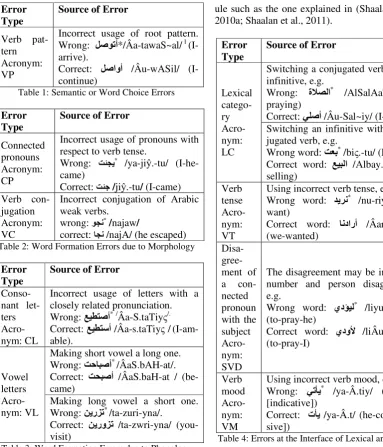
This paper is about the generation of feedback message based on individual proficiency levels. The proficiency level measure is based on the progression in the learner answers. In particular, when a SLL of Arabic writes a wrong verb, it distinguishes between this set of lexical error types: lexical category selection, pattern selec-tion, tense selection, mood selection, subject-verb agreement, verb conjugation, connected pronouns and/or consonant, and vowel letters. Nevertheless, it provides the intelligent feedback that conforms to the learner’s expertise for each
class of error. There are three learning levels for each concept covered: beginner, intermediate and advanced. A learner who generally has mas-tered an Arabic concept might receive a hint just indicating the class of error. Whereas, the learn-er who genlearn-erally knows the concept but still needs practice in its application the feedback is the type of the error. For the beginner learning level, the feedback is as specific aspossible, the exact source of the error is provided.
The edit distance technique is employed to an-alyze the erroneous Arabic verb. The deep analy-sis of the learner input helps in accurately detect-ing the lexical errors and issudetect-ing the appropriate feedback to the learner.
To the best of our knowledge, very few re-searches has considered true diagnosis and issu-ing feedback of Arabic lexical errors. For exam-ple, Shaalan (2005a; 2005b) has developed an ILTS system for Arabic learners which just em-bed specific morphological analysis rules to pro-vide feedback. In addition, there exist some sys-tems that are designed for SLLs of other lan-guages than Arabic which still keep the behavior of spell checkers (Faltin et al., 2005; Faltin, 2003; Rimrott, 2003; Hsieh et al., 2002).
The rest of this paper is structured as follows. Section 2 introduces an analysis of Arabic lexical errors. Section 3 describes the proposed model. Section 4 discusses the results. Section 5 gives concluding remarks.
2 Arabic Lexical Error Typology
3.1 Item Banking
The item banking is a database of test items. It includes different types of questions like Dicta-tion, Word order, Build a sentence, Transform a sentence category, Word formation practice and Fill in blank.
Each question is accompanied by an associat-ed list of concepts to test how well the learner has mastered them. Furthermore, each question has some parameters that help the system to di-agnose errors. The parameter list is a list of fea-ture strucfea-tures (FSs) for all Arabic words in the correct answer. They include features: correct word without diacritics, correct word with dia-critics, root, pattern, type of verb, prefix string, suffix string, lexical category, tense, voice, mood, subject, objectgender, number and person.
3.2 Student Model
The student model used here contains only in-formation about the proficiency level of the stu-dent. The perturbation error model is used to represent this knowledge. In this model, there exist one or more misconceptions for each con-cept in an introductory course for teaching Ara-bic weak verbs. For example, the vowel letters concept has two associated misconceptions: make short vowel long one and the vice versa.
For each concept along with its associated bug, the student model keeps a frequency of this error, to each student, which falls in the range of one of the three learning levels. The frequency of the bug is expressed by a number pair [S, T]; where the variable S represents how many times the student has made this error and the variable T represents the total number of times in which the student has met this concept.
3.3 Lexical Error Checker
This module gets its input from the word analyz-er module. The input presents all possible initial analyses for each erroneous word in the learner answer. These analyses consist of five elements: prefix, stem, suffix, FS that describes the ana-lyzed word, and an initial error indication. The later is a list that denotes: the required editing operation (e.g., insert) to the affix string, the ac-tual character and the position where the opera-tion should take place. For example, if the learn-er writes the wrong vlearn-erb وتلاق* /qAl.-tw/ (told-I). The input of the lexical error checker in this case is as follows:
Prefix: Null, Stem: "ل", Suffix: "ت", FS: first person singular
per-fect verb, Error indication: [in-sert(‘و’,5)]
The objective of the lexical error checker is to detect errors in the stem string and to confirm errors in affixes given from the word analyzer module. It contains the following components: error analysis, error classification, filtering mod-ule.
3.3.1 Error Analysis Module
This module proceeds with the analysis of all words in the learner’s answer. It receives a list containing all possible word analyses from word analyzer module and all possible analyses that have the same root as the correct answer from the morphological analyzer module. And then generate the final analysis of the input words. The following shows how this module works:
Example 1: Write a sentence using the following Arabic roots.
ق -و -ح ،ل -د ،ق -و
-م
/q-w-l,H-q,d-w-m/.
Assume the following two answers; where (a) includes a wrong conjugation of a Hollow (mid-dle weak) verb, and (b) is the correct answer.
a.اد ا * /qAl.-tw
AlHaq~ dAŷimAã/ (I always told the-truth).
b.اد ا ل أ /Âa-quwl AlHaq~
dAŷimAã/ (I always tell the-truth).
Step1: the morphological analyzer does not result in any solution that has the same root as correct answer ل-و -ق /q-w-l/. However, applying
the word analyzer module on the word وتلاق* /qAl.-tw/ (I-told) results in only one solution, 'first per-son singular perfect verb active voice with extra Waw in the affix', which becomes the output of step 1.
Step2: The input solution list could be mini-mized by a number of factors: learner’s answer, question parameters, and error categories han-dled by the system. We derived a set of heuristic rules to discard irrelevant solutions. An example of these rules is given in Table 5.
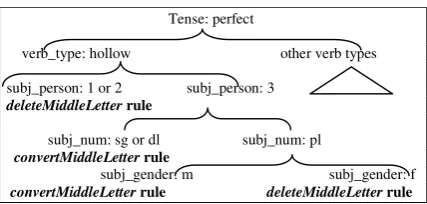
Step3: For every solution in the list, the sys-tem morphologically generates a well-formed stem. A shallow morphological generator is de-veloped that is based on the notion of a Morpho-logical Form Hierarchy (MFH) or tree (Cavalli et al., 2000). The input of this module is a FS.
from the root string. Figure 1 shows an example of a rule attached to a node in the MFH.
Rule (1): Description
IF the affix string in the learner answer match-es the correct affix string AND the FS of the correct answer does not match with the FS of
the learner answer
THENdiscard this solution.
Example: if the learner writes the word تلاق
/qAl.-tu/ (I-told) instead of تلق /qul-tu/ (I-told), the system will extract four suffixes that have
the same orthographic form but differ in their meaning. All these suffixes except 1st singular suffix are discarded
Table 5:Anexample of a filtering rule
Tense: perfect
verb_type: hollow other verb types
subj_person: 1 or 2 subj_person: 3
deleteMiddleLetter rule
subj_num: sg or dl subj_num: pl
convertMiddleLetter rule
subj_gender: m subj_gender: f
convertMiddleLetter rule deleteMiddleLetter rule Figure 1: A subtree showing the stem change for
per-fect verbs of pattern لعف/faEala/
The rationale behind this module is that the specified FS is matched against the features de-fining each subtree until a leaf is reached. At that point, the transformation rule attached to the leaf node is tried. If no rule is found or none of the clauses of the applicable rule match, it returns the value of root unchanged. After applying this step on Example 1, it produces the stem لق /qul/
Step4: In this step, the system matches the generated stem with the extracted (analyzed) one using three-way-match method (Elmi and Evens 1998). The inserted and deleted characters are only constraints to be weak letters3. Also, the converted characters should only be performed with another one that has similar pronunciation. The matching process works as follows: partition the two words according to the following pat-terns the generated stem pattern = xuz and ex-tracted stem pattern = xvz. Where x is the initial segment, z is the tail segment; u and v are the error segments. First, the initial segment is se-lected. The tail segment is processed likewise. Finally, the error segments are the remaining characters of the two words.
3 This is because the learner may have a problem in
either verb conjugation or vowel letters.
Applying this step on Example 1, the extracted stem is لاق /qAl/ while the generated one is لق
/qul/. The matched initial segment is {ق} and the matched tail segment is {ل}. The error segment for the extracted stem is {ا} whereas it is empty for the generated stem. Therefore, the system concludes that there is some extra character ا /A/. This extra character does not match the diacritic sign of the generated word at this position (i.e. the added character is ا while the diacritic sign at second position is ةمض /u/).
Step5: Ambiguity is a standard problem in any NLP application. In ILTS, relaxing the con-straints of the language in order to be able to ana-lyze learner’s answer generally produces more interpretations than systems designed for only well-formed input.The ambiguity problem men-tioned here is discussed and partially solved in (Shaalan et al., 2010b).
3.3.2 Error Classification Module
This module will recognize different error types from word analysis structure. It contains a set of if-then rules to recognize different error types. Examples of these rules are given below.
Rule Make Short Vowel long one Error: IF there is an inserted character in the affix OR (there is an inserted character in the stem AND this char-acter matches with the diacritic sign at this position of the correct word) THEN the error in vowel letters. The parameter of this error is ["short", "long"]
Notice that the learner might make multiple errors in his input. So, this module exhaustively tests all IF-statements to detect all possible error types the learner has made.
Applying this module on the input word وتلاق
/qAl.-tw/ (I-told), it detects that the learner has made three errors: 1) Verb tense error since the correct word tense is imperfect while the ana-lyzed one is perfect, 2) Make short vowel long one since there is an extra character in affix, and 3) Verb conjugation error since there is an extra character at position 2 in the stem and this char-acter does not match the correct diacritic sign.
3.3.3 Filtering Module
This module accommodates multiple errors, in-structional feedback messages need to be priori-tized by the system and displayed one at a time to the student to avoid multiple error reports.
of errors, e.g. verb tense error has higher priority than verb conjugation error.
3.4 Tutoring Module
This module is responsible for initializing the student model for each new registered student and issuing appropriate error specific feedback message suited to the learner's level. The initiali-zation process is to set the frequency of all bugs in the student model to [0, 0].
The feedback system is responsible for gener-ating feedback messages that conform to the learner’s expertise. It includes error database and feedback message generator. The error data-base contains a specification of all different er-rors categories handled by the system.
The feedback message generator module re-ceives a number that defines proficiency level according to this error- beginner or intermediate or advanced. In addition, it receives the error type along with its parameters. Then, it proceeds as follows: for the advanced learning level, the feedback is to provide a hint to the class of the error. For the intermediate, it provides the type of error. For the beginner, the feedback refers to the exact source of the error. For example, the ad-vanced learner will get the following message “error at the interface of lexical and grammar”. While the intermediate will get “verb tense er-ror”. The beginner message is “incorrect use of perfect verb instead of imperfect”
4 System Evaluation
We conducted an experiment that measures how successfully the proposed model diagnoses errors and provides correct error specific feedback that conforms to the learning level. The quantitative measures are used. These measures rely on col-lecting different test sets written by real SLLs in a typical teaching/learning environment. It was necessary that these learners have different back-grounds (i.e., differ in their first language) to test if the system is general enough and not aimed to a specific sort of learners. The different types of errors and the exact source of errors in the test set are subjectively identified by a human spe-cialist to produce the reference set. The test set is then fed into the system and the detected and undetected errors are reported. The recall rate for each error type is calculated.
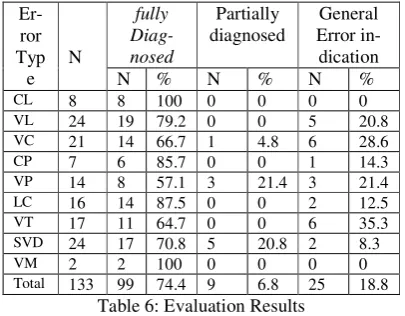
The above mentioned methodology is applied on a real test set that consists of 116 real Arabic sentences. Table 6 summarizes the evaluation results. The first column in this table describes
the different error types while the second column presents the total number of occurrences of each error type in the test set. The rest of columns pre-sent the recall rate of fully diagnosed errors, par-tially-diagnosed, and general error indication, respectively.
Er-ror Typ
e N
fully Diag-nosed
Partially
diagnosed Error in-General dication
N % N % N %
CL 8 8 100 0 0 0 0
VL 24 19 79.2 0 0 5 20.8
VC 21 14 66.7 1 4.8 6 28.6
CP 7 6 85.7 0 0 1 14.3
VP 14 8 57.1 3 21.4 3 21.4
LC 16 14 87.5 0 0 2 12.5
VT 17 11 64.7 0 0 6 35.3
SVD 24 17 70.8 5 20.8 2 8.3
VM 2 2 100 0 0 0 0
Total 133 99 74.4 9 6.8 25 18.8 Table 6: Evaluation Results
Notice, however, the error specific feedback message produced by the system in cases of par-tially diagnosed errors is the same for both the beginner and intermediate learning level. This is because the source of error was not detected by the system. While the feedback message in cases of general error indication is a catch-all error message for all learning levels.
The highly recall rate is for consonant letters and verb mood (100%). While the less recall rate is for verb pattern (57.1%). This is because of the ambiguity problem. The system has no direct knowledge of what the student meant to express. For example, if the learner writes the word تملع
instead of تملعﺗ /ta-ςal~am-tu/ (I-study). It is not clear whether the learner meant تملع /ςalim-tu/ (I-knew) by using the pattern لعف /faςil/ or تمًلع
/ςal~am-tu/ (I-taught) by using the pattern لًعف
/faς~al/. The system successfully detects that the error type is verb pattern but fails to identify the exact wrong pattern. Therefore the feedback message for both beginner and intermediate learner in this case is the same "incorrect use of verb pattern".
5 Conclusion
inade-quate, especially for highly derivational and in-flectional languages such as Arabic. Therefore, we adopted methods and tools that meet the SLLs of Arabic needs. Moreover, those learners want to improve their language skills in order not to fall in the same mistakes very often. There-fore, it was appropriate that we developed a di-agnosis system, letting the learners find out the correct solution for themselves. Error messages point the learner to the right direction for correc-tion.
In order to evaluate our approach, we acquired a test data set from a real educational SLLs envi-ronment. In the absence of a complete computa-tionally erroneous Arabic corpus, either for re-search or commercial purposes, we only could manually collect a relatively small test set. For-tunately, it was sufficient to show that approach and techniques employed in this paper have suc-cessfully analyzed ill-formed verbs written by SLLs of Arabic. Nevertheless, it shows the capa-bility of issuing an intelligent feedback message that conforms to the learner proficiency level allowing the system to perform individualization in the teaching process.
The approach and techniques described in this research can be used with other Semitic lan-guages which share similar morphological fea-tures of Arabic to provide appropriate feedback to their SLLs.
References
Abd Alghaniy, K. E. 1998. Arabic and Malaysian Languages from Phonological and Morphological Perspective: A Contrastive Analysis Approach. Master Thesis, Cairo University, Egypt, 1998. Ali, M. B. 1998. Linguistic Analysis of Mistakes by
Students at the University of Malaya: An Error Analysis Approach. Master Thesis, Cairo Universi-ty, Egypt, 1998.
Cavalli-Sforza, V., Soudi, A. and Mitamura, T. 2000. Arabic Morphology Generation Using a Concate-native Strategy. In Proceedings of the 1st Confer-ence, NAACL 00. Seattle, Washington, pp: 86-93. Elmi, M. A. and Evens, M. 1998. Spelling Correction
Using Context. In Proceedings of 36th ACL 98, Montreal, Canada, pp: 360-364.
Faltin, A. V., L’haire, S. and Ndiaye, M. 2005. A Spell Checker for Language Learners of French and a Learner Corpus. In Proceedings of EURO-CALL 05. Cracow, Poland.
Faltin, A. V. 2003. Syntactic Error Diagnosis in the Context of Computer Assisted Language Learning.
PhD Thesis, University of Geneva, Switzerland, 2003.
Habash, N., Soudi, A., and Buckwalter, T. 2007. On Arabic Transliteration. In Arabic Computational Morphology: Knowledge-based and Empirical Methods. Soudi, Abdelhadi; van den Bosch, Antal; Neumann, Günter (Eds.), 2007. ISBN: 978-1-4020-6045-8
Hsieh, C.-C., Tsai, T.-H., Wible, D. and Hsu, W.-L. 2002. Exploiting Knowledge Representation in an Intelligent Tutoring System for English Lexical Er-rors. In Proceedings of ICCE 2002, Auckland,
New Zealand, pp: 115-116.
Jassem, J. A. 2000. Study on Second Language Learners of Arabic: An Error Analysis Approach. Kuala Lumpur (Malaysia): A.S. Noordeen. ISBN 983-065-093-6.
Rimrott, A. 2003. SANTY: A Spell Checking Algo-rithm for Treating Predictable Verb Inflection Mis-takes Made by Non-Native Writers of German. Term Paper for LING 807 – Computational Lin-guistics at Simon Fraser University (Burnaby, Canada).
Shaalan, K., Magdy, M., Fahmy, A. 2011. Morpho-logical analysis of ill formed Arabic verbs for se-cond language learners. In McCarthy, P.M & Boonthum, C. (ed.), Applied Natural Language Processing and content analysis: Identification, In-vestigation, and Resolution (In Press).
Shaalan, K., Magdy, M., Fahmy, A. 2010a. Morpho-logical Analysis of Ill-formed Arabic Verbs in In-telligent Language Tutoring Framework. In the Proceedings of FLAIRS-23, Applied Natural Lan-guage Processing Track, Florida, USA, 2010. Shaalan, K., Samy, D. and Magdy, M. 2010b.
To-wards Resolving Morphological Ambiguity in Ar-abic Intelligent Language Tutoring Framework. In Proceedings of International Workshop on Sup-porting e-Learning with Language Resources and Semantic Data (LREC 2010), Valletta, Malta Shaalan K. 2005a. An Intelligent Computer Assisted
Language Learning System for Arabic Learners, in Computer Assisted Language Learning: An Inter-national Journal, Taylor & Francis Group Ltd., 18(1 & 2): 81-108.