13
The Acute and Chronic Responses to Exercise with the Core-Tex™
Bryant R. Byrd1, Angela I. Carroll1, Paige H. Forbes1, Janinka B. Durchslag1, Lance C. Dalleck1 1High Altitude Exercise Physiology Program, Western Colorado University, Gunnison, CO, USA
Introduction
Cardiorespiratory, flexibility, neuromotor, and resistance training are each paramount for the overall health, physical fitness, and well-being of individuals. Health and fitness professionals can follow readily available
published guidelines, provided from major health organizations such as the American Council on Exercise (ACE) and the American College of Sports Medicine (ACSM), when designing training programs for positively modifying each of these fitness components
ABSTRACT
Aim: The purpose of this study was two-fold: 1) quantify the acute physiological responses to
exercise with the Core-Tex™ and 2) to determine the effectiveness of 6wk chronic exercise training with the Core-Tex™ at improving cardiorespiratory, flexibility, neuromotor, and muscular fitness.
Methods: Fifteen women and men (mean ± SD: age, height, weight, and VO2max = 26.1 ± 6.8 years, 171.6 ± 9.3 cm, 64.5 ± 12.7 kg, and 41.3 ± 6.5 mL/kg/min, respectively) participated in the study. A portable calorimetric measurement system and Polar F1 heart rate monitor were worn by each participant throughout two 30-minute Core-Tex™ training sessions (an upper body/core day and lower body/core day) to quantify the acute physiological response to exercise with the Core-Tex™. Cardiovascular and metabolic responses across these two sessions were averaged. Additionally, participants completed a 6wk Core-Tex™ exercise training program (30-minute sessions performed 4 times/wk). Cardiorespiratory, flexibility, neuromotor, and muscular fitness were measured at baseline and after 6wk training. Results: Overall heart rate for a 30-minute exercise session was 121.4 ± 13.7 beats/min, which corresponded to 48.1 ± 10.6% HRR. Exercise intensity in METs was 4.8 ± 1.1, which equated to 35.2 ± 5.9% VO2R. Total energy expenditure for a Core-Tex™ exercise training session was 162.0 ± 21.9 kcal/session. After 6wk of exercise training with a Core-Tex™ there were significant (p < 0.05) improvements all cardiorespiratory, flexibility, neuromotor, and muscular fitness measurements. Conclusions: Findings from the present study support the activity of Core-Tex™ as a feasible alternative to traditional exercise modalities for adults that elicits cardiovascular and metabolic responses within an accepted moderate intensity range. Moreover, regular exercise training with the Core-Tex™ improves various domains of fitness in a time efficient manner.
14 (Garber et al., 2011). To fulfill maximum
frequency requirements of each form of activity (14 overall – 5 cardiorespiratory bouts, 3 flexibility bouts, 3 neuromotor bouts, and 3 resistance bouts) it is necessary for individuals to perform at least two (or more) activities the same day; and most likely within the same exercise session. It may be easier for individuals to achieve maximum frequency requirements for each form of activity if the exercise modality itself permits simultaneous training across various fitness components (i.e., neuromotor and cardiorespiratory).
The Core-Tex™ is a newcomer to the fitness industry and differs substantially in function from previous fitness modality products. Core-Tex™ training is underpinned by the premise of reactive variability. Reactive variability constantly provides variability to the muscles, nervous system and joints. Every exercise and repetition is different, thereby reducing stress on the joints, continually requiring the nervous system to adapt (plasticity) to coordinate new movements increasing muscle activation and efficiency. As such, the Core-Tex™ is a
completely unique approach to 3
dimensional, functional movement. It is a reactive training tool that combines dynamic strength, reaction, cardiorespiratory endurance, flexibility and balance into a single modality design, creating the optimal training environment. Nevertheless, because of its novelty, there is a lack of research on the Core-Tex™. Understanding the physiological responses to exercise is
essential for designing safe and effective fitness and rehabilitation training programs. For example, it would be beneficial to understand the metabolic equivalent (MET) value associated with Core-Tex™. A MET value would allow the quantification of Core-Tex™ exercise intensity as low, moderate, or vigorous in nature, and hence, aid in establishing a safe and effective target workload. Furthermore, it would be valuable to have a better understanding of the neuromotor (i.e., balance and agility), strength, and flexibility gains associated with chronic Core-Tex™ training. The purpose of this study was two-fold: 1) quantify the acute physiological responses to exercise with the Core-Tex™ and 2) to determine the effectiveness of 6wk chronic exercise training with the Core-Tex™ at improving cardiorespiratory, flexibility, neuromotor, and muscular fitness. It was hypothesized that: 1) an acute bout of exercise training with the Core-Tex™ will be safe and effective and 2) chronic exercise training on the
Core-Tex™ will lead to time-efficient
improvements in cardiorespiratory,
flexibility, neuromotor, and muscular fitness.
Methods
Participantsrisk-to-15 moderate risk and physically inactive as defined
by the ACSM (ACSM, 2018). This study was approved by the Human Research Committee at Western Colorado University. All participants provided informed consent in advance of participation.
Experimental design
Acute responses to exercise with Core-Tex™
To quantify acute cardiovascular and
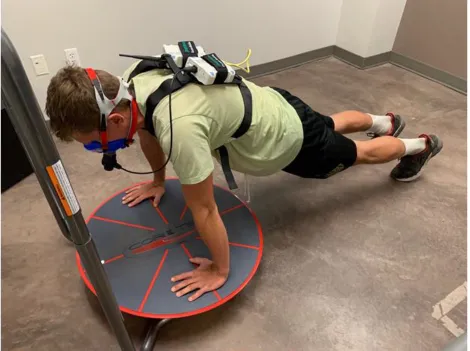
metabolic responses to Core-Tex™ exercise an Oxycon Mobile portable calorimetric measurement system and Polar F1 heart rate monitor were worn by each participant throughout two 30-minute Core-Tex™ training sessions (Figure 1): upper body/core
day and lower body/core day.
Cardiovascular and metabolic responses across these two sessions were averaged.
Figure 1. The portable metabolic system attached to a participant during a Core-Tex™ training session.
Chronic responses to Core-Tex™
At baseline and post-program, participants performed a graded exercise test on a treadmill to determine cardiorespiratory
fitness via the gold standard measure of
maximal oxygen uptake (VO2max).
16 agility and balance), and muscular fitness
were also assessed at baseline and post-program. Specifically, the following measures were obtained to determine the
effectiveness of a 6wk Core-Tex™
intervention at positively modifying fitness parameters:
Maximal exercise test to determine cardiorespiratory fitness (i.e., VO2max)
Sit-and-reach test to assess flexibility Five-repetition maximum (5-RM) for
bench and leg press to quantify muscular fitness
Plank test to assess core muscular fitness
Agility was assessed using the Pro Agility shuttle run
The impact of reactive variability training on balance was assessed with the Y-balance test
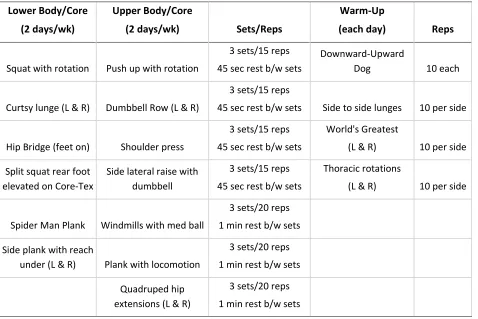
Table 1. The 6wk Core-TexTM exercise training program.
Lower Body/Core (2 days/wk)
Upper Body/Core
(2 days/wk) Sets/Reps
Warm-Up
(each day) Reps
Squat with rotation Push up with rotation
3 sets/15 reps 45 sec rest b/w sets
Downward-Upward
Dog 10 each
Curtsy lunge (L & R) Dumbbell Row (L & R)
3 sets/15 reps
45 sec rest b/w sets Side to side lunges 10 per side
Hip Bridge (feet on) Shoulder press
3 sets/15 reps
45 sec rest b/w sets
World's Greatest
(L & R) 10 per side
Split squat rear foot elevated on Core-Tex
Side lateral raise with dumbbell
3 sets/15 reps
45 sec rest b/w sets
Thoracic rotations
(L & R) 10 per side
Spider Man Plank Windmills with med ball
3 sets/20 reps
1 min rest b/w sets
Side plank with reach
under (L & R) Plank with locomotion
3 sets/20 reps 1 min rest b/w sets
Quadruped hip extensions (L & R)
3 sets/20 reps 1 min rest b/w sets
Training program to determine chronic responses to Core-Tex™ exercise training
All participants completed a standard 6wk Core-Tex™ training program (Table 1). The
17 were encouraged to train no more than
three consecutive days without a rest day. All Core-Tex™ exercise training sessions were performed within group classes of three to four participants supervised by one member of the research team. Only the data from those participants who completed ≥75% of the training sessions (i.e., 18 out of 24 sessions) were included in the final analysis.
Exercise intensity and metabolic calculations
Individual heart rate reserve (HRR) was determined as the difference between resting and HRmax values. Percent HRR was calculated by subtracting resting HR from the Core-Tex™ HR response, dividing by HRR, and then multiplying the quotient by 100. Likewise, individual oxygen uptake reserve (VO2R) was quantified by taking the difference between resting VO2 (a constant of 3.5 mL/kg/min was used for all individuals) and maximum VO2 values. Percent VO2R was calculated by subtracting resting VO2 from the Core-Tex™ VO2 response, dividing by VO2R, and then multiplying the quotient by 100. The metabolic equivalent (MET) for Core-Tex™ was determined by dividing the Core-Tex™ VO2 by a standardized resting VO2 value (i.e., 3.5 mL/kg/min). Energy expenditure (kcal/session) for the Core-Tex™ training session was calculated by multiplying the above-calculated MET equivalent of the Core-Tex™ training session by individual body mass, dividing by 1000, multiplying by the caloric equivalent for the measured respiratory exchange ratio or RER (e.g., an
RER of 0.83 equates to an energy cost of 4.838 kcal/L of oxygen), and last multiplying by 30-minute (duration of Core-Tex™ training session).
Statistical Analyses
All analyses were performed using SPSS Version 25.0 (IBM Corporation, New York, NY, USA) and GraphPad Prism 7.0. (San Diego, CA). Measures of centrality and spread are presented as mean ± standard deviation (SD). Primary outcome measures for the acute cardiovascular and metabolic responses to the Core-Tex™ portion of the study were relative exercise intensity (% HRR and % VO2R), metabolic equivalents (METs), and energy expenditure (kcal/min and kcal/session). Primary outcomes for the chronic responses to exercise training with the Core-Tex™ included various measures of cardiorespiratory, flexibility, neuromotor, and muscular fitness. Paired t-tests were used to compare mean primary outcome changes between baseline and 6wk. The probability of making a Type I error was set at p < 0.05 for all statistical analyses.
Results
Acute cardiovascular and metabolic responses to exercise with the Core-Tex™
18 intensity in METs was 4.8 ± 1.1, which
equated to 35.2 ± 5.9% VO2R. Total energy expenditure for a Core-Tex™ exercise training session was 162.0 ± 21.9
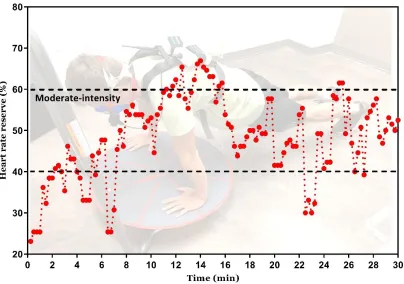
session. Figure 2 illustrates the exercise intensity in terms of HRR for a representative participant throughout the duration of a Core-Tex™ exercise training session.
Table 2. Acute cardiovascular and metabolic responses. Parameter mean SD
HR (beats/min) 121.4 ± 13.7
%HRR 48.1 ± 10.6
%VO2R 35.2 ± 5.9
METs 4.8 ± 1.1
kcal/min 5.4 ± 1.7
kcal/session 162.0 ± 21.9
HR, heart rate; %HRR, percentage heart rate reserve; kcal, kilocalories; METs, metabolic equivalents; %VO2R, percentage oxygen uptake reserve.
Figure 2. Exercise intensity in terms of heart rate reserve (HRR) for a representative participant
19
Chronic cardiovascular and metabolic responses to training with the Core-Tex™
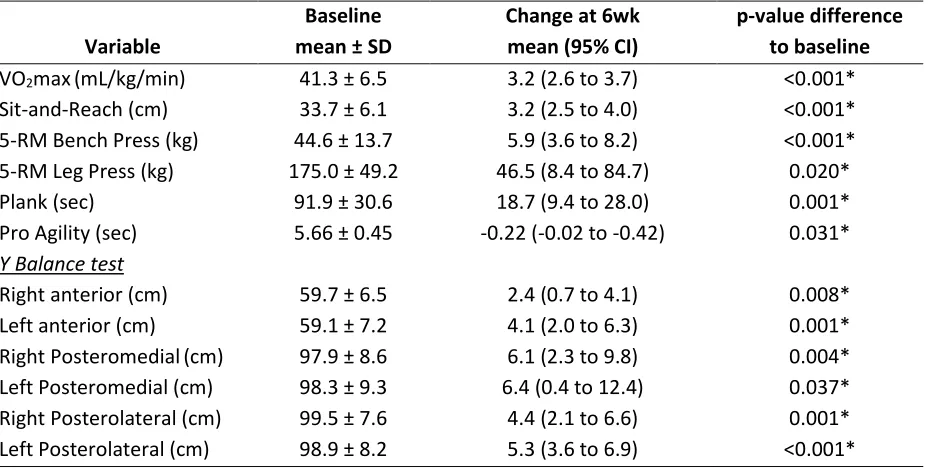
The fitness-related responses to exercise training with the Core-Tex™ are presented in Table 3 for all individuals who completed
the intervention (N = 15). At 6wk, paired t-tests revealed favorable changes (p<0.05) all fitness domains (cardiorespiratory, muscular, flexibility, and neuromotor).
Table 3. Baseline (mean SD) and mean change (95% CI) at 6wk in all primary outcomes after Core-Tex™ exercise training.
Variable
Baseline mean ± SD
Change at 6wk mean (95% CI)
p-value difference to baseline
VO2max(mL/kg/min) 41.3 ± 6.5 3.2 (2.6 to 3.7) <0.001*
Sit-and-Reach (cm) 33.7 ± 6.1 3.2 (2.5 to 4.0) <0.001*
5-RM Bench Press (kg) 44.6 ± 13.7 5.9 (3.6 to 8.2) <0.001*
5-RM Leg Press (kg) 175.0 ± 49.2 46.5 (8.4 to 84.7) 0.020*
Plank (sec) 91.9 ± 30.6 18.7 (9.4 to 28.0) 0.001*
Pro Agility (sec) 5.66 ± 0.45 -0.22 (-0.02 to -0.42) 0.031*
Y Balance test
Right anterior (cm) 59.7 ± 6.5 2.4 (0.7 to 4.1) 0.008*
Left anterior (cm) 59.1 ± 7.2 4.1 (2.0 to 6.3) 0.001*
Right Posteromedial(cm) 97.9 ± 8.6 6.1 (2.3 to 9.8) 0.004*
Left Posteromedial (cm) 98.3 ± 9.3 6.4 (0.4 to 12.4) 0.037*
Right Posterolateral (cm) 99.5 ± 7.6 4.4 (2.1 to 6.6) 0.001* Left Posterolateral (cm) 98.9 ± 8.2 5.3 (3.6 to 6.9) <0.001* Note: confidence interval (CI), five-repetition maximum (5-RM). *denotes p < 0.05.
Discussion
Physical inactivity is an important risk
factor for the development and
progression of CVD (Mozaffarian et al., 2015). Nevertheless, according to 2013 data in adults ≥18 years the age-adjusted proportion who reported engaging in moderate or vigorous physical activity that met current physical activity guidelines for Americans was 50.0% (Mozaffarian et al., 2015). This is perhaps due in part to a lack
of enjoyment experienced from
participation in traditional forms of physical activity (such as walking, running,
20 supporting the Core-Tex™ as an ideal
alternative exercise modality:
1. The typical Core-Tex™ exercise session elicited cardiovascular and metabolic responses that fulfill exercise intensity guidelines for
improving and maintaining
cardiorespiratory fitness (ACSM, 2018; Bryant & Green, 2010). Mean exercise intensity was 48.1% of HRR and 4.8 METs, respectively. Overall energy expenditure for a Core-Tex™ exercise session was 162 kcal/session.
2. Participation in a 6wk exercise-training program with the Core-Tex™ positively modified various fitness domains. In fact, our findings demonstrated that the Core-Tex™ is an exercise modality that may simultaneously satisfy
training guidelines for
cardiorespiratory, flexibility, neuromotor, and muscular fitness.
Acute cardiovascular and metabolic responses to Core-Tex™
Exercise intensity is arguably the most critical component of the exercise prescription model. Failure to meet minimal threshold values may result in lack of a training effect, while too high of an intensity could lead to over-training and negatively impact adherence to an exercise program (Franklin, 2007). Results from the present study indicate exercise with a Core-Tex™ can be classified as
“moderate” according to various
organizations definition of physical activity intensity (ACSM, 2018; Bryant & Green, 2010). For example, moderate exercise intensity in relative terms has been defined as 40-59% of HRR/VO2R (ACSM, 2018). Participants in the present study exercised at workloads with the Core-Tex™ that elicited HRR (48.1%) values that fall within the moderate relative intensity category.
In the 2018 US physical activity guidelines report (Department of Health and Human Services, 2018) and elsewhere (Ainsworth et al., 2011), moderate-intensity physical activity in absolute metabolic terms has been classified as 3 to 6 METs. In the present study, the MET response to exercise with the Core-Tex™ averaged 4.8. Thus, participants in the present investigation exercised at workloads during a typical Core-Tex™ exercise session that elicited metabolic responses within the accepted moderate-intensity range. This is an important finding given the fact that moderate-intensity exercise has been widely recommended for health benefits (ACSM, 2018; Bryant & Green, 2010; Department of Health and Human Services, 2018). Additionally, MET values described in the present study compare favorably to more traditional land-based
aerobic exercise values and
21 between 50 and 100 Watts will elicit a MET
value ranging from 4.0 to 6.0 METs (ACSM,
2018). More recently, Smith and
colleagues (2016) reported that
participation in a TRX Suspension Training class also elicited an absolute moderate-intensity metabolic response at 5.8 METs.
Chronic cardiovascular and metabolic adaptations to Core-Tex™
In the past few decades both low cardiorespiratory and muscular fitness have garnered considerable attention as independent and powerful predictors of CVD risk and premature mortality. For instance, it has been reported that increased muscular fitness is associated with a reduced risk of all-cause mortality (Ruiz et al., 2008). Likewise, Williams (2001) showed in a meta-analysis that there was a marked decrease in relative risk for CVD when individuals moved out of the lowest quartile of cardiorespiratory fitness. More recently, Blair (2009) estimated that low cardiorespiratory fitness accounted for more overall deaths when compared to deaths which could be attributed to traditional CVD risk factors, such as obesity, smoking, hypertension,
high cholesterol, and diabetes.
Accordingly, the changes in
cardiorespiratory (i.e., ↑ VO2max) and muscular fitness (i.e., ↑ 5-RM bench press and leg press scores) in the current study have novel clinical and public health relevance, as a large number of adults fall
into clinically-defined low
cardiorespiratory and muscular fitness
categories and therefore demonstrate increased CVD risk (Lobelo et al., 2010). Overall, VO2max was improved on average by ~1.0 METs following 6wk of exercise training. These improvements likely have
important long-term prevention
implications as a recent study reported a 1 MET increase in VO2max was associated with an 18% reduction in deaths due to CVD (Barlow et al., 2012).
Methodological Considerations
Possible limitations to the present study merit discussion. The present study investigated the acute and chronic cardiovascular and metabolic responses to a representative sample of healthy, yet previously physically inactive, men and women participating in exercise training with a Core-Tex™ according to a standardized 30-minute routine (see Table 1). The cardiovascular and metabolic responses to Core-Tex™ exercise would
undoubtedly vary across different
routines. Additionally, the fitness-related adaptations to exercise training with a Core-Tex™ may be more pronounced with a longer training period beyond the 6wk duration of the present study. Future research might also examine other possible training adaptations including enhanced psychological health (e.g., reduced anxiety, lower stress levels).
Conclusions
22 for adults that elicits metabolic responses
within the accepted moderate intensity range. Moreover, regular exercise training with the Core-Tex™ improves various domains of fitness in a time efficient manner. Overall, these findings are important for exercise physiologists, personal trainers, and others who design exercise programs and promote physical activity in the adult population.
Competing interests
This investigation was supported financially by the American Council on Exercise (ACE). The American Council on Exercise (ACE) was not involved in development of the study design, data collection and analysis, or preparation of the manuscript. There are no other potential conflicts of interest related to this article
Address for Correspondence
Lance Dalleck, Ph.D., High Altitude Exercise Physiology Program, 600 N. Adams St., Western Colorado University, Gunnison, CO, United States, 81231. Phone: 970-943-3095;
Email: [email protected].
References
1. Ainsworth BE, Haskell WL, Herrmann SD, Meckes N, Bassett DR Jr, Tudor-Locke C, Greer JL, Vezina J, Whitt-Glover MC, Leon AS. 2011 Compendium of Physical Activities: a second update of codes and MET values. Med Sci Sports Exerc. 2011;43(8):1575-1581.
2. American College of Sports Medicine. ACSM’s Guidelines for Exercise Testing and Prescription, 10th ed.; Lippincott Williams & Wilkins: Baltimore, MD, USA, 2018.
3. Barlow CE, Defina LF, Radford NB, et al. Cardiorespiratory fitness and long-term survival in "low-risk" adults. J Am Heart Assoc. 2012; 1(4):e001354.
4. Blair SN. Physical inactivity: the biggest public health problem of the 21st century. Br J Sports Med. 2009; 43(1):1-2.
5. Bryant CX, Green DJ. (2010). ACE personal trainer manual. San Diego, CA: American Council on Exercise.
6. Franklin BA. Fitness: the ultimate marker for risk stratification and health outcomes? Prev Cardiol 2007;10:42-46.
7. Garber CE, Blissmer B, Deschenes MR, Franklin BA, Lamonte MJ, Lee IM, Nieman DC, Swain DP. Quantity and quality of exercise for developing and maintaining cardiorespiratory, musculoskeletal, and neuromotor fitness in apparently healthy adults: guidance for prescribing exercise. Med Sci Sports Exerc. 2011; 43:1334-1359
8. Lobelo F, Pate R, Dowda M, Liese A, Daniels S. Cardiorespiratory fitness and clustered cardiovascular disease risk in U.S. adolescents. J Adolesc Health. 2010; 47(4):352-359.
9. Mozaffarian D, Benjamin EJ, Go AS, Arnett DK, Blaha MJ, Cushman M, de Ferranti S, Després JP, Fullerton HJ, Howard VJ, Huffman MD, Judd SE, Kissela BM, Lackland DT, Lichtman JH, Lisabeth LD, Liu S, Mackey RH, Matchar DB, McGuire DK, Mohler ER 3rd, Moy CS, Muntner P, Mussolino ME, Nasir K, Neumar RW, Nichol G, Palaniappan L, Pandey DK, Reeves MJ, Rodriguez CJ, Sorlie PD, Stein J, Towfighi A, Turan TN, Virani SS, Willey JZ, Woo D, Yeh RW, Turner MB; American Heart Association Statistics Committee and Stroke Statistics Subcommittee. Heart disease and stroke statistics--2015 update: a report from the American Heart Association. Circulation. 2015; 131(4):e29-322.
10. Ruiz JR, Sui X, Lobelo F, Morrow JR Jr, Jackson AW, Sjöström M, Blair SN. Association between muscular strength and mortality in men: prospective cohort study. BMJ. 2008 Jul 1;337:a439.
11. Smith LE, Snow J, Fargo JS, Buchanan CA, Dalleck LC. The Acute and Chronic Health Benefits of TRX Suspension Training® in Healthy Adults. Int J Res Ex Phys. 2016; 11(2):1-15.
12. Trost SG, Owen N, Bauman AE, Sallis JF, Brown W. Correlates of adults' participation in physical activity: review and update. Med Sci Sports Exerc. 2002; 34(12):1996-2001.
13. United States Department of Health and Human Services (2018). Physical Activity Guidelines for Americans (2nd ed.). www.health.gov/paguidelines/