of peer-reviewed research and commentary in the population sciences published by the Max Planck Institute for Demographic Research Konrad-Zuse Str. 1, D-18057 Rostock · GERMANY www.demographic-research.org
DEMOGRAPHIC RESEARCH
VOLUME 8, ARTICLE 4, PAGES 93-106
PUBLISHED 14 February 2003
www.demographic-research.org/Volumes/Vol8/4/
DOI: 10.4054/DemRes.2003.8.4
Descriptive Findings
Adolescent childbearing in sub-Saharan
Africa:
Can increased schooling alone raise ages
at first birth?
Neeru Gupta
Mary Mahy
1 Introduction 94
2 Data and methods 95
3 Results 97
3.1 Descriptive analysis 97
3.2 Multiple regression analysis: determinants of changes in adolescent fertility
99
4 Discussion 102
5 Acknowledgements 103
Notes 104
Descriptive Findings
Adolescent childbearing in sub-Saharan Africa:
Can increased schooling alone raise ages at first birth?
Neeru Gupta1 Mary Mahy2
Abstract
This article examines whether increased years of schooling exercised a consistent impact on delayed childbearing in sub-Saharan Africa. Data were drawn from Demographic and Health Surveys conducted in eight countries over the period 1987-1999. Multiple logistic regressions were used to assess trends and determinants in the probability of first birth during adolescence. Girls’ education from about the secondary level onwards was found to be the only consistently significant covariate. No effect of community aggregate education was discernible, after controlling for urbanity and other individual-level variables. The results reinforce previous findings that improving girls’ education is a key instrument for raising ages at first birth, but suggest that increases in schooling at lower levels alone bear only somewhat on the prospects for fertility decline among adolescents.
1 Evidence and Information for Policy, World Health Organization, Geneva, Switzerland. Email:
[email protected]. Affiliation for this study: ORC Macro in Calverton (MD).
2 Division of Policy and Planning, UNICEF, New York (NY). Email: [email protected]. Affiliation
1. Introduction
Sub-Saharan Africa has some of the highest levels of adult and adolescent childbearing in the world. Since the 1980s, several countries in the region have begun a transition toward lower fertility. This has generally been accompanied by an upward trend in the age at first birth, although wide variations remain across countries and social groups. Modernisation has been claimed to be an instigator of fertility decline in many societies (Caldwell 1976, Coale 1973, Easterlin 1983). Increased education, innovations in health care, and improved communication are thought to bring about forces dissolving traditional tendencies toward large families and replacing them with individualism marked by material aspirations. In particular, a strong correlation between women’s education and reduced childbearing consistently emerges from studies throughout the developing world (see, for example, Ainsworth 1994, Martin and Juarez 1995). Mboup and Saha (1998) found that in many countries of sub-Saharan Africa, women with no schooling have about two to three children more than women with secondary or higher education. It has been suggested that in areas that have not yet achieved mass schooling, changes in behaviour will be slow because of the slower pace of social interaction and diffusion, resulting in a lagging fertility decline (Lloyd, Kaufman, and Hewett 2000).
Fertility decline is due in part to delayed childbearing among younger and adolescent women. Lower fertility preferences might reduce the pressure for women to start childbearing at a young age in order to meet their family size goals. A growing body of literature on reproductive health and behaviour among the adolescent populations in sub-Saharan Africa has emerged since the late 1980s. Adolescent fertility has been increasingly viewed as a source of social and policy concern. Early childbearing has been linked to higher rates of maternal and child morbidity and mortality, truncated educational opportunities, and lower future family income. Zabin and Kiragu (1998) reviewed the evidence for the effects of early childbearing (within and outside of union) and pointed to a number of health consequences including, for the mother, higher than average levels of blood pressure, toxaemia, anaemia, bleeding, obstructed and difficult labour, premature delivery, and death. In addition, children born to teenagers are susceptible to higher incidence of low birth weight (which itself can lead to neurological problems, retardation, death), prematurity, stillbirth, and neonatal mortality.
prolonged postpartum breastfeeding that otherwise would have acted to delay a new pregnancy (see Bledsoe et al. 1999). Seemingly diminishing returns of education on delayed sexual activity were cited to help explain observed increases over time in levels of sexual experience among Brazilian adolescents (Gupta 2000).
This article presents a comparative perspective of determinants and trends in adolescent childbearing in sub-Saharan Africa. Data are drawn from Demographic and Health Surveys conducted in eight countries over the period 1987-1999. We examine changes over time in the likelihood of a young woman having a first birth before age 18, and investigate which sub-groups of the populations are at the forefront of trends toward declining adolescent fertility. Multiple regression analyses are performed to disentangle the independent impacts of education on age at first birth. Our main objective is to assess whether increased years of schooling have exercised a consistent impact on delayed childbearing among adolescents, net of other potentially confounding influences associated with modernisation. The intent is not to undermine any other obvious benefits of increases in girls’ education.
2. Data and methods
The present study focuses on trends in age at first birth among adolescent girls in eight countries of sub-Saharan Africa: Burkina Faso, Côte d’Ivoire, Ghana, Kenya, Mali, Senegal, Tanzania, and Zimbabwe. Data are drawn from successive Demographic and Health Surveys (DHS) conducted between 1987 and 1999. The DHS is one of the largest programs producing cross-national and comparative quantitative information on fertility and reproductive health throughout the developing world. Its objectives include the expansion of the international population and health database and promotion of widespread dissemination and use of survey data among policy-makers. Information is collected from personal interviews with a representative sample of women (and increasingly men) of reproductive age. The surveys are carried out in a relatively standardised manner, though questionnaires may be translated and otherwise adapted to the programmatic needs and conditions of a specific country (ORC Macro 2001).
limiting our focus on respondents in the youngest age groups, we hoped to minimise the damaging bias of recall errors, which tend to be more frequent among older respondents. Our analysis examined the probability of a young woman having a first birth before age 18. Since the period of exposure is censored for girls who have not yet completed adolescence, we included in our analysis only respondents aged 18-24 at the time of each survey. Multiple logistic regression models were used to evaluate trends and determinants of adolescent childbearing, employing the Stata statistical software package (StataCorp 2001). Separate models were run for each country to take account of unobserved characteristics. A generalised estimating equation (GEE) was applied to avoid the inefficient estimation of coefficients, given the two-stage DHS sampling scheme. As with many sample surveys, the DHS used stratified sampling designs: selection of area units or clusters (usually census enumeration or other well-defined geographical areas) in a single stage, normally with probability proportional to size, followed by selection of households. Standard logistic models assume that the distribution of the error term follows a binomial distribution and the outcomes are random and independent. However, in a hierarchically nested sample, respondents within the same cluster or community are likely to have similar characteristics and behaviours (due to a number of unmeasured and unmeasurable factors), implying that the outcomes are not independent. The GEE allowed us to estimate the model parameters while controlling for intra-cluster correlation (Liang and Zeger 1993).
The key hypothesis being tested was that differences in schooling patterns would be associated with changes in the risk of a girl’s first birth before age 18. At the individual level, the education covariate was categorised according to no schooling, one to seven years of schooling, and eight or more years of schooling achieved. It is widely recognised that fertility decline is due in part to increased schooling. Among adolescents, while we expect higher levels of education to be associated with a lower probability of early first birth, the direction of causality is less clear. A girl may decide to delay childbearing in order to complete her formal education. On the other hand, some teenage mothers may be forced to leave school after having a child. To reduce the chances of reverse causality, we selected eight years of schooling as our cut-off point in order to minimise the numbers of adolescents who may have been obliged to leave school early because of a pregnancy. Lesser years of education, or until about the secondary level, were considered to occur too early to be influenced by childbearing.
reached this level of schooling were considered to have higher mass schooling and socio-economic development. An exception was made for Mali where, due to small numbers of well-educated adults, the cut-off for higher status was set at 10 percent.
A number of other socio-demographic and contextual variables were included in the models as potential confounding factors: place of residence (urban/rural), mass media exposure (radio listenership), and family planning environment. The urban and rural distinction was considered important because of differences in access to health facilities, cultural beliefs, living situations, and opportunities. The variable for regular radio listenership, as representative of access to the mass media and new ideas, was measured by whether an individual reported listening to the radio at least once a week (Note 1). While residence and radio exposure referred to characteristics reported at the time of the survey, given the focus on younger respondents and the relatively short interval between interview and outcome of interest, these variables can generally be considered to closely reflect the characteristics at the time of first birth.
Another potentially influential variable on the risk of early childbearing was considered as access (physical, financial, and socio-cultural) to family planning and reproductive health care. A strong family planning program in the community could indirectly influence an adolescent’s familiarity with contraception and knowledge of the health risks of early sex and childbearing. Ideally, health care access would be measured from health facility data on outreach programs and use of services by adolescents. However, the availability of such data is still limited in the DHS. Alternatively, the strength of local health programs was assessed through a proxy indicator of whether a large proportion of the adults in the community had practised family planning. This was measured through cluster-level aggregates of the number of adults (women aged 25-49 and men aged 25-54) who reported ever using modern contraceptives (Note 2). Communities where at least 50 percent of adults had used contraceptives were categorised as having a strong reproductive health care environment. Due to wide disparities and sample size constraints, for Mali the cut-off for stronger family planning environment was at least 10 percent of adults having used contraceptives, while for Zimbabwe it was set at 80 percent or more.
3. Results
3.1 Descriptive analysis
birth before age 18 (regardless of marital status) by survey. The proportion is seen to have declined for all countries except Burkina Faso. The highest level of adolescent childbearing was observed in Mali (45 percent). In contrast, less than a quarter of girls had an early first birth in Ghana, Kenya, and Zimbabwe. Côte d’Ivoire witnessed the largest inter-survey reduction in the proportion of early first births (from 41 to 28 percent). In Mali, the difference was only marginal.
Figure 1: Percent of young adult women (18-24 years) who had a first birth before age 18, by DHS survey period
Large cross-national disparities were seen in the levels of girls’ schooling and other socio-demographic characteristics. For example, according to the most recent survey findings, fewer than 10 percent of adolescents (ages 15 to 19) had eight or more years of schooling in Burkina Faso, Mali, and Tanzania (see Table 1). On the other hand, the majority had attained this level in Zimbabwe (66 percent) and Ghana (51 percent). Rapid improvements in schooling were noted between survey periods in Kenya, Senegal, and Zimbabwe. Burkina Faso and Ghana experienced slight decreases in the proportions of better-educated adolescents. At the same time, in Ghana, improvements were seen in terms of an increase
0 20 40 60
Burkina Faso Cote d’Ivoire Ghana Kenya Mali Senegal Tanzania Zimbabwe
Per
cent
in the number of adolescents with one to seven years of schooling, somewhat to the detriment of the number with no education.
Table 1: Percentage distribution of adolescent girls (ages 15-19) according to level of schooling, by DHS survey period
Burkina Faso Côte
d’Ivoire Ghana Kenya Mali Senegal Tanzania Zimbabwe
Schooling 1993 1999 1994 1998 1993 1998 1993 1998 1987 1996 1993 1997 1991 1996 1994 1999
None 73 77 47 51 18 14 5 3 76 76 61 55 15 16 1 1
1-7 years 19 17 39 35 26 35 57 55 19 19 31 34 79 78 46 33
8+ years 8 6 14 14 56 51 38 42 5 5 8 11 6 6 53 66
With regard to other individual characteristics, the countries discussed here are predominantly rural. According to the latest DHS, the proportion of adolescents living in urban areas ranged between 21 percent in Burkina Faso to a high of 46 percent in Senegal. Exposure to mass media varied across the region. The majority listened to the radio regularly in Ghana, Kenya, Mali, and Senegal (between 51 and 68 percent across countries). In contrast, at most one-quarter reported listening to the radio in Burkina Faso and in Côte d’Ivoire.
3.2 Multiple regression analysis: determinants of changes in adolescent fertility
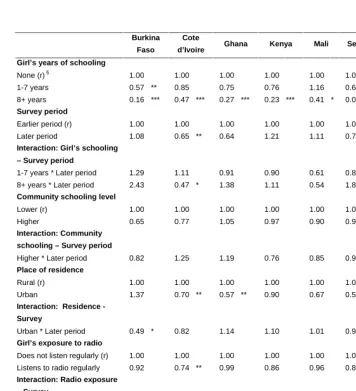
Table 2 displays the results from the multiple logistic regression models examining influences on fertility outcomes among young women in the region. To ease interpretation, our results are expressed in terms of odds ratios, which were calculated by exponentiating the parameters. A ratio greater than unity implies that an individual in the given category would be more likely to have a first birth before age 18 compared to a counterpart in the base category, while a ratio less than unity signals lower likelihood. Trends in the effects of schooling and other variables were analysed through interaction terms of the characteristic on the survey period. These interaction terms were used to specify how influences on the outcome changed between surveys.
consistent; only in Burkina Faso, Senegal, and Tanzania were girls with one to seven years of schooling significantly less likely to have an early birth compared to their counterparts with no schooling. In most countries (except Côte d'Ivoire), the interaction terms for education and survey period were not significant, pointing to relative stability over time in the magnitude of the influences of girls’ education on delayed childbearing.
Meanwhile, after considering the effect of education, there remained a statistically significant decline between the earlier and later surveys in the risk of adolescent first birth in Côte d'Ivoire and Senegal; in the later survey, girls were 30 and 35 percent less likely to have an early birth, respectively.
Community relative education level was not found to be statistically significant in any of the countries (while controlling for intra-cluster correlation). Recall that this variable was assessed though a proxy indicator of higher proportions of adults with eight or more years of schooling within the cluster. Bivariate analyses (not shown) had suggested that girls who had not given birth before age 18 tended to live in communities where the median proportion of well-educated adults was higher. In a previous study from Zimbabwe, negative effects of aggregate education on birth rates were found to dissipate when the community’s urban/rural character was included in the model (Kravdal 2000). It is likely that the education level of a community depends strongly on whether it is located in an urban or rural area.
Table 2: Odds ratios from the multiple regression models for the risk among girls of having a first birth before age 18
Burkina
Faso
Cote
d’Ivoire Ghana Kenya Mali Senegal Tanzania Zimbabwe
Girl’s years of schooling
None (r) §
1-7 years 1.00 0.57 ** 1.00 0.85 1.00 0.75 1.00 0.76 1.00 1.16 1.00 0.60 ** 1.00 0.49 *** 0.64 1.00
8+ years 0.16 *** 0.47 *** 0.27 *** 0.23 *** 0.41 * 0.09 *** 0.15 *** 0.19 ***
Survey period
Earlier period (r)
Later period 1.00 1.08 1.00 0.65 ** 1.00 0.64 1.00 1.21 1.00 1.11 1.00 0.70 * 1.00 0.85 1.00 0.75
Interaction: Girl’s schooling
– Survey period
1-7 years * Later period 1.29 1.11 0.91 0.90 0.61 0.87 1.01 0.84
8+ years * Later period 2.43 0.47 * 1.38 1.11 0.54 1.80 0.95 0.66
Community schooling level
Lower (r) Higher 1.00 0.65 1.00 0.77 1.00 1.05 1.00 0.97 1.00 0.90 1.00 0.93 1.00 0.71 1.00 0.94 Interaction: Community
schooling – Survey period
Higher * Later period 0.82 1.25 1.19 0.76 0.85 0.93 0.72 1.45
Place of residence
Rural (r) Urban 1.00 1.37 1.00 0.70 ** 1.00 0.57 ** 1.00 0.90 1.00 0.67 1.00 0.59 ** 1.00 1.02 1.00 0.85
Interaction: Residence
-Survey
Urban * Later period 0.49 * 0.82 1.14 1.10 1.01 0.93 1.19 0.75
Girl’s exposure to radio
Does not listen regularly (r)
Listens to radio regularly
1.00 0.92 1.00 0.74 ** 1.00 0.99 1.00 0.86 1.00 0.96 1.00 0.85 1.00 1.01 1.00 0.70 **
Interaction: Radio exposure
– Survey
Listens to radio * Later period 0.98 1.68 ** 1.11 1.03 0.96 1.03 1.01 1.71 **
Community family planning
environment Lower (r) Higher 1.00 0.82 1.00 0.87 1.00 1.73 ** 1.00 0.95 1.00 1.16 1.00 0.49 * 1.00 0.72 1.00 1.05
Interaction: Community FP
environment - Survey
Higher * Later period 1.54 0.98 0.55 * 0.75 0.94 2.14 1.33 1.16
Sample size (3513) (3299) (2415) (4630) (3185) (4137) (5166) (3549)
Notes
* p<0.05 ; ** p<0.01 ; *** p<0.001
4. Discussion
This article investigated trends and differentials in age at initiation of childbearing among adolescents in eight countries of sub-Saharan Africa, drawing on data from successive Demographic and Health Surveys. We set out to examine the levels and trends of adolescent reproductive behaviour, and determine the effects of schooling on those trends. An important advantage of using the DHS was their national representation, as many studies of adolescent behaviours refer to only students or other specific subgroups. The data suggested that, despite the brief time between surveys, there was a decline in the numbers of first births among adolescent girls in most countries. An exception was seen in Burkina Faso with a slight rise in the incidence of early first births. At the same time, large disparities were seen in the terms of the levels of early childbearing as well as levels of schooling from country to country.
Multiple regression models were used to ascertain the independent impacts of schooling and other socio-demographic and contextual variables on the fertility trends. The findings indicated that girls’ education exercised strong depressive influences on the probability of early childbearing in all countries. Overall, having eight years or more of formal schooling was the only variable found to be consistently significant across countries and survey periods, pointing to education from about the secondary level onwards as the most promising catalyst toward delayed childbearing in the region. At the same time, effects of primary education were less widely influential. While improving girls’ educational opportunities is reaffirmed as a key instrument for raising ages at first birth, increases in schooling at lower levels alone are found to bear only somewhat on the prospects for fertility decline among adolescents.
No independent effects of community education status on adolescent childbearing were discernible. However, other individual and contextual effects were found, although the influences were less consistently important. In some countries, girls residing in urban areas or with regular radio listening habits were less likely to have an early first birth. Community family planning environment was associated with early childbirth in two countries but the associations were not necessarily consistent across surveys. Given the reliance on information from small numbers of respondents per cluster, it is possible that our two constructions of community status from aggregated survey data may have been inadequate and should be considered further. In addition, in order to disentangle any distinct effects, there should be no causal relationship between them and the other covariates included in the models. It is likely that, for example, urbanity may itself be a stimulus for higher levels of community development.
indicator for time-trends remained significant in Côte d’Ivoire and Senegal, with adolescents about a third less likely to have given birth around the time of the later survey. While increasing girls’ education may be critical for raising ages at first birth, it is not sufficient. Other factors appear to be at play, albeit to a lesser extent—some measured in the present research and others not, or perhaps even unmeasurable from the available survey data. In-depth analysis to understand the contributions of additional schooling on delayed childbearing, while controlling for further fixed and random effects, is left to future studies.
It should be noted that, in this article, the terms “education” and “schooling” were used interchangeably. In the models, girls’ education was categorised according to the number of years of schooling completed: none, one to seven years, and eight or more years. This definition was chosen to maintain cross-national comparability, with the cut-offs meant to capture differences across levels. However, educational systems vary by country. Moreover, indicators of years of schooling generally ignore concepts of quality and skills acquisition. While the present results are useful in identifying pathways for improving adolescents’ reproductive health, the need for qualitative information is also apparent. The variables considered here were only proxies of the structural changes being seen among many African populations. Little evidence is available on the impacts of school curricula, including family life education courses, on reproductive outcomes among girls at risk.
5. Acknowledgements
An earlier version of this paper was presented at the XXIVth IUSSP General Population Conference, session on “The demography of sub-Saharan Africa”, Salvador (Brazil), 18-24 August 2001. Funding for this research was provided by the United States Agency for International Development (USAID) under the MEASURE DHS+ project. The opinions expressed in this article are those of the authors, and do not necessarily reflect the views of USAID, WHO, or UNICEF. Some of the results presented here have been drawn from the report, Trends and Differentials in Adolescent Reproductive Behavior in Sub-Saharan
Africa, part of the DHS Analytical Studies series. The authors would like to thank
Notes
1. Radio was the communication medium selected here because of the diversity of development levels among the countries studied. This variable needs to be interpreted carefully since television and newspapers may be more popular among young respondents in some countries. Changes across surveys in the definition of “regular” radio listenership may also hamper comparability. In the earlier surveys for Burkina Faso, Côte d’Ivoire, Ghana and Kenya, and in both surveys for Mali, Senegal and Tanzania, respondents were asked whether or not they usually listened to the radio once a week. In the later surveys for Burkina Faso, Côte d’Ivoire, Ghana and Kenya, and for both surveys in Zimbabwe, respondents were asked whether or not they usually listened to the radio every day.
References
Ainsworth, M. (1994), Socioeconomic Determinants of Fertility in Sub-Saharan Africa. Washington, DC: World Bank.
Blanc, A. and N. Rutenberg (1990), “Assessment of the quality of data on age at first sexual intercourse, age at first marriage, and age at first birth in the Demographic and Health Surveys.” An Assessment of DHS-I Data Quality. DHS Methodological Reports, No. 1. Columbia, MD: Institute for Resource Development/Macro Systems.
Bledsoe, C.H., J.B. Casterline, J.A. Johnson-Kuhn, and J.G. Haaga (eds.) (1999), Critical Perspectives on Schooling and Fertility in the Developing World. Washington, DC: National Academy Press.
Caldwell, J. (1976), "Toward a restatement of demographic transition theory." Population and Development Review, 2(3-4): 321-366.
Coale, A.J. (1973), "The demographic transition." Congrès international de la population, Vol. I., Liège, pp. 53-71.
Easterlin, R. A. (1983), “Modernization and fertility: a critical essay.” In: R.A. Bulatao and R.D. Lee (eds.), Determinants of Fertility in Developing Countries, Vol. II. New York: Academic Press, pp. 562-586.
Gage, A. (1995), An Assessment of the Quality of Data on Age at First Union, First Birth, and First Sexual Intercourse for Phase II of the Demographic and Health Surveys Program. DHS Occasional Papers, No. 4. Calverton, MD: Macro International.
Gupta, N. (2000), “Sexual initiation and contraceptive use among adolescent women in Northeast Brazil.” Studies in Family Planning, 31(3):228–238.
Kravdal, Ø. (2000), “A search for aggregate-level effects of education on fertility, using data from Zimbabwe.” Demographic Research, 3(3). Available on URL: http://www.demographic-research.org/Volumes/Vol3/3.
Kravdal, Ø. (2002), “Education and fertility in sub-Saharan Africa: individual and community effects.” Demography, 39(2): 233-250.
Liang, K. and S. Zeger (1993), "Regression analysis for correlated data." Annual Review of Public Health, 14:43-48.
Martin, T.C. and F. Juarez (1995), "The impact of women’s education and fertility in Latin America: searching for explanations." International Family Planning Perspectives, 21(2): 52-57.
Mboup, G. and T. Saha (1998), Fertility Levels, Trends and Differentials. DHS Comparative Studies, No. 28. Calverton, MD: Macro International.
ORC Macro (2001), Model “B” questionnaire with commentary for low contraceptive prevalence countries. MEASURE DHS+ Basic Documentation, No. 2. Calverton, MD: ORC Macro.
Rutstein, S.O. and G.T. Bicego (1990), “Assessment of the quality of data used to ascertain eligibility and age in the Demographic and Health Surveys.” An Assessment of DHS-I Data Quality. DHS Methodological Reports, No. 1. Columbia, MD: Institute for Resource Development/Macro Systems.
StataCorp (2001), Stata Statistical Software: Release 7.0. College Station, TX: Stata Corporation.