SRJIS/BIMONTHLY/ DR. SANJEEV KUMAR (2657-2670)
JULY-AUG, 2015, VOL. 2/10 www.srjis.com Page 2657 MENTAL HEALTH OF DISTANCE IN-SERVICE TEACHER TRAINEES
WITH RESPECT TO POSITIVE SELF EVALUATION COMPONENT OF MENTAL HEALTH INVENTORY
Sanjeev Kumar, Ph.D
Trained Graduate Teacher in Non Medical, Department of Elementary Education, H. P. Govt. Middle School, Rugra, P.O. Kuftu, Distt. Solan H. P. 173207.
Mental health is something we all need to live our life happily and satisfactorily. It is a feeling of well-being, happiness, the ability to cope with life’s challenges, to accept others and most of all, to have a positive attitude towards oneself. This paper deals with the mental health of B.Ed. and M.Ed. distance in-service teacher trainees of Himachal Pradesh with respect to the positive self evaluation component of mental health inventory. The study was conducted on 200 distance in-service teacher trainees of ICDEOL, department of education, HPU, Shimla using Mental Health Inventory of Jagdish and Srivastava. The researcher has framed null hypotheses for the objectives. ‘t’ test was used to analyse the data. Male and female distance in-service teacher trainees were found significantly different in the overall mental health scores. The distance in-service teacher trainees of B. Ed. and M. Ed. belonging to open category were found high in their Positive Self Evaluation component of mental health. The distance in-service teacher trainees of B. Ed. and M. Ed. belonging to nuclear family were found high in their Positive Self Evaluation component of mental health and overall mental health. It shows the adjustment and acceptability problems in joint families in this technological period. The researcher has made an effort to give some valuable suggestions to improve the mental health of the distance in-service teacher trainees.
Key words: Mental health, distance in-service teacher trainees, positive self evaluation, open category, reserved category, nuclear family, joint family.
SRJIS/BIMONTHLY/ DR. SANJEEV KUMAR (2657-2670)
JULY-AUG, 2015, VOL. 2/10 www.srjis.com Page 2658 INTRODUCTION: Human beings from birth to death remain in close association of the society. It is the proper interaction of a person with the society which brings out the complete and harmonious development of one’s personality. Health, as a state of psychosomatic well being plays a vital role in this whole process of development of an individual. One of the concepts of health in related to or can be explained in terms of mental health. A good health depends on the well being of both body and mind. Each exerts a direct influence on the other, but owing to the power of mind over matter, good mental health is of greater importance.
CONCEPT OF MENTAL HEALTH: In very simple and general terms mental health denotes the emotional stability, social and interactional efficiency of people. It is an idea which shows the extent to which the person has been able to meet his environmental demands. However who he finds himself trapped in the situation he does not have strategies to deal with those situations and finally get himself mentally strained. The highest degree of mental health might therefore be described as that which permits on individuals to realize the greatest success which his capacities and capabilities permit with maximum satisfaction to him self and the social order the minimum of friction and tension. This implies a stage of such well being that the individual is not conscious of unsatisfied tensions, does not show socially in adequate or objectionable behaviour and maintain himself intellectually and emotionally in any environment. For the improvement of the mental health of the school going students’ greater attention has been given in recent years. The schools increased awareness of its responsibilities in this connection and is reflected in the introduction of guidance services in schools.
Similarly community concern is expressed by the trend in community by opening new guidance service at different several. Which aspect in solving personal problems and try to cater the individuals needs of the person concerned? Concept of mental health has also been introduced in the curriculum and courses related to the teacher education and psychology etc. Mental health refers to the full and harmonious functioning of our total personality as well as to our bio-socio-psychological and spiritual well-being. It is related to the prevention of mental disorders, and the treatment and rehabilitation of people affected by mental disorders. Mental health describes a level of psychological well-being, or an absence of a mental disorder (About.com, 2006). Mental health is a term used to describe how well the individual is adjusted to the demands and
SRJIS/BIMONTHLY/ DR. SANJEEV KUMAR (2657-2670)
JULY-AUG, 2015, VOL. 2/10 www.srjis.com Page 2659 opportunities of life. Mental health is a state of well-being in which the individual realizes his or her own abilities, can cope with the normal stress of life, can work productively fruitfully and is able to make a contribution to his or her community (The World Health Report, 2001). Coleman (1970) defined mental health as “the ability to balance feelings, desires ambitions and ideas in one’s daily livings and to face and accept the realities of life. It is the habit of work and attitude towards people and things that brings maximum satisfaction and happiness to the individuals”. According to Medilexicon’s medical dictionary, mental health is “emotional, behavioral, and social maturity or normality; the absence of a mental or behavioral disorder; a state of psychological well-being in which one has achieved a satisfactory integration of one's instinctual drives acceptable to both oneself and one's social milieu; an appropriate balance of love, work, and leisure pursuits”. Mental health can be seen as a unstable continuum, where an individual's mental health may have many different possible values (Keyes, Corey, 2002). Mental health includes:
How you feel about yourself
How you feel about other people
How you are able to handle the demands of life (mentalhealth.org.).
Every year on 10th of October, The World Health Organization joins in celebrating the World Mental Health Day. The day is celebrated at the initiative of the World Federation of Mental Health and WHO supports this initiative through raising awareness on mental health issues using its strong relationships with the Ministries of health and civil society organizations across the globe. WHO also develops technical and communication material and provides technical assistance to the countries for advocacy campaigns around the World Mental Health Day. This year the theme for the day is “Depression: A Global Crisis”. (WHO, Mental Health).
SRJIS/BIMONTHLY/ DR. SANJEEV KUMAR (2657-2670)
JULY-AUG, 2015, VOL. 2/10 www.srjis.com Page 2660 MENTAL HEALTH OF THE DISTANCE TEACHER TRAINEE: Mental health for a teacher is extremely important not only for his own self but more for the sake of the students under his charge. A mentally unsound teacher is likely to make his students unhealthy. Keeping in view the healthy upbringing of our children, it is very essential that the mental health of the teacher should receive a great attention. For preservation of mental health, or in other words, prevention of mental illness among teachers, the individual, the institution and the State have to work in co-operation.
According to various research studies if the general conditions at home are favourable on the whole to the development of adjusted behaviour there is less chance of undesirable factors outside the home to dray a child into maladjusted behaviour. At the school the personality of the teachers and association of classmates make quite a lot of difference. Mental health is a term used to describe how well the individual is adjusted to the demands and opportunities of life. The idea of mental health is complex and comprehensive. Mental health may be better understood by its comparison with physical health. A person is said to be physically healthy when his/her body is functioning well and free from pains and troubles. Similarly a person is in good mental health when his/her mind or personality is functioning effectively and is free from emotional disturbances.
SRJIS/BIMONTHLY/ DR. SANJEEV KUMAR (2657-2670)
JULY-AUG, 2015, VOL. 2/10 www.srjis.com Page 2661 REVIEW OF RELATED LITERATURE: The researcher revisited the related literature in order to find the gap and relationship in studies in the interested field. Happell, B.; et. al. (2002) conducted a study on attitudes of postgraduate nursing students towards consumer participation in mental health services and the role of the consumer academic. The findings suggest that most students favour a high level of consumer participation but this is limited to specific areas of treatment planning and delivery. Furthermore, the students demonstrate some level of ambivalence regarding the value and necessity of the consumer academic role. Thakur, K.S. and Sharma, M. (2009) studied effects of certain demographic variables on mental health of secondary school teachers. The results of the study indicated significant difference in the level of mental health of secondary school teachers serving in tribal and non–tribal areas were also found to differ significantly with respect to their mental health. Thakur, K. S. and Kumar, Sanjeev (2013) revealed in their study that prospective teachers of science belonging to general and reserved categories were found significantly different in their emotional competence. The total score obtained by prospective teachers of general category was higher than their counterpart. Male and female prospective teachers of science are found significantly different in their emotional competence. Male prospective teachers of science are found more emotionally competent than their counterpart. Kumar, Sanjeev (2015) found in their study that Pre-service teachers of science belonging to general and reserved categories were found significantly different in their mental health. The total score obtained by Pre-service teachers of general category was higher than their counterpart.
The review of studies conducted in India and abroad revealed that most of the investigations are carried out on the mental health of students and teachers belong to different areas. The mental health of teachers of Primary, Secondary and Higher education level are mainly highlighted areas of the studies, but no investigation has been carried out on the mental health of the distance in-service teacher trainees and it is necessary to investigate the mental health of distance in-in-service teacher trainees. Therefore, the effort has been made by the investigator to conduct a study on mental health of distance in-service teacher trainees.
SRJIS/BIMONTHLY/ DR. SANJEEV KUMAR (2657-2670)
JULY-AUG, 2015, VOL. 2/10 www.srjis.com Page 2662 thereafter chances that only a mentally healthy child will mature into a mentally healthy adult. This shows the importance of studying the various influences and their effects on the mental health of adolescents, as they are the future of this country. Some of the influence which affect the mental health and normal development of an individual are the family type and conditions, in terms of numbers of member economy respectively. Other factors which influence the mental health are social category, community, caste, norms of the community and their prejudices towards any particular thing.
Many factors related to socio-cultural and community background determine the kind of schooling and learning environment the family, can after to their children which in turn affect their mental health. Studies on mental health of students are important since they affect classroom rearing, social interaction, development of desirable behaviour. The quality of interaction in adolescents, family and community has great bearing on their behaviour and achievement. Hence the significance of the present study holds a fair importance. From the review of literature in the present study it is evident that most of the studies were conducted in India are mainly focused on the mental health of teachers and school going students. Therefore, in the present study an attempt has been made to study mental health of distance in-service teacher trainees. It is hoped that finding of the present study will be helpful to teacher’s parents, students, guidance workers and all other who are concerned with the welfare of society.
OBJECTIVES OF THE STUDY:
1. To study the difference in the mental health of male and female distance in-service teacher trainees with respect to Positive Self Evaluation component of Mental Health Inventory.
2. To study difference in the overall mental health of male and female distance in-service teacher trainees.
3. To study the difference in the mental health of distance in-service teacher trainees belonging to open and reserved categories with respect to Positive self evaluation components of Mental Health Inventory.
SRJIS/BIMONTHLY/ DR. SANJEEV KUMAR (2657-2670)
JULY-AUG, 2015, VOL. 2/10 www.srjis.com Page 2663 5. To study the difference in mental health in distance in-service teacher trainees related to nuclear and joint families with respect to Positive Self Evaluation component of Mental Health Inventory.
6. To study the overall difference in the mental health of distance in-service teacher trainees related to nuclear and joint families.
HYPOTHESES OF THE STUDY:
1. There is no significant difference in mental health of male and female distance in-service teacher trainees with respect to the Positive Self Evaluation component of Mental Health Inventory.
2. There is no significant difference in the overall mental health of male and female distance in-service teacher trainees.
3. There is no significant difference in mental health of distance in-service teacher trainees belonging to open and reserved categories on the Positive Self Evaluation component of Mental Health Inventory.
4. There is no significant difference in the overall mental health of distance in-service teacher trainees belonging to open and reserved categories.
5. There is no significant difference in mental health of distance in-service teacher trainees related to nuclear and joint families with respect to Positive Self Evaluation component of Mental Health Inventory.
6. There is no significant difference in the overall mental health of distance in-service teacher trainees related to nuclear and joint families.
METHOD USED: The present investigation is a descriptive one in nature. The researcher used ‘survey method’ to conduct this research keeping in view the objectives of the study.
SRJIS/BIMONTHLY/ DR. SANJEEV KUMAR (2657-2670)
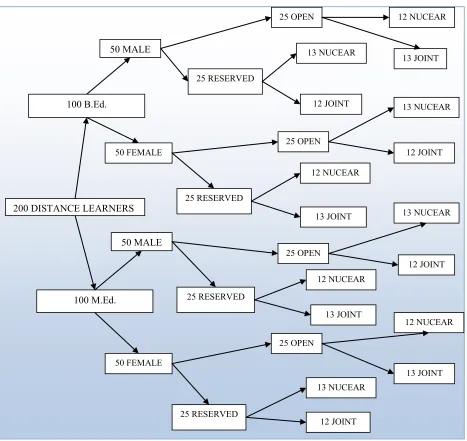
[image:8.612.73.540.189.630.2]JULY-AUG, 2015, VOL. 2/10 www.srjis.com Page 2664 (Schedule Caste, Schedule Tribe and Other Backward Classes). The researcher has selected 12:13 and 13:12 distance in-service teacher trainees of joint families: nuclear families from B. Ed. and same combination of sample from M. Ed. class by systematic random sampling technique. The sampling design is shown in Fig. I as follows.
Fig. I: Sampling Design
TOOL USED: The investigator used Mental Health Inventory developed by Dr. Jagdish and Dr. A.K. Srivastava (1996) to study mental health of distance in-service teacher trainees. The inventory consists of 56 items including 32 false-keyed (negative) [* marked] and 24 true-keyed (positive) statements. The reliability coefficients of different dimensions of MHI were found to
200 DISTANCE LEARNERS
100 M.Ed. 100 B.Ed.
50 MALE
50 FEMALE
25 OPEN
25 RESERVED 50 MALE
50 FEMALE
25 OPEN
25 OPEN 25 RESERVED
25 RESERVED
25 OPEN
25 RESERVED
12 NUCEAR
13 NUCEAR 13 NUCEAR
12 NUCEAR
13 NUCEAR
12 NUCEAR
12 NUCEAR
13 NUCEAR
13 JOINT
12 JOINT
12 JOINT
13 JOINT
12 JOINT
13 JOINT
13 JOINT
SRJIS/BIMONTHLY/ DR. SANJEEV KUMAR (2657-2670)
JULY-AUG, 2015, VOL. 2/10 www.srjis.com Page 2665 be more than 0.70 which was determined by split-half method using odd-even procedure. The reliability coefficient of overall mental health was 0.73. The construct validity of inventory was found to be 0.54. The item wise description of the tool is given in Table 1 as follows.
Table – 1: ITEM – WISE DESCRIPTION OF MENTAL HEALTH INVENTORY (MHI) Sr.
No.
Name of the Item Item number in MHI
1. Positive Self Evaluation (PSE) 1*, 7*, 13*, 19, 23*, 27, 32, 38, 45, 51 2. Perception of Reality (PR) 6, 8, 14*, 24*, 35*, 41, 46*, 52
3. Integration of Personality (IP) 2*, 9*, 15*, 18*, 20, 25*, 28*, 33*, 36*, 40*, 47*, 53*
4. Autonomy (AUTNY) 3*, 10*, 29, 42*, 48*, 54
5. Group Oriented Attitude (GOA) 4, 11*, 16*, 21*, 26, 30*, 39, 43, 49*, 55* 6. Environmental Competence (EC) 5*, 12, 17*, 22*, 31, 34, 37, 44, 50, 56
PROCEDURE: The investigator administered the tool to all concerned distance in-service teacher trainees personally after establishing perfect rapport with them asked them to respond correctly and confidently. The item – wise scores were calculated and six items of MHI were added to obtain overall mental health scores which were used by the researcher for analysis. RESULTS: The total scores of mental health of all distance in-service teacher trainees were obtained and ‘t’ test was used to find out the significance of difference between the specified groups. The group-wise scores of the Positive Self Evaluation component of mental health of the distance in-service teacher trainees are given in the Table no. 2, and 3.
SRJIS/BIMONTHLY/ DR. SANJEEV KUMAR (2657-2670)
[image:10.612.77.535.154.279.2]JULY-AUG, 2015, VOL. 2/10 www.srjis.com Page 2666 TABLE 2: MEANS, S.D.’S AND ‘T’ VALUES OF POSITIVE SELF EVALUATION OF
B. Ed. AND M. Ed. DISTANCE IN-SERVICE TEACHER TRAINEES W.R.T. THEIR GENDER, SOCIAL CATEGORY AND TYPE OF FAMILY
Variable
Statistics
Gender Social Category Type Of Family
Male Female Open Reserved Nuclear Joint
N 100 100 100 100 100 100
Mean 32.43 31.81 31.76 29.26 31.28 30.40
S.D. 2.44 3.74 3.47 3.86 3.06 3.87
S. Ed 0.42 1.93 1.91
‘T’ Value 1.15 1.29 0.46
Significance Ns Ns Ns
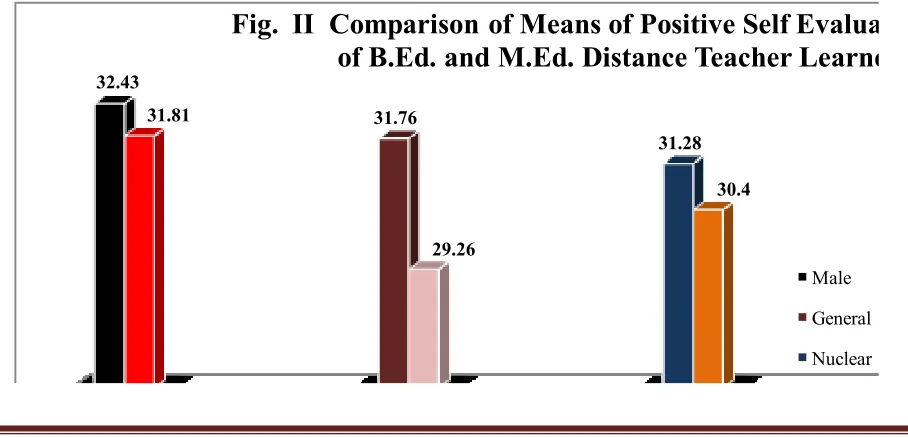
The distance in-service teacher trainees of B. Ed. and M. Ed. belonging to open category were found much higher (Mean=31.76) than the reserved one (Mean=29.26) in their Positive Self Evaluation component of mental health as shown in Fig. I. But, the ‘t’ value 1.29 at 0.05 level was much lower than the table value. Hence it is interpreted that open and reserved distance in-service teacher trainees of B. Ed. and M. Ed. were not found statistically different. As far as the type of family was concerned, the distance in-service teacher trainees belonging to nuclear family were much higher in their mean value (Mean=31.28) than the distance in-service teacher trainees belonging to joint family (30.40) as shown in Fig. I. But, there was not found any significant difference between the distance in-service teacher trainees of B. Ed. and M. Ed. belonging to nuclear and joint family because ‘t’ value (1.91) was found less than the table value even at 0.05 level of confidence.
Gender Social Category Type of Family
32.43
31.81 31.76
29.26
31.28
30.4
Fig. II Comparison of Means of Positive Self Evaluation Scores
of B.Ed. and M.Ed. Distance Teacher Learners
Male Female
General Reserved
[image:10.612.82.536.510.729.2]SRJIS/BIMONTHLY/ DR. SANJEEV KUMAR (2657-2670)
JULY-AUG, 2015, VOL. 2/10 www.srjis.com Page 2667 The Fig. II clearly shows the difference in the mean scores of male and female; open and reserved; and nuclear and joint family distance in-service teacher trainees of B.Ed. and M.Ed.
Table 3: MEANS, S.D.’S AND‘t’ VALUES OF OVERALL MENTAL HEALTH OF B. Ed. AND M. Ed. DISTANCE IN-SERVICE TEACHER TRAINEES w.r.t. THEIR
GENDER, SOCIAL CATEGORY AND TYPE OF FAMILY
VARIABLE
STATISTICS
GENDER SOCIAL CATEGORY TYPE OF FAMILY
MALE FEMALE OPEN RESERVED NUCLEAR JOINT
N 100 100 100 100 100 100
MEAN 689.02 672.06 676.92 683.16 681.46 679.62
S.D. 42.56 55.41 54.59 43.38 51.53 46.44
S. ED 6.99 6.97 6.93
‘t’ VALUE 2.43** 0.90 0.27
SIGNIFICANCE ** 0.05 NS NS
SRJIS/BIMONTHLY/ DR. SANJEEV KUMAR (2657-2670)
JULY-AUG, 2015, VOL. 2/10 www.srjis.com Page 2668 The Fig. III clearly shows the difference in the mean scores of male and female; open/general and reserved; and nuclear and joint family distance in-service teacher trainees of B.Ed. and M.Ed.
Gender Social Category Type of Family
689.02
672.06
676.92 683.16
[image:12.612.90.517.155.338.2]681.46 679.62
Fig. III Comparison of Means of Overall Mental Health
Scores of B.Ed. and M.Ed. Distance Learners
Male Female
General Reserved
Nuclear Joint
SRJIS/BIMONTHLY/ DR. SANJEEV KUMAR (2657-2670)
JULY-AUG, 2015, VOL. 2/10 www.srjis.com Page 2669 educational planners for the maximum utilization of making the teaching-learning process more effective.
REFERENCES
About.com/Mentalhealth/. Mental Health. Retrieved from http://www.About.com/Mentalhealth/ on 25/07/2006.
Coleman, J. C. (1970). Abnormal Psychology and Modern Life. Taraporevala Sons & Co. Pvt. Ltd.: Bombay.
Happell, B.; Pinikahana, J. and Roper, C. (2002). Attitudes of Postgraduate Nursing Students towards Consumer participation in Mental Health Services and the Role of the Consumer Academic. International Journal of Mental Health Nursing, Volume -11, Issue 4, pp. 240-250.
helpguide.org. What is mental or emotional health? Retrieved from http://www.helpguide.org/mental/mental_emotional_health.htm on 02/01/2013.
Keyes, Corey (2002). The mental health continuum: from languishing to flourishing in life. Journal of Health and Social Behaviour 43 (2): 207–222. doi:10.2307/3090197. JSTOR 3090197. Retrieved from http://www.en.wikipedia.org/wiki/Mental_health on 01/09/2012.
Kumar, Sanjeev (2015). Emotional competence as a predictor of mental health of science pre-service teachers of Himachal Pradesh, India. European Academic Research, Vol. III, Issue 1 / April 2015, pp. 315-333. Retrieved from http://euacademic.org/UploadArticle/1541.pdf on 03/05/2015.
Medilexicon (2009). What is mental health? What is mental disorder? Medical news today. Retrieved from http://www.medicalnewstoday.com/articles/154543.php on 01/09/2012. mentalhealth.org. Mental Health and its concept. Retrieved from
http://www.mentalhealth.org.my/index.cfm?menuid=42 on 02/01/2013.
SRJIS/BIMONTHLY/ DR. SANJEEV KUMAR (2657-2670)
JULY-AUG, 2015, VOL. 2/10 www.srjis.com Page 2670 Thakur, K. S. and Kumar, Sanjeev (2013). Mental Health as a Predictor of Emotional Competence of Prospective Teachers of Science in Himachal Pradesh. MIER Journal of Educational Studies Trends and Practices, Vol. 3, No. 1, pp. (84-94).
World Health Organization, Mental health. Retrieved from http://www.who.int/mental_health/en/ on 02/01/2013.
World Health Report 2001 - Mental Health: New Understanding, New Hope, World Health
Organization, 2001. Retrieved from