Full length article
Investigating the effects of smart technology on customer dynamics
and customer experience
Pantea Foroudi
a,*, Suraksha Gupta
b, Uthayasankar Sivarajah
c, Amanda Broderick
baThe Business School, Middlesex University, London, United Kingdom bNewcastle University, London, United Kingdom
cUniversity of Bradford, United Kingdom
a r t i c l e i n f o
Article history: Received 30 May 2017 Received in revised form 20 October 2017
Accepted 12 November 2017 Available online 13 November 2017
Keywords: Customer experience Customer dynamics Behavioural intentions Smart technologies Technology adoption
a b s t r a c t
Increased use of smart technologies by customers is leading to recognition of their influence on the shopping experiences of customers by practitioners. However, the academic literature fails to acknowledge the influence of smart technology usage, combined with behavioural intention of the customer, on the dynamics and experience of customers. This research utilises explanatory research at the preliminary stage to examine this phenomenon in a retail setting. A conceptual framework was created, based on the scholarly knowledge available in extant literature, and was tested using a survey of a convenience sample of 330 consumers shopping in a high-end retail store in London, United Kingdom. Structural Equation Modelling (SEM) via AMOS was employed to test the proposed model. This study contributes to technology adoption based consumer behaviour literature, by explaining the ability of learning commitment to drive the participation of an individual, but its inability to influence their behavioural intention. Findings of this research also reflect on the role of customer dynamics and customer experience in embracing innovative application of smart technologies in a retail setting. The results and implications included in our study also contribute to the understanding of the determinants that affect customer dynamics and customer experience when making use of smart technologies.
©2017 The Authors. Published by Elsevier Ltd. This is an open access article under the CC BY license (http://creativecommons.org/licenses/by/4.0/).
1. Introduction
The rapid proliferation and use of smart technologies (e.g. smart mobile phones, tablets, wearables etc.), which was once predomi-nantly a trend amongst the younger generation, is becoming widely accepted by all parts of society. In this context, a technology is referred to as‘smart’when it is an electronic device or system that can be connected to the internet and used interactively. With so-ciety having turned more tech- and internet-savvy (Immonen& Sintonen, 2015), people now have the chance to experience effi -cient services provided by organisations. This trend has resulted in consumers expecting targeted, more responsive, and equally effi -cient services from retailers and other businesses.
Retailers have embraced the concept of customer experience management, with many incorporating the notion into their
business mission statements. Equally, retailers around the globe, including Europe, are aware of the new possibilities that smart technologies have to offer in their retail environment (e.g. Smart Labels and Unique Identifiers, NFC payments) and have started exploring them (Pantano, 2014). According to Barthel, Hudson-Smith, and de Jode (2015), one of the key drivers in retail is an increasing demand for a seamless experience between online, mobile and in-store shopping. The creation of a superior customer experience is asserted to be one of the pivotal objectives in retailing environments whether it be offline (Verhoef et al., 2009) or online (Chang, Chih, Liou, & Yang, 2016). According to a report by McKinsey, these disruptive technologies are forecast to have a $6.2 trillion effect on the world economy by 2025 and one of the key industries that this will impact will be retail (Manyika et al., 2013). However, the possibilities are far more than simply introducing or making use of new technologies, as this phenomenon in the retail environment has opened up challenges and opportunities at the same time for the retailers. Therefore, it is important that the re-tailers assess the real value and the changes that the use of smart technologies can have on consumer dynamics and creating a new customer shopping experience, based on all the interactions and
*Corresponding author.
E-mail addresses:[email protected](P. Foroudi),Suraksha.Gupta@newcastle.
ac.uk (S. Gupta), [email protected] (U. Sivarajah), Amanda.Broderick@
Newcastle.ac.uk(A. Broderick).
Contents lists available atScienceDirect
Computers in Human Behavior
j o u r n a l h o m e p a g e : w w w . e l s e v i e r . c o m / l o c a t e / c o m p h u m b e h
https://doi.org/10.1016/j.chb.2017.11.014
thoughts about the business (Oh, Fiore,&Jeoung, 2007; Verhoef et al., 2009).
Despite the emergence of smart technologies and the recogni-tion by practirecogni-tioners of their importance in influencing new shopping experiences, the academic literature investigating this topic has been limited. Publications on customer experience are mainly found in practitioner-oriented journals or management books (Meyer, 2007, pp. 117e126;Shaw&Ivens, 2005). Further-more, the extant literature (e.g. Frow & Payne, 2007; Gentile, Nicola, & Giulano, 2007) primarily focuses more on managerial actions and outcomes, rather than on the theories underlying the antecedents and consequences of customer experience. To date, rigorous empirical studies investigating the value of the new con-sumer shopping experiences and changes in concon-sumer dynamics triggered by smart technologies are still limited. The purpose of this study is therefore to investigate the effect of an individual's commitment to learn combined with their behavioural intention on customer dynamics and their retail shopping experience, in the context of the innovative application of smart technologies.
Drawing on the literature focusing on consumer behaviour particularly customer participation, this research proposes that customer dynamics (e.g. searching, comparing, evaluating) may account for an impact on customer experience. In doing so, it provides insight for the retailers and managers into the value created by the use of smart technologies in the retail environment and the implications for the customer shopping experience. Two primary research questions were developed to aid managers in understanding customer dynamics and experience in a retail environment influenced by the use of smart technologies. Thefirst question asked was: Does commitment to learn and behavioural intentions such as social influence, perceived value, etc. have an effect on customer participation and dynamics? Second, does customer dynamics have an effect on customer experience in a retail environment influenced by the use of smart technologies? If there were a substantial effect, retail managers need to understand the important role that customer dynamics has on customer experience.
In order to address the research aim and questions, this paper first reviews the extant literature of the customer experience in a retail environment as part of section2(Conceptual Background). Section 3then presents the research model along with the pro-posed hypotheses. The following section 4 reports the research method and section5reports the data analysis andfindings. The final sections (section6 and 7) of the paper presents a discussion with conclusion, which highlights the keyfindings, the research implications to both theory and practice, the limitations of this study and recommends future research directions. This study will be of significance to the ICT research community and to retail practitioners.
2. Conceptual background
2.1. Customer experience in a retail environment
Undoubtedly, customer experience (CE) plays a significant role in determining the success of a company's offering (Gentile et al., 2007; Yakhlef, 2015). Organisations have used both tangible prod-ucts and intangible services to generate unforgettable events for consumers (Chen&Lin, 2015; Tsaur, Chiu,&Wang, 2007; Pine& Gilmore, 1998). According toSchmitt (1999), customer experience is defined as the perception or acknowledgment that follows from the stimulated motivation of a consumer who observes or partici-pates in an event which can enrich the value of services and products. The scholarly literature on CE is abundant and the debate between practitioners and scholars is very active. Over the last few
decades, the researchers on retail marketing have taken a keen interest in how in-store retail environments influence the con-sumer experience (Belk, 1988; Bitner, 1992; Naylor, Kleiser, Baker,& Yorkston, 2008; Schmitt, 2003; Sousa&Voss, 2006; Verhoef et al., 2009; Yakhlef, 2015). More recently, as the number of contact points between a business and its customers has increased, espe-cially with the rise of smart technologies, such attention to the customer has revealed the essential importance of monitoring the many experiences that are created from those contact points. Such experience plays a significant role in influencing the consumers' preferences, which then impact on consumers' purchase decisions. A recent study byAnderson and Bolton (2015)highlighted the importance of the use of smart technologies such as sensors and radio-frequency identification (RFID) within the retail sector, to capture data to be interpreted for retail acumen. The sensors cap-ture simple data sets, such as the number of customers who have walked through a doorway or down an aisle, to more complex data, such as demographic or behavioural data. For a retailer, this pro-vides an opportunity for analysing a rich source of information to facilitate optimizing the customer experience and thereby im-proves sales (Anderson&Bolton, 2015).
According to Pantano and Timmermans (2014), the imple-mentation of smart technologies in retailing necessitates modifi -cations in both selling activities and businesses processes. The authors highlight that from an organisational point of view, smart technologies require an effort for recognizing, selecting and pre-senting thefinest technology, while enhancing the way to generate, obtain, manage and transfer knowledge from customers to com-panies and vice versa. As a result, highlighting the importance of commitment to learn as well as leveraging the appropriate smart technologies has become essential. Scholarly studies such as Jeppesen and Molin (2003) and Jeppesen (2002, pp. 302e330) advocate that education and innovation efforts from which a company may gain advantage need not essentially be located within the business and may well reside in the customer environ-ment. By using smart technologies, a smart partnership between customer and retailer, after the in-store adoption, is created. At the same time, there is a need for retailers to understand the con-sumers' demands and their behavioural intentions (Chang et al., 2016) such as customers’perceived value and effort expectancy (Cronin, Brady,&Hult, 2000; Teo&Lim, 2001), which is also aided by the introduction of smart technology.
2.2. The dynamics of customer experience
and experiences.
Our arguments are embedded widely in the literature that dis-cusses the behaviour of consumers in the retail environment, to emphasise that consumers will progressively hold control in the fast-changing digital environment (Anderson & Bolton, 2015; Naylor et al., 2008; Schmitt, 2003; Sousa & Voss, 2006). The studies supporting our point of view also stress the ability of re-tailers to get to grips with the implications of converging tech-nologies. Therefore, initiating a discussion on how important it is for retailers to make sense of consumer behaviour as they demand a smart retail experience is timely and significant. The recent shifts in behaviour of consumers may be daunting for retailers unless they are able to embrace the changes in customer dynamics and provide the experience demanded by their customers. Therefore, the key for retailers in such an environment will be to keep a close eye on customer behaviour and their changing habits in an online setting (including increased use of comparison engines) which will affect their business.
3. Research model and hypotheses development
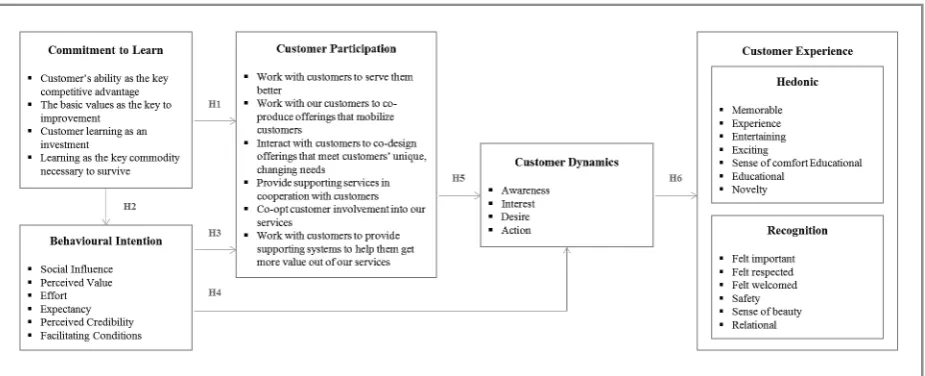
This research links behavioural intentions (e.g. social influence, perceived value etc.) of individual customers with their commit-ment to learn (Petkus, 2010) and explores if together they can have an influence on customer intention to participate in the adoption of smart technology and the dynamics of individuals participating, so as to improve their experience in a retail setting (Fig. 1).
Weijters, Rangarajan, Falk, and Schillewaert (2007)reviewed a model of self-service technology adoption by customers in a retail setting with the purpose of improving service quality and cost reduction for improved productivity. The authors tried to identify antecedents and consequences of customers' motivation to use self-service technologies, a type of smart technology using survey and observational data following the self-scanning methodology adopted by Dabholkar, Michelle Bobbitt, and Lee (2003). Using cross-sectional survey data, collected from six grocery stores in Western Europe by six teams of research associates during a three-day period, enabled the authors to measure the ability of cus-tomers' attitude towards the use of technology to drive actual use, their satisfaction and the number of items purchased while they spent time in store. Although this research explains the use of technology in the context of our research, it does not reflect on the links conceptualised by us between customers' participation in the adoption of smart technology and their commitment to learn.
Plouffe, Vandenbosch, and Hulland (2001)compared the intentions of customers towards adoption of technology in a multi-group customer setting to understand how they jointly adopt innova-tion for success. Keeping a focus onfinancial services being offered by the retail sector, the authors tried to evaluate technology adoption by 350 consumers and 250 retailers and examined how these two groups were different from each other based on the parameters of 1) relative advantage defined as a clear comparative advantage and 2) compatibility defined as degree of fitment of product to current preferences. Their findings indicate that the notion of control over their adoption decision is important for consumers, whereas the intention of retailers was driven by the potential of the adoption to add value to their bottom line. This research explains technology adoption by consumers. However, it fails to explain how much influence customers’commitment to learn a new technology can have on their technology adoption. Hence, it becomes important to hypothesize from the point of view of our research that:
H1. Customers' participation in adoption of smart technology in a retail setting is driven by customers' commitment to learn.
[image:3.595.44.565.568.741.2]A research conducted by Nguyen and Barrett (2006) investi-gated the intention offirms to adopt technology-based practices using data collected from 144 exportfirms in Vietnam. The appli-cation of the technology acceptance model (TAM) enabled the au-thors to explain that perceived usefulness, however not perceived ease of use, of the internet is a strong predictor of intention to adopt technology based services and processes. Their findings further emphasised the role of market orientation on the intention of customers to adopt technology when mediated by perceived use-fulness.Li, Browne, and Chau (2006) explored the link between behavioural intentions of customers towards technology adoption and their level of commitment towards websites. Authors associ-ated trust held by an individual with the behavioural intention of customers to understand customer retention and customer decision-making strategies. They derived their results from data collected from 335 respondents to reflect upon different types of commitment, such as affective commitment and calculative commitment, other than the quality of alternatives available to customers. In another study, Jeppesen and Molin (2003) place emphasis on developments of interactive learning in the customer community that enables consumer innovation.Venkatesh, Morris, Davis, and Davis (2003) highlight social influence, performance expectancy, effort expectancy, and facilitating conditions as key
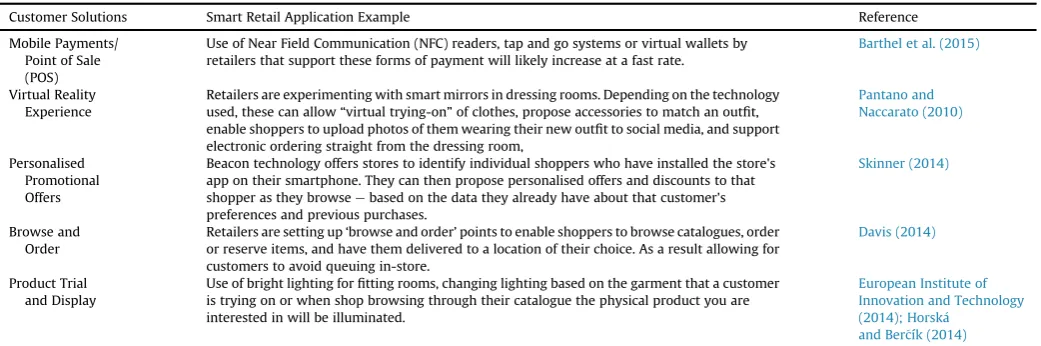
Table 1
Examples of customer solutions in a smart retail context.
Customer Solutions Smart Retail Application Example Reference
Mobile Payments/ Point of Sale (POS)
Use of Near Field Communication (NFC) readers, tap and go systems or virtual wallets by retailers that support these forms of payment will likely increase at a fast rate.
Barthel et al. (2015)
Virtual Reality Experience
Retailers are experimenting with smart mirrors in dressing rooms. Depending on the technology
used, these can allow“virtual trying-on”of clothes, propose accessories to match an outfit,
enable shoppers to upload photos of them wearing their new outfit to social media, and support
electronic ordering straight from the dressing room,
Pantano and Naccarato (2010)
Personalised Promotional Offers
Beacon technology offers stores to identify individual shoppers who have installed the store's app on their smartphone. They can then propose personalised offers and discounts to that
shopper as they browseebased on the data they already have about that customer's
preferences and previous purchases.
Skinner (2014)
Browse and Order
Retailers are setting up‘browse and order’points to enable shoppers to browse catalogues, order
or reserve items, and have them delivered to a location of their choice. As a result allowing for customers to avoid queuing in-store.
Davis (2014)
Product Trial and Display
Use of bright lighting forfitting rooms, changing lighting based on the garment that a customer
is trying on or when shop browsing through their catalogue the physical product you are interested in will be illuminated.
European Institute of Innovation and Technology
(2014); Horska
factors that influence behavioural intention. Ajzen (2002) measured perceived behavioural control using two components of (1) perceived self-efficacy/perceived value and (2) perceived controllability. The source of perceived value as a component of customer intention to use internet space is based on the security issues model proposed by Daniel and Jonathan (2013) and Hutchinson and Warren (2003).
The study byPetkus (2010) highlights how the effect of con-sumer activity such as interactive learning and behavioural inten-tion to learn can result in high value to thefirm in the context of computer game development. Authors of studies such asJeppesen and Molin (2003), Petkus (2010), Nguyen and Barrett (2006), Gounaris (2005)orKeh and Xie (2009)have discussed links be-tween customer commitment and behavioural intention in different settings; however, they have not been able to establish the link between commitment of customers to learn and their behav-ioural intentions. The current literature (Daniel&Jonathan, 2013; Hutchinson & Warren, 2003; Urumsah, 2015) fails to use the components of behavioural intention in the context of internet retail setting. Tofill this gap in the literature, we hypothesize that:
H2. Behavioural intention of customers to adopt smart technology in a retail setting identifies the extent to which customers are committed to learn.
Authors likeVijayasarathy (2004)used the theory of reasoned-action and the technology adoption model to explain the in-tentions of customers to use on-line shopping facilities. The study revolved around variables like ease of use, usefulness, privacy, compatibility, security, normative belief and self-efficacy. Data received from 281 consumers and variables investigated by them were found to be important predictors of behavioural intentions towards on-line shopping. Makarem, Mudambi, and Podoshen (2009)examined factors that determine customer satisfaction in technology enabled service encounters to understand if technology or touch based service processes had any influence on the behav-ioural intentions of customers considering changing interactions between employees of a company and its customers. Using data collected through an administered survey followed by use of qualitative data for expert insights, the authors established that customer satisfaction in technology enabled service encounters can be linked to positive behavioural intentions of customers. Although this study explains the link between level of participation of the customer and their adoption of smart technology, it has not
explained how it is able to influence behavioural intentions of customers. Also, based on previous studies such asLemon et al. (2002)and Douglas and Craig (1997), we understand that con-sumer dynamics is theflow of activities such as searching, com-parison and evaluation, which takes place between a customer and the retailer. These research studies are, however, unable to explain why dynamics of customers when driven by smart technology adoption have the ability to affect their behavioural intentions; it did not consider technology adoption by customers in a retail setting. Considering tis gap in the academic literature, we would like to examine the extent to which:
H3. Customers' participation in adoption of smart technology in a retail setting is driven by customers' behavioural intentions.
[image:4.595.63.526.65.253.2]Shiratuddin (2015)from a small businesses perspective, can drive behavioural intentions of customers who adopt smart technology in a retail setting or for tourists using internet blogs (Lin&Huang, 2006). To push existing knowledge about capability of customer dynamics to drive their behavioural intention based on their adoption of smart technology, we hypothesize that:
H4. Dynamics of customers when driven by adoption of smart technology in a retail setting can drive behavioural intention of customers.
The technology acceptance model (TAM) has enabled re-searchers to explain the adoption and acceptance of technology by customers (Mallat, 2007; Mattila, Karjaluoto,&Pento, 2003; Mittal &Lassar, 1998).Ha and Stoel (2009)used this model to integrate e-shopping quality, trust, and enjoyment and collected data from 298 college students to understand the quality of apparel products based on its four dimensions - i.e. 1) web site design, 2) privacy/ security dimension, 3) atmospheric/experiential dimension and 4) customer service. Their structural model revealed the extent to which e-shopping quality determines the perceptions of customers about the usefulness of a website, trust and enjoyment in rela-tionship to the website. Out of these factors, the authors identified shopping enjoyment and trust as having high significance in technology adoption by customers. Similarly, the use of technology to facilitate shopping was studied in the context of disenfranchised customers byWalker, Craig-Lees, Hecker, and Francis (2002). This research investigated the potential benefits of technology based services to customers and providers alike based on the concept that it all depends upon the purpose to which technology is put and the manner in which it is used. Considering a balanced approach be-tween operational desirability, personal capacity, willingness and experiences of individuals based on their behavioural intentions and perceptions, the authors tried to predict whether customers would adopt or reject a technology. A research byNgo and O'Cass (2013)revealed that customer participation is the degree of con-sumers’involvement and effort, both physical and mental, essential to participate in an activity. Existing studies other than the ones discussed above, likeNeuhofer, Buhalis, and Ladkin (2015)orCasey and Jones (2013)orHolgado and Macchi (2014), however, do not discuss the hidden link between customer participation, dynamics of customers and customer experience. Tofill this gap in the current understanding of academics about this phenomenon, we hypoth-esize that.
H5. Dynamics of customers when driven by adoption of smart technology in a retail setting is driven by customers' participation.
Influence of smart technology on experience of customers has been studied many times by scholars such asHsu and Lu (2004). Considering on-line games as entertainment technology for con-sumers,Hsu and Lu (2004)collected data from 233 users to un-derstand the impact of belief related constructs that consisted of social influence andflow experience on their perceptions of online games. Using a technology acceptance model, analysis of the study by Hsu and Lu (2004) found that social norms, attitude and flow experience explain game playing as predictors of entertain-ment oriented technology adoption. Another research conducted byWu and Wang (2005) tried to evaluate indicators of mobile commerce adaptation by consumers using a technology adoption model. Authors of this research integrated concepts related to consumer dynamics using innovation diffusion theory, perceived risk and costs, to determine mobile commerce acceptance by consumers.
Using data collected through a survey of mobile commerce consumers,Wu and Wang (2005)performed confirmatory factor
analysis on a causal model of mobile commerce acceptance and found that ‘compatibility’had a strong influence, unlike‘ease of use’, which did not have a strong impact on the behavioural intent of users. Definition of compatibility used byWu and Wang (2005) considered the degree of consistency on whether innovation is perceived to be compatible with values, experiences, and needs of users. The authors also reflected on the influence of factors such as slow connections, poor quality of connection, out of date content, apart from missing errors and links, on frustrating experiences of customers in an online setting. Cocosila and Igonor (2015) hy-pothesize about the social value dimension from an image, social presence, critical mass and social norm perspective in their empirical study investigating the adoption of Twitter social networking application. In general, these studies have looked at consumers and users in online settings but they have missed the causality between dynamics of consumers and their experiences of smart technology adoption in a retail setting. Tofill this gap in the existing literature, we hypothesize that:
H6. Dynamics of customers when driven by adoption of smart technology in a retail setting can drive customer experience.
4. Methods
4.1. Data collection
The idea of changes in consumers’dynamics and the influence of smart technology on customer experience could not be exam-ined without referencing particular retailers and asking for customer comment. Therefore, a particular company is referenced on the assessment survey (Elsbach & Bhattacharya, 2001) for evaluating the retailer. The retailer was chosen via in-depth assessment of brand presence for a major London-based chain store brand which has many customers, is also a recognized brand and a traveller destination. This retail store enjoys an optimistic reputation, which relates to its retail brand name (Dennis, Brakus, Gupta,&Alamanos, 2014; Gupta, Melewar,&Bourlakis, 2010). In a survey, 620 questionnaires were sent to the retailer employing a convenience sample. However, 330 adult customers contributed in the research over a four months and 2 weeks period.
4.2. Measures
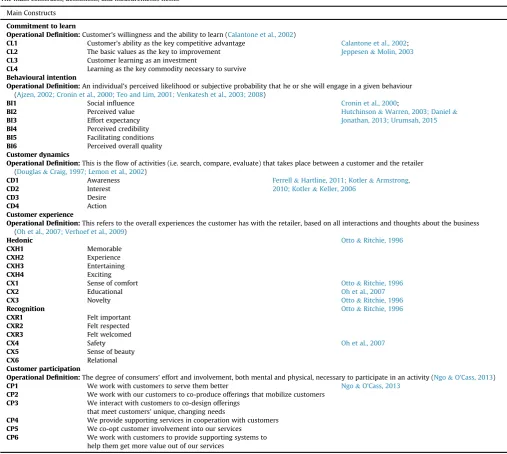
For the survey instrument, the questions were derived from established scales in previous research. The measurement for the constructs of interest was based on established scales proven to be psychometrically sound (Churchill, 1979). All items were scored based on seven-point Likert scales ranking from 1 (strongly disagree) to 7 (strongly agree), to deliver acceptable properties. The underlying distribution of responses tends towards commitment to learn (Calantone, Cavusgil,&Zhao, 2002) and behavioural intention (Cronin et al., 2000; Daniel & Jonathan, 2013; Hutchinson & Warren, 2003; Urumsah, 2015). Customer participation scales (Ngo & O'Cass, 2013) were adopted according to the context. Customer dynamics (Gorton, Angell, White,&Tseng, 2013) was also obtained from existing scales. Additionally, customer experience (Oh et al., 2007; Otto&Ritchie, 1996) was measured.Table 3 il-lustrates the definitions and items which were employed to conduct this research investigation. Kaiser-Mayer-Olkin's measure of sampling adequacy is 0.910 > 0.6. It suggests suitability for exploratory factor analysis; moreover, the relationships between the items are statistically significant and provide a parsimonious set of factors. In addition, Bartlett's test of Sphericity illustrates the relationship between the measurement items, which is higher than 0.3 and is also appropriate for exploratory factor analysis (Hair, Tatham, Anderson,&Black, 2006; Tabachnick&Fidell, 2007).
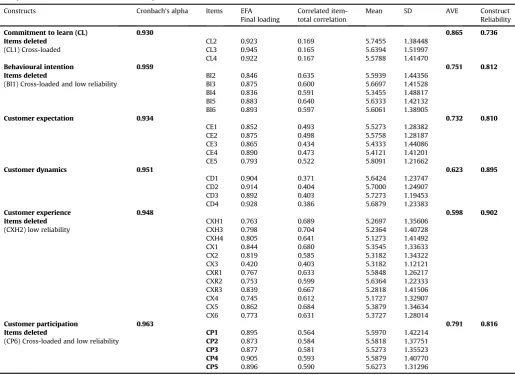
As an initial examination of their performance within the sample, the primary measurement items were subjected to reli-ability analyses and a series of factor analyses. All thea prioriscales presented satisfactory reliability of Cronbach's alpha ( < 0.930) (Nunnally, 1978). However, items such as BI1 (social influence) and CP6 (we work with customers to provide supporting systems to help them get more value out of our services) were removed due to multiple loadings on two factors and low reliability. CL1 (retailer's ability as the key competitive advantage) was dropped due to problematic cross-loadings on extra factors. In addition, CXH2 (experience) was removed for low reliability. The remaining items loaded considerably on the projected constructs, with composite reliabilities ranging from 0.930 to 0.963 (Table 3).
Discriminant validity was tested via confirmatory factor analysis and examined by AVE (average variance extracted) for each research construct and compared with the square correlation among the constructs (Fornell&Larcker, 1981). Based onDillon and Goldstein (1984)andFornell and Larcker’s (1981)recommendation, the variances extracted for the constructs were also compared to the square of each off diagonal value within the Phi-matrix for the constructs. The results show that the average variance extracted (AVE) for each construct ranged from 0.598 to 0.865, and the items
signify a distinctive underlying concept. Moreover, a good rule of thumb is that an average variance extracted of 0.5 or higher shows adequate convergent validity. Table 4 presents the results. To address multi-collinearity, we followed established procedures to mean centre related variables prior to generating proposed inter-action terms to assess the hypotheses.
5. Data analysis andfindings
As per the suggestion by scholars (Anderson&Gerbing, 1988; Hair et al., 2006), the two-stage approach in SEM (structural equation modelling) was employed to test the importance of all pattern coefficients of the eight hypotheses, using 330 observations in the analysis. Thefirst stage examined the inner-model (mea-surement model) by employing AMOS 21 and it was tested to recognize the causal relationships between variables (observed items) and unobserved (the latent) constructs. In addition, the construct validity was examined by CFA (confirmatory factor analysis) in this stage by followingHair et al. (2006) recommen-dations. The second stage was tested using regression path, which explained the causal association between the observed constructs (Anderson&Gerbing, 1988).
To evaluate how the modelfit can be compared to a research baseline-model, this study used incrementalfit indices [CFI, IFI, and TLI] (Hair et al., 2006). To solve the possible problem of an unreli-able standard error and Chi square statistic due to ML application, the model-fit indicators were tested (Bentler & Chou, 1987). Therefore, RMSEA and CFI provide adequate distinctive data to assess the model. CFI 0.923>0.90 shows that goodfit is an incre-mental index, which estimates thefit of a model with the null baseline model. As pointed out byHair et al. (2006), TLI (Tucker-Lewis index), which is recognized as NNFI (non-normedfit index), compares the
c
2value of the model to that of the independence model and takes degrees of freedom for the model into consider-ation (Tabachnick & Fidell, 2007). Based on the recommended criteria byGarver and Mentzer (1999), CFI (comparativefit index), and RMSEA (root mean squared approximation of error) 0.076<0.08 which illustrates acceptablefit (Hair et al., 2006). So, the measurement model of these three factors was nomologically valid (Steenkamp&Van Trijp, 1991). Furthermore, IFI (incremental fit index), and TLI (Tucker-Lewis index) were 0.923 and 0.915 correspondingly and are greater than the recommended threshold of 0.90 and each criteria offit, therefore, illustrated that the mea-surement model'sfit was adequate (Hair et al., 2006). Thefindings of CFA provided a satisfactoryfit. [image:6.595.31.559.85.232.2]As illustrated inTable 4, Cronbach's alpha of all measures was higher than 0.930, representing adequate internal consistency. Table 2
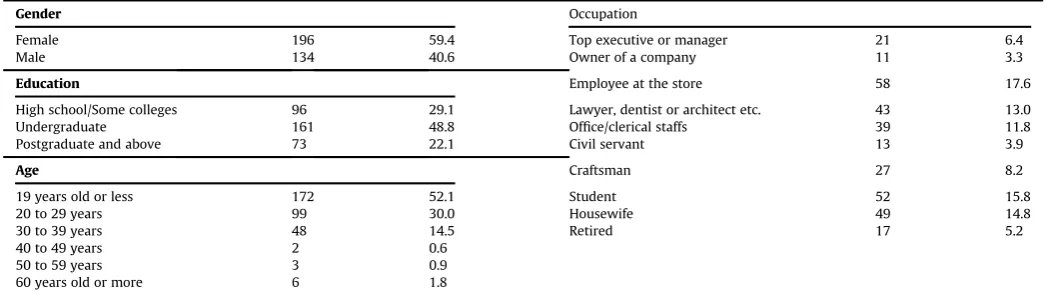
Respondents’characteristics.
Gender Occupation
Female 196 59.4 Top executive or manager 21 6.4
Male 134 40.6 Owner of a company 11 3.3
Education Employee at the store 58 17.6
High school/Some colleges 96 29.1 Lawyer, dentist or architect etc. 43 13.0
Undergraduate 161 48.8 Office/clerical staffs 39 11.8
Postgraduate and above 73 22.1 Civil servant 13 3.9
Age Craftsman 27 8.2
19 years old or less 172 52.1 Student 52 15.8
20 to 29 years 99 30.0 Housewife 49 14.8
30 to 39 years 48 14.5 Retired 17 5.2
40 to 49 years 2 0.6
50 to 59 years 3 0.9
Furthermore, the reliability of measures employing composite reliability were examined; they were greater than recommended (0.736 > 0.7) and suggested a satisfactory level of reliability (Bagozzi &Yi, 1988; Hair et al., 2006). Convergent validity was examined with the values of standard errors and CFA loadings. All item and construct loadings were noteworthy (t-value/CR>1.96). The homogeneity of the research construct was assessed by convergent validity. The average variance extracted for each construct ranged from 0.598 to 0.865 and which illustrates adequate convergent validity (Table 4).
We examined the proposed research conceptual model employing structural equation modelling (Fig. 2). The structural model details the causal associations between theoretical con-structs. Based on the structural model, the research hypotheses were examined from the standardised estimate and t-value (critical ratio) (Anderson and Gerbing, 1982; Chau, 1997). The structure equation modelling reflects the assumed linear, causal relation-ships between the constructs which were tested with the data
collected from the validated measures. The path coefficients represent standardised regression coefficients. The structure equation modelling reflects the assumed linear, causal relation-ships between the constructs were tested with the data collected from the validated measures.
[image:7.595.42.550.79.533.2]Hypothesis 1 suggests that commitment to learn associations are positively related to customer participation. The result supports this hypothesis (
g
¼0.183, t¼2.238). In contrast, commitment to learn relationship with behavioural intention was non-significant and the regression path unexpectedly showed a significant nega-tive relationship between these two variables (g
¼0.131, t¼1.591, p¼0.112). In other words, the regression weight for behavioural intention in predicting commitment to learn is significantly different from 0 at the 0.001 significance level, therefore, Hypothesis 2 was rejected. Hypotheses 3 and 4 concern the po-tential impact of behavioural intention on customer participation and customer dynamics. The analysis shows that there are signifi -cant positive relationships (g
¼0.366, t¼7.043;g
¼0.159, t¼3.048 Table 3The main constructs, definitions, and measurements items.
Main Constructs
Commitment to learn
Operational Definition:Customer's willingness and the ability to learn (Calantone et al., 2002)
CL1 Customer's ability as the key competitive advantage Calantone et al., 2002;
Jeppesen&Molin, 2003
CL2 The basic values as the key to improvement
CL3 Customer learning as an investment
CL4 Learning as the key commodity necessary to survive
Behavioural intention
Operational Definition:An individual's perceived likelihood or subjective probability that he or she will engage in a given behaviour
(Ajzen, 2002; Cronin et al., 2000; Teo and Lim, 2001; Venkatesh et al., 2003; 2008)
BI1 Social influence Cronin et al., 2000;
Hutchinson&Warren, 2003; Daniel&
Jonathan, 2013; Urumsah, 2015
BI2 Perceived value
BI3 Effort expectancy
BI4 Perceived credibility
BI5 Facilitating conditions
BI6 Perceived overall quality
Customer dynamics
Operational Definition:This is theflow of activities (i.e. search, compare, evaluate) that takes place between a customer and the retailer
(Douglas&Craig, 1997; Lemon et al., 2002)
CD1 Awareness Ferrell&Hartline, 2011; Kotler&Armstrong,
2010; Kotler&Keller, 2006
CD2 Interest
CD3 Desire
CD4 Action
Customer experience
Operational Definition:This refers to the overall experiences the customer has with the retailer, based on all interactions and thoughts about the business
(Oh et al., 2007; Verhoef et al., 2009)
Hedonic Otto&Ritchie, 1996
CXH1 Memorable
CXH2 Experience
CXH3 Entertaining
CXH4 Exciting
CX1 Sense of comfort Otto&Ritchie, 1996
CX2 Educational Oh et al., 2007
CX3 Novelty Otto&Ritchie, 1996
Recognition Otto&Ritchie, 1996
CXR1 Felt important
CXR2 Felt respected
CXR3 Felt welcomed
CX4 Safety Oh et al., 2007
CX5 Sense of beauty
CX6 Relational
Customer participation
Operational Definition:The degree of consumers' effort and involvement, both mental and physical, necessary to participate in an activity (Ngo&O'Cass, 2013)
CP1 We work with customers to serve them better Ngo&O'Cass, 2013
CP2 We work with our customers to co-produce offerings that mobilize customers
CP3 We interact with customers to co-design offerings
that meet customers' unique, changing needs
CP4 We provide supporting services in cooperation with customers
CP5 We co-opt customer involvement into our services
CP6 We work with customers to provide supporting systems to
respectively). The standardised regression path between customer participation and customer dynamics (H5) was found to be statis-tically significant (
g
¼0.191, t¼3.828). In addition,Hypothesis 6, [image:8.595.35.551.81.456.2]the relationship between customer dynamics and consumer experience, was found to be significant (
g
¼0.138, t¼2.681). The findings regarding causal paths (standardised path coefficients (b
), Table 4Descriptive statistics, reliabilities and Factor loadings.
Constructs Cronbach's alpha Items EFA
Final loading
Correlated item-total correlation
Mean SD AVE Construct
Reliability
Commitment to learn (CL) 0.930 0.865 0.736
Items deleted (CL1) Cross-loaded
CL2 0.923 0.169 5.7455 1.38448
CL3 0.945 0.165 5.6394 1.51997
CL4 0.922 0.167 5.5788 1.41470
Behavioural intention 0.959 0.751 0.812
Items deleted
(BI1) Cross-loaded and low reliability
BI2 0.846 0.635 5.5939 1.44356
BI3 0.875 0.600 5.6697 1.41528
BI4 0.836 0.591 5.3455 1.48817
BI5 0.883 0.640 5.6333 1.42132
BI6 0.893 0.597 5.6061 1.38905
Customer expectation 0.934 0.732 0.810
CE1 0.852 0.493 5.5273 1.28382
CE2 0.875 0.498 5.5758 1.28187
CE3 0.865 0.434 5.4333 1.44086
CE4 0.890 0.473 5.4121 1.41201
CE5 0.793 0.522 5.8091 1.21662
Customer dynamics 0.951 0.623 0.895
CD1 0.904 0.371 5.6424 1.23747
CD2 0.914 0.404 5.7000 1.24907
CD3 0.892 0.403 5.7273 1.19453
CD4 0.928 0.386 5.6879 1.23383
Customer experience 0.948 0.598 0.902
Items deleted (CXH2) low reliability
CXH1 0.763 0.689 5.2697 1.35606
CXH3 0.798 0.704 5.2364 1.40728
CXH4 0.805 0.641 5.1273 1.41492
CX1 0.844 0.680 5.3545 1.33633
CX2 0.819 0.585 5.3182 1.34322
CX3 0.420 0.403 5.3182 1.12121
CXR1 0.767 0.633 5.5848 1.26217
CXR2 0.753 0.599 5.6364 1.22333
CXR3 0.839 0.667 5.2818 1.41506
CX4 0.745 0.612 5.1727 1.32907
CX5 0.862 0.684 5.3879 1.34634
CX6 0.773 0.631 5.3727 1.28014
Customer participation 0.963 0.791 0.816
Items deleted
(CP6) Cross-loaded and low reliability
CP1 0.895 0.564 5.5970 1.42214
CP2 0.873 0.584 5.5818 1.37751
CP3 0.877 0.581 5.5273 1.35523
CP4 0.905 0.593 5.5879 1.40770
CP5 0.896 0.590 5.6273 1.31296
According to Hair et al. (2006), a coefficient alpha that is greater than 0.70 is highly suitable for most research purposes.
[image:8.595.60.529.539.727.2]standard error,p-value and hypotheses result) and the parameter estimates corresponding to the hypothesised SEM paths and the resulting regression weights are presented inTable 5.
6. Discussion
The focus of this study was to help scholars, retail managers and policy makers to gain a better understanding of the concept of customer dynamics and experience by the practice of smart tech-nologies by posing two questions: (i) Do commitment to learn and behavioural intentions such as social influence, perceived value, etc. have an effect on customer participation and dynamics? and (ii) Do customer dynamics have an effect on customer experience in a retail environment influenced by the use of smart technologies?
The results from a survey of a convenience sample of 330 con-sumers in high-end retail stores in London indicates that cus-tomers' participation in adoption of smart technology in a retail setting is driven by customers' willingness and the ability to learn (customers’commitment) (Calantone et al., 2002) (H1:
g
¼0.183, t¼2.238, supported).There are many individuals who know how to use a smart phone, shop online, or send email and their commitment to learn or use a technology is significant in driving customer participation in smart retail environments. On the other hand, according to the authors there is also the concern of a digital divide where some of the older customer base might not be willing or know how to use a smart phone, shop online, or send email. In most cases, it is not because they do not have access to know how, rather they have come to believe that they are too old to learn or are cautious of the risks of using technology (Immonen & Sintonen, 2015). So, the authors believe that the challenge here for the retailer is to encourage such consumer base in the take up of smart technology and its associated benefits in order to drive customer participation. This can also be linked to an individual's behavioural intentions for their participation in smart retail environments where the degree of consumers' effort and involvement, both mental and physical ability, is highly significant to participate in an activity.
However, thefindings demonstrate that there is no relationship between commitment to learn and customers' perceived likelihood or subjective probability that she/he will engage in a given behaviour (behavioural intention) in a retail setting (Cronin et al., 2000; Teo&Lim, 2001) (H2:
g
¼0.131, t¼1.591, p¼0.112, not supported). Thisfinding is contrary to existing studies that high-light the importance of consumer's commitment to learn for or-ganisations (Jeppesen, 2002, pp. 302e330; Jeppesen & Molin, 2003). However, this might be explained by the fact that almost 96% of the respondents were aged between 18 and 39 years old. This would suggest that most of these consumers would have been already engaged in using smart technologies (e.g. smart phones, tablets, etc.) and therefore less of an emphasis was placed by these potential customers on their ability and commitment to learn smart technologies.Researchers find that there are strong relationships between
customer behavioural intention on customer participation (Ngo& O'Cass, 2013) and customer dynamics (H3:
g
¼0.366, t¼7.043; andH4:g
¼0.159, t¼3.048, supported). The increased use of smart technology coupled with the advancement of second generation web-based technologies such as social media (Sivarajah, Irani,& Weerakkody, 2015) have provided plenty of opportunities for consumers to adapt to this way of thinking. Social media applica-tions such as Facebook, Twitter, and Instagram are playing signifi -cant roles in expanding consumer participation and also influencing customer dynamics related activities (i.e. comparing and evaluating various products) in a smart retail environment. For instance, interacting with customers on social media may result in growing the number of potential customers and the possibility of turning potential customers into buyers. Furthermore, when shifting current potential consumers into buyers, social media en-courages those purchasers to endorse and share their purchase experience with their networks by giving their positive or negative opinions about a purchased product. This is also a result of the social influence of users and peers in the social media network and potential consumer's behavioural intention to participate in these platforms in learning and understanding other user views about existing and new products and services, which is better enabled by these web-based technologies.The dynamics of customers, which refers to the searching, comparison and evaluation of theflow of activities that takes place between a customer and the retailer (Douglas&Craig, 1997; Lemon et al., 2002) can be driven by the adoption of smart technology in a retail setting (H5:
g
¼0.191, t¼3.828, supported). Thisfinding adds to the existing literature (Pantano&Naccarato, 2010) which high-lights that introduction of advanced technologies affects the traditional customer decision making process based on: the need for acknowledgment, search for information, pre-purchase assess-ment, and post-consumption evaluation. In today's world of digital innovation, power is swiftly shifting to the consumer more than ever. For example, the digital medium has brought about trans-parency of prices and made it convenient for consumers with a mobile device or computer to speedily search a product for the lowest price (Grewal et al., 2009a, 2009b). The typical online pur-chase now involves the use of either a search for online coupons, a price comparison engine, a free shipping offer, or discounts, a daily deal or some other incentive that decreases the price paid. This has meant that the adoption of smart technologies has led to different consumer dynamics in a smart retail environment and there is a need for retailers to embrace this power shift and drive better customer experience in order to acquire and retain potential customers. [image:9.595.43.564.655.726.2]Finally, the results illustrate the significant relationships be-tween customer dynamics and customer experience which refers to the overall experience the customer has with the retailer, based on all interactions and thoughts about the business (Oh et al., 2007; Verhoef et al., 2009) (H6:
g
¼0.138, t ¼2.681, supported). The customer experience is no longer limited to customers and their close friends. Smart technologies combined with social media haveTable 5
Results of hypothesis testing.
Estimate S.E C.R p Hypothesis
H1 Commitment to Learn/Customer Participation 0.183 0.082 2.238 0.025 Accepted
H2 Commitment to Learn/Behavioural Intention 0.131 0.083 1.591 0.112 Rejected
H3 Behavioural Intention/Customer Participation 0.366 0.052 7.043 *** Accepted
H4 Behavioural Intention/Customer Dynamics 0.159 0.052 3.048 0.002 Accepted
H5 Customer Participation/Customer Dynamics 0.191 0.050 3.828 *** Accepted
H6 Customer Dynamics/Customer Experience 0.138 0.052 2.681 0.007 Accepted
***p<0.001,**p<0.01,*p<0.05.
given customers the ability to reach out to their contacts online and share that same message with millions of people around the globe. One mistake by a retailer or one bad customer experience can put a firm's reputation at significant risk. However, there are also plenty of opportunities to harness smart technologies and encourage customer advocates to share their experiences, which can extend their reach. These findings highlight that there is a need for re-tailers to embrace smart technologies and recognize how they affect the customer experienceeboth positively and negatively. This will then allow retailers to capitalize on this trend and swoop in on new business.
7. Implications to research and practice
This study contributes to the extant research stream on customer dynamics and customer experience with the develop-ment of a conceptual model highlighting the determinants such as commitment to learn, customer's behavioural intentions and customer participation's implication on customer dynamics and experience in a retail environment leveraging smart technologies. This research theorizes that customer participation may account for the effect of user behavioural intentions and willingness to learn, which consequently impacts customer dynamics and experience. The empiricalfindings add to the existing literature by highlighting for instance the strong relationships between customer behav-ioural intention and customer participation and customer dy-namics. Furthermore, an interesting research implication is that this study points out that the use of smart technologies is affecting the traditional customer decision-making process within a retail context. This study has developed a new set of potential research trajectories for exploration in the future.
The authors of this paper have presented the practice commu-nity such as retail managers with an insight into the role of customer participation and consumer dynamics in realising the value of customer experience influenced by the use of smart technologies. More specifically, it highlights the dynamics of con-sumer behaviour within the digital retail settings enriched with smart technologies. As a result, thefindings of this study are sig-nificant to decision-makers as it emphasises that retail executives need to learn, evolve and embrace the likely effects of smart technologies on customer participation and customer dynamics. The retail managers must also recognize that the innovative tech-nologies will get inexpensive, more versatile and faster and therefore their customer's shopping experience will not just include visiting the store but searching for various retailers, rapid and hassle-free returns, comparing prices, and so on, using their smart mobile devices (Varadarajan et al., 2010).
Practitioners need to understand that shoppers' awareness de-pends not solely on business-generated marketing efforts but also on online expert recommendations or reviews from their peers on social media sites such as Facebook and Instagram (Clemons, 2009). Furthermore, retail executives can also leverage smart technologies to send coupon codes and offers to customers’mobile devices (Oh, Teo, & Sambamurthy, 2012). The retailers can optimize search terms and location-based promotions (Reinartz, 2016; Rigby, 2011). They can provide personalised and targeted offers to shoppers who check in to stores through external platforms like Foursquare. The list of possibilities is ever growing and therefore practitioners need to beflexible and embrace these changes in the retail environment that is influenced by various emerging technologies.
8. Conclusions, limitations and future directions
This study synthesises literature from smart technology, customer behaviour, retail marketing and retail management and
empirically verifies current understanding of the applicability of customer dynamics in gaining knowledge of customer behaviour. This has been achieved by examining the contribution of behav-ioural intentions, commitment to learn and customer participation to drive customer experience. Further studies should seek to comprehend the management and marketing strategies, which can enhance the customer experience through descriptive research by linking consumer dynamics and customer experience with retail strategies, and retail performance metrics, which may help com-panies to attract more customers. Building a favourable customer experience has drawn the attention of marketing, management authors and retailers, but there is limited academic research on this area (Dennis et al., 2014; Verhoef et al., 2009).
This research has illustrated a holistic representation of the customer dynamic and experience construct and developed and validated a conceptual research model outlining its determinants. This should result in insights that could make an important contribution to extant knowledge and will help to validate and improve thefindings in the related literature. Therefore, thefi nd-ings of the present study promise benefits in the retail context in the UK. Moreover, these findings call for great caution when invoking our framework and application in a retail context for consumers of different age groups located in different locations or another country. Our caution is based on the arguments presented by marketing scholars such as Gupta and Gupta (2013) whose studies have explained close links between kind of store, country of origin and consumer behaviour. We also anticipate culture to be an important element to be considered for future research on this topic. Furthermore, the sample of our study consists of young people. Adoption of smart technology by senior citizens or preg-nant women for medical purposes or by young women for safety purposes has not been considered by our research. Therefore, customer segments of different needs and in various age groups can be considered to be a limitation of our study, which should also be considered by future studies. Other factors influencing the setting of our kind of research could be the effect of brand on consumer behaviour or linkages such as brand personality and customer personality (Gupta, 2015). Our model should be reinterpreted by scholars pursuing further research in this area to propose a mechanism with which commitment of consumer to learn can in-fluence their participation, and experience through a review of customer dynamics (searching, comparing, and evaluating).
Future research on this topic should consider justifying reversing the sequence of relationships between customer commitment, participation and experience. An empirical evidence in this area of study will help researchers to rationalise the causal relationships between variables that have been the focus of this study. Predominantly, this study argues that customer participation may account for the effect of user behavioural intentions and willingness to learn, which in turn impacts customer dynamics and experience that offer a rich agenda for future research. This research calls on policy makers and managers to consider the role of customer participation and consumer dynamics in realising the value of customer experience. More specifically, it provides prac-titioners with a better understanding of consumers’ behaviour within the new retail settings enriched with smart technologies. Thus, thefindings of this study are significant for decision-makers. This study also seeks to provide an insight into changes in con-sumer dynamics, concerning for instance searching, comparing,
evaluating, and purchasing behaviour within the new
technologies-mediated environment.
References
distribution at walkbase Company: Developing an information strategy.The Journal of Industrial Distribution&Business, 6(4), 5e16.
Ahn, M., Kang, J., & Hustvedt, G. (2016). A model of sustainable household
tech-nology acceptance.International Journal of Consumer Studies, 40(1), 83e91.
Ajzen, I. (2002). Perceived behavioral control, self-efficacy, locus of control, and the
theory of planned behavior.Journal of Applied Social Psychology, 32(4), 665e683.
Anderson, M., & Bolton, J. (2015). Integration of Sensors to Improve Customer Experience: Implementing Device Integration for the Retail Sector. In
e-Busi-ness Engineering (ICEBE). In 2015 IEEE 12th international conference (pp.
382e386).
Anderson, J. C., & Gerbing, D. W. (1982). Some methods for respecifying
measure-ment models to obtain unidimensional construct measuremeasure-ment. Journal of
Marketing Research, 453e460.
Anderson, J. C., & Gerbing, D. W. (1988). Structural equation modelling in practice: A
review and recommended two-step approach.Psychological Bulletin, 103(3), 411.
Armstrong, J. S., & Overton, T. S. (1977). Estimating nonresponse bias in mail
sur-veys.Journal of Marketing Research, 14(3), 396e402.
Bagozzi, R. P., & Yi, Y. (1988). On the evaluation of structural equation models. Journal of the Academy of Marketing Science, 16(1), 74e94.
Barthel, R., Hudson-Smith, A., & de Jode, M. (2015).Future retail environments and
the internet of things (IoT). UCL: London Global University.
Belk, R. W. (1988). Possessions and the extended self.Journal of Consumer Research,
15(2), 139e68.
Bentler, P. M., & Chou, C. P. (1987). Practical issues in structural modeling.
Socio-logical Methods and Research, 16(1), 78e117.
Bitner, M. J. (1992). Servicescapes: The impact of physical surroundings on
cus-tomers and employees.Journal of Marketing, 56, 57e71.
Calantone, R. J., Cavusgil, S. T., & Zhao, Y. (2002). Learning orientation,firm
inno-vation capability, and firm performance. Industrial Marketing Management,
31(6), 515e524.
Casey, C., & Jones, K. B. (2013). Customer-centric leadership in smart grid
Imple-mentation: Empowering customers to make intelligent energy choices.The
Electricity Journal, 26(7), 98e110.
Chang, S. H., Chih, W. H., Liou, D. K., & Yang, Y. T. (2016). The mediation of cognitive
attitude for online shopping.Information Technology&People, 29(3), 618e646.
Chau, P. Y. (1997). Re-examining a model for evaluating information center success
using a structural equation modeling approach. Decision Sciences, 28(2),
309e334.
Chen, S. C., & Lin, C. P. (2015). The impact of customer experience and perceived
value on sustainable social relationship in blogs: An empirical study.
Techno-logical Forecasting and Social Change, 96, 40e50.
Churchill, G. A. (1999). Marketing Research: Methodological foundations. IL: The
Dryden Press.
Churchill, G. A., Jr. (1979). A paradigm for developing better measures of marketing
constructs.Journal of Marketing Research, 64e73.
Clemons, E. K. (2009). Business models for monetizing internet applications and
web sites: Experience, theory, and predictions.Journal of Management
Infor-mation Systems, 26(2), 15e41.
Cocosila, M., & Igonor, A. (2015). How important is the “social” in social
networking? A perceived value empirical investigation.Information Technology
&People, 28(2), 366e382.
Cronin, J. J., Brady, M. K., & Hult, G. T. M. (2000). Assessing the effects of quality, value, and customer satisfaction on consumer behavioral intentions in service
environments.Journal of Retailing, 76(2), 193e218.
Dabholkar, P. A., Michelle Bobbitt, L., & Lee, E. J. (2003). Understanding consumer motivation and behavior related to self-scanning in retailing: Implications for
strategy and research on technology-based self-service.International Journal of
Service Industry Management, 14(1), 59e95.
Daniel, P. E. Z., & Jonathan, A. (2013). Factors affecting the adoption of online
banking in Ghana: Implications for bank managers.International Journal of
Business and Social Research, 3(6), 94e108.
Davis, B. (2014).11 ways M and S is improving the multichannel experience[online]
Econsultancy. Available at:
https://econsultancy.com/blog/64379-11-ways-m-s-is-improving-the-multichannel-experience/[Accessed 3 Feb. 2016].
Dennis, C., Brakus, J. J., Gupta, S., & Alamanos, E. (2014). The effect of digital signage
on shoppers' behavior: The role of the evoked experience.Journal of Business
Research, 67(11), 2250e2257.
Dillon, W. R., & Goldstein, M. (1984).Multivariate analysis: Methods and applications.
Douglas, S. P., & Craig, C. S. (1997). The changing dynamic of consumer behavior:
Implications for cross-cultural research.International Journal of Research in
Marketing, 14(4), 379e395.
Elsbach, K. D., & Bhattacharya, C. B. (2001). Defining who you are by what you’re
not: Organizational disidentification and the National Rifle Association.
Orga-nization Science, 12(4), 393e413.
European Institute of Innovation and Technology. (2014).EIT ICT Labs: Smart Retail
brings new shopping experiences [online] Available at: http://eit.europa.eu/ newsroom/eit-ict-labs-smart-retail-brings-new-shopping-experiences [Accessed 4 Feb. 2016].
Ferrell, O. C., & Hartline, M. D. (2011).Marketing strategy. London: Cengage Learning.
Fornell, C., & Larcker, D. F. (1981). Structural equation models with unobservable
variables and measurement error: Algebra and statistics.Journal of Marketing
Research, 18(3), 382e388.
Frow, P., & Payne, S. A. (2007). Towards the‘perfect’customer experience.Journal of
Brand Management, 15(2), 89e101.
Garver, M. S., & Mentzer, J. T. (1999). Logistics research methods: Employing
structural equation modeling to test for construct validity.Journal of Business
Logistics, 20(1), 33.
Gentile, C., Nicola, S., & Giulano, N. (2007). How to sustain the customer Experience: An overview of experience components that cocreate value with the customer. European Management Journal, 25(5), 395e410.
Gorton, M., Angell, R., White, J., & Tseng, Y. S. (2013). Understanding consumer responses to retailers' cause related voucher schemes: Evidence from the UK
grocery sector.European Journal of Marketing, 47(11/12), 1931e1953.
Gounaris, S. P. (2005). Trust and commitment influences on customer retention:
Insights from business-to-business services.Journal of Business Research, 58(2),
126e140.
Grewal, D., Levy, M., & Kumar, V. (2009a). Customer experience management in
retailing: An organizing framework.Journal of Retailing, 85(1), 1e14.
Grewal, D., Levy, M., & Kumar, V. (2009b). Customer experience management in
retailing: An organizing framework.Journal of Retailing, 85(1), 1e14.
Gupta, S. (2015). A conceptual framework that identifies antecedents and
conse-quences of building socially responsible international brands.Thunderbird
In-ternational Business Review, 58(3), 225e237.
Gupta, S. B., & Gupta, S. (2013). Representation of social issues in cinema with
specific reference to indian cinema: Case study of slumdog millionaire.The
Marketing Review, 13(3), 271e282.
Gupta, S., Melewar, T. C., & Bourlakis, M. (2010). A relational insight of brand
personification in business-to-business markets.Journal of General
Manage-ment, 35(4), 65.
Hair, J. F., Tatham, R. L., Anderson, R. E., & Black, W. (2006). Multivariate data
analysis. Upper Saddle River, NJ: Pearson Prentice Hall.
Hassan, S., Nadzim, S. Z. A., & Shiratuddin, N. (2015). Strategic use of social media for
small business based on the AIDA model.Procedia-social and Behavioral
Sci-ences, 172, 262e269.
Ha, S., & Stoel, L. (2009). Consumer e-shopping acceptance: Antecedents in a
technology acceptance model.Journal of Business Research, 62(5), 565e571.
Holgado, M., & Macchi, M. (2014). Exploring the role of E-maintenance for value
creation in service provision. InEngineering, technology and innovation (ICE),
international ICE conference(pp. 1e10). IEEE.
Horska, E., & Bercík, J. (2014). The influence of light on consumer behavior at the
food market.Journal of Food Products Marketing, 20(4), 429e440.
Hsu, C. L., & Lu, H. P. (2004). Why do people play on-line games? An extended TAM
with social influences andflow experience.Information&Management, 41(7),
853e868.
Hutchinson, D., & Warren, M. (2003). Security for internet banking: A framework. Logistics Information Management, 16(1), 64e73.
Immonen, M., & Sintonen, S. (2015). Evolution of technology perceptions over time. Information Technology&People, 28(3), 589e606.
Jeppesen, J. C. (2002).Creating and maintaining the learning organization.Creating,
implementing, and managing effective training and development.
Jeppesen, L. B., & Molin, M. J. (2003). Consumers as co-developers: Learning and
innovation outside thefirm.Technology Analysis&Strategic Management, 15(3),
363e383.
Keh, H. T., & Xie, Y. (2009). Corporate reputation and customer behavioral
in-tentions: The roles of trust, identification and commitment.Industrial Marketing
Management, 38(7), 732e742.
Kotler, P., & Armstrong, G. (2010). Principles of marketing. London: Pearson
Education.
Kotler, P., & Keller, K. L. (2006).Marketing Management, 12, 181e183.
Lambert, D. M., & Harrington, T. C. (1990). Measuring nonresponse bias in customer
service mail surveys.Journal of Business Logistics, 11(2), 5e25.
Lemon, K. N., White, T. B., & Winer, R. S. (2002). Dynamic customer relationship management: Incorporating future considerations into the service retention
decision.Journal of Marketing, 66(1), 1e14.
Li, D., Browne, G. J., & Chau, P. Y. (2006). An empirical investigation of web site use
using a commitment-based model.Decision Sciences, 37(3), 427e444.
Lin, Y. S., & Huang, J. Y. (2006). Internet blogs as a tourism marketing medium: A
case study.Journal of Business Research, 59(10), 1201e1205.
Makarem, S. C., Mudambi, S. M., & Podoshen, J. S. (2009). Satisfaction in
technology-enabled service encounters.Journal of Services Marketing, 23(3), 134e144.
Mallat, N. (2007). Exploring consumer adoption of mobile paymentseA qualitative
study.The Journal of Strategic Information Systems, 16(4), 413e432.
Manyika, J., Chui, M., Bughin, J., Dobbs, R., Bisson, P., & Marrs, A. (2013).Disruptive
technologies: Advances that will transform life, business, and the global economy.
McKinsey Global Institute.
Mattila, M., Karjaluoto, H., & Pento, T. (2003). Internet banking adoption among
mature customers: Early majority or laggards?Journal of Services Marketing,
17(5), 514e528.
Meyer, C. A. S. (2007).Understanding customer experience. Harvard Business Review.
February.
Mittal, B., & Lassar, W. M. (1998). Why do customers switch? The dynamics of
satisfaction versus loyalty.Journal of Services Marketing, 12(3), 177e194.
Naylor, G. S., Kleiser, B., Baker, J., & Yorkston, E. (2008). Using transformational
appeals to enhance the retail experience.Journal of Retailing, 84(1), 49e57.
Neuhofer, B., Buhalis, D., & Ladkin, A. (2015). Smart technologies for personalized
experiences: A case study in the hospitality domain.Electronic Markets, 25(3),
243e254.
Ngo, L. V., & O'Cass, A. (2013). Innovation and business success: The mediating role
of customer participation.Journal of Business Research, 66(8), 1134e1142.
transitional markets.Asia Pacific Journal of Marketing and Logistics, 18(1), 29e42.
Nunnally, J. C. (1978).Psychometric theory. New York, NY: McGraw-Hill.
Oh, H., Fiore, A. M., & Jeoung, M. (2007). Measuring experience economy concepts:
Tourism applications.Journal of Travel Research, 46(2), 119e132.
Oh, L. B., Teo, H. H., & Sambamurthy, V. (2012). The effects of retail channel
inte-gration through the use of information technologies on firm performance.
Journal of Operations Management, 30(5), 368e381.
Ostrom, A. L., Parasuraman, A., Bowen, D. E., Patricio, L., Voss, C. A., & Lemon, K.
(2015). Service research priorities in a rapidly changing context.Journal of
Service Research, 18(2), 127e159.
Otto, J. E., & Ritchie, J. B. (1996). The service experience in tourism.Tourism
Man-agement, 17(3), 165e174.
Pantano, E. (2014). Innovation management in retailing: From consumer
perspec-tive to corporate strategy.Journal of Retailing and Consumer Services, 21(5),
825e826.
Pantano, E., & Naccarato, G. (2010). Entertainment in retailing: The influences of
advanced technologies. Journal of Retailing and Consumer Services, 17(3),
200e204.
Pantano, E., & Timmermans, H. (2014). What is smart for retailing?Procedia
Envi-ronmental Sciences, 22, 101e107.
Petkus, E. (2010). Incorporating transformative consumer research into the
con-sumer behavior course experience. Journal of Marketing Education, 32(3),
292e299.
Pine, B. J., & Gilmore, J. H. (1998). Welcome to the experience economy.Harvard
Business Review, 76, 97e105.
Plouffe, C. R., Vandenbosch, M., & Hulland, J. (2001). Intermediating technologies and multi-group adoption: A comparison of consumer and merchant adoption
intentions toward a new electronic payment system.Journal of Product
Inno-vation Management, 18(2), 65e81.
Reinartz, W. (2016).In the future of retail, We’re never not shopping[online] Available
at: https://hbr.org/2016/03/in-the-future-of-retail-were-never-not-shopping
[Accessed 4 Jul. 2016].
Rigby, D. K. (2011).The future of shopping[online] Available at:https://hbr.org/2011/
12/the-future-of-shopping[Accessed 4 Jul. 2016].
Schmitt, B. H. (1999).Experiential marketing: How to get customers to sense, feel,
think, act and relate to your company and brand(New York).
Schmitt, B. H. (2003).Customer experience management: A revolutionary approach to
connecting with your customers. New Jersey: Wiley.
Sekaran, U. (2003).Research methods for business. NJ: Hoboken, John Wiley and
Sons.
Shaw, C., & Ivens, J. (2005).Building great customer experiences. London:
Prentice-Hall.
Sivarajah, U., Irani, Z., & Weerakkody, V. (2015). Evaluating the use and impact of
Web 2.0 technologies in local government.Government Information Quarterly,
32(4), 473e487.
Skinner, S. (2014).Beacon technology offers plenty of opportunities for retailers
[on-line] the Guardian. Available at:http://www.theguardian.com/media-network/
media-network-blog/2014/sep/04/beacon-technology-house-of-fraser-waitrose
[Accessed 03 Feb. 2016].
Snape, J. R., & Rynikiewicz, C. (2012). Peer effect and social learning in
micro-generation adoption and urban smarter grids development? Network
In-dustries Quarterly, 14(2&3), 24e27.
Sousa, R., & Voss, C. (2006). Service quality in multi-channel services employing
virtual channels.Journal of Service Research, 8(4), 356e371.
Steenkamp, J. B. E., & Van Trijp, H. C. (1991). The use of LISREL in validating
mar-keting constructs.International Journal of Research in Marketing, 8(4), 283e299.
Tabachnick, B. G., & Fidell, L. S. (2007). Multivariate analysis of variance and
covariance.Using Multivariate Statistics, 3, 402e407.
Teo, T. S., & Lim, V. K. (2001). The effects of perceived justice on satisfaction and
behavioral intentions: The case of computer purchase.International Journal of
Retail&Distribution Management, 29(2), 109e125.
Tsaur, S. H., Chiu, Y. T., & Wang, C. H. (2007). The visitors behavioral consequences of
experiential marketing: An empirical study on taipei zoo.Journal of Travel&
Tourism Marketing, 21, 47e64.
Urumsah, D. (2015). Factors Influencing Consumers to Use e-services in Indonesian
Airline Companies. InE-services Adoption: Processes byfirms in developing
na-tions(pp. 5e254). UK: Emerald Group Publishing Limited.
Varadarajan, R., Srinivasan, R., Vadakkepatt, G. G., Yadav, M. S., Pavlou, P. A., Krishnamurthy, S., et al. (2010). Interactive technologies and retailing strategy:
A review, conceptual framework and future research directions.Journal of
Interactive Marketing, 24(2), 96e110.
Venkatesh, V., Brown, S. A., Maruping, L. M., & Bala, H. (2008). Predicting different conceptualizations of system use: The competing roles of behavioral intention,
facilitating conditions, and behavioral expectation. MIS Quarterly, 32(3),
483e502.
Venkatesh, V., Morris, M., Davis, G., & Davis, F. (2003). User acceptance of
infor-mation Technology: Toward a unified view.MIS Quarterly, 27(3), 425e478.
Retrieved fromhttp://www.jstor.org/stable/30036540.
Verhoef, P. C., Lemon, K. N., Parasuraman, A., Roggeveen, A., Tsiros, M., & Schlesinger, L. A. (2009). Customer experience creation: Determinants,
dy-namics and management strategies.Journal of Retailing, 85(1), 31e41.
Vijayasarathy, L. R. (2004). Predicting consumer intentions to use on-line shopping:
The case for an augmented technology acceptance model.Information and
Management, 41(6), 747e762.
Walker, R. H., Craig-Lees, M., Hecker, R., & Francis, H. (2002). Technology-enabled service delivery: An investigation of reasons affecting customer adoption and
rejection.International Journal of Service Industry Management, 13(1), 91e106.
Weijters, B., Rangarajan, D., Falk, T., & Schillewaert, N. (2007). Determinants and
outcomes of customers' use of self-service technology in a retail setting.Journal
of Service Research, 10(1), 3e21.
Wu, J. H., & Wang, S. C. (2005). What drives mobile commerce? An empirical
evaluation of the revised technology acceptance model.Information&
Man-agement, 42(5), 719e729.
Yakhlef, A. (2015). Customer experience within retail environments an embodied,