R E S E A R C H A R T I C L E
Open Access
Validation of online psychometric
instruments for common mental health
disorders: a systematic review
Wouter van Ballegooijen
1,2,3*, Heleen Riper
2,3, Pim Cuijpers
2,3, Patricia van Oppen
1,3and Johannes H. Smit
1,3Abstract
Background:Online questionnaires for measuring common mental health disorders such as depression and anxiety disorders are increasingly used. The psychometrics of several pen-and-paper questionnaires have been re-examined for online use and new online instruments have been developed and tested for validity as well. This study aims to review and synthesise the literature on this subject and provide a framework for future research.
Methods:We searched Medline and PsycINFO for psychometric studies on online instruments for common mental health disorders and extracted the psychometric data. Studies were coded and assessed for quality by independent raters.
Results:We included 56 studies on 62 online instruments. For common instruments such as the CES-D, MADRS-S and HADS there is mounting evidence for adequate psychometric properties. Further results are scattered over different instruments and different psychometric characteristics. Few studies included patient populations.
Conclusions:We found at least one online measure for each of the included mental health disorders and symptoms. A small number of online questionnaires have been studied thoroughly. This study provides an overview of online instruments to refer to when choosing an instrument for assessing common mental health disorders online, and can structure future psychometric research.
Keywords:Internet, Depression, Anxiety, Measurement, Psychometrics, Systematic review
Background
Assessment of common mental health disorders, which include depression and anxiety disorders [1], is increas-ingly conducted online, usually employing self-report questionnaires. Current online instruments are often paper questionnaires that have been adapted for online use [2]. Paper and online versions of the same instru-ment correlate strongly, but mean scores and psycho-metrics may differ [2] and, therefore, equivalence cannot be assumed.
Several studies have re-examined the psychometrics of paper questionnaires for use online, e.g. for measuring social phobia [3], panic and agoraphobia [4] and
depression [5]. Besides the established paper instruments that are used online, new instruments are being devel-oped and investigated for validity specifically for use
on-line. These instruments can have technological
advantages, such as the use of audio and video [6, 7], or automatically skipping irrelevant items based on previ-ous answers [8].
To date, the psychometrics of both the digitalised paper questionnaires and newly developed online instru-ments have not been systematically studied. An overview and synthesis of the literature would provide a frame-work for future research and development, and would guide researchers, clinicians and other professionals when choosing an instrument suitable for a specific pur-pose. The current study aims to systematically review and synthesise the scientific literature on the psychomet-rics of internet-based instruments that measure common mental health disorders and related symptoms. We aim
* Correspondence:[email protected] 1
Department of Psychiatry, VU Medical Centre / GGZ inGeest, Amsterdam, Netherlands
2Department of Clinical Psychology, Vrije Universiteit Amsterdam, Amsterdam, Netherlands
Full list of author information is available at the end of the article
© 2016 van Ballegooijen et al.Open AccessThis article is distributed under the terms of the Creative Commons Attribution 4.0 International License (http://creativecommons.org/licenses/by/4.0/), which permits unrestricted use, distribution, and reproduction in any medium, provided you give appropriate credit to the original author(s) and the source, provide a link to the Creative Commons license, and indicate if changes were made. The Creative Commons Public Domain Dedication waiver (http://creativecommons.org/publicdomain/zero/1.0/) applies to the data made available in this article, unless otherwise stated. van Ballegooijenet al. BMC Psychiatry (2016) 16:45
to provide an overview of the psychometric characteris-tics of these instruments, the evidence for these charac-teristics, and an indication of how these findings can be generalised to various populations.
Methods
This systematic review was conducted in accordance with the PRISMA Statement [9]. See Additional file 1. The
ex-traction of psychometric data was based on the
COnsensus-based Standards for the selection of health sta-tus Measurement Instruments (COSMIN) Checklist. [10]
Study selection
We conducted a comprehensive literature search in PubMed and PsycInfo, which is updated up to January 1st 2014. For the PubMed search we applied a previously developed search string for psychometric studies [11] and additional key words to focus on online assessment and common mental health disorders (Additional file 2). The PsycInfo search was a translation of the PubMed search, with additional keywords unique to PsycInfo and the omission of generic terms such as‘methods’and ‘ in-strumentation’, to increase the specificity of the search (Additional file 2).
Study inclusion
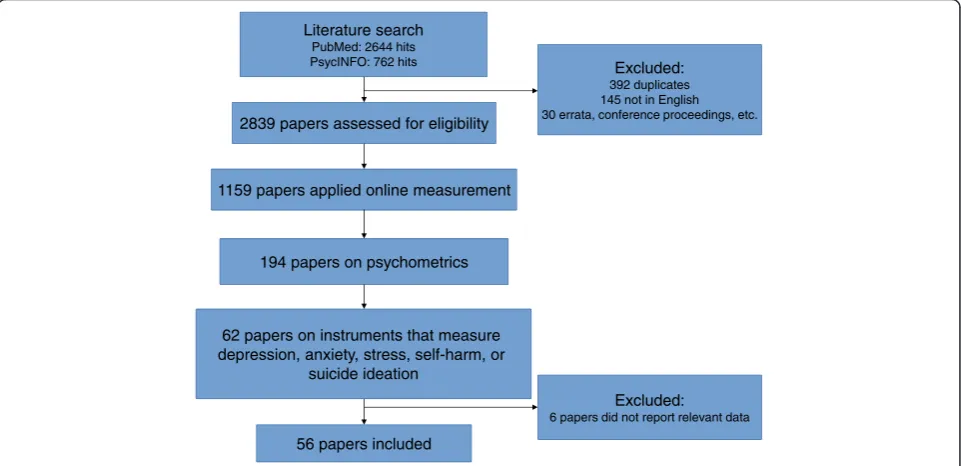
After excluding studies that were not written in English, studies were included in three a priori defined steps, as depicted in the flow chart (Fig. 1). The first inclusion step was to select all studies that applied online self-report assessments, i.e. data were collected using internet-connected devices that individuals used to fill in
questions about themselves. We excluded assessments through stand-alone devices (e.g. in a clinic), or other self-report measurement within a clinic, in order to re-tain comparability between results. We also excluded studies on assessments through unique devices specific-ally developed for the study, face-to-face interviews
con-ducted by videoconference, and interactive voice
response measures by telephone. As second inclusion step, we included only those studies that aimed at asses-sing psychometrics and that provided data of at least one psychometric variable. The third and final inclusion step included studies that described instruments for assessing symptoms of common mental health disorders [1]. These disorders include ICD-10 [12] and DSM-5 [13] unipolar depressive disorders, social phobia, panic disorder with or without agoraphobia (PD/A), agorapho-bia without panic, specific phoagorapho-bia, generalised anxiety disorder (GAD), post-traumatic stress disorder (PTSD) and obsessive-compulsive disorder (OCD). We also in-cluded instruments that assessed specific symptoms of these disorders or general distress that can accompany these disorders, i.e. psychological stress (only when un-related to physical disorders), worrying, suicidal ideation and self-harm.
Data extraction
First, we coded the data that are relevant for generalising a study’s findings, which are the sample size, tics of the participants (age, gender, disease characteris-tics), population (e.g. patients or general population), recruitment method, country in which the study was conducted, language of the measurement instrument,
Literature search PubMed: 2644 hits PsycINFO: 762 hits
2839 papers assessed for eligibility
Excluded: 392 duplicates 145 not in English 30 errata, conference proceedings, etc.
1159 papers applied online measurement
194 papers on psychometrics
56 papers included
62 papers on instruments that measure depression, anxiety, stress, self-harm, or
suicide ideation
Excluded: 6 papers did not report relevant data
Fig. 1Flow chart of included studies
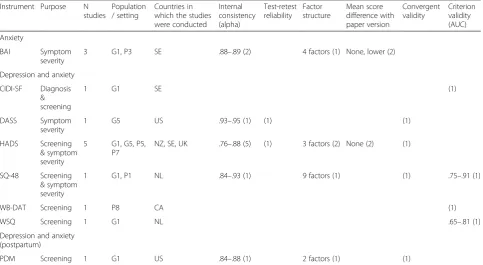
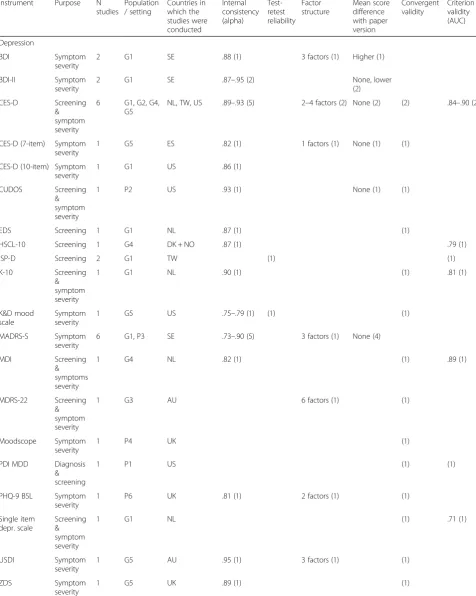
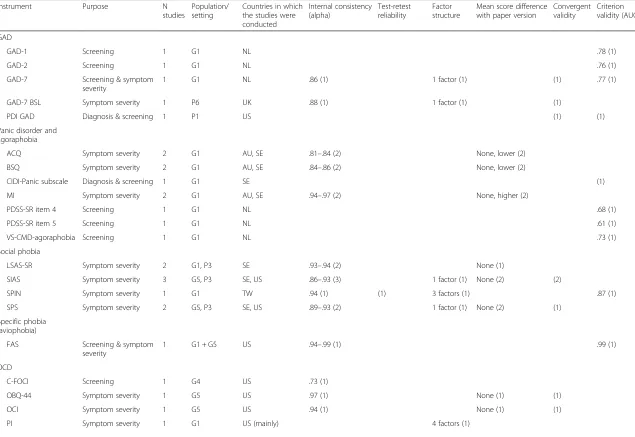
[image:2.595.58.539.482.715.2]any subgroups the results were reported for, and amount of missing data. Next, we extracted the psychometric data provided in the study. The following variables were en-tered into the tables (Tables 1, 2, 3 and 4; Additional file 3): internal consistency (usually expressed as Cronbach’s alpha); test-retest reliability (usually kappa); measurement error; factor structure, including type of analysis (explora-tory or confirma(explora-tory factor analysis, or principal compo-nent analysis) and model fit or variance explained; equivalence of paper and online versions of the instru-ment (usually a correlation); difference in mean scores be-tween online and paper versions; convergent validity, i.e. the relation with an instrument that measures the same construct (usually a correlation); criterion validity in terms of sensitivity, specificity (for the optimal cut-off point), Area Under the Receiver Operating Characteristic Curve (AUC), and other criterion-related outcomes (e.g. kappa); and responsiveness, i.e. the degree to which the instru-ment can measure change. These variables were extracted for each instrument reported in the study. When an in-strument was investigated in multiple samples, e.g. when two studies on one instrument were described in one paper, we listed the sample characteristics and outcomes for each sample separately.
Criterion validity requires a criterion such as a diagno-sis that can be objectively measured, but there is no exact method to ascertain any of the included disorders. Nevertheless, some psychometric studies do aim to as-sess criterion validity, and the criterion is established by an interview conducted face-to-face or by telephone by a clinician or a trained interviewer. We report these data, because it is not within the scope of the present review to discuss the validity of the used criteria.
Quality assessment
Quality assessment was conducted in two ways. First, we coded variables that affect the generalisability and risk of bias of the findings, which are sample size, sample char-acteristics, recruitment method and amount of missing data. Second, we used the COSMIN Checklist with a 4-point scale [10, 14–17]. This checklist contains quality criteria for the psychometric variables described above. For each variable, a quality score is obtained by taking the lowest rating of any item in that list of criteria [10].
Double coding
[image:3.595.57.541.423.688.2]The inclusion process was conducted by two independ-ent raters (WvB and a research assistant). Differences
Table 1Transdiagnostic online self-report instruments and the number of studies that report psychometric characteristics (between parentheses)
Instrument Purpose N studies
Population / setting
Countries in which the studies were conducted
Internal consistency (alpha)
Test-retest reliability
Factor structure
Mean score difference with paper version
Convergent validity
Criterion validity (AUC)
Anxiety
BAI Symptom
severity
3 G1, P3 SE .88–.89 (2) 4 factors (1) None, lower (2)
Depression and anxiety
CIDI-SF Diagnosis & screening
1 G1 SE (1)
DASS Symptom
severity
1 G5 US .93–.95 (1) (1) (1)
HADS Screening & symptom severity
5 G1, G5, P5, P7
NZ, SE, UK .76–.88 (5) (1) 3 factors (2) None (2) (1)
SQ-48 Screening & symptom severity
1 G1, P1 NL .84–.93 (1) 9 factors (1) (1) .75–.91 (1)
WB-DAT Screening 1 P8 CA (1)
WSQ Screening 1 G1 NL .65–.81 (1)
Depression and anxiety (postpartum)
PDM Screening 1 G1 US .84–.88 (1) 2 factors (1) (1)
G1: General population; G2: Adult females; G3: Adult males; G4: General teenage population; G5: Student population; G6: General young adult population; G7: Veteran population; P1: Patient population; P2: Adult psychiatric outpatients; P3: Adult social phobia patients; P4: Adult GP patients; P5: Hearing impaired clinical population; P6: Deaf population; P7: Adults with chronic fatigue syndrome; P8: Participants in studies of the Centre for Addiction and Mental Health; AU: Australia; CA: Canada; DK: Denmark; ES: Spain; NL: Netherlands; NO: Norway; NZ: New Zealand; SE: Sweden; TW: Taiwan; UK: United Kingdom; US: United States; AUC: Area Under the Receiver Operating Characteristic Curve
between raters were solved by discussion and by confer-ring with the co-authors. Three of the authors of this study (WvB, JHS, PvO) and three other raters (research assistants) participated in the data extraction and quality assessment of the included studies. We double coded all extracted data, including the four variables that may affect generalisability and risk of bias. The COSMIN quality ratings were mostly single coded, where 18 % of the included studies were double coded.
Data synthesis
All extracted data (Additional file 3) were sorted on dis-order or symptom and on instrument name, thereby cre-ating a table of instruments for each disorder (Tables 1, 2, 3 and 4). When a study investigated multiple instru-ments for multiple disorders (e.g. one instrument that measures depression and one that measures anxiety), we reported the instruments in the table for the appropriate disorder. We created a separate table for instruments that measured multiple disorders or general symptoms. It was not possible to synthesise the data in a quantita-tive analysis, such as a meta-analysis, because the in-cluded studies investigated a variety of instruments, applying various methods to obtain psychometric data and reporting various outcome measures.
Results Study selection
The PubMed search yielded 2644 results and the Psy-cINFO search added 370 unique studies (Fig. 1). After excluding studies that were not in English and search re-sults that were irrelevant studies, we assessed 2839 stud-ies for eligibility (Fig. 1). Step one of the inclusion, i.e. assessment was conducted using online self-report in-struments, left 1159 studies. Of these, 194 investigated and reported psychometric data (step 2). Next, we in-cluded 62 studies that investigated instruments for assessing common mental health disorders (step 3). Fi-nally, we excluded 6 studies that did not report psycho-metric data that were relevant for our overview and synthesis, so we included 56 studies in our review. See Fig. 1 for a flow chart.
Study characteristics
The details of the 56 included studies and their results are presented in Additional file 3. Combined, these stud-ies described psychometric data for 62 different instru-ments. These studies and instruments are presented in Additional file 3. The data are summarised in Tables 1, 2, 3 and 4. The samples of most studies (48 of 56) con-tained a larger percentage of women (range 0 % to 100 %; Additional file 3). Seven studies included a sam-ple with an average age below 20. Most studies recruited their samples from the general population using
advertisements or links on websites (i.e. self-referral). Also common were studies among university students. Patient populations were less common, as 14 of the 62 instruments were investigated among patient popula-tions. See Tables 1, 2, 3 and 4 and Additional file 3. All 56 of the included studies investigated internet-based in-struments that were completed on a desktop, laptop or tablet computer, while none of the studies reported that their instruments were completed on cellular phones or smartphones.
Outcomes
We found instruments for all of the included mental health disorders. An average of 2.5 psychometric charac-teristics were reported for each instrument. None of the studies reported measurement error or responsiveness of instruments. We left the empty columns of these two outcomes in Additional file 3, but omitted them in Ta-bles 1, 2, 3 and 4. Of the 62 investigated instruments, 29 assessed depressive symptoms. Of these, the CES-D and
the Montgomery–Åsberg Depression Rating Scale Self
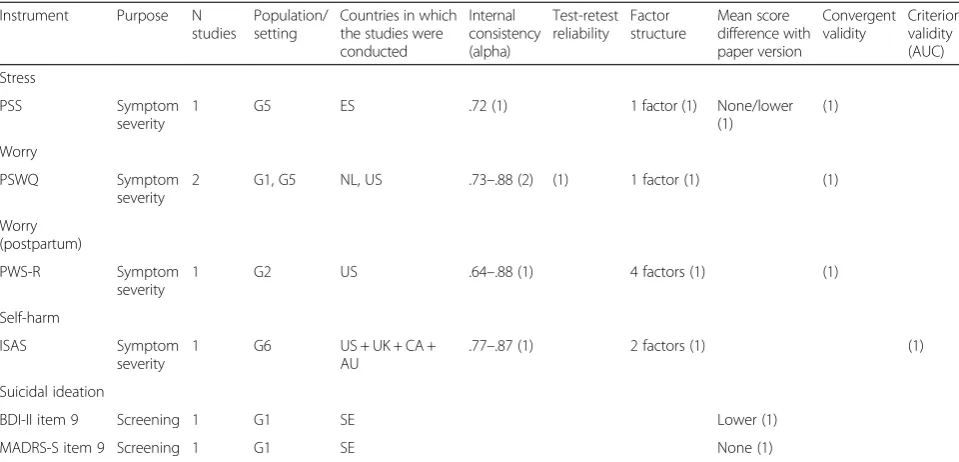
Report (MADRS-S) were most frequently studied (6 studies each). Least studied were instruments for meas-uring suicidal ideation (1 study on 2 single items), self-harm (1 study) and stress (1 study).
Transdiagnostic online instruments
Seven instruments assessed both depressive and anxiety symptoms, or anxiety symptoms that apply to several disorders, such as the Beck Anxiety Inventory (BAI). These can be roughly divided in short instruments that screen for disorders, e.g. the Web Screening Question-naire (WSQ) [18] and the Web-Based Depression and Anxiety Test (WB-DAT) [8], and scales that assess symptom severity, e.g. the Hospital Anxiety and Depres-sion Scale (HADS) [19] and the DepresDepres-sion Anxiety Stress Scales (DASS) [20]. The short screening question-naires had poor to adequate criterion validity for screen-ing individual disorders [8, 18, 21]. Of the symptom severity scales, the HADS was investigated in 5 studies [19, 22–25]. These 5 studies showed a fair to good in-ternal consistency. The online HADS is the only instru-ment we found that was investigated among several patient populations [19, 23, 24]. Although the factor structure may be different from how the measure was designed [19, 23], there is mounting evidence that sup-port adequate validity of the online HADS.
Online assessment of depression
Our review includes 29 instruments that measure de-pressive symptoms. These consist of 22 instruments that measure depression alone and 7 transdiagnostic instru-ments. The 22 studies on instruments for depression generally reported recruiting their samples from the
Table 2Online self-report instruments for depression and the number of studies that report psychometric characteristics (between parentheses)
Instrument Purpose N studies
Population / setting
Countries in which the studies were conducted
Internal consistency (alpha)
Test-retest reliability
Factor structure
Mean score difference with paper version
Convergent validity
Criterion validity (AUC)
Depression
BDI Symptom
severity
2 G1 SE .88 (1) 3 factors (1) Higher (1)
BDI-II Symptom
severity
2 G1 SE .87–.95 (2) None, lower
(2)
CES-D Screening & symptom severity
6 G1, G2, G4, G5
NL, TW, US .89–.93 (5) 2–4 factors (2) None (2) (2) .84–.90 (2)
CES-D (7-item) Symptom severity
1 G5 ES .82 (1) 1 factors (1) None (1) (1)
CES-D (10-item) Symptom severity
1 G1 US .86 (1)
CUDOS Screening & symptom severity
1 P2 US .93 (1) None (1) (1)
EDS Screening 1 G1 NL .87 (1) (1)
HSCL-10 Screening 1 G4 DK + NO .87 (1) .79 (1)
ISP-D Screening 2 G1 TW (1) (1)
K-10 Screening
& symptom severity
1 G1 NL .90 (1) (1) .81 (1)
K&D mood scale
Symptom severity
1 G5 US .75–.79 (1) (1) (1)
MADRS-S Symptom severity
6 G1, P3 SE .73–.90 (5) 3 factors (1) None (4)
MDI Screening
& symptoms severity
1 G4 NL .82 (1) (1) .89 (1)
MDRS-22 Screening & symptom severity
1 G3 AU 6 factors (1) (1)
Moodscope Symptom severity
1 P4 UK (1)
PDI MDD Diagnosis & screening
1 P1 US (1) (1)
PHQ-9 BSL Symptom severity
1 P6 UK .81 (1) 2 factors (1) (1)
Single item depr. scale
Screening & symptom severity
1 G1 NL (1) .71 (1)
USDI Symptom
severity
1 G5 AU .95 (1) 3 factors (1) (1)
ZDS Symptom
severity
1 G5 UK .89 (1) (1)
general population. Five studies investigated instruments for depression among patient populations [3, 6, 26–28], each investigating a different instrument.
The full version of the CES-D has been evaluated in 6 studies [5, 29–33], and 5 characteristics were each re-ported by at least 2 studies (Table 2). Moreover, all 6 studies recruited their samples among non-patients, so the results can be considered complementary. The in-ternal consistency was investigated in 5 of these studies, reporting a Cronbach’s alpha of .89 to .93. Factor ana-lysis showed that the CES-D consists of 2, 3 or 4 factors [32, 33]. The 2-factor solution was among an English speaking population, the 3-factor solution among a Spanish speaking and the 4-factor solution among a Chinese speaking population [32, 33]. Adequate psycho-metric characteristics were found for the CES-D regard-ing equivalence of mean scores with the paper version [31, 33], convergent validity [5, 30] and criterion validity [5, 30]. One study [33] conducted a full measurement in-variance analysis using confirmatory factor analysis, comparing paper and online formats, and found only a negligible difference in the latent mean score of one fac-tor. Overall, it can be concluded that the online CES-D has good psychometric characteristics among non-patient populations, and that a start has been made to investigate its intercultural validity.
Another commonly investigated instrument was the
MADRS-S [3, 4, 34–37]. Five of these studies reported
Cronbach’s alpha, which is adequate to excellent (.73 to
.90, Table 2) [3, 4, 34–36]. Thorndike and colleagues
[37] found that the scale consists of 3 factors. Four stud-ies found that the mean score of the MADRS-S does not differ significantly between the online and the paper ver-sion [3, 4, 35, 36].
Online assessment of GAD
The GAD-7 and two shorter versions were studied among a sample recruited from the general population [38]. The scale showed promising internal consistency,
convergent validity and predictive validity. The psycho-metrics of the GAD-7 were similar among a population of people with hearing loss [6].
Online assessment of panic disorder and agoraphobia
Internet interventions for PD/A, such as self-help courses, have been relatively extensively researched. Therefore, Austin and colleagues [39] and Carlbring and colleagues [4] studied the online questionnaires usually employed for such research. They focussed on equivalence of mean scores with paper versions of the same instruments. This equivalence could generally be assumed due to high corre-lations, but the study of Carlbring [4] found that online versions yield significantly lower mean scores for the Body Sensations Questionnaire (BSQ) and Agoraphobic Cogni-tions Questionnaire (ACQ) and higher scores for the
Mo-bility Inventory (MI) subscale Alone. Finally, an
agoraphobia screening item augmented with images was found to have adequate criterion validity (AUC .73) [7]. All these studies recruited their samples from the general population.
Online assessment of social phobia
Two studies [3, 40] independently investigated the equivalence between online and paper versions of the online versions of the Social Interaction Anxiety Scale (SIAS) and Social Phobia Scale (SPS). Both did not find a difference between formats in mean score, but the factor structure did differ between formats [40], indicating that scores cannot be compared
across formats. Adequate to good internal
[image:6.595.57.537.111.199.2]consistency of these scales has also been found in three studies [3, 40, 41], and adequate convergent validity of the SIAS in two [40, 41]. Lindner and col-leagues revised item 14 of the SIAS, because the ori-ginal item only applied to heterosexual people. This change did not alter the internal consistency or con-vergent validity of the scale [41]. The study of Hed-man and colleagues [3] recruited people classified
Table 2Online self-report instruments for depression and the number of studies that report psychometric characteristics (between parentheses)(Continued)
Postpartum depression
EPDS Screening,
symptom severity
1 G2 unclear .90 (1) 3 factors (1) (1)
PDSS Screening
& symptom severity
1 G2 US .97 (1) (1)
G1: General population; G2: Adult females; G3: Adult males; G4: General teenage population; G5: Student population; G6: General young adult population; G7: Veteran population; P1: Patient population; P2: Adult psychiatric outpatients; P3: Adult social phobia patients; P4: Adult GP patients; P5: Hearing impaired clinical population; P6: Deaf population; P7: Adults with chronic fatigue syndrome; P8: Participants in studies of the Centre for Addiction and Mental Health; AU: Australia; CA: Canada; DK: Denmark; ES: Spain; NL: Netherlands; NO: Norway; NZ: New Zealand; SE: Sweden; TW: Taiwan; UK: United Kingdom; US: United States; AUC: Area Under the Receiver Operating Characteristic Curve
Table 3Online self-report instruments for GAD, panic disorder and agoraphobia, social phobia, specific phobia, OCD and PTSD, and the number of studies that report psychometric characteristics (between parentheses)
Instrument Purpose N
studies
Population/ setting
Countries in which the studies were conducted
Internal consistency (alpha)
Test-retest reliability
Factor structure
Mean score difference with paper version
Convergent validity
Criterion validity (AUC)
GAD
GAD-1 Screening 1 G1 NL .78 (1)
GAD-2 Screening 1 G1 NL .76 (1)
GAD-7 Screening & symptom severity
1 G1 NL .86 (1) 1 factor (1) (1) .77 (1)
GAD-7 BSL Symptom severity 1 P6 UK .88 (1) 1 factor (1) (1)
PDI GAD Diagnosis & screening 1 P1 US (1) (1)
Panic disorder and agoraphobia
ACQ Symptom severity 2 G1 AU, SE .81–.84 (2) None, lower (2)
BSQ Symptom severity 2 G1 AU, SE .84–.86 (2) None, lower (2)
CIDI-Panic subscale Diagnosis & screening 1 G1 SE (1)
MI Symptom severity 2 G1 AU, SE .94–.97 (2) None, higher (2)
PDSS-SR item 4 Screening 1 G1 NL .68 (1)
PDSS-SR item 5 Screening 1 G1 NL .61 (1)
VS-CMD-agoraphobia Screening 1 G1 NL .73 (1)
Social phobia
LSAS-SR Symptom severity 2 G1, P3 SE .93–.94 (2) None (1)
SIAS Symptom severity 3 G5, P3 SE, US .86–.93 (3) 1 factor (1) None (2) (2)
SPIN Symptom severity 1 G1 TW .94 (1) (1) 3 factors (1) .87 (1)
SPS Symptom severity 2 G5, P3 SE, US .89–.93 (2) 1 factor (1) None (2) (1)
Specific phobia (aviophobia)
FAS Screening & symptom severity
1 G1 + G5 US .94–.99 (1) .99 (1)
OCD
C-FOCI Screening 1 G4 US .73 (1)
OBQ-44 Symptom severity 1 G5 US .97 (1) None (1) (1)
OCI Symptom severity 1 G5 US .94 (1) None (1) (1)
PI Symptom severity 1 G1 US (mainly) 4 factors (1)
van
Ballegoo
ijen
et
al.
BMC
Psychiatr
y
(2016) 16:45
Page
7
of
Table 3Online self-report instruments for GAD, panic disorder and agoraphobia, social phobia, specific phobia, OCD and PTSD, and the number of studies that report psychometric characteristics (between parentheses)(Continued)
PTSD
NSES Diagnosis & symptom severity
1 G1, G7 US 4 factors (1)
PCL-C Symptom severity 1 G5 US .91 (1) None (1)
PSS Screening & symptom severity
1 G5 US .92–.94 (1) 4 factors (1) (1)
TSS Symptom severity 1 G5 US .95–.96 (1) None (1)
PTSD (peripartum)
PPQ (modified) Screening & symptom severity
1 G2 US .90 (1) 3 factors (1) (1) (1)
G1: General population; G2: Adult females; G3: Adult males; G4: General teenage population; G5: Student population; G6: General young adult population; G7: Veteran population; P1: Patient population; P2: Adult psychiatric outpatients; P3: Adult social phobia patients; P4: Adult GP patients; P5: Hearing impaired clinical population; P6: Deaf population; P7: Adults with chronic fatigue syndrome; P8: Participants in studies of the Centre for Addiction and Mental Health; AU: Australia; CA: Canada; DK: Denmark; ES: Spain; NL: Netherlands; NO: Norway; NZ: New Zealand; SE: Sweden; TW: Taiwan; UK: United Kingdom; US: United States; AUC: Area Under the Receiver Operating Characteristic Curve
van
Ballegoo
ijen
et
al.
BMC
Psychiatr
y
(2016) 16:45
Page
8
of
with social phobia, but more research among patient groups is recommended.
Online assessment of specific phobia
Two of the transdiagnostic screening measures [18, 21] included specific phobia. These showed poor criterion validity for specific phobia. One instrument, the Flight Anxiety Situations Questionnaire (FAS), has been stud-ied for aviophobia [42]. This study showed near perfect criterion validity (AUC .99). Considering aviophobia is only one of many different specific phobias, much more development is needed in this area.
Online assessment of OCD
Four instruments for OCD have been studied, all in the
US and among the general population [43–45]. Each
in-strument was studied only once. Williams and col-leagues [45] investigated differential item functioning between black and white Americans, finding significant differences for the Padua Inventory (PI). Next to these 4 instruments, the WSQ [18] and the CIDI-SF [21] also screen for OCD.
Online assessment of PTSD
Like instruments for OCD, 4 instruments for PTSD have been studied, all in the US and among the general
popu-lation [31, 46–48]. The transdiagnostic WSQ [18] also
screens for PTSD. One additional study investigated an instrument for perinatal PTSD [49]. Miller and col-leagues [47] checked the factor structure of their meas-ure for PTSD (National Stressful Events Survey) using item-response theory. The factor structure was con-firmed, but the items of the instrument may cover too narrow a range of the latent factors.
Online assessment of worry and stress
The PSWQ, assessing worry, was studied twice [20, 50]. These studies found slightly differing values for internal consistency (.73 and .88). We found one study on an in-strument that assesses stress [51].
Online assessment of suicidal ideation and self-harm
[image:9.595.57.537.109.340.2]We found one study on an instrument that assesses self-harm. [52] This study used Rasch analysis to further con-firm the factors of the Inventory of Statements About Self-injury (ISAS), obtained by factor analysis, and their unidimensionality. Furthermore, we found two single-item measures for suicidal ideation, being item 9 of the BDI-II and item 9 of the MADRS-S [36]. Item 9 of the online BDI-II yielded lower scores than item 9 of the paper ver-sion of the BDI-II [36]. The WSQ [18] also contains an item that screens for suicidal ideation, but the validity of this item was not investigated (also see [53]).
Table 4Online self-report instruments for stress, worrying, suicidal ideation and self-harm, and the number of studies that report psychometric characteristics (between parentheses)
Instrument Purpose N studies
Population/ setting
Countries in which the studies were conducted
Internal consistency (alpha)
Test-retest reliability
Factor structure
Mean score difference with paper version
Convergent validity
Criterion validity (AUC)
Stress
PSS Symptom
severity
1 G5 ES .72 (1) 1 factor (1) None/lower
(1)
(1)
Worry
PSWQ Symptom
severity
2 G1, G5 NL, US .73–.88 (2) (1) 1 factor (1) (1)
Worry (postpartum)
PWS-R Symptom
severity
1 G2 US .64–.88 (1) 4 factors (1) (1)
Self-harm
ISAS Symptom
severity
1 G6 US + UK + CA +
AU
.77–.87 (1) 2 factors (1) (1)
Suicidal ideation
BDI-II item 9 Screening 1 G1 SE Lower (1)
MADRS-S item 9 Screening 1 G1 SE None (1)
G1: General population; G2: Adult females; G3: Adult males; G4: General teenage population; G5: Student population; G6: General young adult population; G7: Veteran population; P1: Patient population; P2: Adult psychiatric outpatients; P3: Adult social phobia patients; P4: Adult GP patients; P5: Hearing impaired clinical population; P6: Deaf population; P7: Adults with chronic fatigue syndrome; P8: Participants in studies of the Centre for Addiction and Mental Health; AU: Australia; CA: Canada; DK: Denmark; ES: Spain; NL: Netherlands; NO: Norway; NZ: New Zealand; SE: Sweden; TW: Taiwan; UK: United Kingdom; US: United States; AUC: Area Under the Receiver Operating Characteristic Curve
Generalisability and risk of bias
The sample sizes of the included studies were generally adequate for analysing psychometric properties. Nine studies contained over 1000 participants. The other studies in the tables (n= 46) had an average sample size of 261 participants. A sample size below 100 was found in 10 studies, which generally gives too little statistical power for psychometric analyses [54]. It should be noted that required sample sizes differ per number of items and type of analysis. Most results could be biased due to selectively missing data. Two studies reported missing data and included numbers. In 33 studies, the amount of missing data was not specifically reported, but could be deduced or estimated. Missing data were not reported by or could not be deduced in 21 studies (see Additional file 3). Overall, COSMIN quality ratings of ‘Excellent’ were rare and ‘Poor’, ‘Fair’ and ‘Good’ ratings were equally common. Instead of adding the COSMIN ratings to the tables and Additional file 3, we decided to report the characteristics the ratings are based on, because the ratings do not always do justice to a study’s quality. The study characteristics give an objective and interpretable indication of the robustness and generalisability of a study’s findings. Lastly, 47 of the 62 instruments were investigated in only one study (Tables 1, 2, 3 and 4), so the robustness of the psychometric properties of these instruments relies heavily on the aspects of the individ-ual studies and cannot be easily generalised to other populations or settings.
Discussion
This review systematically studied the scientific literature on the psychometrics of online instruments that meas-ure common mental health disorders. We report charac-teristics of 62 instruments. Most of these instruments were investigated among samples recruited from the general population. We found at least one online meas-ure for each of the included mental health disorders and symptoms. The results are scattered over different in-struments and different characteristics and, therefore, can be synthesised for only a few instruments. We found few instruments that measure specific phobia, stress, worry self-harm and suicidal ideation. There were no studies that reported that the questionnaires were com-pleted on cellular phones or smartphones.
The CES-D is the most well-studied online instrument and there is evidence for adequate psychometric proper-ties among samples recruited from the general popula-tion. The MADRS-S has been well-studied as well, mostly showing mean score equivalence between online and paper versions. Finally, the HADS is the only instru-ment that was investigated among both the general population and two patient populations, showing ad-equate psychometric properties.
Ideally, two or more online instruments would be avail-able for each disorder, with all of their characteristics ex-amined in several studies, among various populations. There are clear gaps in the tables presented in this study, which warrant further research and development. The psychometric properties measurement error and respon-siveness were not reported for any instrument. Further-more, while there is an abundance of online instruments for depressive symptoms, there is a shortage of ments for other disorders. Although a few new instru-ments have been developed in the meantime, e.g. for suicidal ideation [55], more instruments are needed.
Equivalence between paper and online versions of an in-strument has mostly been studied in the form of equiva-lence of mean scores by correlations and t-tests. We can conclude that correlations are high and differences are small. However, mean score equivalence is only one aspect of measurement invariance. Two studies conducted a broad range of measurement invariance tests [33, 40]. While Yu and Yu [33] found only a negligible difference in the mean score of the somatic factor of the CES-D, Hirai and colleagues [40] found that factor structures of the SIDAS and SPS differ between formats. Differing factor structures indicate that different constructs are assessed and scores cannot be compared across formats. It is im-portant to note that possibly not only the format differs between paper and online versions, but the setting as well. Online questionnaires can be completed at the partici-pant’s home on a device (s) he is familiar with. In the study of Yu and Yu [33], participants completed the paper ques-tionnaires at home, while in the study of Hirai and
col-leagues [40], participants completed the paper
questionnaires in a lab. It is recommended to study inter-format equivalence in one setting, and to use a broad range of measurement invariance aspects, e.g. using multiple-group confirmatory factor analysis [56].
This systematic review has some limitations. Firstly, we may not have included all studies on psychometrics of on-line instruments for common mental health disorders, be-cause there may be studies that applied online assessment without mentioning it in the title or abstract. Online assess-ment is increasingly common and increasingly less import-ant to mention. Secondly, we decided not to label the quality of the included studies, even though a quality as-sessment is common practice in systematic reviews. Be-cause psychometric properties are dependent on study characteristics, it is more insightful to inspect these charac-teristics in order to decide whether an instrument has been investigated well enough for the purpose, population and setting one wants to use it for. Thirdly, our search has been updated up to January 1st 2014 and several psychometric studies on online instruments have been published since. Finally, our search strings (Additional file 2) can be made more comprehensive by adding ‘distress’, ‘mhealth’ and
‘response processes’. The omission of these terms have not impacted our results, however.
Future psychometric studies are encouraged to investi-gate and explore different devices, formats and media. Only one study in our review [37] investigated the effects of different formats of online questionnaires and the pref-erences of the participants. An instrument’s format, e.g. the layout, design, font type and the number of items per page, interacts with its content and with the characteris-tics of the individual who completes the items. [57] Differ-ent formats could also include other media than text, such as audio, images and video, see e.g. [6] and [7]. Another area to explore is measurement by smartphones, which we did not encounter in the included studies. The validity of measurement by smartphone applications has been studied in other fields, such as psychotic symptoms. [58] An advantage of measurement by smartphones is that it enables momentary assessment, opposed to retrospective assessment, because an individual can have access to his/ her smartphone all day long.
Conclusions
We found at least one online measure for each of the included mental health disorders and symptoms, and there is mounting evidence for adequate psycho-metric properties of common instruments such as the CES-D, MADRS-S and HADS. Overall, the re-sults are scattered over different instruments and different characteristics, and much work still has to be done in this field. With this systematic review we provide a framework for future research into psycho-metrics of online instruments. Furthermore, our overview of instruments can guide professionals when choosing an instrument for assessing common mental health disorders online. The tables (Add-itional file 3) provided with this systematic review are free to use and expand. We encourage re-searchers to fill in the missing data and to add in-novative instruments.
Additional files
Additional file 1:PRISMA Checklist.(DOC 60 kb) Additional file 2:Search strings.(DOCX 18 kb)
Additional file 3:Included studies and extracted data.(XLS 117 kb)
Competing interests
The authors declare that they have no competing interests.
Authors’contributions
WvB, HR and JHS designed the study. WvB conducted the literature searches. WvB, JHS and PvO extracted the data. WvB drafted the manuscript. WvB, HR, PC, PvO and JHS critically revised the manuscript and approved the final version.
Acknowledgements
The authors would like to thank the research assistants who helped with study inclusion and data extraction: Sumeyye Pinar, Chrysanthi Karampetsi, Lisa Hegelmaier and Stefania Vacaru. No external funding sources were involved in this study.
Author details
1
Department of Psychiatry, VU Medical Centre / GGZ inGeest, Amsterdam, Netherlands.2Department of Clinical Psychology, Vrije Universiteit Amsterdam, Amsterdam, Netherlands.3EMGO Institute for Health and Care Research, VU Medical Centre, Amsterdam, Netherlands.
Received: 16 April 2015 Accepted: 4 February 2016
References
1. National Institute for Health and Clinical Excellence (NICE). Common mental health disorders: Identification and pathways to care. London: NICE; 2011. 2. Alfonsson S, Maathz P, Hursti T. Interformat reliability of digital psychiatric self-report questionnaires: a systematic review. J Med Internet Res. 2014; 16(12), e268. doi:10.2196/jmir.3395.
3. Hedman E, Ljotsson B, Ruck C, Furmark T, Carlbring P, Lindefors N, et al. Internet administration of self-report measures commonly used in research on social anxiety disorder: A psychometric evaluation. Comput Hum Behav. 2010; 26(4):736–40.
4. Carlbring P, Brunt S, Bohman S, Austin D, Richards J, Ost LG, et al. Internet vs. paper and pencil administration of questionnaires commonly used in panic/ agoraphobia research. Comput Hum Behav. 2007;23(3):1421–34.
5. Cuijpers P, Boluijt P, Van SA. Screening of depression in adolescents through the Internet : sensitivity and specificity of two screening questionnaires. Eur Child AdolescPsychiatry. 2008;17(1):32–8. doi:10.1007/ s00787-007-0631-2.
6. Rogers KD, Young A, Lovell K, Campbell M, Scott PR, Kendal S. The British Sign Language versions of the Patient Health Questionnaire, the Generalized Anxiety Disorder 7-item Scale, and the Work and Social Adjustment Scale. J Deaf Stud Deaf Educ. 2013;18(1):110–22. doi:10.1093/deafed/ens040. 7. van Ballegooijen W, Riper H, Donker T, Martin Abello K, Marks I, Cuijpers P.
Single-item screening for agoraphobic symptoms: validation of a web-based audiovisual screening instrument. PLoS One. 2012;7(7):e38480. doi:10. 1371/journal.pone.0038480.
8. Farvolden P, McBride C, Bagby RM, Ravitz P. A Web-based screening instrument for depression and anxiety disorders in primary care. J Med Internet Res. 2003;5(3), e23. doi:10.2196/jmir.5.3.e23.
9. Moher D, Liberati A, Tetzlaff J, Altman DG, Group P. Preferred reporting items for systematic reviews and meta-analyses: the PRISMA statement. BMJ. 2009;339:b2535. doi:10.1136/bmj.b2535.
10. Terwee CB, Mokkink LB, Knol DL, Ostelo RW, Bouter LM, de Vet HC. Rating the methodological quality in systematic reviews of studies on measurement properties: a scoring system for the COSMIN checklist. Qual Life Res. 2012;21(4):651–7. doi:10.1007/s11136-011-9960-1.
11. Terwee CB, Jansma EP, Riphagen II, de Vet HC. Development of a methodological PubMed search filter for finding studies on measurement properties of measurement instruments. Qual Life Res. 2009;18(8):1115–23. doi:10.1007/s11136-009-9528-5.
12. World Health Organization. ICD-10 Version:2015. 2015. http://apps.who.int/ classifications/icd10/browse/2015/en. Accessed January 2015.
13. American Psychiatric Association. Diagnostic and statistical manual of mental disorders, (DSM-5®). American Psychiatric Pub.; 2013.
14. Mokkink LB, Terwee CB, Patrick DL, Alonso J, Stratford PW, Knol DL, et al. The COSMIN checklist for assessing the methodological quality of studies on measurement properties of health status measurement instruments: an international Delphi study. Qual Life Res. 2010;19(4):539–49. doi:10.1007/ s11136-010-9606-8.
15. Mokkink LB, Terwee CB, Patrick DL, Alonso J, Stratford PW, Knol DL, et al. The COSMIN study reached international consensus on taxonomy, terminology, and definitions of measurement properties for health-related patient-reported outcomes. J Clin Epidemiol. 2010;63(7):737–45. doi:10.1016/ j.jclinepi.2010.02.006.
16. Mokkink LB, Terwee CB, Knol DL, Stratford PW, Alonso J, Patrick DL, et al. The COSMIN checklist for evaluating the methodological quality of studies on
measurement properties: a clarification of its content. BMC Med Res Methodol. 2010;10:22. doi:10.1186/1471-2288-10-22.
17. Mokkink LB, Terwee CB, Gibbons E, Stratford PW, Alonso J, Patrick DL, et al. Inter-rater agreement and reliability of the COSMIN (COnsensus-based Standards for the selection of health status Measurement Instruments) checklist. BMC Med Res Methodol. 2010;10:82. doi:10.1186/1471-2288-10-82. 18. Donker T, Van SA, Marks I, Cuijpers P. A brief Web-based screening
questionnaire for common mental disorders: development and validation. J Med Internet Res. 2009;11(3):e19. doi:10.2196/jmir.1134.
19. McCue P, Martin C, Buchanan T, Rodgers J, Scholey A. An investigation into the psychometric properties of the Hospital Anxiety and Depression Scale in individuals with chronic fatigue syndrome. Psychol Health Med. 2003;8(4):425–39. doi:10.1080/1354850310001604568. 20. Zlomke KR. Psychometric properties of internet administered versions of
Penn State Worry Questionnaire (PSWQ) and Depression, Anxiety, and Stress Scale (DASS). Comput Hum Behav. 2009;25(4):841–3.
21. Carlbring P, Forslin P, Ljungstrand P, Willebrand M, Strandlund C, Ekselius L, et al. Is the Internet-administered CIDI-SF equivalent to a clinician-administered SCID interview? Cogn Behav Ther. 2002;31(4):183–9. 22. Andersson G, Kaldo-Sandstrom V, Strom L, Stromgren T. Internet
administration of the Hospital Anxiety and Depression Scale in a sample of tinnitus patients. J Psychosom Res. 2003;55(3):259–62.
23. McCue P, Buchanan T, Martin CR. Screening for psychological distress using internet administration of the Hospital Anxiety and Depression Scale (HADS) in individuals with chronic fatigue syndrome. Br J Clin Psychol. 2006;45(Pt 4):483–98. doi:10.1348/014466505X82379.
24. Thoren ES, Andersson G, Lunner T. The use of research questionnaires with hearing impaired adults: online vs. paper-and-pencil administration. BMC Ear Nose Throat Disord. 2012;12:12. doi:10.1186/1472-6815-12-12.
25. Whitehead L. Methodological issues in Internet-mediated research: a randomized comparison of internet versus mailed questionnaires. J Med Internet Res. 2011;13(4):e109. doi:10.2196/jmir.1593.
26. Drake G, Csipke E, Wykes T. Assessing your mood online: acceptability and use of Moodscope. Psychol Med. 2013;43(7):1455–64. doi:10.1017/ S0033291712002280.
27. Faries DE, Houston JP, Sulcs EM, Swindle RW. A cross-validation of the provisional diagnostic instrument (PDI-4). BMC Fam Pract. 2012;13:104. doi: 10.1186/1471-2296-13-104.
28. Zimmerman M, Martinez JH. Web-based assessment of depression in patients treated in clinical practice: reliability, validity, and patient acceptance. J Clin Psychiatry. 2012;73(3):333–8. doi:10.4088/JCP.10m06519. 29. Birnholz JL, Young MA. Differential item functioning for lesbians, bisexual, and
heterosexual women in the center for epidemiological studies depression scale. Assessment. 2012;19(4):502–5. doi:10.1177/1073191112440032. 30. Donker T, Van SA, Marks I, Cuijpers P. Brief self-rated screening for
depression on the Internet. J AffectDisord. 2010;122(3):253–9. doi:10.1016/j. jad.2009.07.013.
31. Fortson BL, Scotti JR, Del Ben KS, Chen YC. Reliability and validity of an Internet traumatic stress survey with a college student sample. J Trauma Stress. 2006;19(5):709–20. doi:10.1002/jts.20165.
32. Leykin Y, Torres LD, Aguilera A, Munoz RF. Factor structure of the CES-D in a sample of Spanish- and English-speaking smokers on the Internet. Psychiatry Res. 2011;185(1–2):269–74. doi:10.1016/j.psychres.2010.04.056. 33. Yu SC, Yu MN. Comparison of Internet-based and paper-based
questionnaires in Taiwan using multisample invariance approach. CyberpsycholBehav. 2007;10(4):501–7. doi:10.1089/cpb.2007.9998. 34. Hedman E, Ljotsson B, Blom K, E-A S, Kraepelien M, Ruck C, et al. Telephone
versus internet administration of self-report measures of social anxiety, depressive symptoms, and insomnia: psychometric evaluation of a method to reduce the impact of missing data. J Med Internet Res. 2013;15(10):e229. doi:10.2196/jmir.2818.
35. Holländare F, Askerlund AM, Nieminen A, Engstrom I. Can BDI-II and MADRS-S be transferred to online use without affecting their psychometric properties? E-J Appl Psychol. 2008;4(2):63–5.
36. Holländare F, Andersson G, Engstrom I. A comparison of psychometric properties between internet and paper versions of two depression instruments (BDI-II and MADRS-S) administered to clinic patients. J Med Internet Res. 2010;12(5):e49. doi:10.2196/jmir.1392.
37. Thorndike FP, Carlbring P, Smyth FL, Magee JC, Gonder-Frederick L, Ost LG, et al. Web-based measurement: Effect of completing single or multiple items per webpage. Comput Hum Behav. 2009;25(2):393–401.
38. Donker T, Van SA, Marks I, Cuijpers P. Quick and easy self-rating of Generalized Anxiety Disorder: validity of the Dutch web-based GAD-7, GAD-2 and GAD-SI. Psychiatry Res. 2011;188(1):58–64. doi:10.1016/j.psychres.2011.01.016. 39. Austin DW, Carlbring P, Richards JC, Andersson G. Internet administration of
three commonly used questionnaires in panic research: Equivalence to paper administration in Australian and Swedish samples of people with panic disorder. Int J Test. 2006;6(1):25–39.
40. Hirai M, Vernon LL, Clum GA, Skidmore ST. Psychometric properties and administration measurement invariance of social phobia symptom measures: Paper-pencil vs. Internet administrations. J Psychopathol Behav Assessment. 2011;33(4):470–9.
41. Lindner P, Martell C, Bergstrom J, Andersson G, Carlbring P. Clinical validation of a non-heteronormative version of the Social Interaction Anxiety Scale (SIAS). Health Qual Life Outcomes. 2013;11:209. doi:10.1186/ 1477-7525-11-209.
42. Skolnick RB, Schare ML, Wyatt KP, Tillman MA. Aviophobia assessment: validating the Flight Anxiety Situations Questionnaire as a clinical identification measure. J Anxiety Disord. 2012;26(8):779–84. doi:10.1016/j. janxdis.2012.07.006.
43. Coles ME, Cook LM, Blake TR. Assessing obsessive compulsive symptoms and cognitions on the internet: evidence for the comparability of paper and Internet administration. Behav Res Ther. 2007;45(9):2232–40. doi:10.1016/j.brat.2006.12.009. 44. Storch EA, Khanna M, Merlo LJ, Loew BA, Franklin M, Reid JM, et al.
Children’s Florida Obsessive Compulsive Inventory: psychometric properties and feasibility of a self-report measure of obsessive-compulsive symptoms in youth. Child Psychiatry HumDev. 2009;40(3):467–83. doi:10.1007/s10578-009-0138-9.
45. Williams MT, Turkheimer E, Schmidt KM, Oltmanns TF. Ethnic identification biases responses to the Padua Inventory for obsessive-compulsive disorder. Assessment. 2005;12(2):174–85. doi:10.1177/1073191105275620.
46. Elhai JD, Miller ME, Ford JD, Biehn TL, Palmieri PA, Frueh BC. Posttraumatic stress disorder in DSM-5: estimates of prevalence and symptom structure in a nonclinical sample of college students. J Anxiety Disord. 2012;26(1):58–64. doi:10.1016/j.janxdis.2011.08.013.
47. Miller MW, Wolf EJ, Kilpatrick D, Resnick H, Marx BP, Holowka DW et al. The Prevalence and Latent Structure of Proposed DSM-5 Posttraumatic Stress Disorder Symptoms in U.S. National and Veteran Samples. Psychological Trauma: Theory, Research, Practice, and Policy. 2012.
48. Read JP, Farrow SM, Jaanimagi U, Ouimette P. Assessing trauma and traumatic stress via the Internet: Measurement equivalence and participant reactions. Traumatology. 2009;15(1):94–102.
49. Callahan JL, Borja SE, Hynan MT. Modification of the Perinatal PTSD Questionnaire to enhance clinical utility. J Perinatol. 2006;26(9):533–9. doi:10. 1038/sj.jp.7211562.
50. Verkuil B, Brosschot JF. The online version of the Dutch Penn State Worry Questionnaire: factor structure, predictive validity and reliability. J Anxiety Disord. 2012;26(8):844–8. doi:10.1016/j.janxdis.2012.08.002.
51. Herrero J, Meneses J. Short Web-based versions of the perceived stress (PSS) and Center for Epidemiological Studies-Depression (CESD) Scales: A comparison to pencil and paper responses among Internet users. Comput Hum Behav. 2006;22(5):830–46.
52. Kortge R, Meade T, Tennant A. Interpersonal and intrapersonal functions of deliberate self-harm (DSH): A psychometric examination of the Inventory of Statements About Self-Injury (ISAS) scale. Behaviour Change. 2013;30(1):24–35. 53. Hemelrijk E, van Ballegooijen W, Donker T, van Straten A, Kerkhof A.
Internet-based screening for suicidal ideation in common mental disorders. Crisis. 2012;33(4):215–21. doi:10.1027/0227-5910/a000142.
54. Kline P. Handbook of psychological testing. London: Routledge; 1993. 55. van Spijker BA, Batterham PJ, Calear AL, Farrer L, Christensen H, Reynolds J,
et al. The suicidal ideation attributes scale (SIDAS): Community-based validation study of a new scale for the measurement of suicidal ideation. Suicide Life Threat Behav. 2014;44(4):408–19. doi:10.1111/sltb.12084. 56. Hirschfeld G, von Brachel R. Multiple-Group confirmatory factor analysis in
R–A tutorial in measurement invariance with continuous and ordinal indicators. Pract Assessment, Res Eval. 2014;19(7):2.
57. Groves RM, Fowler Jr FJ, Couper MP, Lepkowski JM, Singer E, Tourangeau R. Survey methodology (Vol. 561). Hoboken, NJ: John Wiley & Sons; 2011. 58. Palmier-Claus JE, Ainsworth J, Machin M, Barrowclough C, Dunn G, Barkus E,
et al. he feasibility and validity of ambulatory self-report of psychotic symptoms using a smartphone software application. BMC Psychiatry. 2012; 12:172. doi:10.1186/1471-244X-12-172.