Anionic Surfactant Removal Using Electrochemical Process: Effect of
Electrode Materials and Energy Consumption
Batoul Mohebrad
1, Abbas Rezaee
1*, Somayyeh Dehghani
11) Department of Environmental Health Engineering, Faculty of Medical Sciences, Tarbiat Modares University, Tehran, Iran
*Author for Correspondence: [email protected]
Received: 26 Jab. 2017, Revised: 28 Feb. 2017, Accepted: 15 Mar. 2017
ABSTRACT
The aim of this study was the investigation of electrochemical process for sodium dodecyl sulfate (SDS) removal from aqueous solutions using different electrode materials. The influence of operating parameters such as current density, solution initial pH, surfactant concentrations, retention time, supporting electrolyte concentrations, electrode materials (aluminum, titanium, galvanized steel, stainless steel) and electrical energy consumption were evaluated. The obtained results indicated that the stainless steel electrode was more efficient than other electrodes. Maximum SDS removal was obtained 94.98% at the optimum condition of initial pH 7.0, 60 min retention time, 3.125 mA/cm2 current density, 100 mg/L initial SDS concentration and 0.2g/L NaCl concentration. The electrical energy
consumption of stainless steel, aluminum, titanium and galvanized steel was achieved 4, 3.68, 12 and 4.48 KWh/m3, respectively. It was found that the electrochemical reaction using stainless steel plate electrodes was efficient in SDS removal from aquatic environments.
Key words:
Anionic Surfactants, Interfacial Science, Surface Activity, ElectrochemicalINTRODUCTION
Nowadays, synthetic surfactants are utilized in various industries and research fields at primary and complex processes. Metal processing, textile, food, pharmaceuticals and paper are main industries for utilization of the synthetic surfactants. They are also applied in some personal care products and household cleaning materials [1].
Based on the charge of the hydrophilic part of synthetic surfactants, they were classified in four groups: nonionic, anionic, cationic and zwitterionic [2,3]. Ionic surfactants are included anionic and cationic surfactants. They are around two-third of utilized surfactants [4]. Major groups of surfactants utilized in detergent formulations are anionic surfactants (AS). The AS include more than 90% of the ionic surfactants. The dominant group of anionic surfactants is categorized to linear alkyl benzenesuffocate (LAS), alkyl benzenesuffocate (ABS) and linear alkyl sulfate [4]. Sodium dodecyl sulfate (SDS) is one of the linear alkyl sulfates, which is a popular surfactant with extensively commercialized [4,5]. SDS is utilized at various household and industrial cleaners, cosmetics, personal care products, and various types of industrial manufacturing operations. Also, AS are important ingredients of dispersants, that utilize in oil-spill cleanup activities. Nowadays, consumption of surfactant is progressively increased [4].
Large amounts of surfactants are in domestic wastewater due to the high application of detergents for cleaning and washing purposes [6]. Presence of these pollutants in wastewater is considered as one of the problems, because low biodegridibility of these compounds [2]. Surfactants are produced surface tension reduction in water and other fluids [2]. The discharge of these compounds to the environment can cause foam formation, ground water pollution and create an ecological hazard for aquatic organisms. They also make many human health problems, including dermatitis and adverse effect on aquatic flora [6].
The standard of detergent discharge to surface and ground water was reported 1.5 and 0.5mg/L respectively [6]. The main problem of surfactants is refractory to biodegradation [5]. Hence, application of biological treatment methods needs high retention time and subsequently treatment cost will be increased [7].
surfactants removal, such as ozonation or photo-catalytic oxidation have been reported low cost methods [7,10]. Between advanced treatment processes, electrochemical techniques are a high effient technique in wastewater treatment [11,12]. Ferrous ions produced at the anode are oxidized to the ferric ions then react with hydroxide ions generated at the cathode, creating a sediment of impurities with the unsolvable ferric hydroxide. The electrochemical reactions by metal (M) as anode are proposed as follows [11]:
- At the anode:
M (s ) → M(aq)n+ + ne- (1) 2H2O (l) → 4H+(aq) + O2(g) + 4e- (2) - At the cathode :
M (aq) n+ + ne- → M(s) (3)
2H2O (l) + 2e- H2(g) + 2OH- (4)
The aqueous medium chemistry, particularly conductivity, particle size, pH, and concentrations of chemical constituent are main parameters in an electrochemical process [11,12].
The advantages of electrochemical process are including: no need for additional chemicals, less sludge generation, well-set equipment, least secondary pollutions and easiness of operation [13,14]. According to adverse effects of SDS in the environment, various electrochemical process was proposed for electrochemical treatment of the detergents. According to the literature review, some studies have been proposed for the surfactant removal, but optimization of effective electrochemical parameters in multiple electrode material like aluminum, titanium, galvanized steel, stainless steel and their electrical energy consumption has not been evaluated. In this study, the effect of different parameters such as current density (mA/cm2), pH of solution, initial concentration of surfactants, retention time, supporting electrolyte and different electrode materials (aluminum, titanium, galvanized steel, stainless steel) were evaluated on the SDS degradation in aquatic environments using electrochemical process.
MATERIALS AND METHODS
Materials
Sodium dodecyl sulphate [CH3(CH2)11OSO3Na]
solutions were prepared with deionized water. All materials and reagents used in the experiments were analytical grade.
Electrochemical reactor
The treatment of wastewater containing SDS was carried out in 250 mL glass reactor using a magnetic stirrer for mixing the solution. A batch electrochemical unit with monopolar electrodes was
consisting of an electrochemical cell, D.C. power supply and electrodes. Applied electrodes material was aluminum, titanium, galvanized steel, and stainless steel. All electrodes had the same dimensions (40 mm 40mm × 1mm) by spacing of 10mm between them. The total area of the electrode submerged in the electrolytic solution was 16 cm2.
Experimental procedure
At the beginning of each run, the SDS solution was fed into the reactor. The pH values were adjusted to a desired value using NaOH (0.1M) and/or HCl (0.1M). The conductivity of the solution was enhanced by adding NaCl into the reaction solution. The effect of different operating parameters including current density (1.5, 3.125, 6.25 and 12.5mA/cm2), reaction time (15, 30, 45, 60 and 90 min), initial pH (3, 7 and 9), supporting electrolyte dosage (100, 200, 300, 400mg/L), concentration of SDS (50, 100, 200, 300 and 400mg/L) and electrode materials (aluminum, titanium, galvanized steel, and stainless steel) were considered. Colloidal metal particulates of hydroxides and quantity of foam were observed in reaction solution after electrocoagulation. In electrocoagulation and electroflotation, the suspended solids were removed. The sludge was eliminated by filtration using 20 μm Whatman filter paper (Sartrious, Germany). At the end of each experiment, the electrodes were washed with water and weighed. The experiments were done in the room temperature.
Analysis
The samples were examined for SDS according to standard methods for the examination of water and wastewater (part 5540) [15]. Residual SDS concentrations were determined at a maximum absorbance wavelength of 620nm and the chemical oxygen demand (COD) was determined by common photometric tests using COD test tubes by UV– Visible Spectrophotometer (Ray Leigh UV-9200, USA). The pH values were adjusted by a portable pH-tester (Sension 378, HACH). A magnetic stirrer (ALFA HS-8600) was used to homogenized the solutions. The DC source was utilized to supply power of the system (ATTEN APS3005S-3D, China).
The removal efficiency of SDS in solution was calculated as follows:
%η =(SDS0 - SDSt)/SDS0 ×100
Where, η is SDS removal efficiency, SDS0 and SDSt
are the initial SDS concentration and SDS at t-time in solution (mg/L).
RESULTS AND DISCUSSION
Effect of electrode material
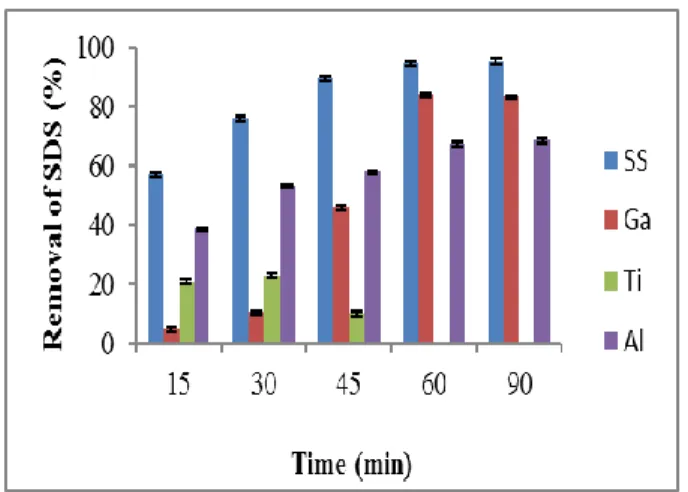
In this research, different electrode materials including aluminum, titanium, galvanized and stainless steel were evaluated on electrochemical removal of surfactant. It was found that stainless steel plate electrode has better performance on SDS removal efficiency (94.98%) compared with other applied electrodes (Fig. 1). During treatment, the color of solution changed from greenish to brownish color. It could be explained by production of Fe2+ and Fe3+. Particles formed at this stage had 35 cm3 thicknesses and precipitated within 2 hours. In similar condition, the maximum removed SDS by aluminum, titanium, and galvanized steel plate electrodes was 67.72%, 30.23%, and 84.37%, respectively.
The particles thicknesses formed in mentioned electrodes used were as follows: aluminum (30cm3 particle and 20cm3 white, greenish yellow scum), titanium (10cm3 particle and 10cm3 grayish color scum) and galvanized (25 cm3 particle and 15cm3 amber color scum). These particles precipitated within 3, 3 and 2 hours, respectively. Coagulation could be occurring by production of metallic hydroxide flocs during electrochemical wastewater treatment [16]. Applied current leads to anode dissolution and subsequently wide variety of coagulated types and metal hydroxides form which destabilize and gather the suspended solids and adsorb dissolved pollutants at appropriate pH values [17].
The obtained result showed that stainless steel is more efficient than other electrodes, for SDS removal in pH of 7. Nasrullah et al. (2012) had reported that the stainless steel electrode was more effective than aluminum and iron electrode for wastewater treatment, which can reduce 98.07% of COD and 95.69% of SS, during 30 min reaction time[18]. Stainless steels mainly composed of iron with 12-30% chromium, up to 22% nickel and less amounts of carbon, selenium, copper, molybdenum and titanium [19]. In solution, Fe3+ may create compounds such as FeOH2+, Fe2(OH)4+, Fe(OH)2+,
and Fe(OH)4− according to pH range, which finally convert to Fe(OH)3 that is a dense and quickly
precipitated floc in the reaction solution [11]. The Fe (OH)n(s) remains as a gelatinous suspension in the
aqueous solution. It can treat the wastewater pollutants by electrostatic attraction or complexion, and finally by coagulation [20]. The H2 generated
caused by redox reactions can remove dissolved materials or any suspended particles by flotation [21,22].
Fig. 1: The comparison between four electrode material on SDS removal efficiency; Current density: 3.125mA/cm2, pH of solution: 7, NaCl: 0.2g/L and reaction time: 0-90 min.
Effect of initial pH
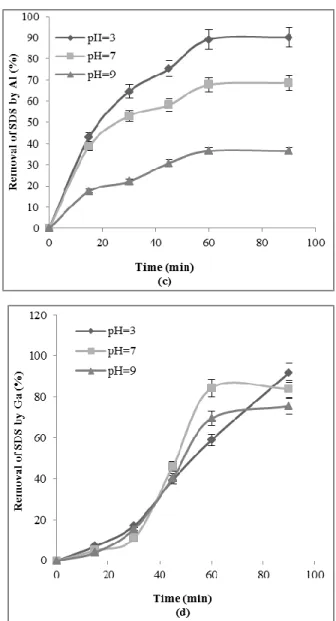
To study the effect of pH values on the surfactant removal, the electrocoagulation method was investigated in the pH ranges of 3 – 9. The electrolysis process was done under the operating conditions as follows: the initial concentration of SDS: 100mg/L; current density: 3.125mA/cm2; and retention time: 0 - 90 min. Results indicated that the surfactant removal, enhanced at pH 7 and started to decline at pH values of 3 and 9. The optimum pH value 7 was obtained (Fig. 2.a, b, c, d). Overall, stainless steel electrode is mainly iron based with 12% to 30% chromium, up to 22% nickel and minor amounts of carbon, molybdenum, copper, titanium and selenium. During the electrochemical process, a small quantity of iron and other metal was gradually dissolved into the reaction solution from working electrode, and joined with OH- to form flocs that precipitate with pollutants in the aqueous solution. The studies carried out by some authors were also obtained similar results[11,13]. It is reported that the Fe(OH)n composed in electrocoagulation - as a
precipitation/ flotation of the aggregated flocs )Eqs:1-7) [24- 25-26].
At Anode
Ti(s) → Ti4+ +4e- (Eq.1)
At Cathode
4H2O+4e-→ 2H(g) + 4OH- (Eq.2)
Ti4++4H2O→Ti(OH)4+ 4H+ (Eq.3)
Ti (OH) 4+ OH−→Ti (OH) 4− (Eq.4)
The following chemical reactions occur in the presence of chlorine ions:
2Cl−+2e-→Cl2. (Eq.5)
Cl2+H2O→HOCl+Cl−+H+ (Eq.6)
HOCl→OCl−+H+ (Eq.7)
It can be the result of formation of hydroxide precipitates with other cations..J. Ge et al. (2004) stated that removal of surfactant in acidic to neutral pH occurred [31]. Another study found that the titanium current efficiencies are higher at either acidic or alkaline condition than in neutral.[24-25-26].
Fig. 2: The effect of electrode materials on SDS removal efficiency. (a) Magnetic stainless steel electrode. (b) Titanium plate electrode. (c) Aluminum plate electrode. (d) Galvanized steel plate electrode
.
Effect of current density
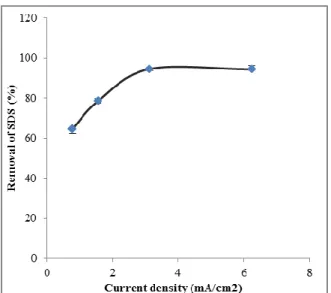
Based on reports, the current density has largely an effect on the electrocoagulation process[24]. Therefore, the efficacy of this parameter was studied on the SDS removal in various values of 0.75, 1.56, 3.125, and 6.25mA/cm2 (Fig. 3). It was revealed that higher surfactant removal could be achieved by increasing current density up to 3.125mA/cm2. The removal rate stayed unchangeable at higher values of current densities. It could be explained that increasing the current density could improve the production of coagulant on anode and cathode (eg. M (OH)3 flocks formations) hence the removal
Fig.3: The effect of current density on SDS removal efficiency; pH of solution: 7, NaCl: 0.2g/L
Effect of surfactant concentration
In this study, the effect of initial doses of SDS was considered in the range of 50 to 400mg/L. It was found that by increasing the initial dose of surfactant more than 100mg/L, the removal rate slightly decreased. The removal of the SDS reached to 55% in the presence of 400mg/L SDS. There are three major processes that arise during electrocoagulation: (I) electrode surface reactions (II) coagulants formation in aqueous solution (III) adsorption of soluble or suspended pollutants on coagulants and removed by precipitation or flotation. Reactions at the stainless steel electrodes are similar to iron electrode [9,23,28]. Mahmoud et al. (2014) studied the effect of initial concentration of surfactant (0-150mg/L) on electrocoagulation method using iron electrode with similar results [23]. Yuksel et al.
(2009) indicated that the removal efficiency reduced from 100% to 37% with increment of surfactant concentration [9]. This is likely caused by formation of inadequate amounts of iron hydroxide complexes and applied current to coagulate and degrade the higher molecules of SDS. The higher removal efficiency could be achieved at lower surfactant concentrations. Rahmanifar et al. (2006) has observed that by increasing the SDS concentration, the degradation rate was considerably decreased [28].
Effect of NaCl concentration
At constant current, by adding an electrolyte into the reaction solution the conductivity could increase and subsequently the voltage between electrodes reduce due to cell resistance reduction [29]. In this research, the solution conductivity was enhanced by adding NaCl to support electrolyte (0.1 to 0.4g/L). It was
observed that with increasing NaCl concentration up to 0.2g/L, the removal efficiency, improved (from 60% to 90%). Further amount of NaCl concentration decreased the electrochemically SDS removal (to 70%). This trend could be due to higher dissolving rate of electrode plates by chemical and electrochemical corrosion [30]. The presence of chlorine ions in the solution containing Fe (OH)3 can
cause intermediate species formation like Fe(OH)Cl2
and FeCl3. It can be concluded, the decrease of metal
species amounts for coagulation process, resulting in less treatment efficiency [31].
Effect of electrolysis time
Generally, reaction time influences on the electrochemical process efficiency. This parameter was considered in the range of 15 to 90min. Other operating conditions were as follows: initial concentration of surfactant: 100mg/L; current density: 3.125mA/cm2 and pH: 7. As shown in Fig. 4, during 60 min of treatment time, process efficiency reached to 94.98%. It could be due to increasing the amount of metal hydroxide flocs which raises the removal efficiency via a coagulation followed by precipitation [32]. Further reaction time (more than 60min) had no significant effect on process efficiency. The value of 60 min was chosen as the optimum amount.
0 10 20 30 40 50 60 70 80 90 100
0 50 100
R
em
o
v
a
l
o
f
S
D
S
(%
)
Time (min)
Fig 4: The effect of electrolysis time on SDS removal efficiency; Current density: 3.125mA/cm2, pH of solution:
7, NaCl: 0.2 g/L
Electrical energy consumption
Electrical energy consumption has significantly effected on economy of electrocoagulation and electrofloation processes. This important parameter obtains by using the followed equation [26,30]: E = u I t (Eq.8)
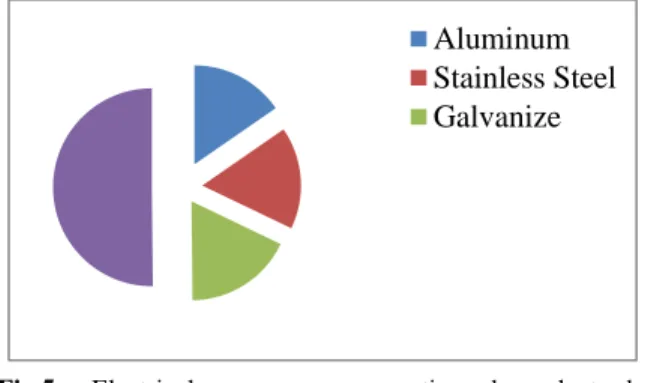
In this study, the energy consumption was calculated for different applied electrodes. This parameter for stainless steel, aluminum, titanium and galvanized steel were 4, 3.68, 12 and 4.48KWh/m3, respectively (Fig. 5). Abdel-Gawad et al. (2012) reported that the optimum amounts of I, m, pH and time were equals to18 mA/cm2, 1g/L, 6.5 and 80 min. In this situation, the maximum removal of COD was 58.85% and the energy consumption was 16.2kWh/m3 using iron electrodes [34].
Aluminum Stainless Steel Galvanize
Fig.5: Electrical energy consumption by electrode materials used on SDS removal efficiency
.
Mineralization of SDS
Fig.6. Illustrate the COD removal efficiency for different concentration of SDS (50–400mg/L). It was found that by increasing the initial dose of surfactant (more than 100mg/L), the COD removal rate slightly decreased. It means that SDS mineralization reached by production of free hydroxyl radicals and degradation of the surfactant into inorganic species can be accomplished on the stainless steel electrode.Wuping Konget et al. (2006) has observed that by increasing the SDS concentration, the degradation rate was considerably decreased [35]. Geert Lissens has shown that surfactants could be deactivated and oxidized with total organic carbon (TOC) removals up to 82% by the action of intermediates of water discharge (e.g. hydroxyl radicals) [ 36]
.
Fig.6: The COD variation electrochemical oxidation for different concentration of SDS (50 – 400mg/L), Current
density: 3.125mA/cm2, pH of solution: 7, and NaCl: 0.2g/L for stainless steel electrode.
Degradation kinetics of SDS removal
The removal rate of surfactant can be represented by the linear pseudo-second order equation:
Where, t is the time of electrolysis, C is the removal at time t, k is the reaction rate coefficient and Cmax is the maximum removal = 99.99,.
Fig. 7 shows the surfactant removal (t/C versus t). As plotted curve shows the correlation coefficient (R) for the pseudo-second order equation was 0.9993. Calculated Cmax values from equation agree well with
the experimental data. This strongly suggests that the surfactant removal is most appropriately represented by a pseudo-second order. Results of S. S. Mahmoud
et al. correspond to the results of this research [23].
y = 0.0096x + 0.0183 R² = 0.9993
0 0.1 0.2 0.3 0.4 0.5 0.6 0.7
0 20 40 60 80
t/c
Time (min)
Fig.7: Degradation kinetics of SDS at pH of solution=7, 60 min retention time, 3.125mA/cm2 current density, 100mg/L initial SDS concentration and 0.2g/L NaCl concentration for stainless steel.
CONCLUSION
In this study, the efficiency of various electrodes applying in electrochemical process was considered for SDS removal from aqueous solutions. Hence, the influence of multiple operating conditions such as current density (mA/cm2), pH of solution, different
solution=7, 60 min retention time, 3.125 (mA/cm2)
current density, 100mg/L initial SDS concentration and 0.2 g/L NaCl concentration. In the optimum condition, 94.98% of surfactant was removed using stainless steel as an electrode. The electrical energy consumption of stainless steel, aluminum, titanium and galvanized steel was achieved 4, 3.68, 12 and 4.48 KWh/m3, respectively. It was found that the electrochemical reaction with stainless steel plate electrodes is an efficient in SDS removal from aquatic environments.
ETHICAL ISSUES
Ethical issues such as plagiarism have been observed by the authors.
CONFLICT OF INTEREST
Authors have no conflict of interests.AUTHORS’ CONTRIBUTION
All authors equally help to write this manuscript.
FUNDING/ SUPPORTS
Tarbiat Modares University supported this study.
ACKNOWLEDGEMENT
The authors are grateful for funding by Tarbiat Modares University
REFERENCES
[1].El-Gawad HAS. Aquatic environmental monitoring and removal efficiency of detergents. Water Sci. 2014; 28(1): 51-64.
[2].Hashemi S, Rezaee A, Nikodel M, Ganjidost H, Mousavi SM. Equilibrium and kinetic studies of the adsorption of sodium dodecil sulfate from aqueous solution using bone char, React Kinet Mech Catal 2013; 109(2): 433-46.
[3].Ying G-G. Fate, behavior and effects of surfactants and their degradation products in the environment. Environ Int. 2006; 32(3): 417-31. [4]. Gupta S, Pal A, Ghosh PK, Bandyopadhyay M. Performance of waste activated carbon as a low-cost adsorbent for the removal of anionic surfactant from aquatic environment. J Environ Sci Health A. 2003; 38(2): 381-97.
[5].Harendra S, Vipulanandan C. Determination of sodium dodecyl sulfate (SDS) and biosurfactants sorption and transport parameters in clayey soil. J Surfact Deterg. 2012; 15(6):805–13.
[6].Ghoochani M, Shekoohiyan S, Mahvi A, Haibati B, Norouzi M . Determination of detergent in Tehran ground and surface water. American-Eurasian J Agric Environ Sci. 2011; 10(3): 464-69.
[7].Leu HG, Lin SH, Lin TM. Enhanced electrochemical oxidation of anionic surfactants. J Environ Sci Health. 1998; 33(4): 681-99.
[8].Wang X-J, Song Y, Mai J-S. Combined Fenton oxidation and aerobic biological processes for treating a surfactant wastewater containing abundant sulfate. J Hazard Mater. 2008; 160(2-3): 344-48. [9].Yüksel E, Şengil İA, Özacar M. The removal of sodium dodecyl sulfate in synthetic wastewater by peroxi-electrocoagulation method. Chem. Eng. J. 2009; 152(2-3): 347-53.
[10].Panizza M, Bocca C, Cerisola G. Electrochemical treatment of wastewater containing polyaromatic organic pollutants. Water Res. 2000; 34(9): 2601-05.
[11].Önder E, Koparal A.S, Öğütveren Ü.B. An alternative method for the removal of surfactants from water: Electrochemical coagulation. Sep. Purif. Technol. 2007; 52: 527-32.
[12].Hoseinzadeh E, Rezaee A. Electrochemical degradation of RB19 dye using low-frequency alternating current: effect of a square wave, RSC Adv. 2015; 5, 96918-26.
[13].El-Naas MH, Al-Zuhair S, Al-Lobaney A, Makhlouf S. Assessment of electrocoagulation for the treatment of petroleum refinery wastewater. J. environ. manage. 2009; 91(1): 180-85.
[14].Phalakornkule C, Polgumhang S, Tongdaung W, Karakat B, Nuyut T. Electrocoagulation of blue reactive, red disperse and mixed dyes, and application in treating textile effluent. J. environ. manage. 2010; 91(4): 918-26.
[15].Way C, Standard methods for the examination of water and wastewater. Water Environment Federation, Secaucus, NJ, USA. 2012.
[16].Ukiwe L, Ibeneme S, Duru C, Okolue B,
Onyedika G, Nweze C. Chemical and
electrocoagulation techniques in coagulation-floccculationin water and wastewater treatment-a review. Int J Res Rev Appl Sci. 2014; 18(3): 285-94. [17].Vepsäläinen M. Electrocoagulation in the treatment of industrial waters and wastewaters. VTT Technical Research Centre of Finland. 2012.
[18].Nasrullah M, Singh L, Wahida Z.A. Treatment of sewage by electrocoagulation and the effect of high current density. Energy Environ Eng J. 2012; 1(1): 27-31.
[19].Stoica M, Cârâc G, Alexe P, Dinica R. Electrochemical Behaviour of AISI 304 Stainless Steel Immersed in Mixtures Consisting by Biocide and Fungal Suspensions. INTECH Open Access Publisher. 2012.
wastewater by electrocoagulation-electroflotation. J. Chem. Educ. 1998; 75(8): 40.
[21].Varank G, Erkan H, Yazýcý S, Demir A, Engin G. Electrocoagulation of tannery wastewater using monopolar electrodes: process optimization by response surface methodology. Int J Environ Res. 2014; 8(1): 165-80.
[22].Shim HY, Lee KS, Lee DS, Jeon DS, Park MS, Shin JS. Application of Electrocoagulation and Electrolysis on the Precipitation of Heavy Metals and Particulate Solids in Washwater from the Soil Washing. J Agri Chem Environ. 2014; 3(4): 130-38. [23].Mahmoud, S. Ahmed M. Removal of surfactants in wastewater by electrocoagulation method using iron electrodes. Phys Sci Res Int. 2014; 2(2): 28-34.
[24].Jiantuan G, Jiuhui Q, Pengju L, Huijuan L. New bipolar electrocoagulation–electroflotation process for the treatment of laundry wastewater. Sep Purif Technol. 2011; 36 (1): 33–39.
[25].Yüksel E, Şengil A,engil, Ozacar M. The removal of sodium dodecyl sulfate in synthetic wastewater by peroxi-electrocoagulation method. Chem. Eng. J. 2009; 152 (2-3): 347–53.
[26].Chaminda P. Samaranayake, Sudhir K. Sastry. Electrode and pH effects on electrochemical reactions during ohmic heating. J. Electroanal. Chem. 2005; 577 (1): 125–35.
[27].Janpoor F, Torabian A, Khatibikamal V. Treatment of laundry waste‐water by electrocoagulation. J Chem Technol Biotechnol. 2011; 86(8): 1113-20.
[28].Rahmanifar M, Mousavi M, Shamsipur M, Riahi S. A study on the influence of anionic surfactants on electrochemical degradation of polyaniline. Polym Degrad Stabil. 2006; 91(12): 3463-68.
[29].Kuokkanen V, Kuokkanen T. Recent applications of electrocoagulation in treatment of water and wastewater—A review. Green Sustainable Chem. 2013; 3(2): 89-121.
[30].Bensadok K, El Hanafi N, Lapicque F. Electrochemical treatment of dairy effluent using combined Al and Ti/Pt electrodes system. Desalination. 2011; 280(1): 244-51.
[31].Wang C-T, Chou W-L, Kuo Y-M. Removal of
COD from laundry wastewater by
electrocoagulation/electroflotation. J hazard mater. 2009; 164(1): 81-86.
[32].Karichappan T, Venkatachalam S, Jeganathan P.M. Optimization of electrocoagulation process to treat grey wastewater in batch mode using response surface methodology. J Environ Health Sci Eng. 2014; 12(1):29.
[33].Mouedhen G, Feki M, Wery MDP, Ayedi H.
Behavior of aluminum electrodes in
electrocoagulation process. J hazard mater. 2008; 150(1): 124-35.
[34].Abdel-Gawad SA, Baraka AM, Omran KA, Mokhtar MM. Removal of some pesticides from the simulated wastewater by electrocoagulation method using iron electrodes. Int J Electrochem Sci. 2012; 7(8): 6654-65.