2017 3rd International Conference on Electronic Information Technology and Intellectualization (ICEITI 2017) ISBN: 978-1-60595-512-4
Microstructure Analysis of Silica Sol Shell
Based on Composite Fiber Reinforcement
Qingsong Yan and Gang Lu
ABSTRACT
Composite fibers were used to enhance silica sol shell for investment casting. The fracture morphology of the shell was observed and analyzed by scanning electron microscopy (SEM). The influence of the characteristics of the composite fiber on the cast-type shell was analyzed. The results for the high performance of investment casting shell preparation to provide a scientific basis and theoretical support.
INTRODUCTION
Investment casting is an advanced material near net forming technology, with high precision, high efficiency, low loss and other advantages, widely used in aerospace, automotive and other fields. Silica sol is a kind of high quality binder commonly used in investment casting. Silica sol coating is easy to use, stable and easy to store, resulting in less environmental pollution and strong controllability [1-3]. However, the silica sol shell has the disadvantages of slow drying speed, low wet strength of the shell, high residual strength, and long shell length. At the same time, the strength and permeability of the cast silica sol shell are in a mutually restricted relationship. In order to ensure that the shell strength, the shell thickness was usually increased, which leads to poor heat shell, poor ventilation and filling difficulty. So _______________________
Qingsong Yan, Gang Lu, National Defense Key Disciplines Laboratory of Light Alloy Processing Science and Technology, Nanchang Hangkong University, Nanchang 330063, China
we must improve the pouring temperature of liquid metal, making the shell and metal reaction degree intensified, and even the shell deformation is serious, greatly affected the overall quality of the casting [4-5].
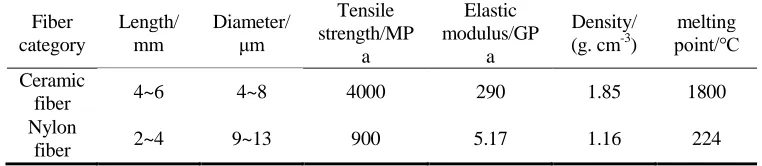
TABLE Ⅰ. MAIN PERFORMANCE PARAMETERS OF THE FIBER.
Fiber category Length/ mm Diameter/ μm Tensile strength/MP a Elastic modulus/GP a Density/ (g. cm-3)
melting point/℃
Ceramic
fiber 4~6 4~8 4000 290 1.85 1800
Nylon
fiber 2~4 9~13 900 5.17 1.16 224
In recent years, fiber reinforced composite materials have made remarkable achievements, and continue to penetrate into the machinery, construction, investment casting and other fields [6-7]. The ceramic shell was added with rice bran which was burnt after roasting. The microporosity were formed in the matrix, increasing the porosity of the ceramic shell and improving the performance of the shell obviously, so as to improve the quality of investment casting [8-9]. Adding high polymer adhesive and nylon shell of organic fiber reinforced in the slurry, showed little influence on the wet strength of shell, but it effectively resisted cracking at the corners of the shell; the nylon fiber was completely burnt out in the shell inner left a lot of micro pores, enhance the permeability of the shell [10-11]. The ceramic / nylon composite fiber impregnated slurry was used to prepare the cast-type shell by Nanchang Hangkong University[12-15]. The influence of the mass content, length and proportion of the composite fiber on the comprehensive performance of the silica sol was studied. The strength and permeability of the shell were improved at the same time. On the basis of the above research, this paper analyzes the microstructure of silica sol shell based on composite fiber strengthening, which is helpful to analyze the influence of composite fiber properties on the casting shell. The results provide scientific basis and theoretical support for the preparation of high performance castable shell.
EXPERIMENTAL MATERIALS AND METHODS
Technology Co., Ltd. The main performance parameters of fiber as shown in table Ⅰ. Select a reasonable shell preparation process, to the silica sol slurry impregnated with different content of composite fiber preparation casting shell.
The microstructure of fracture surface of silica sol shell with different composite fiber content was observed by Quanta200 electron scanning microscope.
RESULTS AND ANALYSIS
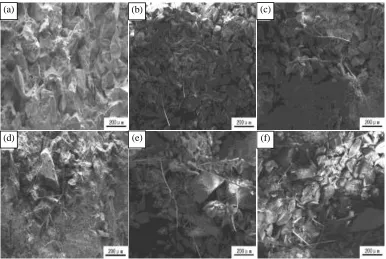
[image:3.612.105.491.313.572.2]The fracture microstructure of the specimen reflects the fracture characteristics of the shell material and the internal structure of the material. Observing the fracture morphology of the shell specimens systematically is helpful to analyze the strengthening mechanism of the composite fiber properties to the silica sol casting shell. The microstructure of the fracture surface after calcination at high temperature was shown in figure 1.
Figure 1. Fracture microstructure of composite fiber reinforced silica sol shell samples with different contents
((a):0%;(b):0.15%;(c):0.3%;(d):0.45%;(e):0.6%;(f):
0.75%).
As shown in Fig. 1 (a), the fracture of the shell sample after the high temperature calcination is relatively rough, because the shell is roasted and the slurry uniformly
(a) (b) (c)
coated with the sand particles is tightly bonded together. The compactness of the shell is enhanced, so that the shell has a certain sintering strength. When the shell specimen is broken, the hard slurry is bonded together to form a corners with sharp corners, and the fracture is rough. As the composite fiber content increases from 0.15% to 0.6%, as shown in Figs. 1 (b) to 1 (e), the number of fibers and the porosity increase almost simultaneously in the same field area. After the shell is fired at high temperature, the ceramic fiber with high refractoriness is retained in the shell and forms an organic combination with the shell base. When the shell specimen is subjected to external force, the ceramic fibers are destroyed by interface debonding and pull out failure etc., consume a lot of energy, preventing the fracture of the shell sample obviously and enhancing the shell. At the same time refractory low degree of nylon fiber loss burned, leaving the micro pores in the shell, which can be seen as containing many micro pore porous body, porous shell strength specimen decreases, with porosity with increasing separation effect on shell. When the content of composite fiber is low, the strengthening effect of the ceramic fiber shell is larger than the dissevering effect of nylon fiber, and the strength of the shell is improved after roasting. When the fiber content increased to 0.75%, as shown in figure 1 (f), shell fracture porosity and pore size increased, pore size of some is large. When the fiber content is exorbiting, the fibers are unevenly dispersed in the slurry and form a fiber bundles in the shell matrix. The nylon fibers were burned and the ceramic fiber still exists, the fiber bundle becomes more loose in the shell fracture. When the shell sample is broken, the bundle was pulled out leaving large pores, which separates the function of shell samples and destroys the integrity of the shell body. The negative effect of composite fiber on the shell is greater than the positive effect, lead to a decline in the strength of the sample shell.
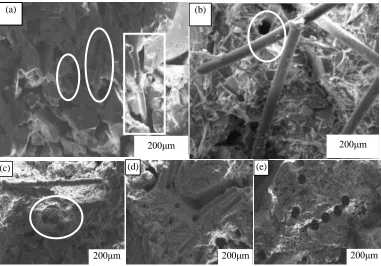
Maintaining the composite fiber content of 0.6%, change the proportion of ceramic fiber and nylon fiber and prepare the silica sol shell. The microstructure of the silica sol shell fracture with different composite fiber ratio is shown in Fig. 2. It can be seen from Fig. 2 (a) that when there is only ceramic fibers, the ceramic fibers with high refractoriness are still retained in the shell matrix, which can enhance the shell and have little effect on the air permeability. With the addition of nylon fiber, as shown in Figure 2 (b), the fracture surface of the specimen has obvious tiny pores, the aperture of the circular hole is close to the diameter of the nylon fiber, and the edge of the hole does not appear such as sand removal and deformation. It is indicated that the hole is left behind as the nylon fiber burned when the shell baking at high temperature,but not because the ceramic fiber is formed after debonding and pulling out when the shell sample is broken. With the increase in the proportion of nylon fibers in the composite fiber, as shown in Fig. 2 (c) to (d), the number of holes in the shell due to the loss of the nylon fiber is increased and the air permeability of the shell is increased.
nylon fiber has a good coating performance, the thickness of coated paste increases. The inner structure of the shell refractory is compact, which reduces the air permeability of the mold shell. The negative effect is greater than the ventilation effect by the nylon fiber burned down, so the air permeability of the mold shell declines.
With the increase of the proportion of nylon fibers in the composite fiber, the content of the ceramic fiber which is significantly enhanced by the shell decreases and the enhancement effect decreases. The micropores in the shell increase, and the total area of the fracture surface increase, will damage the strength of the shell. But the greater the proportion of nylon fiber, shell coated with the more pulp, the greater the thickness, played a role in enhancing the shell. The two factors of the role factor balance in power with a certain randomness. So the effect has a certain fluctuation, and the strength of the shell after roasting has a small amplitude of steady state fluctuation.
[image:5.612.108.489.305.571.2]
Figure 2. Fracture microstructure of composite fiber reinforced shell with different ratio
((a)100% ceramic fiber;(b) 75%: 25% ceramic fiber: nylon fiber; (c) 50%: 50% ceramic fiber: nylon fiber; (d) 25%: 75% ceramic fiber: nylon fiber ; (e) 100% nylon fiber).
CONCLUSIONS
(1) Composite fiber reinforced silica sol shell casting, when the fiber content in
(c)
200μm 200μm
(d) (e)
200μm 200μm
(a) (b)
the range of 0.15%~0.6%, the fiber number and porosity increased almost simultaneously in the same field of view. When the fiber content reaches 0.75%, the porosity increases significantly at the shell fracture, and the pore size of the part increases.
(2) With the increase of the proportion of nylon fibers in the composite fiber, lots of small pores appear at the fracture surface of the shell specimen obviously. The pore size is close to the diameter of the nylon fiber, and the edge of the hole does not show off the phenomenon such as peeling and deformation. The number of holes increases, so as to the air passage of the shell increases.
ACKNOWLEDGMENTS
The research was funded by the Aviation Science Foundation (2015ZE56015) and the Provincial Education Department Project (DA201703357).
REFERENCES
1. Mingzhi Zhou, Chunlin Zhu, Qinhai Chen, Chong Zhang. 2013. Application of investment casting to radar component manufacture[J]. Electro-Mechanical Engineering, (4):46-48(in Chinese).
2. Zhenzhong Fan, Xiuli Xu, Yuling Wang, Jianjun Liu. 2014. Investment casting technology application and development in the aviation industry[J]. Special Casting & Nonferrous Alloys, (3):285-289(in Chinese).
3. Yanfei Chen, Shunqi Zheng, Jiangping Tu,Shulong Xiao, Jing Tian, Lijuan Xu, Yuyong Chen.
2012. Fracture characteristics of notched investment cast TiAl alloy through in situ SEM observation[J]. Transactions of Nonferrous Metals Society of China, (22): 2389-2394(in Chinese).
4. Yangqing Dou, Kun Bu, Yangliu Dou. 2010. Reversing design methodology of investment casting die profile based on ProCAST[J]. China Foundry, 7(2): 132-137(in Chinese).
5. Chaohui Liu, Qiang Wang. 2013. Improved methods for silica sol mould shelling
performance[J]. Hot Working Technology, 42(11):69-71(in Chinese).
6. Yuanshu Xiao, Xiaochao Zhang, Xiaohong Shan. 2012. Properties and applications of high performance ceramic fibers[J]. Textile Industry and Technology, 41 (4): 45-53(in Chinese). 7. Xiaoya Wang, Yunfeng Cao. 2012. New fiber materials - ceramic fiber[J]. Cellulose Science
and Technology, 20 (1): 79-85(in Chinese).
8. Harun Z, Kamarudin N H, Taib H M. 2013. Effect of rice husk on fired ceramic shell strength[J]. Advanced Materials Research. 795: 732-737.
9. Neussl E, Sahm P R. 2001. Selectively fiber-reinforced components produced by the modified
investment casting process[J]. Composites: Part A, 32: 1077-1083.
10. Yuan C, Jones S. 2003. Investigation of fiber modified ceramic moulds for investment casting[J]. Journal of the European Ceramic Society, (23): 399-407.
11. Yuan C, Jones S, Blackburn S. 2005. The influence of autoclave steam on polymer and organic
fiber modified ceramic shells[J]. Journal of the European Ceramic Society, 25(7): 1081-1087.
12. Gang Lu, Pu Mao, Qingsong Yan, Hao Wu, Chaozhong Ji. 2016. Effects of ultrasonic vibration
and hydroxypropyl methylcellulose on dispersion properties of short cut fiber in investment casting Silica Sol Slurry[J]. Materials Engineering, 44 (01): 71-76(in Chinese).
content on strength and air permeability of investment casting silicon sol shell[J]. Chinese Journal of nonferrous metals, 25 (11): 3164-3170(in Chinese).
14. Gang Lu, Pu Mao, Yan Qing, Gang Lu, Hao Wu. 2014. Influence of short cut fiber on coating
property of silica sol slurry[J]. Special-cast and Non-ferrous Alloys, 34 (11): 1188-1191(in Chinese).