2017 2nd International Conference on Computational Modeling, Simulation and Applied Mathematics (CMSAM 2017) ISBN: 978-1-60595-499-8
Virtual Training Samples and CRC based Test Sample
Reconstruction and Face Recognition Experiments
Wei HUANG and Li-ming MIAO
School of Computer and Information Engineering, Hanshan Normal University, 521041, Chaozhu, China
Keywords: Face recognition, Sparse representation, CRC, MIRROR.
Abstract. Sparse Representation (SR) has the merit to associate each test sample properly with the training samples. Collaborative representation classification (CRC) is a well-known generalized SR method and has achieved outstanding performance in Face Recognition (FR). In this paper, we propose an improvement to CRC, which combines the original training sample and mirror virtual face to form a new training set, uses this new training set to rebuild the test sample and then performs a two-step classification. The face recognition experiments show that the proposed method outperforms CRC and has certain robustness.
Introduction
In the past twenty years, face recognition (FR) has received increasing attention owing to its wide potential applications, such as identity authentication, society security, surveillance, human-computer interface. However, researchers confront some difficulties in face recognition due to great variations in appearance of samples caused by illuminations, expressions, age, postures and so on. Though numerous methods have been proposed to solve these problems as reviewed in, face recognition is still a great challenge [1].
Sparse representation (SR) has gained much attention in face recognition [2,3]. SR is indeed one of the state-of-the-art image classification methods. SR has the merit to properly associate each test sample with the training samples, because it determines relation for every test sample and the set of training samples. In particular, SR achieves this by producing a solution for each test sample. Differing from the statistical face recognition methods such as Eigenface and Fisherface, the face recognition methods based on SR are able to take the test sample into account when obtaining their solutions. Up to now, there have been a number of SR methods with different aims. These SR methods have been applied to various tasks such as feature selection [4], image super-resolution [5], image recovery [6,8] and image denoising [7].
In general, SRC requires that the l1 norm of the coefficient vector of the linear combination be
as small as possible. On the other hand, many researchers also proposed l2 norm based
representation method such as collaborative representation based classification (CRC) [9] and the two-phase test sample sparse representation (TPTSSR) [10]. CRC has the advantages of efficient computation and high accuracy. CRC has achieved good performance in pattern recognition [11,12]. However, it seems that CRC suffers from a drawback. When CRC represents the test sample via a linear combination of all training samples in face recognition, the representation results may have great difference from the test sample. The main reason is that the dimension of the face image is usually much greater than the number of training samples, so the test sample cannot be accurately expressed by a linear combination of all training samples. Similar analysis has been shown for in linear regression classification [3].
accuracy of face recognition. This problem can be overcome if more samples can be used to represent the test sample, but the key is how to obtain additional samples. Intuitively, the faces of all human beings have a similar image structure, which implies different persons, should also have similar intrapersonal variations. In other words, one class can “borrow” samples from other classes in order to faithfully represent the query sample, and we also can generate some new virtual samples such as symmetrical sample [13] and mirror face samples [14]. In FR, for each class we may consider the samples from similar classes or the virtual samples and use them to better represent the query sample.
In this paper, we propose an improvement to CRC, which combines the original training sample and mirror virtual face to form a new training set. Then the test samples will be reconstructed by the new training set. At last the two-step classification algorithm is performed to improve the recognition accuracy furthermore. There two aspects to improve the recognition accuracy. On the one hand, we enlarge the training set by mirror virtual face image. On the other hand, we use the TPTSSR classification algorithm to reduce the impact of lack training samples. The efficiency experiments show that the proposed method outperforms CRC and has certain robustness.
The rest of this paper is organized as follows. Section 2 demonstrates the CRC method. Section 3 discusses our proposed method in detail. Section 4 conducts extensive experiments to demonstrate the performance of our works, and Section 5 concludes the paper.
The CRC Method
Zhang et al. in reference [9] pointed that collaborative representation was the real power of SRC. As a typical small-sample-size problem, the training set of FR is always not enough to represent the testing sample y . Collaborative representation classification is proposed to represent y
collaboratively by using all the training samples from different classes. Assume X0 includes all
the training samples from all the classes. [
1,
2,,
k,,
c]( nkk R
1
, nkis the number of training samples from the kthclass) is the coefficient ofX . So the coefficient vector can be estimated by
y X I X
X0T 0 ) 1 0T (
(1) where is a positive small constant and we set 0.01 in this paper. The representation residual dk can be calculated as follows:
2 ||
|| k k
k y X
d k 1,2,,c (2)
The rule in favor of the class with minimum distance can be calculated by:
k k
d y
identity( )argmin (3)
Proposed Method
Table 1. The proposed algorithm.
1. Normalize the columns of X0 to have unit L2-norm. X0 is the original training sample set. 2. Compute a mirror virtual training sample m of original sample r by
) 1 , ( ) ,
(i j r i q j
m (4)
where i1,,p,j 1,,q, p and q stand for the numbers of rows and columns of r respectively. r(i,j) denotes the pixel located in the ith row and jth column of the original sample. The mirror sample set M is made of all mirror samples. Then these two sets are combined to produce a new one Xˆ [X0 M].
3. Rebuild test sample using combined training sample set by CRC
y X I X
XˆT ˆ ) ˆT ( ˆ 1 1
(5)
X
yˆˆ (6)
4. Compute regularized residuals of yˆ
y X I X
XˆT ˆ ) ˆTˆ ( ˆˆ 1 1
(7)
2 2 || ˆ ˆˆ ˆ || ˆ k k
k y X
d ,k 1,2,,c (8)
k
Xˆ denotes the set of training samples from class kand ˆˆkdenotes the coefficient from classk.
5.Output the identity of y as
} ˆ { min arg )
(y dk
identify (9)
Experiments
In this section, we will implement our method in two standard face databases, FERET face database and AR face database which are usually used to test the performance of face recognition methods. The compared algorithm is CRC which is one of the stat of the art face recognition algorithms.
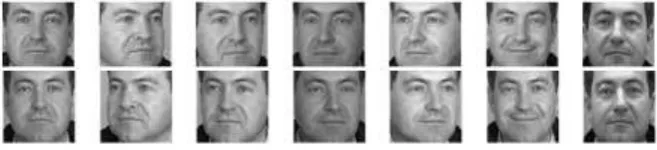
A subset from the cropped FERET database [15] consisting of 1400 images from 200 subjects is used here. The variations of images include facial expression, illumination and face posture. Now FERET face database has become a standard database for testing and evaluating state-of-the-art face recognition algorithm. The original and virtual mirror samples of one subject are shown in Fig. 1.
Figure 1. Some original samples and virtual mirror samples on FERET database. The first row is the original samples of one subject the second row is the virtual mirror samples.
From Fig. 1 we can see that the frontal face is similar with its virtual mirror face and the virtual mirror face will be a turning left face (see the second face in the second row) when the original face is a turning right image (see the second face in the first row). That means the virtual mirror faces can enlarge the training set and overcome pose problem in some degree.
[image:3.595.132.461.561.636.2]Table 2. The accuracy rate in Feret database.
p CRC The proposed method
2 0.576 0.6390 3 0.455 0.6062 4 0.533 0.5917
From Table 2 we can find that the proposed method has a big improvement compared with CRC in any case. At most, the recognition rate of the proposed method is superior to that of CRC by 33.2% when p=2. Also, the proposed method has 11.01% and 10.94% improvement when p=3 and
p=1 respectively.
A subset from the cropped AR database [16] consisting of 3,120 images from 120 subjects, is used here. The AR face image database includes 960 images (about 14 samples per subject) of non-occluded frontal views with various facial expressions, 720 images (6 samples per subject) of sunglasses and 720 images (6 samples per subject) of scarves (as shown in Fig. 2). All the images were resized to 32×32. In this experiment the first p samples per subject were used for training and the others were used for testing. The experiment results are shown in Fig. 2.
Figure 2. Some original samples and virtual mirror samples on AR database. The first row is the original samples of one subject the second row is the virtual mirror samples.
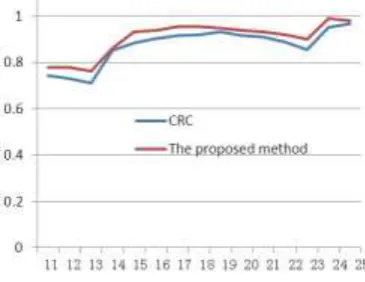
The compared experiment results are show in Fig. 3.
[image:4.595.200.383.402.543.2]Fig. 3 shows the experiment results which are compared with CRC in AR face databases.
Figure 3. The accuracy rate in AR database.
From Fig. 3 we can learn that the accurate recognition accuracies of the proposed method are always higher than CRC in AR face database. Also, in FERET database the proposed method is more excellent than that in AR database. The experiment results show that virtual mirror sample and the two-step classification all contribute to performance improvement of the proposed method.
Conclusion
furthermore. The experiment results on FERET and AR face database show that the proposed method outperforms CRC and has certain robustness.
Acknowledgement
This work is partially supported by the Natural Science Foundation of Guangdong Province (No. 2016A030307050), the Special Foundation of Public Research of Guangdong Province (No. 2016A020225008, No. 2017A040405062).
Reference
[1] B. Olshausen and D. Field, “Sparse coding with an overcomplete basis set: a strategy employed by V1?” Vision Research, vol. 37, no. 23, pp. 3311–3325, 1997.
[2] W.E. Vinje and J.L. Gallant, “Sparse coding and decorrelation in primary visual cortex during natural vision,” SCIENCE, vol. 287, no. 5456, pp. 1273-1276, 2000.
[3] Yong Xu, Xuelong Li, Jian Yang, Zhihui Lai, and David Zhang, Integrating conventional and inverse representation for face recognition, IEEE Transactions on Cybernetics, 2013, DOI: 10.1109/TCYB.2013.2293391
[4] J. Mairal, M. Elad, and G. Sapiro, “Sparse representation for color image restoration,” IEEE Trans. Image Processing, vol. 17, no. 1, pp. 53–69, 2008.
[5] J. Mairal, F. Bach, J. Ponce, G. Sapiro and A. Zisserman, “Non-local sparse models for image restoration,” Proc. Int’l Conf. Computer Vision, 2009.
[6] M. Elad and M. Aharon, “Image denoising via sparse and redundant representations over learned dictionaries,” IEEE Trans. Image Processing, vol. 15, no. 12, pp. 3736–3745, 2006.
[7] M. Aharon, M. Elad, and A.M. Bruckstein, “The K-SVD: An algorithm for designing of overcomplete dictionaries for sparse representation,” IEEE Trans. Signal Processing, vol. 54, no. 11, pp. 4311-4322, 2006.
[8] E. Candès, J. Romberg, and T. Tao, “Stable signal recovery from incomplete and inaccurate measurements,” Comm. On Pure and Applied Math, vol. 59, no. 8, pp. 1207-1223, 2006. [9]Zhang L et al. Sparse representation or collaborative representation: which helps face recognition? In: IEEE International Conference on Computer Vision (ICCV 2011), pp:471-478.
[9] Yong Xu, D. Zhang, J. Yang, J.-Y. Yang, A two-phase test sample sparse representation method for use with face recognition, IEEE Transactions on Circuits and Systems for Video Technology, 2011,21(9):1255-1262.
[10] Jadoon Waqas, Yi Zhang, Lei Zhang: Graph-Based Features Extraction via datum Adaptive Weighted Collaborative Representation for Face Recognition. IJPRAI 28(2) (2014).
[11] Pengfei Zhu, Wangmeng Zuo, Lei Zhang, Simon Chi-Keung Shiu, David Zhang: Image Set-Based Collaborative Representation for Face Recognition. IEEE Transactions on Information Forensics and Security 9(7): 1120-1132 (2014).
[12] Yong Xu, X. Zhu, Z. Li, G. Liu, Y. Lu, H. Liu, Using the original and “symmetrical face” training samples to perform representation based two-step face recognition, Pattern Recognition, 2013(46):1151-1158.
[13] Yong Xu, Xuelong Li, Jian Yang, David Zhang, Integrate the original face image and its mirror image for face recognition, Neurocomputing, 131:191-199,2014.