2017 2nd International Conference on Artificial Intelligence and Engineering Applications (AIEA 2017)
ISBN: 978-1-60595-485-1
Medical Insurance Fraud Recognition Based on
Improved Outlier Detection Algorithm
JIAN WU, RUNTONG ZHANG, XIAOPU SHANG and FUZHI CHU
ABSTRACT
This paper presents an improved outlier detection algorithm based on K-means clustering to identify suspicious medical fraud in medical insurance audits. This paper elaborates how to preprocess medical insurance data for medical insurance fraud, and puts forward the improved principle and process of outlier detection algorithm based on K-means clustering. The experiment is carried out by using real medical insurance data, and the efficiency of the algorithm conducted a test.
KEYWORDS
Medical insurance, K-means clustering, Outlier algorithm.
INTRODUCTION
Medical insurance is an insurance to compensate for the medical expenses of medical treatment. Medical insurance system is to solve the insured treatment problem, the use of health insurance fund. Internationally, it is generally agreed that the average proportion of health insurance violations is between 20-30%. In recent years, medical insurance system reform to further promote the scope of basic medical insurance services is growing. With the widespread use of medical insurance and the widespread use of health insurance card, accompanied by the emergence of some health insurance card non-compliance, such as treatment, inspection, over-service and other acts, the entire medical insurance industry caused great harm. With the popularity and maturity of medical information systems, all medical units have kept a lot of data and records, while the data is still increasing, but health insurance for the violation of the monitoring still remain in the main stage of labor. So the use of these data efficiently and automatically detect violations will be of great significance.
The main purpose of outlier detection is to detect anomalous or abnormal data from a given data set. As an important data analysis technology in data mining, outlier detection technology has been widely used in network intrusion detection, financial fraud detection and other fields. Therefore, this paper attempts to study the suspicious behavior of medical insurance from the point of view of outlier detection of data mining.
_________________________________________
Jian Wu, School of Economics and Management, Beijing Jiaotong University, Beijing, 100044, China; [email protected]
After normalizing the medical insurance data, the improved K-means clustering algorithm based on K-means clustering is used to solve the suspicious medical insurance data in the data was identified.
LITERATURE REVIEW
Medical Insurance Fraud Detection
In foreign countries, there are many studies that will apply data mining to health insurance fraud. IBM Research Center Marisa et al [1] first proposed to use data mining method to detect health insurance fraud, and the use of association rules and neural segmentation method to identify medical insurance fraud. Taiwan Yang et al. [2] proposed a detection framework based on the "clinical path", presented a pattern of "behavioral events", found patterns by digging frequent subgraphs, and experimented with Taiwan National Health Insurance data, the results show that the model is more effective than manual inspection. In the intelligent method, the neural network is widely used to establish the fraud recognition model because of its special merit. He et al. [3] designed a neural network model to detect medical insurance fraud, reaching 88.4% correct rate. He et al. [4] also applied the genetic algorithm and KNN algorithm to health insurance fraud detection, which was used by the Australian Health Insurance Board to identify medical insurance fraud as the law further improved accuracy.
As China's health insurance system and foreign countries there are some differences, has its own characteristics, therefore, many domestic scholars with China's health insurance policy to explore the actual situation. For example, He Junhua [5] from the three data mining three points of view, respectively, based on the clustering method of the insured person subdivision model, based on sequence pattern discovery mode of mining and frequent pattern mining algorithm based on consistent fraud Behavior detection. Liu Jiangchao [6] defined the abnormal prescription as a prescription with less than a certain threshold for the combination of commonly used drugs. The study used frequent itemsets mining to excavate the commonly used drug combination in medical insurance data, and obtain some meaningful drug patterns to explain the analysis. Yuan Xiaodong [7] proposed a clinical behavior anomaly detection model based on association rules. Based on the characteristics of the temporal behavior characteristics of clinical behavior data, a frequent sequence mining algorithm with time constraints was improved, and the association rules of clinical behavior sequence were obtained by algorithm. Based on the construction of clinical behavior abnormalities detection model.
K-means Algorithm
Svetlona [8] proposed an outlier removal clustering algorithm (ORC) that can provide both anomaly detection and data clustering. They propose an algorithm that has two stages. At first k-means clustering is applied with an outlyingness factor, Oi is calculated for each data point by the ratio of the distance from the point to the center of mass and the maximum distance from the center of mass to any other point. The threshold value T is set to less than 1 to check the outliers. If the peripheral factor of any point is greater than the threshold, it is considered to be an outlier and removed from the data set. Their experimental data includes synthetic data and some map images. The average absolute error (MAE) is used to evaluate the performance of the algorithm, and the parameter T value depends on the data set, which may result in poor performance in heterogeneous large-scale data sets.
Z. He [9] proposed another definition of localized outliers based on the cluster. According to their definition, all data points in a cluster are considered to be outliers rather than individual points, and smaller clusters are considered to be outliers. They use some digital parameters, ie, α, β to identify small clusters (SC) and large clusters (LC). Clustering results depend on these parameters, but how to set parameters for various datasets is not very clear. They use the SQUEEZER algorithm to cluster the data because it implements high-quality clustering and can handle high-dimensional data. And then determine the value of each individual record of the outlier in the data set.
Yoon et al. [10] used k-means clustering for the complete dataset and found the appropriate value for k using the Cubic Cluster Standard (CCC). CCC is a technique used to estimate the number of clusters assessed by the Monte Carlo method. Once the clustering is complete, search for external and internal outliers in the clustering results. The external exception value is the data point at the maximum distance of the other cluster, and the internal outliers are data points away from the cluster location. If the removal of the outliers creates a meaningful cluster, the process stops. This method is only applicable to software measurement data, but also need to explain the domain experts.
Summary
Due to China's medical insurance policy and the specificity of the contents of the data, leading to foreign identification methods cannot be directly applied. While the existing research in the domestic application of outlier technology to the field of health care less attention, mostly concerned about the drug mode, clinical behavior detection. Therefore, the research of this paper is mainly for the analysis of the medical insurance reimbursement data of a county, and then it is standardized, and then, according to the high-dimensional characteristics of medical insurance data, an improved outlier point based on K-means clustering is proposed Algorithm to detect suspicious health insurance data.
Design of Outlier Algorithm
K-means Clustering Algorithm
The basic idea of K-means algorithm is to cluster k points in space, and to classify objects closest to them. The value of each cluster center is updated by iterative method until the best clustering result is obtained.
The algorithm works as follows: First, accept the parameter k to determine the k clustering centers, where the method of determining k clustering centers will directly affect the clustering results, and then divide n data objects into k clusters , Each object based on its clustering centroid to the Euclidean distance is assigned to its closest cluster. The point set assigned to the center of mass is considered to be a cluster. This formed k clusters. Next, the center of each cluster is updated based on the average of the objects assigned to it. The process is repeated so that each point is assigned to the nearest cluster based on a change in the position of the cluster centroid. When no object changes the cluster or the center stops moving, the process stops.
In order to evaluate the quality of clustering, the K-means algorithm uses squared error and (SSE) and total variance (SST). The Euclidean distance between each object and the center of the cluster to which it belongs is an error, and the sum of the squared errors is SSE. SST is the sum of the mean of the data set and the distance between all points in the dataset. For two different clustering results, clustering with lower SSE / SST is considered better. SSE and SST are defined as follows:
k
2
i=1 C
SSE= dist( , )
i
i i
c x x C
(1)2
SST=
dist C x( , )m x D (2)Ci denotes the i-th cluster, D denotes the data set, x denotes each object in the data set, k denotes k clusters, Cm denotes the average of all the objects, and ci denotes the center of the i-th cluster.
The initial K-means clustering algorithm initially determines that the k clustering centers are randomly selected, so the results of each experiment are very dependent on the selection of the initial clustering center. Therefore, the commonly used method is to use different randomly generated clustering center point of the algorithm, and then for the results of comparative analysis, select the results that one better. However, this approach is too influential in efficiency and can easily lead to instability. Therefore, this paper chooses to use a relative distance judgment method to determine the initial k clusters. The first step is to first randomly select a point as the first initial cluster center point, and then select the point farthest from the point as the second initial cluster center point, and then select the distance from the first two points The largest point is the center point of the third initial cluster, and so on until the center of k initial clusters is selected.
Outlier finding and extraction
the distance between the object o and the center is greater than p multiplied by the average of the distance between the center and the other object, the object o is the outlier for the n object set. Where p is always greater than 1.
In the improved K-means algorithm, the algorithm assigns each object to its nearest center, and then it calculates the clustered SSE / SST to reduce the error. It then identifies the outliers (ie, p> 1) according to the proposed definition of the outliers. If any outliers are detected, it is removed from the dataset and stored as an outlier. Next, recalculate the center of the cluster. This process stops when the object does not change its location from one cluster to another. Specific steps are as follows:
Input: D (A1, A2, ..., An), k, p
Output: Clustered results, outliers, SSE, and SST Start:
1. Calculate the center of k clusters
2. For the objects in dataset D, calculate the Euclidean distance to k clustering centers
3. Calculate the average distance between the center of the k clusters and all the objects in the data set D.
4. Assign each object to their nearest cluster and calculate SST, SSE
5. For each data object x in the data set, if it is greater than p to the center of the cluster, multiply the average distance, consider it to be an outlier, remove it from the data set, and calculate the SSE, SST
6. According to the clustering results, recalculate the center of k clusters 7. Repeat step 2 until the clustering results do not change
Experiment and Analysis
In this section, we will use real medical insurance data to test the improved outlier detection algorithms mentioned earlier. Data from the county's medical insurance data, due to the difference between the disease, this paper selected pneumonia, pulmonary heart disease, chronic bronchitis these three diseases, case data were 930,1981,760, marked suspicious The data are 26,44,20 respectively. The algorithm used in this paper to achieve the R language.
Detection Rate Analysis
Figure 1. The clustering results of pulmonary heart disease data at k = 8.
0% 10% 20% 30% 40% 50% 60% 70% 80% 90% 100%
4 5 6 7 8 9
Th
e
d
ete
ct
io
n
r
a
te
K
K value changes when the detection rate trend
Pulmonary heart disease Pneumonia Chronic bronchitis
Figure 2. P = 2, k value changes when the detection rate trend.
Figure 2 shows the results of clustering of pulmonary heart disease data when k = 8, and the number of data in the eight cluster clusters is 175, 419, 35, 285, 402, 158, 69, 348, respectively.
After clustering the pulmonary heart disease data according to k = 8, the outliers were extracted from 8 clusters according to the principle of p = 2. Due to the limitation of space, the figure is the output out of the outlier outliers of the number and part of the outlier information. By comparing the number with the original data, the detection rate was 86%.
[image:6.612.116.480.251.483.2]is less than that of pulmonary heart disease. Therefore, when k is larger, the number of clusters becomes larger and the threshold becomes constant, and the outliers become more difficult to extract.
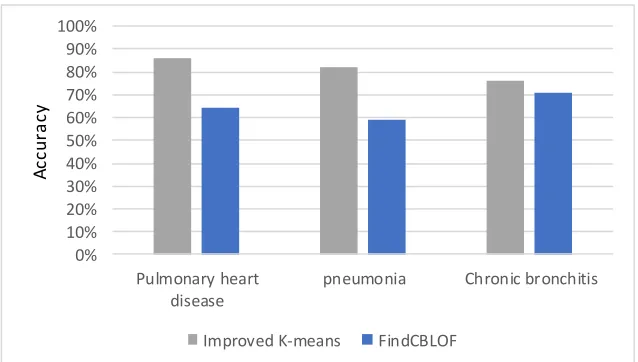
In general, the use of improved K-means clustering outlier algorithm for the real health insurance data has a good performance for pneumonia, pulmonary heart disease, chronic bronchitis three types of disease detection rate can be achieved 82%, 86%, 76%.
In the next experiment, we use the FindCBLOF algorithm to calculate the same pneumonia, pulmonary heart disease, chronic bronchitis three types of disease data, because the FindCBLOF algorithm that is abnormal rather than a single point, but the cluster the smaller cluster is identified as an outlier. When the parameters α and β are different, the experimental results are different. Therefore, this paper also carried out a number of experiments, selected the best experimental results and the proposed K-means algorithm for the detection rate were compared. The results are shown in Figure 4.
Time Efficiency Analysis
On the basis of the medical insurance data set, the effect of the parameter k value on the algorithm time is further tested in the improved outlier detection algorithm. As shown in the figure below, the graph shows the run time of the algorithm for experimental data on lung heart disease. It can be seen that the parameter k is linearly related to the effect of the algorithm run time. However, since the measured time is in milliseconds, the overall effect is not significant.
The improved algorithm proposed in this paper is that the time complexity is O (I * k * m * (no)), where I is the iteration of convergence, m is the number of attributes, n is the number of objects, o is the outliers Quantity, k is the number of clusters. The spatial complexity is O ((n-o) + k) * m because only the data objects and clustering centers need to be stored. The FindCBLOF method uses the SQUEERZER algorithm to cluster data and assign outliers to each data object, so they require two special algorithms (SQUEEZER and FindCBLOF) for outlier detection, so it is clear that their method Our approach has more computational complexity.
0% 10% 20% 30% 40% 50% 60% 70% 80% 90% 100%
Pulmonary heart disease
pneumonia Chronic bronchitis
Ac
cu
ra
cy
[image:7.612.138.457.507.688.2]Improved K‐means FindCBLOF
CONCLUSION
In this paper, from the point of view of data mining outlier detection, the reality of medical insurance data were studied, and put forward the medical insurance data preprocessing method, and then put forward good at dealing with high-dimensional data based on improved K-means clustering The results show that the detection of suspicious data can be applied to the detection of suspicious data of actual medical insurance, and compared with the traditional FindCBLOF detection algorithm, the accuracy and time efficiency Aspects of the performance are better than the traditional FindCBLOF algorithm.
However, since the medical insurance data studied in this paper only considers the attributes related to the reimbursement of medical insurance, it does not involve the patient's personal statistics and prescription drug information. Therefore, future research can take into account these have not yet fully excavated medical insurance data information, from which to find more meaningful information.
SUMMARY
This work was partially supported by a Key Project of National Natural Science Foundation of China (NSFC) with grant number 71532002.
REFERENCES
1. Marisa S. Viveros, John Nearhos, Michael J. Rothman. “Applying Data Mining Techniques to a Health Insurance Information System.” In Proceedings of the 22nd VLDB Conference Mumbai(Bombay), India,1996.
2. Yang W.S., Hwang S.Y. “A process-mining framework for the detection of health care fraud and abuse. Expert Systems with Applications,” 2006, V13 1: 56-68.
3. H. He, J. Wang, Warwick Graco, S. Hawkins. “Application of neural networks to detection of medical fraud.Expert Systems with Applications,” 1997, 13(4): 329-336.
4. Hongxing He, Warwick Graco, Xin Yao. “Application of Genetic Algorithm and k-Nearest Neighbour Method in Medical Fraud Detection.” In Proceedings of SEAL1998: 74-81.
5. Junhua He. Study and application of data mining technology in medical insurance field. Fudan University, 2011.
6. Jiangchao Liu. Application of Data Mining Algorithm in Medical Insurance Data. National University of Defense Technology, 2009.
7. Yuan Xiaodong. Application of Clinical Behavioral Anomaly Detection Based on Association Rules. Jiangsu University, 2010.
8. Hautamäki V., Cherednichenko S., Kärkkäinen I., et al. “Improving K-Means by Outlier Removal. Lecture Notes in Computer Science,” 2005, 3540: 978-987.
9. Z. He, X. Xu, and S. Deng, “Discovering cluster based local outliers,” Pattern Recognition Letters, vol. 2003, pp. 9–10, 2003.
10. K.-A. Yoon, O.S. Kwon, and D.H. Bae, “An approach to outlier detection of software measurement data using the k-means clustering method,” in Empirical Software Engineering and Measurement, 2007. ESEM 2007. First International Symposium on, 2007, pp. 443 – 445.
11. Yang Maolin. Outlier Detection Algorithm. Huazhong University of Science and Technology, 2012.
12. An Improved Algorithm for Outlier Detection of Stream Data Based on Anti - k - Nearest Neighbor. Computer and Modernization, 2016 (8): 32-35.