doi:10.4236/sgre.2010.11005 Published Online May 2010 (http://www.SciRP.org/journal/sgre)
Green Environment: Decision-Making and Power
Utility Optimization towards Smart-Grid Options
Dolores DeGroff
Department of Civil, Environmental and Geomatics Engineering Florida Atlantic University, Boca Raton, USA. Email: [email protected]
Received February 24th, 2010; revised May 11th, 2010; accepted May 12th, 2010.
ABSTRACT
Decision-making toward prudent energy conservation is a primary issue in the power utility management while con-ceiving green environment. Presented in this paper are relevant considerations and prudent ways of decision-making thereof. Examples are furnished to illustrate the underlying considerations and are discussed using practical examples. Specifically green ambient is considered and the underlying payoff resulting from each combination of strategies adopted (or courses of action taken) by the technology-option participants is evaluated. Game-theoretic pursuits are followed.
Keywords: Green Building, Power Utility Conservation, Payoff-matrix, Game-theoretic Formulations
1. Introduction
Green environment is an eco-friendly ambient. In modern civil and environmental engineering point of view, it translates into conceiving a building infrastructure, which is eco-friendly. Such green-centric ambient involves spaial proliferation of green constructions (sustainable buildings) and making the surroundings at large with processes that are environmentally responsible and re- source-efficient throughout the life-cycle of the green entities. Making of a green environment starts from siting to design, construction, operation, maintenance, reno- vation, and deconstruction efforts with eco-friendly fea- tures. Relevant approach expands and complements the classical building design concerns of economy, utility, durability, and comfort.
The common denominator in forming green ambient is to impact human health preservation. This is accomp- lished by: Efficient usage of energy, water, and other resources; protecting occupant health against any eco- related hazards; reducing waste, pollution and environ- mental degradation and developing a congenial ambient contributing larger employee productivity.
Green-building/environment concept envisages using natural materials that are available locally. Other related topics include sustainable design, green architecture, and energy efficient buildings so as to bring in harmony with the natural features and resources surrounding the site. Among several key steps in designing sustainable build- ings and environment, generating on-site renewable energy and optimization of power utility are very impor-
tant. Relevant efforts involve prudent decision-making in the underlying engineering. The focus of this paper is to exemplify related decision-making analyses.
2. Green Environment Optimization
The concept of “green” towards sustainable development of environment stems from energy (especially fossil oil) utilization concerns. The crisis and the environment pollu- tion issues of 1970s posed the niche and desire for more energy-efficient and environmentally-friendly constructi- on practices as well as looking at integrated and syner- gistic designs in new and existing infrastructure.
Associated conservation emphasizes taking advantage of renewable resources, for example, using sunlight through passive solar, active solar and photovoltaic tech- niques and using plants and trees through green roofs, rain gardens, and for reduction of rainwater run-off. Also, techniques, such as using packed gravel or permeable concrete in lieu of conventional concrete or asphalt to enhance replenishment of ground water, are directed to realize a green ambient.
or more of the above considerations. Further, related syn- ergistic design would yield specific and individual green concept technologies that may work together to produce a greater cumulative effect.
3. Green Environment: Smart Energy Grid
Concept
Largely, on-site renewable energy generation and utiliz- ation is recommended in formulating a green ambient. But making a large geography green, in essence would require smart and intelligent power generation, transmission, distribution and utilization efforts. Relevant distributed energy resources technology covers application areas of integration of distributed energy resources and their in- novative aggregation mechanisms for participation in the electric system operation. Distributed energy resources for integration encompass distributed generation (in- cluding renewable generation such as those derived from solar and local wind sources, and non-renewable, en- ergy-efficient generation resources on or near the loads), storagem (including advanced battery-based and non- battery-based storage devices), and demand-side re- sources (such as smart appliances, electric vehicles (EVs) or plugin hybrid electric vehicles (PHEVs), and electrici- ty-using equipment in industrial or commercial applica- tions engaging in smart grid functions). Smart grid metrics for the technology application areas are:
Load participating based on grid conditions: fraction of load served by interruptible loads, utility-directed load control, and incentive-based, consumer-directed load control;
Load served by microgrids: fraction of entire load served by microgrids;
Grid-connected distributed generation (renewable and non-renewable) and storage: percentage of all gen-eration capacity that is distributed gengen-eration and storage;
EVs and PHEVs: percentage shares of on-road, lig- ht-duty vehicles comprised of EVs and PHEVs;
Grid-responsive, non-generating, demand-side equi- pment: total load served by smart, grid-responsive equip- ment (smart appliances, industrial/commercial equipment including motors and drivers).
Considering the underlying transmission and distribu- tion (T&D) infrastructure, technology application areas at the transmission level include substation automation, dyn amic limits, relay coordination, and the associated sens- ing, communication, and coordinated action. Distribution- level application areas include distribution automation (such as feeder-load balancing, capacitor switching, and restoration), enhanced customer participation in demand response, outage management systems, voltage regula- tion, VAR (volt ampere reactive) control, geographic information systems, data management, and mobile work- force management, and improved power quality to meet the range of customer needs. Further, smart grid metrics for the
T&D technology application areas are: 1) T&D system reliability: duration and frequency of power outages; 2) automation: percentage of substations using automation; 3) advanced metering: percentage of total demand served by advanced metered customers; 4) advanced system measure- ment: percentage of substations possessing advanced measurement technology; 5) capacity factors: yearly aver- age and peak-generation capacity factor generation and 6) T&D efficiencies: energy conversion efficiency of elec- tricity generation, and electricity T&D efficiency.
Related to the above considerations, addressed in this paper are methods of decision-making in conserving the power/electrical energy toward green ambient creation.
4. Decision-Making in Power Conservation
A major issue in smart power grid management under greenambient is to make a prudent decision on exercising efficient power conservation. Pertinent to such issues, the decision has to be made among possible alternatives with all the certainty and uncertainty considerations duly taken into account. That is, decisions made are dictated by a prescribed set of decision criteria. Evolving such criteria and heuristically applying them to the problem is attem- pted in this paper with relevant examples.
pe-riod of time. This finite time-pepe-riod is known as the analysis period. Within this analysis period, the useful life could be identical in respect of all the possible alternatives indicated for a green project; or, it could be different for each alternative. Another situation may correspond to the analysis period being of infinite extent. Adjunct to PW considerations, the other criteria on decision-making in-volve other factors, namely, success rate of the project and eco-friendliness.
4.1 Statistical Decisions
Decision-making is often risky, difficult and complex. This is because such decisions may have to be made mostly with insufficient information. Lack of or sparse information is undesirable but often unavoidable. This condition of insufficient information depicts the “positive entropy” a measure of uncertainty. Such an uncertain state will lead to admitting that, different potential outcomes may be recognized without reasonable projections of their probability of occurrence. This admission portrays the implicit risk in the decision made thereof on the outcomes. Risk is the extent of variability among the outcomes as- sociated with a particular strategy pursued in a business. It exists whenever, there is a range of possible outcomes that go with the decision and the statistics of such incomes are known (in terms of the probabilities of the outcomes). In general, efforts that offer higher expected results involve greater risk. Further, the risk is directly linked to the util- ity. That is, the utility function that measures the extent of satisfaction will respond to the extent of risk involved in a specific strategy pursued. If the utility function is plotted against the risk (for example, dollar expended on a pro- ject), there are three possible scenarios:
1) If the resulting plot is concave, the utility function is risk-averse;
2) A convex graph means that the utility function is risk-seeking;
3) A linear (straight) relation between the utility func- tion versus the risk corresponds to a risk-neutral situation. Summarizing.
Further, whenever utility of an exercised effort is greater than the expected utility of the effort, the pursued strategy is risk-averse. When utility of effort exercised is equal to the expected utility of the effort, the pursued strategy is risk-neutral; and, when utility of effort exerc- ised is less than the expected utility of the effort, the pursued strategy is risk-seeking.
4.2 Risk management in Green Environment Efforts
Power utilities are responsible to defend and protect a critical infrastructure against any failure, however mo-mentary. The utilities are also responsible for making prudent investments and focus on minimizing risk. Such responsibilities of the power utility operation can be com-prehended via smart grid systems. An impediment,
how-ever, does exist to the widespread adoption of smart grid tech- nology because smart grid technologies have not been extensively proven and the existing utility business model does not provide enough economic rewards for such cut- ting-edge utilities [1].
Still, many corporations have adopted the smart grid structures and such companies incorporating smart grid technologies have put a unique level of investment in a variety of technologies.
5. Decision-Making under Green
Environment
A smart grid is an umbrella term that covers moderniza- tion of both the transmission and distribution grids. The modernization is directed at a disparate set of goals in- cluding facilitating greater competition between provid-ers, enabling greater use of variable energy sources, es-tablishing the automation and monitoring capabilities nee- ded for bulk transmission at cross continent distances, and enabling the use of market forces to drive energy con- servation.
Smart meters, one of the smart grid features, serve the energy efficiency goal. The approach is to make it poss- ible for energy suppliers to charge variable electric rates so that charges would reflect the large differences in cost of generating electricity during peak or off peak periods. Such capabilities allow load control switches to control large energy consuming devices such as hot water heaters so that they consume electricity when it is cheaper to pro- duce. That is, to reduce demand during the high cost peak usage periods, communications and metering technolo- gies inform smart devices in the home and business when energy demand is high and track how much electricity is used and when it is used.
Intelligence in distribution grids will enable small pro- ducers to generate and sell electricity at the local level using alternative sources such as rooftop-mounted photo voltaic panels, small-scale wind turbines, and micro hydro generators. As such there could be several utilities com- peting at the local level [1].
By reducing peak demand, a smart-grid can reduce the need for additional transmission lines and power plants that would otherwise be needed to meet the demand [2]. The ability to reduce peak demand via smart grid-enabled consumer demand response/load management can defer or reduce the need to build resources that would be unused most of the time. A smart-grid can also defer capital in-vestments by prolonging the life of existing assets through enhanced asset management methodologies that exploit additional condition monitoring and diagnostic informa-tion about system components. Thus there are economic benefits to utilities to embrace the smart-grid, and it fol-lows a competitive power utility market will develop from its adoption.
cision-makers are involved. The theory of equality applies to presuming that each decision-maker of a competing technology vendor is as good, intelligent and rational as the decision-makers of other competing units. However, each decision-player is confronted with the odds of other deci- sion-makers’ ploys. Thus, the decision-makers are players, the conflicts they face are games and the rationale of their competition is referred to as the game theory [3]. To il- lustrate the buried concepts of the game theory, it is nec- essary first to define and explain certain terms of rele- vance:
Strategies: Alternative courses of action taken by game-players.
Pure strategy: A player adopting the same alternative at every play.
Game of strategy: A game with the best course of ac- tion for a player being dependent on what that player’s adversaries can do.
Optimum strategy: Using one alternative or a mix of alternatives (that is, using different alternatives) for suc- cessive plays.
Payoff matrix: In two-person games, for example, the rows of the payoff matrix contain the outcomes for one player, and the columns contents of the columns carry the outcomes for the other player.
Saddle-point: A saddle-point is identified by an outc- ome, depicting both the smallest number in its row and the largest number in its column in the payoff matrix. Con- sidering a hypothetical payoff matrix indicated in Table 1, its saddle-point can be identified as shown. Note that the table is constructed with reference to three alternatives A(I), A(II), and A(III) and corresponding identified states of nature N1, N2, N3, and N4.
Value of the game: It is the return from playing one game depicting the amount that a player nets from theensuing outcome.
Mixed strategy: It is the policy pursued by the players in the absence of the saddle-point. That is, different al- ternatives are used for a fixed proportion of the plays, but the alternative employed for each play is a random choice from those available.
Nash equilibrium: It corresponds to a set of strategies such that none of the players can improve their payoff, given the strategies of the other players.
The success of using game theory largely stays with applying judicious logic consistent with practical impli-
Table 1. Illustration of a saddle-point in a hypothetical pay-off matrix
N1 N2 N3 N4
A(I) (9) 10 11 12
A(II) 1 2 3 4
A(III) 5 6 7 8
(The saddle point (9) is the largest in its column and smallest in itsrow).
cations. The procedure involved includes: Assigning me- aningful payoffs, solving the associated matrix, (which is usually large), handling multiple players and accounting for the possibilities of collusion, conciliation, irrationality of players, and nonconformance of traditional game the-ory principles.
In essence, the game theory applies to competitive de-cisions under uncertainty. It covers the following versions of game: 1) Zero-sum/two-person game where two op-ponents are presumed to have the same knowledge of outcomes; and, the winnings of one equates to the losses of the other. 2) Zero-sum/two-person optimal pure (or mixed stra- tegy) that allows selecting a single course of action (or randomly mixed actions) constrained by a set of proportions maintained, leads to the calculation of the value of the game assuring minimum return; 3) Multiple player games and 4) Nonzero-sum games. The last two games are more involved to-formulate and solve. How-ever, they carry promising applications in the tech-noeconomic world.
The following examples pertinent to power utility serv- ice are indicated to illustrate the game theory applications and solving approaches. The first example refers to a two player/zero-sum case and the second example is concer- ned with two player/nonzero-sum problem.
5.1 Example 1: A Game-Theoretic Approach to Smart Grid Utility Pricing Issues
Supposed a power utility service provider (PSP) has ex-tended new service in an area where it faces competition from an incumbent local producer (ILP). The PSP finds that the ILP’s promotional strategy varies from reduced price/service charges (C1) of electricity during low de-mand periods, and promoting the promise of no distur-bances in power quality and reliability (C2) by designing and deploying its own neighborhood electricity circuit controlled by on-off switches and protected by circuit breakers. In order to competitively attract customers, the PSP also comes out with a plan that comprises of:
1) The new service at a rate (I1) but for peak curtail-ment, hiked rates for electricity used above a predeter-mined amount;
2) deploying in-home displays of power usage (I2); or 3) offering the ability to accommodate alternative en-ergy to attract customers who want to go green (I3).
Table 2. Payoff matrix on the service plans of the PSP and ILP in Example 1
ILP
C1 C2 I1 3 % 8 %
I2 + 2 % 6 %
PSP
I3 1 % + 5 %
service plans under discussion.
5.1.1 Solution to Example 1
Graphical method: This method corresponds to entering the data from the payoff matrix with payoffs on the ordi- nates and mixed strategy on the abscissa. The vertical scale should be chosen such that, it must accommodate the entire range of payoffs involved; and, the horizontal scale extends from 0 to 1.
The subsequent steps are as follows:
1) Determination of the dominance and reduce the pay off matrix to (2 N) size.
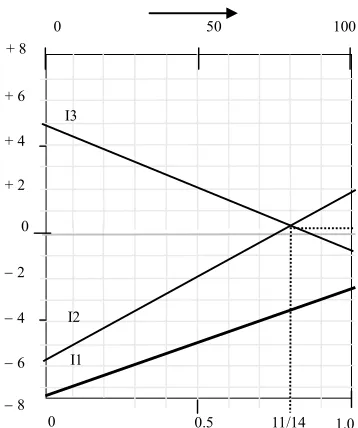
2) Graphical representation of the payoff. (The scales of the graph always represent the player with only two al- ternatives. The third alternative is removed as a result of dominance criterion). Illustrated in Figure 1 is the graphi- cal solution under consideration.
3) Determination of the fractional (proportioned) use of alternatives by PSP in a mixed strategy.
4) Evaluation of value of the game to the PSP.
[image:5.595.333.512.384.598.2]The proportioned (mixed) use of I2 and I3 by PSP can be determined by knowing the coordinates of the point of intersection of the corresponding lines drawn on the graph (Figure 1). The coordinates can be either directly read off from the graph or by solving the simultaneous equations of the lines. The equations for the lines can be determined from the geometry as: For I3, [y + 6x = 5]; and, for I2, [y – 8x = –6]. Hence solving them, the point of intersection is (11/14, 4/14). Suppose is the fractional use of I3 and 1) is the fractional use of I2. Now, consider the reduced payoff matrix shown in Table 3. In terms of it follows that,
+ (1 – ) (–1) 11/14 (–6 + (1 – ) 5], solving which yields = 6/14. Hence, (1 – ) = 8/14 as indicated on the reduced payoff matrix (Table 3). This leads to the conclusion that, the PSP should adopt 43 % effort on I2 strategy (deploying in-home displays of power usage) and 57% of effort on I3 strategy (ability to accommodate alternative energy).
If such a mixed proportion of efforts is exerted by the PSP, then what is its value of the game? This value refers to maximum advantage (gain) to the PSP, should the ILP follows optimum strategy. It is an expected value, EV (for PSP) and can be deduced (using the reduced payoff matrix indicated above) as follows:
EV(PSP) = [6/14 11/14 (+ 2)] + [6/14 3/14 (– 6)]
+ [8/14 11/14 (– 1)]
+ [8/14 11/14 (+ 5)] 1.92 %
The above calculation takes into account the mutually independent strategies of the PSP and the ILP and how their relative (proportionate) efforts weigh the percentages of payoff under possible alternatives are adopted.
Thus, by resorting to the mixed proportion of extending I2 and I3 strategies, the PSP is likely to gain a small revenue growth of about 1.92 % in the presence of the ILP adopting optimal strategy.
5.2 Nonzero-Sum/Two-Person Game Problem
The nonzero-sum game refers to situations in which all the game-players are either losers or winners in some respect or other. Typically, winning a war can be cited as an example, in which the reality is that nobody is a winner. The victor may apparently look like a winner, by taking the overall aspects of war; the victor suffers as much as the vanquished. Likewise, in a labor dispute that has been solved, both the workers and the management enjoy the fruit of victory in their own perspective of the gains re-sulted from bargaining. The game players in this case
0 + 2 + 4 + 6 + 8
8 6 4 2
0 0.5 11/14 1.0
I1 I3
I2
Payoff to ILPs in %
0 10050
Figure 1. Graphical solution to the problem. (I1-alternative is not taken into the solution as it has less dominance than the other alternatives)
Table 3. Reduced payoff matrix of Table 2
ILP C1 C2
I2 +2% 6% 6/14
PSP
I3 1% +5% 8/14
[image:5.595.309.537.663.720.2]have implicitly colluded (against the consumers) so as to get something advantageous to themselves through bar-gaining. Such games are typically of nonzero strategies because any conciliatory measure accepted enforces one party to give up one or more of its alternative strategies in favor of the other.
The following example (Example 2) is presented to il-lustrate the underlying concepts. The nonzero problems in general, however, carry no unique solutions because of the unspecified chances of alternatives being given up by the game-players.
5.2.1 Example 2: A Non-Zero Sum Two-Person Game Problem
Cogeneration is the use of a heat engine or a power station to simultaneously generate both electricity and useful heat. Cogeneration captures the by-product heat for do-mestic or industrial heating purposes. It is most efficient when the heat can be used on site or very close to it. Overall efficiency is reduced when the heat must be transported over longer distances. Suppose an ILP em-ploying smart-grid technology and a utility using co-generation (CHP) are competing to extend power to in-dustrial customers. The CHP is a competitor to the ILP and tries to attract industry by offering the following al-ternatives:
C1: Reduced rate based on contract length;
C2: Special discount for an industry agreeing that there will be high demand during peak time.
The ILP also attracts customers by offering the fol-lowing alternatives:
I1: Special discount for industrial customers operating at night;
I2: Special discount for industries having distributed power available;
I3: ILP already has an existing smart-grid infrastructure for power access to serve some part of the service area in which the cogeneration company has no penetration yet due to technical reasons. I3 is intended to serve exclu-sively such areas.
Both ILP and the cogeneration utility (CHP) deploy advertisements on their services with equal competence. A market consultant presents the payoff matrix (shown in Table 4) on possible gains and losses for each possible outcome. The payoffs indicated represent the net change in revenue over a specific period resulting from compet-ing promotional efforts of the competitors.
[image:6.595.309.537.651.726.2]Suppose the utility functions uC(P) and uI(P) of the co-generation-company(CHP) and the ILP versus the payoffs
Table 4. Payoff matrix proposed by market consultant for the problem of Example 2
ILP
I1 I2 I3
C1 () $ 1 M $ 0 (+) $ 1 M CHP C2 (+) $ 4 M (+) $ 2 M () $ 3 M
(in millions of dollars) are expressed respectively by the following functional relations based on empirical market considerations:
uC(P) = 0.1 P + 0.5
uI(P) = – 0.0082 P2 – 0.0973 P + 0.6998 (1) It is interest to determine and discuss the revenue prospects and the related economy of the two competitors in reference to the services being marketed. Relevant pursuit is as follows:
5.2.2 Solution to Example 2
By converting monetary payoffs indicated above into “utility payoffs”, one can solve the associated problem. The underlying consideration is as follows: The CHP is relatively new and franchised to operate in the region under discussion. Its utility for the money can be assumed to directly proportional to the revenue earned or lost. On the contrary, the ILP extends across large regional boundaries but traditionally adopts a conservative man-agement policy. Relevant utility function therefore, relies on the organizational policy and its attribution to one set of alternatives may not be the same for another set of alternatives.
Often, it is difficult to determine the utility index. It is a time-consuming and complex procedure that accounts for managerial perspective on a company’s aspiration level and expected standard of performance. It may involve some generous outlook to gain favor of customers as well as, may impose austerity measures to keep the losses a minimum. Small companies are flushed with ambition and carry the potentials of rapid growth, crash programs and diverse products and/or services. The major objective of management is to earn prestige and reputation so as to remain steady in the market (even at the expense of some tolerable losses). Its planning and engineering personnel will take the chance to play strategic games (or gamble!) in the competitive market. Larger companies, however, try to play the same game.
[image:6.595.58.285.670.724.2]The utility function should be selected carefully lest the consequences of wrong and misconceived translation of payoff into utility index would lead to the company’s irreversible downfall. The readers may recall recent (1998-2001) IT-market scenario and compare the utility perspectives and market-attitudes of small start-up dot-com dot-companies (with poured-in venture capitals) versus those of industries that had years of built-up infrastructure with large outlays that can be expressed in terms of their
Table 5. Utility payoff matrices of Example 2
Relative utility payoffs of
CHP
Relative utility payoffs of
ILP
ILP ILP
I1 I2 I3 I1 I2 I3
C1 0.4 0.5 0.6 0.8 0.7 0.6
prominent presence, huge capital (or share worthiness) and mammoth work-force values. Perhaps, there was over enthusiasm (or wrong horses played the wrong horse- play!) on the part of many dotcom industries in projecting utility functions, out-of-proportion to the payoffs in-volved.
In short, the utility theory governs the value that can be attached to an outcome for any alternative and a given future. That value can vary among individuals or from one business to the other. Utility is very much policy-specific and is therefore, ardently unique to any given business or industry. It is a response of the business enterprise to the anticipated risk in a competitive market environment judged from the payoff involved.
In this problem (Example 2), the utility versus payoff is specified in terms of utility functions, uC(P) and uI(P) of the cogeneration company and the ILP respectively as: [uC(P) = 0.1 P + 0.5] and [uI(P) = – 0.0082 P2 – 0.0973
P + 0.6998]. The payoff denotes the fact that the gain of one competitor is loss to the other for any given alterna-tive. Correspondingly, the larger utility perceived by one competitor amounts to a lesser utility perceived by the competitor (for that alternative). The utility functions indicated in the problem reflects this consideration by having opposite slopes of the functional relations, u = f(P).
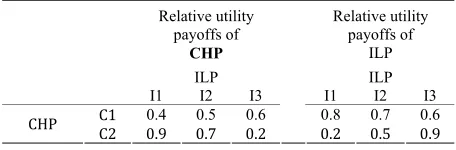
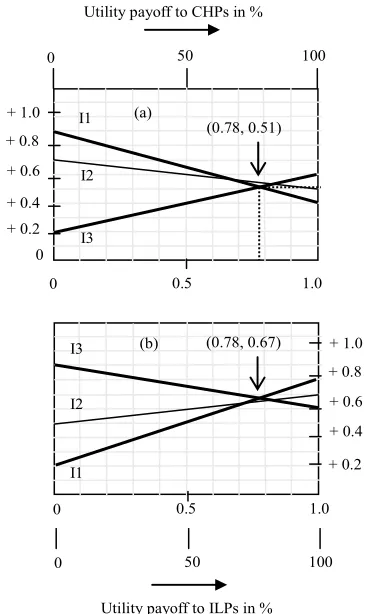
Using the given utility functions, the payoff matrix can be translated into corresponding utility payoff matrices for the cogeneration-company and the ILP as shown in Table 5. With the utility payoff data (as in Table 5), the next step is to construct the (utility) payoff graphs for the co-generation CHP and the ILP as illustrated in Figures 2(a) and 2(b) respectively. As indicated in Example 1, the dominance criterion allows I2 alternative not to be con-sidered in the evaluation. Further, by solving the equa-tions of the intersecting lines of I1 and I3, the coordinates of the points of intersection in the two graphs are deter-mined (as indicated on Figure 3). These coordinate values can be interpreted as follows: Considering the utility payoffs for the cogeneration CHP, the company can ex-pect an average (relative) utility payoff of about 0.51 by resorting to its strategy alternative C1, to an extent of about 78 % of its time and efforts. The next part of exer-cise is to determine the fractions of (I1 and I3) that can be inferred from the utility graphs of Figure 2 as decided by the proportions of utility payoff percentages (C1 and C2) set along the abscissa of the graphs.
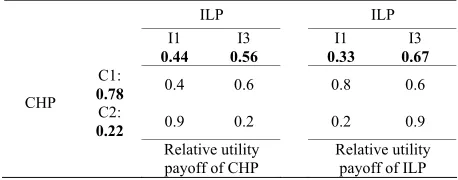
The results (obtained via the procedure indicated in Example 2) are tabulated in Table 6 (in bold faces). These results indicate that, in pursuing the strategy of adopting C1 at 78%, the cogeneration CHP compromises about 0.67 of its value (of the game) be consumed by the ILP, (if the ILP chooses to use about 33% of its time and efforts towards I1 and about 67% towards I3).
Using the results as above, if the ILP decides to make use of maximum strategy for its own utility payoffs, the
0 + 0.2 + 0.4 + 0.6 + 0.8
0.5 1.0 Utility payoff to CHPs in %
0 50 100
+ 1.0
0
0.5 1.0 0
I1
I2
I3
(0.78, 0.51)
I3
I2
I1
(0.78, 0.67)
Utility payoff to ILPs in %
0 50 100
+ 0.2 + 0.4 + 0.6 + 0.8 + 1.0 (a)
[image:7.595.331.514.88.395.2](b)
Figure 2. Utility payoff graphs of: (a) CHP and (b) ILP
value of the game, namely, EV(CHP) for the cogeneration CHP will not alter. This would keep both companies pleased and can be verified by the following calculation:
EV(CHP) = [0.78 0.44
(0.4) + 0.78 0.56 (0.6)
+ 0.22 0.44 (0.9) + 0.22 0.56 (0.2)]
≈ 0.51
(2) Further, the cogeneration company (CHP) will benefit slightly by getting a cash-gain of about $ 0.11 M in the game envisaged; and the ILP remains satisfied as a result of its high utility payoff (as implied by its utility function). Hence the strategies adopted by both sides would help maintain a status quo in the competitive market projected.
Table 6. Relative utility payoffs of the CHP and the ILP in Example 2
ILP ILP I1
0.44
I3
0.56
I1
0.33
I3
0.67
C1:
0.78 0.4 0.6 0.8 0.6
CHP C2:
0.22 0.9 0.2 0.2 0.9
Relative utility payoff of CHP
Relative utility payoff of ILP
0.55] for the cogeneration CHP; and, the corresponding utility index for the ILP will be, [0.7 0.5 + 0.3 0.9 = 0.62]. There is also a compromise solution in which both companies may get equal utility payoff. For example, the ILP can refrain from using its (I1 and I2) alternatives and at the same time the cogeneration CHP should agree to use only its C1 strategy. This will yield a compromising so-lution of identical utility payoffs (of index equal to 0.6) to both of them. Thus, there are several ad hoc solutions feasible in the game-theoretic approach for bargaining
dispositions when nonzero-sum situations are encoun-tered.
6. Concluding Remarks
Thus, given a set of technology options, a payoff matrix strategy can be adopted to make right decisions as illus-trated in the above examples. The problems indicated refer to a variety of constraints under which optimal payoff solutions are made via difference schemes of cri-teria-specifications.
REFERENCES
[1] “Smart Grid: Enabler of the New Energy Economy,” Electricity Advisory Committee, December 2008. http://www.oe.energy.gov/eac.htm
[2] D. Tuite, “For Power Design Opportunities, Try the Smart Grid,” Electronic Design, Vol. 58, January 2010. [3] J. L. Riggs, “Engineering Economics,” McGraw-hill