2017 2nd International Conference on Artificial Intelligence and Engineering Applications (AIEA 2017)
ISBN: 978-1-60595-485-1
Effect of Cold Rolled on Microstructure and
Mechanical Properties of TiNi Shape Memory Alloy
YANFENG LI, XIAOYUN SONG, XIANGQIAN YIN and WENUJN YE
ABSTRACT
The effect of cold rolled reductions on microstructure and mechanical properties of TiNi alloys was investigated by means of tension test and TEM. From the results it can be determined that when the annealing temperature reached 550℃, the recrystallization and grain growth began to occur after the cold deformation, and the tensile strength of the alloy decreased greatly and the elongation was more than 50%. The stress platform of stress-strain curves was decided by cold deformation and annealing temperature, which meets the Clasusius-Clapeyron equation. When the alloy rolled above 37%, large deformation energy storage is conducive to the occurrence of recrystallization. The microstructure evolves form recovery to nucleation of amorphous structures, recrystallization and grain growth as the rising of annealing temperature.
KEYWORDS
Shape memory alloy, TiNi alloy, cold rolled, mechanical properties, and microstructure.
INTRODUCTION
TiNi shape memory alloys have been attracting much attention recently as smart materials that exhibit a transformation in crystal structure at low temperature; this allows for the metal to change shape back and forth without any damage to the microstructure. TiNi-based shape memory alloys are attractive for structural and functional applications in engineering and medicine due to their unique and important mechanical and functional properties [1-3].
Severe plastic deformation or thermo mechanical treatment is necessary to improve shape memory effects and mechanical properties. Much researchers have been focused on severe plastic deformation, which can significantly influence the microstructure and phase transformation of TiNi alloys [4, 5]; in addition, the mechanical and shape memory properties are improved by forming nanostructures in the alloys.
_________________________________________
Yanfeng Li, State Key Laboratory of Nonferrous Metals and Processes, General Institute for Non-ferrous Metals, Beijing 100088, China. [email protected]
Xiaoyun Song, State Key Laboratory of Nonferrous Metals and Processes, General Institute for Non-ferrous Metals, Beijing 100088, China. [email protected]
Nakayama et al. [6] found that the Ti-50.2% Ni alloy was deformed by 50% cold rolling, the martensitic transformation did not occur during the cooling process. V.G.Pushin et al. [7] have shown that Nan crystalline microstructures are available in a large deformation, with a grain size of about tens of nanometers. In addition, the processing resulted in a greater recovery stress and maximum reverse strain of the shape memory.
The purpose of the present work is to reveal the evolution of microstructure and mechanical properties as a function of the TiNi alloy after cold rolled deformation and heat treatment.
MATERIALS AND EXPERIMENTS
The nominal composition of Ni50.2Ti49.8 (atom percent) alloy ingot was prepared using a high frequency induction vacuum furnace, the weight of ingot was about 20 kg.They were then hot forging and hot rolling to the thick of 1.5mm. The final cold rolled at room temperature with the reduction were 12%、26%、37%、48%、58%, successively. Subsequent annealing was done at 350-600 ℃ for 30 min with intervals of 50 ℃. The microstructural characterization of the alloys was carried out by TEM. The TEM specimens were electro-polished in an electrolyte with 90% (volume fraction) grain alcohol and 10% per chloric acid at -40 ℃. The mechanical properties were investigated by tensile tests carried out on a SHIMADZU AG-250KNIS type universal tensile test machine with a strain rate of 0.5 mm/min.
RESULTS AND DISCUSSION
[image:2.612.99.492.505.659.2]Fig. 1 shows the tensile stress-strain curves of the annealed Ni50.2Ti49.8 alloys with the rolled deformation of 12% and 58%, the annealing temperature was between 350 ℃ and 600 ℃. Tension test was performed at room temperature (25 ℃).
The mechanical properties of the Ni50.2Ti49.8 alloy with different cold working deformation of 12%, 26%, 37%,48% and 58% after annealed at 450 ℃, 500 ℃, 550
[image:3.612.186.405.129.665.2]℃ were shown in Figure.2 (a), (b) and (c).
When the amount of cold rolled deformation was 12% and the annealing temperature was lower than 500 ℃, there was no marten site reorientation or stress-induced marten site platform on the stress-strain curve. The main reason was that the recrystallization of the alloy at this temperature annealing has not occurred. The lower deformation rate, the lower dislocation density, and the highly tensile strength was about 1100-1200 MPa.When the annealing temperature reached 550 ℃, the recrystallization occurred in the alloy, the stress strain curve appeared on the stress plateau, and the tensile strength of the alloy decreased sharply. Because of the small amount of cold working deformation, the alloy has better plasticity, and the elongation was more than 50% after annealed at different temperatures.
The mechanical properties at room temperature of 48% cold deformation and 58% cold deformation after different annealing temperature was similar, when the annealing temperature was less than 500 ℃, the material in a recovery or recrystallization of the initial stage, there were a large number of dislocations within the material, the elongation of the alloy was low (<15%) and the tensile strength was high. When the annealing temperature is higher than 500 ℃, recrystallization and grain growth occurred in the alloy, the elongation of the alloy increase (>50%), and the tensile strength decreased sharply.
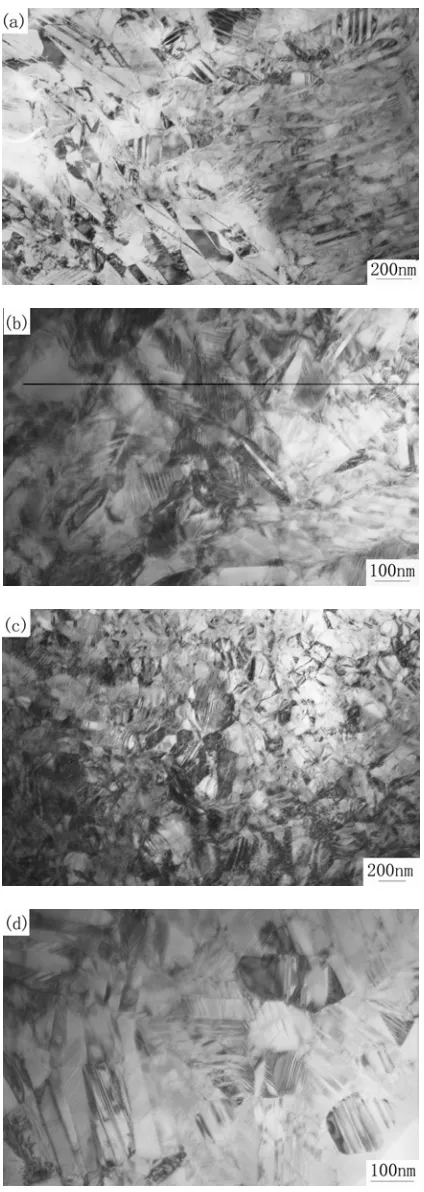
Figure 3. Microstructures of Ni50.2Ti49.8 alloy with different cold deformation (a-12%, b-26%, c-37%, d-48%) after annealed at 500 ℃
recrystallize with 12% rolling deformation and annealed at 500 ℃. The marten site twin became coarse when rolled by 26% deformation. When the culled deformation raised to 37%, it was can be to obtaining the fine grain structure. The small grain size was about 100nm. When the alloy rolled with 48% and then annealed, crystallization has been completed and the grain began to grow. Therefore, it can be concluded that the higher the amount of cold working deformation, the lower the recrystallization temperature, because the processing deformation is large, the microstructure is completely broken or even obtain nan crystalline, amorphous structure, and large deformation energy storage is conducive to the occurrence of recrystallization.
The results of research on effects of cold deformation on transformation and recovery properties of Ti49.8Ni50.2 alloy show that microstructure evolves as following upon the increasing of annealing temperature: recovery, forming a well-developed polygon zed substructure, nucleation, recrystallization, grain growth, when deformation reduction is lower such as 12% and 26%. However, microstructure evolves form recovery to nucleation of amorphous structures, recrystallization and grain growth in the case of higher deformation reduction such as 37%, 48% and 58%.
CONCLUSION
The effect of cold rolled on microstructure and mechanical properties of TiNi shape memory alloy were investigated. The important conclusions are as follows:
(1) The alloy underwent different amount of cold deformation and the same annealing temperature, the larger the cold deformation, the higher of tension strength. When the annealing temperature reached 550 ℃, the recrystallization and grain growth began to occur after the cold deformation, and the tensile strength of the alloy decreased greatly and the elongation was more than 50%.
(2) When the alloy rolled above 37% and then annealed, large deformation energy storage is conducive to the occurrence of recrystallization. The microstructure evolves form recovery to nucleation of amorphous structures, recrystallization and grain growth as the rising of annealing temperature.
ACKNOWLEDGEMENTS
This work is supported by National Natural Science Foundation of China (NSFC, No. 51571036).
REFERENCES
1. Jan Van Humbeeck. Non-medical applications of shape memory alloys. Materials Science and Engineering A, Vol. 273-275 (1999), p. 134-148.
2. S.K. Wu, H.C. Lin. Recent development of TiNi-based shape memory alloys in Taiwan. Materials
Chemistry and Physics, Vol. 64 (2000), p. 81-92.
3. Kazuhiro Otsuka, Xiaobing Ren. Recent developments in the research of shape memory alloys. Intermetallics, Vol. 7 (1999), p. 511-528.
5. S.H. Chang, S.K. Wu, G.H. Chang. Transformation sequence in severely cold-rolled and annealed Ti50Ni50 alloy. Materials Science and Engineering A, Vol. 438-440 (2006), p.509-512.
6. H. Nakayama, K. Tsuchiya, M. Umemoto. Crystal refinement and amorphisation by cold rolling in
TiNi shape memory alloys. Scripta Materialia, Vol. 44(2001), p. 1781-1785.