BIROn - Birkbeck Institutional Research Online
Thomas, Michael S.C. (2010) Language acquisition in developmental
disorders. In: Kail, M. and Hickmann, M. (eds.) Language Acquisition across
Linguistic and Cognitive Systems.
Language Acquisition and Language
Disorders 52. Amsterdam, The Netherlands: John Benjamins, pp. 67-87.
ISBN 9789027253149. (Submitted)
Downloaded from:
Usage Guidelines:
BIROn
-
B
irkbeck
I
nstitutional
R
esearch
On
line
Enabling open access to Birkbeck’s published research output
Language acquisition in developmental disorders
Book Chapter
http://eprints.bbk.ac.uk/2877
Version: Pre-print
Citation:
© 2010 John Benjamins Publishing
Publisher version
______________________________________________________________
All articles available through Birkbeck ePrints are protected by intellectual property law, including copyright law. Any use made of the contents should comply with the relevant law.
______________________________________________________________
Deposit Guide
Contact: [email protected]
Birkbeck ePrints
Birkbeck ePrints
Language acquisition in developmental disorders
Michael S. C. Thomas
School of Psychology, Birkbeck College University of London, London
To appear in: M. Kail & M. Hickmann (Eds.), Language acquisition across linguistic
and cognitive systems. Amsterdam: John Benjamins Publishing Company.
Address for correspondence:
Dr. Michael Thomas
Developmental Neurocognition Laboratory School of Psychology
Birkbeck College, University of London Malet Street, Bloomsbury
London WC1E 7HX, UK Email: [email protected]
Homepage: http://www.bbk.ac.uk/psyc/staff/academic/mthomas Lab. homepage: http://www.psyc.bbk.ac.uk/research/DNL/ Tel.: +44 (0)20 7631 6386
Fax: +44 (0)20 7631 6312
Keywords: Developmental disorders, Atypical development, Language disorders,
Williams syndrome, Down syndrome, Autism, Specific Language Impairment,
Dyslexia, Developmental delay, Computational modelling, Connectionism,
Neuroconstructivism, Compensation, Redundancy, Functional brain imaging,
Abstract
In this chapter, I review recent research into language acquisition in developmental
disorders, and the light that these findings shed on the nature of language acquisition
in typically developing children. Disorders considered include Specific Language
Impairment, autism, Down syndrome, and Williams syndrome. I argue that disorders
of language should be construed in terms of differences in the constraints that shape
the learning process. I outline the integrative nature of this learning process, and how
properties such as redundancy and compensation may be key characteristics of
learning systems with atypical constraints. These ideas, as well as the new
methodologies now being used to study variations in pathways of language
acquisition, are illustrated with case studies from Williams syndrome and Specific
Language Impairment.
1: Introduction
What light can developmental disorders shed on language development? Can they
reveal the extent to which language development is channelled by biological
constraints? Can they demonstrate whether language learning relies on general
cognitive mechanisms or whether it is domain-specific? In this chapter, we consider
what has been learned by the comparison of language development across multiple
disorders, as well as the unresolved issues that still exist in this field.
First, let us clarify what is meant by developmental disorders. Developmental
disorders can be split into four groups. The first are disorders caused by
well-understood genetic abnormalities, such as Down syndrome (three copies of
chromosome 21) and Williams syndrome (deletion of around 28 genes from one copy
impairments are typically not restricted to a single cognitive domain. The second
group are disorders defined on the basis of behavioural deficits, such as dyslexia,
Specific Language Impairment and autism. In these disorders, behavioural genetics
indicates sometimes substantial heritability, but the causal genes are not yet known
and may well not be mutations (that is, they may be spectrum disorders corresponding
to an unlucky accumulation of normal genetic variations that each add a small risk for
the target disorder). In these disorders, it is sometimes argued that the deficits are
restricted to single cognitive domains (e.g., reading in dyslexia, language in Specific
Language Impairment) but there remain doubts as to whether these disorders are
indeed homogeneous rather than behavioural clusters with milder associated deficits
and heterogeneous causes. The third group correspond to disorders where there is
learning disability but its cause is unknown. The final group correspond to disorders
caused by environmental factors, such as acquired brain damage, viral infections or an
impoverished environment, be it cognitive (such as neglect) or biological (such as in
Foetal Alcohol syndrome). The first and last of these four groups index the primary
locus of causality – the first group nature, the last group nurture – while the middle
two reflect our current lack of knowledge about the cause of some disorders. A given
behavioural impairment may be generated in more than one way. For example, poor
reading may be the consequence of either dyslexia or limited opportunities to learn to
read. Our discussion will predominantly focus on the first two of these four groups –
neurogenetic and behavioural disorders (see, e.g., Goldin-Meadow, 2005, for
discussion of language development under conditions of impoverished input).
Disorders of development that are caused by early acquired brain damage will be
Both dissociation and association methodologies have been applied to
developmental disorders of language (see Bishop, 1997, Karmiloff-Smith, 1998,
Temple, 1997, for discussion). Where ability A develops normally but ability B
develops atypically, a possible inference is that they are subserved by independent
systems that do not interact during development. Where ability A and ability B both
develop atypically, one possible inference is that a common system subserves their
development; another is that they are subserved by two systems that causally interact
across development (Morton, 2004). Very different explanatory frameworks have
been deployed in interpreting language deficits in developmental disorders. On the
one hand, some researchers have extended the logic of adult cognitive
neuropsychology to developmental disorders, hypothesising that patterns of
behavioural deficits should be related to normal modular theories of the language
system (for the appropriate age); deficits are then viewed as the failure of individual
components to develop (e.g., Clahsen & Temple, 2003). On the other hand, other
researchers stress the interactive, adaptive nature of the developmental process; they
argue that the normal adult modular structure is the product of the developmental
process rather than a precursor to it and, since cognitive components interact across
development, impairments are likely to spread; moreover, genetic effects in disorders
are typically widespread in the brain rather than equivalent to focal lesions; together,
these researchers infer that the language system in developmental disorders may be
qualitatively atypical and therefore one need expect no direct correspondence to the
normal language system (e.g., the neuroconstructivist position; see Karmiloff-Smith,
1998; Mareschal et al., 2007; Thomas & Karmiloff-Smith, 2002, 2005; see Thomas,
Pursuer, & Richardson, in press, for a more detailed comparison of these position).
language may offer a direct window onto the structure of the normal language system
while others argue that at worst, disorders may tell us nothing about normal language
development beyond an inkling of the constraints shape it. One goal of this chapter is
to indicate where in between these two extremes the truth may lie.
The following examples illustrate the types of claims that have been made
about language development in development disorders. It has been argued that
Specific Language Impairment may be a genetic failure of language (and in some
cases, only syntax) to develop against a background of otherwise normally developing
cognition (e.g., as assessed by non-verbal intelligence tests) (Pinker, 1999; van der
Lely, 2004). Williams syndrome, a rare neurogenetic disorder, shows an uneven
cognitive profile, with relatively strong language ability (for overall mental age) and
especially in receptive vocabulary, a particular weakness in visuospatial construction
and a background of learning disability. Based on early reports, Pinker (1994, 1999)
argued that language might develop normally in this disorder despite deficits in
general cognition. In high-functioning individuals with autism, it has been argued that
the structural parts of language can be acquired appropriately but these individuals do
not master its use in social situations, which is crucial for effective communication
(Happé, 1994). These three claims revolve around disorders that exhibit dissociations.
Equally, we need explanations of associations, for example where all aspects of
language development are delayed in a disorder but individuals nevertheless seems to
follow normal milestones, though perhaps terminating at a lower level of
sophistication (e.g., as in Down syndrome). What property of a cognitive system
could produce general language delay? Speculations about how language
development can go wrong rely on a detailed understanding of how it works in the
2. Language as a learning problem
The effects of developmental damage to the language system may be quite different to
the effects of acquired damage in adulthood, because in the former case one cannot
assume that there is already a language system in place (Thomas & Karmiloff-Smith,
2002). Instead, developmental deficits must be interpreted as disruptions to an
adaptive learning process. Theories of language development differ depending on
how tightly constrained they view the learning process to be (very tightly in nativist
theories, where environmental input serves to ‘trigger’ adult states; weakly in
empiricist theories where structure in input-output mappings serves to construct the
adult state from more general resources). Minimally, developmental disorders must be
viewed in terms of changes to the constraints under which language development
takes place, whether learning is tightly or loosely constrained. But learning theories
bring into play a range of other concepts. These include the interactions between
different information sources or processing mechanisms, the importance of the quality
of input and output representations, changes in plasticity with age, compensation
between processing components when some are initially impaired, and the possibility
of redundancy (i.e., multiple developmental pathways to success).
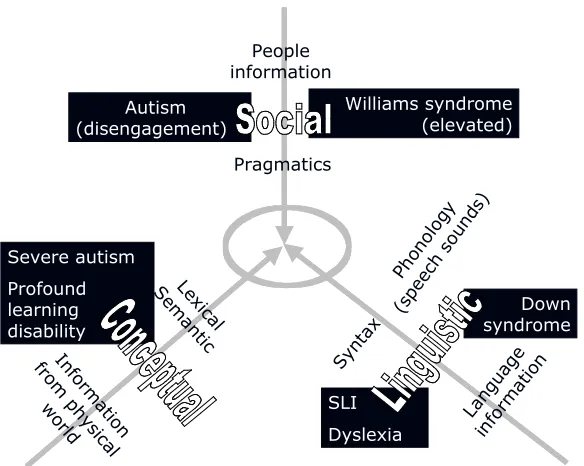
At the most abstract level, Tager-Flusberg and Sullivan (1998) characterised
normal language development as involving the integration of three streams of
information, about the physical world, about people, and about the structure of
language itself. Ultimately, these will form the basis of lexical semantics, pragmatics,
and phonology/syntax respectively. These information streams are depicted in Figure
1. The most important point is that language development involves the integration of
to achieve some social goal. But integration may be a complex process: some types of
information may be redundantly available in more than one information stream; or
information in one stream may help resolve ambiguities in the other and so aid its
acquisition (the basis of the developmental notion of bootstrapping). In this way,
Chiat (2001) emphasised how disorders of language development must construe
observed impairments in terms of the way each disorder changes the problem of
learning the mapping from sound to meaning and from meaning to sound.
==================
Insert Figure 1 about here
==================
Cross-syndrome comparisons are potentially most informative about the
different ways in which the developmental process can be deflected. Figure 2
demonstrates data from our lab that illustrate the sorts of patterns that can be observed
when disorders are compared (see Annaz, 2006; Thomas et al., 2009, for general
methods). These data depict cross-sectional developmental trajectories for 18 children
with Williams syndrome (WS), 15 children with Down syndrome (DS), 16
high-functioning children with autism (HFA), and 17 low-high-functioning children with autism
(LFA) between the ages of 5 and 12, against a typically developing (TD) sample of 25
children. The left panel shows performance on a standardised test of receptive
vocabulary (a task where the child has to point to the picture that goes with a word),
while the right panel shows performance on a non-verbal test of visuospatial
construction (a task where the child has to complete a simple puzzle, building a target
pattern from geometric shapes). In both cases, test (mental) age is plotted against
Two of the disorders show similar profiles across verbal and non-verbal
measures, illustrating developmental associations. For the HFA group, development is
slightly below the TD trajectory but within the normal range, while the DS group
shows very delayed and only slowly improving performance on both measures. By
contrast, the WS group shows development parallel to and just below the normal
range for language (similar to the HFA group), but very delayed development on
visuospatial construction (similar to the DS group). Meanwhile, the LFA group shows
poor performance on language development (indeed, there is no significant
improvement with chronological age in this cross-sectional sample) but then
development within the normal range for visuospatial construction (similar to the
HFA group). These latter two cases illustrate developmental dissociations.
==================
Insert Figure 2 about here
==================
Such cross-syndrome comparisons have been carried out to explore
associations and dissociations within the domain of language itself, both in early
development (Tager-Flusberg & Sullivan, 1998) and later childhood (Fowler, 1998)
(see also Rice, Warren & Betz, 2005). These comparisons focused on phonology,
syntax, semantics and pragmatics, and identified several contrasting profiles. For
high-functioning children with autism, problems primarily occur in pragmatics, in line
with the social disengagement typical of the disorder. For low-functioning children
with autism, there are additionally problems with lexical semantics and concept
formation. Problems in lexical semantics and concepts also characterise the
development of children with learning disability (or ‘mental retardation’, to use US
by delay but with a relatively successful eventual outcome. However, there are also
differences in pragmatics, but now the pattern is of hypersociability with an elevated
interest in using language for social engagement. In Down syndrome, problems
appear to primarily impact on the structural aspects of language, especially phonology
and those parts of language that rely on phonological distinctions (morphology,
syntax). Specific Language Impairment and dyslexia are also viewed as behavioural
disorders that impact primarily on structural language information, with sub-types
emphasising difficulties in phonology, semantics, or syntax. The contrast between
these disorders is included in Figure 1.
What kinds of conclusions have been drawn from these comparisons? Fowler
(1998) noted that pragmatics and semantics appear to be most closely tied to overall
mental age across different disorders, while phonology and syntax can dissociate.
Either pragmatics and semantics involve more general systems, or their successful
development requires interactions between a greater number of cognitive components.
McDonald (1997) contrasted various populations in which language acquisition is
broadly successful (including WS and HFA) with those in which language acquisition
is unsuccessful (including DS and SLI, but also late L1 and L2 learners). Her
conclusion was that good representations of speech sounds (phonology) are crucial in
predicting eventual successful acquisition. When the individual cannot encode the
basic phonological contrasts over which the rules of language operate, prognosis is
poor. However, as Morton (2004) argues, many cognitive components typically
contribute to the successful development of an overall system, and if any one of these
is impaired (and no redundancy is present) the system may fail to develop normally.
Good phonology may be a necessary but not sufficient requirement for successful
In their reviews, both Fowler (1998) and Tager-Flusberg and Sullivan (1998)
were struck by the absence of radically different pathways by which language can be
developed. In most disorders, acquisition exhibits similarities to the normal trajectory,
proceeding through a common sequence and via common milestones (as far as
acquisition progresses in a given disorder). Their common conclusion was that these
similarities must be the result of invariant internal biological constraints that shape
language development in all the disorders. Thus Fowler argued that “…language
acquisition [is] heavily constrained by brain structure” (1998, p.309), while
Tager-Flusberg and Sullivan concluded that “there are not multiple alternative ways of
acquiring language, though as each of these components [phonology, semantics, and
syntax] develops over time, they may become integrated in different ways, which lead
to syndrome-specific profiles” (1998, p.231). An alternative possibility is that, on
computational grounds, some of the similarities to typical development are to be
expected since learning systems with different properties are nevertheless trying to
solve the same problem; that is, all the children are trying to solve the problem of
communicating meaning via sound (Thomas, 2005a).
In the next two sections, we consider two more detailed examples of language
acquisition in developmental disorders. These stress how important it is to view
atypical language development in terms of the trajectory of an adaptive learning
system operating under altered constraints (computational or informational). The first
example shows how research has progressed over a decade or more of investigating
language development in Williams syndrome, and introduces the idea of redundancy
in language development. The second example of Specific Language Impairment
reveals the emergence of new methods to address key issues in the atypical
3. The case of language development in Williams syndrome
Williams syndrome has been much studied over the last fifteen years due to the
uneven cognitive profile observed in this neurogenetic disorder (Donnai &
Karmiloff-Smith, 2000). Figure 2 depicts one of the most salient dissociations observed in
standardised testing: a disparity between receptive vocabulary and visuospatial
constructive skill. Individuals with WS also show a hypersociable or ‘over-friendly’
personality profile (Jones et al., 2000), with a relative strength in facial recognition
(Annaz et al., 2009). By contrast, they have relative weaknesses in numeracy and
problem solving skills, and overall IQs typically fall between 50 and 70. Based on the
early findings of Ursula Bellugi from a small number of individuals with the disorder,
Pinker (1994, 1999) argued that WS might constitute a genetic dissociation in which
grammar develops normally but general intelligence is impaired – in support of a
wider argument that normal language development involves innate, domain-specific
mechanisms. Although, as with any disorder, there is variability, individuals with WS
often have a surprising facility with language compared to some of their other
abilities, and compared to other disorders with comparable overall mental age such as
Down syndrome (e.g., as shown in Figure 2). A dissociation of this nature encourages
the idea that developmental disorders might serve to ‘fractionate’ the cognitive system
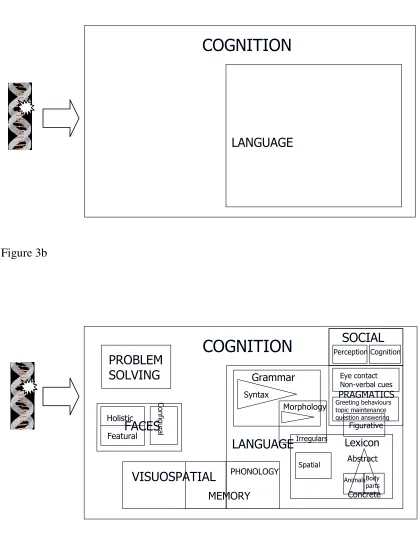
into its component parts. The simple fractionation proposed by Pinker (1994) is
shown in Figure 3a.
========================
Insert Figure 3a and 3b about here
These initial claims inspired a burst of research on WS that has lasted fifteen
years and incorporated investigation of the genetic basis of the disorder, its effects on
brain development, and a detailed consideration of the cognitive abilities of these
individuals using more sensitive experimental tasks. Research on brain development
has tended to indicate that the genetic effects of the mutation are fairly widespread
rather than focal, consistent with most neurogenetic disorders that affect cognition
(Toga, Thompson & Sowell, 2006). By contrast, research on the cognitive abilities of
these individuals has revealed an increasingly complex and fine-grained picture. In
the domain of language, the most salient characteristic in WS is that development is
delayed (Brock, 2007). Early in childhood, the language ability of these children is on
a par with children with DS (Paterson et al., 1999). Only in later childhood and
adolescence does WS language development stretch away, while that of DS
asymptotes. In most published empirical studies, the performance of individuals with
WS is compared to a typically developing control group matched for mental age
(MA); performance is very rarely at the level of a control group matched for
chronological age. MA comparisons implicitly accept that there is no dissociation
between language ability and overall mental age in WS (although the notion of a
single, overall mental age is itself weakened for disorders in which component
abilities are at different levels).
Various studies have reported dissociations within the domain of language, for
instance problems in learning spatial prepositions, difficulties in the pragmatics of
conversation, and problems with more complex aspects of morphology. Thomas and
Karmiloff-Smith (2003) reviewed the literature at the turn of the century and
identified two types of emerging hypothesis. The Semantics-Phonology Imbalance
development but that it occurs in a subtly different way. In WS, there might be greater
emphasis on the sounds of words and less emphasis on their precise meaning. For
example, in early language development, children with WS show vocabulary growth
ahead of the normal markers of semantic development such as referential point and
object sorting (see Thomas, 2005a, for a review). By contrast, the Conservative
hypothesis suggests that there is nothing atypical about language development in WS
– it is entirely in line with mental age (i.e., it is delayed). What anomalies there are
stem from other characteristics of the disorder such as the visuospatial deficit that
causes problems in learning spatial prepositions (in, on, under) and the hypersociable
profile that leads these individuals to use language strategically in a way to capture
and maintain attention in social interactions (see, e.g., Thomas et al., 2006, for an
example in the context of unusual vocabulary use in WS). Under the Conservative
hypothesis, language in WS is made to look more impressive by comparing it to other
cognitive domains in which there are particular weaknesses (e.g., visuospatial
construction) and to other disorders in which there are known phonological
processing problems, such as DS and SLI (e.g., Ring & Clahsen, 2005).
As research has progressed in WS, methodological problems such as restricted
sample sizes and inappropriate control groups have increasingly been addressed.
Brock (2007) recently reviewed the status of the two competing hypotheses. He found
that the Conservative hypothesis has gained progressively more support over the
Imbalance hypothesis. Delay remains the most salient feature of language
development in WS and performance appears to be in line with the level of general
cognition (excluding the visuospatial deficit). While there are some anomalies
compared to MA-matched control groups, most of these appear to stem from other
as shown by the data in Figure 2, left panel). This skill is puzzlingly strong even
compared to the rest of language and the disparity remains to be explained. Brock
(2007) argues that the slow and anomalous early phase of language development in
WS combined with the eventual relative success in acquisition implicates redundancy.
That is, early language development in the disorder does not exploit the normal
combination of information sources and cognitive processes; it finds a pathway to
success that takes longer but is nonetheless eventually successful. This position
contrasts with that of Tager-Flusberg and Sullivan (1998) who, as we saw earlier,
argued against alternative pathways for successful language acquisition.
To offer a concrete example of this redundancy, Laing et al. (2002) identified
deficits in shared attention in toddlers with WS. Although these toddlers scored well
on dyadic interactions (sharing attention with the caregiver), they exhibited deficits in
triadic interactions, where attention had to be shifted between the caregiver and an
object that was being played with. The deficit was a consequence of their elevated
interest in (and fixation on) the face of the caregiver. It is thought that triadic
interactions are an important contributor to learning object names in situations where
the caregiver labels an object that is being played with (“Look at the ball! This is a
ball!”) (e.g., Tomasello & Farrar, 1986). Therefore, the toddler with WS may to some
extent be deprived of this information source in their language development.
However, explicit labelling is not the only route to learning object names, and while
development is slower, these children do succeed in vocabulary acquisition. The
inference is therefore that other redundant pathways to success are followed, which
are less efficient and take longer.
Overall, research into the cognitive profile of individuals with WS has tended
within cognitive domains. Although the initial fractionation in WS was argued to be
between language and cognition as shown in Figure 3a, the current picture of is closer
to that shown in Figure 3b. This fine-scaled fractionation contrasts with the coarse and
widespread effect of the genetic mutation on brain development. One can make this
point more starkly: in WS, the granularity of genetic differences in cortex is far
coarser than the level of cognitive modules, yet the impact on cognitive development
is a granularity of subsequent fractionations considerably finer than the level of
cognitive modules (Thomas, 2006). The difference in granularity between genetic and
cognitive effects arises because cognitive structure is the result of a developmental
process that exaggerates or attenuates the effects of atypical constraints on learning,
depending on the cognitive domain (Karmiloff-Smith, 1998). In the next section, we
will see how new methods are important to specifying the nature of this
developmental process.
4. The case of language development in Specific Language Impairment
SLI is a behaviourally defined disorder diagnosed by the presence of a deficit in
language development in the presence of apparently normal non-verbal development
and the absence of any obvious neurological impairment or environmental cause. It is
a heritable disorder but the precise genes involved are unknown (although some
candidate genes and chromosomal regions have been proposed; see Smith, 2007). SLI
is sometimes conflated with the British KE family. Affected members of this family
were reported to have particular problems with language and the cause was traced to a
mutated gene on chromosome 7 called FOXP2 (see Marcus & Fisher, 2003). As with
WS and in keeping with other neurogenetic disorders, subsequent research has
unaffected family members are more widespread than the domain of and substrate for
language (Watkins, Dronkers & Vargha-Khadem, 2002; Watkins et al., 2002).
However, behaviourally defined SLI is not caused by the FOXP2 mutation (Newbury
et al., 2002).
SLI is a disorder that primarily impacts on syntax and phonology, although its
particular features depend on the language being acquired (Leonard, 1998). It appears
to be a heterogeneous disorder, with subtypes that differentially impact
morphology/syntax, semantics, and pragmatics (Bishop & Norbury, 2002). Three
principal theories have been advanced for the cause of behaviourally defined SLI.
First, SLI has been explained in terms of deficits to rule-based, language-specific
structures (e.g., van der Lely, 2004). Versions of this theory include an impairment in
specific structural relationships (agreement, specifier head-relations), absent linguistic
features, fixation in a period of development where tense marking is ‘optional’, and
problems in more general language functions (implicit rule learning, representing
relationships between structures). Second, SLI has been explained in terms of a
non-linguistic processing deficit that happens to particularly impact on language (e.g.,
Joanisse, 2007). Proposals on the nature of this impairment include reduced
processing rate, capacity limitations on cognitive processing, a deficit that particularly
affects phonology, and a low-level perceptual or temporal processing deficit. Third, a
neurobiological proposal by Ullman and Pierpont (2005) called the
Procedural-Declarative theory argues that grammar acquisition is like skill learning, and therefore
relies on procedural or implicit memory. By contrast, vocabulary acquisition concerns
the learning of explicit knowledge and therefore relies on declarative memory. SLI
theories identify the deficits in SLI as involving disruptions to the language
information stream in Figure 1.
Ullman and Pierpont’s (2005) proposal is notable in that it identifies
compensation as a key feature in producing the language profile of children with SLI.
In the face of an impairment to the procedural learning system, Ullman and Pierpont
argue that the declarative memory system attempts to compensate by acquiring certain
aspects of language, such as frequently used phrases or inflected words. So, for
example, where a typically developing child might inflect an English past tense such
as ‘talked’ in terms of the regularities that operate in inflectional morphology (in
English, to form the past tense, add –ed to the verb stem), the child with SLI might
succeed in inflecting this high frequency verb by learning it as an unanalysed whole
(note, however, that the performance of these children on inflection tasks is generally
fairly poor). The evidence for this is that where normal children inflect regular verbs
equally accurately irrespective of their frequency, children with SLI show frequency
effects, inflecting high frequency regulars more accurately than low frequency
regulars (van der Lely & Ullman, 2001). Frequency effects are taken to be the
hallmark of the operation of declarative memory.
What is important about Ullman and Pierpont’s approach is that it emphasises
the atypical learning process. Impaired behaviour is the outcome of development
working under different constraints, rather than the result of focal damage to a
component of a static system. That is not to say that damage to a static system might
not sometimes be an appropriate explanation, for instance, to explain a similar
behavioural deficit when observed in a normal adult who has suffered brain damage.
For example, individuals suffering Broca’s aphasia after left anterior damage exhibit
otherwise healthy children before the age of 5-7 does not produce SLI; it causes
language delay followed by recovery to within the normal range (see Bates & Roe,
2001, for a review). Interestingly, the effects of early child brain damage are similar
irrespective of side of damage. By contrast, in adults impairments in processing the
structural aspects of language only occur after left-sided damage. In short, then, SLI
must be viewed as an atypical developmental process, not in terms of damage to
pre-existing structures.
However, Ullman and Pierpont’s approach highlights the fact that we don’t
really know what the atypical developmental process looks like (Thomas, 2005b).
How does compensation actually work? Why is it not fully successful, in which case
the atypical process would evidence no surface behavioural impairments? The
implication is that compensatory processes are limited in some respect; but unless the
processes are specified in detail, sufficient to make predictions about what level of
compensation a given theory would suggest, proposals about compensation cannot be
falsified and the attendant theories are untestable. Two recent methodologies have
begun to make progress in specifying the nature of compensatory processes.
One of the methodologies is the use of computational models of development
to provide formal, implemented simulations of the proposed atypical process (Thomas
& Karmiloff-Smith, 2003). This approach begins by building a computational model
of normal development for a particular aspect of language acquisition, such as
learning to produce past tenses or to parse sentences. The normal developmental
trajectory is the consequence both of the linguistic environment to which the system is
exposed and its internal computational constraints, such as the nature of its
representations and learning algorithm. Manipulations to the linguistic environment
atypical development, if those manipulations are able to deflect the normal trajectory
so that it now characterises the pattern observed in a particular disorder.
In this way, Thomas (2005b) demonstrated how altering a computational
property in a connectionist model of English past tense acquisition was sufficient to
deflect development from the normal trajectory to the SLI profile. This property was
the discriminability of the internal processing units (roughly corresponding to the
signal-to-noise ratio of a neural processing system). This manipulation was notable
for three reasons. First, the property was altered in a processing channel that was
shared by both regular inflections (talk-talked) and irregular inflections (drink-drank),
yet it affected regular inflections more seriously than irregulars. This is because good
discriminability is necessary to learn the sharp category boundaries in internal
representations that will depict rules or regularities. Changes to shared resources can
therefore produce uneven deficits to the separate processes that use those resources.
Second, changing the processing property at the start of development altered the way
the system exploited the information available to it. In the normal system,
phonological input was preferentially used to drive regular past tense formation while
lexical-semantic (word-specific) information was preferentially utilised to drive
irregular past tense formation. In the inefficient, slowly developing atypical system,
there was a greater reliance on word-specific lexical-semantic information to drive all
past tense formation. This led to the emergence of frequency effects in regular past
tense formation observed empirically by van der Lely and Ullman (2001); and it is in
line with the proposal that all verbs are treated as exceptions in SLI. Third, the model
captured SLI accuracy levels in children of around ten years of age. However, the
atypical model was then run on to predict adult performance. The results suggested
system came to extend its knowledge to novel cases (i.e., applying the rule). In other
words, externally, the system eventually seemed to compensate for highly practised
items but internally it failed to normalise.
Using a similar approach, Thomas and Redington (2004) constructed a
recurrent connectionist model of sentence processing to simulate the results of an
experiment in which participants had to identify the agent and patient of a sentence
(Dick et al., 2001). In this task, participants heard sentences that were either canonical
(active: The dog chases the cat; subject cleft: It is the dog that chases the cat) or
non-canonical (passive: The cat is chased by the dog; object cleft: It is the cat that the dog
chases) and were required to make a binary choice as quickly as possible on which of
two pictures (dog, cat) corresponded to the agent (dog). Dick et al. (2001) found that
adults with acquired aphasia exhibited marked difficulties at identifying the agents of
non-canonical sentences, that is, both passives and object clefts. When the trained
‘adult’ connectionist model was lesioned, it too exhibited this pattern of deficits.
However, when the same model had its processing resources reduced prior to training
to simulate a developmental disorder, it generated a novel prediction that the deficits
should be more marked for object cleft sentences than passives.
Let us consider why this should be the case. In the aphasic model, both passive
and object cleft failed together because they were low frequency constructions, and
therefore less robustly represented in the network. In the atypical model, the resource
limitation reduced the ability of the connectionist network to learn information across
sequences of words. Object cleft sentences are identified by a noun-noun sequence
(cat that the dog) and so suffered from developmental limitations in sequence
processing. However, passive sentences are also (redundantly) identified by lexical
learned to use these cues to identify this construction. Importantly, when Dick et al.
(2004) extended their paradigm to typically developing children and children with
SLI, the results supported the prediction of the model: performance on passives and
object clefts was closely related in adult aphasics, while in children with SLI, passive
constructions were identified more accurately than object clefts.
These models demonstrate the benefit of implementation for making theories
more explicit. Together, the models demonstrate: (1) how adaptive learning systems
do the best they can with atypical properties they possess; (2) that compensated
systems may use information sources in different ways; and (3) that atypical
processing properties may allow compensation for some parts of language but not
others.
A second methodology essential to uncover the nature of compensation in
developmental disorders is that of functional brain imaging. The computational
simulations suggest that, with age and practise, behavioural problems can resolve
even though the underlying processes have not normalised. If so, behavioural
measures, especially those with poor sensitivity such as standardised tests, may be
insufficient to assess developmental outcome. By contrast, functional brain imaging
offers a window on the way in which the brain has adapted to perform language tasks
when its computational constraints are atypical.
Using this approach, we recently imaged the brain of a 42-year-old man called
CK who was diagnosed with SLI aged 6 (Richardson et al., 2006). Donlan et al.
(2006) compared the language profile of CK available from standardised tests and
educational records when he joined a special school for children with language
impairments in 1971, with his performance as an adult in order to explore the eventual
6 years of age, and particular difficulties with auditory memory and morphological
inflections. The records note that CK had reduced babbling as a baby, he used only 3
words used at two years of age (girl, pig, stop) and there was then no further
productive output until 5 years and 3 months (he started receiving speech and
language therapy at 4 years and 11 months). CK’s adult profile indicated that some
aspects of his language were now within or above the normal range: receptive
vocabulary was in the 99th percentile, auditory discrimination was at ceiling, picture
comprehension was in the 63rd percentile, and naming showed a z-score of 0.16, i.e.,
slightly above average. However, CK revealed persisting deficits in tasks requiring
phonological working memory: non-word repetition had a z-score of –1.94, well
below the normal range, and recall of sentences as in the 1st percentile.
Functional imaging was used to explore brain activations in CK during passive
listening to sentences, or reading of sentences presented one word at a time at the
same rate, against a baseline of backwards speech or nonsense visual symbols. CK’s
performance was compared to a group of 14 adult controls. The results revealed that
for CK, there was reduced activation in temporal regions normally associated with
phonological processing, but increased activation in dorsal pre-motor and superior
temporal regions, as well as in the caudate nucleus. The latter are all motor areas but
note that the task CK was asked to perform included no motor component. One must
interpret results of this form with care, since there are at least three ways one could
explain the differences between CK and controls: (1) as adaptive compensation; (2) as
a failure of the system to inhibit task-irrelevant circuits; (3) as a case of task-irrelevant
activations causing interference (though those activations might be adaptive for some
other task). Nevertheless, one possible interpretation of the findings is that CK was
support semantic retrieval during language comprehension. Interestingly,
Vargha-Khadem et al. (1998) also reported increased activation in the caudate nucleus in
language tasks in the affected members of the KE family. However, those individuals
also showed increased activation in Broca’s area, a pattern not observed in CK.
In sum, current research of developmental disorders of language is exploiting
multiple, interdisciplinary methods, including genetic, computational, and brain
imaging in an attempt to better characterise the nature of the atypical developmental
process (see Mareschal et al., 2007, for a review of a similar multidisciplinary
approach to developmental dyslexia).
5. Conclusion
Developmental disorders of language can exhibit contrasting profiles of strength and
weakness. These can be traced to different information streams involved in the task of
language learning. The relation of atypical language systems (such as those observed
in Williams syndrome and Specific Language Impairment) to the normally developing
system remains controversial, but perhaps the best approach is to view them as
shedding light on the constraints that shape the learning process. However, the onus
then moves onto specifying the detailed nature of this learning process, involving
such ideas as redundancy (illustrated in the example of WS) and compensation
(illustrated in the example of SLI). New methodologies such as computational
modelling and functional brain imaging will be important complements to behavioural
Acknowledgements
This work was supported by British Academy Grant SG – 40400 and UK Medical
Research Council Grant G0300188 to Michael Thomas.
References
Annaz, D. (2006). The development of visuospatial processing in children with
autism, Down syndrome, and Williams syndrome. Unpublished PhD thesis.
University of London.
Annaz, D., Karmiloff-Smith, A., Johnson, M. H., & Thomas, M. S. C. (2009). A
cross-syndrome study of the development of holistic face recognition in children
with autism, Down syndrome and Williams syndrome. Journal of Experimental
Child Psychology, 102, 456-486.
Bates, E., & Roe, K. (2001). Language development in children with unilateral brain
injury. In C. A. Nelson & M. Luciana (Eds.), Handbook of Developmental
Cognitive Neuroscience (p. 281-307). Cambridge, Mass: MIT Press.
Bishop, D. V. M. (1997). Cognitive neuropsychology and developmental disorders:
Uncomfortable bedfellows. Quarterly Journal of Experimental Psychology, 50A,
899-923.
Bishop, D. V. M., & Norbury, C. F. (2002). Exploring the borderlands of autistic
disorder and specific language impairment: A study using standardised diagnostic
instruments. Journal of Child Psychology and Psychiatry, 43, 917-929.
Brock, J. (2007). Language abilities in Williams syndrome: a critical review.
Development and Psychopathology, 19, 97-127.
Chiat, S. (2001). Mapping theories of developmental language impairment: Premises,
Clahsen, H., & Temple, C. (2003). Words and rules in Williams syndrome. In Y.
Levy, Y. & J. Schaeffer (Eds.), Towards a definition of Specific Language
Impairment in children. Erlbaum.
Dick, F., Bates, E., Wulfeck, B., Aydelott, J., Dronkers, N., & Gernsbacher, M.
(2001). Language deficits, localization, and grammar: Evidence for a distributive
model of language breakdown in aphasic patients and neurologically intact
individuals. Psychological Review, 108(3), 759-788.
Dick, F., Wulfeck, B., Krupa-Kwiatkowski, & Bates (2004). The development of
complex sentence interpretation in typically developing children compared with
children with specific language impairments or early unilateral focal lesions.
Developmental Science, 7(3), 360-377.
Donlan, C., Aboagye, S., Clegg, J. & Stackhouse, J. (2006). Cognitive-developmental
processes in individuals with Specific Language Impairments: Three cases
observed in childhood and mid-life. Unpublished manuscript.
Donnai, D., & Karmiloff-Smith, A. (2000) Williams Syndrome: from genotype
through to the cognitive phenotype. American Journal of Medical Genetics, 97,
164-171.
Dunn, Ll. M., Dunn, L.M., Whetton, C. & Burley, J. (1997). British Picture
Vocabulary Scale 2nd edition (BPVS-II). NFER-Nelson Publishing Company
Limited: Windsor, Berks.
Elliott, C. D., Smith, P. & McCulloch, K. (1996). British Ability Scales Second Edition
(BAS II). NFER-Nelson Publishing Company Limited: Windsor, Berks.
Fowler, A. (1998). Language in mental retardation: Associations with and
(Eds.), Handbook of Mental Retardation and Development (p. 290-333).
Cambridge: Cambridge University Press.
Goldin-Meadow, S. (2005). The resilience of language. Psychology Press: Hove,
Sussex.
Happé, F. (1994). Autism. UCL Press: London.
Joanisse, M.F. (2007). Phonological deficits and developmental language
impairments. In D. Mareschal, S. Sirois & G. Westermann (Eds.),
Neuroconstructivism Volume II: Perspectives and Prospects. (pp. 205–229).
Oxford University Press: Oxford.
Jones, W., Bellugi, U., Lai, Z., Chiles, M., Reilly, J., Lincoln, A., & Adolphs, R.
(2000). Hypersociability in Williams syndrome. Journal of Cognitive
Neuroscience, 12: Supplement, 30-46.
Karmiloff-Smith, A. (1998). Development itself is the key to understanding
developmental disorders. Trends in Cognitive Sciences, 2(10), 389-398.
Laing, E., Butterworth, G., Ansari, D., Gsödl, M., Laing, E., Barnham, Z., Lakusta,
L., Tyler, L.K., Grice, S., Paterson, S., & Karmiloff-Smith, A. (2002). Atypical
linguistic and socio-communicative development in toddlers with Williams
syndrome. Developmental Science, 5 (2), 233-246.
Leonard, L. B. (1998). Children with specific language impairment. Cambridge, MA:
MIT Press.
Marcus, G. F. & Fisher, S. E. (2003). FOXP2 in focus: what can genes tell us about
speech and language? Trends in Cognitive Sciences, 7(6), 257-262.
Mareschal, D., Johnson, M., Sirios, S., Spratling, M., Thomas, M. S. C., &
Westermann, G. (2007). Neuroconstructivism Volume 1: How the brain
McDonald, J. L. (1997). Language acquisition: The acquisition of linguistic structure
in normal and special populations. Annual Review of Psychology, 48, 215-241.
Morton, J. (2004). Developmental disorders: A causal modelling approach. Blackwell
Publishing: Oxford.
Newbury, D. F., et al. (2002). FOXP2 is not a major susceptibility gene for autism or
specific language impairment. American Journal of Human Genetics, 70, 1318–
1327.
Paterson, S. J., Brown, J. H., Gsödl, M. K., Johnson, M. H. & Karmiloff-Smith, A.
(1999). Cognitive modularity and genetic disorders. Science, 286, 2355-2358.
Pinker, S. (1994). The language instinct. Penguin: London
Pinker, S. (1999). Words and rules. Weidenfeld & Nicolson: London.
Rice, M., Warren, S. F., & Betz, S. K. (2005). Language symptoms of developmental
language disorders: An overview of autism, Down syndrome, fragile X, specific
language impairment, and Williams syndrome. Applied Psycholinguistics, 26,
7-27.
Richardson, F., Thomas, M. S. C., Donlan, C., Crinion, J., & Price, C. (2006). Case
study of a 42-year-old man who had SLI as a child: functional imaging of an
atypical language system. Unpublished data.
Ring, M. & Clahsen, H. (2005). Distinct patterns of language impairment in Down's
syndrome, Williams syndrome, and SLI: The case of syntactic chains. Journal of
Neurolinguistics, 18, 479-501.
Smith, S. (2007). Genes, language development, and language disorders. Mental
Retardation and Developmental Disabilities Research Reviews, 13, 96-105.
Tager-Flusberg, H. & Sullivan, K. (1998). Early language development in children
Handbook of development and retardation (pp. 208-239). New York: Cambridge
University Press.
Tassabehji, M. (2003).Williams-Beuren syndrome: a challenge for
genotype-phenotype correlations. Human Molecular Genetics, 15, 229-237.
Temple, C. (1997). Developmental cognitive neuropsychology. Psychology Press:
Hove, Sussex.
Thomas, M. S. C. (2005a). Constraints on language development: Insights from
developmental disorders. In: P. Fletcher & J. Miller (Eds.), Language disorders
and developmental theory, (p. 11-34). John Benjamins: Philadelphia.
Thomas, M. S. C. (2005b). Characterising compensation. Cortex, 41(3), 434-442.
Thomas, M. S. C. (2006). Williams syndrome: Fractionations all the way down?
Cortex, 42, 1053-1057.
Thomas, M. S. C., Annaz, D., Ansari, D., Serif, G., Jarrold, C., & Karmiloff-Smith,
A. (2009). Using developmental trajectories to understand developmental
disorders. Journal of Speech, Language, and Hearing Research, 52, 336-358.
Thomas, M. S. C., Dockrell, J. E., Messer, D., Parmigiani, C., Ansari, D., &
Karmiloff-Smith, A. (2006). Speeded naming, frequency and the development of
the lexicon in Williams syndrome. Language and Cognitive Processes, 21(6),
721-759.
Thomas, M. S. C. & Karmiloff-Smith, A. (2002). Are developmental disorders like
cases of adult brain damage? Implications from connectionist modelling.
Behavioural and Brain Sciences, 25(6), 727-780.
Thomas, M. S. C. & Karmiloff-Smith, A. (2003). Modelling language acquisition in
Thomas, M. S. C., & Karmiloff-Smith, A. (2005). Can developmental disorders reveal
the component parts of the human language faculty? Language Learning and
Development, 1(1), 65-92.
Thomas, M. S. C., Purser, H. R. M., & Richardson, F. M. (in press). Modularity and
developmental disorders. To appear in: P. D. Zelazo (Ed), Oxford Handbook of
Developmental Psychology. Oxford: Oxford University Press.
Thomas, M. S. C. & Redington, M. (2004). Modelling atypical syntax processing. In
W. Sakas (Ed.), Proceedings of the First Workshop on Psycho-computational
models of human language acquisition at the 20th International Conference on
Computational Linguistics. Pp. 85-92.
Toga, A. W., Thompson, P. M., & Sowell, E. R. (2006). Mapping brain maturation.
Trends in Neurosciences, 29(3), 148-159.
Tomasello, M., & Farrar, M. J. (1986). Joint attention and early language. Child
Development, 57, 1454-1463.
Ullman, M. T. & Pierpont, E. I. (2005). Specific Language Impairment is not specific
to language: The Procedural Deficit Hypothesis. Cortex, 41(3), 399-433.
van der Lely, H. K. J. (2004). Evidence for and implications of a domain-specific
grammatical deficit. In L. Jenkins (Ed.), The genetics of language, (p. 117-145).
Elsevier, Oxford.
van der Lely, H. K. J. & Ullman, M. T. (2001). Past tense morphology in specifically
language impaired and normally developing children. Language and Cognitive
Processes, 16, 177-217.
Vargha-Khadem F., Watkins, K. E., Price C. J., Ashburner, J., Alcock, K., Connelly,
language disorder. Proceedings of the National Academy of Sciences USA, 95,
12695-12700
Watkins, K. E., Dronkers, N. F., & Vargha-Khadem, F. (2002). Behavioural analysis
of an inherited speech and language disorder: comparison with acquired aphasia.
Brain, 125, 454-464.
Watkins, K. E., Vargha-Khadem, F., Ashburner, J., Passingham, R. E., Friston, K. J.,
Connelly, A., Frackowiak, R. S. J., Mishkin, M. & Gadian, D.G. (2002). MRI
analysis of an inherited speech and language disorder: structural brain
Figure Captions
Figure 1. Information streams combined in language acquisition, along with
developmental disorders in which the primary deficits relate to one of the streams
Figure 2. Cross-sectional developmental trajectories for children with different
developmental disorders on two standardised tests (Annaz, 2006). Left panel: British
Picture Vocabulary Scale (Dunn et al., 1997); right panel: Pattern Construction from
the British Abilities Scales (Elliott et al., 1996). ASD = Autistic spectrum disorder,
HF = high functioning, LF = low functioning, DS = Down syndrome, WS = Williams
syndrome, TD = typically developing controls
Figure 3. Developmental fractionation of cognition in Williams syndrome: (a) early
characterisation: genetic mutation produces simple fractionation between general
cognition and language; (b) subsequent research indicates complex pattern of
fractionation in both linguistic and non-linguistic domains (Thomas, 2006). Labelled
boxes indicate dissociations reported by one or more studies in the literature.
Triangles indicate domains in which there is a scale of difficulty, with individuals
Figure 1. SLI Dyslexia Williams syndrome (elevated) Down syndrome Autism (disengagement) Severe autism Profound learning disability Le xic al S em an tic Syn tax Pragmatics Phon olo gy (sp eech so und
s) In fo rm atio n from p hy sic al w
orld Lan
Figure 2
British Picture Vocabulary Scale
0 20 40 60 80 100 120 140 160
0 20 40 60 80 100 120 140 160 AGE IN MONTHS
A G E E Q U IV A L E N T ( M O N T H S ) . ASD-HF ASD-LF DS WS TD Pattern Construction 0 20 40 60 80 100 120 140 160
0 20 40 60 80 100 120 140 160
AGE IN MONTHS