DEVELOPMENT
OF
SOFTWARE
ARCHITECTURE
FOR
A
3D
VIRTUAL
ENVIRONMENT
WITH
THE
INCORPORATION
OF
A
REACTIVE
INTELLIGENT
AGENT
TANIA JEZABEL LÓPEZ GARCIA1, ROSA MARÍA RODRIGUEZ-AGUILAR2, JESÚS
ANTONIO ALVAREZ-CEDILLO1, TEODORO ALVAREZ-SANCHEZ3
1National Polytechnic Institute, UPIICSA, Av Te 950, Farms Mexico, Mexico City, MEXICO
2Autonomous University of the State of Mexico, CU Nezahualcóyotl. Av. Bordo de Xochiaca S / N, Col.
Benito Juárez, Cd. Nezahualcóyotl, State of Mexico, MEXICO
3National Polytechnic Institute, CITEDI, National Polytechnic Institute 500, Tijuana, BC, MEXICO
E-mail: 1[email protected] , 1[email protected], 2[email protected], 3[email protected]
ABSTRACT
The development of applications with Virtual Reality technology is currently on the rise. However, there is no formal methodology or architecture for the creation of this type of systems. However, to solve the problem, traditional information systems methodologies, traditional information systems methodologies are used that have been adapted to the development of this type of applications, which has caused a waste of the resources that these technologies offer. That is why we propose the design of architecture specifically for a 3D Virtual Environment, using an artificial intelligence technique, in this case, an Intelligent Reactive Agent. The proposed architecture was developed from a Videogame architecture.
Keywords: Systems architecture, Intelligent agent, 3D virtual environment.
1. INTRODUCTION
Software engineering is a discipline whose purpose is to develop computer programs that provide automated solutions to specific needs, for which it relies on a set of techniques, tools, methods and processes used for the creation and maintenance of software. Software systems.
However, currently, these methodologies have been exceeded with new software development needs as mentioned by Boehm (2006), indicating that the evolution of this discipline will be characterized by the emergence of intelligent platforms, new types of applications, such as sensor networks, adaptive systems, as well as bioinformatics, among others.
Virtual Reality (VR), is a technology that allows human-computer communication so that there is a closer interaction, for example, the combination of modern computer technologies with detection and measurement technology or simulation technology
and microelectronic technology (Qing-yun Dai, 2013 ).
Among the definitions of RV is that of Lozano & Calderón (2004), who affirm that the RV is known as the computational technology whose objective is to represent three-dimensional environments, which are generally visual experiences in a screen or on a stereoscopic device. Sometimes they include auditory, sensory sensations, among some others. Currently, the definitions in this regard do not very much, and all refer to the same characteristics.
A 3D Virtual Environment corresponds to a desktop RV system, which is more precisely adjusted to the specifications of the development of this project. Since, being directed to all type of public, it was thought of a system with RV that does not need specific devices to live a 3D experience.
[image:2.612.116.265.318.542.2]These types of systems are the most common; they can be found in games or advanced desktop applications. As mentioned by Luna (2012), it consists of presenting 3D images without the need for individual or specific equipment for RV. In this case, the image can be on a monitor or directly projected on another surface.
Figure 1. Applications and Uses of the RV. (Adaptation of Flowers C. Jesús A., 2014)
2.DEVELOPMENT OF VIRTUAL
ENVIRONMENTS WITH ARTIFICIAL
INTELLIGENCETECHNIQUES
Formally, this type of system is known as the "Virtual Three-dimensional Environment (EV3D)", which refers to the elaboration of particular objects that will later be used within a scene. There are different types of polygonal primitives and geometry, which represent the information visualized in 3D, on the other hand, the "scene" is
represented in a structure called "scene graph", which is an acyclic directed graph of nodes that contains the data that determine a virtual scenario and control its shading process (Gonzalo Luzardo, 2014).
V. Juřík (2016), mentions that in an EV3D, it is the computer that is responsible for generating sensory impressions, which are sent to the user through the senses. The level of immersion is defined as the sensation of the environment, allow to determine the quality of the impressions generated by the computer.
When a Virtual Environment needs to evolve based on the information it gathers from the interaction with the real world, emphasis must be placed on how an object and its environment can communicate; this increases the level of interaction that can be executed within the Virtual Environment. The question now is to choose when the object initiates these interactions and when by the surrounding environment.
For the task of assigning complex behaviours to objects and their environment as the results of their interaction, the next generation of EV3Ds arises. How is mentioned by Sandra Santiago (2015), in her work "Intelligent Virtual Environment Model Based on the Perception and Reasoning of its Elements with a Character for the Generation of Realism", say that these environments have as main objective the increase of the behaviour and interactivity of an EV3D.
It this is achieved through the incorporation of Artificial Intelligence tools that interact with the visual system, thus complementing each other to achieve a new characteristic, thus leading to an asynchronous distribution of events1 It this is achieved thanks to Artificial Intelligence techniques implemented in the characteristics of environmental behaviour:
1. Neural networks 2. Smart agents 3. Heuristic
4. Search Local search
1 It does not have a constant time interval between each
Interaction is given by two critical aspects that will define its complexity, such as:
1.
The Dynamics of the environment2.
NavigationThe first concept is about the rules that determine the behaviour of the components that make up the virtual world in the interaction with the user. It generally works by exchanging information; the second term is the navigation, refers to the user's ability to move within the virtual world independently, where the programmer defines the restrictions, to allow different degrees of freedom in the actions of the user (walking, running, swimming, flying).
Within the navigation, the user's point of view is also taken into account, that is, the vision positioning: first person, third person or both (Luna, 2012).
In RV applications, real-time interaction is usually implemented, which means that the response of the system to the user's action will be zero, that is, the shortest possible delay. It this will generate a response in a time imperceptible to the human sensory system. In order to achieve the imperceptibility of response, in the literature, several cases where the senses receptors are maximized to improve the experience in the human being.
In the first case, it is intended to maintain the sensation of continuous movement, which is achieved by a sequence of generated images, minimum, at 10 Hz (10 hertz or 10 times per second), however, it is advisable to stay at 25 at 30 Hz, the optimum maximum is considered at 60 Hz or more. (Luna, 2012)
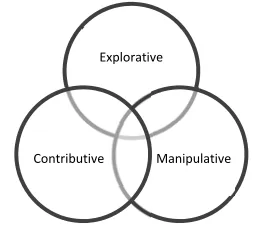
In VR, the level of interaction about the functionality between user-system is categorized into three levels, which refer to the degree of intervention that the user has in the virtual environment (Figure 2).
3. 3DMODELING
The geometric model is an essential part of the present work since, in this section, the visual aspect will be defined by 3D modelling software (Blender). A two-dimensional virtual environment entails a straightforward process to one in three dimensions, because for the first one there is
nothing more than to use essential design tools, since only flat images are implemented, however, for the creation of three dimensions, there is a higher degree of complexity because it is necessary to implement a tool capable of exporting reliable geometry in a manipulable and straightforward format on any platform.
Polygon modelling is the most fundamental expression of three-dimensional computer-generated models, which are made up of vertices, edges and faces. The amount of polygons that each model contains is fundamental since it is directly related to the graphic quality of the model, as well as the kinematic behaviour of the environment. Likewise, it has been considered the cost of memory that the amount of polygons implies, which is beneficial for the application because it is a structural model, so the relationships that could exist with other complex models in the environment is almost nil.
It is worth mentioning, due to the development context of the present application, that the manipulation and treatment of the models made in Blender, was possible thanks to three basic operations of vector calculation. As the technique of polygonal geometry implemented, in the virtual environment, helps 3D models consume the minimum in computational costs, so the processor can quickly calculate the equations that are part of the objects in the environment.
On the other hand, the process to apply the texture or material implies other techniques among which the UV Mapping technique was chosen. The texturing comes to cover the lack of uniformity that could be left using only materials, for example, that does not entirely cover the desired colour, shape, or some other detail of its final appearance. UV
Explorative
[image:3.612.343.472.187.303.2]Manipulative Contributive
mapping is a technique used to map "image" textures on three-dimensional models. The textures used were arranged using Photoshop to create concordant patterns in the mapping. This technique constitutes an excellent way to texture a model because it fits perfectly to the image. See Figure 3.
[image:4.612.91.302.187.286.2]
Figure 3. Texturing Process with UV Mapping in Blender.
It this is achieved because the mapping manages to assign an image for each polygon allows to make up the model since each vertex of the polygon represents a pair of 2D coordinates that defines which part of the image is mapped.
Precisely, these coordinates are known as UV's, which are comparable to the XYZ coordinates in the 3D plane.
4. INTELLIGENTAGENTS
In recent decades there is a need to create intelligent systems that allow users to develop specific statistics based on development processes and especially considering the time factor. In the use of these systems that are capable of keeping statistics and being more autonomous, the term Agent is born.
A large number of definitions of the concept of an agent can be found in the literature, without any of them being entirely accepted by the scientific community, perhaps Russell's [38], which considers an agent as an entity that perceives and acts on an environment
1. Agent: A computer system (HW and SW) that has the following properties. Autonomy: It can operate without human intervention and has some control over its actions and state. Internal.
2. Social ability: Interact with other agents via languages.
3. Reactivity: They perceive their
environment and respond promptly to changes.
4. Pro-activity: Capable of exhibiting behaviour directed towards goals, showing initiative.
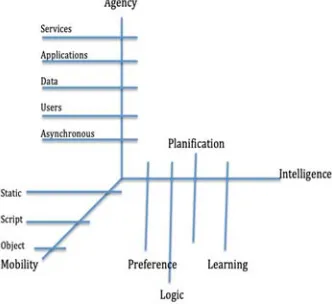
There are different types of agents; one of that classification are intelligent agents, intelligent agents are defined in terms of a defined three-dimensional space (Figure 4) [37], Agency, Intelligence and Mobility.
Figure 4. Scope of intelligent agents [37]
Agency: is the degree of autonomy and authority established in the agent, and can be measured qualitatively, by the nature of the interaction between the agent and other entities.
Intelligence: is the degree of reasoning and behaviour learned: the agent's ability to accept statements of the user's goals and carry out entrusted tasks.
Mobility: Some systems learn and adapt to their environment, both in terms of user objectives, in which the agents themselves travel through the network.
5. INTELLIGENTVIRTUALAGENTS
[image:4.612.340.506.251.403.2]goal either on its initiative or because given a situation it is required [38].
Smart agents can be considered as individual entities within a program, in our case, an EV3D, who have control over their life and movements within it. They can carry out processes continuously that help them know what and how to do their tasks. Besides, they can communicate with other agents inside or outside their environment, which helps them to achieve their goal more efficiently [39].
According to the point of view of artificial intelligence, an intelligent agent must have the following properties: temporal continuity, autonomy, sociability, reaction capacity, pro-activity, own initiative, mobility, truthfulness, generosity and rationality [39], [40 ], [41].
3DIVA have characteristics of virtual environments and intelligent agents:
1. They live within a simulated 3D execution environment.
2. They have a 3D graphic representation within the world they inhabit, and they can perceive, adapt and react to their environment (this depends on the level of immersion of the application).
3. They can express their behaviours graphically as a living being would. 4. Although they only exist and work in a
specific environment, they are aware of the changes that occur around them and can respond to them autonomously.
It is common to confuse the concept of AVA with that of Avatar. An Avatar is the graphic representation of a person or element that exists in real life; its behaviour is explicitly controlled by an external user, through control commands; Therefore, it is not autonomous.
The incorporation of AI into EV3D is an extended field of research, such as the analysis of the behaviour of intelligent agents and their credibility in virtual environments, creation of synthetic agents, virtual actors, virtual humans, among others.
All this represents the convergence that has been generated between Artificial Intelligence (AI) and the EV3D. The insertion of AI techniques interacting with the system of graphic systems supporting EV3D provides: [33].
1. Optimizes interactivity. This type of environment requires a high level of interaction and helps the user, so it is necessary to resort to "intelligent assistance", which will seek new interaction capabilities for objects within the environment and the user (s). It also adds a fundamental factor, to achieve a complex interaction, which is the recognition of the actions executed by the user, in this way the EV3D can adapt to its behaviour based on those actions.
2. A new alternative in the representation of knowledge. Currently, the drawing and representation of virtual environments in a computer, has changed significantly, with the emergence of new and powerful tools, in addition to this, also evolved in its structure because now the model based on scene graphs allows greater control in the EV development. Moreover, with the current demand to integrate intelligent characters into the environment, which implies the maintenance of the symbolic representation (environment), in which the agent (s) or character (s) can provide feedback on their knowledge. In the characters within an environment, the information handled by the simulation agents covers different levels of representation. The basic level will collect geometric information about the environment (sizes, positions, directions, colours, property that are visible from 3D objects and actors). Meanwhile, the symbolic representation of the environment will allow the characters and agents to solve more optimally the inconveniences that might arise in the EV3D. This type of representation will help in programming solutions to many constraints in terms of interactivity with the user.
behavioural variability in different situations. In this way, state machines, rule systems, factual bases, and other reactive characteristics, can be included to control the levels of freedom of different environmental mechanisms, for example, windows, doors, furniture, lights, stairs.
Properly there is no accepted general definition. Since many researchers tend to agree that agents are software entities with autonomy, but in the characteristics and properties, each has its criteria as to which are the most essential. However, for terms of the existing project, Smith's (1994) definition is the most accurate because it indicates that an agent is a persistent software entity, focused on a specific purpose.
Systems with this property are distinguished from other types of multifunctional applications mainly by their structure, since agents such as persistent software entities are programmed to meet specific objectives, and in turn, can interact with each other.
[image:6.612.321.510.416.570.2]When implementing an architecture "intelligent agents", according to Thanos G. (2014), a set of available primitives must be present, because these will control the environment. Likewise, using their number and complexity, they will define the scope of the agent. If an avatar was used for the user, and he could gesture, there would be no need to add or detect emotions. See Figure 5.
Figure. 5 Structure of an Intelligent Agent.
However, in this particular case, was not used any avatar, but merely the agent himself immersed in the representation of the user.
6. INTELLIGENTAGENTREAGENT
The reagents are subdivided into several categories according to the behavioural approach; a pure reagent acts depending on perceptions that are taking their environment, without considering the above.
This type of action may not be so useful since many virtual environments require to keep a history to optimize their decisions (e.g. a chess game).
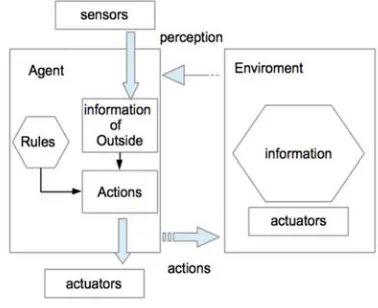
In Figure 6, shows the operating components of a simple reactive agent, is, by definition, able to perceive their environment and react to the changes that occur in it. The decision-making system is usually the one that determines the handling of the variability of situations in the simulated world, detecting changes that alter the behaviour in the simulated world, and discarding the irrelevant data.
Remember that the agents represent the autonomous entities of the system. These agents can manage objects that are not represented within the EV, that is, they will be able to manage accounts linked to the user, databases, or any other element that has no virtual representation.
Figure 6. Diagram of a Reactive Agent.
7. DEVELOPMENTMETHODOLOGY
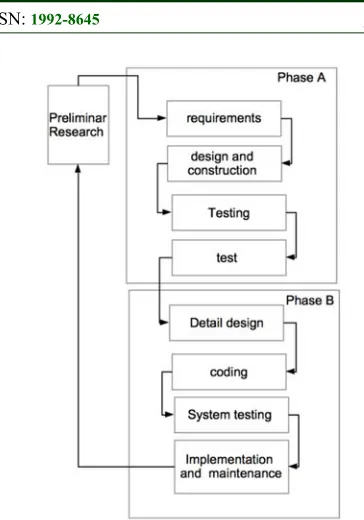
[image:6.612.101.292.476.622.2]Figure 7. Methodology oriented to prototypes.
Phase A: The stages that make up this phase are requirements and specifications, design and construction, evaluation and modification, which are oriented to the polygonal and visual development of the virtual environment. At the end of this phase, it can be evaluated as a prototype, since it represents the interface that the user will handle.
Phase B: This second stage forms the implementation of the geometry in the environment, aspects of interaction with the user implementing VR technologies, and analyzing the last details of the interface in the integration of all the stages for its later execution.
The main problem that is addressed is the low interest and assistance rate, which has provided different surveys at the national and local level (specifical data from a survey conducted in Mexico City). Mexico City was chosen as a study site because it is one of the busiest cities in the country and where many cultural buildings are located where different workshops, courses and certifications are taught in related subjects.
Among these cultural properties has been chosen CENART (National Center for the Arts), for being one of the spaces that together, in turn, research centres and educational art and cultural institutions of high relevance, it is because it is relevant for this paper (Cultural, 2016).
8.THE ARCHITECTURE OF THE 3D
VIRTUAL ENVIRONMENT WITH AN
INTELLIGENTAGENT
As mentioned above, the main objective of this architecture is to divide the operation of the system into entities and modules that can be developed in the long term with new interventions and adjust new one's processes.
The functionality of the Smart Virtual Environment based on a reactive agent (in the subsequent "CNA RV System"), is developed mainly by the following modules:
1. Communication 2. Module Graphic 3. Module Motion
4. Module Behavior Module Our proposed schema is shown in Figure 8.
Figure 8 General Structure of the System.
The data provided by the user interaction in the 3D environment will be stored in arrangements that will be the primary knowledge, with which the system is fed back and adjusted, through the agent.
[image:7.612.315.529.390.555.2]when the behaviour of the members of the environment is defined. In the communication at this level, do not contemplate details such as animations and collisions of the objects in the environment, but have a focus on the relevant actions for the module that concerns the behaviour of the agent.
2. Graphics Model: The graphics engine is responsible for the "three-dimensional drawing". Also, it is responsible for the creation of the window, using the calls to the underlying operating system. All the information generated in the 3D model was exported to the graphics engine used in the present work, which is Unity. Unity is a multiplatform video game engine created by Unity Technologies., Through a file ". Fbx", which is the one that has more excellent compatibility with the software and which has been proven to keep more completely by its hierarchy, the information created from the model The hierarchy process works through different levels that contain objects with their parameters; this division of levels is done so that there are only a few objects per level for more control. The following figure illustrates, in a general way, the levels of hierarchy in a computational application with 3D modelling at the graphics level.
3. Movement Model: This module is directly linked to the development of physics within the environment. However, it feeds on all the behaviour of the system in general. It is based on the definition of the characteristics of real events, in order to determine movements of an object or animations within the environment. In this module converges the kinematics of physics within the environment and the specific programmed movements. That is, in this section, specific characteristics of the movements are handled; for example, the movement of an avatar before a specific stimulus.
4. Behaviour Module: This is where the behaviour model that describes the behaviour of the system in general terms is designed, which converges perfectly with the movement module complementing the necessary
information for the intelligent agent algorithm. This level focuses on the semantic system where all the elements that make up the application must be defined, and if required, it must assign its characteristics, classify them and define them in a universal context based on the development engine. In other words, it is the connection that makes it possible for an element of the EV to change its surrounding behaviour to notice this movement. The greater focus is on the reactions of the system to the decisions of the user, for this reason, the machine model of states will be handled, through the intelligent agent who will be in charge of managing environmental behaviour.
9. TESTSANDRESULTS
The results obtained through the "Usability Test" (Pereira, 2002) that is focused on the evaluation of the system based on the defined metrics (interface, virtual reality, user). The following table shows the evaluation data issued by the participants of the present usability test, from various reagents specified to corroborate the correct functioning of a system with RV.
Four tables are presented indicating the levels of schooling contemplated that shows a correlation with different pronounced profiles. These methods, in any of their categories, are applicable in the development of software in RV, given to what is stipulated in ISO 9241-11.
Table 1 Results of the evaluation obtained of the application of our instrument using usability Test.
It is essential to mention that the methods used Questionnaire and Test, belong to different evaluation systems within the Usability, although they may seem the same, the information collected by both formats has different approaches. Pd. d. Lilliam Perurena Cancio, (2013).
The present information allows recognizing essential points within the validation test, using accurate conclusions, such as:
The evaluated aspect that generated the highest average was the one corresponding to information for the user. Which is essential, since the agent was implemented to provide the user with the necessary information to meet the objective.
The most valued reagents: structure organization, interactivity, feedback, content presentation, immersive feeling, understanding. They fit perfectly to the ideals of the development of the application, based on the objectives set. However, the percentage obtained on average is far from optimal.
The least valued reagents are the next: 1. Structure consistency 2. System performance 3. Information search 4. Navigation procedure 5. Reliability
These poorly valued items are the points that need improvement and also imply a significant relapse in the evaluation.
Likewise, it can be rescued, thanks to the standard deviation, that is a percentage of 71.4% of the aspects evaluated, there is a tendency towards a positive evaluation.
Figure 9. Test by item.
10. CONCLUSIONS
It is possible to can assert that the effectiveness, satisfaction and effectiveness of the system can be measured about the overall percentage acquired, based on the comparison of the averages generated by each level of schooling involved in the test, calculated and defined by the percentage of 85%, on a scale of 1 to 100.
In this way, the use of a reactive intelligent agent leaves the right conditions for the incorporation of agents with specific tasks within the system (e.g. interface agent and pedagogical agents)) since it was possible to verify an improvement in the optimization of processes in the interactive features within the 3D environment.
ACKNOWLEDGEMENTS
[image:9.612.90.304.117.324.2]REFERENCES
[1] Alejandro Cerón Cardona, PA (2014). Essential Manual of Unity 3D as Support for National Tourism Development. Pereira
[2] Andrea Bonsch, TV (2017). Turning Anonymous Members of a Multiagent System into Individuals. Aachen Visual Computing Institute, RWTH Aachen University. USC Institute for Creative Technologies, USA. , Germany.
[3] Anu Sivunen, in (2014). Social Presence as a Multi-Dimensional Group Construct in 3D Virtual Environments. Journal of
Computer-Mediated Communication, 20: 19-36.
[4] Arango, JA (July 2014). Development of Intelligent Virtual Environments Based on the Meta-Model MAM5. Valencia, Polytechnic University of Valencia. Department of Computer Systems and Computing Valencia, Spain.
[5] Arsalan Heydarian, JP-G. (2015). Immersive virtual environments versus physical built environments: A benchmarking study for building design and user-built environment explorations. Automation in Construction,
Volume 54, Pages 116-126.
[6] Brunet, P. (2012). Interactive Graphics Systems: Virtual Reality Architectures. Barcelona. Department de Software, Polytechnic University of Catalonia, Spain.
[7] Dr Lilliam Perurena Cancio, IM (2013). Usability of Web sites, Methods and Evaluation Techniques. Cuabana Journal of
Information in Health Sciences, Vol. 24, No.
2.
[8] Garduño, EA (July 2012). Analysis and Design of the Interface for a Collaborative Learning System Supported by an Intelligent Tutor Agent (Doctoral Thesis). Mexico, Autonomous Metropolitan University. Division of Sciences and Arts for Design. , Mexico.
[9] Giuseppe De Giacomo, VN (2014). Agent Behavior Composition in Virtual Environments Realized Using Game Engines.
21st European Conference on Artificial
Intelligence (ECAI) 2014. Prague.
[10] Gómez, ID (June 2006). Techniques and Metrics for Usability Evaluation. Popayán University of Cauca. Faculty of Electronics and Telecommunications Engineering, Colombia.
[11] Gonzalo Luzardo, JH (August 5, 2014). Artificial Intelligence in Virtual
Environments: Autonomous Virtual Humans (HVA) as Intelligent Virtual Agents (3DIVA). Madrid Spain.
[12] Hernández, LR (2017). Artificial Intelligence: Smart Agents and Environments. Mexico City. National Autonomous University of Mexico, Mexico.
[13] Hollinger, D. (2016-2017). Artificial Intelligence and Machine Learning. Wroclaw, Wroclaw University of Technology. Faculty of Electronics Department of Cybernetics and Robotics, Poland.
[14] Ibañez, ML (2004). Behavioural Animation of 3D Intelligent Characters Based on MiniMin-HSP (Heuristic Search Planning). Valencia. The University of Valencia. Spain.
[15] Jahanzeb Hafeez, SL (2017). Image-Based 3D Reconstruction of Texture-less Objects for VR Contents. International Journal of
Advanced Smart Convergence, Vol.6 No.1
9-17.
[16] Juan Manuel Jiménez Gutiérrez, LF (2014). Animation and Reconstruction on the Prehispanic Zone of Monte Albán, Oaxaca. Mexico .
[17] Llobet, IS (2015). Babel: development of a platform video game in Unity. Valencia. The polytechnic university of Valencia. Spain. [18] Luna, JN (September 2012). Virtual Reality,
State of the art and critical analysis (Master in Software Development). Pomegranate. The University of Granada. Spain.
[19] M. in C. Pozas Cárdenas Mariano Javier, M. e. (19 of 05 of 2015). Virtual Reality Systems. Hidalgo, Mexico
[20] Mabanza, N. (July 2016). Determining the Usability of Pedagogical Interface Agents in the Context of Adult Computer Literacy Training: A South African Perspective. Bloemfontein. The University of the Free State. Department of Computer Science and Informatics, South Africa.
[21] Mathieu Aubry, BC (March 2014). Painting-to-3D model alignment via discriminative visual elements. ACM Transactions on
Graphics (TOG), Article No. 14.
[22] Murray, JW, (2014). C # Game Programming
Cookbook for Unity 3D. Boca Raton, Florida:
CRC Press. Taylor & Francis Group.
[23] Robles, JM (January 20, 2017). The most relevant technologies for the future of humanity. Madrid Spain.
[24] Rodríguez, MV (September 21, 2015). Virtual Reality Applied to Travel. Spain.
and Reasoning of its Elements with a Character for the Generation of Realism (Doctoral Thesis). Medellín, National University of Colombia. Faculty of Mines, Department of Computer Science, Colombia. [26] Serkan Dincer, AD (2015). The Impact of
Pedagogical Agent on Learners' Motivation and Academic Success. Of Gruyter Open.
Practice and Theory in Systems of Education,
Volume 10, number 4.
[27] Soto, AV (May 12, 2012). Binivel programming techniques for network design. Cholula School of Engineering, University of the Americas Puebla. Department of Industrial and Mechanical Engineering. , Puebla, Mexico.
[28] Thanos G. Stavropoulos, EK (2014). An Applied Energy Management Approach in Intelligent Environments based on a Hybrid Agent Architecture. 21st European Conference on Artificial Intelligence (ECAI)
2014. Prague.
[29] Thompson, M., (2017). Virtual Worlds: Art
Studio Extension. New York: ProQuest.
[30] V. Juřík, LH (July 2016). Cognitive Aspects of Collaboration in 3D Virtual Environments.
The International Archives of the Photogrammetry, Remote Sensing and Spatial
Information Sciences, (pp. Volume XLI-B2,
2016 XXIII ISPRS Congress, 12-19).
[31] Valdez, KV, (2011). Comparative study of free and proprietary software tools for 3D modelling. Practical case Modeling of Human Faces. The University of Murcia. Center for Virtual Archeology Studies. Spain.
[32] Varela, Á. M. (2015). An application of interactive multi-criteria optimization to air pollution control / Annex1. University of Vigo, Dept. of Applied Mathematics, Vigo, Spain, Spain.
[33] Xin Bai, JL (October 2013). Enhance Learning in a Virtual Professional. GSTF International
Journal of Nursing and Health Care (JNHC),
Vol.1 No.1.
[34] Yang Kuang, JJ (2015). Research on Key Problems of Making 3D Scene Model Based on VRML. International Industrial Informatics and Computer Engineering
Conference (IIICEC 2015) (pages
1283-1286). The authors - published by Atlantis Press.
[35] Zaragoza., A. d. (10 of 2012). Project Management in Videogames of the Last Generation / Integration of a Videogame project. Zaragoza, Spain.
[36] Zumaquero, SF (February 8, 2010). Usability evaluation methods for RV, RA and Ubiquitous Systems. Albacete, Spain.
[37] Gilbert & JE Doran Simulation as a research strategy. In KG Troitzsch, U. Mueller, GN (Eds.), Social science microsimulation (pp.
448-454). Berlin: Springer, 1996
[38] Stuart Rusell, Peter Norvig, Artificial intelligence: A Modern Approach, Prentice-Hall, second edition, 2007.
[39] Huhns, M., Singh, MP: Readings in Agents. Readings in Agents. Capítulo 1, pp. 1-24 (1998)
[40] Woolbridge, M., Jennings, NR: Intelligent Agents: theory and practice (1995)