ISSN: 1992-8645 www.jatit.org E-ISSN: 1817-3195
THE MODERATING EFFECT OF ISLAMIC WORK ETHICS
ON THE RELATIONSHIP BETWEEN KNOWLEDGE
MANAGEMENT CAPABILITIES AND ORGANIZATIONAL
PERFORMANCE AT THE PRIVATE HIGHER EDUCATION
INSTITUTIONS IN OMAN
1AIDA A.AZIZ AHMED AL-ARIMI
,2MASLIN MASROM, 3NIK HASNAA NIK MAHMOOD
1,2,3
Razak School of Engineering and Advanced Technology Universiti Teknologi Malaysia
Jalan Sultan Yahya Petra 54100 Kuala Lumpur, Malaysia
E-mail: 1 [email protected], [email protected], [email protected]
ABSTRACT
Knowledge management capabilities are recognized as an important means for sustaining and improving organizational performance of the private higher education institutions. The evaluation of knowledge management infrastructure capabilities and knowledge management process capabilities has become important since it provides a reference for directing the private higher education institutions to enhance their organizational performance. The Islamic work ethics may have a moderating effect on the relationship between knowledge management infrastructure capabilities, knowledge management process capabilities and organizational performance. This paper provides an understanding of relationship between knowledge management infrastructure capabilities, knowledge management process capabilities, organizational performance and the Islamic work ethics. Additionally, it provides a new framework that helps the private higher education institutions to assess their knowledge management infrastructure capabilities, knowledge management process capabilities, organizational performance and the Islamic work ethics. The research findings showed that the level of knowledge management infrastructure and process capabilities at the private higher education institutions was high, and indicated that the knowledge management process capabilities had a positive significant causal effect relationship with organizational performance, however the research findings showed that the relationship between knowledge management infrastructure capabilities with organizational performance had a non-significant causal effect. Finally, the Islamic work ethics had a significant moderating effect on the relationship between knowledge management infrastructure and process capabilities and organizational performance.
Keywords: Knowledge Management, Knowledge Management Infrastructure Capabilities, Knowledge Management Process Capabilities, Organizational Performance, Islamic Work Ethics, Private Higher Education Institutions.
1. INTRODUCTION
In a continuously changing world, people seek for new knowledge incessantly. Knowledge management (KM) is one of the most important factors to stimulate and achieve the strategic goals for any organization. Also, even though the KM concept has been accepted for decades, yet the organizations have not been fully successful in application aspects. KM has vital importance in higher education which is responsible for the creation and transfer of knowledge to people [1]. How does the private higher education institutions
ISSN: 1992-8645 www.jatit.org E-ISSN: 1817-3195
Scholars had attempted to measure the contribution of the knowledge management infrastructure capabilities and knowledge management process capabilities in organizational performance by different models in business context. Few researches measured the relationship between knowledge management infrastructure capabilities and knowledge management process capabilities with organizational performance at the private higher education context. Furthermore, there is a lack in research in exploring the work ethics role on the relationship between knowledge management and organizational performance more specifically the moderate effect of the Islamic work ethics.
2. LITERATURE REVIEW
The following literature reviewed the empirical researches in knowledge management capabilities contribution to the organizational performance which most was in the business settings and few researches were in the higher education setting, and work ethics, knowledge management and organizational performance relationship.
[5] Studied the theory of organizational knowledge management capabilities (KMC). This research examined the issue of effective knowledge management (KM) from the perspective of organizational capabilities. This perspective proposed that a knowledge infrastructure consisting of technology, structure and culture along with knowledge process architecture of acquisition, conversion, application and protection which are essential organizational capabilities or pre-conditions for effective KM. [4] found that the knowledge management infrastructure capabilities (KMIC) and knowledge management process capabilities (KMPC) have a positive relationship with KM effectiveness (organizational effectiveness). The organizational effectiveness measured using a broad set of non-financial outcomes for example innovation, coordination, responsiveness, ability to identify market opportunities, speed to market and process efficiency. However, [5] did not examine the financial performance, and this study was in business setting.
[6] Extended the notion of organizational effectiveness and added the financial measures and surveyed ten companies. The study found a weak positive relationship between the extent to which the organizations created and exploited knowledge
and overall organizational performance (OP) including financial metrics, and this research was in business setting.
[7] Lee and Lee (2007) examined the knowledge management (KM) capabilities, processes and performance and suggest strategic directions for the successful implementation of knowledge management. The result showed that there is a significant relationship among knowledge management capabilities (KMC), processes and performance, and this study was in business setting.
[8] Analyzed the relationship between knowledge management infrastructure capabilities (KMIC); culture (collaboration, trust and learning culture), structure (decentralization), management (top management support and promotion) and technology (IT support), knowledge management process capabilities (KMPC) (acquisition, conversion, application and protection), creative organizational learning and organizational performance (OP). The results showed that collaboration, learning culture, top management support and IT support affect the KMPC. KMPC and creative organizational learning in turn mediate the relationship between KMIC and OP which demonstrate the relevance of KMIC for OP. This research was in business setting.
[9] Investigated the effects of knowledge management infrastructure capabilities (KMIC); technology, structure, culture and incentive and knowledge management process capabilities (KMPC); acquisition, conversion, application, storing and protection) on organizational performance (OP). The result presented that there is a positive relationship between effective knowledge management (KM) and OP. However, no empirical evidence was found to suggest that knowledge management capabilities (KMC) are linked to the objective financial performance, which remains a topic for future review. The results also showed that knowledge management was affected by organization's size, but not by type of organization. This research was in business setting.
ISSN: 1992-8645 www.jatit.org E-ISSN: 1817-3195
indicated that some knowledge resources (e.g. organizational structure, knowledge acquisition, knowledge application and Knowledge protection) are directly related to OP while others (e.g. technology, organizational culture and knowledge conversion), though important preconditions for knowledge management (KM) are not directly related to OP. This research was in the setting of higher education institutions.
[11] Examined the knowledge management (KM) infrastructure at Kuwait University and saw how faculty members evaluate KM influence on organizational performance. The results revealed that faculty members evaluate knowledge management as ‘very good’ which indicated that KM components are highly related to organizational performance. This research was in higher education settings.
[12] Studied the relationship between knowledge management (KM) and organizational performance (OP): an exploratory analysis. KM practices were found to be directly related to OP which, in turn, was directly related to financial performance. There was no direct relationship found between KM practices and financial performance. A different set of KM practices was associated with each value discipline (i.e. customer intimacy, product development and operational excellence). A gap exists between the KM practices that firms believe to be important and those that were directly related to organizational performance. This research was in business setting.
[13] Examined the impact of knowledge management capability (KMC) and supplier relationship management (SRM) on corporate performance. The results indicated that KM capabilities positive influence on corporate performance, while SRM is the partial intervening variable between KMC and corporate performance. This research was in business setting.
[14] Studied the performance implications of knowledge management (KM) processes that are examining the roles of infrastructure capability and business strategy. The result found that the roles of infrastructure capability and business strategy have a positive association with the KM process and confirmed the relationship between KM and firm performance. This research was in business setting.
[15] Proposed an integrated knowledge management capability (KMC) framework for
assessing organizational performance. The knowledge management infrastructure capability (KMIC) consisted of; knowledge-based structure, knowledge-based technology, knowledge-based human resources and knowledge-based culture. The knowledge management process capabilities (KMPC) consisted of knowledge acquisitions, knowledge conversions, knowledge applications, knowledge protections and knowledge storing. The knowledge management functions consisted of knowledge creation, knowledge sharing and knowledge utilizations. The results indicated that there is positive correlation between KMC and OP. The results also showed that the proposed framework can be used to assess OP and also can be used as decision tool to decide which KMC should be improved. This research was in business setting.
[16] Investigated the role of knowledge management (KM) in enhancing organizational performance (OP). The research examined the relationship between knowledge management infrastructure capabilities (KMIC); technology, structure, culture and human resources and knowledge management process capabilities (KMPC); acquisition, conversion, application, storing and protection and the KM performance. The research sample was 302 IT employees. The result presented that all elements of KMC have a positive significant relationship with all measures of the OP at 1% level of significant; it means that there is a great correlation between KMIC, KMPC and OP. This research was in business setting.
[17] Examined the impact of knowledge management resources on organizational performance. The results showed that some knowledge resources (structure & acquisition) were directly related to organizational performance, while others (technology & culture) were not directly related to organizational performance.
[18] Investigated the relationship between ethics, knowledge creation and organizational performance. The results revealed that there is a positive and strong correlation between ethics and organizational performance. The relationship between ethics and knowledge creation processes is also positive and significant but no significant relationship is observed between knowledge creation processes and organizational performance.
ISSN: 1992-8645 www.jatit.org E-ISSN: 1817-3195
(KMIC) and organizational performance(OP) and the relationship between knowledge management process capabilities (KMPC) and organizational performance(OP) has been investigated by a number of studies [11][13][18][10][15][16][19] [8][17][9][14][12][7][6][5]. Few researches examined the association between KMIC, KMPC and OP in the higher education setting [10] [11]. Additionally, little research investigated the role of work ethics on the relationship between knowledge management and OP [18]. Also, although knowledge management has spread its wings across many domains, it still lacks its implementation in higher education institutions [20]. According to [21] even though organizations have implemented knowledge management (KM) and offer inconsistent support that KM enhances firm performance and relevant empirical research has yet to produce satisfactory evidences on the nature of the relationship between KM and firm performance. The existing researches are not enough to make a conclusion about the relationship between KMIC, KMPC and OP in non-business setting (e.g., higher education).
2.1 Knowledge Management Capability
Knowledge management capability (KMC) is the ability to organize, shift, configure and arrange knowledge-based resources to achieve the goals and gain business values from the organization based on knowledge-based view [22][23]. [24] defined knowledge management capability (KMC) as an organizational capability to manage the organization’s knowledge with efficacy (efficiently and effectively) and assert.
Knowledge management capability (KMC) is the ability to deploy knowledge resources effectively and implement knowledge processes efficiently to derive organizational benefits [25]. According to [19], KMC is the ability of an enterprise to leverage existing knowledge to create and protect new knowledge. Furthermore, an enterprise should combine personal skills and knowledge, physical and technical resources, structure and culture to stimulate the ongoing knowledge dynamism [26].
Knowledge management capability (KMC) are defined as the use of knowledge assets, such as human, organization, and information capital, to produce knowledge synergy through a series of coordinated knowledge processes, such as knowledge acquisition, transfer, integration, and application [27].
According to [5] knowledge management capability consists of knowledge management infrastructure capability (KMIC) and knowledge management process capability (KMPC). Knowledge management infrastructure capability (KMIC) is deeply related to balancing people and technology; establishing and cultivating a knowledge environment; combining technology and organizational design; managing tacit knowledge and establishing flexible and modular organizational structure [5]. Knowledge management process capability (KMPC) refer to the abilities of a firm using knowledge assets in a series of coordinated knowledge processes for the purpose of creating valuable knowledge [5]. Knowledge assets and capabilities may interact with each other to develop organizational capability and further improve organizational performance [28].
2.2 Organizational Performance
[29] Stated that organizational performance (OP) encompasses three specific areas of firm outcomes: (a) financial performance (profits, return on assets, return on investment, etc.); (b) product market performance (sales, market share, etc.); and (c) shareholder return (total shareholder return, economic value added).Performance can be characterized as a measure of the accomplishment of organizations objectives [30].
Organizational performance (OP) is measured through financial and non-financial measures like sale, profit, and market share and non-financial factors measures are efficiency, quality of service, productivity of organization, satisfaction of employees [31]. An organization must constantly strive to improve performance. Traditionally, organizational performance (OP) was measured using financial data however, financial measurements defines the results of actions already taken and are usually reported at the end of projects, so there is no instant feedback when a problem occurs. In this sense, a single financial performance measurement could not support the continuous improvement and innovation of the organization [32].
2.3 Islamic Work Ethics
ISSN: 1992-8645 www.jatit.org E-ISSN: 1817-3195
morality [33]. [34] Defined Islamic work ethics (IWE) as an orientation that shapes and influences the involvement and participation of believers in the workplace. It implies that work is a virtue in light of man’s needs and a necessity to establish equilibrium in one’s individual and social life. IWE can be defined as the good principles and values based on the Islamic sources.
According to [35] Islamic work ethics (IWE) is a guideline in conducting work based on Islamic teaching. It is an orientation that shapes and influences the believers‟ involvement and practice in the workplace. [36] Defined IWE as the set of moral principles that distinguish what is right from what is wrong in the Islamic context. [37] Defined IWE as an orientation toward work and approaches work as a virtue in human lives. Islamic work ethics (IWE) is a principle of right and wrong which designate to demonstrate what human ought to do taught Quran and shown in the great life of Prophet Muhammad [38]. IWE is a concept of ethics that is based on Islamic teaching and principle which rely on faith [39]. IWE is defined as a set of values or system of beliefs derived from the Quran and Sunnah concerning work and hard work [40].
From the literature review, there is a scarcity in empirical researches investigating the moderate effect of the Islamic work ethics (IWE) on the relationship with organizational aspects as following:
First, the moderating effect of the Islamic work ethics (IWE) on the relationship between job stress and work outcomes among employees at private and public sector in Pakistan [41]. Second, the moderating effect of the IWE on the relationship between human resources (HR) practices (Employees Recruitment and Selection, Employees Training and Development, Employees Performance Appraisals and Employees Compensation System) and perceived project success in project-based Pakistani organization [42]. Third, the moderating effect of the IWE on the relationship between organizational justice and work outcomes (turnover intentions, job satisfaction, and job involvement) [43]. Fourth, the moderating effect of the IWE on the relationship between organizational commitment and turnover intentions in public sector of Pakistan [44]. Fifth, the moderating effect of IWE on the relationship between employee's commitment and employees work satisfaction among employees in banking
sector [45]. Sixth, the moderating effect of the IWE on the relationship between knowledge sharing capability and innovation capability among administrative and diplomatic service officers from the Malaysian public sector organizations [4]. Seventh, the moderating effect of the IWE on the relationship between organizational commitment and the job satisfaction among Muslim employees in several organizations in the United Arab Emirates (UAE) [46]. Finally, [47] proposed a framework on the moderating effect of the IWE on the relationship between emotional intelligence and leadership practice among the middle administrators at the Malaysian public universities.
Additionally, few previous researches showed that there is a significant positive relationship between knowledge management (KM) and work place ethics [48] [49] [50] [51] [37]. [49] Studied and explained that competing values framework does not include scales for trust and an ethical workplace and concerning the important role of ethics culture in knowledge management (KM) process, competing values framework was revised by adding an aspect which indicates ethics culture and trust. [18] Investigated the relationship between ethics, knowledge creation and organizational performance. The findings showed that there is a positive and strong correlation between ethics and organizational performance. The relationship between ethics and knowledge creation processes is also positive and significant but no significant relationship is observed between knowledge creation processes and organizational performance.
Furthermore, few researches investigated the relationship between the Islamic work ethics(IWE) and organizational performance (OP) direct relationship and found that there is a significant positive effect between IWE and OP [2][3]. Additionally, little research investigated the direct relationship between workplace ethics and found the direct relationship between work place ethics and knowledge management process (knowledge creation) [48] [49] [50] [51] [37]. Little research measured the moderate effect of the IWE on the relationship between knowledge sharing capability and innovation capability and the findings proved the moderate effect of IWE on the relationship [4].
ISSN: 1992-8645 www.jatit.org E-ISSN: 1817-3195
about the relationship between IWE and OP in non-business setting (e.g., higher education). [4] measured the moderate effect of the IWE on the relationship between knowledge sharing capability and innovation capability and the findings proved the moderate effect of IWE on the relationship. Finally, there is a scarcity in research in measuring the IWE moderate effect on the relationship between knowledge management infrastructure capabilities (KMIC), knowledge management process capabilities (KMPC) with the organizational performance (OP) especially in the context of the private higher education institutions in Oman. The current research intended to achieve the moderating effect of the IWE on the relationship between KMIC, KMPC and OP at the private higher education in Oman
.
3. RESEARCH OBJECTIVES AND HYPOTHESES
The objectives of this research are as follows: 1. To identify the level of knowledge
management infrastructure capabilities (KMIC) and knowledge management process capabilities (KMPC) at the private higher education institutions (PHEIs) in Oman. 2. To determine the relationship between
knowledge management infrastructure capabilities (KMIC), knowledge management process capabilities (KMPC) and the organizational performance (OP) at the private higher education institutions (PHEIs) in Oman. 3. To measure the moderating effect of the
Islamic work ethics (IWE) on the relationship between knowledge management infrastructure capabilities (KMIC) knowledge management process capabilities (KMPC) and the organizational performance (OP) at the private higher education institutions (PHEIs) in Oman.
Meanwhile, the hypotheses of this research are as following:
Hypothesis 1: There is a significant relationship
between knowledge management infrastructure capabilities (KMIC) and organizational performance (OP) at the private higher education in Oman.
Hypothesis 2: There is a positive and significant
relationship between knowledge management process capabilities (KMPC) and organizational performance (OP) at the private higher education in Oman.
Hypothesis 3:There is a significant moderate effect
of the Islamic work ethic (IWE) on the relationship between knowledge management infrastructure capabilities (KMIC), knowledge management process capabilities (KMPC) and organizational performance (OP) at the private higher education in Oman.
4. METHODOLOGY
This research used a quantitative correlation method using survey questionnaire to fulfill the research objectives. The research sample was 163 management staff at the private higher education institutions in Oman. The questionnaire was divided into five parts to specifically address the objectives determined in this research. Part one consisted of the demographic information of the respondent. Part two and three contained statements of measuring knowledge management infrastructure capabilities (KMIC) and knowledge management process capabilities (KMPC) adopted 81items from [5] measure. Part four; comprised statements of measuring the Islamic work ethics (IWE) adopted a short version 17 items of [52] measure. Part five consisted statements of measuring the organizational performance (OP) adopted 40 items from [5] [53] [54] [15]. The research measure had coefficient alpha of .810 -0.965 in previous studies and in actual research scored 0.892-0.925. The research questionnaire was based on a five-point Likert-type scale with anchors from “5- Strongly agree” to “1- Strongly disagree”.
5. RESULTS
The research data was analyzed using IBM SPSS Statistics version 20 and IBM SPSS AMOS version 20. The research data was screened for errors and missing data by inspecting the frequencies for each of the research variables [55] and the results are presented in the following section.
5.1 Demographic Characteristics
ISSN: 1992-8645 www.jatit.org E-ISSN: 1817-3195
Table 1.1: Frequency and Percentage Distribution of Respondents by Demographic Characteristics
Demographic Characteristics Frequency (n) Percentage (%) Gender: Male Female 91 72 55.8 44.2 Age:
20 to 31 years 32 to 41 years 42 to 51 years 52 to 65 years
21 46 66 30 12.9 28.2 40.5 18.4 Nationality: Omani Non Omani 41 122 25.2 74.8 Qualification: Diploma Bachelor Master PhD Certification (Information Technology) 9 39 58 56 1 5.5 23.9 35.6 34.4 .6 Years of Experience: 1-5 years 6-10 years 11-15 years 16-20 years 21-25 years 26-above years 52 37 35 19 10 10 31.9 22.7 21.5 11.7 6.1 6.1
5.2 Level of Knowledge Management Infrastructure Capabilities and Knowledge Management Process Capabilities
The first objective of this research was to determine the level of knowledge management infrastructure capabilities (KMIC) and knowledge management process capabilities (KMPC) implemented at the private higher education institutions. The overall mean value for KMIC was 2.6380 and standard deviation was 0.51905. Additionally, the overall mean for KMPC was 2.4785 and standard deviation was 0.55929.Based on 5 Likert scale labeled as low (1.00 through 2.33), moderate (2.34 through 3.66) and high (3.67 -5.00), majority of the respondents (i.e. management staff) scored a high level of KMIC and KMPC. This indicated that the private higher
education institutions (PHEIs) paid a good attention to KMIC and KMPC.
5.3 Hypothesis Testing
The second and third of the research objectives were presented in Hypotheses 1 and 2 which focused on the relationship between knowledge management infrastructure capabilities (KMIC), knowledge management process capabilities (KMPC) and organizational performance (OP) at the private higher education institutions (PHEIs) in Oman. The results of structural equation model (SEM) model fit were revealed in Table 1.2 and the hypotheses assessment was shown in Table 1.3.The results showed that there was a non-significant relationship between KMIC and OP. However, there was a significant positive relationship between KMPC and OP at the PHEIs in Oman.
Table 1.2: The Structural Equation Model (SEM) Model Fit Name of Category Fit Indexes Level of Acceptance Index Level Modified Overall SEM KMIC--->OP KMPC--->OP
Absolute Fit Chisq X2
RMSEA<0.08
249.023 0.078
Incremental Fit CFI > 0.90 TLI > 0.90 NFI > 0.90
[image:7.612.294.525.529.627.2]0.950 0.939 0.906 Parsimonious Fit Chisq/df< 5.0 1.992
Table 1.3: The Hypotheses Tests are of the Modified Overall KMIC, KMPC and OP Structure Equation Model
Hypotheses Path
Estima te
S.E C.R P Estimate
β Modified Overall SEM KMIC-->OP KMPC-->OP 0.152 0.176 0.094 0.077 1.606 2.297 0.108 0.022 0.331 0.471
ISSN: 1992-8645 www.jatit.org E-ISSN: 1817-3195
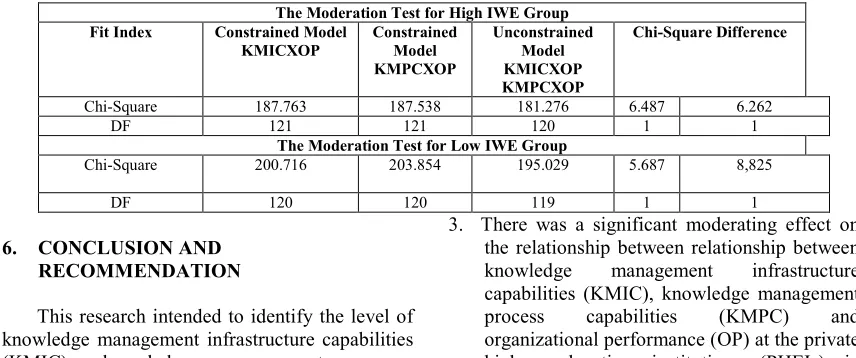
The results of structural equation model (SEM) using multiple grouping analysis of the high and low group of the moderating variable (IWE) difference of the Chi Square and the degree of freedom between the constrained and un constrained of the two groups [55] were revealed in
[image:8.612.89.517.204.383.2]Table 1.4. The result showed that there was a significant positive moderating effect of the IWE on the relationship between KMIC, KMPC and OP at PHEIs in Oman.
Table 1.4: The Moderation Test using High and Low IWE Group SEM of the Relationship between KMIC, KMPC and OP
The Moderation Test for High IWE Group Fit Index Constrained Model
KMICXOP
Constrained Model KMPCXOP
Unconstrained Model KMICXOP KMPCXOP
Chi-Square Difference
Chi-Square 187.763 187.538 181.276 6.487 6.262
DF 121 121 120 1 1
The Moderation Test for Low IWE Group
Chi-Square 200.716 203.854 195.029 5.687 8,825
DF 120 120 119 1 1
6. CONCLUSION AND RECOMMENDATION
This research intended to identify the level of knowledge management infrastructure capabilities (KMIC), knowledge management process capabilities (KMPC) at the private higher education institutions (PHEIs) in Oman. Second, this research also aimed to determine the relationship between KMIC and KMPC and organizational performance (OP) at the PHEIs in Oman. Additionally, this research sought to measure the moderating effect of the Islamic work ethics (IWE) on the relationship between KMIC, KMPC and OP at PHEIs in Oman. The findings are summarized as follows:
1. The levels of the knowledge management infrastructure capabilities (KMIC) (organizational structure, organizational culture and technology infrastructure) and the knowledge management process capabilities (KMPC) (knowledge acquisition, knowledge conversion, knowledge application and knowledge protection) at the private higher education institutions (PHEIs) in Oman was high.
2. There was a non-significant relationship
between knowledge management
infrastructure capabilities (KMIC) and organizational performance (OP). On the other hand there was a positive significant relationship between knowledge management process capabilities (KMPC) and OP at the private higher education institutions (PHEIs) in Oman.
3. There was a significant moderating effect on the relationship between relationship between knowledge management infrastructure capabilities (KMIC), knowledge management process capabilities (KMPC) and organizational performance (OP) at the private higher education institutions (PHEIs) in Oman.
The findings through the statistical analysis could contribute practicality on the implementation of knowledge management infrastructure capability (KMIC) and knowledge management process capability (KMPC) at the private higher education institutions (PHEIs) in Oman in order to identify the reasons why the KMIC (organizational structure, organizational culture and technology infrastructure) did not have a significant relationship with organizational performance (OP) although the level of KMIC was high at the PHEIs. In addition, the PHEIs should focus more in the KMPC (knowledge acquisition, knowledge conversion, knowledge application and knowledge protection) in their daily work activities since it contributes significantly in OP. Furthermore, the Islamic work ethics (IWE) resulted in having a significant moderating effect on the relationship between KMIC, KMPC and OP which addressed that the management staff should utilize the IWE to improve the relationship between KMIC, KMPC and OP.
ISSN: 1992-8645 www.jatit.org E-ISSN: 1817-3195
management infrastructure capabilities (KMIC) (organizational structure, organizational culture and technology infrastructure) and the knowledge management process capabilities (KMPC) (knowledge acquisition, knowledge conversion, knowledge application and knowledge protection).
The private higher education institutions (PHEIs) should look into several factors to enhance the successful utilization of knowledge management infrastructure capabilities (KMIC) (organizational structure, organizational culture and technology infrastructure) and the knowledge management process capability (KMPC) (knowledge acquisition, knowledge conversion, knowledge application and knowledge protection) as following:
1. The KMIC should improve the organizational structure of the PHEIs in a way that encourage knowledge utilization, creation, sharing and implementation among the management staff collectively.
2. The KMIC should promote the knowledge management culture among the management staff in the way of understanding the benefits of knowledge management and promote the knowledge culture that values the individuals’ expertise, training, job learning, teamwork in the PHEIs vision and mission.
4. The KMIC should employ technological infrastructure in a way that allows employees to collaborate, learn and retrieve knowledge with each other and monitor the competitors and generate opportunities with PHEIs allies and partners.
5. The knowledge management process capabilities (KMPC) should improve the knowledge acquisition process by acquiring and exchange knowledge from PHEIs customers, suppliers, partners and feedback from projects, inter and intra organizational collaborations and new knowledge from the higher education sector and competitors. 6. The knowledge management process
capabilities (KMPC) should develop knowledge conversion process through converting knowledge into new services, practical plans and actions and transferring the organizational knowledge into individual knowledge and absorbing knowledge from individual, business partners and distribute knowledge throughout the PHEIs. Additionally, the PHEIs should integrate different sources of knowledge, organize it and replace the outdated knowledge.
7. The knowledge management process capabilities (KMPC) should develop knowledge application process by applying and accessing the knowledge learnt from mistakes and learned experience to develop new services, improve efficiency, solve problems, face competitors and adjust the PHEIs strategic directions.
8. The knowledge management process capabilities (KMPC) should focus knowledge protection process by having a process to protect knowledge from inappropriate use inside and outside the PHEIs. Also, the PHEIs should have the incentive that encourages the protection of knowledge, the policies and procedures to protect the PHEIs business secretes and knowledge embedded in the PHEIs employees and clearly communicate of the importance of knowledge protection. 9. The Islamic work ethics (IWE) plays an
essential moderating effect on the relationship
between knowledge management
infrastructure capabilities (KMIC), knowledge management process capabilities (KMPC) and organizational performance (OP) so the PHEIs should apply the IWE code of conduct so that the management staff and employees implement ethical standards in the KMIC (organizational structure, organizational culture and technology infrastructure) and the KMPC (knowledge acquisition, knowledge conversion, knowledge application and knowledge protection) to enhance organizational performance.
ACKNOWLEDGMENT
The authors wish to thank the anonymous reviewers for their helpful comments on the manuscript.
REFRENCES:
[1] P. Songsangyos, “The Knowledge Management in Higher Education in Chiang Mai: A Comparative Review”. International Conference on Education and Educational Psychology (ICEEPSY 2012). Procedia –
Social and Behavioral Sciences, 69, 2012, pp.
399 – 403.Elsevier Publishing.
[2] A. S. Abbasi, M. M. Ghulam, and H. Muzammil, “Islamic Work Ethics: How they Affect Organizational Learning, Innovation and Performance”. Actual Problems of
Economics, Vol. 138, No. 12, 2012,
ISSN: 1992-8645 www.jatit.org E-ISSN: 1817-3195
[3]
S. Yesil, Z. H. Sekkeli, and O. Dogan, “An Investigation into the Implication of Islamic Work Ethics in the Workplace”. Journal of
Economics and Behavioral Studies, Vol. 4,
No. 11, 2012, pp. 612-624.
[4] N. Kumar and R.C Rose, “The Impact of Knowledge Sharing and Islamic Work Ethic On Innovation Capability”. Cross Cultural
Management: An International Journal, Vol.
19, No. 2, 2012, pp. 142 – 165.
[5] A.H. Gold, A. Malhotra and A. H. Segars, “Knowledge Management: An Organizational Capabilities Perspective”. Journal of
Management Information Systems, Vol.18, No.
1, 2001, pp. 185-214.
[6] S.A. Mohrman, D. Finegold and A. M. Mohrman, “An Empirical Model of the Organization Knowledge System in New Product Development Firms”. Journal of
Engineering and Technology Management,
Vol. 20, 2003, pp.7-38.
[7]Y.C. Lee and S.K. Lee, “Capability, Processes, and Performance of Knowledge Management: A Structural Approach”. Human Factors and
Ergonomics in Manufacturing, Vol. 17, No. 1,
2007, pp. 21-41.
[8] S. Lee, B.G. Kim and H. Kim, “An Integrated View of Knowledge Management for Performance”. Journal of Knowledge
Management, Vol. 16, No. 2, 2012, pp. 183–
203.
[9] T. Cho, “Knowledge Management Capabilities
and Organizational Performance: An
Investigation into the Effects of Knowledge
Infrastructure and Processes on
Organizational Performance”. Doctoral
Dissertation, University of Illinois at Urbana-Champaign, Urbana, Illinois, 2011.
[10] S. Fattahiyan, R. Hoveida, S.A. Siadat and H.Talebi, “The Relationship between Knowledge Management Enablers, Processes Resources and Organizational Performance in Universities (Case Study: Selected Universities of the Isfahan Province”.
International Journal of Education and
Research, Vol.1, No.11, 2013, pp. 1-14.
[11]A.M.Q. Al-Qarioti, “The Impact of Knowledge Management on Organizational Performance: An Empirical Study of Kuwait University”.
Eurasian Journal of Business and
Management, Vol. 3 No. 4, 2015, pp. 36-54.
[12] M. Zack, J. McKeen and S. Singh,
“Knowledge Management and Organizational Performance: An Exploratory
Analysis”. Journal of Knowledge
Management, Vol. 13, No. 6, 2009, pp.392-
409. [13] S. Tseng, “The Impact of Knowledge
Management Capabilities and Supplier Relationship Management on Corporate Performance”. International Journal of
Production Economics, 154, 2014, pp. 39-47.
Elsevier Publishing.
[14] T.C. Chang and S.H. Chuang, “Performance Implications of Knowledge Management Processes: Examining the Roles of Infrastructure Capability and Business Strategy”. Expert Systems with Applications, Vol. 38, No. 5, 2011, pp. 6170-6178.
[15] A.N.H. Zaied, “An Integrated Knowledge
Management Capabilities Framework for Assessing Organizational Performance”.
International Journal of Information
Technology and Computer Science (IJITCS),
Vol, 4, No. 2, 2012, pp.1-10.
[16] A.N.H. Zaied, G.S. Hussein and M.M. Hassan, “The Role of Knowledge Management in Enhancing Organizational
Performance”. International Journal of
Information Engineering and Electronic
Business, Vol. 4, No. 5, 2012, pp. 27-35.
[17] A. M. Mills and T.A. Smith, “Knowledge Management and Organizational Performance: A Decomposed View”. Journal of Knowledge
Management, Vol. 15, No. 1, 2011, pp.
156-171.
[18] P. Akhavan, M. Sanjaghi, J. Rezaeenour, and H. Ojaghi, “Examining the Relationships between Organizational Culture, Knowledge
Management and Environmental
Responsiveness Capability”. The Journal of Information and Knowledge Management
Systems, Vol. 44,No. 2, 2014, pp. 228-248.
[19] S. M. Tseng and P.S. Lee, “The Effect of Knowledge Management Capability and Dynamic Capability on Organizational Performance”. Journal of Enterprise
Information Management, Vol. 27, No. 2,
2012, pp.158 – 179.
[20] A. A. Zahrawi and Y. Yahya, “Embedding Co-Creation Method for the Development of Knowledge Management System in Higher Learning Institutions”. Journal of Information
and Knowledge Management. Vol. 4, No. 9,
2014, pp. 35-41.
[21] A. Seleim, A and O.Khalil, “Understanding
the Knowledge Management-Intellectual
Capital Relationship: A Two-Way
Analysis”. Journal of Intellectual Capital,
ISSN: 1992-8645 www.jatit.org E-ISSN: 1817-3195
[22] S. H. Chuang, “A Resource-Based Perspective on Knowledge Management Capability and Competitive Advantage: An Empirical Investigation”. Expert Systems with
Applications, Vol, 27, No, 3, 2004, pp.
459-465.
[23] G.S. Kearns and A. L. Lederer, “A Resource-Based View of Strategic IT Alignment: How Knowledge Sharing Creates Competitive Advantage”. Decision Sciences, Vol. 34, No. 1, 2003, pp.1–29.
[24] S.Singh, Y.Chan and J. Mckeen, “Knowledge Management Capability and Organizational Performance: A Theoretical Foundation”. 1st Organizational Learning,
Knowledge and Capabilities (OLKC)
Conference. 20-22 March. University of
Warwick, Coventry, UK, 2006, pp.1-54. [25] R. Dawson, “Knowledge Capabilities as the
Focus of Organizational Development and Strategy”. Journal of Knowledge Management, Vol. 4, No. 4, 2000, pp. 320-327.
[26]
I.
Prieto and M. P. V. Easterby-Smith, “Dynamic Capabilities and the Role of Organizational Knowledge: An Exploration”.European Journal of Information Systems. Vol.
15, No. 5, 2006, pp. 500-510.
[27] I. L.Wu and Y.P. Hu, “Examining Knowledge Management Enabled Performance for Hospital Professionals: A Dynamic Capability View and the Mediating Role of Process Capability”. Journal of the
Association for Information Systems.
Vol. 13, No.12, 2012, pp. 976-999. [28] R.M. Grant, “Toward a Knowledge-Based
Theory of the Firm. Strategic Management toward a Knowledge-Based Theory of the Firm”. Strategic Management Journal. Vol. 17 No. S2, 1996, pp.109-122.
[29] P. Richard, S. Davinney and G. Johnson, “Measuring Organizational Performance:
Towards Methodological Best
Practices”.Journal of Management, Vol. 35, No.3, 2009, pp. 718-804.
[30] R. Daft, “Organization Theory and Design”, (11th ed), Mason, OH: South-Western: Cengage Learning, 2012.
[31]A. M. F. Al Damoe, M. Yazam, B. K. Ahmed, “The Mediating Effect of HRM Outcomes (Employee Retention) on the Relationship between HRM Practices and Organizational Performance”. International Journal of
Human Resource Studies. Vol. 2, No.1, 2012,
pp. 2162-3058.
[32] R.S. Kaplan and D.P. Norton, “The Balanced Scorecard – Measures That Drive Performance”. Harvard Business Review, Vol. 70, No. 1, 1992, pp. 71-79.
[33] M.S. Ahmad, “Work Ethics: An Islamic Prospective”. International Journal of Human
Science, Vol. 8, No.1, 2011, pp. 851-859.
[34] S.H. Nasr, “Islamic Work Ethics”. Hamdard
Islamicus, Vol. 7, No. 4, 1984, pp.25-35. [35]
A. J
.
Ali, “Islamic Perspective on Managementand Organization”. United Kingdom: Edward
Elgar Publishing, 2005.
[36] R. I. Beekun. “Islamic Business Ethics”.
Herndon, Virginia, USA: IIIT Publication, 1997.
[37] R. R. Rizk, “Back To Basics: An Islamic Perspective on Business and Work Ethics”.
Social Responsibility Journal, Vol. 4, No. 1/2,
2008, pp. 246-254.
[38]A.A. Hashi, “Islamic Ethics: An Outline of its Principles and Scope”. Revelation and
Science Vol. 1, No. 3, 2011, pp. 122-130.
[39] S.N.Salahudin, S.S. Baharuddin, S.S., M.S. Abdullah and A. Osman, “The Effect of Islamic Work Ethics on Organizational Commitment”. 7th International Economics and BusinessManagement Conference (IEBMC2015). 5-6 October. Procedia
Economics and Finance, 35, 2016, pp. 582 –
590. Kuantan, Malaysia: Elsevier Publishing. [40] S. Ahmad and M.Y.Owoyemi. “The Concept
of Islamic Work Ethic: An Analysis of Some Salient Points in the Prophetic Tradition”. International Journal of Business and Social
Science, Vol. 3, No.20, 2012, pp.116-123.
[41] M. U. Ajmal and S. Irfan, “Understanding the Moderating Role of Islamic Work Ethics between Job Stress and Work Outcomes”.
Journal of Business and Management, Vol. 16,
No.1, 2014, pp. 62-67.
[42] A.S. Khan and F. Rasheed, “Human resource Management Practices and Project Success, a Moderating Role of Islamic Work Ethics in Pakistani Project-Based Organizations”.
International Journal of Project Management,
Vol.33, No. 2, 2014, pp. 435-445.
[43] K. M. Khan, M. Abbas, A. Gul and U. Raja, “Organizational Justice and Job Outcomes: Moderating Role of Islamic Work Ethic”.
Journal of Business Ethics. Vol. 126, No. 2,
2015, pp. 235-246.
ISSN: 1992-8645 www.jatit.org E-ISSN: 1817-3195
Intentions: A Study of Public Sector of Pakistan”. Mediterranean Journal of Social
Sciences Vol. 4, No. 2, 2013, pp. 767-775.
[45] M.Ali, M.S. Khan, F. Mushtaq, M.A. Khan, and S. M. H. Naqvi. “Sway of Islamic Work Ethics on Employees Commitment and Satisfaction in Banking Sector”.
Interdisciplinary Journal of Contemporary
Research in Business, Vol. 5, No. 8, 2013, pp.
389-399.
[46] D.Yousef, “Islamic Work Ethic; A Moderator
Between Organizational Commitment and Job Satisfaction in a Cross-Cultural
Context”. Personal Review, Vol. 30, No.2, 2001, pp. 152-169.
[47]S. Ahmad and M.Y. Owoyemi, “The Concept of Islamic Work Ethic: An Analysis of Some Salient Points in the Prophetic Tradition”. International Journal of Business and Social
Science, Vol. 3, No. 20, 2012, pp. 116–123.
[48] P. Akhavan, M. Ramezan, and J Yazdi Moghaddam, “Examining the Role of Ethics in Knowledge Management Process”. Journal of
Knowledge-Based Innovation in China, Vol. 5,
No.2, 2013, pp. 129–145.
[49] R. K. Rai, “Knowledge Management and Organizational Culture: A Theoretical Integrative Framework”. Journal of
Knowledge Management, Vol. 15, No.5, 2011,
pp. 779 – 801.
[50] S. Rezaeian and S. Ghazinoori, “Modeling the Role of Ethics in Success of KM Systems”.
Journal of Science and Technology Policy
Quarterly, Vol. 3, No. 2, 2010, pp. 65-80.
[51] A. Jalil, A., F. Azam and M. K. Rahman, “Implementation Mechanism of Ethics in Business Organizations”. International
Business Research, Vol, 3, No. 4, 2010, pp.
45-151.
[52] A. Ali, “Scaling an Islamic Work Ethic”.
Journal of Social Psychology, 128(5), 1988,
pp. 575- 583.
[53]H. Lee and B. Choi, “Knowledge Management Enablers, Processes, and Organizational Performance: An Integrative View and Empirical Examination”. Journal of
Management Information System, Vol. 20, No.
1, 2003, pp. 179- 228.
[54] D.N. Chen and T. P. Liang, “Knowledge Evolution Strategies and Organizational Performance: A Strategic Fit Analysis”.
Electronic Commerce Research and
Applications, Vol. 10, No. 1, 2011, pp. 75-84.
[55] J. Pallant, “ SPSS Survival Manual: A Step by Step Guide To Data Analysis using
SPSS for Windows. (3rd ed)”. England:
McGraw-Hill, 2007.
[56] A. Zainudin, “ A Hand Book on SEM
Structural Equation Modeling Using SEM
Amos Graphic”, (4th ed)”. Universiti Teknologi MARA Kelantan: Publication Centre (UiTM Press), 2012.