ISSN: 1992-8645 www.jatit.org E-ISSN: 1817-3195
FEATURE-BASED PHISHING DETECTION TECHNIQUE
1XIN MEI CHOO, 2KANG LENG CHIEW, 3DAYANG HANANI ABANG IBRAHIM,
4NADIANATRA MUSA, 5SAN NAH SZE, 6WEI KING TIONG
Faculty of Computer Science and Information Technology,
University Malaysia Sarawak, 94300 Kota Samarahan, MALAYSIA
E-mail: [email protected], [email protected], [email protected], [email protected],
5
[email protected], [email protected]
ABSTRACT
Phishing is an Internet fraud to entice unsuspecting victims. The tactic of phishing is to impersonate the trusted entities by employing both social engineering and technical subterfuge. Moreover, phishing is a form of online identity theft that creates a fake copy of popular site. There are many types of anti-phishing techniques available. However, they are mostly still in the infancy stage which may give false alarm to the user. Therefore, this research aims to develop a feature-based phishing detection technique to overcome the limitation. The proposed method involves aggregating new features with several existing features to form a sensitive features set. Based on the features set, the proposed method will utilise support vector machine to perform the classification. The experimental results show convincing performance with 95.33 percent of accuracy.
Keywords: URL Features, Website Features, Phishing Detection, Anti-Phishing, Feature Extraction,
Classification
1. INTRODUCTION
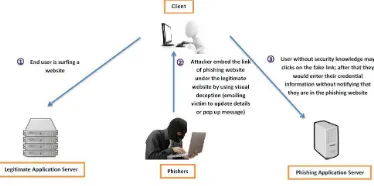
[image:1.612.103.290.556.649.2]Phishing attacks usually target user confidential information such as username, password and financial ID. Phishers would use their sophisticated attack vector such as emailing, or pop up window notification to lure the victim to visit the phishing website which has legitimate-looking layout. This will allow the phishers to harvest the victim credentials and sell them in the black market (as depicted in Figure 1).
Figure 1: Example of Phishing Attack Scenario
Anti-phishing refers to the method that is employed to prevent and defend phishing attacks. There are many techniques that offer protection at different domain. Some techniques work on emails, while others work on website attributes [2]. The
proposed method works on the later. The contribution of this paper is twofold: first, it identifies and analyses attributes exhibited in phishing websites. Second, it proposes several new features and integrates to an existing method to enhance the overall detection performance. The works start by analysing and looking for abnormal attributes of a phishing website. The abnormal attributes that usually appear on phishing website include some uncommon symbols in the URL and some irregular HTML form and title elements. Therefore, extracting features from these attributes will enhance the phishing detection ability.
2. LITERATURE REVIEW
ISSN: 1992-8645 www.jatit.org E-ISSN: 1817-3195
update in order to keep effective. Symptom-based prevention approach analyses the content of each webpage, then generate phishing alerts according to the type and number of symptoms detected. Domain binding is a browser-based technique where sensitive information such as username and password are combined with the domain. If this information is not bind, the technique will warn the users [2].
2.1 Blacklist and Whitelist
Blacklist and whitelist techniques are the most common and straightforward solutions. However,
their effectiveness is determined by the
completeness of the list. As a result, these techniques are not effective against new phishing websites [4]. Furthermore, majority of phishing websites are short-lived and the updated list is of less functional.
2.2 Page Analysis
Page analysis inspects the properties of a webpage based on the features, which are extracted from the HTML source code or derived from a URL. For page source, the number of HTML form tags might provide an indicator to detect phishing website. In addition, the number of input fields such as user ID and password are also crucial and suitable to be used as an indicator [3]. Phishers may trick users to provide their credentials through these input elements. Unsuspecting users are also susceptible to visually deceptive text, images mask underlying text, images mimicking windows and windows mask underlying windows [2]. Hence, these elements are important for the analysis.
2.3 URL Structure Analysis
The URL string can be broken down into multiple tokens that constitutes of binary features. Examples of features include length of the URL, number of dots, existence of IP address in the URL and URL with HTTPS and SSL [1]. In order to get a more comprehensive analysis, Alexa database and WHOIS database are usually used to check the URL domain name, domain registrar, name server and age of domain.
3. METHODOLOGY
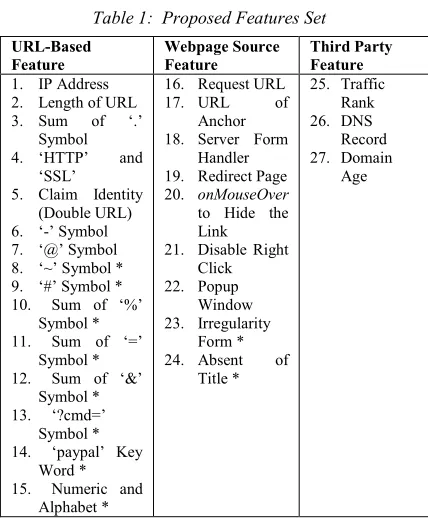
[image:2.612.313.527.90.349.2]Motivated by Rami et al. work [1], this paper proposes a feature-based technique to detect the phishing webpage. The paper will propose additional features and combine with some of the selected features from [1]. The features are shown in Table 1 where the proposed additional features are indicated with asterisk *.
Table 1: Proposed Features Set
URL-Based Feature
Webpage Source Feature
Third Party Feature
1. IP Address 2. Length of URL
3. Sum of ‘.’
Symbol
4. ‘HTTP’ and
‘SSL’ 5. Claim Identity
(Double URL) 6. ‘-’ Symbol 7. ‘@’ Symbol 8. ‘~’ Symbol * 9. ‘#’ Symbol * 10. Sum of ‘%’
Symbol * 11. Sum of ‘=’
Symbol * 12. Sum of ‘&’
Symbol * 13. ‘?cmd=’
Symbol * 14. ‘paypal’ Key
Word * 15. Numeric and
Alphabet *
16. Request URL
17. URL of
Anchor 18. Server Form
Handler 19. Redirect Page
20. onMouseOver
to Hide the Link 21. Disable Right
Click 22. Popup
Window 23. Irregularity
Form *
24. Absent of
Title *
25. Traffic Rank 26. DNS Record 27. Domain
Age
ISSN: 1992-8645 www.jatit.org E-ISSN: 1817-3195
domain information provided by the third party can help to determine the legitimacy of a website [5].
Following the notation used in [1], the listing below shows the rules for each feature:
3.1 Class 1: URL-Based Feature
1 If {IP address exists in URL → feature = True} Else {feature = False}
2 If {URL length < τ1a → feature = False}
Else If {τ1a ≤ URL length ≤ τ1b → feature = Suspicious}
Else {feature = True}
3 If {Dots in domain part < τ2 → feature = False}
Else {feature = True}
4 If {HTTPS exist in URL → feature = False} Else {feature = True}
5 If {Claim Identity or Double URL → feature = True} Else {feature = False}
6 If {Domain part includes ‘-’ symbol → feature = True} Else {feature = False}
7 If {URL contains ‘@’ symbol → feature = True} Else {feature = False}
8 If {URL contains ‘~’ symbol → feature = True} Else {feature = False}
9 If {URL contains ‘#’ symbol → feature = True} Else {feature = False}
10 If {URL contains ‘%’ symbol → feature = True} Else {feature = False}
11 If {URL contains ‘=’ symbol → feature = True} Else {feature = False}
12 If {URL contains ‘&’ symbol → feature = True} Else {feature = False}
13 If {URL contains ‘?’ symbol → feature = True} Else {feature = False}
14 If {URL contains ‘paypal’ keyword → feature = True} Else {feature = False}
15 If {URL contains alphanumeric → feature = True} Else {feature = False}
3.2 Class 2: Webpage Source Feature
1 If {Request URL ‘<img>’ < τ6a → feature = False}
Else If {τ6a ≤ Request URL ‘<img> ≤ τ6b → feature =
Suspicious} Else {feature = True}
2 If {URL of Anchor ‘<a href>’ < τ7a → feature = False}
Else If {τ7a ≤ URL of Anchor ‘<a href> ≤ τ7b → feature =
Suspicious} Else {feature = True}
3 If {Server Form Handler ‘<form>’ < τ8a → feature = False}
Else If {τ8a ≤ Server Form Handler ‘<form>’ ≤ τ8b → feature
= Suspicious} Else {feature = True}
4 If {Redirect page # < τ9a → feature = False}
Else If {τ9a ≤ Redirect page # ≤ τ9b → feature = Suspicious}
Else {feature = True}
5 If {OnMouseOver < τ10 → feature = False}
Else {OnMouseOver > τ10 → feature=True}
6 If {Right Click Disable < τ11 → feature = False}
Else {Right Click Disable > τ11 → feature=True}
7 If {Popup < τ12 → feature = False}
Else {Popup > τ12 → feature=True}
8 If {Irregularity Form < τ13 → feature = False}
Else {Irregularity Form > τ13 → feature=True}
9 If {Title Element Exist → feature = False} Else {Title Element Exist → feature=True}
3.3 Class 3: Third Party Information Feature
(Alexa and WHOIS)
1 If {Website Rank < τ14a → feature = False}
Else If {τ14a ≤ Website Rank ≤ τ14b → feature = Suspicious}
Else {feature = True}
2 If {There is no DNS record for the domain → feature = True Else {feature = True}
3 If {Age of Domain < τ15a → feature = False}
Else If {τ15a ≤ Age of Domain ≤ τ15b → feature =
Suspicious} Else {feature = True}
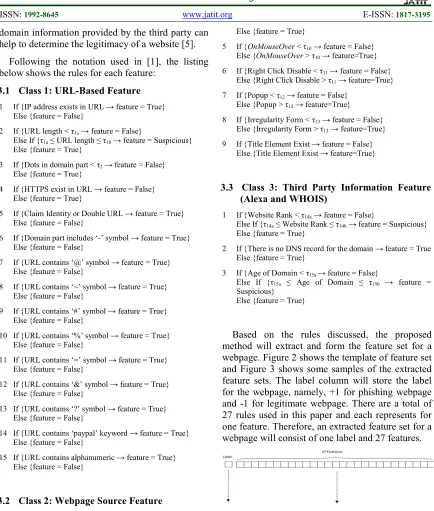
Based on the rules discussed, the proposed method will extract and form the feature set for a webpage. Figure 2 shows the template of feature set and Figure 3 shows some samples of the extracted feature sets. The label column will store the label for the webpage, namely, +1 for phishing webpage and -1 for legitimate webpage. There are a total of 27 rules used in this paper and each represents for one feature. Therefore, an extracted feature set for a webpage will consist of one label and 27 features.
[image:3.612.91.525.67.578.2]Figure 2: Template of Feature Set
Figure 3: Sample of Some Extracted Feature Sets
ISSN: 1992-8645 www.jatit.org E-ISSN: 1817-3195
implemented in [8] with the default setting (i.e., radial basis function is used as the kernel function, and the values for parameter γ and C is set to 1/n1 and 1.0, respectively). The classification process involves two phrases; there are training and testing phrases. During the training phrase, SVM will produce a model based on the pattern of the extracted feature sets. With the model, SVM will predict the sample's label (phishing or legitimate) in the testing phrase. Figure 4 and 5 show the general flow of training and testing phrases, respectively.
Figure 4: General Flow of Training Phrase
Figure 5: General Flow of Testing Phrase
4. EXPERIMENTAL RESULTS
We have constructed a dataset from a total of 1000 webpages. The dataset contains 500 phishing and 500 legitimate webpages. Phishing webpages
are downloaded from PhishTank2 and legitimate
webpages are from Alexa3 with different categories
(i.e., banking, social networking, news,
1 n is the number of features used during the classification
and in our case, it is 27
2 http://www.phishtank.com 3
http://www.alexa.com
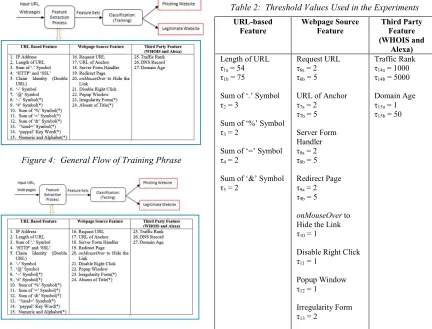
[image:4.612.93.525.230.559.2]commerce, forums and blogging). The experiment has dedicated 70 percent of the dataset for training phrase and the remaining 30 percent for testing phrase. Three experiments are designed to evaluate the effectiveness of the proposed method, as well as comparing our performance with the existing method proposed by Rami et al. [1]. The experiments also include comparison between the three classes of features and also the comparison within all the 27 features. Table 2 shows all the threshold values used in the experiments.
Table 2: Threshold Values Used in the Experiments
URL-based Feature
Webpage Source Feature
Third Party Feature (WHOIS and
Alexa)
Length of URL τ1a = 54
τ1b = 75
Sum of ‘.’ Symbol τ2 = 3
Sum of ‘%’ Symbol τ3 = 2
Sum of ‘=’ Symbol τ4 = 2
Sum of ‘&’ Symbol τ5 = 2
Request URL τ6a = 2
τ6b = 5
URL of Anchor τ7a = 2
τ7b = 5
Server Form Handler τ8a = 2
τ8b = 5
Redirect Page τ9a = 2
τ9b = 5
onMouseOver to
Hide the Link τ10 = 1
Disable Right Click τ11 = 1
Popup Window τ12 = 1
Irregularity Form τ13 = 2
Traffic Rank τ14a = 1000
τ14b = 5000
Domain Age τ15a = 1
τ15b = 50
4.1 Performance Comparison between the
Proposed Method and Rami et al. Method [1]
We implemented both the proposed method and Rami et al. method [1] using Matlab and evaluated on the same dataset. In order to get a fair comparison, we run our experiment using a few types of cross validations. Table 3 shows the detection results for the experiment (we abbreviate Rami et al. method [1] as Rami) and are computed using the following equation:
Accuracy= TP+TN
ISSN: 1992-8645 www.jatit.org E-ISSN: 1817-3195
where TP, TN, FP and FN denote true positive, true negative, false positive and false negative, respectively. The results show the proposed method has improved Rami’s method. The results also show consistency across different cross validations. The highest improvement result of four percent is obtained using cross validation with K=15. Whereas cross validation with K=5 and holdout method obtained same improvement percentage of 3.34 percent. The improvements have validated the efficiency of the newly proposed features.
Table 3: Performance Comparison between the Proposed Method and Rami et al. Method [1]
Holdout Method
Cross Validation Method
K=5 K=15
Proposed Method
95.67% 94.67% 95.33%
Rami 92.33% 91.33% 91.33%
Differences 3.34% 3.34% 4.00%
4.2 Performance comparison between the
Three Classes of Features
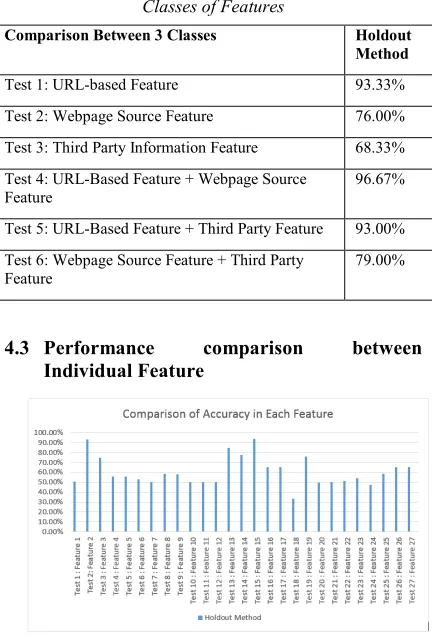
[image:5.612.311.527.106.427.2]This section is devoted to gain some insight on the performance of each individual class and combination of them. We run six tests in this experiment. Test 1 to 3 involves a single class of features and Test 4 to 6 involves a combination of two classes of features. For example, Test 1 is using only URL-based feature. Whereas Test 4 is using the combination of URL-based feature and webpage source feature. Table 4 shows the experimental results for this comparison. The table clearly shows that URL-based feature is superior compared to the other two classes and achieved 93.33 percent. Due to the URL-based feature's effectiveness, its combination with the other classes of features also produced promising results. This is showed in Test 4 and 5. From the table, third party information feature has the lowest performance. However, its role is still important to detect some outliners. For example, there are some legitimate website which are not W3C compliance and this may cause a false alarm to the proposed method. Therefore, using the information extracted from WHOIS and Alexa will remedy the problem. This experiment is important because it shows the effectiveness level of each feature class as well as the combination among the classes. This evaluation is necessary and allows us to decide the final feature set.
Table 4: Performance Comparison between Different Classes of Features
Comparison Between 3 Classes Holdout
Method
Test 1: URL-based Feature 93.33%
Test 2: Webpage Source Feature 76.00%
Test 3: Third Party Information Feature 68.33%
Test 4: URL-Based Feature + Webpage Source Feature
96.67%
Test 5: URL-Based Feature + Third Party Feature 93.00%
Test 6: Webpage Source Feature + Third Party Feature
79.00%
4.3 Performance comparison between
Individual Feature
Figure 6: Performance Comparison between Individual Features
In addition to the evaluation of different classes of features, this section discusses performance comparison between individual features. The experiment involves 27 tests that use only one feature at a time to perform the detection. Figure 6 shows the results for all the tests. Notably, there are three most effective features and have achieved detection performance above 80 percent. They are feature 15 (alphanumeric), feature 2 (length of URL) and feature 13 (existence of ?cmd=). Feature 15 and 13 are the newly proposed features and feature 2 is from [1].
5. DISCUSSION
ISSN: 1992-8645 www.jatit.org E-ISSN: 1817-3195
effective and achieved 93.33 percent of accuracy. This indicates that URL-based feature plays an important role in detecting phishing website. Mainly because it is technically easier for phishers to deceive user by constructing an URL with identity liked keyword (e.g., PayPal as the keyword to deceive PayPal user). Unsuspecting user tends to click on an URL when they see the URL contains keyword that they recognise. The experiment also shows that the combination between URL-based and webpage source features yield the highest accuracy of 96.67 percent. The improved accuracy can be attributed to the discriminative features extracted from the content of a webpage. It is noteworthy to mention that phishers will usually alter the webpage to behave maliciously in order to harvest the login credentials. Such attempts are detected in our webpage source features. Although the combination of these two classes of features shows higher accuracy than the combination of all the classes in the experiments, we still opt to combine all classes as the final features set. This is because the third party information feature can serve as a complementary feature to capture some outliner of phishing websites and reduce false positive for some new legitimate website.
Note that the feature extraction of proposed method is currently focused on the textual elements. Phishers may be able to bypass the detection by manipulating on graphical elements. For example, phishers may use an image as the canvas and overlap on the whole webpage. This image will contain the textual content of the webpage and looked like a normal webpage.
6. CONCLUSION
In this paper, a feature-based phishing detection technique is proposed. The aggregation between ten new features and 17 existing features from [1] has shown improvement in the detection performance. A series of experiments have been conducted to validate the efficiency of the newly added features. The experimental results show a promising outcome with as high as 95.33 percent of accuracy and manage to improve four percent compared to the original method by Rami et al. [1].
7. ACKNOWLEDGEMENT
The funding for this project is made possible through the research grant obtained from UNIMAS and the Ministry of Education, Malaysia under the RAGS Grant [RAGS/SG/05(4)/929/2012 (30)].
8. REFERENCES
[1] M. M. Rami, F. Thabtah and L. McCluskey,
An Assessment of Features Related to Phishing
Websites using An Automated Technique, 7th
International Conference for Internet Technology and Secured Transaction, 2012.
[2] M. M. Gaurav and J. Anuraj, Anti-Phishing
Techniques: A Review, International Journal
of Engineering Research and Applications, Vol. 2 (2), 2012, pp. 350-355.
[3] C. Ludl, S. McAllister, E. Kirda and C.
Kruegel, On Effectiveness of Techniques to
Detect Phishing Sites, 4th International
Conference on Detection of Intrusions and Malware, and Vulnerability Assessment, 2007, pp. 20-39.
[4] H. H. Jun and H. Kim, Phishing Detection with
Popular Search Engines: Simple and Effective,
4th Canada-France MITACS Workshop on Foundations and Practice of Security, 2011, pp. 194-207.
[5] S. Garera, N. Provos, M. Chew and A. D.
Rubin, A Framework for Detection and
Measurement of Phishing Attacks, Proceedings
of the 2007 ACM Workshop on Recurring Malcode, 2007, pp. 1-8.
[6] R. Dhamija, J. D. Tygar and M. Hearst, Why
Phishing Works, Proceedings of the SIGCHI
Conference on Human Factors in Computing Systems, 2006, pp. 581-590.
[7] A. Le, A. Markopoupou and M. Faloutsos,
PhishDef: URL Names Say It All, IEEE
International Conference on Computer Communications, 2011, pp. 191-195.
[8] C-C Chang and C-J Lin, LIBSVM: A library
for support vector machines, ACM
Transactions on Intelligent Systems and Technology, Vol. 2 (3), 2011, pp. 27:1-27:27.
[9] K. L. Chiew, E. H. Chang, S. N. Sze and W. K.