Full Length Research Article
ADJUSTMENT OF ADOLESCENTS IN RELATION TO THEIR PARENT-CHILD RELATIONSHIP
*Pooja Bhagat and Dr. Baliya, J.N.
Department of Educational Studies, Central University of Jammu, (J and K), India
ARTICLE INFO ABSTRACT
Adjustment is a process by which a person can maintain balance between his needs and circumstances. The present study was conducted with the purpose to see the adjustment of adolescents in relation to their parent-child relationship. The study was conducted over a sample of 200 randomly selected adolescents studying in class 9thof Samba District (J and K). Adjustment inventory constructed and standardized by A.K.P. Sinha and R.P. Singh and Parent-child relationship scale constructed and standardized by Dr. Nalini Rao were used to collect data. The collected data was analyzed with the help of ‘t’ test. The results of the study showed significant differences in the adjustment of adolescents in relation to their parent-child relationship.
Copyright©2016, Pooja Bhagat and Dr. Baliya.This is an open access article distributed under the Creative Commons Attribution License, which permits unrestricted use, distribution, and reproduction in any medium, provided the original work is properly cited.
INTRODUCTION
To lead a happy and satisfied life adjustment is a essential characteristics. Adjustment is a continous life-long process. It is adaptation, achievement as well as process. It is a compromise between needs and circumstances. It is harmonious relationship between the individual himself and the environment. Of various stages of human growth and development, adolescence satge is very critical peroid of life. The peroid is marked by tremendous physical, psychological, behavoural, cognitive, emotional changes. These changes lead to various problems among adolescents. Adolescents often face problems with their parents, school, peer group etc. It becomes very difficult for the adolescents to cope up with these problems. These problems lead to mal-adjustments in adolescents. There is a need to understand these problems faced by adolescents. Parent and teachers are more responsible for the adjustment of the child.The important areas of adjustment as Home, Health, Social, Emotional and School Adjustment:
Home Adjustment: A house consists of family which means parents, children and also grandparents. Each member in the home has his/her own personality which affects the others.
*Corresponding author: Pooja Bhagat
Department of Educational Studies, Central University of Jammu, (J and K), India
Health Adjustment: Health is a source of satisfaction. Persons who have physical defects or deformities may develop various types of complexes and frustrations.
Social Adjustment: Adjustment with other in the society is called social intelligence. Social adjustment is influenced by social maturity of the person. Social adjustment is the adjustment in the social situation. It is adjustment in all types of status and roles in all the social institution.
Emotional Adjustment: Emotion adjustment is also called personal adjustment. Emotion is the current of energy that are within us. Emotion may be defined as the stirred up an organism involving internal and external changes in the body. Our emotions control our behaviour. Emotion is a dynamic inner adjustment in the organism that operates for the Satisfaction and welfare of the individual. Parent and teachers are more responsible for the emotional adjustment of the child.
Educational Adjustment: Healthy environment in the school helps the persons in making school satisfaction of the child with the behaviour in of his class-fellow, teachers, and head of the institution, methods of teacher, discipline, time-table, co-curricular activities influences his adjustment.
ISSN: 2230-9926
International Journal of Development Research
Vol. 06, Issue, 08, pp. 9168-9174, August,2016
DEVELOPMENT RESEARCH
Article History:
Received 19th May, 2016
Received in revised form 26th June, 2016
Accepted 17th July, 2016
Published online 30th August, 2016
Key Words:
Parent-child relationship, Adjustment,
Parent-child relationship
Parent-child relationship is a major determining factor in the development of personality and psycho-social development of children. Parent-adolescent relationship refers to the frequency and intensity of communication and interaction patterns between adolescent and their parents. The parent-child relationship consists of a combination of behaviors, feelings and expectations that are unique to a particular parent and a particular child. The quality of the parent-child relationship is affected by the parent’s age, marital status and experience
Review of Related Literature
Ahmadi and Ali Fathi-Ashtiani (2008) studied Educational Adjustment and Educational Motivation in Military and Non-Military Students is a meaningful difference between military and nonmilitary students in terms of familial adjustment, hygienic adjustment and total adjustment (p≤0.01). Hamidi and Hosseinib (2010) studied Relationship between Irrational Beliefs and Social, Emotional and Educational Adjustment among Junior Students and result showed that there is an inverse significant relation between irrational beliefs and general, social, emotional, and educational adjustment. Adhiambo, Odwar and Mildred (2011) conducted a study on the relationship among School Adjustment, Gender and Academic Achievement amongst Secondary School Students in Kisumu District Kenya and results showed that there were no significant differences between girls and boys in school adjustment. Deepshikha and Bhanot (2011) studied Role of Family Environment on Socio-emotional Adjustment of Adolescent Girls in Rural Areas of Eastern Uttar Pradesh and found that all the eight family environment factors, viz. cohesion, expressiveness conflict, acceptance and caring, independence, active-recreational orientation, organization and control together showed significant role in socio-emotional and educational adjustment of adolescent girls.Singh and Agarwala (2012) studied educational adjustment among male children studying in Hindi and English medium schools and the study finding revealed that majority of respondent had highly significant difference between educational adjustments across medium.
Mahmoudi (2012) studied Influence of adjustment and self-esteem on family environment and findings of this study revealed that Indian and Iranian students differed significantly in all areas of adjustment. But with respect to health and emotional adjustment, Indian students were better adjusted, than their counter parts at Iran and in cases of social and home adjustment, Iranian students were better adjusted than Indian students. Goyat (2012) worked on Adjustment Level Among Primary School Teachers in Jhajjar District. In this study it has been observed that there is no Significant difference between male, Female and Rural, Urban Primary School Teachers. Peerzada (2013) studied Adjustment of Science and Social Science Higher Secondary School Teachers - A Comparative Study and the findings of the study showed that the social science teachers have more adjustment problems than science teachers. Sharma and Saini (2013) studied Health, social and emotional problems of college students. The findings of the study revealed that Girls are average in the dimensions of health and social adjustment and unsatisfied in emotional
areas. Boys are average in the dimensions of social adjustment and unsatisfied in health and emotional areas. There is no significant they differ significantly difference between health, social and emotional adjustment of Girls and Boys. There is a significant difference between health and emotional adjustment of urban and rural college students but they do not differ significantly in social adjustment.
Rajeswari and Eljo (2013) studied Emotional Adjustment of Adolescent School Students. The findings of the study revealed that there exists low level of emotional adjustment ability among the adolescent school students. Makwana and Kaji (2014) conducted a study on Adjustment of Secondary School Students in Relation to their Gender. The result shows that there is no significant difference in Home, School and Emotional adjustment of boys and girls secondary school student. But there is significant difference in Social adjustment of boys and girls secondary school students at 0.05 level. It means boys are Social adjustment better than girls. Gill (2014) investigated Emotional, Social and Educational Adjustment of Visually Handicapped Students of Special Schools students and found that there is no significant difference between the educational social and emotional adjustments of special school Students belonging to boys and girls. Mansingbhai and Patel (2014) studied Adjustment and Academic Achievement of Higher Secondary School Student and results revealed that male adolescent differ significantly on health, social and emotional adjustment as compare to female adolescent. Significant difference is also existed between male and female adolescent on academic achievement. Mohanraj and Latha (2014) studied Perceived Family Environment in Relation to Adjustment and Academic Achievement. Academic performance was significantly related to independence and conflict domains of family environment.
correlation between socio-emotional adjustment and academic achievement of adolescent girls; (2) The socio-emotional adjustment of adolescent girls has a significant effect on their academic achievement; and (3) there was significant difference between rural and urban adolescent girls in their socio-emotional adjustment. Accariya and Khalil (2016) studied Socio-Emotional Adjustment of Learning-Disabled Students Undergoing School Transitions.
The findings point to three main concerns of LD adolescents regarding their transition to junior-high: A sense of isolation, a lack of social and adaptation skills, and a poor relationship with teachers. Kaur and Kaur (2016) studied Adjustment among Adolescent Girls Studying in Co-Educational and Non Co-Educational Schools and results of their study revealed that significant differences were found between the Adjustment of adolescent girls studying in educational and non co-educational schools for all the dimensions of adjustment i.e emotional, social and educational respectively. Kaur and Kaur (2016) studied Adjustment among Adolescent Girls Studying in Co-Educational and Non CoEducational Schools and found Significant differences between the Adjustment of adolescent girls studying in co-educational and non co-educational schools for all the dimensions of adjustment i.e emotional, social and educational respectively.
Objectives
To study Emotional adjustment of adolescents in relation to their parent-child relationship.
To study Social adjustment of adolescents in relation to their parent-child relationship.
To study Educational adjustment of adolescents in relation to their parent-child relationship.
To study overall adjustment of adolescents in relation to their parent-child relationship.
Hypotheses
There is no significant difference in the Emotional adjustment of adolescents in relation to their parent-child relationship.
There is no significant difference in the Social adjustment of adolescents in relation to their parent-child relationship.
There is no significant difference in the Educational adjustment of adolescents in relation to their parent-child relationship.
There is no significant difference in the overall adjustment of adolescents in relation to their parent-child relationship.
Sample
For the present study a sample of 200 adolescents of 9th class studying in government and private schools of Samba District (J and K) has been taken up.
Tools Used
Adjustment inventory constructed and standardized by A.K.P. Sinha and R.P. Singh (1971) was administered. The inventory measures the adjustment of secondary school students in three areas of adjustment - Emotional, Social and Educational. The inventory contains 60 items, 20 items in each area of adjustment. 20 items measure Emotional adjustment, 20 items measure Social adjustment and 20 items measure Educational adjustment. Emotional Adjustment: High scores indicate unstable emotion. Students with low scores tend to be emotionally stable. Social Adjustment: Individuals scoring high are submissive and retering. Low scores indicate aggressive behaviour. Educational Adjustment: Individual scoring high are poorly adjusted with their curricular and co-curricular programmes. Persons with low scores are interested in school programmes.
Parent-Child Relationship Scale developed and standardized by Nalini Rao (1989). The The test-retest-reliability coefficient ranged from 0.770 to 0.871 for boys sample and 0.772 to 0.873 for the girls sample over the ten subscales.
Statistical techniques used
The collected data was analyzed with the help of inferential statistics such as Means and t-test.
RESULTS
Objective-1
[image:3.595.102.512.642.679.2] The first objective was to study Emotional adjustment of adolescents in relation to their parent-child relationship. The data related to this objective were analyzed by employing‘t’ test.
Table 1. Showing ‘t’ value of Emotional adjustment of adolescents in relation to their parent-child relationship
Group N M S.D. SEM SEDM ‘t’ value Results
High Parent-child Relationaship 100 7.91 3.37 0.337 0.42 3.41** Significant at 0.01 level Low parent-child relationship 100 9.35 2.53 0.253
*Significant at 0.05 level **Significant at 0.01 level
Table 2. Showing ‘t’ value of Social adjustment of adolescents in relation to their parent-child relationship
Group N M S.D. SEM SEDM ‘t’ value Results
High Parent-child Relationaship 100 7.05 2.50 0.250 0.32 2.71** Significant at 0.01 level Low parent-child relationship 100 6.17 2.07 0.207
[image:3.595.103.511.718.765.2]Graph 1. Showing ‘t’ value of Emotional adjustment of adolescents in relation to their parent-child relationship
Table-1 indicates that, the mean score of high parent-child relationship adolescents is 7.91 with S.D. 3.37 and the mean score of low parent-child relationship adolescents is 9.35 with S.D. 2.53, t-value comes out to be 3.41 which is significant at 0.01 level. It means there is significant difference in the Emotional adjustment of adolescents in relation to their parent-child relationship. Thus, the null hypothesis stating that “There is no significant difference in the Emotional adjustment of adolescents in relation to their parent-child relationship”, is rejected. Further the mean scores of low parent-child relationship is 9.35 which is significantly higher than mean scores of high parent-child relationship is 7.91. High mean score indicates untable emotion as per adjustment inventory. Students with low scores tend to be emotionally stable. This indicates that the high parent-child relationship adolescents are emotionally more adjusted as compared to low parent-child relationship adolescents.
Objective-2
The second objective was to study Social adjustment of adolescents in relation to their parent-child relationship. The data related to this objective were analyzed by employing ‘t’ test.
Graph 2. Showing ‘t’ value of Social adjustment of adolescents in relation to their parent-child relationship
Table-2 indicates that, the mean score of high parent-child relationship adolescents is 7.05 with S.D. 2.50 and the mean score of low parent-child relationship adolescents is 6.17 with S.D. 2.07, t-value comes out to be 2.71 which is significant at 0.01 level. It means there is significant difference in the social adjustment of adolescents in relation to their parent-child relationship. Thus, the null hypothesis stating that “There is no significant difference in the social adjustment of adolescents in relation to their parent-child relationship”, is rejected. Further the mean scores of high parent-child relationship is 7.05 which is significantly higher than mean scores of low parent-child relationship is 6.17. Individuals scoring high are submissive and retering. Low scores indicate aggressive behaviour. This indicates that the high parent-child relationship adolescents are socially more adjusted as compared to low parent-child relationship adolescents.
Objective-3
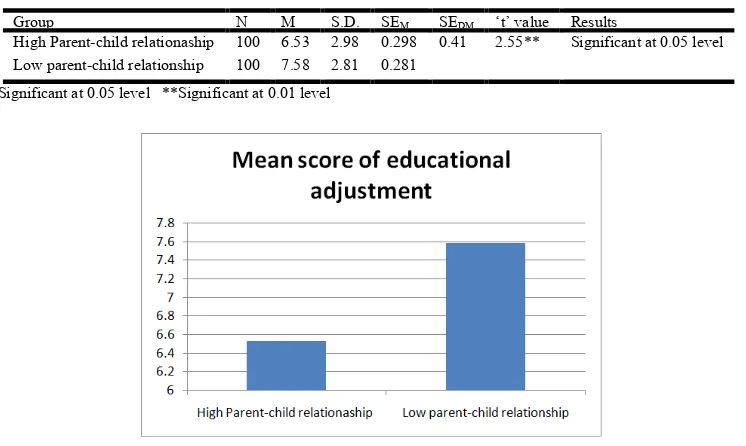
[image:4.595.308.546.53.205.2] The third objective was to study Educational adjustment of adolescents in relation to their parent-child relationship. The data related to this objective were analyzed by employing ‘t’ test.
Table 3. Showing ‘t’ value of Educational adjustment of adolescents in relation to their parent-child relationship
Group N M S.D. SEM SEDM ‘t’ value Results
High Parent-child relationaship 100 6.53 2.98 0.298 0.41 2.55** Significant at 0.05 level Low parent-child relationship 100 7.58 2.81 0.281
*Significant at 0.05 level **Significant at 0.01 level
Graph 3. Showing ‘t’ value of Educational adjustment of adolescents in relation to their parent-child relationship
[image:4.595.58.272.57.195.2] [image:4.595.109.482.543.766.2]Table-3 indicates that, the mean score of educational adjustment of high parent-child relationship adolescents is 6..53 with S.D. 2.98 and the mean score of educational adjustment of low parent-child relationship adolescents is 7.58 with S.D. 2.81, t-value comes out to be 2.55 which is significant at 0.05 level. It means there is significant difference in the educational adjustment of adolescents in relation to their parent-child relationship. Thus, the null hypothesis stating that “There is no significant difference in the educational adjustment of adolescents in relation to their parent-child relationship”, is rejected. Further the mean scores of educational adjustment of low parent-child relationship is 7.58 which is significantly higher than mean scores of educational adjustment of high parent-child relationship is 6.53. Individual scoring high are poorly adjusted with their curricular and co-curricular programmes. Persons with low scores are interested in school programmes. This indicates that the low parent-child relationship adolescents are educationally less adjusted as compared to high parent-child relationship adolescents.
Objective-4
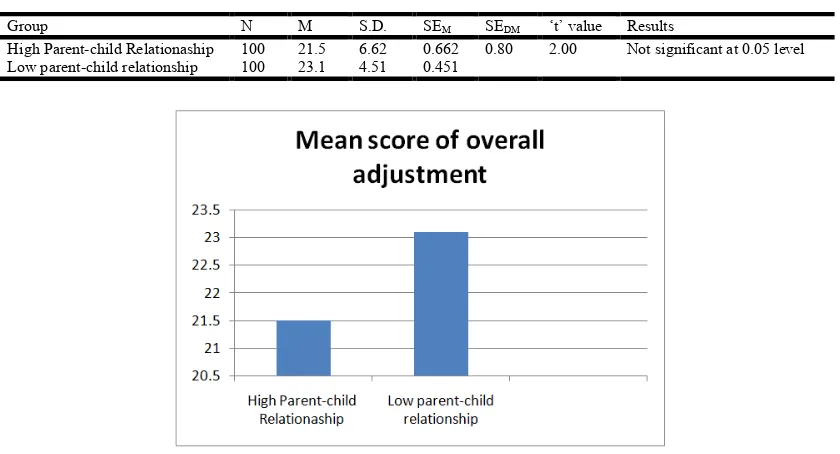
The fourth objective was to study overall adjustment of adolescents in relation to their parent-child relationship. The data related to this objective was analyzed by employing ‘t’ test.
Table-4 indicates that, the mean score of overall adjustment of high parent-child relationship adolescents is 21.5 with S.D. 6.62 and the mean score of low parent-child relationship adolescents is 23.1 with S.D. 4.51, t-value comes out to be 2.00 which is significant at 0.05 level. It means there is significant difference in the overall adjustment of adolescents in relation to their parent-child relationship. Thus, the null hypothesis stating that “There is no significant difference in the overall adjustment of adolescents in relation to their parent-child relationship”, is rejected. Further the mean scores of low parent-child relationship is 23.1 which is significantly
higher than mean scores of high parent-child relationship is 21.5. High mean score indicates poor adjustment as per adjustment inventory. This indicates that overall adjustment of high parent-child relationship adolescents are more as compared to low parent-child relationship adolescents.
Conclusions
The high parent child relationship adolescents are found emotionally more adjusted as compared to low parent child relationship adolescents.
The high parent child relationship adolescents are found socially more adjusted as compared to low parent child relationship adolescents.
The high parent child relationship adolescents are found educationally more adjusted as compared to low parent child relationship adolescents.
The high parent child relationship adolescents are found overall more adjusted as compared to low parent child relationship adolescents.
Educational Implications
As the results of the present study showed significant influence of parent child relationship on the emotional, social, educational and overall adjustment of secondary school adolescents.
The study has its implications for different stakeholders to enhance the adjustment of the adolescents:
The good relationship between the parents’ and their adolescents’ will enhance the emotional adjustment of the students.
Parents should provide conducive home environment to their children so that they can discuss their needs and problems freely with their parents’.
[image:5.595.95.515.379.606.2] Undue control and restrictions should not be imposed on children.
Table 4. Showing ‘t’ value of overall adjustment of adolescents in relation to their parent-child relationship
Group N M S.D. SEM SEDM ‘t’ value Results
High Parent-child Relationaship 100 21.5 6.62 0.662 0.80 2.00 Not significant at 0.05 level Low parent-child relationship 100 23.1 4.51 0.451
For enhancing social adjustment of adolescents there should be provision of various types of co-curricular activities in schools.
Various programmes such as NCC, NSS, cultural activities will promote social adjustment of students.
For enhancing educational adjustment of adolescents, parents should provide extra coaching and necessary educational materials to adolescents.
School should provide proper curricular and co-curricular activities to adolescents.
REFERENCES
Accariya and Khalil. 2016. Socio-Emotional Adjustment of Learning-Disabled Students Undergoing School Transitions. Creative Education, 7, 139-151.
Adhiambo, Odwar and Mildred. 2011. a study on the relationship among School, Gender and Academic Achievement amongst Secondary School Students in Kisumu District Kenya. Journal of Emerging Trends in
Educational Research and Policy Studies, 2 (6): 493-497.
Ahmadi, K., and Ali Fathi-Ashtiani. 2008. Study of Educational Adjustment and Educational Motivation in Military and Non-Military Students. Journal of Social
Sciences, 4 (2): 128-135.
Asli, A. A., Kiamanesh, A., and Ahadi, H. 2015. Comparative study of Aggression and Academic Adjustment based of Attachment styles. MEANJIN - Arts and Humanities
Journal, Vol 7, Issue 2, PP: 240-248.
Bala. 2014. Values and Adjustment Problems of High Achievers and Low Achievers. International Journal of
Educational Planning and Administration, Volume 4,
Number 2 (2014), pp. 113-118.
Basu, S. 2012. Adjustment of Secondary School Students. An International peer reviewed Scholarly Research Journal
for Interdisciplinary Studies, Vol.–I, Issue-III.
Deepshikha and Bhanot. 2011. Role of Family Environment on Socio-emotional Adjustment of Adolescent Girls in Rural Areas of Eastern Uttar Pradesh. J Psychology, 2 (1): 53-56.
Devi, R. 2015. Psycho-Social Problems of Adjustment among Highly Qualified Unemployed Youths—A Study. Literate unemployed youths have suffering from psycho-social problems. International Research Journal of Interdisciplinary and Multidisciplinary Studies (IRJIMS)
A Peer-Reviewed Monthly Research Journal, Volume-I, Issue VI, Page No. 119-125.
Gaur. 2013. A Comparative Study of Adjustment Problems of High and Low Achievers in Higher Secondary School of Gwalior City (M.P). Asian Journal of Multidisciplinary
Studies, Volume1, Issue 4
Gihar, S., and Sharma, A. 2015. Impact of Personality traits on Adjustment and Education Aspiration of Secondary Students, VOL. II/VIII. 2146-2154.
Gill, S. 2014. Emotional, Social and Educational Adjustment of Visually Handicapped Students of Special Schools students. International Journal of Scientific and Research
Publications, Volume 4, Issue 3.
Goyat, 2012. worked on Adjustment Level Among Primary School Teachers in Jhajjar District. In this study it has been
observed that there is no Significant difference between male, Female and Rural, Urban Primary School Teachers. Gul. 2015. Impact of Socio-Emotional Adjustment on
Academic achievement of Adolescent Girls in Jammu and Kashmir. Śodha Pravāha (A Multidisciplinary Refereed
Research Journal), Vol. V / No.3.
Hamidi, F., and Hosseinib, Z. M. 2010. The Relationship between Irrational Beliefs and Social, Emotional and Educational Adjustment among Junior Students. Procedia
Social and Behavioral Sciences, 5 1531–1536.
John W. Best. and James V. Kahn. 1993 “Research in education” (7th edition) N.Delhi: Prentice Hall of India Pvt. Ltd. , p.199.
Kaur, J., and Kaur, M. 2016. Study of Adjustment among Adolescent Girls Studying in Co-Educational and Non CoEducational Schools. International Journal of Allied
Practice, Research and Review, Vol. III, Issue II, p.n.
01-06.
Koul, L. 2004. Methodology of Educational Research. New Delhi: Vikas Publishing House Pvt. Ltd.
Kumar, V. V., Mehta, M., and Maheshwari, N. 2014. Exploring achievement motivation, adjustment and emotional intelligence of students across different Indian demographic groups. European Academic Research Vol. II, Issue 2.
Mahmoudi, A. 2012. Influence of adjustment and self-esteem on family environment. Indian Journal of Science and
Technology, Vol.5, No.4.
Makwana and Kaji. 2014. Adjustment of Secondary School Students in Relation to their Gender. The International
Journal of Indian Psychology, Volume 2, Issue 1.
Mansingbhai and Patel. 2014. Adjustment and Academic Achievement of Higher Secondary School Student. Journal of Information, Knowledge and Research in Humanities
and Social Sciences, Volume 3, Issue 1.
Martínez and Semrud-Clikeman M. 2004. Emotional adjustment and school functioning of young adolescents with multiple versus single learning disabilities. J Learn
Disabil., 37(5):411-20.
Mohanraj and Latha. 2014. Perceived Family Environment in Relation to Adjustment and Academic Achievement.
Journal of the Indian Academy of Applied Psychology,
Vol. 31, No.1-2, 18-23.
Nathial, M. S. 2014. A study of adjustment and emotional intelligence of university coaches in India. American
Journal of Applied Psychology; 3(6): 122-126.
Neeraja, P. and Anuradha, K. 2014. Adjustment Problems Faced By Children With Learning Disabilities Impact Of Special Education. Indian J.Sci.Res., 5(1) : 77-81,
Peerzada, N. 2013. Adjustment of Science and Social Science Higher Secondary School Teachers - A Comparative Study. Academia Arena, 5(2): 34-38.
Rajeswari and Eljo. 2013. Emotional Adjustment of Adolescent School Students.International Journal of
Humanities andSocial Sciences, Vol. 2, Issue 2, 49-56.
Rajkonwar, S., Dutta, J., and Soni, J. C. 2015. Adjustment and Academic Achievement of Visually Handicapped School Children in Assam. International Journal of Science and
Research (IJSR), Volume 4, Issue 4.
Handicapped College Students. The International Journal
of Indian Psychology, Volume 2, Issue 1.
Rao, N. 1989. Parent-Child Relationship Scale. Agra: National Psychological Corporation.
Rao, N. 1989. Parent-Child Relationship Scale. Agra: National Psychological Corporation.
Sangeeta and Chirag. 2012. A Study of Adjustment Problems of College Students in Relation to Gender, Socio-Economic Status and Academic Achievement International
Journal of Behavioral Social And Movement Sciences,
Vol.01, Issue 02.
Sarita, Sonia, Sudesh, 2015. A comparative study of adjustment problems of girls at U.G. level and P.G. levels in co-educational colleges. International Journal of
Applied Research, 1(12): 404-406.
Sharma and Saini. 2013. Health, social and emotional problems of college students. IOSR Journal of Humanities
and Social Science (IOSR-JHSS), Volume 14, Issue 5, PP
21-34.
Singh, H., and Agarwal, S. 2012. A study on educational adjustment among male children studying in Hindi and English medium school. Asian J. Home Sci., 7 (2): 450-452.
Singh, S. K. 2013. Anxiety and Adjustment Pattern of High and Low Academic Achievers. Gra - Global Research
Analysis, Volume : 2 | Issue : 1.
Singh. 2011. Emotional Intelligence as Related to Adjustment to Adolescents. International Journal of Educational
Planning and Administration. Volume 1, Number 2 pp.
179-187.
Sinha, A.K.P. and Singh, R.P. 1971. Adjustment inventory. Agra: National Psychological Corporation.
Tamannaeifar, M. R. and Nezhad, T. J. 2014. Comparison of Social, Affective, Educational Adjustment and Academic Achievement between the Students with Learning Disability and Normal Students. International Journal of
Psychology and Behavioral Research, Vol., 3(2), 102-107.
Vishal and Kaji. 2014. Adjustment of Boys and Girls School Level Students in Ahmedabad. The International Journal
of Indian Psychology, Volume 2, Issue 1.
Yellaiah. 2012. A Study of Adjustment on Academic Achievement of High School Students. International Journal Of Social Sciences and Interdisciplinary Research,
Vol.1, No. 5.