3707
SEARCHING OVER ENCRYPTED SHARED DATA VIA
CLOUD DATA STORAGE
1SAMEEH ABDULGHAFOUR JASSIM, 2WALEED KAREEM AWAD
1Department of Vocational Education, General Directorate of Education in Anbar, Ministry of Education,
Hit, Anbar, Iraq
2College of Computer Science and Information Technology, University of Anbar, Anbar, Iraq
E-mail: 1[email protected], 2[email protected]
ABSTRACT
Cloud computing has developed from various technologies such as autonomic computing, virtualization, grid computing, and other technologies, and the secure storage is essential and important for it due to it provides virtualized resources on Internet. Therefore, Data owner must encrypt his documents locally before uploading it in the public cloud storage to prevent unauthorized access to his data. Sometimes, the data owner wants to share some of his encrypted documents that stored in the cloud with other authorized users, so, he must send the secret key for each document for all authorized users, but this way has many limitations due to the difficulty of key management and key distribution. To overcome drawback of this approach we proposed system to generate a single key used for multiple number of documents and users depending on two techniques asymmetric cryptography and symmetric cryptography. Asymmetric cryptography used the IBC of the data owner to generate his private key and split the private key into two parts give one part to all authorized users and the other part send to Semi-Trusted Third Party (STTP). While symmetric cryptography used by combined secret key with the encrypted file properties and decrypted the result by the public key of the data owner by using asymmetric cryptography (RSA algorithm). Finally, many results were obtain from implementing the proposed system, among these results; the data owner could add or revoke any user without change the master secret key, also the data owner not need to share multi keys with authorized users. As well as, the system overcame the problem on difficulty of searching over encrypted data through encryption key in a public cloud.
Keywords: Cloud Computing, Cryptography, Revocation, Virtualization, Homomorphic.
1. INTRODUCTION
Security of network is a vital part of everyday life; because the rapidly increasing that occurring on the Internet by increasing the number of transactions, as well as there are a new challenges arise with every new technology. Therefore, Cloud computing is a modern business model that use the internet to access to a grand pool of resources. The main aim from using the cloud computing is to reduce the costs and giving the users the ability to focus on their business instead of the information technology enabling this business.
A security mechanism can be define as a device or a process used to detect, prevent, or recover from a security attack, so, to achieve security objectives
security mechanisms used encryption,
steganography, hashing, etc. While network security used to prevent unauthorized users to access to data and software at the network level. Generally, network security consists of three layers:
(a) Border security (used to achieve control on security devices such as intrusion detection systems, firewalls, and intrusion prevention systems), (b) Authentication layer (used to authenticate of uses identities), and (c) authorization (used to give the users the primitive to access resources and which type of access this user is granted)[1].
3708 and management, trust, business sustainability, and development of scalable service [1].
Storing data online in the cloud called cloud storage. However, data sharing is a very important issue in cloud storage as well as the method of sharing the encrypted data also represents a big challenge in the cloud storage[2].
Data owner must encrypt his/her documents locally before uploading it in the public cloud storage because the documents almost containing sensitive information and must be kept secured from all except the authorized users. Key-aggregate searchable encryption (KASE) used to search about the encrypted keywords while the data owner must be providing the users by keys to enable them to access on their data, so, data owner will have a problem in distributing a huge number of keys to the users.
The aim of this paper is to achieving privacy to the data owners’ files those are stored on the public cloud. Furthermore, enhance the keys management as well as the system provides to data owner the ability to revoke or add any user without change the master secret key. In addition, we used the asymmetric cryptography to exchange the keys while a symmetric cryptography used to encrypt and decrypt the big files. This paper organized as follows: Section 2 gives a literature survey about significant related work. Then, cloud storage, advantages of using the cloud, and homomorphic cryptosystems are explain in section 3, 4 and 5 respectively. After that, we explained the virtualization in section 6. Next, in section 7 we described the proposed system architecture to implement the system in accordance with the requirements goals. Section 8 gives the system operations of our proposal and its main phases. In Section 9 system requirements and results are presented. Finally, the most important conclusions of the paper are gives in Section 10.
2. LITERATURE SURVEY
Cloud computing has been developed from various technologies since 2008 until now because it is being put to work in a variety of solutions and services that led many companies and researchers to suggest, study, and implement novel systems in cloud computing. The aim from the literature survey is to cover all relevant scientific literature of top quality.
In [3] Dan Boneh, et al refers methodology of using Public Key Encryption with keyword Search based on the computational of Diffie-Hellman
problem and IBE construction. This system used when the own data want to upload their data to un-trusted third-party database. In this approach, the customer must send the key to the server to identify that all messages are containing some specific keyword without learning extra information.
In 2015 K.Manohar, R. Anil Kumar and N.Parashuram had proposed way of Key aggregate searchable encryption (KASE) as a foster solution. In KASE when user(A) giving a single aggregate key rather than {ki}mi=1 for sharing m files with user(B), while user(B) giving a single aggregate trapdoor rather than { Tri }mi=1, to the server of cloud. The aggregate trapdoor can be used with some public data by the server cloud to execute keyword search and return the result to user(B). Searchable with a constant size trapdoor generated by a constant size aggregate key applied to design a KASE under which any subset of the keyword cipher texts from any documents set[4].
In [5] K. Rajasrika, P.S. Smitha proposed an approach to achieving cloud data sharing using KASE. They used the technique of bilinear aggregate signature to achieve key auditing. To reduce the computation overhead, they used Key auditing. In the proposed system there is no special relation is required between the classes. In additional, they introduced the concepts of scheme robustness and similarity relevance to formulate the privacy issues in encryption schemes and proposing a random key encryption scheme to solve the insecurity problem.
In [6] Nikesh Pansare , et al proposed a method for (KASE) for user revocation in cloud storage, in this proposed system any customer can selectively share group of selected documents with a group of selected customers, as well as revocation of customer is used in the system. Forward secrecy and backward secrecy are use in user revocation for the key updating in the cloud storage. The mean of forward secrecy used if a new customer adds into the group to inform the aggregate of the new member to the group. Whereas the mean of backward secrecy used when any customer leaves from the group, the aggregate key must be update in the server and the new aggregate key must be inform the group members.
3709 search operation on encrypted data can be done at the server side[7].
3. CLOUD STORAGE
[image:3.612.96.294.246.300.2]Cloud storage can be defined as a delivering virtualized storage to the users on demand. Storage Networking Industry Association (SNIA) proposed Data Storage as a Service (DaaS) as depicted in Figure (1). DaaS is defined as “Delivery over a network of appropriately configured virtual storage and related data services, based on a request for a given service level”[8].
Figure 1: Data Storage as a Service (DaaS) according to SNAI definition (adapted from [8])
A cloud storage services provide transparency to the customers, which means the customers no need to know how the cloud service provider manages, implements, or operates their data within the cloud. Data resources must be available to access to the cloud at any time, and from any location in the world through networks. The main purpose from using cloud storage and other cloud services used to reduce the cost (i.e., “pay per use”)[8]. The challenges that related to the cloud characteristics are:
Outsourcing: Data and process security are the main reason behind the limitation of widespread use and development of cloud storage. When the customers outsourcing their data into cloud storage they will delegating the responsibility of business functions to a third party to perform the burden of maintaining data. On contrast, the customers will partially lose control on their data and tasks. Therefore, data owners must be aware of confidentiality, integrity and privacy challenges as well as business continuity, availability of services and data error recovery. Consequently, cloud service provider (CSP) must provide trust and access management to data storage[9].
Multi-tenancy: Cloud service providers usually use virtual environment in cloud infrastructure to share multiple customers their resources, that means the data belonging to different customers may be put on the same physical machine. CSP use virtualization because its economic efficiency, so, malicious users may use this
vulnerabilities on the cloud platform to perform flooding attacks[9].
Massive data: Security of cloud computing is more difficult to control because the environment of it becomes dynamic and demanding. Moreover, data and applications scale grows such as data mining and image processing in the cloud. Therefore, traditional security mechanisms are not sufficient and efficient because the communication overhead and the heavy computations [2][9].
There are principal security properties are highly recommended with any remote storage system like cloud storage, namely, integrity, confidentiality and freshness. Data must protect from modified when it transferred and stored in cloud storage servers. As such, cloud service providers must provide to customers data availability claims and fine grained access as well as security requirements such as effective data and process isolation[9].
4. ADVANTAGES OF USING THE CLOUD The most important advantages of using the cloud are hard to dispute but we will summarized it as follows[1][10]:
1.Saving the cost: for instance, the customers of
cloud computing could rent a hardware space to use it in the peak time instead of buying server hardware to use it for a short time period (pay per use).
2.Reduce the costs of maintenance and
implementation (IT departments of the organizations are focus on innovation rather than maintenance and implementation).
3.The infrastructures of cloud computing are
scalable and Flexible.
4.Small/medium-sized organizations can be used
the high-performance applications that available on the cloud computing to develop their businesses.
5.Reduced the effect of the environmental: sharing
the hardware resources in the cloud computing will reduce the amounts of carbon footprint and saving the environment.
5. HOMOMORPHIC CRYPTOSYSTEMS
3710 expected to play an important part in cloud computing because it allowing organizations to store encrypted data in a public cloud as well as allowing complex mathematical operations to perform on ciphertext without compromising the encryption[9][11][12].
A homomorphism in abstract algebra can be defined as a structure-preserving map between two algebraic structures, like groups. A group is a set G, jointly with an operation ₒ (denominate the group law of G) which combines any two elements (a and b) to compose another element, symbolized a ₒ b. There are four requirements must be satisfied between the set and operation, (G, ₒ) to qualify as a group known as the group axioms[13]:
• Associativity: For all a, b, and c in G, (a ₒ b) ₒ c = a ₒ (b ₒ c).
• Closure: For all a, b, and c in G, the result of the operation, a ₒ b is also in G.
• Inverse element: For each a in G, there exists an element b in G such that a ₒ b = b ₒ a = e, (where e is the identity element).
• Identity element: There is an element e in G, where for every element a in G, the equality e ₒ a = a ₒ e = a holds. This element is unique, and thus one speaks of the identity element. The identity element of a group G is usually written as 1.
6. VIRTUALIZATION
Virtualization has evolved greatly since the 1960s, Figure (2) shows the evolution of the data center from the basic virtualization to a full
Software-Platform-Infrastructure (SPI) model
[image:4.612.132.482.355.527.2]framework, thereby reducing the cost and increasing the flexibility.
Figure 5: SPI evolution through virtualization (adapted from [14])
Also, the virtualization can be defined simply as an emulation of hardware in software platform in order to share the resources of one physical computer with a multitude of environments, so, the virtualization considered the essential technology of the cloud computing. Moreover, there are various types of virtualization for instance virtual memory (used to make the physical locations of the scattered data between the RAM and Hard Drive of the computer are worked and stored contiguously and in order), Redundant Array of Independent Disks
(used with disk partitioning), processor
virtualization, networks virtualization, and many of the other virtualization technologies like[15][16]:
- Server virtualization: it is the ability to partition one physical server into multiple virtual servers.
- Application virtualization: it is software that used to allow multiple operating systems to run on and separate from underlying operating system, hence, the applications believe it is working directly with the original operating system.
- Presentation virtualization: it is a way to
isolate the processing from the
3711 application (store in the server in any location in the world) from his location. In general, cloud computing used a large pool of servers called datacenter that may be located on any location of the world and it can be access via the Internet, In such a way, virtualizing servers is used in order to allows multiple virtual servers to run on one physical server [16].
Virtualization is used for many purposes and the most important of them are[16][14]:
Allow multiple users to share computer
system resources.
Isolating the users from each other as well as
from the control program.
Emulating the hardware that found on another
machine.
The used of hardware resources will increase.
The resource costs and the management will
reduce.
Enhanced business flexibility.
Reduced downtime and enhanced security.
Could deployment of additional servers
rapidly.
Anyway, a hypervisor is usually software virtualization that used to monitor and control on virtual machines and also used to allow multiple virtual machines to share a single physical machine resources as well as it allows multiple guests operating systems to run on one computer hardware[15]. Therefore, the hypervisor considered the important part when using the virtualization, because the attacker if succeeds to attack the hypervisor he will be succeed to access to all the system resources.
In addition, the denial of service attacks are increased in virtualized systems because the virtualized systems share the same resources for instance processor, I/O devices, disk, memory, and so on. So, the protection techniques against denial of service attacks are more complex than traditional systems[14]. The basic types of the Denial-of-service attack are[15]:
Consuming of Computational resources for
instance processor time, bandwidth, disk space, and so on.
Obstruction of configuration information for
instance the information of routing
Obstruction of state information for instance
unsolicited resetting of TCP sessions
Disruption the components of physical network.
Crippling the communication media between the
victim and the intended users therefore they cannot be communicate adequately between them.
7. GENERAL DESCRIPTION OF PROPOS-ED SYSTEM ARCHITECTURE:
We present, in this section, a typical technique for key aggregate searchable encryption (KASE) for group data sharing via cloud data storage based on Identity-Based Cryptography (IBC) and partition the private key into multi portions. In addition, in this proposal we used two techniques (symmetric cryptography and asymmetric cryptography) to take advantage of the advantages of each technique. This proposal is aimed to: (1) Reduce the complexity of the keys management and reduce the number of keys that distributed; (2) The users could search over any numbers of encrypted shared files depending on their file properties (name, size in bit, created date, modified date, etc.) and their private keys; (3) Protect the security of data that are shared in the cloud from the cloud provider and other malicious users by encrypt the data before storing into the DaaS; and finally (4) Easy to add users to the group or revocation the users from the group.
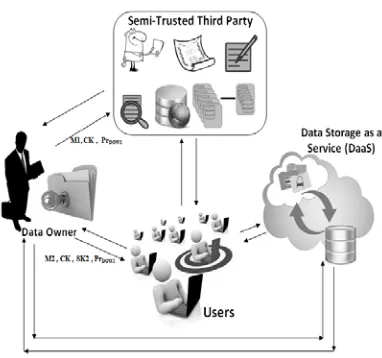
Figure (3) illustrates a descriptive the structure for the proposed system, which consists of four main parts. It relies on the following entities, permitting a user to share, store and retrieve data as well as search on encrypted data with multiple users:
• Data owner: Each Data Owner must have a unique and authentic identity, denoted by IBC and it can be either an individual or an enterprise. Moreover, the Data Owner used Data Storage as a Service (DaaS) to share, store and retrieve data as well as search on encrypted data with multiple users.
• Semi-Trusted Third Party (STTP): Provide an access control of all users of proposed system as well as enable the users to search on encrypted documents.
3712 • Users: The users have the ability to access and
[image:6.612.100.291.192.371.2]decrypt the documents stored in the cloud depending on the access rights that are authorizations granted by the Data Owner. Moreover, the Data Owner must classify the users depending on their access rights into several groups and characterized each groups by a identifier with their a set of access rights.
Figure 3: The general proposed system structure
8. SYSTEM OPERATIONS 8.1 Data Owner Operations
Firstly, Data Owner generate private key (PrDOW)
depending on his identity and dividing the private
key (PrDOW) into two parts giving one half (PrDOW1)
to the Semi Trusted Third Party (STTP) and send
the other part (PrDOW2) to all authorized users, There
are many algorithms used to split the private key of user. Therefore, we will use the threshold to splitting the private key, whereas, Data Owner will make the "master" public key (the identity of the
Data Owner (PuDOW)) public for all the interested
users. The users used the identity of the Data Owner in order to verify him.
Secondly, Data Owner also chooses secret key (SK) and dividing it into two parts sends one part (SK1) to all authorized users by secure e-mails and sends the other part (SK2) to STTP. The secret key (SK) is used to encrypt the documents of the Data Owner locally before uploading to the un-trusted cloud because the symmetric cryptography (block ciphers) is much faster than asymmetric cryptography in such applications (clouding applications).
After that, Data Owner must classify his documents into multi groups depending on users’ authorizations, and then encrypt his documents (P) by using the secret key (SK) and the properties of
the documents or folders (dp), and upload the results to un-trusted cloud (data owner may store each documents that have the same authorized access into one folder). We use the AES algorithm for the encryption and decryption of documents:
F = H(SK + (dp)); C = E (P, F);
In addition, Data Owner encrypts the keywords and documents properties (dp) by using his public
key (PuDOW):
CK = E (keywords , dp)(PuDOW) mod n
The Data Owner should attach the index of the encrypted keywords with the encrypted documents and uploading it to un-trusted cloud. Hence, the data owner matches the index of the decrypted documents with the index of the encrypted documents by using integer numbers that used by the users after decrypted the keywords. Thereafter, the Data Owner decrypts the keywords and documents properties (CK) by using the two halves
of his private key ((PrDOW1) and (PrDOW2)):
M1= D (CK)(PrDOW1) mod n
M2= D (CK)(PrDOW2) mod n
M1, CK and tables (contain the information about all users and documents) send to Semi Trusted Third Party (STTP), while M2 and CK send to the authorized users. In this way, neither the user could complete the search to obtain the decrypted keywords without getting help from the STTP nor the STTP could decrypt the encryption keywords and obtain the secret keywords due to he does not have the other part of the data owner private key
(PrDOW2) and the secret key (SK2).
3713 8.2 Semi Trusted Third Party Operations
STTP is the second part of the system which will
have the half of the user’s private key (PrDOW2),
STTP also provides an access control of all cloud computing users. STTP takes all the halves of the users' private keys for each organization from Data Owners and stores it in the database with decrypted keywords and decrypted documents properties as well as other information of the users. STTP has many advantages such as:
i. The full operations of search to get the
documents properties cannot be accomplish without acceptance of STTP because it has the halves of users private key.
ii. STTP manages the activities of users for
instance (authorization, checks expire of key, etc.).
iii. It manages the revocation of the users. When the
data owner revokes a user, he sends the users’ identity to the STTP to add the user to the “revocations user’s database”. Therefore, the STTP should check the recipient of the users’ request in the “revocations user’s database” if the user is not revoke STTP sends to the user all data that help him to search, download, and decrypt his documents or files.
8.3 Users Operations
The third part of the proposed system is the users. The users use inquiry privacy when they need to search about the documents, that means the attaches cannot determine the keyword used in an inquiry. However, the users could be staffs of an organization in the same group or department, which permits them to search, download, and decrypt documents or files from the cloud.
The user should send request to STTP to take the permission from it. So, the STTP checks the user’ request in the “revocations user’s database” if the user is not revoke and he has the authorization to access to the documents, the STTP return to the
user token (M1= D (CK)(PrDOW1) and SK2). Thus,
the user multiplies M1 by M2 in order to get the decryption keyword and the documents properties.
M = M1 * M2 mod n
The STTP could not decrypt the encrypted documents because he does not have the M2 and the SK1. However, the user matches the index of the decrypted documents with the index of the encrypted documents to know the encrypted keywords. After that the user send the encrypted keywords to the cloud storage to download the
encrypted documents then the user takes hash function to the documents properties (dp) and adds the result with the hash function of (SK2 + SK1) to obtain the F.
SK = SK1 + SK2; F = H (SK + (dp));
P = D (C, F );
8.4 Data Storage as a Service (DaaS) Operations The final part of the system is DaaS, A DaaS used to provide space storage (virtual infrastructure) to store and retrieve the encrypted documents of the data owner. In addition, Data Owner can use the virtual applications to manage his/her data stored in the cloud servers. Moreover, DaaS has an algorithm used to search within encrypted documents by using the encrypted keywords and return the result to all users, therefore, any user could search and download the encrypted documents if he has the properties of documents (dp) and the secret key (SK). In such way, we reduce the searching time and then retrieve the documents.
9. SYSTEM REQUIREMENTS AND
RESULTS
9.1 System Requirements
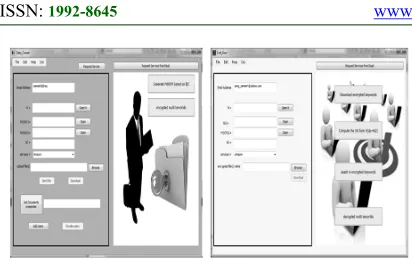
We implemented the proposed system by using computer simulation as a first step for experimentation it. Moreover, we used Microsoft Visual Studio 2010 (visual C# language); due to it provide a great support of GUI to computing environments as well as it present to the data owner and the users a possibility to change or modify the content of the cloud services depending on their demands.
However, to implement the system we use the operating system Windows 7 (32-bit), and Microsoft SQL Server 2008 database as well as Microsoft Visual Studio 2010 (visual C#). While the hardware was, PCs of Intel Celeron Pentium 4 with CPU speed 1.50 GHz. In addition, RAM 2 GB and 40 GB free on hard disk.
3714
Figure 4: Typical interfaces windows for data owner and users
9.2 The Results and Discussion
There are many operations such as;
cryptography, store, retrieve data, and search in encrypted documents were implemented in the proposed system. Furthermore, we use different types of hash functions (MD5 with output 16 bytes, SHA1 with output 20 bytes, SHA256 with output 32 bytes, SHA384 with output 48 bytes, SHA512 with output 64 bytes, and RIPEMD with output 20 bytes) with many system operations and compare the results and the execution time in millisecond with each others. The Table (1) provides details on
the execution time taken for generate data owner
private key (PrDOW) based on IBC and split it into
two parts by using different types of hash functions.
Table 1: Time in milliseconds for generate data owner
private key (PrDOW) based on his IBC
Types of hash function
sha1 md5 sha256 sha384 sha512 RIPEMD
2 ms 3 ms 36 ms 2 ms 2 ms 18 ms
[image:8.612.92.519.410.689.2]Table (2) shows the execution times that are required from the data owner to completing the operations of search about folders names in the database (as shown in Figure 5) and then taken hash function to the properties of files inside it by using different types of hash function. After that, the data owner encrypts the result based on his IBC in order to generate the encrypted keywords (CK). The data owner should not use SHA512 to do the mentioned operations because SHA512 was the slower than the other types of hash function.
Table 2: Time in milliseconds for search about folders names and taken hash function to the properties of files, subsequently encrypts the result based on data owner identity
The length Types of hash function
sha1 md5 sha256 sha384 sha512 RIPEMD
One file inside one folder 158 199 210 171 195 190
100 folders each folder contain
10 files 36228 36393 37907 41286 44148 36035
1000 folders each folder contain
10 files 57426 55261 71257 103126 122051 60793
2000 folders each folder contain
10 files 118368 116287 146474 214525 250998 121624
Figure 5: Database for folders names and the files which inside it
When the user wants a service, he should send
request to STTP to take the permission from it. And the STTP return to the user token
(M1=D(CK)(PrDOW1) and SK2), if the user has
authorization access. Subsequently, the user multiplies M1 by M2 in order to get the
3715
Table 3: Time in milliseconds to search in encrypted database using encrypted keywords and return the results as a decrypted keywords
The length Types of hash function
sha1 md5 sha256 sha384 sha512 RIPEMD
500 encrypted keywords 2931 2999 2914 2925 2934 2952
5000 encrypted keywords 2943 3051 3076 2984 2970 2771
10000 encrypted keywords 3108 3109 3052 2945 2931 2946
In addition, the user must extract the
properties of documents (dp) (size in bit, name, type) and add the result with the SK then compute different types of hash function on the result to get final secret key that used with the AES algorithm for the decryption of documents. The execution time to get the final secret key is
shows in table (4). It’s tested with three files different in size (1MB, 10 MB, 100MB). The data owner could use RIPEMD hash function to generate his private key based on his IBC because RIPEMD was the slowest than the other and it immune from collision attacks and brute-force attack.
Table 4: Time in milliseconds to get final secret key (SK)
Size of files Types of hash function
sha1 md5 sha256 sha384 sha512 RIPEMD
1 MB 1704 1447 2086 2194 2485 6460
10 MB 1870 1923 1809 2110 2954 11257
100 MB 1984 2120 2047 2589 2468 15549
10. CONCLUSION
We studied in this paper the problem of searching over encrypted shared data in the cloud computing, and proposed some possible solutions. The aim from proposed system is to achieve privacy to the data owners’ files those are stored on the public cloud. Furthermore, enhance the keys management as well as the system provides to data owner the ability to revoke or add any user without change the master secret key. In addition, we used the asymmetric cryptography to exchange the keys while a symmetric cryptography used to encrypt and decrypt the big files. We applied six types of hash function (MD5, SHA1, SHA256, SHA384, SHA512, RIPEMD) on different cryptography operations to compare the results and to compute the implementation time for each type.
The future works that could be done, by designing and implementing other types of asymmetric cryptography for exchanging and splitting the private key (such as Diffie–Hellman problem) and then compare the advantages and disadvantages of the results with our proposal.
REFRENCES:
[1] Mohammed M. Alani, “Elements of Cloud Computing Security”, A Survey of Key Practicalities , ISSN 5768 ISSN
2191-5776 (electronic), SpringerBriefs in
Computer Science, ISBN 978-3-319-41410-2 ISBN 978-3-319-41411-9 (eBook), DOI 10.1007/978-3-319-41411-9, 2016, pp.1-16. [2] Wakchaure Sonali Pandharinath and Sonkar
Shrinivas K., “ Group Data Searching And
Sharing Using Key Aggregate
Cryptosystem”,
IJARIIE-ISSN(O)-2395-4396, Vol-2 Issue-1 2016, pp.674-677. [3] D. Boneh, Giovanni Di Crescenzo, R.
Ostrovsky, G. Persiano. “Public Key
Encryption with Keyword Search”,
EUROCRYPT 2004, LNCS 3027, 2004, pp. 506-522.
[4] K.Manohar,2R. Anil Kumar and
N.Parashuram, “Key Aggregate Searchable Encryption for Group Data Sharing Via Cloud Data Storage”, International Journal of Computer Engineering In Research Trends, ISSN (O): 2349-7084, Volume 2, Issue 12, December-2015, pp. 1132-1136.
3716 Searchable Encryption”, International Journal of Innovative Research in Computer and Communication Engineering, ISSN(Online): 2320-9801, ISSN (Print): 2320-9798, (An ISO 3297: 2007 Certified Organization), DOI: 10.15680/IJIRCCE.2015. 0312154, Vol. 3, Issue 12, December 2015, pp. 12773 -12778
[6] Nikesh Pansare, Akash Somkuwar , Adil Shaikh and Satyam Shrestha, “Key-Aggregate Searchable Encryption (KASE) for User Revocation in Cloud Storage”, International Journal of Engineering and Techniques - Volume 2 Issue 1, ISSN: 2395-1303, Jan - Feb 2016, pp.68-70.
[7] PUTTA SRIVANI, SIRANDAS
RAMACHANDRAM and RANGU
SRIDEVI, “EXPERIMENTAL RESULTS
ON MULTI-KEY SEARCHABLE
ENCRYPTION TECHNIQUE WITH
DIFFERENT ELLIPTIC CURVES AND APP DESIGNING”, Journal of Theoretical and Applied Information Technology, ISSN: 1992-8645, E-ISSN: 1817-3195, 15th November 2017. Vol.95. No 21, pp. 5787- 5794.
[8] SNIA, Advanced Storage and Information Technology, “Implementing, Serving, and Using Cloud Storage”. Cloud Storage
Initiative. October 2010,
http://www.snia.org/sites/default/files/2010-
10-WP-ImplementingServingandUsingTheCloud.pdf , pp.1-15.
[9] Nesrine Kaaniche, “Cloud data storage
security based on cryptographic
mechanisms”, TELECOM SudParis, PHD THESIS, Thesis No: 2014TELE0033, HAL Id: tel-01146029, Submitted on 27 Apr 2015, pp.11-13.
[10] John W. Rittinghouse and James F.
Ransome, “Cloud Computing
Implementation, Management, and Security”, CRC Press, Taylor & Francis Group, 6000 Broken Sound Parkway NW, Suite 300, Boca Raton, FL 33487-2742, © 2010 by Taylor and Francis Group, LLC, International Standard Book Number: 978-1-4398-0680-7 (Hardback), 2010, pp. xxxiv-53.
[11] IBTIHAL MOUHIB and EL OUADGHIRI DRISS, “ENHANCED DATA SECURITY
APPROACH FOR CLOUD
ENVIRONMENT BASED ON VARIOUS ENCRYPTION TECHNIQUES”, Journal of
Theoretical and Applied Information
Technology, ISSN: 1992-8645, E-ISSN: 1817-3195, 31st October 2015. Vol.80. No.3, pp. 439-446.
[12] OUADIA ZIBOUH, ANOUAR DALLI and HILAL DRISSI, “CLOUD COMPUTING SECURITY THROUGH PARALLELIZING FULLY HOMOMORPHIC ENCRYPTION
APPLIED TO MULTI-CLOUD
APPROACH”, Journal of Theoretical and Applied Information Technology, ISSN: 1992-8645, E-ISSN: 1817-3195, 20th May 2016. Vol.87. No.2, pp. 300-307.
[13] Xun Yi, Russell Paulet, Elisa Bertino (auth.),
“Homomorphic Encryption and
Applications”, SpringerBriefs in Computer Science, ISSN 2191-5768 ISSN 2191-5776 (electronic), ISBN 978-3-319-12228-1 ISBN
978-3-319-12229-8 (eBook), DOI
10.1007/978-3-319-12229-8, Springer Cham Heidelberg New York Dordrecht London, Library of Congress Control Number: 2014953221, 2014, pp.1-126.
[14] Ronald L. Krutz and Russell Dean Vines, “Cloud Security, A Comprehensive Guide to Secure Cloud Computing”, Wiley Publishing, Inc., ISBN: 978-0-470-58987-8, 2010, pp. 23-159.
[15] David E. Y. Sarna, “Implementing and Developing Cloud Computing Applications”, Auerbach Publications, Taylor and Francis Group, LLC, ISBN 978-1-4398-3082-6 (hardback), 2011, pp.10-176.
![Figure 1: Data Storage as a Service (DaaS) according to SNAI definition (adapted from [8])](https://thumb-us.123doks.com/thumbv2/123dok_us/8903139.955702/3.612.96.294.246.300/figure-data-storage-service-daas-according-definition-adapted.webp)
![Figure 5: SPI evolution through virtualization (adapted from [14])](https://thumb-us.123doks.com/thumbv2/123dok_us/8903139.955702/4.612.132.482.355.527/figure-spi-evolution-virtualization-adapted.webp)