3846
DEVELOPING (UTAUT 2) MODEL OF ADOPTION MOBILE
HEALTH APPLICATION IN JORDAN E- GOVERNMENT
MALIK BADER ALAZZAM1, YASSER MOHAMMAD AL-SHARO2, MAJED KAMEL
AL-AZZAM3
1Department of software engineering1, Ajloun National University Ajloun, 26810, Jordan 2Department of computer science2, Ajloun National University Ajloun, 26810, Jordan
3Business Administration Department Yarmouk University
ABSTRACT
Mobile Health Application (MHAs) positively influence the quality of hospital services and lessen health costs. Lack of education and awareness may hinder the use of the MHA system. Through the Unified Theory of Acceptance and Use of Technology (UTAUT) framework, this research scrutinized the elements which influence the MHA acceptance. The UTAUT model is a new tool for evaluating the integration/adoption of MHAs. Through empirical studies and the use of the UTAUT2 model we aim to clarify the behavioral exercise of healthcare specialists and their propensity to using the MHA system. The objective of the research is to test trust information elements which influence integration and adoption of the MHA by healthcare providers. This research focuses on Jordanian hospitals which use the MHA. The study further direct to create a well-defined view of which factors influence the adoption and acceptance of the MHA, by making use of questionnaires as a starting point for in-depth and comprehensive future studies.
Methods: The article made use of surveys coursed through Jordan hospitals to gather data from healthcare providers/specialist/professionals, who were familiar with the MHA system. A total of 278 responses were derived from 555 survey-forms for data analysis.
Keywords:- Mhas, Healthcare Professionals, UTAUT1, UTAUT2, Acceptance, Trust In Information, E Government
1.INTRODUCTION
The Mobile Health Application (MHAs) is the collective body of diverse info instruments, which include: test systems, emergency information, electronic prescription, DSS, telemedicine, and digital imagery), that could positively impact on healthcare professional’s decision-making processes. Through the integration of the MHA, daily hospital operations and practice could be safer. A review of literature proves the many benefits of MHA for the patient [1]. Benefits include, increased quality of health care, due to easily accessible healthcare-related data. This could significantly improve coordination among healthcare professionals [2]; positively increase efficiency of primary health care; empower and encourage patients’ active participation in decisions relating to health care [3]; and may be used for proper transfer of information on suggested precautionary health care, through primary-care channels [5]. Moreover, it is a device which encourages technology transfer and
knowledge exchange, as well as help in the decision making based on up to date information about its patients [1].
I. CURRENT KNOWLEDGE OF MHA
ACCEPTANCE
3847 needs large capitalization and investment in time and effort, but the radical change to hospital work and service is clear [9]. The impressions on the MHA usually vary between health professional groups, which makes MHA’s acceptance by the medical community even more complex within a pluralist eHealth regime [10].
2.RELATEDWORK
A. Unified Theory of Acceptance and Use of
Technology (UTAUT)
For two decades, researchers held seminars and lectures to encourage acceptance. Several theories and models have been used to forward these studies in different locales for various areas of the study. The findings and conclusions from these studies differ. Proponents of the UTAUT model uniformed eight theories which is namely: Theory of reason Action (TRA), Technology acceptance model (TAM), Motivational model (MM), Theory of planned behavior (TPB), combined TAM and TPB (C-TAM-TPB), Model of PC Utilization (MPCU). Innovation Diffusion Theory (IDT); and Social Cognitive [1]- [8], [9].
Theory (SCT) Bandura (1986). The UTAUT adds up different sides of all the concepts from the abovementioned theories into four elements, which says that intention, usage, and four (4) key constructs are the key factors to their interrelationships [10]. Figure 1 shows the dynamics of the UTAUT model. The UTAUT Model forms four constructs, namely: Effort Expectancy (EE), Performance Expectancy (PE), Social Influence (SI), and Facilitating Conditions (FC). Certain studies under the UTAUT model also consider Endogenous Variables (EV), which refer to those which influence behavior and intent to use the technology. There are four other factors to consider, namely: age, experience, gender, and voluntariness. Performance Expectancy means the degree by which an individual considers the benefit and performance of the technological system [2], [11]. The degree by which the MHA system can be easily used is a key factor and indicator, which plays a role to figure out the “Behavioral Intention to use” technology and its EE (Effort Expectancy). A person’s perception of how important a new system is functioning as a significant indicator to determine technological intention to use. Facilitating conditions refers to the propensity to believe that the technology will play a vital and effective function in the organizational and technical structure.
Employing the UTAUT model in this study is justifiable and sensible due to its worldwide and integrative features, which incorporate a multitude of explanatory variables from the primary theoretical models used in analyzing and defining technology acceptance and use. More specifically, [10] it involves an exhaustive analysis of relevant works and proposes an amalgamated framework which combines the public influences on the core concepts. Thus, we can surmise and expect that such theory which employs and adopts such contributions from other models will be the better choice for analyzing and defining technology acceptance and use [9].
B. UTAUT2
[4] Advances the UTAUT, to accurately analyze adoption and usage of technology from a buyer's point-of-view. It introduces three new concepts, namely Hedonic Motivation (HM), Price Value (PV), and Habit (HT). Demographic attributes of users were also considered, namely: experience, age, and gender, which may influence behavioral intention (BI) and use of technology. Findings were obtained from the employment of 2-pronged web-based surveys. It took four months to collect 1,512 responses. As compared to UTAUT, the added factors considered in UTAUT 2 resulted in a greater variance in behavioral intention (BI).
1) Hedonic Motivation (HM)
Hedonic motivation may be defined as an internal form of incentive, which may include fun, enjoyment, or pleasure derived from using technology. It is considered as key concept to define technology reception and usage. HM is akin to Perceived Enjoyment, and “playfulness” is like TAM, in functioning as an element of intrinsic motivation, [4], [12], [13].
2) Price Value (PV)
Generally, people choose to avail of products/information if they see that the benefits derived therefrom are greater than the actual cost of purchasing the product/information, this is known as price value. It can be further defined, in the context of the theory, as learner’s mental exchange between the economic cost and paybacks of using the technology, [4], [13], [14].
3) Habit (HT)
3848
[image:3.612.181.430.116.298.2]as the degree by which persons are inclined to behave in a routine like a manner [4], [12]. [1]
Figure 1: UTAUT (2)
Information and Communication Technologies (ICTs) include an assortment of beneficial implements for collecting, storing, and exchanging eHealth-related data [1]. Thus, there is proof that ICT can advance quality, security, and cost-efficiency for processing of healthcare information. The Mobile Health Application (MHAs) is considered essential for effectively employing ICTs within the healthcare community. It gives way for the amalgamation of innumerable medical orders, and procedures (e.g. electronic prescriptions, emergency information, ordering of tests, telemedicine, digital imaging, etc.), which can streamline information collection, storage, and processing, and greatly improve on the decision-making of hospitals. The use of such information is essential in daily clinical practices, and this can be improved and made more efficient using MHA
[38]. There are high hopes and expectations that patients, healthcare professionals, organizations, and the general public will receive help from the use of MHA. A review of literature proves the many benefits of MHA for patient [15].
A primary benefit cited is the improvement in “quality of care”, after the patients and their health care providers could access their relevant health data. [16].
Through relevant disease management programs [17], the MHA can help and empower citizens to actively take part in the decision-making process for policies concerning health.
The MHA helps in knowledge exchange and technology transfer, as well as in the decision-making process of and amongst healthcare specialists by giving access to germane and up-to-date information of their patients.
Table 1 Shows The Overview Of The Studies Carried Out On The Adoption Of Employee Of The E Health System
Author Description origin Method, simple
size
Factors
[3] investigate empirically the impact
of organizational culture
Jordan Questionnaire,
271 employees
organizational culture
[4] Examines the user adoption of a
new tablet application that aims to provide support for cognitive stimulation for the elderly
Paris , survey , 15
senior users
show a good acceptability of the app’s games that continues and improves with time
[5] Applying an Acceptance Model to
assess the adoption of M-Health Services by health related users in UAE
UAE Survey , 144 Validated proposed hypotheses and model.
PU, PEOU, TR and SE found directly influencing the intention to use M-Health services
[6] Assessing the current state of the
art in mobile health-related and clinical apps
USA, Europe,
brief survey of evaluation studies
Interactions may require substantial effort. Advice may not align with users’ expectations or life activities
[7] Developing and performing user
evaluation for a mobile DSS running on iOS known as OphthalDSS
Spain Survey, 50
physicians answered
Positively Quality, Ease of Use,
[image:3.612.83.527.547.728.2]3849
[8] Examines MHA acceptance factors
in an academic-based eHealth
Us Questionnaire,
802 faculty
Physician involvement. Adequate training,
Physician autonomy. Doctor-patient
relationship, Perceived ease of use, Perceived usefulness, attitude about MHA usage
[9] To assess adoption of electronic
health records (MHAs)
Us Survey.
155 children’s
Functionalities.
[10] the effect of (MHA) acceptance Surveyed, 72 influence on patient care,
interference with other activities, influence on communication and relationships, billing process,
[11] To examine variation in the
adoption of electronic health record (MHA)
Us Survey,
4484 physicians
size availability of MHA functionalities, (functionality use,
[12] Pilot study of MHAS acceptance in
Jordan hospitals by utaut2 Jordan Survey 70 UTAUT
[13] to study the role of business case
analysis in
healthcare organizations'
Us Case study
interviewed 43
organizational
Cost external factors, size and complexity, stage of MHA adoption, structure of health system-physician relationships, geographic location,
[14] implementation usage behavior of
Electronic Medic Records system
Jordan 7 hospitals ,700
questionnaires
Usefulness Ease ,ease of use
[15] Health information using the
Medical Evidence Gathering and
Analysis through Health IT
(MEGAHIT).
US Case study
Interviews with
43 participants
governance dimensions
[16] patient safety from hospitals in six
developing countries
Egypt, Jordan Morocco, Sudan Tunisia Yemen
Survey 10 group
Standers
[17] to find out the status of electronic
private healthcare information
protection and safeguards
UAE Qualitative,
quantitative, 115 Chief
Security
security of private and personal
information
[18] exploring the factors influencing
behavior and adoption of USB-based Personal Health Records (PHR)
Taiwan Questionnaires
1549 Higher Usage Intentions, Perceived Usefulness
[19] A Proposed Framework to
Investigate the User Acceptance of Personal Health
Records in Malaysia using UTAUT2 and PMT
Malaysia Proposal PMT +UTAUT
[20] literature review is used to gain
knowledge about the medical and
information security cultures
involved
US literature review,
95 articles
security behavior Behavioral change agents Information security behavior
[21] Trust in stored data in MHAs
acceptance of medical staff: using UTAUT2
Jordan 70 Stored data +UTAUT
[22] Previous studies concerning the
security and privacy (MHAs)
Literature review 775 articles
Security and privacy
[23] analyze barriers perceived by
different healthcare
Saudi Arabian Case study
158 participated
Human , Financial , Laws and Policies, Organizational ,Barriers, Computers and IT Professional
[24] MHA acceptance and utilization by
physicians in Jordan
Jordan Interviews,
questionnaire 500
acceptance and utilization TAM
C. Trust and technology
Technology online became a buzzword in every aspects of our life. It is heavily used in the information sector especially in knowledge transactions.[25] It does so because information sector produces intangible goods which do not
3850 bridging the borders. Therefore, technology is embedded with human life in almost all activities. There are many types of technology which differs according to the used information. For example, past decades, e-commerce and e-government have globally witnessed a rapid growth and received a considerable attention from the practitioners as well as the academies. The importance of technology motivates many studies in the worldwide to explore the factors that play central role in technology acceptance.
The Contribution
Trust in information (TI)
Trust in information (TI) signifies the level of trustworthiness of information acquired entrenched in online milieu. Chopra and Wallace (2003) classified TI as a significant trust found in e- environments, mainly apparent via information quality indicators, for example, accuracy, currency and coverage. The quality attributes of e-government systems information provision as utmost important in the development of trust in e-health. In addition, the quality of information is an important and meaningful determinant towards the readiness to utilise e-government services. Hence, trust in MHA system will rely mainly on the trust, which the user is able to show in the information that is accessible to them. This involves the reliability, accuracy and relevance of the information which is purpose-specific (Chopra and Wallace 2003; Barua, 2012; Papadopoulou and Nikolaidou, 2010).Dimensions
Dimensions
The dimensions of (TI) emphasise on:
i. Information Reliability: To validity, completeness and reliability of information provided.
ii. Information Adequacy: The adequacy of information provided which is drive-specific.
iii. Information Relevance: The relevancy of information provided which is purpose-specific.
iv. Information Understand ability: The comprehensibility of the information provided.
v. Information Accuracy: The accuracy of information provided. vi. Information Currency: The
currency of information provided.
3851 • Figure 1: Trust Information Model
3.RESEARCHHYPOTHESIS
MHAs and UTAUT2
The UTAUT model has been widely used for analyzing and forecasting MHA espousal and approval. This is presented in Table 1. In the case of the Jordanian Hospitals, the employees will likely find the MHA system helpful and useful. It can help them to execute the tasks of the Directorate, efficiently and effectively. Performance Expectancy, Effort Expectancy, Social Influence, Hedonic Motivation, Price Value, and Habit will have direct effects on the behavioral intention to use of MHA, by medical professionals and staff. Consequently, higher levels of intention of use will result in increased adoption of the MHAs. H1. Performance expectancy is correlated with a positive manner to utilize the MHA System. H2. Effort expectancy is
likewise correlated optimistically to BI of the MHA system. H3. Similarly, positive social influence means it will be more likely that the MHA system will be adopted. H4. The same rings true for facilitating conditions. H5. Hedonic motivation is certainly linked for with the aim of using MHA system. H6. Price value is also correlated in a progressive manner to the propensity to use MHA system. H7. Likewise, Habit positively influences BI to use MHA system. H8. Trust in Information is particularly associated for using the MHA system.
4.DATAANALYSISANDRESULTS
[image:6.612.98.326.77.335.2]This article describes the analysis conducted and displays the empirical results to examine the hypotheses of this research, using SMART-PLS 2.0 and SPSS version 18 software. This chapter comprised of nine major sub-sections.
Table 2: Summary of Sampling Size in PBH and PRH
Name of Hospital
No of Population
Physician p=91
Nurses P=348
Pharmacists P=21
Laboratory Technicians
P=33
Administrative P= 62
Total Sample
555
PBH 428 *P=39 S=8 P=154 S=102 P=11 S=10 *P=15 S=12 *P=31 S=26 158
PRH 308 P*=52 S=4 P*=194 S=72 *P=10 S=8 *P=18 S=8 P=31 S=28 120
TOTAL 736 12 174 18 20 54 278
The number of sample was identify using a technique suggest by Sekaran (2003), if the population was 700 then the sample size should be a minimum of 248 as show Table 3.4.
TRUST INFORMATION
RELIABILIT Y
ADEQUACY
RELEVANCE
UNDERSTAN DABILITY ACCURACY
3852
Table 3: Size Sample for Given Population Size
N S
400 196
500 217
600 234
700 248
800 260
420 questionnaires were distributed to professional healthcare providers. This study used the sample random method. As suggested by Sekaran (2003), the questionnaires were distributed to the participants after revising the retest and pilot test. The participants were given two months to complete the questionnaire.
[image:7.612.151.464.324.378.2]According to Wong (2013), prior study proposed that a sample size of 100 to 200 is usually a good starting point in carrying out path modelling (Hoyle, 1995). 50% response rate is excellent considering that response rate of 30% is acceptable for surveys (Sekaran, 2003; Hari et al., 2010). Table 3.5 showed the response rate and usable questionnaire for this study.
Table 4: Summary of Response Rate
Number of distributed questionnaires 420
Unreturned 111
Uncompleted 31
Returned and usable questionnaires 278
Respond rate ( 278/420) 50%
a. Sample Profile
[image:7.612.85.530.436.725.2]Table 4 represents the frequencies and percentages of the demographical variables.
Table 5: Sample Profile
Group Frequency Percentage
Gender
Male 69 25
Female 209 75
Age
< 35 77 27
= > 35 < 50 107 38
> 50 94 34
Education level
Master or PhD 15 5
Degree 138 49
Diploma 115 41
Secondary school or below 10 3
Type of Hospital
Princess Badeah 158 56
Princess Rahmah 120 44
Function
Physician 12 4.
3853
Pharmacist 18 6
Laboratory 20 7
Administrative 54 19
Experience
> 3 months < 12 months 146 52
> one year < = two years 95 34
Above two years 37 13
Daily Use MHAs
less than one hour 61 22
From one hour to four hours 112 40
From 4 to 10 hours 83 29
above 10 hours daily 22 7
Over 278 received questionnaires, 209 responses were received from female (75%) and 69 from male (25%) participants. Therefore, females mostly dominated the sample of this study. In specifying the age of the respondents, 27.7% of them were less than 35 years, 38.3% are between 35 to 50 years old and 34% of them were more than 50 years old.
The respondents were also asked to determine their educational level. As a result, 49.6% of them possessed degrees, 41.1% have diplomas, 5.7% have master or PhD level education and 3.5 have secondary school or below. In specifying the type of hospital, 56% were from Princess Badeah and 44% were from Princess Rahmah. In specifying the profession of the respondents, 63.1% of them were nurses, 19.1% were administrative staff, 7.1% were laboratory technicians, 6.4% were pharmacists and 4.3% were physicians.
The respondents were also asked to determine their experience. As a result, 52.5% of them have 3 to 12 months of experience, 34% have 1 to 2 years and 13.5% have above 2 years’ experience.
Finally, in specifying the Daily Use MHAs, 40.4% used between one to four hours, 29.8% used between four to 10 hours, 22% used less than one hour, and 7.8% used above 10 hours daily.
b. Measurement Model (CFA) –SEM
The measurement model or confirmatory factor analysis (CFA) is used to find out the links between manifest or observed and latent or
unobserved variables. The measurement model could therefore be said to define the manner in which latent or unobserved variables are assessed in terms of the manifest variables [29] . Operationalization of constructs is a very important step [30] in the process of ensuring accuracy. Researchers have a choice of several established scales in attempting to ensure theoretical accuracy.
However, despite the availability of a varied number of scales, researchers are often plagued by the problem of a lack of established scales and are thus driven to developing new measurement scales or greatly modifying existing scales to accommodate new context. Given all these considerations, the basis for the SEM analysis is in the selection of items to measure the constructs [30].
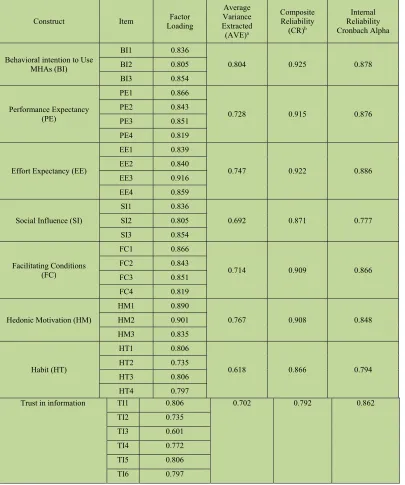
In the CFA models, each of the constructs was assessed for their reliability and validity. Reliability is assessed using Cronbach’s alpha, construct reliability (CR) and average variance extracted (AVE), whilst for validity using construct, including convergent and discriminant.
The next sub-sections discuss the development of measurement model. The results of testing the convergent validity and discriminant validity are presented, using SMART-PLS 2.00.
[image:8.612.83.529.53.264.2]c. Convergent Validity
Table 4.9 represents the result of Cronbach’s alpha and convergent validity for the
3854
Table 6: Results of Convergent Validity for Measurement Model
Construct Item Loading Factor
Average Variance Extracted
(AVE)a
Composite Reliability
(CR)b
Internal Reliability Cronbach Alpha
Behavioral intention to Use MHAs (BI)
BI1 0.836
0.804 0.925 0.878
BI2 0.805
BI3 0.854
Performance Expectancy (PE)
PE1 0.866
0.728 0.915 0.876
PE2 0.843
PE3 0.851
PE4 0.819
Effort Expectancy (EE)
EE1 0.839
0.747 0.922 0.886
EE2 0.840
EE3 0.916
EE4 0.859
Social Influence (SI)
SI1 0.836
0.692 0.871 0.777
SI2 0.805
SI3 0.854
Facilitating Conditions (FC)
FC1 0.866
0.714 0.909 0.866
FC2 0.843
FC3 0.851
FC4 0.819
Hedonic Motivation (HM)
HM1 0.890
0.767 0.908 0.848
HM2 0.901
HM3 0.835
Habit (HT)
HT1 0.806
0.618 0.866 0.794
HT2 0.735
HT3 0.806
HT4 0.797
Trust in information TI1 0.806 0.702 0.792 0.862
TI2 0.735
TI3 0.601
TI4 0.772
TI5 0.806
TI6 0.797
a: Average Variance Extracted = (summation of the square of the factor loadings)/{(summation of the square of the factor loadings) + (summation of the error variances)}.
b: Composite reliability = (square of the summation of the factor loadings)/{(square of the summation of the factor loadings) + (square of the summation of the error variances)}.
As shown in Table, the results of assessing the standardized factor loadings of the model’s items indicated that the standardized
3855 Once the unit-dimensionality of the constructs was achieved, each of the constructs was assessed for their reliability. Reliability is assessed using average variance extracted (AVE), construct reliability (CR) and Cronbach’s alpha Table 4.9 shows that the AVE, which reflects the overall amount of variance in the indicators accounted for by the latent construct, was above the cut-off 0.5 for all constructs as suggested by Hair (2006), ranged from 0.586 to 0.832.
The composite reliability values, which depict the degree to which the construct indicators indicate the latent construct, exceeded the recommended value of 0.6 for all constructs as recommended by Bagozzi and Yi (1988), ranging from 0.866 to 0.934.
[image:10.612.82.531.253.448.2]The Cronbach’s alpha values, which describes the degree to which a measure is error-free, ranged from 0.777 to 0.921 which were above the threshold of 0.7 as suggested by Nunnally (1994).
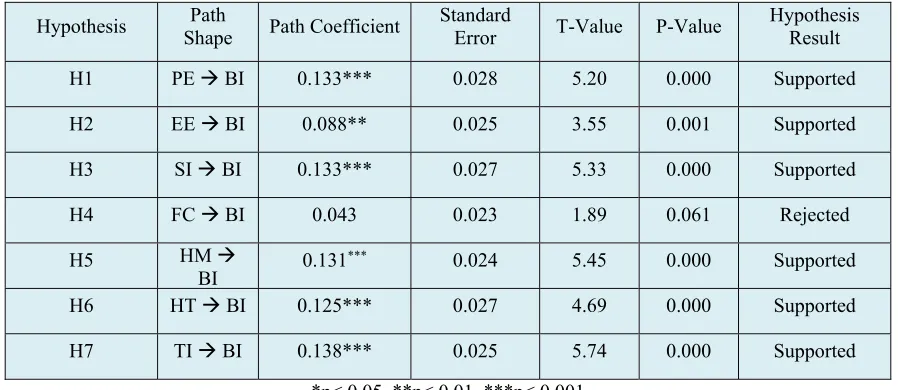
Table 7: Examining Results of Hypothesized Causal Effects in Structural Model 2
Hypothesis Shape Path Path Coefficient Standard Error T-Value P-Value Hypothesis Result
H1 PE BI 0.133*** 0.028 5.20 0.000 Supported
H2 EE BI 0.088** 0.025 3.55 0.001 Supported
H3 SI BI 0.133*** 0.027 5.33 0.000 Supported
H4 FC BI 0.043 0.023 1.89 0.061 Rejected
H5 HM
BI 0.131
*** 0.024 5.45 0.000 Supported
H6 HT BI 0.125*** 0.027 4.69 0.000 Supported
H7 TI BI 0.138*** 0.025 5.74 0.000 Supported
*p< 0.05, **p< 0.01, ***p< 0.001
As shown in Table 4.14 seven paths from Performance Expectancy (PE), Effort Expectancy (EE), Social Influence (SI), Hedonic Motivation (HM), Habit (HT), Trust in information (TS) on Behavioral Intention to Use MHAs (BI) were statistically significant as their p-values were all below the standard significance level of 0.05. Thus, the hypotheses H1, H2, H3, H5, H6, and H7 were supported. Conversely, the effect of Facilitating Conditions (FC) on Behavioral Intention to Use MHAs (BI) was not found as statistically significant by having p-value above the standardized significance level of 0.05. Thus, the hypothesis H1.d was rejected.
Model Validation
To validate the model from the in-depth study, structured interviews were conducted with three experts of other medical staff with whom the researcher worked. The medical specialties of these staff are in high position in hospital management as follow: two experts work in (PBH) princess Badeah hospital and one expert
work in princess Rahmah hospital (PRH). The researcher tried to examine the current situation of healthcare in Jordan hospitals and how to get a healthier Jordan, the main focus of the interviews was two-folds:
To explore the current situation of acceptance electronic health record system in Jordan.
What are the factors influencing medical staff adoption of (MHAS) in Jordan hospitals?
3856 demographic information and work environments. An example of the interview questions was: “What motivates medical staff (including you) in your field to trust their data?” During the interviews, the participants were asked to answer the questions based on not only their own experience but also their observations in their research disciplines in
5. FINAL RESEARCH MODEL
6. CONCLUSION
The current study attempted to explore the factors influence the MHAs acceptance in Jordanian hospitals government and the link between trust in information, and Behavioral Intention to use MHAs in Jordanian hospitals and thus it opened the door for the possibility of more research. The most significant contribution of the present study is that to the UTAUT2 theoretical knowledge.
The study's model is an extension of the UTAUT2 model comprising of external factors and behavioral Intention to use MHAs. The findings are expected to improve the theoretical knowledge on the topic particularly its relation to UTAUT2 and the application in the Jordanian health domain. The study also improved the classic UTAUT2 by introducing Trust in information Factor and behavioral Intention to use based on a social perspective. The present study contributed to the literature concerning health informatics and particularly to the healthcare professional model of MHAs acceptance in the context of Jordanian government hospitals. In addition, the study also
contributed to the Jordanian Ministry of Health (MOH) for its invaluable evaluation of the healthcare acceptance of MHAs in Jordanian hospitals or for that matter, in which EMRs use has been mandated. The research outcome can be utilized to improve the existing MHAs and these can be used in the evaluation, utilization, and identification of factors influencing MHAs acceptance in Jordanian public hospitals.
7. SUMMARY
3857 to examine the factors of healthcare professionals’ acceptance of (MHAs) in Jordan. In addition, this stage involved the determination of the research methodology consisting of procedures, processes and guidelines compounding the type of research appropriateness, and items measurement were tested followed by re-testing and pilot testing, evaluation of content, face validity, and data handling.
8. LIMITATIONS OF THE STUDY
The present study focused only on one healthcare system and considered the results as generalizable to a certain number of populations where the sample was taken from. Therefore, this may not be an accurate depiction of attitudes. In addition, the geographic division of Jordan may also affect (MHAs) perceptions as some individuals coming from different geographic locations were expected to display different attitudes. Another limitation of the study was the use of a generic survey in the collection of data which is useful for collecting quantitative data but they do not facilitate for an in-depth study and inquiry into the given issue.
Moreover, the small sample size was also a limitation that owed itself to a small number of individuals’ willingness to participate. Another limitation of the present study was the study of only those factors that affect the implementation of (MHAs). Based on this issue, future research can be attempted to find out the influence of acceptance.
REFERENCES:
[1] M. Rasmi, M. B. Alazzam, M. K. Alsmadi, A. Ibrahim, R. A. Alkhasawneh, and S. Alsmadi, “Healthcare professionals ’ acceptance Electronic Health Records system : Critical literature review ( Jordan case study ) Healthcare professionals ’ acceptance Electronic Health Records system : Critical literature review ( Jordan case study ),” Int. J. Healthc. Manag., vol. 0,
no. 0, pp. 1–13, 2018.
[2] V. Venkatesh, “consumer acceptance and use of information technology: extending the unified theory of acceptance and use of technology,” vol. 36, no. 1, pp. 157–178, 2012.
[3] R. I. Ababaneh, “The role of organizational culture on practising quality improvement in Jordanian public hospitals,” Leadersh. Heal.
Serv., vol. 23, no. 3, pp. 244–259, 2010.
[4] M. Yasini and G. Marchand, “Adoption and Use of a Mobile Health Application in Older Adults for Cognitive Stimulation,” 2016. [5] C. Paper, “Technology Acceptance Model
for the Use of M- Health Services among Health Related Users in UAE,” no. December, 2015.
[6] M. N. K. Boulos, A. C. Brewer, C. Karimkhani, D. B. Buller, and P. Robert, “Mobile medical and health apps : state of the art , concerns , regulatory control and certification,” vol. 5, no. 3, pp. 1–23, 2014. [7] I. De, T. Díez, M. Lopez-coronado, M. M.
López, M. M. López, I. De, and T. Díez, “mHealth App for iOS to Help in Diagnostic Decision in Ophthalmology to Primary Care Physicians mHealth App for iOS to Help in Diagnostic Decision in Ophthalmology to Primary Care Physicians,” no. October, 2017.
[8] M. E. Morton and S. Wiedenbeck, “EHR acceptance factors in ambulatory care: a survey of physician perceptions.,” Perspect.
Health Inf. Manag., vol. 7, p. 1c, Jan. 2010.
[9] M. M. Nakamura, T. G. Ferris, C. M. DesRoches, and A. K. Jha, “Electronic health record adoption by children’s hospitals in the United States.,” Arch. Pediatr. Adolesc. Med., vol. 164, no. 12, pp. 1145–51, Dec.
2010.
[10] M. V Bloom and M. K. Huntington, “Faculty , Resident , and Clinic Staff ’ s Evaluation of the Effects of EHR Implementation,” no. September, pp. 562–566, 2010.
[11] S. R. Rao, C. M. Desroches, K. Donelan, E. G. Campbell, P. D. Miralles, and A. K. Jha, “Electronic health records in small physician practices: availability, use, and perceived benefits.,” J. Am. Med. Inform. Assoc., vol.
18, no. 3, pp. 271–5, May 2011.
[12] M. B. Alazzam, A. B. D. Samad, H. Basari, and A. Samad, “PILOT STUDY OF EHRS ACCEPTANCE IN JORDAN HOSPITALS BY UTAUT2,” vol. 85, no. 3, 2016.
[13] P. H. Song, A. S. McAlearney, J. Robbins, and J. S. McCullough, “Exploring the business case for ambulatory electronic health record system adoption.,” J. Healthc.
Manag., vol. 56, no. 3, pp. 169-80–2.
3858 [15] S. S. Feldman and T. a Horan,
“Collaboration in electronic medical evidence development: a case study of the Social Security Administration’s MEGAHIT System.,” Int. J. Med. Inform., vol. 80, no. 8,
pp. e127-40, Aug. 2011.
[16] S. Siddiqi, R. Elasady, I. Khorshid, T. Fortune, a Leotsakos, M. Letaief, S. Qsoos, R. Aman, a Mandhari, a Sahel, M. El-Tehewy, and a Abdellatif, “Patient Safety Friendly Hospital Initiative: from evidence to action in seven developing country hospitals.,” Int. J. Qual. Health Care, vol.
24, no. 2, pp. 144–51, Apr. 2012.
[17] M. Zineddine and I. Privacy, “automated healthcare information privacy and security : the uae context,” vol. 2012, pp. 311–318, 2012.
[18] W.-S. Jian, S. Syed-Abdul, S. P. Sood, P. Lee, M.-H. Hsu, C.-H. Ho, Y.-C. Li, and H.-C. Wen, “Factors influencing consumer adoption of USB-based Personal Health Records in Taiwan.,” BMC Health Serv. Res., vol. 12, no. 1, p. 277, Jan. 2012.
[19] A. Mamra, “A Proposed Framework to Investigate the User Acceptance of Personal Health Records in Malaysia using UTAUT2 and PMT,” vol. 8, no. 3, pp. 386–392, 2017. [20] D. Box and D. Pottas, “Improving
Information Security Behaviour in the Healthcare Context,” Procedia Technol., vol.
9, pp. 1093–1103, Jan. 2013.
[21] M. B. Alazzam, A. Samad, H. Basari, and A. S. Sibghatullah, “Trust in stored data in EHRs acceptance of medical staff : using UTAUT2,” vol. 11, no. 4, pp. 2737–2748, 2016.
[22] J. L. Fernández-Alemán, I. C. Señor, P. Á. O. Lozoya, and A. Toval, “Security and privacy in electronic health records: a systematic literature review.,” J. Biomed. Inform., vol.
46, no. 3, pp. 541–62, Jun. 2013.
[23] M. Khalifa, “Barriers to Health Information Systems and Electronic Medical Records Implementation. A Field Study of Saudi Arabian Hospitals,” Procedia Comput. Sci.,
vol. 21, pp. 335–342, Jan. 2013.
[24] A. Al-adwan and H. Berger, “Understanding Physicians ’ Adoption of EMR : An Extended Technology Acceptance Model the Case of : Jordan Understanding Physicians ’ Adoption of EMR : An Extended
Technology Acceptance Model the Case of Jordan,” 2013.
[25] S. M.Alazzam, BASARI, “EHRs Acceptance in Jordan Hospitals By UTAUT2 Model: Preliminary Result,” J. Theor. Appl. Inf.
Technol., vol. 3178, no. 3, pp. 473–482,
2015.
[26] U. Sekaran, Research Method for business A
Skill building Approach, 4ed ed. 2003.
[27] K. K. Wong, “28/05 - Partial Least Squares Structural Equation Modeling (PLS-SEM) Techniques Using SmartPLS,” Mark. Bull.,
vol. 24, pp. 1–32, 2013.
[28] J. F. Hari, W. C. Black, B. J. Babin, and R. E. Anderson, Multivariate Data Analaysis,
Seventh. Pearson Prentice Hall, 2010.
[29] R. Ho, Handbook of univariate and multivariate data analysis and interpretation
with SPSS. 2006.
[30] Hair, Multivariate data analysis, vol. (sixth
ed. 2006.
[31] Y. Bagozzi, R.P. and Yi, “On the evaluation of structural equation model’,” J. Acad.
Mark. Sci., vol. 16, no. 1, pp. 74–94, 1988.
[32] I. . Nunnally, J.C. and Bernstein,
3859 APPENDIX:
Item Scale
Performance Expectancy PE1 1 2 3 4 5
PE1 I find MHAs useful in my daily life
PE2 Using MHAs increases my chances of achieving things that are important to me. (dropped)
PE3 Using MHAs helps me accomplish things more quickly.
PE4 Using MHAs increases my productivity.
Effort Expectancy EE
EE1 Learning how to use MHAs is easy for me.
EE2 My interaction with MHAs is clear and understandable
EE3 I find MHAs easy to use
EE4 It is easy for me to become skillful at using mobile Internet.
Social Influence SI
SI1 People who are important to me think that I should use mobile Internet
SI2 People who influence my behavior think that I should use mobile Internet.
SI3 People whose opinions that I value prefer that I use mobile Internet.
Facilitating Conditions
FC1 I have the resources necessary to use mobile Internet.
FC2 I have the knowledge necessary to use mobile Internet
FC3 Mobile Internet is compatible with other technologies I use.
FC4 I can get help from others when I have difficulties using mobile Internet.
Hedonic Motivation
HM1 Using MHAs is fun
HM2 Using MHAs is enjoyable
3860 Habit
HT1 The use of MHAs has become a habit for me.
HT2 I am addicted to using mobile Internet. HT3.
HT3 I must use mobile Internet
HT4 Using MHAs has become natural to me. (dropped)
Behavioral Intention
BI1 I intend to continue using MHAs in the future
BI2 I will always try to use MHAs in my daily life.
BI3 I plan to continue to use MHAs frequently
Use behavior
U1 The use of electronic health records usually for me
U2 I'm addicted to the use of electronic health records system
U3 Should the use of electronic medical records system.
U4 Use the system became normal for me.
Trust information
TI1 MHAs ensures that the data collected will be solely used for the intended purpose
TI2 MHAs ensures that stored data are protected from unauthorized manipulation/alteration
TI3 MHAs provides information which is valid and complete so as to be reliable
TI4 MHAs provide adequate information for the purpose requested
TI5 MHAs provide information which is relevant to the purpose requested
TI6 MHAs provides The provision of information which is understandable
TI7 MHAs provides an accurate information