Lawson, Stuart (2017) Report on offset agreements: evaluating current Jisc
Collections deals. Year 2 – evaluating 2016 deals. figshare.
Downloaded from:
Usage Guidelines:
Please refer to usage guidelines at or alternatively
evaluating current Jisc Collections
deals
Year 2 – evaluating 2016 deals
Stuart Lawson
Published 7 September 2017
This work has been sponsored by Jisc as part of the Jisc Collections Studentship Award at Birkbeck, University of London.
Contents
1. Introduction 3
2. Data sources 4
3. Publisher feedback 5
4. Agreements:
Wiley 6
Taylor & Francis 7
Springer 8
SAGE 9
Institute of Physics (IOP Publishing) 10
Royal Society of Chemistry 11
5. Discussion 12
6. Conclusion 18
References 19
Introduction
Offset agreements for academic journals are designed to reduce the overall cost to academic libraries of supporting scholarly publishing. In these agreements, journal subscription costs and open access publication costs are offset against each other. There are different approaches to achieving this. Some offset agreements reduce the cost of article processing charges (APCs) – the fees sometimes paid to publishers to make research open access – and some reduce the amount an institution pays for a subscription in proportion to the amount it pays for APCs.1 Offsetting is intended as a transitional mechanism to support progress towards a fully
open access scholarly publication system, and is part of the UK’s national open access strategy.2
This report is a comparative study of the different offset agreements that Jisc Collections has negotiated to date on behalf of UK academic libraries. It relies on financial data provided by higher education institutions (HEIs) themselves about the amounts they have paid for subscriptions and APCs. The most recent full year for which financial data was available at the time of publication was 2016, so this report will focus on the six offset agreements in use for the duration of that year. These are from the publishers Wiley, Taylor & Francis, Springer, SAGE, the Institute of Physics (IOP Publishing), and the Royal Society of Chemistry. All six agreements are pilots and therefore subject to revision in subsequent years. The Royal Society of Chemistry offsetting scheme ceased at the end of 20163 and has been replaced by a
different scheme for 2017-18, and De Gruyter has begun a scheme that came into effect in 2017.
Each of the six offset agreements is analysed and compared based on the available data. The discussion section highlights key issues arising from the data, especially with regards to the total cost of publication (TCP).4 The full costs of the transition to open access include much
more than just APCs, so the impact of additional administration costs is also considered. This report is the second of three annual reviews of offset agreements: the previous 2016 report5
used financial data for 2015, and the 2018 report will use financial data for 2017.
1 Some publishers offer discounts on APCs through prepayment or membership agreements, but these schemes are independent of journal subscriptions and are not related to the total cost of publication. The six mechanisms used by the publishers analysed in this report all include some element of recognition for total combined expenditure and can thus be said to be true offset agreements.
2 Earney (2017)
3 Royal Society of Chemistry (2016)
4 See Pinfield, Salter, & Bath (2015) for a definition of TCP. For more research on subscription expenditure, APC expenditure, and the total cost of publication by UK HEIs see Björk & Solomon (2014); Johnson, Pinfield, & Fosci (2015); Jubb et al. (2015); Lawson, Gray, & Mauri (2016); Pinfield, Salter, & Bath (2015, 2016); Shamash (2016, 2017).
Data sources
APC expenditure data has been made openly available by numerous higher education institutions (HEIs) and research funders over the past few years;6 a recent Knowledge
Exchange report7 is an international collaboration that addresses data collection issues across
Europe. The analysis in this report is based on a sample of 38 HEIs in the UK that have made APC data for 2016 available; these institutions are listed in the appendix. Only 25 of the HEIs are the same as in last year’s sample. The sample is based on willing participation so it is not representative and is skewed towards more research-intensive institutions: the 38 HEIs contribute approximately half8 of the sector’s subscription expenditure and have received
69%9 of RCUK’s open access block grants (a rough proxy for APC expenditure). Three of the
institutions (Aston University, University of Bath, and University of Nottingham) provided data in line with RCUK reporting periods (August-July), rather than for the full year.
As with last year’s report, the date used to determine inclusion in the dataset is the date that the APC was applied for.10 Determining which APCs in the dataset have been paid as part of
an offset agreement is not always easy because institutions do not all record this in the same way. As institutions are becoming more familiar with offset agreements, the reliability should improve each year. A copy of the APC and subscription data used in this report is available at
https://doi.org/10.6084/m9.figshare.5382421.
Subscription expenditure by HEIs with major publishers during the years 2010-16 is openly available for almost all institutions in the UK. This data was obtained through sending Freedom of Information (FOI) requests to HEIs, rather than being provided by publishers.11
All publishers with offset agreements in this report are included in the public data for the year 2016 (see Table 1). Therefore the amounts paid in 2016 are known with greater certainty than was possible in the previous year’s offsetting report, which relied on estimates because 2015 data was not yet available. In theory it would now be possible to re-run last year’s report using the more accurate current data, and this will be done for the end-of-project report in late 2018.
6 See Lawson (2016) for a figshare collection containing the majority of this data. 7 Stern (2017)
8 For the six publishers in question, 53% (£30,770,307 out of £58,270,757) of what was paid in 2016. 9 £50,519,112 of the £73,306,917 made available by RCUK to 118 institutions from 2013/14 to 2016/17 (see
Lawson 2016b).
10 In the dataset, this is represented by the field ‘Date of initial application by author’. Since the field ‘Date of APC payment’ could potentially also be used as criterion for inclusion, footnotes in the analysis below show what the APC expenditure would look like using that date instead.
Table 1: Subscription expenditure of UK HEIs with six publishers, 2015–1612
2015 2016
Wiley £19,149,348 £19,875,300 Taylor & Francis £14,231,266 £16,483,429 Springer £8,759,854 £9,897,706 SAGE £8,082,882 £9,037,365 Institute of Physics £1,543,231 £1,630,076 Royal Society of Chemistry £1,294,897 £1,346,881
Publisher feedback
The publishers that appear in this report were shown a copy before publication to allow them to comment. Two main issues were raised: data accuracy, and the ability for the approach used in the report to accurately reflect the costs and value of offset agreements. It is true that both the quality of data and the method of sampling are imperfect (see below pp.13-14). The best way to rectify this would be for all expenditure data to be publicly available. Although the sample does not capture all of the sector’s spending and is not fully representative, a self-selecting sample is currently the only way to ensure that a reasonably large proportion of the UK’s institutions are included in the analysis. A valuable point raised by one publisher is that the sample includes some institutions that have not signed up to offset agreements, so
although the figures given in Table 8 are fairly accurate for a sector-wide view, an individual institution could potentially see far greater savings that the average amounts if it makes full use of the offset opportunities.
Wiley
Duration of deal: 1 January 2015 – 31 December 2017 Duration of offset pilot: 1 January 2015 – 31 December 2017
Table 2: 2016 Wiley expenditure by sample of 38 HEIs
Subscription spend: £11,305,42713
APC spend: £2,181,42414
Total spend (subscriptions + APCs): £13,486,851 Number of APCs published under offset deal: 328
Amount saved through offsetting: £590,40015
Discount on total cost of publication: 4.2%
The offset amount of 4.2% has been calculated by comparing the actual TCP (£13,486,851) with an estimate for what the TCP would have been without offsetting (£14,077,251).
13 In 2016, the total paid by the consortium was £19,875,300 and the total paid by the sample was £11,305,427. 14 Using the field ‘Date of APC payment’ instead of ‘Date of initial application by author’ as criterion for
inclusion, the figure is £2,317,648.
15 Number of offset APCs (328) multiplied by amount of discount on each (£1,800 – the standard hybrid APC price for Wiley). Figure excludes VAT. The offset deal does include full open access journals as well as hybrid, so an article-level analysis may reveal a slightly different total if some articles are published in journals with higher or lower APCs.
Institutions that subscribe to the Jisc Collections 2015-17 Wiley agreement are eligible to join the offsetting pilot if they open a pre-pay Wiley Open Access Account (WOAA). This account is used to accrue credit to pay for APCs in Wiley journals.
This ‘offset credit’ is calculated based on total customer spend with Wiley on journal subscriptions, including fees for access to unsubscribed titles, and APC fees. This means institutions are tiered by total spend with Wiley – the more they spend, the more offset credit they receive to pay future APCs with.
The level of offset credit in 2016 was calculated based on an institution’s spend for 2015. Wiley created a separate WOAA credit account run in parallel with the institution’s regular WOAA account. Provided there is cash in the credit account all APCs are deducted from there. Unused pre-payment funds are rolled over.
Taylor & Francis
Duration of deal: 1 January 2015 – 31 December 2017 Duration of offset pilot: 1 January 2015 – 31 December 2017
Table 3: 2016 Taylor & Francis expenditure by sample of 38 HEIs
Subscription spend: £7,303,37216
APC spend: £425,27317
Total spend (subscriptions + APCs): £7,728,645 Number of APCs published under offset deal: 323 Amount that has been offset: £432,17418
Discount on total cost of publication: 5.3%
The offset amount of 5.3% has been calculated by comparing the actual TCP (£7,728,645) with an estimate for what the TCP would have been without offsetting (£8,160,819).
16 In 2016, the total paid by the consortium was £16,483,429 and the total paid by the sample was £7,303,372. 17 Using the field ‘Date of APC payment’ instead of ‘Date of initial application by author’ as criterion for
inclusion, the figure is £443,553.
18 Number of offset APCs (323) multiplied by amount of discount on each (£1,338 – the standard hybrid APC price for Taylor & Francis is £1,788 and this was reduced to £450). Figure excludes VAT.
Institutions participating in the Jisc Collections 2015-17 Taylor & Francis agreement are included in the offset pilot for 2015 and 2016. Participating institutions received vouchers entitling them to heavily discounted APCs in hybrid journals.
The level of discount depends on the institution’s total expenditure. Each voucher gives a 75% discount on one APC in a hybrid journal, reducing the APC from £1,788 to £450 (excluding VAT). The number of vouchers issued is calculated by institutional spend divided by the average hybrid APC price (£1,788):
number of vouchers = institutional spend / average APC price
Springer
Duration of deal: 1 January 2016 – 31 December 2018
Duration of offset pilot: 1 October 2015 – 31 December 2018
Table 4: 2016 Springer expenditure by sample of 38 HEIs
Subscription spend: £6,373,54119
APC spend: £339,37220
Total spend (subscriptions + APCs): £6,712,913 Number of APCs published under offset deal: 1,136 Amount that has been offset: £3,753,07621
Discount on total cost of publication: 36%
The offset amount of 36% has been calculated by comparing the actual TCP (£6,712,913) with an estimate for what the TCP would have been without offsetting (£10,465,989).
19 In 2016 the total paid by the consortium was £9,897,706 and the total paid by the sample was £6,373,541. 20 Using the field ‘Date of APC payment’ instead of ‘Date of initial application by author’ as criterion for
inclusion, the figure is £374,197.
21 The number of offset APCs in the dataset (1136) multiplied by amount of discount on each (€2,200 – the standard hybrid APC price for Springer, which converts to £1,773 based on average yearly exchange rate for 2016 of 0.8059, see UK Government 2017) totals £2,014,128. In a separate dataset provided to Jisc directly by Springer, the 38 institutions are shown to have 2,120 articles made open access under the terms of the deal, with a value of €4,657,000 (£3,753,076). The total value to the consortium of 3,073 published articles was €6,748,600 (£5,438,697). In Table 4, the Springer-provided figure of £3,753,076 has been used as a basis, because it is known that some institutions chose not to record articles in their APC expenditure data if they were covered by the Springer Compact deal, so the Springer-provided data is likely to be more accurate. This figure does not factor in any increase in subscription spend which now technically includes APCs within it. See Marques (2017) for more details.
The Springer Compact agreement enables researchers from the 91 participating UK institutions to publish their articles immediately as open access in around 1,600 Springer journals as well as to access all content published in approximately 2,500 Springer journals.
The agreement is a move away from the historical print model and as such aims to reduce cost and administration barriers to hybrid open access publishing and to promote a move towards open access publication. Moreover, it allows all UK articles published in eligible Springer Open Choice hybrid journals to be made open access immediately upon
SAGE
Duration of deal: 1 January 2015 – 31 December 2016 Duration of offset pilot: 1 January 2014 – 31 December 2016
Table 5: 2016 SAGE expenditure by sample of 38 HEIs
Subscription spend: £3,878,51422
APC spend: £104,47823
Total spend (subscriptions + APCs): £3,982,992 Number of APCs published under offset deal: 9924
Amount that has been offset: £143,67625
Discount on total cost of publication: 3.5%
The offset amount of 3.5% has been calculated by comparing the actual TCP (£3,982,992) with an estimate for what the TCP would have been without offsetting (£4,126,668).
22 In 2016, the total paid by the consortium was £9,037,365 and the total paid by the sample was £3,878,514. 23 Using the field ‘Date of APC payment’ instead of ‘Date of initial application by author’ as criterion for
inclusion, the figure is £117,067.
24 These fall into three categories: 59 APCs at £200, 33 at £400, and seven at other amounts paid in USD. 25 The standard hybrid APC price for SAGE is £1,600 plus VAT. The figure given here is the sum of the
number of £200 offset APCs (59) multiplied by amount of discount on each (£1,400 – so a total of £82,600), plus the number of £400 offset APCs (33) multiplied by amount of discount on each (£1,200 – so a total of £39,600), plus the savings from the miscellaneous other offset amounts (£21,476).
UK institutions that subscribe to the SAGE Premier collection receive a discount on APCs in hybrid titles. The discounted APC is currently reduced to £200 for authors publishing in titles within the SAGE Choice scheme (hybrid open access journals) and SAGE Premier titles. Authors enter a code and an invoice is raised at the discounted rate.
Institute of Physics (IOP Publishing)
Duration of deal: 1 January 2016 – 31 December 2016
[image:11.595.70.359.439.564.2]Duration of offsetting pilot: 1 May 2014 – 31 December 2017
Table 6: 2016 IOP expenditure by sample of 38 HEIs
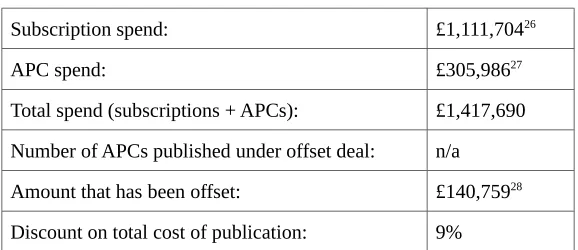
Subscription spend: £1,111,70426
APC spend: £305,98627
Total spend (subscriptions + APCs): £1,417,690 Number of APCs published under offset deal: n/a Amount that has been offset: £140,75928
Discount on total cost of publication: 9%
The offset amount of 9% has been calculated by comparing the actual TCP (£1,417,690) with an estimate for what the TCP would have been without offsetting (£1,558,449).
26 In 2016, the total paid by the consortium was £1,630,076 and the total paid by the sample was £1,111,704. 27 Using the field ‘Date of APC payment’ instead of ‘Date of initial application by author’ as criterion for
inclusion, the figure is £358,036.
28 This figure is 90% of the amount spent by HEIs in the sample on IOP APCs in 2015.
Hybrid APCs for articles published in one year are offset against institutions’ expenditure on subscription and licence fees in the following year, as long as they maintain subscriptions to IOPscience. Ninety per cent of a university’s expenditure in one year on APCs is offset, or the total cost of their subscriptions, whichever is the greater.
IOP will monitor articles published on an open access basis in hybrid journals by authors at participating institutions during the course of each year and report to each institution at the end of the year on the number of published articles and their publication costs.
Royal Society of Chemistry
Duration of deal: 1 January 2016 – 31 December 2016 Duration of offsetting pilot: 2012 – 2016
Table 7: 2016 RSC expenditure by sample of 38 HEIs
Subscription spend: £797,75029
APC spend: £287,50930
Total spend (subscriptions + APCs): £1,085,259 Number of APCs published under offset deal: 29031
Amount that has been offset: £464,00032
Discount on total cost of publication: 30%
The offset amount of 30% has been calculated by comparing the actual TCP (£1,085,259) with an estimate for what the TCP would have been without offsetting (£1,549,259).
29 In 2016, the total paid by the consortium was £1,346,881 and the total paid by the sample was £797,750. 30 Using the field ‘Date of APC payment’ instead of ‘Date of initial application by author’ as criterion for
inclusion, the figure is £285,332.
31 It is hard to verify the precise accuracy of this figure due to different ways that institutions record use of the vouchers. There were 224 vouchers listed in the dataset, and an extra 14 vouchers from the University of York which were not included in the main dataset, bringing the total to 238. However, RSC provided Jisc with a different dataset of all gold open access vouchers used in 2016. In this a further 111 vouchers were identified as belonging to the sample, but institutions had over-reported by 59. Therefore the total number used is 238+111-59=290.
32 Number of offset APCs (290) multiplied by amount of discount on each (£1,600 – the standard hybrid APC price for RSC). This does not include VAT.
Discussion
Value
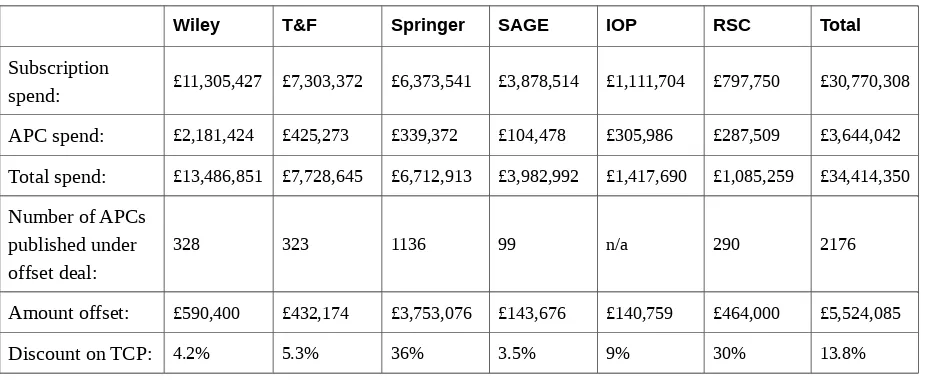
Offsetting has reduced the total cost of publication (TCP) compared to projected expenditure levels if no deals were in place. For the sample of 38 UK institutions in this report, the combined value of offset agreements across all publishers is £5.5m or 13.8% (see Table 8). Since the HEIs in the sample represent over two-thirds of the sectors’ APC expenditure,33 the
[image:13.595.71.538.264.454.2]total value of the six offset agreements in 2016 can be estimated at £8m.
Table 8: The value of publishers’ offset agreements compared
Wiley T&F Springer SAGE IOP RSC Total
Subscription
spend: £11,305,427 £7,303,372 £6,373,541 £3,878,514 £1,111,704 £797,750 £30,770,308 APC spend: £2,181,424 £425,273 £339,372 £104,478 £305,986 £287,509 £3,644,042
Total spend: £13,486,851 £7,728,645 £6,712,913 £3,982,992 £1,417,690 £1,085,259 £34,414,350
Number of APCs published under offset deal:
328 323 1136 99 n/a 290 2176
Amount offset: £590,400 £432,174 £3,753,076 £143,676 £140,759 £464,000 £5,524,085
Discount on TCP: 4.2% 5.3% 36% 3.5% 9% 30% 13.8%
This is a significant amount of money for the sector and much higher than last year’s estimate of £2.5m for 2015.34 However, there are important caveats to consider. Firstly, the sample is
skewed towards the most research-intensive institutions,35 and the level of savings generated
through offsetting differs depending on institutions’ level of expenditure – for instance the Wiley agreement tends to benefit high-spending institutions more, whereas the Springer agreement can benefit low-spending institutions (if they publish a lot of open access articles). Secondly, the ‘savings’ calculated in this report are against projected expenditure levels for 2016, i.e. the amounts that institutions might have paid in the absence of offset agreements, and this is difficult to estimate accurately. This is because, although there is no evidence yet of authors changing where they publish based on the presence of offset agreements, some APCs that were offset may simply not have been paid if there were no agreements in place. It is probably more accurate to regard the value of the deals as cost avoidance rather than savings.36
33 See Note 8 on p.4 for calculations of the figure (69%). In the data provided by Springer for the value of its offset APCs in 2016, the figure for the sample’s proportion of APC value happens to also be 69%.
34 Lawson (2016a)
35 For high-spending institutions, the Wiley agreement can lead to great variation in the amount of credit each year, with the total amount paid swinging higher and lower in alternate years. This creates problems for the institution and analytical difficulties in making year-on-year comparisons.
It is clear that some agreements are better value than others, and reduce the total cost of publication more than others. The RSC and Springer agreements proportionally reduce the TCP significantly more than the Wiley, SAGE, Taylor & Francis, or IOP agreements. Over the past few years, RSC’s ‘Gold for Gold’ scheme has been the most successful in reducing the TCP, but it has now been discontinued and replaced by an alternative offsetting mechanism whereby institutions pay a flat fee each year – calculated based on the prior number of articles they have published with RSC – in order to make all of their articles open access. So although offsetting will continue, it appears that in future years the deals from that publisher will be of less value to the sector and next year’s report will reveal whether this is the case.
The Springer Compact agreement provides by far the largest cash savings to the sector due to the fact that it covers the highest number of APCs (3,073 articles were published under the agreement in 201637). The agreement appears to be effective in terms of both reducing costs
and in being easy to administer for institutions. On the other hand, the overall expenditure by the sector with Springer increased by 13% (£1,137,852) compared to 2015. So while the value of the APCs covered by the deal was much greater than this extra expenditure, the sector did need to increase its expenditure with Springer at a rate well above either inflation or normal year-on-year growth rates. This has implications for concerns about market concentration (see below).
The fact that offsetting deals ‘save’ money while making more work open access but actually lead to increased overall expenditure has parallels with the logic behind big deals, i.e. they give access to more content for a relatively small upfront increase in price and so ‘save’ money in a relative way but they lead to higher absolute levels of expenditure. Since the total combined expenditure by UK HEIs on journal subscriptions and APCs is over £200m a year and shows no signs of decreasing (unless centralised funding of APCs is affected by HE policy changes, see below), a saving of £8m is fairly significant but still relatively small when considering the total cost of publication at a sector- or consortium-wide level. The goal of true offsetting with the aim of transitioning to a fully open access publication system is still a long way off.
Data accuracy
As mentioned above, the limitation of the method used in this report to calculate the value of offset agreements is that some APCs that were offset may simply not have been paid if there was no offset agreement in place, in which case the baseline TCP used in the calculations would have been lower. It is not possible to control for this accurately. The extent to which it is a major issue probably varies between different institutions and different publishers. For instance, under the Royal Society of Chemistry’s ‘Gold for Gold’ deal, vouchers covered 100% of the APC cost, so it is likely that this is more of an issue with RSC than with the other publishers. It is also notable that only two institutions reported the same number of vouchers used as RSC reported in their own data, which raises concerns about the accuracy of the data.
The fact that RSC have withdrawn their voucher scheme for 2017 means that in next year’s report, the APC data will reveal whether a large drop occurs in the number of open access articles published in its journals, particularly for institutions that choose not to join RSC’s new 2017-18 offset agreement.
Administration costs
The administrative burden of implementing open access is significant for institutions38 but
appears to be greatly outweighed by cash savings. Various arrangements have been put into place in an attempt to streamline the administration process. Pre-payment deals, where a bulk sum is paid up front, is one such arrangement and has been found to save time over
invoicing.39 Vouchers or discount codes for APC payments have also been used – sometimes
as part of a pre-payment deal – although these are not recommended by most institutions who use them because of the extra administrative work.40
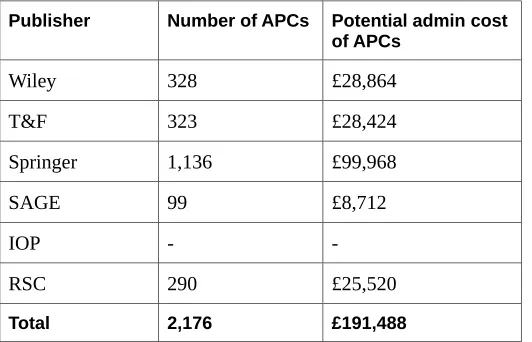
It is possible to estimate what the administrative cost of APCs would be if they were paid outside of an offset agreement and processed as usual (see Table 9). The per-article
administration cost for gold open access has been calculated variously at £8841 and £25-103.42
[image:15.595.71.337.439.610.2]Since the £88 estimate is based on a much bigger – albeit less detailed – dataset and has subsequently been used in other analyses,43 it has also been used in this report.
Table 9: Hypothetical administration costs of processing APCs
Publisher Number of APCs Potential admin cost of APCs
Wiley 328 £28,864 T&F 323 £28,424 Springer 1,136 £99,968 SAGE 99 £8,712
IOP -
-RSC 290 £25,520
Total 2,176 £191,488
The total of £191,488 is very similar to earlier estimates of the admin costs of the TCP, at 0.5% rather than 0.6%.44 (Last year the estimate was somewhat smaller at £50,952, or 0.3%).
38 Burgess (2015: 21–25), De Castro (2015), Johnson, Pinfield, & Fosci (2015) 39 Holliday & Jones (2015, 2015a)
40 Jisc OA Good Practice Pathfinder project (2016) 41 Johnson, Pinfield, & Fosci (2015)
42 Holliday & Jones (2015)
43 Such as Pinfield, Salter, & Bath (2016).
However, this figure only takes into account administration costs associated with individual APC transactions, and not further overheads such as the management costs associated with setting up offset agreements, decisions on how to implement offsetting within the institution, or advocacy and communication of deals to researchers. It is possible that if these additional labour costs were included in the calculations then the proportion of TCP attributed to administration may be higher – but the labour costs of administering subscriptions is also significant, so if TCP calculations factored in librarians’ labour costs in supporting scholarly publications, it is unclear what the overall effect would be.
The administrative burden of different offset agreements has been investigated from a qualitative perspective45 which provides valuable insight – telling us that, for example, the
SAGE and IOP agreements appear to have been easier to implement than the RSC one – but this brings us no closer to accurately quantifying the costs. Since some offset agreements remove the need for invoicing individual APCs it may be the case that they tend to have slightly lower overheads than the average, thus balancing out any extra administration costs accompanying the deals, but this is purely speculative and not measurable at present.
Research funding
Research funders provide most of the money spent on APCs by UK institutions. In 2014-15, 12% of the total cost of publication was spent on APCs.46 In the sample of 38 institutions,
69% of all money used to pay APCs in 2016 came from two research funders: RCUK and the Wellcome Trust47 (see Fig 1). So institutions are relying largely on funders to cover the costs
of the transition to open access. This is a situation that offsetting aims to change.
A recent announcement from RCUK has confirmed that the research councils will continue to provide a similar level of funding for APCs after their current funding scheme ends in April 2018 – funding has been extended a further two years, until 2020.48 The passing of the
Higher Education and Research Act 2017 has settled some of the questions around the medium-term organisation and funding of the UK higher education
45 Jones (2015); Manista (2016)
46 Shamash (2016: 18). The same figure is given by Pinfield, Salter, & Bath (2016). It is worth noting that this only refers to known APC payments made from centrally-managed funds. Pinfield & Middleton (2016) estimate that non-centrally funded APCs add 17% to the total known APC spend at the University of Nottingham, while Andrew (2016) estimates 20% at the University of Edinburgh.
47 COAF is the Charity Open Access Fund, a joint fund from several medical research funders that is administered by the Wellcome Trust.
sector, but since open access is not seen to be the highest priority right now it is still not clear what the long-term future of APC funding will look like – and only a minority of institutions have developed additional funding streams to pay for APCs themselves.49 Therefore although
APC funding will continue after RCUK becomes UK Research and Innovation (UKRI) in 2018, if there is a withdrawal of funding at a later date this would almost certainly lead to a significant reduction in APC expenditure. On the other hand, the proportion of APC funding that originated from institutional funds has increased from 10% to 17%50 in 2016, with 17 of
the 38 HEIs using institutional funds. In part, this is due to offsetting – 32% (639) of the 2,009 APCs paid out of institutional funds were paid as part of an offset agreement. When these APCs are removed from the equation, a more modest 11.5% of APCs were paid from institutional funds.
Offset agreements will play a key role in maintaining the ability of UK researchers to publish in APC-funded open access journals. If RCUK withdraws funds but keeps the open access mandate, then HEIs will still be able to fulfil the mandate to some extent – but only if authors publish predominantly with publishers that their institution has an offset agreement with. In this instance HEIs will have to advise researchers to publish with certain publishers, a position which is likely to provoke strong resistance from researchers. A balance may be sought whereby funders will continue to pay APCs but only if an acceptable offset agreement is in place, which would reduce the funders’ expenditure while also supporting the continuation of offsetting. There is a risk that replacing dedicated open access block grants with a reliance on offset agreements will cause issues with smaller and specialist institutions that cannot afford to subscribe to the big deals that are required to access offsetting. Of course, APCs are not the only means of funding open access publication,51 and alternative arrangements such as
consortial funding for open access journals may appear more attractive to institutions wishing to support open access publications if their ability to pay APCs is diminished.
The future of offsetting
Some problems identified in last year’s report have not been solved,52 such as the fact that
payment for page and colour charges are still distributed within institutions rather than centrally managed,53 so it is difficult to know exactly how much is spent on them or how
many page and colour charges are mistakenly included in APC expenditure data. And with the exception of the Wiley deal (and the discontinued RSC scheme), the offset agreements only offset the cost of articles in hybrid journals rather than full open access journals as well. Since the efficacy of hybrid journals as a mechanism for transitioning towards full gold open access has been widely questioned, this limits the extent to which offsetting can achieve its aim.
49 Sharp (2015) noted at least 18 institutions which have an institutional fund, so it would be worth monitoring whether this number increases over time – it is possible that it is already significantly higher than in 2015. 50 2,009 out of 11,878 APCs that state their funding source.
51 See Eve (2014); Morrison et al. (2017)
One of the big unresolved issues for offsetting is that it continues to consolidate ‘lock in’ with particular publishers. In contravention of Jisc’s principles for offset agreements,54 all existing
agreements require an institution to maintain a subscription to a big deal – in some cases over multiple years – in order to receive any benefit from offsetting. The largest subscription publishers tend to be the largest recipients of APC funds55 because 74-80% of APCs tracked in
the UK are paid to hybrid journals,56 which will only change if funders and institutions take
action to stop it. So tying offset agreements to big deals will continue to consolidate market concentration – potentially amplifying the dysfunctional nature of the subscription market.
A number of other northern European nations now have open access policies prioritising gold open access57 and there is a strong trend of rhetoric aspiring to full open access with the next
five to ten years (or by 2020, as one initiative optimistically suggests).58 It is too early to
predict with any confidence whether these aspirations will be ultimately successful – although some of the timescales are certainly unrealistic, given the massive international co-ordination required – and at present it is unclear what effect the UK’s exit from the European Union will have given the country’s leading role in promoting gold open access. Offset agreements such as the Springer Compact are also spreading among those nations with gold-centric policies; the ESAC initiative has recently been working with stakeholders from multiple European nations to coordinate more streamlined and automated APC payment processes for offset agreements, including providing guidance to publishers.59 So perhaps big deals will keep their
dominant market share by pursuing innovative offsetting arrangements.
54 Jisc (2015). The only one of the five principles which is used by all participating publishers is that offset should occur at the local as well as global level. This is a given, since applying local offset is a condition of being included in the list of participating publishers. See also ESAC (2016).
55 Shamash (2016, 2017)
56 Shamash (2016); Wellcome Trust (2016)
57 For example in Norway (CRIStin 2016; Norwegian Ministry of Education and Research 2017) and the Netherlands (NWO 2016).
Conclusion
The combined value of offset agreements to the higher education sector in 2016 has been estimated at £8m. Some agreements reduce the total cost of publication (TCP) more than others, with the Springer agreement providing by far the largest cash savings (£5.4m) and also, along with the RSC agreement, proportionally reducing the TCP the most.
Administration costs are harder to calculate but appear to make up a small percentage of the TCP.
For the UK, the possibility of RCUK (soon to become UKRI) discontinuing support for APC payments in the future is the biggest risk to progress on the transition to gold open access. In this scenario, offset agreements would be key to maintaining continuity and allowing authors to publish open access in APC-funded journals. The Springer Compact agreement is an example of how this could work.
References
Andrew, Theo (2016) Improving estimates of the total cost of publication by recognising ‘APCs paid in the wild’. The Winnower. < https://thewinnower.com/papers/4241-improving-estimates-of-the-total-cost-of-publication-by-recognising-apcs-paid-in-the-wild>
Bauer at al. (2015) Recommendations for the transition to open access in Austria. <http://dx.doi.org/10.5281/zenodo.34079>
Björk, B.‐C. and Solomon, D.J. (2014) Developing an effective market for open access article processing charges. London: Wellcome Trust.
<https://www.fwf.ac.at/fileadmin/files/Dokumente/Downloads/Dev_Effective_Market_OA_Article_Processing_ Charges.pdf>
Burgess, R. (2015) Review of the implementation of the RCUK open access policy. Swindon: Research Councils UK. <http://www.rcuk.ac.uk/documents/documents/openaccessreport-pdf/>
CRIStin (2016) National guidelines for open access to research results. < http://www.cristin.no/english/open- access-eng/national-guidelines-for-open-access-to-research-re/national-guidelines-for-open-access-to-research-results.pdf>
De Castro, Pablo (2015) The OpenAIRE2020 FP7 Post-Grant Open Access Pilot: Implementing a European-wide funding initiative for open access publishing costs. Information Services & Use, 35: 235–241.
<http://doi.org/10.3233/ISU-150786>
Earney, Liam (2017) Offsetting and its discontents: Challenges and opportunities of open access offsetting agreements. Insights, 30(1): 11–24. DOI: http://doi.org/10.1629/uksg.345
ESAC (2016) Joint Understanding of Offsetting. <http://esac-initiative.org/joint-understanding-of-offsetting/> ESAC (2017) 2nd Offsetting Workshop, Vienna, 9-10 March 2017. < http://esac-initiative.org/2nd-offsetting-workshop-9-10-march-2017-vienna/>
EU2016 (2016) All European scientific articles to be freely accessible by 2020.
< http://english.eu2016.nl/binaries/eu2016-en/documents/press-releases/2016/05/27/all-european-scientific-articles-to-be-freely-accessible-by-2020/press-release-all-european-scientific-articles-to-be-freely.pdf> Eve, Martin (2014) Open Access and the Humanities (Cambridge: Cambridge University Press)
Gray, Andrew (2015) Considering non-open access publication charges in the “Total Cost of Publication”.
Publications, 3(4): 248–262. <http://dx.doi.org/10.3390/publications3040248>
Holliday, L. and Jones, K. (2015) Using functional cost analysis to evaluate the APC payments process. [original report no longer available. Early draft available at < https://gw4openaccess.files.wordpress.com/2015/03/gw4-oa-pathfinderwp-1-report-march2015.docx>]
Holliday, L. and Jones, K. (2015a) Pre-payments and the development of the APC market.
< https://gw4openaccess.files.wordpress.com/2015/12/a-review-of-the-literature-on-the-potential-wider-market-effects-of-pre-payments-on-the-apc-payments-market-v2-11.pdf>
Jisc (2015). Principles for offset agreements. <https://www.jisc-collections.ac.uk/Global/News%20files%20and %20docs/Principles-for-offset-agreements.pdf>
Jisc OA Good Practice Pathfinder project (2016). Vouchers and discount codes recommendations for publishers and institutions. <
https://gw4openaccess.files.wordpress.com/2016/04/vouchers-and-discount-codes-recommendations-for-publishers-and-institutions.docx>
Jones, Finlay (2015) Open Access Good Practice project: GW4 offset implementation review. < https://gw4openaccess.files.wordpress.com/2015/11/open-access-good-practice-project-gw4-offset-implementation-review-v3.docx>
Jubb, M., Goldstein, S., Amin, M., Plume, A., Aisati, M., Oeben, S., ... Fosci, M. (2015) Monitoring the transition to open access: A report for Universities UK. London: Research Information Network on behalf of Universities UK. <http://www.researchinfonet.org/oamonitoring/>
Lawson, Stuart (2016) Open financial data on article processing charges. figshare. <https://dx.doi.org/10.6084/m9.figshare.c.2860717>
Lawson, Stuart (2016a) Report on offset agreements: evaluating current Jisc Collections deals. Year 1 – evaluating 2015 deals. figshare. <https://dx.doi.org/10.6084/m9.figshare.4047777.v1>
Lawson, Stuart (2016b) RCUK open access block grant allocation 2013–17. figshare. DOI:
https://doi.org/10.6084/m9.figshare.4047315
Lawson, Stuart (2017) Journal subscription expenditure in the UK 2015–16. figshare. <https://doi.org/10.6084/m9.figshare.4542433.v3>
Lawson, S., Gray, J. and Mauri, M. (2016) Opening the black box of scholarly communication funding: A public data infrastructure for financial flows in academic publishing. Open Library of Humanities, 2(1).
<http://doi.org/10.16995/olh.72>
Lawson, S. and Meghreblian, B. (2014) Journal subscription expenditure of UK higher education institutions.
F1000Research. <http://dx.doi.org/10.12688/f1000research.5706.3>
Manista, Frank (2016) Report for Jisc Collections on administrative burden of offset agreements. Unpublished. Marques, Mafalda (2017) Springer Compact agreement: first year evaluation.
<https://scholarlycommunications.jiscinvolve.org/wp/2017/03/06/compact-agreement-first-year-evaluation/> Morrison, H.; Brutus, W.; Dumais-Desrosiers, M.; Kakou, T.L.; Laprade, K.; Merhi, S.; Ouerghi, A.; Salhab, J.; Volkanova, V.; Wheatley, S. (2017) Open Access Article Processing Charges (OA APC) longitudinal study 2016 dataset. Data, 2(2). DOI: http://dx.doi.org/10.3390/data2020013
Norwegian Ministry of Education and Research (2017) National goals and guidelines for open access to research articles. < https://www.regjeringen.no/contentassets/ae7f1c4b97d34806b37dc767be1fce76/national-goals-and-guidelines-for-open-access-to-research-articles.pdf>
NWO (2016) Q&A open access at NWO.
<http://www.nwo.nl/en/policies/open+science/open+access+publishing>
Pinfield, S. and Middleton, C. (2016) Researchers’ adoption of an institutional central fund for open-access article-processing charges: A case study using innovation diffusion theory. SAGE Open.
<http://dx.doi.org/10.1177/2158244015625447>
Pinfield, S., Salter, J. and Bath, P.A. (2015) The ‘total cost of publication’ in a hybrid open-access environment: Institutional approaches to funding journal article-processing charges in combination with subscriptions. Journal of the Association for Information Science and Technology, early view. <http://dx.doi.org/10.1002/asi.23446> Pinfield, S., Salter, J. and Bath, P.A. (2016) A ‘gold-centric’ implementation of open access: Hybrid journals, the ‘total cost of publication’ and policy development in the UK and beyond. Journal of the Association for
Information Science and Technology, in press. <http://eprints.whiterose.ac.uk/96336/>
Royal Society of Chemistry (2016) Gold for Gold scheme to end 2017. < http://www.rsc.org/journals-books-databases/librarians-information/librarians-notes/all-articles/2016/jun/g4g-scheme-ends-2017/>
Shamash, Katie (2016) Article processing charges (APCs) and subscriptions. Jisc. <https://www.jisc.ac.uk/reports/apcs-and-subscriptions>
Shamash, Katie (2017) Article processing charges in 2016. Jisc.
<https://scholarlycommunications.jiscinvolve.org/wp/2017/08/23/article-processing-charges-in-2016/> Sharp, Catherine (2015) Institutional policies on the use of open access funds: A report from the Jisc Pathways to Open Access project. <http://blogs.ucl.ac.uk/open- access/files/2015/12/Pathways-to-OA-APC-funds-survey-report-Dec-15.pdf>
Stern, Niels (2017) Knowledge Exchange consensus on monitoring Open Access publications and cost data. Knowledge Exchange. DOI: https://doi.org/ 10.5281/zenodo.480852
UK Government (2017) HMRC foreign exchange rates: yearly averages and spot rates. <https://www.gov.uk/government/publications/exchange-rates-for-customs-and-vat-yearly> Wellcome Trust (2016) Wellcome Trust and COAF open access spend, 2014–15.
Appendix: List of the 38 higher education institutions used in the
sample
Aberystwyth University Aston University Bangor University University of Bath
University of Birmingham University of Cambridge Cardiff University Cranfield University Durham University University of Exeter University of Glasgow
Goldsmiths, University of London University of Hull
Imperial College London Keele University
King’s College London Lancaster University University of Liverpool London School of Economics University of Manchester
Manchester Metropolitan University Newcastle University
Northumbria University University of Nottingham University of Oxford Plymouth University
Queen Mary University of London Queen’s University Belfast
University of Reading
Royal Holloway, University of London University of Sheffield
University of Southampton University of St Andrews
St George’s, University of London University of Sussex
Swansea University