De Silva, Muthu and Rossi, Federica (2018) The effect of firms’ relational
capabilities on knowledge acquisition and co-creation.
Technological
Forecasting and Social Change 133 , pp. 72-84. ISSN 0040-1625.
Downloaded from:
Usage Guidelines:
Please refer to usage guidelines at or alternatively
The effect of firms’ relational capabilities on knowledge acquisition and co-creation
with universities
Muthu de Silva
Birkbeck, University of London Malet Street, London WC1E 7HX, UK
Federica Rossi
Birkbeck, University of London Malet Street,
London WC1E 7HX, UK
Note: This is a post-peer review accepted version, please cite:
De Silva, M., and Rossi, F. (2017). The effect of firms’ relational capabilities on
Running head: Firms’ relational capabilities and knowledge acquisition and
co-creation
Title: The effect of firms’ relational capabilities on knowledge acquisition and
co-creation with universities
Abstract
This study examines how firms’ relational capabilities influence two main approaches to
sourcing knowledge from universities, namely, acquiring and co-creating knowledge. By
adopting a sequential mixed methods design to gather empirical evidence from firms that
interact with universities, it contributes to unravelling the puzzle presented in the literature on
the positive effects and drawbacks of relational capabilities. We find that the balance between
the opposing effects of relational capabilities differs depending on the knowledge sourcing
approach. While capabilities for aligning goals, objectives, and routines/practices between
firms and academics are of significant importance only for knowledge co-creation,
communication capabilities are important for both, with greater significance for knowledge
acquisition. We highlight implications about what relational capabilities firms should nurture
in order to best source knowledge from universities.
Key words: Interorganisational collaborations; knowledge acquisition; knowledge
co-creation; knowledge sourcing; relational capabilities; university-firm interactions.
JEL codes: O32 - Management of Technological Innovation and R&D; O31 - Innovation and
Invention: Processes and Incentives; L21 – Business Objectives of Firms; L23 – Organisation
INTRODUCTION
The increasing pace of technological change, the growing complexity of new technologies, the
rapid growth of markets for technology, and the increasing modularisation of knowledge, have
increased firms’ reliance on external knowledge in their innovation processes. In the context
of a widening range of channels through which firms accrue inbound knowledge, interactions
with universities play a central role, mainly owing to the latter’s unique ability to produce
frontier scientific knowledge (Brusoni et al., 2001; Etzkowitz 2016). Evidence suggests that,
although universities do not generally constitute the most frequently used sources of external
knowledge (Cohen et al., 2002; Arundel and Geuna, 2004; Abreu et al., 2008), firms,
particularly those with high research and development (R&D) intensity, rate them as very
valuable (Bishop et al., 2011; Petruzzelli, 2011)1. There is a growing literature about firms’
knowledge sourcing from universities, which explores the characteristics of firms that are more
likely to source university knowledge – focusing on variables such as size, R&D expenditure,
financial slack, geographical and organisational proximity to the university, search strategies
(Laursen and Salter, 2004; Bruneel et al., 2015), as well as the channels that they use in order
to do so (Perkmann and Walsh, 2007; D’Este and Patel, 2007; Boardman and Ponomariov,
2009). Nonetheless, the understanding of what internal capabilities help firms to draw on
different approaches to knowledge sourcing from universities remains underdeveloped
(Bruneel et al., 2015; Appio et al., 2017).
1
For example, Arundel and Geuna (2004), focusing on the European firms that spend more on R&D (excluding France), found that more
By addressing this knowledge gap, this study extends the current literature in several ways.
First, it differentiates between two approaches to the process of sourcing knowledge from
universities. Building on the literature on interfirm strategic alliances2 – which has highlighted
different processes through which firms source external knowledge – a distinction is made
between: (i) knowledge acquisition, whereby firms receive knowledge from universities, which
may be integrated within their own knowledge base independently of the interaction (Friedman
and Silberman, 2003; Siegel et al., 2007); and (ii) knowledge co-creation, whereby firms
combine their market knowledge with the university’s advanced scientific and technological
knowledge, in order to jointly solve specific challenges (Curley and Salmelin, 2013). In the
former case, the university and the firm play well-defined roles as knowledge producer and
knowledge receiver respectively, since knowledge flows unidirectionally from one to the other;
while in the latter case, although firms and universities remain specialists in their own domains,
the knowledge producer and receiver roles are blurred (Osei-Frimponga et al., 2016; Taheri
and van Geenhuizen 2016; Yip et al., 2015).
Second, among the various capabilities that might explain firms’ heterogeneity in acquiring
and co-creating knowledge (Lucena and Roper, 2016; Colombo et al., 2011), the study focuses
particularly on the role of firms’ capabilities to manage their relationship with universities. The
interorganisational literature has investigated the influence of relational capabilities on the
success of strategic alliances or supply chain interactions (Kale et al., 2000; Yli-Renko et al.,
2001), showing that firms’ relational capabilities play a crucial role in supporting external
knowledge sourcing (Dyer and Singh, 1998; Lee et al., 2003; Carmeli and Azeroual, 2009).
However, the influence of relational capabilities on knowledge sourcing has not been explored
2Such alliances are defined as “agreements characterised by the commitment of two or more firms to reach a common goal entailing the
in connection with university-firm interactions (Appio et al., 2017). It might not be possible to
generalise the findings of this literature to university-firm interactions without empirical
testing, due to inherent differences between universities and firms in terms of their knowledge
bases (Bartunek, 2007; Mindruta, 2013; Petruzzelli and Rotolo, 2015), culture (Lockett and
Wright, 2005; Sauermann and Stephan, 2013), motivation and reward systems for interaction
(Bruneel et al., 2015), approaches to innovation (Barnes et al., 2002), research orientation
(Petruzzelli and Rotolo, 2015), and acceptable time frame for addressing problems (Rynes et
al., 2001).
Third, in line with recent studies on relational capabilities our study assume that all types of
relational capabilities are not equally important to support different approaches to knowledge
sourcing (Zhang et al., 2017). We explicitly investigate the relationship between different
relational capabilities and the acquisition and co-creation of knowledge with universities. Since
the literature has highlighted that relational capabilities may have drawbacks as well as
advantages (Anderson and Jap, 2005; Spitzberg and Cupach, 2009), the appropriate balance
between them may differ in the context of different approaches to knowledge sourcing. Hence,
we develop theoretical hypotheses on the relationship between each type of relational
capabilities and firms’ acquisition and co-creation of knowledge with universities. These
hypotheses are then tested empirically using a sample of 190 British firms.
The investigation of how different relational capabilities enable knowledge acquisition and
co-creation is a highly original aspect of the present analysis. The findings have implications for
firm and university management: better understanding of which relational capabilities best
support firms in sourcing different types of knowledge can guide firms, and to some extent also
universities, in assessing and further developing the relational capabilities they need. They also
measures to support firms’ relational capabilities to foster knowledge acquisition and
co-creation.
THEORETICAL FRAMEWORK
Knowledge acquisition and co-creation as different approaches to sourcing knowledge
from universities
The study focuses on the factors that support two distinct approaches to sourcing knowledge
from universities: knowledge acquisition and knowledge co-creation. This distinction builds
on typologies of knowledge-based interactions developed in previous studies of
university-industry interactions and interfirm strategic alliances. The literature, in fact, has proposed
numerous knowledge sourcing typologies, including: knowledge transfer and knowledge
creation (Agrawal and Henderson, 2002; Rynes et al., 2001; Bartunek, 2007; Geuna and
Muscio, 2009) or knowledge co-production (Orr and Bennett, 2009; Knights and Scarbrough,
2010); knowledge exploration and knowledge exploitation (March, 1991; Laursen and Salter,
2004; Bruneel et al., 2015); and knowledge acquisition and knowledge access (Grant and
Baden-Fuller, 2004; Lui, 2009). Studies of university-industry interactions often take the
university’s perspective, focusing either on knowledge transfer processes (e.g. investigating
how universities transfer knowledge to stakeholders outside academia) or on knowledge
co-production (sometimes called knowledge creation or knowledge exchange) processes (e.g.
investigating how academic researchers’ engagement with practitioners helps to shape both
research and practice). The concept of knowledge co-production is deliberately vague with
respect to the interactions through which such engagement occurs, ranging from very close
collaborations to less close working relationships, e.g. knowledge creation during joint
symposia (Amabile et al., 2001; Rynes et al., 2001), without consensus on their boundaries
firm’s perspective place greater emphasis on how (for what objectives) the sourced knowledge
is used by the firm, often contrasting knowledge exploration with knowledge exploitation
(Laursen and Salter, 2004; Bruneel et al., 2015), rather than on the processes through which
the sourcing occurs. Studies of interfirm strategic alliances (Grant and Baden-Fuller, 2004)
investigate knowledge sourcing processes and their drivers, but they do not account for the
participants’ intrinsic diversity that is often observed in university-firm interactions.
Knowledge acquisition and knowledge co-creation identify two contrasting approaches to
sourcing knowledge, characterised by different objectives and different sourcing processes.
Knowledge acquisition involves the unilateral sourcing of knowledge from university on the
part of the firm, whose objective is to internalise and absorb (Grant and Baden-Fuller, 2004)
university knowledge in order to integrate it within its own knowledge base3. Once knowledge
has been acquired, the firm can use it in order to create value, either for experimentation
(March, 1991; Laursen and Salter, 2004), or exploitation, within the firm (Yli-Renko et al.,
2001) or collaboratively (Laursen and Salter, 2004). However, such exploration and/or
exploitation processes occur separately from the acquisition process, which involves a
unidirectional flow of knowledge from the university to the firm. Knowledge acquisition
occurs when, for example, firms acquire basic scientific knowledge by reading scientific
publications (Caloghirou et al., 2001), or when they license university intellectual property and
technology (Balconi and Laboranti, 2006; Geuna and Nesta, 2006).
Knowledge co-creation4 refers to the joint generation of new knowledge by both the university
and the firm (Garner and Ternouth, 2011; Perkmann and Salter, 2012), with the objective to
combine their knowledge bases in order to jointly solve a specific challenge. The firm and the
university would not be able to produce this new knowledge independently, because the
challenge they are trying to address requires their knowledge bases to be innovatively
combined. The process necessarily involves joint exploration in order to produce new
knowledge (Laursen and Salter, 2004; March, 1991; Bruneel et al., 2015). Very often, it also
involves the subsequent joint exploitation of the newly created knowledge to address a specific
challenge (Blumenthal et al., 1996; Caloghirou et al., 2001). For example, knowledge
co-creation may involve the combination of firms’ market knowledge and universities’ advanced
scientific and/or technical knowledge to develop technological, organisational, service, or
marketing innovations (Etzkowitz and Leydesdorff, 2000; Perkmann and Salter, 2012). Hence,
we expect knowledge co-creation processes to involve close interactions between firm and
university personnel, usually with the objective to innovate jointly.
The two concepts of knowledge acquisition and co-creation highlight two extreme types in a
continuum of possible forms of knowledge sourcing from universities. Moreover, a firm may
use different knowledge sourcing approaches interdependently. For instance, a firm may
acquire a university license but later pursue a strategy of engaging with the inventor during the
exploitation phase (Agrawal, 2006) in order to develop innovative products building on that
license, so that initial knowledge acquisition leads to some degree of co-creation. Indeed,
search behaviour for acquisition might positively relate with the firm’s ability to successfully
engage in subsequent co-creation (Fontana et al., 2006). Conversely, it is also possible for a
4The term ‘co-creation’ was initially used in the marketing literature to highlight close interactions between producers and buyers, in which
the customer becomes a co-innovator(Payne et al., 2007). More recently the research focus has shiftedfrom customer-business co-creation
firm to engage in co-creation with the university with the intention to integrate the co-created
knowledge into its knowledge base and unilaterally exploit it later on (Inkpen 2000). In this
study we do not look into the interdependence between different knowledge sourcing
processes, and the empirical approach that we use to model the influence of relational
capabilities on knowledge acquisition and co-creation allows us to account for such potential
unseen interactions.
Influence of relational capabilities on the firm’s ability to acquire and co-create
knowledge
The knowledge based view of the firm (Kogut and Zander, 1996; Yli-Renko et al., 2001)
describes firms as repositories of knowledge and capabilities. According to this view, building
difficult to imitate capabilities, including relational capabilities to acquire and exploit external
knowledge, garners an essential source of competitive advantage (Kanter, 1994; Lado et al.,
1997; Madhok and Tallman, 1998; Paulraj et al., 2008; Yli-Renko et al., 2001). By developing
capabilities to leverage their relational resources in knowledge-based interactions with other
parties, for example those along their supply chain, firms can yield productivity and reduce
transaction costs (Dyer and Singh, 1998; Lane and Lubatkin, 1998; Yli-Renko et al., 2001).
Yli-Renko et al. (2001) argue that relational capabilities are important for firms to draw on
knowledge vested in their network of interactions, by affecting conditions necessary for
successful knowledge-based collaborations. Among varied sources of knowledge, firms can
leverage the advanced and up-to-date knowledge possessed by universities for sustainable
competitive advantage (Perkmann and Salter, 2012). Hence, firms’ relational capabilities to
manage interactions with universities may influence their likelihood to acquire and co-create
knowledge. In the literature, relational capability is viewed as a higher-order construct
actors (Dyer and Singh, 1998; Woo and Ennew, 2004). Since different studies have
conceptualised the components of relational capability differently in order to suit the context
and research objectives5 (Ulaga and Eggert, 2006), three facets of relational capability that may
influence knowledge acquisition and co-creation are proposed here.
These three facets are: structuring capability, which refers to the firm’s ability to devise ex
ante contractual agreements and mutually agreeable frameworks as to how the relationship is
expected to carry out; alignment capability which refers to the firm’s ability to align their goals,
objectives, and routines/practices with those of universities; communication capability, which
denotes the firm’s ability to maintain dialogue with the university by promoting effective and
efficient communication. Since relational capabilities may have drawbacks as well as
advantages, we expect that the balance between them may differ in the context of different
approaches to knowledge sourcing. Hence, we develop hypotheses about how each of these
facets of relational capability may differently influence firms’ knowledge acquisition and
co-creation with universities.
Structuring capability. While transaction cost economics argues in support of contractual
agreements, the sociology literature places greater emphasis on the development of relationship
management frameworks encouraging the development of trust and embeddedness, as a
pathway for avoiding opportunistic behaviour in interorganisational interactions (Dyer and
Singh, 1998; Gibbons and Henderson, 2012). What we call structuring capability is the
5 For instance, in the relationship marketing literature, Woo and Ennew (2002) identify cooperation, adaptation, and atmosphere as sub
constructs. In the interorganisational collaboration literature, Dyer and Singh (1998) introduce the relational view of the firm as composed
of relation-specific assets, knowledge sharing routines, complementary resources/capabilities, and effective governance. Similarly, in the
supply chain management literature, Paulraj et al., (2008) assert that relational capabilities comprise long term relationship orientation,
network governance and use of information technology. When discussing knowledge exploration and exploitation in young
capability of firms to develop upfront contractual agreements and relationship management
frameworks (Ariño et al., 2014) – termed as ‘learning to contract’ (Mayer and Argyres, 2004)
– by engaging in a set of practices that supersede the ‘pure’ transactional nature of contracts,
but are not completely informal safeguards.
Firms with structuring capability are able to agree on the price, and terms of the contract, to
define a clear working plan and to set clear goals (Ternouth et al., 2012) before entering the
relationship. Having these elements in place before the start of the relationship can reduce
uncertainty/causal ambiguity (Vlaar et al., V 2007), protect proprietary assets (Kale et al.,
2000), discourage free riding (Dyer and Singh, 1998), promote norms of reciprocity (Larson,
1992), improve relational rents (Madhok and Tallman, 1998), and enable the parties to achieve
targets smoothly (Srinivasan and Brush, 2006). Firms that are able to clearly define upfront the
terms and the content of their collaborations are more likely to acquire the knowledge they
need from universities: in fact, since firms’ knowledge bases tend to be inherently different
from those of universities, firms would not acquire university knowledge unless they have
some clarity about the specific knowledge they are going to source (Fink and Kessler, 2010).
On the contrary, the importance of structuring capability might be lower for knowledge
co-creation processes, which involve very close interactions between parties to develop new
knowledge, the nature of which is relatively less clear upfront when compared to knowledge
acquisition. In this context, learning and adaptation by partners during the collaboration may
be more important than having a well defined collaboration structure (Gulati, 2007; Faems et
al., 2008; Gulati et al., 2012). As the collaboration evolves dynamically, environmental
conditions and partners’ needs may change, requiring them to change the direction of the
project. This involves on-going and dynamic maintenance of the relationship (Vargo and
studies on inter-organisational relationships have found that low specificity of contractual
terms – which includes not stipulating how the focal firm’s partner should deliver the
performance and what resources it should use – enhances the partner’s autonomy and therefore
fosters innovation (Sumo et al., 2016). Hence, we hypothesise that structuring capability may
be more important for knowledge acquisition than knowledge co-creation:
Hypothesis 1: A firm’s relational structuring capability has greater positive influence on its
likelihood to acquire knowledge from universities, than on its likelihood to co-create
knowledge with universities.
Alignment capability. Reaching alignment between collaborators around co-operative
norms, routines, and goals has been recognised as important for the success of
interorganisational relationships, as these practices can help to build trust, increase
co-operation, reduce transaction costs and improve relationship stability (Caloghirou et al., 2004;
Dyer and Chu, 2003; Zollo et al., 2002). Nevertheless, achieving alignment might be time
consuming and costly, and once achieved this could cause lock-in and restrict innovativeness,
creativity and the breadth of knowledge sourcing (Ernst and Bamford, 2005; Goerzen, 2007).
Also, as alignment promotes greater mutual understanding, it could cause each side to be less
objective and dependable (Inkpen and Beamish, 1997), and even increase opportunistic
behaviour (Anderson and Jap, 2005). This contradiction makes it interesting to investigate how
firms’ capability to achieve alignment with universities influences knowledge acquisition and
co-creation.
The organisational distance between universities and firms is very large due to inherently
different operational practices, attitudes (Rynes et al., 2001; Bonaccorsi and Thoma, 2007;
Mindruta, 2013; Petruzzelli and Rotolo, 2015), rules, cultural habits (Lockett and Wright,
Petruzzelli and Rotolo, 2015;). Academics’ research agenda, which might be curiosity driven,
costly and with relatively long-term pay-offs, may not be aligned with business objectives
(Haeussler and Colyvas, 2011; Bruneel et al., 2015). Also, since universities and firms have
different operational practices (Petruzzelli and Rotolo, 2015), academics might be
unaccustomed or unwilling to respond to commercial pressures (Tartari and Breschi, 2012).
By increasing uncertainty and transaction costs (Zukin and DiMaggio, 1990; Boschma, 2005;
Petruzzelli and Rotolo, 2015), such large distance could inhibit the interactive learning and
joint innovation processes that underpin knowledge co-creation (Capaldo and Petruzzelli,
2014). Relational alignment – which implies aligning the firms’ goals, objectives (Perkmann
and Walsh, 2009; Bruneel et al., 2015) routines (Tsai, 2000; Carmeli and Azeroual, 2009;
Bruneel et al., 2015) and practices (Lorenzoni and Lipparini, 1999; Deken and Lauche, 2014)
with those of academics – can help firms to engage in knowledge co-creation with universities
in several ways (Taheri and van Geenhuizen 2016). First, it allows firm personnel to reduce
their distance from academics with respect to objectives, attitudes, systems and cultures
(Bruneel et al., D 2010; Muscio and Pozzali, 2013), leaving them free to engage in specific
knowledge based tasks instead of focusing on overcoming their differences (Yli-Renko et al.,
2001). Second, alignment can help firms to produce some form of shared mental analogy,
mutual empathy and a common framework, essential prerequisites for close working
relationships to achieve a common goal (Nonaka and Konno, 1998; Amabile et al., 2001;
Rynes et al., 2001) and, hence, to produce results of interest to both the business and the
academic communities (Perkmann and Salter, 2012). This suggests that firms’ alignment
capability is particularly important for knowledge co-creation, outweighing the potential
In the case of knowledge acquisition, as firm personnel and academics do not attempt to
combine two knowledge bases to reach common objectives through very close interactions,
achieving alignment may be less important than in the case of knowledge co-creation. For
acquisition, having the appropriate collaboration structure and clear and appropriate goals in
place may matter more (Szulanski et al., 2004; Perkmann and Salter, 2012; Bruneel et al.,
2015). Attempting to achieve alignment may even increase transaction costs (Szulanski et al.,
2004) and reduce the breadth of knowledge being acquired, so that the benefits of alignment
may be outweighed by its drawbacks (Anderson and Jap, 2005). Hence, we hypothesise:
Hypothesis 2: A firm’s relational alignment capability has greater positive influence on its
likelihood to co-create knowledge with universities, than on its likelihood to acquire knowledge
from universities.
Communication capability. In the context of relationship management, communication
practices that involve sharing knowledge and information, including monitoring the fulfilment
of commitments and obligations, between team members in an open (Kale et al., 2000) and
transparent (Chakrabarti and Santoro, 2004) manner, avoiding hierarchical authority (Zaheer
and Bell, 2005), are considered of paramount importance for the achievement of the
collaboration’s objectives6 (Albino et al., 1998; Arino et al., 2001; Poppo and Zenger, 2002;
Ramasamy et al., 2006). Nevertheless, open and transparent communication might result in
divulging information that can damage the firm’s competitive advantage. For instance, difficult
to protect knowledge being transferred from one party to other could expose the firm to the
6 Communication capability emphasises socially embedded, on-going and operational communication practices, and therefore it differs from
structuring capability which emphasises upfront formal contractual designs. Moreover, it differs from alignment capability due to its
emphasis on practices that affect how knowledge/information is shared, rather than on changing operational practices or goals to match with
those of the collaborators. The distinction between alignment and communication capabilities mirrors similar distinctions presented in the
external world unnecessarily, allowing collaborators to exploit knowledge unilaterally
(Capaldo, 2014), encouraging opportunistic behaviour and relationship failure (Anderson and
Jap, 2005; Spitzberg and Cupach, 2009). Two major aspects differentiate university-firm
interactions from interfirm alliances, which should be considered when adapting these
arguments to the context of firms sourcing knowledge from universities: first, there are
substantial communication barriers between universities and firms, which boost the importance
of relational communication capabilities, and second, universities and firms can hardly be
considered as competitors (Howells et al., 2012; Decter et al., B 2007), which suggests that
there is relatively low risk of opportunistic behaviour by universities. Hence, the benefits of
communication should outweigh its potential risks, facilitating both knowledge acquisition and
knowledge co-creation.
We expect communication capability to be important for both knowledge acquisition and
knowledge co-creation. In regards to knowledge acquisition, since the acquired knowledge is
exploited outside the relationship (Lane and Lubatkin, 1998), effective communication is vital
to ensure that valuable knowledge is appropriately transferred to the firm by reducing potential
loss of knowledge during the acquisition process. Hence, knowledge acquisition is essentially
a communication process (Albino et al., 1998). Chen and Paulraj (2004) found that
communication within strategic alliances is key for the exchange of timely, accurate, and
relevant knowledge. Effective communication enhances firms’ ability to recognise and assess
the value of external knowledge, to acquire relevant knowledge (Yli-Renko et al., 2002), to
process and use acquired knowledge (Zahra et al., 2000) and the willingness of external parties
to share information with the firm. Effective communication reflects an enhanced absorptive
capacity of firms (Cohen and Levinthal, 1990), and therefore it facilitates the transfer of both
lowering transaction costs and enabling firms to generate relational rents, referring to the values
gained through relationship-specific assets (Dyer and Chu, 2003; Paulraj et al., 2008).
Similarly, communication capability is crucial for co-creation. Effective communication
enables firms to avoid potential conflicts that may arise with universities owing to their diverse
background (Amabile et al., 2001). Open communication is essential for knowledge
development (Takeishi, 2001; Kotabe et al., 2003) in high value relationships (Paulraj et al.,
2008). Open and transparent firms are more likely to use university knowledge intensively
(Laursen and Salter, 2004). Transparency speeds up the pace of innovation facilitating
generation, use and distribution of knowledge (Caloghirou et al., 2004) and increasing the
access to heterogeneous sources of information, avoiding lock-in (Saviotti, 1996). Effective
communication, a key for monitoring the fulfilment of commitments and obligations, also helps
to avoid opportunistic behaviour and other lack of trust issues, facilitates trust building (Paulraj
et al., 2008) and creates a conducive environment to engage in collaborative projects
(Antonelli, 2000; Paulraj et al., 2008). Hence, we hypothesise:
Hypothesis 3: A firm’s relational communication capability positively influences its likelihood
to acquire knowledge from universities and its likelihood to co-create knowledge with
universities.
DATA AND METHODOLOGY
The empirical analysis follows a sequential mixed methods design in three stages; namely, (1)
an initial data gathering stage, (2) an on-line survey, and (3) post-survey in-depth interviews.
This mixed method approach was used as a way to improve the validity of the overall study
interviews were conducted with R&D managers/ product managers of firms, who are
responsible for managing interactions with universities (see Appendix A for more details). The
findings of the initial interviews were used to (1) check the theoretical explanations of the main
variables relating to knowledge acquisition and co-creation and relational capabilities against
business practices and (2) design the survey questionnaire with the aim of improving construct
validity (Tashakkori and Teddlie, 1998; Bisbe et al., 2007). The results of the initial interviews
clearly validated our theoretical constructs. Additionally, the survey was piloted with the initial
interviewees to improve its reliability.
The online survey, which constitutes the main data source for our analysis, was aimed at
gathering quantitative evidence on firms’ experience of university interactions. This survey
was sent (during March to April 2013) to 903 firms based in the United Kingdom (UK), drawn
from a database of companies maintained by the Work Foundation, a not for profit research
organisation owned by the University of Lancaster. Since the purpose of the study is to
investigate the influence of firms’ relational capabilities on knowledge acquisition and
co-creation with universities, the sample is appropriate as it includes firms that, being in close
contact with a university-owned research organisation, are particularly likely to source
university knowledge. The respondents of the survey were mainly CEOs / directors / R&D or
product managers of their organisations; people in these roles are usually believed to have an
overall understanding of firm’s capabilities and processes, as they have influence or what is
commonly referred to as ‘processing power’ to decide the strategic direction of the organisation
(Dexter, 1970; Fenno, 1978).
The survey received 190 complete responses (21% response rate). The respondents do not
significantly differ from the overall sample in terms of number of employees, turnover per
exceptions: firms based in Scotland and firms in the knowledge intensive business service and
other services7 sector are overrepresented). Furthermore, the distribution of the respondents in
terms of size and sector is not significantly different from that of the approximately 800 British
firms that interact with universities according to the UK Innovation Survey (Department for
Business, Innovation and Skills 2010)8.
Several of the survey questions – particularly those related to the firms’ approaches to
knowledge sourcing from universities, and to the firms’ management of their relationships with
universities – had not been previously covered in any national survey, or in any other study, to
our knowledge. As such, this research setting provides a unique opportunity to investigate how
different relational capabilities underpin knowledge acquisition and co-creation with
universities.
After the online survey, in-depth interviews were conducted with seven respondents (see
Appendix A for more details) to further understand context-specific causal mechanisms, a
practice which is believed to improve internal validity (Downward and Mearman, 2007). None
of these respondents had been interviewed in the initial data gathering stage. Some qualitative
findings from these in-depth interviews are presented in the ‘findings’ section, in order to
provide contextual grounding for the interpretations of the quantitative analysis’ results, and to
7 Sectors have been classified according to the United Kingdom Standard Industrial Classification of Economic Activities (SIC) 2007. The
KIBS category comprises companies in Sections K Financial and insurance activities, J Information and communication, L Realestate
activities, M Professional, scientific and technical activities and N Administrative and support service activities. The other services category
comprises companies in Sections G Wholesale and retail trade; repair of motor vehicles and motorcycles, H Transportation and storage, I
Accommodation and food service activities, R Arts, entertainment and recreation, S Other service activities. The difference is due in
particular to professional, business and trade associations (section S) being overrepresented among respondents.
8 The UK Innovation Survey is a national survey of businesses, conducted by the Department for Business Innovation and Skills, which
collects information on main sources of information on business innovation in the UK. One of the sources is universities and 5.6 percent of
respondents have mentioned that they collaborate with universities. The size of the sample of this survey was 29,000 and the response rate
illustrate the possible direction of underlying causal mechanisms (Kim and Miner, 2007; Autio
et al., 2013).
Variables construction
The main source of data for our variables was the online survey, while evidence from the seven
post-survey in-depth interviews was used to validate our findings (Kim and Miner, 2007; Autio
et al., 2013).
Dependent variables
In the survey, respondents were asked to consider 5 different ways to source knowledge
(related to knowledge acquisition and knowledge co-creation), listed in Table I, and for each
one of these to tick whether, in the previous 12 months, knowledge had been sourced, not
sourced, or whether that way to source knowledge had not been used. Building on these
responses, we then developed two dependent variables that reflect whether firms had acquired
or co-created knowledge respectively. Of the five questionnaire items indicating different
approaches to knowledge sourcing, those aligned with the definition of knowledge acquisition
presented in this study are: (i) acquiring the technology the company needs; (ii) acquiring basic
knowledge; (iii) acquiring intellectual property. The dependent variable Knowledge
Acquisition is a binary variable equal to 1 if the firm ticked that it had sourced knowledge using
at least one of these approaches in the previous 12 months, and zero otherwise (i.e. the variable
indicates whether the firm acquired knowledge from universities or not). The questionnaire
items aligned with the definition of knowledge co-creation are: (i) engaging in interactive
learning and co-creation of knowledge with universities and (ii) developing new products and
processes together with universities. The dependent variable Knowledge Co-creation is a
these approaches in the previous 12 months, and zero otherwise (i.e. the variable indicates
whether the firm co-created knowledge with universities or not).
……….………..
INSERT TABLE I ABOUT HERE
……….………..
Independent variables
One of the survey questions mentioned nine practices (listed in Table II) indicating relational
capabilities of firms; in relation to each practice, respondents were asked to tick whether, in
the previous 12 months, they had used that practice successfully, less successfully, or had not
used it. Responses to this question were used to construct three variables capturing firms’
relational capabilities, in the following way. For each of the nine practices, a binary variable
was constructed measuring whether a firm had relied on the practice in the management of
university interactions (the variables takes value 1 if the firm stated that they had used that
practice successfully in the previous 12 months, and zero otherwise). A PCA routine was then
performed on these nine binary variables, in order to highlight the sets of practices that firms
tend to adopt together, denoting the possession of certain relational capabilities.
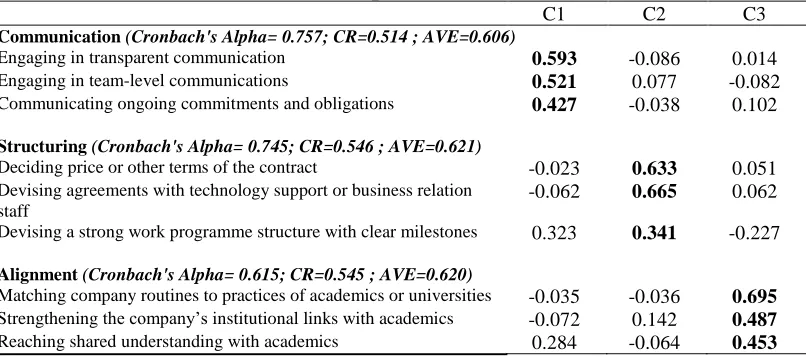
As shown in Table II, there are three main components with eigenvalues >1. The
Kaiser-Meyer-Olkin Measure is 0.724 (>0.5), indicating that the patterns of correlations are relatively
compact and factor analysis should yield distinct and reliable factors. The sum of three
components explains 65.3 percent of variance (i.e. C1–26.2 percent, C2–21.6 percent, C3–17.5
percent). Cronbach's Alpha being more than 0.6 indicates the reliability of the constructs (Price
and Mueller, 1986). Furthermore, the Composite Reliability (CR) (Chin 1988) and Average
confirms the reliability of the measures and AVE also confirms the convergent validity. All
these results indicate that the components derived are appropriate for this analysis.9
………..……….. INSERT TABLE II ABOUT HERE ………..
The factors that load highly on each component were grouped, and we checked these against
our conceptual constructs, in order to come up with a qualitative description of the three main
components. The first component is aligned with what has been defined as communication
capability: it loads highly on the variables that measure firms’ commitment to be transparent,
to flatten hierarchical communication structures by introducing team-level communications,
and to monitor the fulfilment of commitments and obligations in the course of the
collaboration. The second component is aligned with what has been defined as structuring
capability: it loads highly on variables that measure capabilities to decide the price and other
terms of the contract, to devise agreements with university technology support or business
relations staff and to develop a strong programme with clear milestones. The third component
is aligned with what has been defined as alignment capability: it loads highly on variables that
measure strengthening the company’s institutional links with academics, reaching shared
understanding with academics, matching the company’s routines to academic practices. Hence,
this approach allows us to validate our theoretically-informed categorisation of relational
capabilities using our empirical dataset: the PCA supports the identification of some
meaningful categories of relational capabilities that, while strongly rooted in the empirical data,
also reflect the conceptual categories emerging from an analysis of the university-firm
interactions and interorganisational collaborations literature.
Factor scores for each observation, called, Communication (C1), Structuring (C2) and
Alignment (C3) are used as data points for these three variables measuring relational
capabilities. Factor scores could be interpreted as the projections of the observations onto the
principal components (Basilevsky, 1983). 10
Control variables
Responses to several survey questions about the nature of firms’ interactions with universities
in the previous 12 months (number of universities the firm had collaborated with, number of
relationships per university, and share of collaborations with UK-based universities) were used
in order to develop control variables.
Firms that have experience of collaborating with many different universities (Subramaniam
and Venkatraman, 2001), and firms that frequently interact with universities (Gustafsson et al.,
2012), may enjoy greater ability to deal with academics and with university institutions. For
example, having gained better understanding of academic culture and university practices and
having adapted their processes to better work with universities, they may overcome cultural
barriers. Their organisational, cognitive and cultural proximity to universities may be high, and
this in turn facilitates the transmission of knowledge (Javidan et al., 2005; D’Este and
Iammarino, 2010; Bruneel et al., 2015). Therefore, two control variables aimed at capturing
firms’ breadth of experience in interacting with university institutions are included in the
empirical model: a dummy variable (Broad experience) equal to 1 if the firm interacted with
many university institutions (more than two) and had many relationships with each university
10As a robustness check, we also developed an alternative version of the three variables measuring relational capabilities, with each
variable counting the number of different practices used successfully (each variable therefore could take on values from 0 to 3). Using these
(more than ten) in the previous 12 months, and the number of different channels (N_channels)
that the firm used to interact with universities in the previous 12 months.
Due to geographical and cultural proximity favouring the transmission of tacit knowledge,
firms that interact with universities that are geographically close may be more likely to source
knowledge, particularly where tacit knowledge is important, although this may not be crucial
for firms that are involved in collaborations around mainly codified knowledge (Caloghirou et
al., 2001; Bodas Freitas et al., 2014). Therefore the model also includes a variable capturing
whether firms are particularly oriented to foreign collaborations (Foreign collaborations) that
takes value 1 when the firm interacted with a few universities (less than ten) and most of its
interactions (more than three quarters) were with foreign universities.
Some controls relating to firm demographic and innovation characteristics are also included.
In order to mitigate common method bias (Podsakoff et al., 2003), this information was drawn
from public databases,: the FAME database (UK SIC 2007 sector, postcode, date of
incorporation, number of employees and turnover) and the Espacenet database (number of
patents assigned to the firm).
Abundant evidence suggests that while large companies are better able to successfully interact
with universities, small and medium sized enterprises (SMEs) encounter several barriers
(Witty, 2013). Also, large firms seem to value interactions with universities more than SMEs
do (Howells et al., 2012). This could be due to their resource abundance when compared with
the scarcer financial and human resources of SMEs (Acs and Audretsch, 1990). In the empirical
model, firm size is measured as the number of employees (N_employees). Similarly, firms with
greater absorptive capacity (Cohen and Levinthal, 1990), that is firms that are better able to
by variables capturing a firms’ research or patent intensity or the skill profile of its workforce
(Zahra and George, 2002). To proxy for absorptive capacity, the model includes variables
measuring the firms’ age (years since date of incorporation, Firm age) and patent intensity
(number of patents per employee, Patents per employee).
A firm’s sector of operation also matters. Empirical studies show that firms collaborate more
frequently on applied science projects, especially materials and computer science (Levin et al.,
1987; Meyer-Krahmer and Schmoch, 1998; Cohen et al., 2002). This is not to say, however,
that firms working in other areas do not interact with universities: it has been shown that
knowledge-intensive business service providers also engage strongly with universities (Amara
et al., 2004). Since the sector of operation affects firms’ likelihood to interact with universities
(Schartinger et al., 2001) and the value they attribute to university knowledge (Arundel and
Geuna, 2004), it may also influence their acquisition and co-creation of knowledge. The sector
of economic activity is therefore controlled for, considering five comprehensive sectors.11
Estimation strategy
Based on the previous theoretical discussion, the empirical analysis explores how firms’
likelihood to acquire and co-create knowledge is influenced by their relational capabilities,
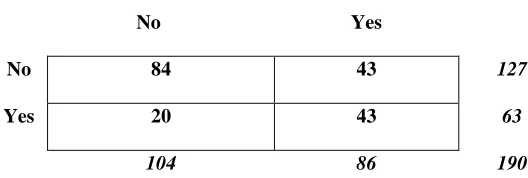
while controlling for several factors. As expected, the two dependent variables are correlated
(X2 (1, N=190)= 20.11, p=0.000). As Figure 1 illustrates, knowledge co-creation is more likely
11 The five sectors considered are: 1) Agriculture and mining (includes Sections A Agriculture, Forestry and Fishing and B Mining and
Quarrying), 2) Manufacturing, utilities and construction (includes Sections C Manufacturing, D Electricity, gas, steam and air conditioning
supply, E Water supply, sewerage, waste management and remediation activities and F Construction), 3) KIBS (includes Sections K
Financial and insurance activities, J Information and communication, L Real estate activities, M Professional, scientific and technical
activities and N Administrative and support service activities), 4) public sector (includes Sections O Public administration and defence;
compulsory social security, P Education and Q Human health and social work activities) and 5) other services (includes Sections G
Wholesale and retail trade; repair of motor vehicles and motorcycles, H Transportation and storage, I Accommodation and food service
among firms that also acquired knowledge from universities. But we do not treat knowledge
acquisition as a necessary condition for knowledge co-creation, or vice versa: our theoretical
model does not imply that these two approaches to knowledge sourcing operate in a mediation
relationship. Therefore, we employ an analytical approach that considers knowledge
acquisition and co-creation jointly. To accommodate for the different pathways, a bivariate
probit model is used to estimate knowledge acquisition and knowledge co-creation as a pair of
seemingly unrelated regressions. Such a model allows for two binary independent variables
that vary jointly. For example, it has been used to study the choice to use personal and
institutional channels of university-industry interaction (Bodas Freitas et al., 2014). This
specification allows for the coefficients to be estimated, while adjusting for correlation between
the two equations (Greene, 1996). Indeed, knowledge acquisition and knowledge co-creation
are correlated, and the seemingly unrelated bivariate probit regression fits the data better than
two separate probit equations.
Throughout the research process, we took several measures to address endogeneity (Shadish et
al., 2002). First, our adoption of carefully crafted sequential mixed method design improves
internal and construct validity. Second, we statistically checked the highest correlation among
the constructs. The highest value was 0.540 (with a majority less than 0.3), which is lower than
Bagozzi et al.’s (1991) cutoff of 0.8, as shown in Appendix B. Third, we tried to include as
many theoretically justified controls as possible to avoid variable omission (Rubin, 2008;
Shadish et al., 2002). Fourth, we took measures to mitigate common method bias (Podsakoff
et al., 2003), which may occur when both dependent and independent variables are perceptual
measures (Podsakoff and Organ, 1986). Not only we included data on respondents’
questionnaire was purposefully long and complex12, reducing respondent’s ability to guess the
model. To test for any remaining common method bias, following Chang et al., (2010) we
conducted a factor analysis of all 15 dependent and independent variables. This results in 7
highly significant components capturing 76% of the variance, with the first component
accounting for only 21% of the variance, which assures us that the data does not suffer from
common method bias.
………….……….. INSERT FIGURE 1 ABOUT HERE ………….………..
FINDINGS
The descriptive statistics indicate the nature of firms’ interactions with universities. 42.3 per
cent of respondents (71 firms) interacted with between two and ten universities, 14.9 per cent
(25 firms) interacted with only one university and 18.5 per cent (31 firms) with more than ten
universities. When firms were asked to mention the main university with which they had
interacted in the previous 12 months, they mentioned more than fifty universities based in the
UK, including teaching and research intensive as well as old and new universities. Among
them, 41.7 per cent (71) reported having had on average between two and ten interactions with
each of the universities they had worked with during the previous 12 months, 20.2 per cent (34
firms) had one interaction on average, and 9.5 per cent (16 firms) had more than 10 interactions
on average.
12 In addition to the questions used to construct dependent and independent variables, the questionnaire also included questions on: how
interactions with the university were usually initiated; what IP protection mechanisms were used when interacting with universities; what
42 per cent of respondents (79 firms) reported that more than three quarters of their
relationships involved universities in the UK. On the other hand, 8.4 per cent (16 firms) had
approximately half of their relationships with UK universities, and for 12.6 per cent (24 firms)
this proportion was less than a quarter, indicating a very global engagement profile.
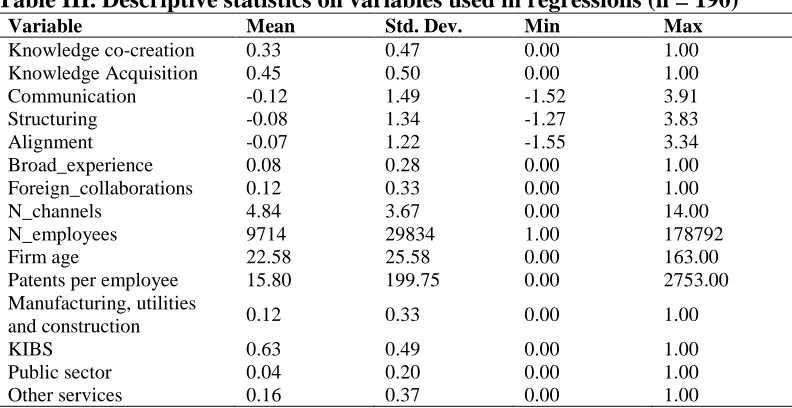
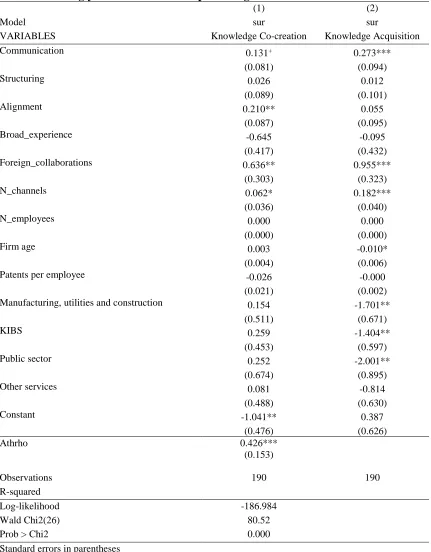
Table III reports the main descriptive statistics on the variables included in the regression,
while table IV reports the results of the seemingly unrelated bivariate probit regression13, 14.
……….……….. INSERT TABLE III ABOUT HERE ……….……….. ……….……….. INSERT TABLE IV ABOUT HERE ………..………..
The factor capturing relational structuring capabilities is not significant in relation to either
dependent variable, so our H1 is not supported: we have hypothesised that structuring
capabilities would have a greater positive influence on knowledge acquisition compared to
co-creation, but it appears that structuring capabilities are not significant in relation to either.
Knowledge acquisition is greater for firms with stronger communication capabilities, as shown
by the positive and significant coefficient of Communication in relation to the dependent
variable Knowledge Acquisition. The coefficient of the Communication variable is also
positive, although marginally non-significant (with p=0.107), in relation to the dependent
variable Knowledge Co-creation. This is consistent with hypothesis H3.
13 The same findings as those emerging from the seemingly unrelated bivariate probit model hold when running two separate probit
regressions, with dependent variables Knowledge Acquisition and Knowledge co-creation respectively. However the seemingly univariate
probit model is preferable due to having better fit (higher pseudo R2 and higher F-statistic) and the hypothesis of independence of the two
equations being rejected (chi2(1) = 8.31832 Prob > chi2 = 0.0039).
14 As a robustness check, we have run the same models (seemingly unrelated bivariate probit, and individual probit models) on the subset of
firms that have explicitly stated that they have engaged in knowledge acquisition (114 firms), knowledge co-creation (113 firms), or both
The importance of relational communication capabilities for knowledge acquisition is clearly
highlighted in our in-depth interviews. For instance, a director of open innovation at a
consumer goods company mentioned:
“Top-down relationships have been less successful. Communication is key to identify the type
of knowledge to be acquired for the benefit of the company and to make sure that the specific
knowledge is transferred. Even if one member of team involved in this process is not on board
this can adversely affect the relationship”.
Another director in a manufacturing company, who mentioned his organisation having
acquired university knowledge, explained how they had used communication to overcome
barriers caused by distance between universities and firms. This further supports our
expectation that firms use effective communication to manage knowledge acquisition
processes:
“We always select a team who could communicate well with university academics since
sometimes we do not speak the same language and have many differences between us
[academics and firms]. Communication between those who do the ‘deal’ and understanding of
deal terms by the team to ensure expectations are clear is critical”
The importance of transparent communication over structuring the relationship has been
highlighted too: for instance, the head of business development of a consultancy group said:
“We are transparent with academics and try to build a good relationship. This is important to
access and select the type of knowledge that we really want from a portfolio of knowledge and
skills possessed by academics. Relationship building through open innovation is a much better
strategy than trying to engage in never ending negotiations with them to design contracts
The greater importance of communication capability, as opposed to structuring capability, for
knowledge co-creation with universities is also evident from the in-depth interviews. For
instance, the head of partnerships of a pharmaceutical company mentioned:
“Open and transparent communication enables us to understand the skills, strengths and needs
of universities, which was important when engaging in joint research. It was very difficult to
devise contracts upfront due to the nature of our research: it is very difficult to predict the
outcome ex-ante. We need to engage in on-going discussion with academics, for which effective
communication was crucially important”
In-depth interviews also highlight the lack of importance of structuring capability for
knowledge co-creation. A director of partnership in a drug discovery company mentioned:
“Initially we were too much bothered about coming up with a very well defined plan. So we
spent so much time for negotiations and contract development. But it never worked well. It was
not possible come up with detailed planning at the beginning. Just a waste of time”.
Alignment capabilities have a positive and significant influence on knowledge co-creation,
whereas the variable Alignment has a positive but not significant influence on knowledge
acquisition. This is consistent with H2.
The in-depth interviews confirm the importance of alignment capabilities for knowledge
co-creation. For instance, the head of partnership of a pharmaceutical company highlighted how
they tried to reach a shared understanding with academics as a strategy to reduce distance
between them:
“Universities and we are different in several ways. When we have collaborative projects, we
publish] on publication. Our ability to have ‘sensible’ discussions in partnerships about
publication and patent strategy that benefits both parties have meant that potential downstream
issues are avoided”.
The importance of strengthening the firm’s institutional links with academics is clearly evident
from the interviews. An R&D manager of an energy company mentioned:
“Working together with academics is not easy. We have different goals, innovation approaches
and knowledge. Our secret for success is our ability to work with universities through company
X (an intermediary). They (company X) help us to decide strategies to work with university
team, work with us very closely, coordinate our work, help us with legal and administrative
tasks. I could not imagine successfully completing the project without them…..I know many
firms are not impressed with these offices (i.e. intermediaries), but if you could work with them
successfully, you could get the best. I think that we know the art of working with universities
through these offices (intermediaries)”
Firms that engage in many channels of interaction and firms that engage mainly in foreign
collaborations are more likely to acquire and co-create knowledge (although in the latter case
the marginal effects are smaller). Having many channels of interaction could suggest higher
cultural and organisational proximity to universities. Firms that mainly interact with foreign
universities may also be particularly able to engage in knowledge sourcing, particularly in
knowledge acquisition, which does not necessarily require close interactions with universities.
At the same time, since those that are able to co-create knowledge are capable of aligning goals,
practices and routines, geographical distance might not restrict them from interacting with
foreign universities. This supports past research that has found that geographical proximity can
be substituted by other types of proximities (D’Este and Iammarino, 2010; Bruneel et al.,
DISCUSSION AND RECOMMENDATIONS
This study offers a theoretical and empirical framework for understanding how firms should
strategically hone their relational capabilities to source knowledge from universities.
Compared to previous literature on university-industry interactions, the study refines the
understanding of the factors that support firms’ knowledge sourcing from universities, by
differentiating between two approaches to knowledge sourcing, namely, knowledge acquisition
and knowledge co-creation. Compared to previous literature on interfirm collaborations, the
study extends the understanding of the role of relational capabilities in supporting the success
of interactions, by distinguishing between different types of relational capabilities, and by
providing a more integrated and balanced approach that considers both advantages and
drawbacks of such capabilities.
First, our findings support the argument presented in the literature (Gibbons and Henderson,
2012) that collaboration success depends more on communication capabilities encouraging the
development of trust and embeddedness (Dyer and Singh, 1998; Gibbons and Henderson,
2012) than firms’ ability to design formal upfront contracts. Relational communication and
alignment capabilities provide firms with competitive advantage when sourcing knowledge
from universities as these are difficult to imitate by competitors. Hence, the capability to devise
upfront contract or agreements seem to be less important in dynamically evolving
knowledge-based interactions, regardless of which knowledge sourcing approach they use, than those
relational capabilities that help organisations to develop trust and shared values.
Secondly, the findings contribute to unravelling the puzzle presented in the literature on the
positive (Poppo et al., 2008) and negative (Anderson and Jap, 2005) effects of relational
Alignment capability positively influences knowledge co-creation, while it is not significant
for knowledge acquisition. The former can occur because the alignment of firms’ practices,
routines and values with those of academics enables them to develop conditions conducive for
close interactions – such as trust, cohesion, flexibility, mutuality (Paulraj et al., 2008) and a
shared mental analogy (Nonaka and Konno, 1998; Amabile et al., 2001; Rynes et al., 2001) –
that allow them to invest more on specific knowledge based tasks (Yli-Renko et al., 2001). As
a consequence, the drawbacks of alignment are outweighed by benefits. Instead, in the context
of knowledge acquisition, the drawbacks of alignment outweigh benefits (Anderson and Jap,
2005) since making deliberate efforts to align firms with academics unnecessarily increases
transaction costs (Szulanski et al., 2004).
Communication capability positively influences both knowledge acquisition and co-creation,
but it is particularly important for the former. Indeed, from the operational point of view
knowledge acquisition could be perceived as a form of communication process.
Better understanding of which relational capabilities best support firms in sourcing different
types of knowledge can help firms, and to some extent universities, to assess and further
develop the relational capabilities they need. When firms are engaged in acquisition it is
important to focus on improving communication, or to use a team who is good at
communicating with academics. However, it would be unnecessary to make deliberate efforts
to reach alignment with academics if the firm is mainly interested in acquiring knowledge. On
the contrary, if a firm engages in co-creation, they should make efforts to achieve alignment
with academics in terms of goals, routines and practices. Also, firms should priorities
developing informal, productive and dynamic relationships with universities over reaching
The findings can help policymakers to develop effective measures to support firms’ relational
capabilities to foster knowledge acquisition and co-creation. If policies intend to support firms’
acquisition of academic knowledge, measures should be taken to facilitate communication
processes between academics and firm personnel. If policies intend to support knowledge
co-creation between universities and firms, they need to be accompanied by measures aimed at
facilitating both communication and alignment processes.
This study suffers from some limitations, in particular the relatively small number of
observations and the focused nature of the sample. At the same time, the choice to focus on a
subset of firms that interact frequently with universities is justified in light of the need to
investigate behaviours such as knowledge co-creation, which are not yet widely diffused. As
there is no consensus around the effects of relational capabilities, a similar study to could be
conducted in relation to general interorganisational interactions to test whether our findings –
on the dependence of the influence of relational capabilities on the approach for knowledge
sourcing – could be generalised.
References
Abreu, M., Grinevich, V., Hughes, A., Kitson, M., and Ternouth, P., 2008, Universities,
Business and Knowledge Exchange. London and Cambridge : Council for Industries and
Higher Education and Centre for Business Research.
Acs, Z. J., and Audretsch, D. B., 1990, Innovation and small firms. Cambridge and London:
The MIT Press
Agrawal, A., 2006, “Engaging the inventor: Exploring licensing strategies for university