Semantic Representations for Domain Adaptation:
A Case Study on the Tree Kernel-based Method for Relation Extraction
Thien Huu Nguyen†, Barbara Plank§and Ralph Grishman†
†Computer Science Department, New York University, New York, NY 10003, USA §Center for Language Technology, University of Copenhagen, Denmark [email protected],[email protected],[email protected]
Abstract
We study the application of word embed-dings to generate semantic representations for the domain adaptation problem of re-lation extraction (RE) in the tree kernel-based method. We systematically evaluate various techniques to generate the seman-tic representations and demonstrate that they are effective to improve the general-ization performance of a tree kernel-based relation extractor across domains (up to 7% relative improvement). In addition, we compare the tree kernel-based and the feature-based method for RE in a compat-ible way, on the same resources and set-tings, to gain insights into which kind of system is more robust to domain changes. Our results and error analysis shows that the tree kernel-based method outperforms the feature-based approach.
1 Introduction
Relation Extraction (RE) is an important aspect of information extraction that aims to discover the semantic relationships between two entity men-tions appearing in the same sentence. Previous research on RE has followed either the kernel-based approach (Zelenko et al., 2003; Bunescu and Mooney, 2005; Zhao and Grishman, 2005; Zhang et al., 2006; Bunescu, 2007; Qian et al., 2008; Nguyen et al., 2009) or the feature-based ap-proach (Kambhatla, 2004; Grishman et al., 2005; Zhou et al., 2005; Jiang and Zhai, 2007a; Chan and Roth, 2010; Sun et al., 2011). Usually, in such supervised machine learning systems, it is as-sumed that the training data and the data to which the RE system is applied to are sampled inde-pendently and identically from the same distribu-tion. This assumption is often violated in reality and exemplified in the fact that the performance
of the traditional RE techniques degrades signif-icantly in such a domain mismatch case (Plank and Moschitti, 2013). To alleviate this perfor-mance loss, we need to resort to domain adaptation (DA) techniques to adapt a system trained on some
source domainto perform well on newtarget do-mains. We here focus on theunsupervised domain adaptation(i.e., no labeled target data) and single-system DA (Petrov and McDonald, 2012; Plank and Moschitti, 2013), i.e., building a single sys-tem that is able to cope with different, yet related target domains.
While DA has been investigated extensively in the last decade for various natural language pro-cessing (NLP) tasks, the examination of DA for RE is only very recent. To the best of our knowl-edge, there have been only three studies on DA for RE (Plank and Moschitti, 2013; Nguyen and Grishman, 2014; Nguyen et al., 2014). Of these, Nguyen et al. (2014) follow the supervised DA paradigm and assume some labeled data in the target domains. In contrast, Plank and Moschitti (2013) and Nguyen and Grishman (2014) work on the unsupervised DA. In our view, unsuper-vised DA is more challenging, but more realistic and practical for RE as we usually do not know which target domains we need to work on in ad-vance, thus cannot expect to possess labeled data of the target domains. Our current work therefore focuses on the single-system unsupervised DA. Besides, note that this setting tries to construct a single system that can work robustly with differ-ent but related domains (multiple target domains), thus being different from most previous studies on DA (Blitzer et al., 2006; Blitzer et al., 2007) which have attempted to design a specialized system for every specific target domain.
Plank and Moschitti (2013) propose to embed word clusters and latent semantic analysis (LSA) of words into tree kernels for DA of RE, while Nguyen and Grishman (2014) studies the
cation of word clusters and word embeddings for DA of RE on the feature-based method. Although word clusters (Brown et al., 1992) have been em-ployed by both studies to improve the performance of relation extractors across domains, the appli-cation of word embeddings (Bengio et al., 2003; Mnih and Hinton, 2008; Turian et al., 2010) for DA of RE is only examined in the feature-based method and never explored in the tree kernel-based method so far, giving rise to the first ques-tion we want to address in this paper:
(i) Can word embeddings help the tree kernel-based methods on DA for RE and more impor-tantly, in which way can we do it effectively?
This question is important as word embeddings are real valued vectors, while the tree kernel-based methods rely on the symbolic matches or mis-matches of concrete labels in the parse trees to compute the kernels. It is unclear at the first glance how to encode word embeddings into the tree ker-nels effectively so that word embeddings could help to improve the generalization performance of RE. One way is to use word embeddings to com-pute similarities between words and embed these similarity scores into the kernel functions, e.g., by resembling the method of Plank and Moschitti (2013) that exploited LSA (in the semantic syntac-tic tree kernel (SSTK), cf.§2.1). We explore vari-ous methods to apply word embeddings to gener-ate the semantic representations for DA of RE and demonstrate that semantic representations are very effective to significantly improve the portability of the relation extractors based on the tree kernels, bringing us to the second question:
(ii) Between the feature-based method in Nguyen and Grishman (2014) and the SSTK method in Plank and Moschitti (2013), which method is better for DA of RE, given the recent discovery of word embeddings for both methods?
It is worth noting that besides the approach dif-ference, these two works employ rather different resources and settings in their evaluation, mak-ing it impossible to directly compare their perfor-mance. In particular, while Plank and Moschitti (2013) only use the path-enclosed trees induced from the constituent parse trees as the represen-tation for relation mentions, Nguyen and Grish-man (2014) include a rich set of features extracted from multiple resources such as constituent trees, dependency trees, gazetteers, semantic resources in the representation. Besides, Plank and
Mos-chitti (2013) consider the direction of relations in their evaluation (i.e, distinguishing between rela-tion classes and their inverses) but Nguyen and Grishman (2014) disregard this relation direction. Finally, we note that although both studies evalu-ate their systems on the ACE 2005 dataset, they actually have different dataset partitions. In order to overcome this limitation, we conduct an eval-uation in which the two methods are directed to use the same resources and settings, and are thus compared in acompatiblemanner to achieve an in-sight on their effectiveness for DA of RE. In fact, the problem of incompatible comparison is unfor-tunately very common in the RE literature (Wang, 2008; Plank and Moschitti, 2013) and we believe there is a need to tackle this increasing confusion in this line of research. Therefore, this is actu-ally the first attempt to compare the two methods (tree kernel-based and feature-based) on the same settings. To ease the comparison for future work and circumvent theZigglebottompitfall (Pedersen, 2008), the entire setup and package is available.1
2 Relation Extraction Approaches
In the following, we introduce the two relation ex-traction systems further examined in this study.
2.1 Tree kernel-based Method
In the tree kernel-based method (Moschitti, 2006; Moschitti, 2008; Plank and Moschitti, 2013), a relation mention (the two entity mentions and the sentence containing them) is represented by the path-enclosed tree (PET), the smallest constituency-based subtree including the two tar-get entity mentions (Zhang et al., 2006). The syn-tactic tree kernel (STK) is then defined to compute the similarity between two PET trees (where tar-get entities are marked) by counting the common sub-trees, without enumerating the whole frag-ment space (Moschitti, 2006; Moschitti, 2008). STK is then applied in the support vector ma-chines (SVMs) for RE. The major limitation of STK is its inability to match two trees that share the same substructure, but involve different though semantically related terminal nodes (words). This is caused by the hard matches between words, and consequently between sequences containing them. For instance, in the following example taken from Plank and Moschitti (2013), the two frag-ments “governor from Texas” and “head of
land” would not match in STK although they have very similar syntactic structures and basically con-vey the same relationship.
Plank and Moschitti (2013) propose to resolve this issue for STK using the semantic syntac-tic tree kernel (SSTK) (Bloehdorn and Moschitti, 2007) and apply it to the domain adaptation prob-lem of RE. The two following techniques are uti-lized to activate the SSTK: (i) replace the part-of-speech nodes in the PET trees by the new ones labeled by the word clusters of the corresponding terminals (words); (ii) replace the binary similar-ity scores between words (i.e, either 1 or 0) by the similarities induced from the latent semantic analysis (LSA) of large corpus. The former gener-alizes the part-of-speech similarity to the seman-tic similarity on word clusters; the latter, on the other hand, allows soft matches between words that have the same latent semantic but differ in symbolic representation. Both techniques empha-size the invariants of word semantics in different domains, thus being helpful to alleviate the vocab-ulary difference across domains.
2.2 Feature-based Method
In the feature-based method (Zhou et al., 2005; Sun et al., 2011; Nguyen and Grishman, 2014), re-lation mentions are first transformed into rich fea-ture vectors that capfea-ture various characteristics of the relation mentions (i.e, lexicon, syntax, seman-tics etc). The resulting vectors are then fed into the statistical classifiers such as Maximum Entropy (MaxEnt) to perform classification for RE.
The main reason for the performance loss of the feature-based systems on new domains is the behavioral changes of the features when domains shift. Some features might be very informative in the source domain but become less relevant in the target domains. For instance, some words, that are very indicative in the source domain might not appear in the target domains (lexical sparsity). Consequently, the models putting high weights on such words (features) in the source domain will fail to perform well on the target domains. Nguyen and Grishman (2014) address this problem for the feature-based method in DA of RE by introduc-ing word embeddintroduc-ings as additional features. The rationale is based on the fact that word embed-dings are low dimensional and real valued vec-tors, capturing latent syntactic and semantic prop-erties of words (Bengio et al., 2003; Mnih and
Hinton, 2008; Turian et al., 2010). The embed-dings of symbolically different words are often close to each other if they have similar semantic and syntactic functions. This again helps to mit-igate the lexical sparsity or the vocabulary differ-ence between the domains and has proven helpful for, amongst others, the feature-based method in DA of RE.
2.3 Tree Kernel-based vs Feature-based The feature-based method explicitly encapsulates the linguistic intuition and domain expertise for RE into the features, while the tree kernel-based method avoids the complicated feature engineer-ing and implicitly encode the features into the computation of the tree kernels. Which method is better for DA of RE?
In order to ensure the two methods (Plank and Moschitti, 2013; Nguyen and Grishman, 2014) are compared compatibly on the same resources, we make sure the two systems have access to the same amount of information. Thus, we follow Plank and Moschitti (2013) and use the PET trees (be-side word clusters and word embeddings) as the only resource the two methods can exploit.
For the feature-based method, we utilize all the features extractable from the PET trees that are standardly used in the state-of-the-art feature-based systems for DA of RE (Nguyen and Gr-ishman, 2014). Specifically, the feature set em-ployed in this paper (denoted by FET) includes: the lexical features, i.e., the context words, the head words, the bigrams, the number of words, the lexical path, the order of mention (Zhou et al., 2005; Sun et al., 2011); and the syntactic features, i.e., the path connecting the two mentions in PET and the unigrams, bigrams, trigrams along this path (Zhou et al., 2005; Jiang and Zhai, 2007a).
linguistic intuition for specific domains) of the feature-based method.
3 Word Embeddings & Tree Kernels
In this section, we first give the intuition that guides us in designing the proposed methods. In particular, one limitation of the syntactic seman-tic tree kernel presented in Plank and Moschitti (2013) (§2.1) is that semantics is highly tied to syntax (the PET trees) in the kernel computation, limiting the generalization capacity of semantics to the extent of syntactic matches. If two rela-tion menrela-tions have different syntactic structures, the two relation mentions will not match, although they share the same semantic representation and express the same relation class. For instance, the two fragments “Tom is the CEO of the company” and “the company, headed by Tom” express the same relationship between “Tom” and “company” based on the semantics of their context words, but cannot be matched in SSTK as their syntac-tic structures are different. In such a case, it is desirable to have a representation of relation men-tions that is grounded on the semantics of the con-text words and reflects the latent semantics of the whole relation mentions. This representation is expected to be general enough to be effective on different domains. Once the semantic representa-tion of relarepresenta-tion menrepresenta-tions is established, we can use it in conjunction with the traditional tree kernels to extend their coverage. The benefit is mutual as both semantics and syntax help to generalize rela-tion menrela-tions to improve the recall, but also con-strain each other to support precision. This is the basic idea of our approach, which we compare to the previous methods.
3.1 Methods
We propose to utilize word embeddings of the con-text words as the principal components to obtain semantic representations for relation mentions in the tree kernel-based methods. Besides more tra-ditional approaches to exploit word embeddings, we investigate representations that go beyond the word level and use compositionality embeddings for domain adaptation for the first time.
In general, suppose we are able to acquire an additional real-valued vectorVifrom word
embed-dings to semantically represent a relation mention Ri(along with the PET treeTi), leading to the new
representation ofRi = (Ti, Vi). The new kernel
function in this case is then defined by:
Knew(Ri, Rj) = (1−α)SSTK(Ti, Tj) +αKvec(Vi, Vj)
where Kvec(Vi, Vj) is some standard vector
ker-nel like the polynomial kerker-nels. α is a trade-off parameter and indicates whether the system at-tributes more weight to the traditional SSTK or the new semantic kernelKvec.
In this work, we consider the following meth-ods to obtain the semantic representationVi from
the word embeddings of the context words ofRi
(assumingdis the dimensionality of the word em-beddings):
HEAD:Vi= the concatenation of the word
em-beddings of the two entity mention heads of Ri.
This representation is inherited from Nguyen and Grishman (2014) that only examine embeddings at the word level separately for the feature-based method without considering the compositionality embeddings of relation mentions. The dimension-ality of HEAD is2d.
According to the principle of compositional-ity (Werning et al., 2006; Baroni and Zamparelli, 2010; Paperno et al., 2014), the meaning of a com-plex expression is determined by the meanings of its components and the rules to combine them. We study the following two compositionality embed-dings for relation mentions that can be generated from the embeddings of the context words:
PHRASE: Vi = the mean of the embeddings
of the words contained in the PET tree Ti of
Ri. Although this composition is simple, it is in
fact competitive to the more complicated methods based on recursive neural networks (Socher et al., 2012b; Blacoe and Lapata, 2012; Sterckx et al., 2014) on representing phrase semantics.
TREE: This is motivated by the training of re-cursive neural networks (Socher et al., 2012a) for semantic compositionality and attempts to aggre-gate the context words embeddings syntactically. In particular, we compute an embedding for every node in the PET tree in a bottom-up manner. The embeddings of the leaves are the embeddings of the words associated with them while the embed-dings of the internal nodes are the means of the embeddings of their children nodes. We use the embeddings of the root of the PET tree to represent the relation mention in this case. Both PHRASE and TREE haveddimensions.
SIM: Finally, for completeness, we experi-ment with a more obvious way to introduce word embeddings into tree kernels, resembling more closely the approach of Plank and Moschitti (2013). In particularly, the SIM method simply replaces the similarity scores between word pairs obtained from LSA by the cosine similarities be-tween the word embeddings to be used in the SSTK kernel.
4 Experiments
4.1 Dataset, Resources and Parameters We use the word clusters trained by Plank and Moschitti (2013) on the ukWaC corpus (Baroni et al., 2009) with 2 billion words, and the C&W word embeddings from Turian el al. (2010)2with
50 dimensions following Nguyen and Grishman (2014). In order to make the comparisons com-patible, we introduce word embeddings into the tree kernel by extending the package provided by Plank and Moschitti (2013), which uses the Char-niak parser to obtain the constituent trees, the SVM-light-TK for the SSTK kernel in SVM, the directional relation classes, etc. We utilize the de-fault vector kernel in the SVM-light-TK package (d=3). For the feature-based method, we apply the MaxEnt classifier in the MALLET3package with
the L2 regularizer on the hierarchical architecture for relation extraction as in Nguyen and Grishman (2014).
Following prior work, we evaluate the sys-tems on the ACE 2005 dataset which involves 6 domains: broadcast news (bn), newswire (nw), broadcast conversation (bc), telephone conversa-tion (cts), weblogs (wl) and usenet (un). The union ofbnandnw(news) is used as the source domain whilebc,ctsandwlplay the role of the target do-mains. We take half of bc as the only target de-velopment set, and use the remaining data and do-mains for testing. The dataset partition is exactly the same as in Plank and Moschitti (2013). As described in their paper, the target domains quite differ from the source domain in the relation dis-tributions and vocabulary.
4.2 Word Embeddings for Tree Kernel We investigate the effectiveness of different se-mantic representations (§3.1) in tree kernels by
2http://metaoptimize.com/projects/wordreprs/ 3http://mallet.cs.umass.edu/
0 0.1 0.3 0.5 0.7 0.9 1
46 48 50 52
α
[image:5.595.311.521.59.212.2]F-measure
Figure 1:αvs F-measure on PET+HEAD+PHRASE
taking the PET tree as the baseline4, and evaluate
the performance of the representations when com-bined with the baseline on the bc development set.
Method P R F1
PET (Plank and Moschitti, 2013) 52.2 41.7 46.4
PET+SIM 39.4 37.2 38.3
PET+HEAD 60.4 44.9 51.5
PET+PHRASE 58.4 40.7 48.0
PET+TREE 59.8 42.2 49.5
PET+HEAD+PHRASE 63.2 46.2 53.4
PET+HEAD+TREE 61.0 45.7 52.3
PET+PHRASE+TREE 59.2 42.4 49.4
[image:5.595.306.525.296.405.2]PET+HEAD+PHRASE+TREE 60.8 45.2 51.9
Table 1:Performance on the bc dev set for PET. Best com-bination (HEAD+PHRASE) is denoted WED in Table 2
Table 1 shows the results. The main conclusions include:
(i) The substitution of LSA similarity scores with the word embedding cosine similarities (SIM) does not help to improve the performance of the tree kernel method.
(ii) When employed independently, both the word level embeddings (HEAD) and the compo-sitionality embeddings (PHRASE, TREE) are ef-fective for the tree kernel-based method on DA for RE, showing a slight advantage for HEAD.
(iii) Thus, the compositionality embeddings PHRASE and TREE seem to capture different information with respect to the word level em-beddings HEAD. We expect the combination of HEAD with either PHRASE or TREE to further improve performance. This is the case when adding one of them at a time. PHRASE and TREE seem to capture similar information, combining all (last row in Table 1) is not the overall best sys-tem. The best performance is achieved when the HEAD and PHRASE embeddings are utilized at
nw+bn(in-dom.) bc cts wl
# System: P: R: F1: P: R: F1: P: R: F1: P: R: F1:
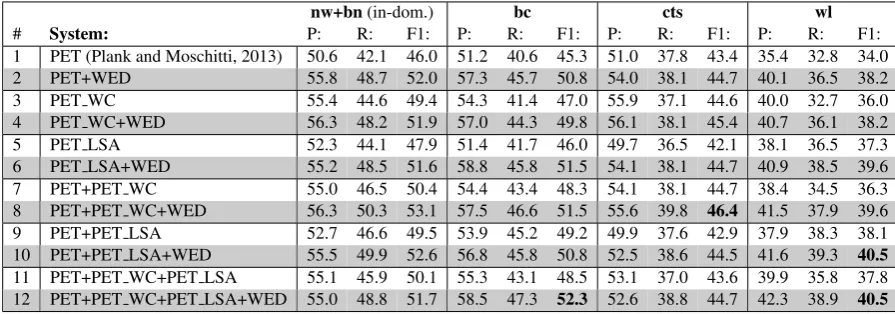
[image:6.595.73.521.62.219.2]1 PET (Plank and Moschitti, 2013) 50.6 42.1 46.0 51.2 40.6 45.3 51.0 37.8 43.4 35.4 32.8 34.0 2 PET+WED 55.8 48.7 52.0 57.3 45.7 50.8 54.0 38.1 44.7 40.1 36.5 38.2 3 PET WC 55.4 44.6 49.4 54.3 41.4 47.0 55.9 37.1 44.6 40.0 32.7 36.0 4 PET WC+WED 56.3 48.2 51.9 57.0 44.3 49.8 56.1 38.1 45.4 40.7 36.1 38.2 5 PET LSA 52.3 44.1 47.9 51.4 41.7 46.0 49.7 36.5 42.1 38.1 36.5 37.3 6 PET LSA+WED 55.2 48.5 51.6 58.8 45.8 51.5 54.1 38.1 44.7 40.9 38.5 39.6 7 PET+PET WC 55.0 46.5 50.4 54.4 43.4 48.3 54.1 38.1 44.7 38.4 34.5 36.3 8 PET+PET WC+WED 56.3 50.3 53.1 57.5 46.6 51.5 55.6 39.8 46.4 41.5 37.9 39.6 9 PET+PET LSA 52.7 46.6 49.5 53.9 45.2 49.2 49.9 37.6 42.9 37.9 38.3 38.1 10 PET+PET LSA+WED 55.5 49.9 52.6 56.8 45.8 50.8 52.5 38.6 44.5 41.6 39.3 40.5 11 PET+PET WC+PET LSA 55.1 45.9 50.1 55.3 43.1 48.5 53.1 37.0 43.6 39.9 35.8 37.8 12 PET+PET WC+PET LSA+WED 55.0 48.8 51.7 58.5 47.3 52.3 52.6 38.8 44.7 42.3 38.9 40.5 Table 2:In-domain (first column) and out-of-domain performance (columns two to four) on ACE 2005. Systems of the rows not in gray come from Plank and Moschitti (2013) (the baselines). WED means HEAD+PHRASE.
the same time, reaching an F1 of 53.4% (compared to 46.4% of the baseline) on the development set.
The results in Table 1 are obtained using the trade-off parameter α = 0.7. Figure 1 addi-tionally shows the variation of the performance with changingα(for the best system on dev, i.e., for the representation PET+HEAD+PHRASE). As we can see, the performance for α > 0.5 is in general better, suggesting a preference for the semantic representation over the syntactic repre-sentation in DA for RE. The performance reaches its peak when the suitable amounts of semantics and syntax are combined (i.e,α= 0.7).
In the following experiments, we use the embedding combination (HEAD+PHRASE) with α= 0.7for the tree kernels, denoted WED.
4.3 Domain Adaptation Experiments
In this section, we examine the semantic rep-resentation for DA of RE in the tree kernel-based method. In particular, we take the sys-tems using the PET trees, word clusters and LSA in Plank and Moschitti (2013) as the baselines and augment them with the embeddings WED = HEAD+PHRASE. We report the performance of these augmented systems in Table 2 for the two scenarios: (i) in-domain: both training and test-ing are performed on the source domain via 5-fold cross validation and (ii) out-of-domain: models are trained on the source domain but evaluated on the three target domains. To summarize, we find:
First, word embeddings seem to subsume word clusters in the tree kernel-based method (compar-ing rows 2 and 4, and except domain cts) while word embeddings and LSA actually encode dif-ferent information (comparing rows 2 and 6 for
the out-of-domain experiments) and their combi-nation would be helpful for DA of RE.
Second, regarding composite kernels, given word embeddings, the addition of the baseline ker-nel (PET) is in general useful for the augmented kernels PET WC and PET LSA (comparing rows 4 and 8, rows 6 and 10) although it is less pro-nounced for PET LSA.
Third and most importantly, for all the systems in Plank and Moschitti (2013) (the baselines) and for all the target domains, whether word clusters and LSA are utilized or not, we consistently wit-ness the performance improvement of the base-lines when combined with word embedding (com-paring systems X and X+WED where X is some baseline system). The best out-of-domain perfor-mance is achieved when word embeddings are em-ployed in conjunction with the composite kernels (PET+PET WC+PET LSA for the target domains bc and wl, and PET+PET WC for the target do-main cts). To be more concrete, the best system with word embeddings (row 12 in Table 2) signif-icantly outperforms the best system in Plank and Moschitti (2013) withp <0.05, an improvement of 3.7%, 1.1% and 2.7% on the target domains bc, cts and wl respectively, demonstrating the bene-fit of word embeddings for DA of RE in the tree kernel-based method.
4.4 Tree Kernel-based vs Feature-based DA of RE
nw+bn(in-dom.) bc cts wl
System: P: R: F1: P: R: F1: P: R: F1: P: R: F1:
Tree kernel-based:
PET+PET WC+HEAD+PHRASE 56.3 50.3 53.1 57.5 46.6 51.5 55.6 39.8 46.4 41.5 37.9 39.6 Feature-based:
[image:7.595.75.525.62.166.2]FET+WC+HEAD 44.5 51.0 47.5 46.5 49.3 47.8 44.5 40.0 42.1 35.4 39.5 37.3 FET+WC+TREE 44.4 50.2 47.1 46.4 48.7 47.6 43.7 40.3 41.9 32.7 36.7 34.6 FET+WC+HEAD+PHRASE 44.9 51.6 48.0 46.0 49.1 47.5 45.2 41.5 43.3 34.7 39.2 36.8 FET+WC+HEAD+TREE 45.1 51.0 47.8 46.9 48.4 47.6 43.8 39.5 41.5 34.7 38.8 36.6
Table 3:Tree kernel-based in Plank and Moschitti (2013) vs feature-based in Nguyen and Grishman (2014). All the compar-isons between the tree kernel-based method and the feature-based method in this table are significant withp <0.05.
procedure, the same model of directional relation classes, the same PET trees for tree kernels and feature extraction, the same word clusters and the same word embeddings). We first evaluate the feature-based system with different combinations of embeddings (i.e, HEAD, PHRASE and TREE) on the bc development set. Based on the evalua-tion results, we then discuss the effect of the se-mantic representations on the feature-based sys-tem and the tree kernel-based syssys-tem, and then compare the performance of the two methods when they are augmented with their best corre-sponding embedding combinations.
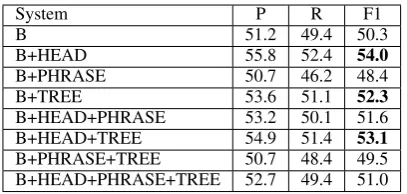
System P R F1
B 51.2 49.4 50.3
B+HEAD 55.8 52.4 54.0
B+PHRASE 50.7 46.2 48.4
B+TREE 53.6 51.1 52.3
B+HEAD+PHRASE 53.2 50.1 51.6
B+HEAD+TREE 54.9 51.4 53.1
[image:7.595.80.284.405.502.2]B+PHRASE+TREE 50.7 48.4 49.5 B+HEAD+PHRASE+TREE 52.7 49.4 51.0
Table 4:Performance of the feature-based method (dev).
Table 4 presents the evaluation results on the bc development for the feature-based system where B is the baseline feature set consisting of FET and word clusters (WC) (Nguyen and Grishman, 2014).
The Role of Semantic Representations Con-sidering Table 4 for the feature-based method and Table 1 for the tree kernel-based method, we see that when combined with the HEAD embeddings, the compositionality embedding TREE is more ef-fective for the feature-based method, in contrast to the tree kernel-based method, where the PHRASE embeddings are better. This can be partly ex-plained by the fact that the tree kernel-based method emphasizes the syntactic structure of the relation mentions, while the feature-based method exploits the sequential structure more.
Conse-quently, the syntactic semantics of TREE are more helpful for the feature-based method, whereas the sequential semantics of PHRASE are more useful for the tree kernel-based method.
Performance Comparison The three best em-bedding combinations for the feature-based sys-tem in Table 4 are (listed by performance order): (HEAD), (HEAD+TREE) and (TREE), where (HEAD) is also the best word level method em-ployed in Nguyen and Grishman (2014). In order to enable a fairer and clearer evaluation, when doing comparison, we use both the three best embedding combinations in the feature-based method and the best embedding combina-tion (HEAD+PHRASE) in the tree kernel-based method. In the tree kernel-based method, we do not employ the LSA information as it comes in the form of similarity scores between pairs of words, and it is not clear how to encode this information into the feature-based method effectively. Finally, we utilize the composite kernel for its demon-strated effectiveness in Section 4.3.
The most important observation from the ex-perimental results (shown in Table 3) is that over all the target domains, the tree kernel-based sys-tem is significantly better than the feature-based systems with p < 0.05 (assuming the same re-sources and settings mentioned above). In fact, there are large margins between the tree kernel-based and the feature-kernel-based methods in this case (i.e, about 3.7% for bc, 3.1% for cts and 2.3% for wl), clearly confirming the hypothesis about the advantage of the tree kernel-based method over the feature-based method on DA for RE in Section 2.3.
5 Analysis
Word Embeddings for the Tree-kernel based Method We focus on the comparison of the best model in Plank and Moschitti (2013) (row 11 in Table 2) (called P) with the same model but augmented with the embedding WED (row 12 in Tabel 2) (called P+WED). One of the most inter-esting insights is that the embedding WED helps to semantically generalize the phrases connecting the two target entity mentions beyond the syntactic constraints. For instance, model P fails to discover the relation between “Chuck Hagel” and “ Viet-nam” in the sentence (of the target domain bc): “Sergeant Chuck Hagel was seriously wounded twice in Vietnam.” (i.e, it returns the NONE re-lation as the prediction) as the substructure asso-ciated with “seriously wounded twice” does not appear with any relation in the source domain. Model P+WED, on the other hand, correctly pre-dicts the PHYS (Located) relation between the two entities as the PHRASE embedding of “Chuck Hagel was seriously wounded twice in Vietnam.” (phrase X1) is very close to the embedding of the source domain phrase: “Stewart faces up to 30 years in prison” (phrase X2) (annotated with the PHYS relation between “Stewart” and “prison”).
In fact, X2 is only the 9th closest phrase in the source domain of X1. The closest phrase of X1 in the source domain is X3: the phrase be-tween “Iraqi soldiers” and “herself” in the sen-tence “The Washington Post is reporting she shot several Iraqi soldiers before she was captured and she was shot herself, too.”. However, as the syntactical structure of X1 is more similar to X2’s, and is remarkably different from X3 as well as the other closest phrases (ranked from 2nd to 8th), the new kernel function Knew would still prefer X2
due to its trade-off between syntax and semantics.
Tree Kernel-based vs Feature-based From the analysis of the systems in Table 3, we find that, among others, the tree kernel-based method im-proves the precision significantly via the seman-tic and syntacseman-tic refinement it maintains. Let us consider the following phrase of the target domain bc: “troops have dislodged stubborn Iraqi sol-diers” (called Y1). The feature-based systems in Table 3 incorrectly predict the ORG-AFF relation (Employment or Membership) between “Iraqi sol-diers” and “troops”. This is mainly due to the high weights of the features linking the words “troop” and “soldiers” with the relation type ORG-AFF in the feature-based models, which is, in turn,
orig-inated from the high correlation of these words and the relation type in the training data of the source domain (domain bias). The tree kernel-based model in Table 3 successfully recognizes the NONE relation in this case. A closer examination shows that the phrase with the closest embedding to Y1 in the source domain is Y2: “Iraqi soldiers abandoned their posts”,5 which is annotated with
the NONE relation between “Iraqi soldiers” and “their posts”. As the syntactic structure of Y2 is also very similar to Y1, it is not surprising that Y1 is closest to Y2 in the new kernel function, conse-quently helping the tree kernel-based method work correctly in this case.
6 Related work
Word embeddings are only applied to RE recently. Socher et al. (2012b) use word embeddings as in-put for matrix-vector recursive neural networks in relation classification while Zeng et al. (2014), and Nguyen and Grishman (2015) employ word embeddings in the framework of convolutional neural networks for relation classification and ex-traction, respectively. Sterckx et al. (2014) uti-lize word embeddings to reduce noise of training data in distant supervision. Kuksa et al. (2010) present a string kernel for bio-relation extraction with word embeddings, and Yu et al. (2014; 2015) study the factor-based compositional embedding models. However, none of this work examines word embeddings for tree kernels as well as do-main adaptation as we do.
Regarding DA, in the unsupervised DA setting, Huang and Yates (2010) attempt to learn multi-dimensional feature representations while Blitzer et al. (2006) introduce structural correspondence learning. Daum´e (2007) proposes an easy adapta-tion framework (EA) while Xiao and Guo (2013) present a log-bilinear language adaptation tech-nique in the supervised DA setting. Unfortunately, all of this work assumes some prior (in the form of either labeled or unlabeled data) on the target do-mains for the sequential labeling tasks, in contrast to our single-system unsupervised DA setting for relation extraction. An alternative method that is also popular to DA is instance weighting (Jiang and Zhai, 2007b). However, as shown by Plank and Moschitti (2013), instance weighting is not
very useful for DA of RE.
7 Conclusion
In order to improve the generalization of rela-tion extractors, we propose to augment the seman-tic syntacseman-tic tree kernels with the semanseman-tic rep-resentation of relation mentions, generated from the word embeddings of the context words. The method demonstrates strong promise for the DA of RE, i.e, it significantly improves the best sys-tem of Plank and Moschitti (2013) (up to 7% rela-tive improvement). Moreover, we perform a com-patible comparison between the tree kernel-based method and the feature-based method on the same settings and resources, which suggests that the tree kernel-based method (Plank and Moschitti, 2013) is better than the feature-based method (Nguyen and Grishman, 2014) for DA of RE. An error anal-ysis is conducted to get a deeper comprehension of the systems. Our future plan is to investigate other syntactic and semantic structures (such as depen-dency trees, abstract meaning representation etc) for DA of RE, as well as continue the comparison between the kernel-based method and the feature-based method when they are allowed to exploit more resources.
References
Marco Baroni and Roberto Zamparelli. 2010. Nouns are vectors, adjectives are matrices: Representing adjective-noun constructions in semantic space. In
EMNLP.
Marco Baroni, Silvia Bernardini, Adriano Ferraresi, and Eros Zanchetta. 2009. The WaCky wide web: a collection of very large linguistically processed
web-crawled corpora. In Language Resources and
Evaluation, pages 209–226.
Yoshua Bengio, R´ejean Ducharme, Pascal Vincent, and Christian Jauvin. 2003. A neural probabilistic
lan-guage model. InJournal of Machine Learning
Re-search 3, pages 1137–1155.
William Blacoe and Mirella Lapata. 2012. A com-parison of vector-based representations for semantic
composition. InEMNLP.
John Blitzer, Ryan McDonald, and Fernando Pereira. 2006. Domain adaptation with structural
correspon-dence learning. InEMNLP.
John Blitzer, Mark Dredze, and Fernando Pereira. 2007. Biographies, bollywood, boom-boxes and blenders: Domain adaptation for sentiment classi-fication. InACL.
Stephan Bloehdorn and Alessandro Moschitti. 2007. Exploiting Structure and Semantics for Expressive Text Kernels. InCIKM.
Peter F. Brown, Peter V. deSouza, Robert L. Mercer, Vincent J. Della Pietra, and Jenifer C. Lai. 1992. Class-based n-gram models of natural language. In
Computational Linguistics, pages 467–479.
Razvan C. Bunescu and Raymond J. Mooney. 2005. A shortest path dependency kernel for relation
extrac-tion. InEMNLP.
Razvan C. Bunescu. 2007. Learning to extract rela-tions from the web using minimal supervision. In
ACL.
Yee Seng Chan and Dan Roth. 2010. Exploiting
back-ground knowledge for relation extraction. In
COL-ING.
Hal Daume. 2007. Frustratingly easy domain adapta-tion. InACL.
Ralph Grishman, David Westbrook, and Adam Meyers. 2005. Nyu’s english ace 2005 system description. InThe ACE 2005 Evaluation Workshop.
Fei Huang and Alexander Yates. 2010. Exploring representation-learning approaches to domain
adap-tation. InThe ACL Workshop on Domain Adaptation
for Natural Language Processing (DANLP).
Jing Jiang and ChengXiang Zhai. 2007a. A systematic exploration of the feature space for relation
extrac-tion. InNAACL-HLT.
Jing Jiang and ChengXiang Zhai. 2007b. Instance weighting for domain adaptation in nlp. InACL.
Nanda Kambhatla. 2004. Combining lexical, syntac-tic, and semantic features with maximum entropy models for information extraction. InACL.
Pavel Kuksa, Yanjun Qi, Bing Bai, Ronan Col-lobert, Jason Weston, Vladimir Pavlovic, and Xia Ning. 2010. Semi-supervised abstraction-augmented string kernel for multi-level bio-relation
extraction. InECML PKDD.
Andriy Mnih and Geoffrey Hinton. 2008. A scalable hierarchical distributed language model. InNIPS.
Alessandro Moschitti. 2006. Efficient convolution ker-nels for dependency and constituent syntactic trees.
InECML.
Alessandro Moschitti. 2008. Kernel methods, syntax and semantics for relational text categorization. In
CIKM.
Thien Huu Nguyen and Ralph Grishman. 2015. Rela-tion extracRela-tion: Perspective from convoluRela-tional
neu-ral networks. In The NAACL Workshop on Vector
Space Modeling for NLP (VSM).
T. Truc-Vien Nguyen, Alessandro Moschitti, and Giuseppe Riccardi. 2009. Convolution kernels on constituent, dependency and sequential structures for relation extraction. InEMNLP.
Luan Minh Nguyen, W. Ivor Tsang, A. Kian Ming Chai, and Leong Hai Chieu. 2014. Robust domain adaptation for relation extraction via clustering con-sistency. InACL.
Denis Paperno, The Nghia Pham, and Marco Baroni. 2014. A practical and linguistically-motivated ap-proach to compositional distributional semantics. In
ACL.
Ted Pedersen. 2008. Empiricism is not a matter of
faith. InComputational Linguistics 3, pages 465–
470.
Slav Petrov and Ryan McDonald. 2012. Overview of the 2012 shared task on parsing the web. InThe First Workshop on Syntactic Analysis of Non-Canonical Language (SANCL).
Barbara Plank and Alessandro Moschitti. 2013. Em-bedding semantic similarity in tree kernels for do-main adaptation of relation extraction. InACL. Longhua Qian, Guodong Zhou, Fang Kong, Qiaoming
Zhu, and Peide Qian. 2008. Exploiting constituent dependencies for tree kernel-based semantic relation
extraction. InCOLING.
Richard Socher, Alex Perelygin, Jean Y. Wu, Jason Chuang, Christopher D. Manning, Andrew Y. Ng, and Christopher Potts. 2012a. Recursive deep mod-els for semantic compositionality over a sentiment
treebank. InEMNLP-CoNLL.
Richard Socher, Brody Huval, Christopher D. Man-ning, and Andrew Y. Ng. 2012b. Semantic com-positionality through recursive matrix-vector spaces. InEMNLP.
Lucas Sterckx, Thomas Demeester, Johannes Deleu, and Chris Develder. 2014. Using active learning and semantic clustering for noise reduction in dis-tant supervision. InAKBC.
Ang Sun, Ralph Grishman, and Satoshi Sekine. 2011. Semi-supervised relation extraction with large-scale word clustering. InACL.
Joseph Turian, Lev-Arie Ratinov, and Yoshua Bengio. 2010. Word representations: A simple and general method for semi-supervised learning. InACL. Mengqiu Wang. 2008. A re-examination of
depen-dency path kernels for relation extraction. In IJC-NLP.
Markus Werning, Edouard Machery, and Gerhard Schurz. 2006. Compositionality of meaning and content: Foundational issues (linguistics & philoso-phy). InLinguistics & philosophy.
Min Xiao and Yuhong Guo. 2013. Domain adapta-tion for sequence labeling tasks with a probabilistic
language adaptation model. InICML.
Mo Yu, Matthew Gormley, and Mark Dredze. 2014. Factor-based compositional embedding models. In
The NIPS workshop on Learning Semantics. Mo Yu, Matthew Gormley, and Mark Dredze. 2015.
Combining word embeddings and feature
embed-dings for fine-grained relation extraction. In
NAACL.
Dmitry Zelenko, Chinatsu Aone, and Anthony Richardella. 2003. Kernel methods for relation
ex-traction. InJournal of Machine Learning Research
3, pages 1083–1106.
Daojian Zeng, Kang Liu, Siwei Lai, Guangyou Zhou, and Jun Zhao. 2014. Relation classification via
con-volutional deep neural network. InCOLING.
Min Zhang, Jie Zhang, Jian Su, and Guodong Zhou. 2006. A composite kernel to extract relations be-tween entities with both flat and structured features. InCOLING-ACL.
Shubin Zhao and Ralph Grishman. 2005. Extracting relations with integrated information using kernel methods. InACL.