Pascal
Third Edition
Update Notice 1
111111111111
The enclosed pages updatc the following manual:
Pascal Reference, Third Edition A -09-00852-01- A
Insert the pages of this Update Notice into the Pascal Reference according to the instructions below. Each new page is dated so that you know which pages are updatc pages and which are original pages to the Pascal Reference. The Summary of Changes on the first page of this Update Notice summarizes the changes made in this notice.
All material discussed in this Update Notice will be incorporated into the next edition of the Pascal Reference. To retain a record of this Update Notice, we suggest you insert this cover page immediately after the title page of your Pascal Reference.
Volume 1
Find and Remove
I to Iv
vi to xii 5-3/5-4 5-9/5-10 12-15 to 12-18 Index-1 tolndex-18
Volume 2 i to Iv
vii/viii 13-25/13-26 14-13 to 14-16 14-47 to 14-50 14-61114-62
Replace WIth
I to Iv
vii to xli 5-3/5-4 5-9/5-10 12-15 to 12-18.2 Index-1 tolndex-18
Find and Remove
F-3/F-4 F-7 to F-10 F-13/F-14
U-1 to H-18 Index-1 to Index-18
Replace With
F-3/F-4 F-7 to F-l0 F-13/F-14 H-1 to H-20 Index-l tolndex-18
Copyright © 1981, 1984, 1987 by Convergent Technologies, Inc.,
San Jose, CA. Printed in USA.
Third Edition (September 1984) A-09-00852-01-A Update Notice 1 (December 1987) 09-01363-01
All rights reserved. No part of this document may be reproduced, trans-mitted, stored in a retrieval system, or translated into any language without the prior written consent of Convergent Technologies, Inc.
Convergent Technologies makes no representations or warranties with respect to the contents hereof and specifically disclaims any implied warranties of merchantability or fitness for any particular purpose. Further, Convergent Technologies reserves the right to revise this publIcation and to make changes from time to time in its content without being obligated to notify any person of such revision or changes.
Convergent Technologies and NGEN are registered trademarks of Convergent Technologies, Inc.
Art Designer, AutoBoot, Chart Designer, ClusterCard, ClusterNet, ClusterShare, Context Manager/VM, Convergent, CT-DBMS, CT-MAIL,
CT-Net, CTIX,
eros,
CTOS/VM, DISTRIX, Document Designer, The Operator, A WS, CWS, IWS, S/50, S1120, S1220, S/320, S/640, SI1280,Multibus, TeleCluster, Voice/Data Services, Voice Processor, WGS/Calendar, WGS/Desktop Manager, WGS/Mail, and X-Bus are
trademarks of Convergent Technologies, Inc.
CONTENTS: VOLUME 1
SUMMARY OF CHANGES... vii
RELATED DOCUMENTATION... ix
1
2
LANGUAGE OVERVIEW .•••••••••••.•••••••••. COMPILER •••••••.•••••••••••••..•.••••••• Language Levels ••••••••••...••..•.•.•• The Compiler Metacommands ••••.•.•••••. PROGRAMS AND COMPILABLE PARTS OF
PROGRAMS •••.••.••••••.•••...•.••.••. Program Structure ••••••.•••••••••.•••• Modules ••••••••••••••••••••••••••••••• units .•..••.•••••••••••...•••••.••.• Advantages to Breaking Programs into Modules and units ••••••••••.•...•..••• PROCEDURES AND FUNCTIONS •••••..•...••••• STATEMENTS ••••••••••••••••••••••••..•••• EXPRESSIONS ••••••••••••••••••••••••••••• VARIABLES •••••••••.••••••••...•••••••••• CONSTANTS •••••.••••••••••••.•.•..••••••• TYPES •••••••••.••••••••••••••••••••.••.• IDENTIFIERS ••••.•.•••••••••.•••••••.••.• NOTATION ••.••...••••.••••••.•.••.•••.•.• NOTATION ••••.•••••••.••••••••.••.••••••• COMPONENTS OF IDENTIFIERS ••.•••••••.•••• Letters ••••.•.•••••••••••••••.•••••••• Digits .•••••..•..•.••..•••••••..•..•.• Using the Underscore Character •••••.•• SEPARATORS •••••.•.•••.••••••••..•••••.•• COMMENTS ••••••••.•.•••••.••.•••.•.•••.•• SPECIAL SyMBOLS .•.••.••••••••.••.••.•••• Punctuation •••••.••••••••••.••.••.•..• Operators ••••••••.••••••••••••.•...••• Reserved Words ••...••••••••••••••••..• UNUSED CHARACTERS .•••••••••••••••.••.•.• OTHER NOTES ON CHARACTERS ••.•••••••••..•
4 INTRODUCTION TO DATA TyPES .••••••••••••. WHAT IS A TyPE? •.•••••••..••••••••••••. DECLARING DATA TyPES •••.•••••••••••••••• TYPE COMPATIBILITy ••.•••..••••••••••••••
Type Identity and Reference
Parameters •••••••••.•••..••••••••••••• Type Compatibility and Expressions •••• Assignment Compatibility ••.•••••••.•••
5 SIMPLE TyPES ••.•...••....••.•••••••••••. ORDINAL TyPES ••••.••...•..•••••••••••••• Integer •••••••••.•..•.•••••••••••.•••• Word ••••••••••.•••..••.••••••••••••••• Char ••••••••.••••.•.•.•.•••••••••••••• Boolean ••••••••.•• ~ •.•..•••••••••••••• Enumerated Types ..••••••.•••••••.••••• Subrange Types ..••••.••.•••••••••..••• REAL •••••••••••••••••..•••..••••••.•.••. INTEGER4 ••••••.••••••.•••••• : •••••••••••
6 ARRAYS, RECORDS, AND SETS ..•••••••...••. ARRAYS ••••••••••.••••••••••••••••••••••• SUPER ARRAyS •••••.••••••••••••••••••.••. STRINGs ••••••••.•••••••••.•••••••••••• LSTRINGs ••••••••.••••••••••••••••••••• Using STRINGs and LSTRINGs •••••••••••• RECORDS ••••••••••••••••••••••••••••••••• variant Records .•••••••••••••••••••••• Explicit Field Offsets •..••••••••••••• SETS •••••••••••••••••.•••••••.••••.•••••
Internal Representation of Arrays, Records, and Sets ••••••..••••.••••••••
7 FILES ...•••...•..••...•••.•••..•.. DECLARING FILES ••.•••••••••••••••••••••. BUFFER VARIABLES •••••••••••••••••••••••• FILE STRUCTURES ••.•••.•••..••••••••..••. BINARY •••...••.••.••.••••••••••.•••••. ASCI I •••••••.•..•••..•••.••••••••••••. FILE ACCESS MODES .•••••••••.•••••••••••• Terminal Mode Files .••••.•••••..•..••. Sequential Mode Files •••••••..•••..••. Direct Mode Files •••••.••••••••••••••• INPUT AND OUTPUT ••••••..•••••.••.••••••• EXTEND LEVEL I/O ...••.•••••..••..•...•••
iv Pascal Manual
SUMMARY OF CHANGES
The 9.1 and 10.0 Releases of Pascal are described in this update notice to the the Pascal Manual, third edition (Volume 1, A-09-00852-01-A, and Volume 2, A-09-00868-01-A).
changes in Update Notice 1 include the removal of functions no longer supported with the Pascal 9.1 release, the addition new Linker procedures, a description of the (optional) Math service for floating point calculation, and the inclusion of other technical corrections.
These changes are summarized below.
o The functions, AIDRQQ an~ ANDRQQ, are no longer supported (as of the 9.1 software release).
o Error message 2052, Signed Divide by Zero, is reported for all occurrences of integer division by zero (as of the 9.1 software release).
o object modules must be linked using the Bind command rather than the Link command in order to produce a version 6 run file. (Version 4 run files produced by the Link command are no longer supported as of the 10.0 software release.)
NOTE
In this manual, the terms CTOS and CTOS operating system refer to either the CTOS operating system, which runs on the Intel 8086 microprocessor, or the CTOS/VM operating system, which runs on the Intel 80X86 series of microprocessors.
RELATED DOCUMENTATION
The following manuals, or related products, are referenced in this manual. It may be helpful to have copies of them on hand when you are using this manual.
The complete Guide to Technical Documentation is provided in the Executive Manual or similar command-line interpreter manual for your operating system.
utilities Executive
System Administration
CTOS System Administrator's Guide Operating System
CTOS Operating System CTOS/VM Concepts CTOS/VM Reference, Languages
Assembly Language BASIC
BASIC Compiler FORTRAN
FORTRAN-86 Level II COBOL
COBOL Ani~
W'O'rkstation C Programming Tools
Debugger Editor Forms
LInker/Librarian status Codes
UTILITIES
SYSTEM ADMINISTRATION
The CTOS System Administrator's Guide
The CTOS System Administrator t s Guide describes
the administrative aspects of the CTOS and CTOS/VM operating systems. Topics include setting up var-ious operating system types, installing system services, adding application software, and installing perripheral devices. In addition, the manual describes SRP and workstation configura-tion, system protection, nationalization, and operating system customization (SysGen).
OPERATING SYSTEM
The CTOS Operating System manual describes the CTOS Operating System concepts and operations. Topics include parameters, I/O, memory, messages, timers, system services, virtual code, and interrupts. Additionally, i t contains the system structure formats.
CTOSjVM Concepts describes the CTOS/VM Operating System. Topics include parameters, I/O, memory, messages, timers, system services, virtual code, interrupts, and administration.
CTOSjVM Reference, together with CTOSjVM Concepts, describes each operation contained in the System Image and in the standard object module library, CTOS.lib. This manual also contains the format of each system structure.
LANGUAGES
Assembly Language describes programming with assembly language at the symbolic instruction level, including the instruction set. Some knowledge of assembly language and the machine architecture of the associated CPU is recommended before using this manual.
The BASIC manual describes the BASIC language
syntax.-The BASIC Compiler manual describes how to use the BASIC Compiler and the BASIC Assembler.
The FORTRAN manual describes the FORTRAN language syntax and includes instructions for using the FORTRAN Compiler in the CTOS environment. Additional topics include how to compile and link FORTRAN programs and how to configure FORTRAN with non-FORTRAN procedures.
The FORTRAN-86 manual describes the FORTRAN-86 la~guage syntax and includes instructions for
us~ng the FORTRAN-86 Compiler. Additionally, FORTRAN-86 operation is explained for the DISTRIX and CTOS environments.
The COBOL Animator describes the commands used to debug COBOL programs as they execute. An example is included.
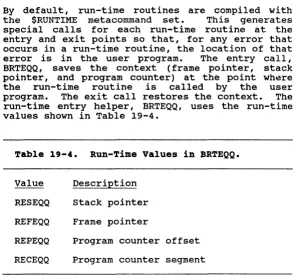
The Pascal Reference manual describes the Pascal programming language. It provides specific information for using the Pascal Compiler and for using Pascal to make CTOS calls.
The 'Workstation C Programmer's Guide describes enhancements to the C programming language, models of segmentation, library functions, and troubleshooting tips for workstation systems. The manual assumes that its reader is familiar with the C programming language.
The Editor manual describes how to use the Editor to create or modify an ASCII text file.
The Forms manual describes how to use the Forms Editor to interactively design and edit forms. Also included is a description of how the Forms run time works when it is called from an application program to display forms and to accept user input.
The Linker/Librarian describes the Linker, which links separately compiled object files, and the Librarian, which builds and manages libraries of object modules.
The Status Codes manual contains a comprehensive listing of all status codes that can be generated by a CTOS workstation or a Shared Resource Processor, including bootstrap ROM error codes and CTOS utilization codes. The codes are organized, explained, and interpreted in numerical order.
The iAPX Programmer's Reference is an Intel-published manual that describes the iAPX 286 archi tecture . It inc I udes sections on the base architecture and instruction set, real address mode, memory management, protection, and interrupts. There is also a section on advanced topics.
The 80386 Programmer's Reference is an Intel-published manual that describes the 80386 archi tecture. It incl udes sections on applications and systems programming, 16-bit compatibility, and the instruction set.
Hav ing both an INTEGER and a WORD type permi ts mapping of 16-bit quantities in either of two ways:
o as a signed value ranging from -32767 to +32767
o as a non-negative value ranging from 0 to 65535
However, do not mix WORD and INTEGER values in an expression (although doing so generates a warning rather than an error message). Neither are WORD and INTEGER values assignment-compatible.
CHAR
In this version of Pascal, CHAR values are 8-bit ASCII values. CHAR is an ordinal type. All 256-byte values are included in the type CHAR. In addition, SET OF CHAR is supported. Relational comparisons use the ASCII collating sequence.
The CHR function changes any ordinal type value to CHAR type, as long as ORO of the value is in the range from 0 to 255.
(See the appendix entitled "Standard Character Set" in your operating system manual for a complete listing of the ASCII character set.)
BOOLEAN
BOOLEAN is an ordinal type wi th only two (pre-declared) values: FALSE and TRUE. The BOOLEAN type is a special case of an enumerated type, where ORO (FALSE) is 0 and ORO (TRUE) is 1. This means that FALSE < TRUE.
ENUMERATED TYPES
An enumerated type defines an ordered set of values. These values are constants and are enumerated by the identifiers that denote them.
Examples of enumerated type declarations:
FLAGCOLOR
=
(RED, WHITE, BLUE)SUITS
=
(CLUB, DIAMOND, HEART, SPADE) DOGS=
(MAUDE, EMILY, BRENDAN)The type values (for example, RED, CLUB, or MAUDE) do not have to be declared in the CONST section or any other section in the program.
Every enumerated type is also an ordinal type. Identifiers for all enumerated type constants must be unique within their declaration level.
The ORO function, at the standard level, can be used to change enumerated values into INTEGER values; the WRD function changes enumerated values into WORD values.
The values obtained by applying the ORO function to the constants of an enumerated type always begin with zero. Thus, the values obtained for the type FLAGCOLOR, from the example above, are as follows:
ORO (RED) 0 ORO (WHITE) 1 ORO (BLUE) 2
The RETYPE function, at extend level, can be used to change INTEGER or WORD values to an enumerated type. For example:
IF RETYPE (COLOR, I)
=
BLUE THEN WRITELN (' TRUE BLUE')Enumerated types are particularly useful for representing an abstract collection of names, such as names for operations or commands. Modifying a program by adding, a new value to an enumerated type is much safer than using raw numbers, since any arrays indexed with the type or any sets based on the type are changed automatically.
As an extension to standard Pascal, the exponent character can be "0" or "d" as well as "E" or "e", for example, 12.34d56. Note that the 0 or d expo-nent character does not indicate double precision, as it does in the FORTRAN language.
This version of Pascal performs floating point operations using the numeric coprocessor chip the Math service, or the Pascal run-time support library numeric coprocessor emulator routines. The numeric coprocessor chip is an option installed only on some workstations. (See the SUbsection "Linking Your Program" in section 18, "using the Compiler," for information on how to link you program if you have a numeric coprocessor chip.) The Math service also is an option. See the Math service Release Notice for inatallation details.
Operations on two REAL4 operands are calculated in REAL4 precision with the numeric coprocessor emulator, but with REAL8 precision if you have a numeric coprocessor chip installed on your workstation.
REAL literals are converted first to REAL8 format and then to REAL4 as necessary (for example, to be passed as a CONST parameter or to initialize a variable in a VALUE section). If you need actual REAL4 constants, you must declare them as REAL4 variables (perhaps adding the REAOONLY attribute) and assign them a constant in a VALUE section.
Both REAL4 and REAL8 values are passed to intrinsic functions as reference (CONSTS) param-eters, rather than as value parameters. The compiler accepts REAL expressions as CONSTS pa-rameters: i t will evaluate the expression, assign the result to a stack temporary, and pass the address of the temporary, which is usually more efficient than passing the value itself.
All results are rounded up to the nearest representable number (with 0.5 rounded up or down to make the next digit even.)
INTEGER4
As with INTEGER and WORD values, INTEGER4 values are a subset of the whole numbers. INTEGER4 values occupy four bytes of storage and range from -MAXINT4 to MAXINT4. MAXINT4 is a predeclared constant with the value of 2,147,483,647 (2**31 - 1). The value -2,147,487,648 (-2**31) is not a valid INTEGER4.
Unlike INTEGER and WORD, the INTEGER4 type is not considered an ordinal type. There are no INTEGER4 subranges and INTEGER4 cannot be an array index or the base type of a set. INTEGER4 values also cannot be used to control FOR and CASE statements.
INTEGER4 is currently an extended numeric type, as is REAL. Values of type INTEGER or WORD in an expression change automatically to INTEGER4 if the expression requires an intermediate value that is out of the range of either INTEGER or WORD. Values of type INTEGER4 do not change to REAL in an expression; you must explicitly use the FLOAT4 function to make the conversion. The functions ROUND4 and TRUNC4 are also available for REAL/INTEGER4 conversion.
To assign instead of sign-extend example:
a WORD to an INTEGER4, use BY LONG the ORD function, because ORD will
the sign bit of the WORD. For
Integer4Var := BYLONG (0, WordExpression);
The CASE Statement
The CASE statement is similar to the conditional statement in that i t specifies that only one (or none) of a number of statements must be executed.
CASE and OTHERWISE are reserved words.
The syntax of the CASE statement is:
CASE <index> OF
<valuel>: <statementl>; <value2>: <statement2>;
<valueN>: <statementN> END
where
<index>
is any expression of an ordinal type.
CAUTION
The short integer (SINT) data type must not be used as a value for <index>. If used, results are undefined.
<valuel>
can be any constant of the same type, or a list of constants separated by commas, or a subrange of the same type. The same applies to <value2>, .• <valueN>.
At the extend level, the CASE statement can also look as follows:
CASE <index> OF
<value1>: <statement1>; <value2>: <statement2>;
<valueN>: <statementN>; OTHERWISE <statement> END
When the CASE statement is executed, <index> is evaluated. If <index> is equal to <value1> (or, if <value1> is a list of constants or a subrange and <index> equals one of the constants specified by <value1», then <statement1> is executed; the rest of the statements are ignored. Control then passes to the statement following the CASE statement.
<index> value is equal to a constant by <value2>, only <statement2> is (The same is true for the rest of the If the
defined executed. <value>'s.)
If <index> is not equal to any of the constants defined by the <value>'s, then one of the following occurs:
o If the OTHERWISE clause is present, <statement> is executed, and control is passed to the statement following the CASE statement. An empty OTHERWISE clause forces control to pass on to the next statement following the CASE statement.
o If the OTHERWISE clause is not present, results are either undefined or can generate a run-time error. (See the discussion of the OTHERWISE clause following the CASE example, below. )
Example:
VAR OPERATOR (PLUS,MINUS,TIMES): NEXTCH CHAR;
BEGIN
CASE OPERATOR OF PLUS: X:= X + Y; MINUS: X := X - Y: TIMES: X := X
*
Y END;{OPERATOR is the CASE index. PLUS, MINUS,} {and TIMES are CASE constants. In this} {instance they are all of the values} {assumable by the enumerated variable,} {OPERATOR.}
CASE NEXTCH OF
'A' •• 'Z', , , : WRITE ('Identifier'); , + " , - " ,
* " , / ' :
WRITE (' operator' ) ; {Commas separate CASE constants}{and ranges of CASE constants.} OTHERWISE
WRITE ('Unknown Character')
{that is, if any other character} END
Note that <index> cannot be an INTEGER4, since INTEGER4 is not an ordinal type.
The CASE syntax for <valuel> •• <valueN> is the same as for RECORD variant declarations. In standard Pascal, a CASE constant is one or more constants separated by commas. At the extend level, you can substitute a range of constants, such as 'A' •• 'Z', for a constant. No constant value can apply to more than one statement.
CAUTION
Depending on optimization, the code generated by the compiler for a CASE statement can be either a "jump table" or series of comparisons (or both). If i t is a jump table, a jump to an arbitrary location in memory can occur if the control variable is out of range and the range-checking switch is off.
A semicolon (;) can appear after the final state-ment in the 1 ist, but is not required. The compiler skips over a colon (:) after an OTHERWISE and issues a warning.
REPETITIVE STATEMENTS
Repetitive statements specify repeated execution of a statement. In standard Pascal, these include the WHILE, REPEAT, and FOR statements.
At the extend level, there are two additional statements, BREAK and CYCLE, for leaving or restarting the statements being repeated. These statements are functionally equivalent to a GOTO but easier to use.
The WHILE statement
The WHILE statement repeats a statement zero or more times, until a Boolean expression becomes false. The syntax of the WHILE statement is
WHILE <expression> DO <statement>
where
<expression>
is any Boolean expression.
<statement>
is any statement.
WHILE and DO are reserved words.
<statement> is executed while <expression> is TRUE, that is:
1. <expression> is evaluated.
2. If its value is FALSE, the execution of the WHILE statement is terminated and control passes to the next executable statement.
This page is intentionally left blank.
INDEX
This index covers both Volumes 1 and 2. sections 1 throllgh 12 are in Volume 1. sections 13 through the Glossary are in Volume 2.
page numbers in boldface indicate the principal dis-cussion of a topic.
*,
11-4 +, 11-4 , 11-4:=,
12-5 <, 11-7 <=, 11-7 <>, 11-7 =, 11-7 >, 11-7 >=, 11-7ABORT, 14-12, 17-8, 19-16
A2DRQQ, 14-16
A2SRQQ, 14-16, 17-8, 19-16
ABS, 14-13
Access modes, files, 7-6 to 7-7
ACDRQQ, 14-13 ACSRQQ, 14-13
Actual parameter, 13-8 Addition operators, 11-4 Address, segmented,
13-11
Address types, 8-4 to 8-9, G-3
comparing, 11-8 predeclared, 8-6
ALLMQQ, 14-4, 14-14 Allocation of memory,
14-3 to 14-5 AND, 11-5, 11-7 AND THEN, 12-28 Angle brackets
«»,
11-10
ANSI/IEEE standard Pascal, comparisons to, B-1 to B-14 ANSRQQ, 14-14 ARCTAN, 14-15
Arithmetic, floating point, 5-9, 18-8 Arithmetic functions,
14-6 to 14-8 predeclared, 14-7 writing your own, 14-8 Arrays, 6-2 to 6-15
conformant, 6-5, B-1 constant, 9-11 to 9-13 declarations, 6-2 index, 5-10, 6-2, 10-6
to 10-7
internal representa-tion, 6-26, G-4 PACKED, 6-8, 6-3 super arrays, 6-4 to
6-15, B-1, G-3 variable-length, 6-4
Assignment compati-bility (cont.) pointer types, 8-3 STRINGs and LSTRINGs,
6-11 WORD, 5-3
Assignment statement, 10-5, 12-5 to 12-7 ASSRQQ, 14-15
ATDRQQ, 14-16 At sign (@), 2-7 ATSRQQ, 14-16 Attributes,
combining, 10-16, 13-18
declaring, 13-19 in modules, 16-9 procedural and
func-tional, 13-15, 13-18 to 13-27 variable, 10-10 to
10-16 video, F-9
Attributes, by name EXTERN, 10-12 to 10-13 INTERRUPT, 13-14 to
13-26
ORIGIN, 10-13 to 10-14, 13-23 to 13-24
PORT, 10-13 to 10-14, 13-10
PUBLIC, 10-12 to 10-13, 13-20, 13-22 to 13-23 PURE, 13-20, 13-26 READONLY, 10-14 to
10-15, 13-10 STATIC, 10-11 to 10-12
$ BRAVE , 17-10 Base type, 5-2 BEGIN and END, 12-2,
12-3, 12-11 BEGOQQ, 14-10, 14-16 BEGXQQ, 14-17, 19-1,
19-8
Binary files, 7-5 Binary numbers, 9-7 to
9-8
Binary tree search ex-ample, H-11 to H-20
Index-2 Pascal Manual
Bitwise logical func-tions, 11-5 Block, 13-1
Body, 1-4 to 1-5, 12-1 BOOLEAN type, 5-3, 11-2,
G-2
expressions, 11-7 READs, 15-16 WRITEs, 15-22 Bounds-checking, 5-6 Bounds, super array, 6-6 Braces, ({}), 2-3
Brackets, ([]), 6-24, 10-14, 13-20 BREAK statement, 12-24
to 12-25
Buffer variable, 7-3 to 7-4, 10-8
BYLONG, 14-18 BYTE, 5-6 BYWORD, 14-18
Calculating expressions, 1-12, 11-1
Calling sequence, 13-24 Carriage return, 2-1 CASE constant, 6-19,
12-4
CASE statement, 5-10, 9-4, 12-15 to 12-18 constants in, 5-5 in variant records,
6-19
Case, upper or lower, 2-1
Changing type value, 11-18
CHAR, 5-3, G-2
Character constants, 9-9 to 9-10
Characters, 2-1 to 2-7 case, 2-1
separators, 2-2 to 2-3 special uses in
Pascal, 2-1 to 2-7 underscore, 2-2
unused, 2-6 to 2-7 CHDRQQ, 14-19
CHR, 14-19 CHSRQQ, 14-19
CLOSE, 7-9, 14-19, 15-24 CNDRQQ, 14-20
CNSRQQ, 14-20
Colon and equals sign
(:=), 12-5 Command form, 18-5 Comments, 2-3 to 2-4
metacommands, 17-1 Comparison, STRINGs and
LSTRINGs, 6-12 Comparisons to other
versions of Pascal, B-1 to B-14
Compatibility between types, 4-5 to 4-8 address types, 8-8 pointer types, 8-3 STRINGS, 6-8
Compilands, 1-4 to 1-7, 16-1 to 16-22 accessing one from
another, 13-22 modules, 16-8 to 16-10 units, 16-11 to 16-22;
see also Modules and units
Compiler, 18-1 to 18-17 bounds-checking, 5-6 compilands, 16-1 to
16-22
controlling source file, 17-15 to 17-18
directives, 1-2, 17-1 to 17-27; see also Metacommands error messages, 19-16,
A-1 to A-51 intermediate files,
18-14
invoking, 18-5 to 18-7 language levels, 1-2 listing file control,
17-19 to 17-22 memory requirements,
18-14 to 18-15
Computing a value, 1-12 CON CAT , 14-20
Concatenation of strings, 9-14 Conditional statements,
12-12 to 12-18 Conformant array, 6-5,
B-1
CONST parameters, 10-15, 13-12
CONST section, 9-3, 13-3 Constant arrays, 9-11 to
9-13
Constant coercions, 4-5 Constant expressions,
5-7, 9-14 to 9-15, 11-3
Constant records, 9-11 to 9-13
Constant sets, 9-11 to 9-13
Constants, 1-14, 9-1 to 9-15
arrays, 9-11 to 9-13 CASE, 6-19, 12-4 character, 9-9 to 9-10 identifiers, 3-1, 9-1,
9-3 INTEGER, 9-6 LSTRINGs, 6-10 MAXINT, 5-1 numeric, 9-4 parameters, 13-12 predeclared, 6-10, 9-6 REAL, 5-9, 9-5
records, 9-11 to 9-13 sets, 9-11 to 9-13 structured, 9-11 to
9-13
type compatibility, 4-5
WORD, 9-6
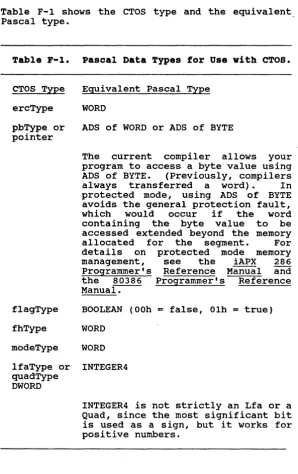
CTOS, F-1 to F-22
example showing how to access, F-6 to F-8 structures, F-5
CYCLE statement, 12-24 to 12-25
$DEBUG, 11-14, 13-25, 17-10
Data conversion func-tions, 14-5 to 14-6 Data types; see Types Debugging, 19-3
metacommands, 17-8 to 17-14
Declaration section, 1-4, 3-3
Declaration arrays, 6-2 constants, 9-3 files, 7-1 to 7-2 functions, 1-9, 13-1,
13-5 to 13-7 pointer types, 8-3 procedures, 1-9, 13-1
to 13-4
variable attributes, 10-10; see also Types
variables, 10-3 DECODE, 14-22 DELETE, 14-23 Derived type, 6-4 DGroup, 18-10, 19-6 Diagrams, syntax, C-1 to
C-13 Digits, 2-2
DIRECT access mode, 7-6 to 7-8
Directives, 13-18 to 13-27
compiler; see Meta-commands
EXTERN, 13-21 to 13-22 FORWARD, 13-19, 13-21 DISCARD, 7-9, 14-23,
15-25
DISMQQ, 14-4, 14-23 DISPOSE, 14-3, 14-24 DIV, 11-5
Division, 11-4 to 11-5 OS Allocation, 18-10
Index-4 Pascal Manual
$ ERRORS , 17-10 $END, 17-16 to 17-17 $ ENTRY , 13-25, 17-10,
19-18 EDF file, F-2 Empty record, 6-20 Empty sets, 11-11 Empty statement, 12-2,
12-5
EMSEQQ, 17-8, 19-16 ENCODE, 14-25 END, 12-3, 12-11 End-of-file, 15-6 End-of-line, 15-6 ENDOQQ, 14-10, 14-25 ENDXQQ, 14-26
ENTGQQ, 16-3, 19-8 Entry point, 19-1
Enumerated types, 5-4 to 5-5, G-2
changing to, 5-4 constants, 9-1 READs, 15-16 EOF, 14-26, 15-6 EOLN, 14-27, 15-6 Equal to (=), 11-7 ErcType, F-3
Error checking, 12-6 run-time routines,
19-2 Error handling
metacommands, 17-8 to 17-14
run-time support library, 19-16 to 19-21
Error messages, 19-16, A-1 to A-51
in listing file, 17-26 Escape sequences, video,
F-10 to F-16 EVAL, 11-17, 14-10,
14-27
Evaluating expressions, 11-14 to 11-17, 14-10
Examples, H-1 to H-20 accessing CTOS, F-6 to
F-8
binary tree search, H-11 to H-20 minimal Pascal, 19-23
to 19-25
Examples (cont.) module, 1-5, H-1 to
8-5
units, 1-5, H-6 to 8-10
video display, F-16 to F-25
Exclamation point (!), 2-3
EXDRQQ, 14-27 EXP, 14-28
Explicit field offsets, 6-21 to 6-23
Exponents, 5-9, 9-5 Expressions, 1-12, 11-1
to 11-18 BOOLEAN, 11-7
common subexpressions, 12-7
constant, 5-7, 9-14 to 9-15, 11-3
conversion of types . in, 11-3 to 11-6 evaluating, 11-14 to
11-17, 14-10 INTEGER, 11-3
optimization, 11-12, 11-14 to 11-17 passing the value of,
11-14 to 11-17, 13-12
set, 11-9 to 11-11 simple types, 11-2 to
11-6
type compatibility, 4-6, 5-2
using functions
within, 1-8, 11-12 to 11-13, 11-17 to 11-18
EXSRQQ, 14-27
Extensions to standard Pascal, B-5 to B-9 EXTERN attribute,
varia-Field, 6-16
identifier, 3-1, 6-16, 10-7
tag field, 6-18 values, 10-7 variables, 10-7 File
external definition (EDF), F-2
listing format, 17-23 to 17-27
object list, 19-3 symbol, 19-3; see also
Files
File control Block, accessing fields of, 15-24
File-oriented functions, 15-1 to 15-29
File-oriented proce-dures, 15-1 to 15-29 Files, 7-1 to 7-12
access modes, 7-6 to 7-7
ASCII, 7-5 binary, 7-5
buffer variable, 7-3 to 7-4, 10-8 declaring, 7-1 to 7-2 INPUT and OUTPUT, 7-2,
7-8, 15-11, 16-4 internal
representa-tion, G-4 temporary, 15-29 text, 7-5, 15-10 to
15-12
File structure, 7-5 File system, 14-3, 15-2
Frames, video display, F-14
FREECT, 14-4, 14-19 FREMQQ, 14-4, 14-30 Function identifier,
13-5
Functions, 1-8 to 1-9, 13-1 to 13-27 arithmetic, 14-6 to
14-8
current value, 11-17, 13-6
data conversion, 14-5 to 14-6
declaration, 1-9, 13-1, 13-5 to 13-7 designating in an
expression, 11-12 to 11-13
directives, 13-18 to 13-27
directory of available functions, 14-1 to 14-67; see also Functions, by name file-oriented, 15-1 to
15-29
identifiers, 3-1 parameters, 13-8 to
13-17, G-3 predeclared, 14-1 REAL values, 5-9 using as a procedure,
11-17 to 11-18; see also Attri-butes, by name Functions, by name
A2DRQQ, 14-16
A2SRQQ, 14-16, 17-8, 19-16
ABS, 14-13 ACDRQQ, 14-13 ACSRQQ, 14-13 AISRQQ, 14-13 ALLHQQ, 14-4, 14-14 ALLMQQ, 14-4, 14-14 ANSRQQ, 14-14 ARCTAN, 14-15 ASDRQQ, 14-15 ASSRQQ, 14-15 ATDRQQ, 14-16 ATSRQQ, 14-16 BYLONG, 14-18 BYWORD, 14-18
Index-6 Pascal Manual
CHDRQQ, 14-19 CHR, 14-19 CHSRQQ, 14-19 CNDRQQ, 14-20 CNSRQQ, 14-20 COS, 14-21 DECODE, 14-22 DISMQQ, 14-4, 14-23 ENDOQQ, 14-10, 14-25 EOF, 14-26, 15-6 EOLN, 14-27, 15-6 EXDRQQ, 14-27 EXP, 14-28 EXSRQQ, 14-27 FLOAT, 14-19 FLOAT4, 14-19 FREECT, 14-19 FREMQQ, 14-30 GET, 14-30, 15-3 GETMQQ, 14-4, 14-30 GTYUQQ, 14-31 HIBYTE, 14-31 HIWORD, 14-31 LADDOK, 14-32 LDDRQQ, 14-32 LDSRQQ, 14-32 LMULOK, 14-33 LN, 14-33 LNDRQQ, 14-33 LNSRQQ, 14-33 LOBYTE, 14-34 LOCKED, 14-34 LOWER, 13-11, 14-35 LOWORD, 14-35 MDDRQQ, 14-37 MDSRQQ, 14-37 MEMAVL, 14-37 MNDRQQ, 14-38 MNSRQQ, 14-38 MXDRQQ, 14-41 MXSRQQ, 14-41 ODD, 14-44 ORD, 14-44 PIDRQQ, 14-46 PISRQQ, 14-46 POSITN, 14-46 PRDRQQ, 14-49 PREALLOCHEAP, 14-47 PREALLOCLONGHEAP,
14-48 PRED, 14-48 PRSRQQ, 14-49 PURE, 13-20, 13-26 RESULT, 13-6, 14-53
Functions, by name
(cont •. )
RETYPE, 11-18, 14-54 to 14-55
ROUND, 14-56 ROUND4, 14-56 SADDOK, 14-57 SCANEQ, 14-57 SCANNE, 14-58 SHDRQQ, 14-58 SHSRQQ, 14-58 SIN, 14-59 SIZEOF, 14-59 SMULOK, 14-59 SNDRQQ, 14-60 SNSRQQ, 14-60 SQR, 14-60 SQRT, 14-60 SRDRQQ, 14-60 SRSRQQ, 14-60 SUCC, 14-61 THDRQQ, 14-61 THSRQQ, 14-61 TNDRQQ, 14-61 TNSRQQ, 14-61 TRUNC, 14-62 TRUNC4, 14-62 UADDOK, 14-63 UMULOK, 14-63 UPPER, 13-11, 14-65 WRD, 5-2, 14-66
$GOTO, 17-11 GET, 14-30, 15-3
GOTO statements, 12-8 to 12-10
using BREAK and CYCLE instead, 12-24 greater than (», 11-7 greater than or equal to
(>=), 11-7 GTYUQQ, 14-11, 14-31
$IF, 17-16 to 17-17 $INCLUDE, 16-12, 17-17
example, H-6 to H-9 $INCONST, 17-17 $INDEXCK, 17-11 $INITCK,11-5, 13-4,
13-6, 17-11 $INTEGER, 17-6 II2MSQQ, E-1
IC column of listing file, 17-25 Identical types, 4-5 Identifiers, 1-17, 3-1
to 3-5
case of characters used, 2-1 constant, 3-1, 9-1,
9-3
construction of, 2-1 to 2-2
declaring, 3-3
enumerated types, 5-4 field, 6-16
function, 13-5 module, 16-8
predeclared, 3-5, D-1 to D-3
program, 16-3
restrictions, 2-1 to 2-6
scope, 3-2 to 3-4 STRING, 6-8 super type, 6-4 unit, 3-1, 16-13 to
16-14
variable, 3-1, 10-1, 10-6
IEEE real number format, 5-8
conversion of REAL numbers from old format to, E-1 IF statement, 12-12 to
Index type of an array, 6-2
Initialization, 14-10, 19-8 to 19-13 metacommand, 17-11 program, 16-4 using to write your
own routines, 19-14
INPUT (file), 7-8, 15-11, 16-4
Input/output, 7-9, 15-7
to 15-9
extend level, 15-24 to 15-29
file, 7-2
predeclared files, 15-10 to 15-12 routines, 14-11 textfiles, 15-10 to
15-12, 15-24 to 15-29
INSERT, 14-32
INTEGER, 5-1 to 5-2, 11-2
assignment compati-bility, 5-3 changing to
enumer-ated, 5-4 changing to WORD,
14-10 constants, 9-6 expressions, 11-3 internal
representa-tion, G-1 READs, 15-15 WRITEs, 15-21 INTEGER1, 5-2, 5-6 INTEGER2, 5-2
INTEGER4, 5-10, 11-2 assigning to WORD,
5-10 constants, 9-6 internal
representa-tion, G-1 READs, 15-16 WRITEs, 15-22 Interactive I/O Interface, 16-17 to
16-19; see also Units, examples
Index-8 Pascal Manual
Internal representation of data types, G-1 to G-5
arrays, 6-26 pointer types, 8-4 records, 6-26 sets, 6-26 super array, 6-6 INTERRUPT attribute,
13-14 to 13-26 Interrupt vectoring and
enabling, 13-25 Invoking the compiler,
18-5 to 18-7
ISO Pascal, comparisons to, B-1 to B-14
JG column of listing file, 17-25
Keyboard LED indicators, F-9
$LINE, 17-12 $LINESIZE, 17-20 $LIST, 17-20
LABEL section, 12-3, 13-3
LADDOK, 14-32
Lazy evaluation, 15-7 to 15-9
LDDRQQ, 14-32 LDSRQQ, 14-32 LED indicators, F-9 Length access, STRINGs
and LSTRINGs, 6-12 Less than «), 11-7 Less than or equal to
«=) ,
11-7Letters, 2-1; see also Characters
Libraries; see Run-time support library Line number of listing
file, 17-25
Lines, in textfiles, 2-1 Linking, 18-8 to 18-11 Listing file, 18-3
control, 17-19 to 17-22
format, 17-23 to 17-27 Literals, REAL, 5-9 LMULOK, 14-33 LN, 14-33 LNDRQQ, 14-33 LNSRQQ, 14-33 LOBYTE, 14-34 LOCKED, 14-34 Loop label, 12-4 Looping, use of BREAK
and CYCLE, 12-24 LOWER, 13-11, 14-10,
14-35 Lower case, 2-1 LOWORD, 14-35
LSTRING, 6-6, 6-9 to 6-15
comparing, 11-8 concatenation, 9-14 constants, 6-10, 9-9
to 9-10
differences from STRINGs, 6-10 examples, 6-14 to 6-15 intrinsics, 14-9 to
14-10
parameter passing, 6-13
READs, 15-17
type compatibility, 4-5 to 4-6 WRITEs, 15-23
$MATHCK, 14-6, 17-12 $MESSAGE, 17-18 M21SQQ, E-l
MARKAS, 14-4, 14-36
Memory requirements, compiler, 18-14 to 18-15
Metacommands, 1-2, 17-1 to 17-27
error handling and de-bugging, 17-8 to 17-14
giving, 17-1
listing file control, 17-19 to 17-22 optimization with,
17-6
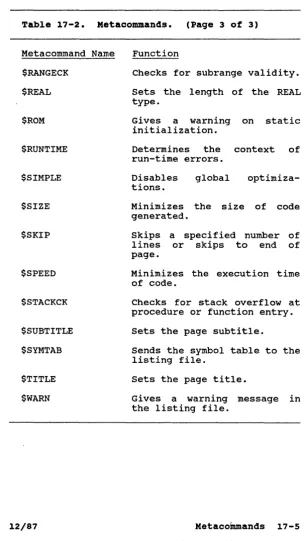
source file control, 17-15 to 17-18 summary, 17-3 to 17-5 Metacommands, by name
$BRAVE, 17-10
$DEBUG, 11-14, 13-25,
17-10
$END, 17-16 to 17-17 $ENTRY, 13-25, 17-10,
19-18 $ERRORS, 17-10 $GOTO, 17-11
$IF, 17-16 to 17-17 $INCLUDE, 16-12, 17-17 $INCONST, 17-17
$INDEXCK, 17-11 $INITCK, 11-5, 13-4,
Metacommands, by name (cont. )
$SKIP, 17-20 $SPEED, 17-6
$STACKCK, 13-25, 17-14 $SUBTITLE, 17-20 $SYMTAB, 17-21
$THEN, 17-16 to 17-17 $TITLE, 17-21
$ WARN , 17-14
Metavariables: see commands and Meta-commands, by name Minimizing program size,
19-22 to 19-25 Minus (-), 11-4 MISO, 19-9 MNDRQQ, 14-38 MNSRQQ, 14-38 MOD, 11-5
Mode of file, 7-2 Modules, 1-4 to 1-7,
16-8 to 16-10 attributes for
proce-dures and func-tions, 16-9 example, 1-5, B-1 to
B-5
identifiers, 3-1, 16-8 structure, 1-5 to 1-7 suppressing the
default PUBLIC attribute, 13-20 MOVE, 6-13
MOVEL, 14-38 MOVER, 14-39 MOVESL, 14-40 MOVESR, 14-41
Multiplication, 11-4 MXDRQQ, 14-41
MXSRQQ, 14-41
$NILCK, 17-13 NaN, 5-8, 11-9 NEW, 14-3, 14-42 to
14-43
Nondecimal numbering, 9-7 to 9-8
NOT, 11-5, 11-7
Not a number (NaN), 5-8, 11-9
Not equal to
«»,
11-7Index-10 Pascal Manual
Notation, 1-18, 2-1 to 2-7, 17-16
NULL, 6-10, 9-10 Null set, 6-24
Numbering, nondecimal, 9-7 to 9-8
Numbers, 5-1 to 5-10 legal digits, 2-2 Numeric constants, 9-4
$OCODE, 17-20 Object file, 18-5 Object list file, 18-3,
19-3
Octal numbers, 9-7 to 9-8
ODD, 14-6, 14-44
Offsets, explicit field offsets, 6-21 to 6-23
Operand, 11-1
Operating system, acces-sing with Pascal, F-1 to F-22
Operators, 1-12, 2-5 to 2-6, 11-1 to 11-2 AND THEN, 12-28 and types, 11-2 BOOLEAN, 11-7, 12-28 INTEGER quotient and remainder, 11-5 OR ELSE, 12-28 precedence, 11-1,
11-15 quotient, 11-5 relational, 11-2 remainder, 11-5 sets, 11-10 Optimization, 5-6,
10-14, 12-6 to 12-7, 12-23
expressions, 11-14 to 11-17
metacommands for, 17-6 minimal run-time use,
19-22 to 19-25 Optimizer, 13-26 OR, 11-5, 11-7 OR ELSE, 12-28 ORO, 14-44
Ordinal types, 5-1 to 5-7
changing to Boolean, 5-3
changing value, 5-2 subranges, 5-5
ORIGIN attribute, 13-23 to 13-24
variables, 10-13 to 10-14
OTHERWISE statement, in variant records, 6-19
OUTPUT (predeclared file), 7-2, 7-8, 15-11
Overflow, 11-14, 13-25, 14-7
error messages, A-5, A-33
Overlays, 18-16 to 18-17 run-time overlays, ,
18-8
Overview of Pascal language, 1-1 to 1-18
$PAGE, 17-20 $PAGE, 17-20 $PAGEIF, 17-20 $PAGESIZE, 17-20 $POP, 17-18 $PUSH, 17-18 PACK, 14-6, 14-45 PACKED, 13-10
PACKED array, 6-3, 6-8 PACKED types, 8-11 PAGE, 14-45, 15-7 Panic errors, A-1 Parameters, 13-8
actual, 13-8
CONST, 10-15, 13-12
passing, 11-15 to 11-16, 13-6 to 13-17
by reference, 13-12 to 13-13
to STRINGs and LSTRINGs, 6-13 procedural and
func-tional, 13-13 to 13-17
program, 7-8, 16-4, H-10 to H-18 reference, 4-5 to 4-6,
8-7 to 8-8, 13-9 to 13-11
segment, 13-12 super array, 13-11 value, 13-8 to 13-9 VARS, 8-7 to 8-8 Parentheses in
expres-sions, 11-15
Parts of a program, 1-4 to 1-10
TYPE section, 4-4 VALUE section, 1-13 Pascal, 1-1 to 1-18
CTOS, F-1 to F-22 command form, 18-5 comparisons to other
versions, B-1 to B-14
compiler, 18-1 to 18-17
library; see Run-time support library notation, 1-18, 2-1 to
2-7, 17-16
program examples, H-1 to H-5
running a program, 18-12 to 18-13 systems programming
PISRQQ, 14-46 Plus (+), 11-4 PLYUQQ, 14-11
Pointer type, 6-5, 8-1 to 8-4
compatiblity, 8-3 declarations, 8-3 internal
representa-tion, 8-4, G-2 to G-3
READs, 15-16 WRITEs, 15-23
Pointer variables, 10-8 to 10-9
PORT attribute, proce-dural, 13-10 PORT attribute,
vari-ables, 10-13 to 10-14
portability, 1-2, 5-8, B-1
POSITN, 14-46 PPMFQQ, 16-6 PRDRQQ, 14-49 PREALLOCHEAP, 14-5,
14-47
PREALLOCLONGHEAP, 14-5, 14-48
precision, 5-9 PRED, 14-48
Predeclared address types, 8-6
Predeclared constants, 9-6
Predeclared functions, 14-1
Predeclared identifiers, 3-5
summary, 0-1 to 0-3 Predeclared types, 6-6 Primitives, 15-1 to
15-29
Procedural types, 8-12 Procedures, 1-8 to 1-9,
13-1 to 13-27 data conversion, 14-5
to 14-6
declaration, 13-1 to 13-4
directives, 13-18 to 13-27
directory, 14-1 to 14-67
file-oriented, 15-1 to 15-29
Index-12 Pascal Manual
file system, 14-3 identifiers, 3-1 parameters, 13-8 to
13-17, G-3 predeclared, 14-1 Procedures, by name
ABORT, 14-12, 16-8, 19-6
ASSIGN, 7-2, 7-9, 14-15, 15-24, 16-3 BEGOQQ, 14-10, 14-16 BEGXQQ, 14-17, 19-1,
10-8
CLOSE, 7-9, 14-19, 15-24
CONCAT, 14-20
COPYLST, 6-13, 14-20 COPYSTR, 6-13, 14-21 DELETE, 14-23
DISCARD, 7-9, 14-23, 15-25
DISPOSE, 14-3, 14-24 ENCODE, 14-25
ENDXQQ, 14-26 EVAL, 11-17, 14-10,
14-27 FILLC, 14-28 FILLSC, 14-28 GET, 14-30, 15-3
INSERT, 14-32 MARKAS, 14-4, 14-36 MOVE, 6-13
MOVEL, 14-38 MOVER, 14-39 MOVESL, 14-40 MOVESR, 14-41 NEW, 14-3, 14-42 to
14-43
PACK, 14-6, 14-45 PAGE,' 14-45, 15-7 PTYUQQ, 14-11, 14-49 PUT, 14-49, 15-4 READ, 14-50, 15-2,
15-13 to 15-17 READFN, 7-2, 7-9,
14-50, 15-26, 16-3 READLN, 14-51, 15-13
to 15-17
READSET, 7-9, 14-51, 15-26
RELEAS, 14-4, 14-52 RESET, 14-53, 15-4 to
15-5
RESULT, 11-17 to 11-18, 13-6, 14-53
Procedures, by name (cont. )
REWRITE, 14-55, 15-5 SEEK, 7-9, 14-58,
15-27 to 15-28 UNLOCK, 14-6, 14-64 UNPACK, 14-64 WRITE, 14-67, 15-2,
15-18 to 15-23 WRITELN, 14-67, 15-18
to 15-23
Procedure statements, 12-7 to 12-8 Program examples; see
Examples
Program parameters, 7-8, 16-3
example, H-11 to H-20 Programs, 1-4 to 1-5
compiling, 18-1 to 18-17
entry point, 19-1 identifiers, 3-1, 16-3 initialization, 16-4 linking, 18-8 to 18-11 parameters; see
Pro-gram parameters parts of, 16-1 to
16-22
Pascal examples, H-1 to H-5
portability, 1-2, 5-8, B-1
running, 18-12 to 18-13
size, 19-22 to 19-25 structure, 1-3 to
1-10, 1-13, 16-1 to 16-7, 19-9 VALUE section, 10-4 VAR section, 10-3 PRSRQQ, 14-49
PTYUQQ, 14-11, 14-49 PUBLIC attribute, 13-20,
Question mark, (7), 2-7, B-1
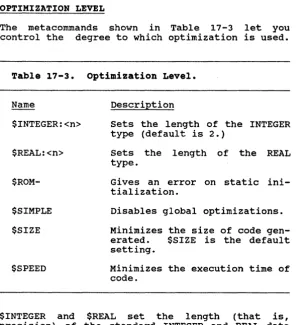
$RANGECK, 5-6, 12-6, 12-17, 13-9, 17-13 $REAL, 5-8, 17-6 $ROM, 10-4, 17-6
$RUNTIME, 13-25, 17-14, 19-19
Radix, 9-7 to 9-8
Range-checking, 5-6; see $RANGECK
Range of data types; see Internal representa-tion
READ, 14-50, 15-2, 15-13 to 15-17
formats, 15-15
READFN, 7-2, 7-9, 14-50, 15-26, 16-3
Reading, STRINGs and LSTRINGs, 6-12 READLN, 14-51, 15-13 to
15-17
READONLY attribute, 10-14 to 10-15, 13-10
READSET, 7-9, 14-51, 15-26
REAL type, 5-8 to 5-9, 11-2
comparing, 11-9 constants, 9-5 conversion to IEEE
format, E-1 internal
representa-tion, 5-8, G-1 mixing with INTEGER,
Record (cont.)
field variables and values, 10-7 internal
representa-tion, 6-26, G-4 variant record, 6-17
to 6-21, 9-4 WITH statement, 12-26
to 12-28 Recursion, 13-1 Reference parameters,
4-5 to 4-6, 8-7 to 8-8, 13-9 to 13-11 Reference types, 8-1 to
8-12, G-2 to G-3 comparing, 11-8 compatibility, 4-6 READs, 15-16 WRITEs, 15-23 Reference variables,
10-8 to 10-9
Relative address types; see Address types and ADR
RELEAS, 14-4, 14-52 Remainder, 11-5
REPEAT statement, 12-19 to 12-20
Repetitive statements, 12-18 to 12-25 Reserved words, 2-6
summary, 0-1 to 0-3 RESET, 14-53, 15-4 to
15-5
RESULT, 11-17 to 11-18, 13-6, 14-53
RETURN statement, 12-26 RETYPE, 11-18, 14-54 to
14-55
REWRITE, 14-55, 15-5 ROUND, 14-56
ROUND4, 14-56
Run file, 18-3, 18-12 Run-time error messages,
A-42 to A-51
Run-time routines, 19-9 Run-time support
library, 16-12, 19-1 to 19-25
architecture, 19-4 to 19-21
avoiding, 19-22 to 19-24
entry point, 19-1
Index-14 Pascal Manual
error handling, 19-16 to 19-21
initialization, 19-1, 19-8 to 19-13 memory organization,
19-5 to 19-7 program structure,
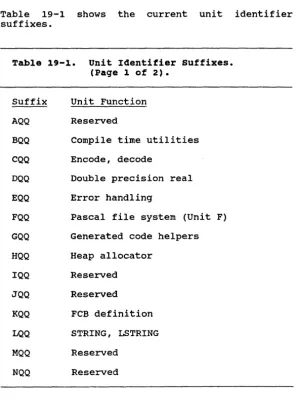
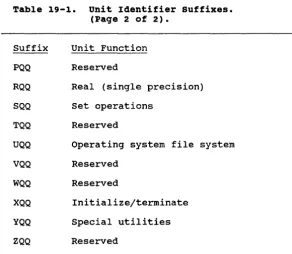
19-9 suffixes, 19-4
using initialization and termination points, 19-14 to 19-16
Running a program, 18-12 to 18-13
$SIMPLE, 12-6, 17-6, 11-12
$SIZE, 17-6 $SKIP, 17-20 $SPEED, 17-6
$STACKCK, 13-25, 17-14 $SUBTITLE, 17-20 $SYMTAB, 17-21 SADDOK, 14-57 SCANEQ, 14-57 SCANNE, 14-58
Scientific notation, 9-5 Scope of identifiers,
3-2 to 3-4 Screen; see Video
display
Screen attributes, F-9 SEEK, 7-9, 14-58, 15-27
to 15-28
Segment, data segment, 18-10
Segment parameters, 13-12
Segmented address, passing as a parame-ter, 13-11
Segmented address types; see Address types and ADS
Semaphore, 14-11 Semicolon, 12-2 Separator characters,
2-2 to 2-3, 12-2 SEQUENTIAL access mode,
7-6 to 7-7 SET, 11-2
set constants, 5-5 set constructors, 5-5 set expressions, 11-9 to
11-11
SET of CHAR, 5-3 Sets, 6-24 to 6-26
and variables, 11-11 base type, 5-10, 6-24
bytes allocated for, 6-26
constant, 9-11 to 9-13 efficient use of, 6-25 empty, 11-11
internal representa-tion, 6-26, G-4
null set, 6-24 operators, 11-10 SHDRQQ, 14-58 SHSRQQ, 14-58
Simple statements, 12-5 to 12-10
Simple type expressions, 11-2 to 11-6
simple types, 5-1 to 5-10
compatibility, 4-6 SIN, 14-59
sine, 14-15 SINT, 5-2, 5-6 SIZEOF, 14-4, 14-59
SMULOK, 14-59 SNDRQQ, 14-60 SNSRQQ, 14-60
Source file, metacom-mands to control, 17-15 to 17-18 SQR, 14-60
SQRT, 14-60
Square brackets ([]), 13-20
instead of BEGIN and END, 12-3
SRDRQQ, 14-60 SRSRQQ, 14-60
Statement labels, iden-tifiers for, 3-1 Statements, 1-10 to
1-11, 12-1 to 12-18, 12-24 to 12-25
compound, 12-11 to 12-12
conditional, 12-12 to 12-18
empty, 12-2, 12-5 labels, 12-3 to 12-4 procedure, 12-7 to
12-8
repetitive, 12-18 to 12-25
separating, 12-2 sequential control,
12-28
simple, 12-5 to 12-10 structured, 12-1,
12-11 to 12-28
syntax, 12-2 to 12-4 Statements, by name
Assignment, 10-5, 12-5 to 12-7
BREAK, 12-24 to 12-25 CASE, 9-4, 12-15 to
12-18
CYCLE, 12-24 to 12-25 FOR, 12-20 to 12-24 GOTO, 12-3, 12-8 to
12-10
IF, 12-12 to 12-14 REPEAT, 12-19 to 12-20 RETURN, 12-26
WHILE, 12-18 to 12-19 WITH, 12-26 to 12-28 STATIC attribute, 10-11
to 10-12
status messages, A-1 to A-51
STRINGs (cont.) READs, 15-17
variable length; see LSTRING
WRITEs, 15-23
Structure of programs, 16-1 to 16-7 Structure, run-time,
19-9
Structured constants, 9-11 to 9-13 Structured statements,
12-11 to 12-28 Structured types, 6-1,
8-11
Structures, internal representation, G-4 Subrange types, 5-5 to
5-7, 15-14
subranges, using con-stant expressions as bounds, 5-7
Subroutines; see Proce-dures, Functions, Modules, or units Subtraction operators,
11-4 SUCC, 14-61
Super arrays, 6-4 to 6-15
compatibility, 4-5 identifiers, 3-1 predeclared, 6-6 internal
representa-tion, 6-6, G-3 parameters, 13-11 upper bound, 6-6 Super type identifiers,
6-4
Swap buffer, 18-16 to 18-17
Symbol, 17-16 Symbol file, 19-3 Syntax
diagrams, C-1 to C-13 statements, 12-2 to
12-4; see also Notation
Systems programming, F-1 to F-22
$THEN, 17-16 to 17-17 $TITLE, 17-21
Tag field, 6-18
Index-16 Pascal Manual
Tangent, 14-15, 14-16 Temporary files, 15-29 TERMINAL access mode,
7-6 to 7-7 Termination, 19-8 to
19-13
Text files, 7-5, 15-10 to 15-12
formatting, 15-7 THDRQQ, 14-61 THSRQQ, 14-61 TNDRQQ, 14-61 TNSRQQ, 14-61
Trouble shooting, error messages, A-1 to A-51
TRUNC, 14-62 TRUNC4, 14-62 TYPE section, 4-4 Type compatibility,
STRINGs, 6-8
Type conversion, 11-3 to 11-6
Type declaration, 4-3 to 4-4
TYPE section, 13-3 Types, 1-14 to 1-15, 4-1
to 4-8
address, 8-4 to 8-9, 15-16, 15-23 and expressions, 5-2 array, 6-2 to 6-15 assignment
compati-bility, 4-5, 4-7 to 4-8
base, 5-2
BOOLEAN, 5-3, 11-2, 15-16, 15-22 BYTE, 5-6
CHAR, 5-3
Compatibility, 4-5 to 4-8, 6-8, 4-5 to 4-8
conversion, 14-5 to 14-6
conversion in expres-sions, 11-3 to 11-6
declaring, 4-3 to 4-4 derived type, 6-4 Enumerated, 5-4 to
5-5, 15-16, 15-22 file, 7-1 to 7-12 for variables or
values, 4-1
Types (cont.) identical, 4-5 identifiers and, 3-1 identity of, 4-5 INTEGER, 5-1 to 5-2,
11-2, 15-15, 15-21 INTEGER1, 5-6, 5-2 INTEGER2, 5-2
INTEGER4, 5-10, 11-2, 15-16, 15-22 internal
representa-tion of, G-1 to G-5
LSTRING, 6-6, 6-9 to 6-15, 15-17, 15-23 ordinal, 5-1 to 5-7 PACKED, 8-11
pointer, 6-5, 8-1 to 8-4, 15-16, 15-23 predeclared subrange,
5-6
procedural, 8-12 REAL, 5-8 to 5-9,
11-2, 15-16, 15-22 REAL4, 5-8 to 5-9 REAL8, 5-8 to 5-9 Record, 6-16 to 6-23 Reference, 4-1, 8-1 to
8-12, 15-16, 15-23 SET, 11-2
sets, 6-24 to 6-26 simple, 4-1, 5-1 to
5-10 SINT, 5-2, 5-6 STRING, 6-6 to 6-9,
15-17, 15-23 structured, 4-1, 8-11,
6-1
sub range , 5-5 to 5-7, 15-14
super array, 6-4 to 6-15, 13-11, B-1 super, 4-4
WORD, 5-2 to 5-3,
Units, 1-4 to 1-7, 16-11 to 16-22, 19-22 examples, 1-5, H-6 to
H-10
identifiers, 3-1, 16-13 to 16-14 in other languages,
16-21
structure, 1-6 to 1-7 using attributes with,
13-19
version number of implementation, 16-21
Unit U, 19-9 UNLOCK, 14-64 UNPACK, 14-6, 14-64 UPPER, 13-11, 14-10,
14-65 Upper case, 2-1
USCD Pascal, comparisons to, B-12 to B-14 USE, 16-12
Value parameters, 13-8 to 13-9
VALUE section, 1-13, 10-4, 13-3
Values, 1-13, 10-1 to 10-16
computing, 1-12
enumerated set of, 5-4 field, 10-7
in assignment state-ments, 10-5 indexed, 10-6 to 10-7 VAR, 13-9
VAR parameter, 13-12 VAR section, 10-3,
10-10, 13-3
Variables (cont.)
identifiers, 3-1, 10-6 in assignment
state-ments, 10-5 indexed, 10-6 to 10-7 initializing, 10-4 memory location, 10-11 multiple attributes,
10-16 names, 1-17
passing segmented ad-dress of, 8-7 to 8-8
reference, 10-8 to 10-9
segmented address, 10-13
types, 4-1
using, 10-5 to 10-10 value, 14-6; see also
variant record variant record, 6-17 to
6-21, 9-4 empty, 6-20 labels, 5-5 VARS, 13-11
VARS parameters, 8-7 to 8-8, 13-12
Video display, F-9 to F-29
frames, F-14
Virtual Code Management facility, 18-16 to 18-17
Index-18 Pascal Manual
$WARN, 17-14 Warnings, A-1
WHILE, 12-18 to 12-19 WITH, 12-26 to 12-28 WORD, 5-2 to 5-3, 11-2
assigning INTEGER4 to, 5-10
assignment compati-bility, 5-3 changing to
enumer-ated, 5-4 constants, 9-6 internal
representa-tion, G-1 READs, 15-15 WRITEs, 15-21 Word ANDing, 5-2 Word shifting, 5-2 WRD, 5-2, 14-66 WRITE, 14-67, 15-2,
15-18 to 15-23
WRITELN, 14-67, 15-18 to 15-23
Writing, STRINGs and LSTRINGs, 6-12
XOR, 11-5
Copyright © 1981, 1984, 1987 by Convergent Technologies, Inc.,
San Jose, CA. Printed in USA.
Third Edition (September 1984) A-09-008S2-01-A Update Notice 1 (December 1987) 09-01363-01
All rights reserved. No part of this document may be reproduced, trans-mitted, stored in a retrieval system, or translated into any language without the prior written consent of Convergent Technologies, Inc.
Convergent Technologies makes no representations or warranties with respect to the contents hereof and specifically disclaims any implied warranties of merchantability or fitness for any particular puryose. Further, Convergent Technologies reserves the right to revise this pubhcation and to make changes from time to time in its content without being obligated to notify any person of such revision or changes.
Convergent Technologies and NGEN are registered trademarks of Convergent Technologies, Inc.
Art Designer, AutoBoot, Chart Designer, ClusterCard, CIusterNet, ClusterShare, Context Manager/VM, Convergent, CT-DBMS, CT-MAIL, CT-Net, CTIX, CTOS, CTOS/VM, DISTRIX, Document Designer, The Operator, AWS, CWS, IWS, S/50, S/120, S1220, S/320, S/640, SI1280,
Multibus, TeleCluster, Voice/Data Services, Voice Processor, WGS/Calendar, WGS/Desktop Manager, WGS/Mail, and X-Bus are
trademarks of Convergent Technologies, Inc.
CONTENTS: VOLUME 2
13
14
INTRODUCTION TO PROCEDURES AND
FUNCTIONS ••••••••••..•••..••.••••••••••• PROCEDURES ••••••••••••••••••••••••••..•• FUNCTIONS •••••••••.••.••..•••••••••••... PARAMETERS TO PROCEDURES AND FUNCTIONS •• Value Parameters ••••••.•••.••••••••••• Reference Parameters .•.••••••••.•••••• Super Array Parameters •••••••••••••• Constant and Segment Parameters ••••• Procedural and Functional
Parameters ••.•••••••••..••••••••••..•• DIRECTIVES AND ATTRIBUTES .•••• ~ ••••••••• The FORWARD Directive •.•.••••••••••••• The EXTERN Directive ••••••••••••.••••. The PUBLIC Attribute ••.••••.•••••••••• The ORIGIN Attribute •••••••••••••••.•• The INTERRUPT Attribute .••••••••••.••• The PURE Attribute ••••.•••••••••••.•••
iv
CHR •••••••••••••••••••••••••••••••••••
CHSRQQ and CHDRQQ •••••••••••••••••••••
CLOSE •••••••••••••••••••••••••••••••••
CNSRQQ and CNDRQQ ••••••••••••••••••••
CON CAT ••••••••••••••••••••••••••••••••
COPYLST . . . . COPYSTR ••••••••••••••••••••••••••••••• COS ••••••••••••••••••••••••••••••••••• DECODE •••••••••••••••••••••••••••••••• DELETE •••••••••••••••••••••••••••••••• DISCARD ••••••••••••••••••••••••••••••• DISMQQ •••••••••••••••••••••••••••••••• DISPOSE ••••••••••••••••••••••••••••••• DISPOSE ••••••••••••••••••••••••••••••• ENCODE •••••••••••••••••••••••••••••••• ENDOQQ •••••••••••••••••••••••••••••••• ENDXQQ •••••••••••••••••••••••••••••••• EOF •.•••••••••••••••••••••••••••••••••• EOLN' ••••••••••••••••••••••••••••••••••
EVAL . • • • • • • • • • • • • • • • • • • • • • • • • • • • • • • • • •
EXSRQQ and EXDRQQ ••••••••••••••••••••• EXP •••••••••••••••••••••••••••••••••••
FILLC •••••.••••..••.•••••.•••••••••.••
FILLSC •••••••••••••••••••••••••••••••• FLOAT •••••••••••••••••••••••••••••••••
FLOAT4 • • • . • • • • • • • • • • • • • • . • • • • • • • • • • • • •
FREE CT •••••••••••••••••••••••••••••••• FREEMQQ ••••••••••••••••••••••••••••••• GET ••••••••••••••••••••••••••••••••••• GETMQQ •••••••••••••••••••••••••••••••• GTYUQQ •••••••••••••••••••••••••••••••• HIBYTE •••••••••••••••••••••••••••••••• HIWORD •••••••••••••••••••••••••••••••• INSERT .•••••••..•••.•••.••••..•••••••• I.ADDOK ••••••••••••••••••••••••••••••••
LDSRQQ and LDDRQQ •••••••••••••••••• === lMULOK ••••••••••••••••••••••••••••••••
LN' •••••••••••••••••••••••••••••••••••• LN'SRQQ and LN'DRQQ ••••••••••••••••••••• LOBYTE •••••••••••••••••••••••••••••••• LOCKED •••••••••••••••••••••••••••••••• LOWER ••••••••••••••••••••••••••••••••• LOWORD •••••••••••••••••••••••••••••••• MARKAS •••••••••••••••••••••••••••••••• MDSRQQ and MDDRQQ ••••••••••••••••••••• MEMA VL •••••••••••••••••••••••••••••••• MNSRQQ and MNDRQQ ••••••••••••••••••••• MOVEL ••••••••••••••••••••••••••••••••• MOVER ••••••••••••••••••••••••••••••••• MOVESL •••••••••••••••••••••••••••••••• MOVESR •••••••••••••••••••••••••••••••• MXSRQQ and MXDRQQ •••••••••••••••••••••
Pascal Manual
19 aUN TIME AND DEBUGGING •••••••••••••••••• OVERVIEW OF THE PASCAL RUN TIME ••••••••• DEBUGGING .••••••••.•••••••••.••••.•..••• RUN-TIME ARCHITECTURE •••••••••.••.•••••• Run-Time Routines ••••••••••••...•••••• Memory Organization ••••••••.•..••••••• Initialization and Termination .••••••••• Machine Level Initialization ••.•.•.•.• Program Level Initialization •.•••••••• Program Termination ..••••••••.•••••••• Using the Initialization and
Termination Points in Your Program .•.• Error Handl ing .•.•••••••••••••••••...••• Machine Error Context ••••••••••••••••• Source Error Context •••••••••••••••••• AVOIDING THE USE OF RUN-TIME ROUTINES ••• Examples •.••••••••••••••••.••••.•••••• Example 1: Min.Pas ••••••••••••••..•• Example 2: Max.Pas ••••••••••••••••••
APPENDIX A: COMPILER ERROR MESSAGES ••••••••
APPENDIX B: COMPARISONS TO THE ISO STANDARD AND OTHER PASCALS ••••••••••.•.•
APPENDIX C: PASCAL SYNTAX DIAGRAMS •••••••••
APPENDIX D: SUMMARY OF RESERVED WORDS AND PREDECLARED IDENTIFIERS ••••••••
APPENDIX E: CONVERSION TO AND FROM IEEE FORMAT ...••••••••••••••••••.•••
APPENDIX F: USING PASCAL AS A SYSTEMS
PROGRAMMING LANGUAGE .•••••..•••
APPENDIX G: INTERNAL REPRESENTATIONS OF DATA TyPES ..•••••••.•••••.•.•..
APPENDIX H: PROGRAMMING EXAMPLES .••••..••..
19-1 19-1 19-3 19-4 19-4 19-5 19-8 19-10 19-11 19-13
19-14 19-16 19-19 19-20 19-22 19-23 19-23 19-25
A-I
B-1
C-l
0-1
E-l
F-l
G-l