N A N O E X P R E S S
Electronic States and Light Absorption in a Cylindrical Quantum
Dot Having Thin Falciform Cross Section
Karen G. DvoyanÆDavid B. HayrapetyanÆ Eduard M. KazaryanÆAni A. Tshantshapanyan
Received: 3 September 2008 / Accepted: 11 November 2008 / Published online: 6 December 2008
Óto the authors 2008
Abstract Energy level structure and direct light absorption in a cylindrical quantum dot (CQD), having thin falciform cross section, are studied within the framework of the adia-batic approximation. An analytical expression for the energy spectrum of the particle is obtained. For the one-dimensional ‘‘fast’’ subsystem, an oscillatory dependence of the wave function amplitude on the cross section parameters is revealed. For treatment of the ‘‘slow’’ subsystem, parabolic and modified Po¨schl-Teller effective potentials are used. It is shown that the low-energy levels of the spectrum are equi-distant. In the strong quantization regime, the absorption coefficient and edge frequencies are calculated. Selection rules for the corresponding quantum transitions are obtained. Keywords Modified Po¨schl-Teller potentialCylindrical quantum dotFalciform cross sectionLight absorption Selection rules
Introduction
Optical experiments with self-assembled quantum dots (QDs) have demonstrated strong carrier confinement. This is due to the fact that the dot size reduction results in strong ‘‘blue shift’’ of extremely narrow luminescence peaks of isolated dots [1–3]. Confinement effects in
magneto-capacitance and infrared absorption have also been observed experimentally [4,5].
Physical properties of so-called ‘‘quantum lenses,’’ or lenticular QDs are of special interest [4,6,7]. In particular, energy spectrum of charge carriers (CCs) inside QDs shaped as a spherical segment or an ellipsoid is studied. In reference [8], a cylindrical quantum lens with almost semi-circle cross section was considered. Up to date, however, cylindrical quantum dots (CQDs) with thin lenticular cross sections were studied in paper [9] only.
Typically, a lens geometry is assumed [10], with a cir-cular cross section of maximum radius r, and maximum thickness h, wherein the CCs are confined in a hard wall potential. Mathematical description of energy levels of such nanostructures is a delicate problem, particularly in the thin lens limit, h=r!0; which corresponds to a sin-gular perturbation regime.
Study of CQDs having thin falciform cross section will enable one to model more realistic structures which are usually formed in the course of manufacturing. Generally, during growth of QDs, due to unavoidable diffusion process of interface atoms, a coating interlayer between the CQD material and semiconductor matrix is formed. This new interlayer, CDQ with thin falciform cross section, affects the distribution of quantum levels of the CQD significantly. In this paper, we study electronic states and direct light absorption in CDQs having thin falciform cross section. For the lower energy levels of the CQD, the confining potential is approximated by one-dimensional potential with variable width.
Theory
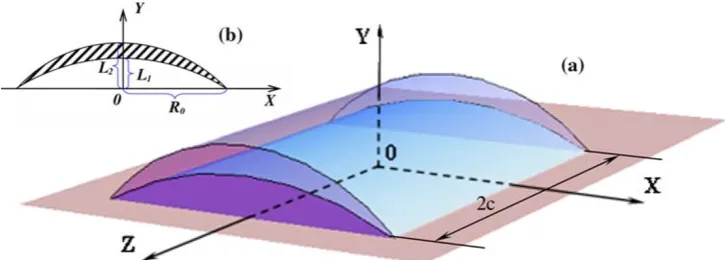
Thus, we consider an impenetrable CQD having thin fal-ciform cross section, as shown in Fig.1a. Potential energy K. G. DvoyanD. B. HayrapetyanE. M. Kazaryan
A. A. Tshantshapanyan (&)
Department of Applied Physics and Engineering,
Russian-Armenian State University, 123 Hovsep Emin Str., Yerevan 0051, Armenia
e-mail: [email protected] D. B. Hayrapetyan
of a charged particle (an electron, or a hole) has the fol-lowing form:
Uðx;y;zÞ ¼
0; x2þ ðyþy1Þ2 R2
1\x2 þðyþy2Þ2R22; z2 ½ c;c;
1; in the other areas 8
> > < > > :
; ð1Þ
whereR1 ¼ ðR20þL21Þ=2L1,R2 ¼ ðR20þL22Þ=2L2 are radii of two circles of the cross section, respectively, 2cis height of the cylinder, L1, L2 are heights of cross section
seg-ments, respectively, R0 is the intersection point of the
circles andX-axes. The motion of the charged particle in the plane of cross section is localized in the dashed area as it is shown in Fig.1b.
In the strong size quantization (SQ) regime, the elec-tron-hole Coulomb interaction energy is much less than the confinement energy of the CQD walls. In this regime, one can neglect the Coulomb interaction. Thus, the energy states of the electron and the hole should be determined independently. The particular shape of CQD suggests that motion of a CC in theY-direction should be faster than that in X-direction what enables one to apply adiabatic approximation. The Hamiltonian of the system in this case has the following form:
^
H¼ h 2
2l
o2 oX2þ
o2 oY2þ
o2 oZ2
þUðX;Y;ZÞ: ð2Þ
Being expressed through dimensionless variables, the Hamiltonian (2) may be represented as the sum of the ‘‘fast’’ and ‘‘slow’’ subsystems’ operators, H^1 and H^2; respectively, and, theZ-directionH^3 operator:
^
H¼H^1þH^2þH^3þUðx;y;zÞ; ð3Þ where
^
H1¼
o2
oy2;H^2¼
o2
ox2;H^3¼
o2
oz2; ð4Þ
and the following notations are introduced:x¼X=aB;y¼ Y=aB; z¼Z=aB; H^¼H=E^ R; with ER¼h2=2mea2B being the effective Rydberg energy,aB¼jh2=mee2;the effective
Bohr radius of electron,me, the effective mass of electron,
andj, the dielectric constant of the medium. We seek the wave function of the problem in the following form:
Wðx;y;zÞ ¼uðxÞfðy;xÞvðzÞ: ð5Þ Due to the CQD problem symmetry, motion of the electron in thez-direction is separated. The energy is given by the following expression:
ez¼
p2n2 z
4c2 ; nz¼1;2;. . .; ð6Þ wherenz is the quantum number.
When the coordinate of the ‘‘slow’’ subsystem, x, is fixed, the motion of the electron is localized in the one-dimensional effective potential well, having the following spatial profile:
hðxÞ ¼h2ðxÞ h1ðxÞ; ð7Þ
h1ðxÞ ¼
ffiffiffiffiffiffiffiffiffiffiffiffiffiffiffiffiffiffiffiffiffiffiffiffiffiffiffiffiffiffiffiffi R2
0þL21
2
4L2 1
x2 s
þL1 R20þL21
2L1 ;
h2ðxÞ ¼
ffiffiffiffiffiffiffiffiffiffiffiffiffiffiffiffiffiffiffiffiffiffiffiffiffiffiffiffiffiffiffiffi R2
0þL22
2
4L22 x 2 s
þL2 R2
0þL22 2L2
;
ð8Þ
whereLL2L1is the maximal value of CQD falciform cross section height.
The Schro¨dinger equation for the ‘‘fast’’ subsystem has the form
fðy;xÞ00þfðy;xÞe1ðxÞ ¼0: ð9Þ After simple transformations, one can obtain the following expressions for the wave function and electron energy, respectively:
fðy;xÞ
¼
ffiffiffiffiffiffiffiffiffiffiffiffiffiffiffiffiffiffiffiffiffiffiffiffiffiffi 2 h2ðxÞ h1ðxÞ s
cos pnh1ðxÞ h1ðxÞ h2ðxÞ
sin pn
h1ðxÞ h2ðxÞy
þ
ffiffiffiffiffiffiffiffiffiffiffiffiffiffiffiffiffiffiffiffiffiffiffiffiffiffi 2 h2ðxÞ h1ðxÞ s
sin pnh1ðxÞ h1ðxÞ h2ðxÞ
cos pn
h1ðxÞ h2ðxÞy;
[image:2.595.181.544.58.188.2]ð10Þ Fig. 1 aCylindrical quantum
e1ðxÞ ¼VReal¼ p2n2
h2ðxÞ; n¼1;2;. . .; ð11Þ wheren is the quantum number.
Here we obtain the following result: the wave functions’ amplitudes depend on geometrical parameters of the QD shape. This means that probability of the CC localization presents oscillatory behavior near the peripheral areas of CQD.
Expression (11) takes the place of the potential in the Schro¨dinger equation for the ‘‘slow’’ subsystem, but the Schro¨dinger equation with such effective potential is not analytically solvable. That is why we have applied adia-batic approximation, to solve this problem. Two models for the ‘‘slow’’ subsystem effective potentials are used. Parabolic Approximation
The ‘‘slow’’ subsystem potential energy is formed by fal-ciform geometry of the QD cross section which allows to use adiabatic approximation. Namely, we use the condition
x
j j R0 which means that CC is localized in the vicinity of the geometric center of falciform cross section. This condition holds for the low-energy states. For the higher excited energy states, the adiabatic approximation is not applicable. The energy of the ‘‘fast’’ subsystem is repre-sented by the Taylor series, where linear, cubic, and other odd terms are equal to zero:
e1ðxÞ ¼VParðxÞ anþb2nx
2 ð12Þ
with an¼
p2n2 L2 ; b
2 n¼
p2n2ðR 1R2Þ R1R2L3
: ð13Þ
ConditionL R0clearly indicates that the fourth-order
term is about 100 times smaller than the quadratic term. Here it should be noted that the origin of the quadratic potential is due to the fact that the width of one-dimensional effective potential well is a variable quantity. Expression (12) plays the role of the effective potential in the Schro¨dinger equation for the ‘‘slow’’ subsystem: u00ðxÞ þ eanb2nx
2
uðxÞ ¼0: ð14Þ
Solving this equation, we obtain the expressions for the CC wave function and energy:
uðxÞ ¼ebn x 2
2 HN ffiffiffiffiffib n
p x
; ð15Þ
e¼anþ2bn Nþ
1 2
; N¼0;1;2;. . . ð16Þ
where HN
ffiffiffiffiffi bn
p x
are Hermit polynomials, and N is oscillatory quantum number.
Modified Po¨schl-Teller Potential Approximation
As it was mentioned above, the adiabatic approximation is applicable for calculation of lower levels of the energy spectrum. Parabolic potential, obtained by use of Taylor series of the energy expression for the ‘‘fast’’ subsystem, gives rise to a set of equidistant energy levels in spectrum. It is notable that each energy level of the ‘‘fast’’ subsystem has its own set of equidistant levels with gaps depending on the quantum number of the particular ‘‘fast’’ subsystem. How-ever, only two or three lower energy levels are split into equidistant level subsystems; for higher levels of the ‘‘fast’’ subsystem the sublevels are not equidistant any more.
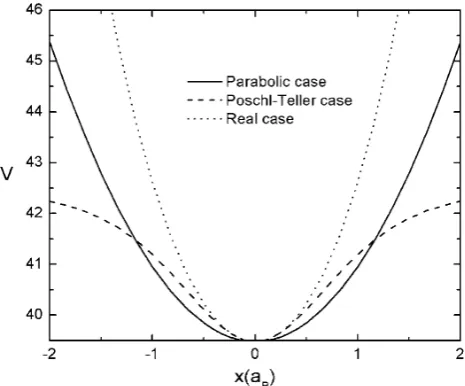
We suggest a more realistic model of one-dimensional effective potential which we represent in the form of modified Po¨schl-Teller potential (see Fig.2) [11, 12]. In dimensionless quantities, this potential has the following form:
e1ðxÞ ¼VPTðxÞ ¼p 2n2
L2
kðk1Þ c2ðchðx=cÞÞ2þ
kðk1Þ
c2 : ð17Þ Herekandcare parameters describing the depth and width of corresponding quantum well, respectively. Note that they depend on the quantum number nof the ‘‘fast’’ sub-system. Choice of this particular potential is explained by the fact that the Taylor expansion of potential (17) for small values of thex-coordinate is parabolic as it is the case for (12) also. On the other hand, at higher values of the x-coordinate the discrepancy of the Po¨schl-Teller potential from parabolic one is increasing. Thus, violation of equi-distance of energy levels of ‘‘slow’’ subsystem can be taken into account.
The one-dimensional Schro¨dinger equation with the Po¨schl-Teller potential reads:
[image:3.595.309.542.491.684.2]u00ðxÞþ e p 2n2
ðL2L1Þ2
kðk1Þ c2 þ
kðk1Þ c2ðchðx=cÞÞ2
!
uðxÞ¼0: ð18Þ We adopt the following notation:
k2¼ep 2n2
L2
kðk1Þ
c2 ð19Þ
thus reducing Eq.18to the following one [12]:
u00þ k2þ kðk1Þ c2ðch x=cð ÞÞ2
!
u¼0: ð20Þ
A series of transformations results in the following expressions for the wave function and energy spectrum of CC:
uðxÞ ¼chk x c "
C12F1 u;v; 1 2;1ch
2 x c
þC2 1ch2 x c
1
2
2F1 uþ 1 2;vþ
1 2;
3 2;1ch
2 x c
#
;
ð21Þ
e¼ðk1nÞ 2
c2 þ
p2n2 L2 þ
kðk1Þ
c2 ; ð22Þ
where u¼1
2ðkckÞ and v¼ 1
2ðkþckÞ; C1 and C2 are
normalization constants, 2F1ða;b;c;xÞ is the hypergeometric function. For small values of the coordinatex, the potential (17) takes the form
VPTðxÞ p 2n2
L2 þ
kðk1Þx2
c4 : ð23Þ
Further, solution to the Schro¨dinger equation for the ‘‘slow’’ subsystem with the potential (23) is completely similar to the procedure with parabolic potential considered above. As a result, we arrive at the following expression for the equidistant energy spectrum of a CC:
e¼anþ
2pffiffiffiffiffiffiffiffiffiffiffiffiffiffiffiffiffikðk1Þ
c2 Nþ
1 2
; N¼0;1;2;. . . ð24Þ
which perfectly agrees with the result (16).
Direct Interband Light Absorption
Now, we consider direct interband light absorption by CQD with thin falciform cross section, in the strong SQ regime. This means that the conditionsLaeB;ahBare satisfied, where aeBðhÞ is an effective Bohr radius of the
electron (or the hole). We consider the case of a heavy hole, whenmemh;withme andmhbeing the effective
masses of the electron and hole, respectively. Under con-ditions of one-electron band theory approximation, the absorption coefficient is given by the expression [13]: K¼AX
m;m0 Z
WemWhm0 dr~
2
d hXEgEmeEmh0
; ð25Þ
wheremandm0are sets of quantum numbers corresponding to the electron and heavy hole, Eg is the forbidden gap
width in the bulk semiconductor, X is the incident light frequency, andAis a quantity proportional to the square of matrix element in decomposition over Bloch functions.
We have performed numerical simulations for a QD consisting of GaAs with the following parameters: me¼ 0:067m0; me¼0;12mh; ER¼5:275 meV; aeB¼104A;˚ Eg ¼1:43 eV;m0is a free electron mass. Finally, for the
parabolic case for the quantityKand, absorption edge (AE) we obtain, respectively,
K¼A X
n;N;N0
In;N;N0d hXEgEe
mE
h m0
ð26Þ
W110¼1þ p2
4 d2 c2þp
2d2 L2þ2p
ffiffiffiffiffiffiffiffiffiffiffiffiffiffiffiffi R2R1 R1R2 r
d2 ffiffiffiffiffi L3
p ð27Þ
whereW110¼hX110=Eg;In;N;N0 is an integral quantity (see Appendix 1). Here we use expression d¼h=pffiffiffiffiffiffiffiffiffiffi2lEg as a
length unit, wherel¼memh=meþmhis the reduced mass of the electron and hole.
Selection rules in the case of the parabolic potential appear to be as follows:nz¼n0z:For other quantum numbers
tran-sitions between the corresponding levels are admissible. Note that in the limit case whenL1!0 the falciform cross section becomes a segment of a circle and we arrive at the following well-known result: the transitions are allowed between the energy levels having quantum numbers inz-directionnz¼n0z;
iny-direction,n¼n0 and, different parity (see [8]). In the oscillatory quantum number values, transitions are allowed between the levels either having N¼N0 and equal parity quantum numbers,NN0¼2t:Partial reduction of number of selection rules in the case of falciform cross section of cylindrical-well QD is due to oscillatory character of the dependence of wave function’s amplitude (10) on cross sec-tion parameters of the QD. Obviously, that transisec-tion to the limitL1!0 is equivalent to the limith1ðxÞ !0 in expres-sion (10). Thus, the oscillatory character of dependence of the wave function amplitude [see (10)] on cross section parame-ters of QD is canceled. In other words, the electron and hole wave functions’ overlap integral in the falciform cross section plane is always nonzero, a fact which partially reduces the selection rules’ number.
transitions are allowed between the energy levels with quantum numbersm¼ m0;nz¼n0z;wheremis
magnet-ical quantum number in the plane of cross section. In the case of modified Po¨schl-Teller potential, for the quantityKand AE we obtain
K¼A X
n;N;N0
Jn;N;N0d hXEgEe
mE
h m0
ð28Þ
W110¼ p2
4 d2 c2þp
2d2
L2þ ðk2Þ 2d2
c2þkðk1Þ d2
c2 ð29Þ whereW100¼hX100=Eg;Jn;N;N0 is an integral quantity (see Appendix 1). In this case the same selection rules for quantum numbers are valid, as in the case of parabolic approximation.
Discussion of Results
As one can see from the CC energy spectrum expressions (16) and (24), the energy levels inside the CQD with fal-ciform cross section are equidistant. More precisely, each level of the ‘‘fast’’ subsystem has its own family of equi-distant energy levels created by the ‘‘slow’’ subsystem. As a consequence of the adiabatic approximation, this result is valid only for the low spectrum levels (i.e., small quantum numbers). Note that the CC levels are equidistant in the case whenh1ðxÞ !0 also [9]. However, in the case when h1ðxÞ 6¼0; the wave function amplitude dependence on falciform cross section parameters is unique [see (10)]. As it is mentioned above, this dependence results in oscillatory behavior of the wave function amplitude thus affecting the overlap integral form and partially reduces the selection rules set. It is also important that approximation of one-dimensional energy expression by a modified Po¨schl-Teller potential enables one to take into account the energy levels which are nonequidistance at higher energy values. One can see from Fig.2 that the effective one-dimensional potential is well approximated by the modified Po¨schl-Teller potential. As the x-coordinate grows, the discrep-ancy between the exact and approximate potentials becomes evident both for the modified Po¨schl-Teller and parabolic potentials (see Appendix2).
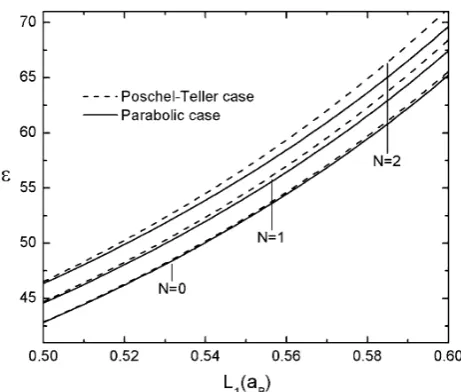
Figure3 illustrates the dependence of the CC spectral energy levels for the first equidistant family inside CQD having falciform cross section as a function of heightL1of
the small cross section segment, in both cases of one-dimensional potential approximation. In other words, we compare results obtained from relations (16) with those from (24). From Fig.3, it is easily seen that the CC energy levels are equidistant in both cases since for small values of thex-coordinate it is sufficient to keep only quadratic terms in the Taylor development of the modified Po¨schl-Teller
potential what leads to practical coincidence with parabolic potential. Growth of the parameter L1 results in width
reduction of falciform cross section of the CQD, which in its turn increases the CC energy due to SQ. However, when decomposition of modified Po¨schl-Teller potential is used, the energy levels are positioned higher than in parabolic potential approximation and their gap is increased withL1.
This fact is explained by higher SQ portion in the particle energy. One can see from Fig.2, with increasing of x-coordinate approximated modified Po¨schl-Teller potential increases faster than parabolic potential. Thus the effect of QD walls is stronger in the first case than in the second.
Figure4 illustrates the dependence of first three energy levels of a CC on the heightL1of the small segment in the
falciform cross section, when the modified Po¨schl-Teller potential approximation is used. Note that the energy levels are not more equidistant (see expression22). As it was mentioned above, the modified Po¨schl-Teller potential allows describing nonparabolic character of the CC energy, the fact clearly shown in Fig.4. Such dependence (both in ‘‘fast’’ and ‘‘slow’’ motions) opens a sufficiently broad opportunity for using the CQD ensemble as an active medium in quantum lasers. For example, in US Patent #6541788 a method and device for converting light from a first wavelength to a second wavelength is presented, where acting objects are multilayer ellipsoidal quantum dots and lenses; it is a good example for targeting appli-cations this research.
Figure5 shows dependence of light absorption fre-quency edges for the CQD on the height L1of the small
segment of falciform cross section under fixed values of large segment heightL2, when parabolic approximation is
Fig. 3 Dependence of first equidistant family of CC energy in CQD with thin falciform cross section on height of segment L1for both
[image:5.595.309.540.54.250.2] [image:5.595.55.287.124.179.2]used. Note that L1 growth causes the AE shift to higher
frequencies (‘‘blue’’ shift). Thus, the contribution of SQ becomes higher as falciform width is reduced. For the same reason the curves corresponding to small L2 values are
positioned higher. Opposite behavior is seen in Fig.6, where AE dependence on the large segment height L2
under fixed values of small segment heightL1is shown for
the case when parabolic approximation is used. As expected, larger L2 values cause the shift of AE to low
frequencies (‘‘red’’ shift). This phenomenon is explained by reduced SQ effect of QD walls when width of the falciform cross section becomes larger. The curves
corresponding to small values of parameter L1 are
posi-tioned below, which is also explained by reduction of confinement effect.
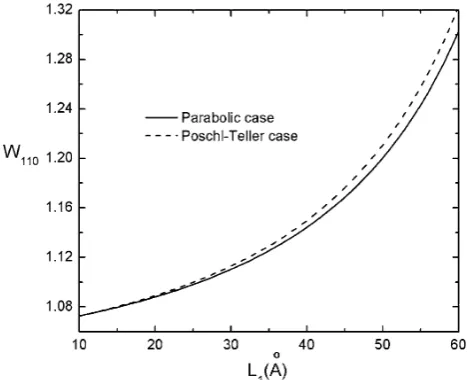
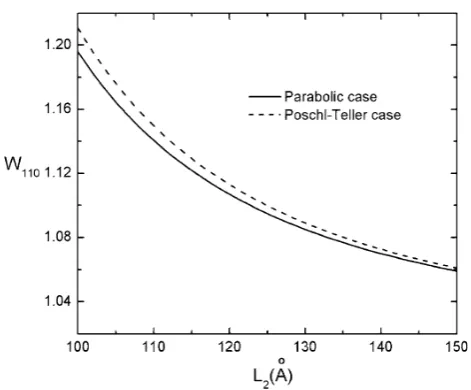
Finally, in Figs.7 and8 comparisons are given of the AE values or the falciform cross section with parametersL1
and L2in the cases when parabolic and modified
Po¨schl-Teller potential approximations are used. One can see in the Fig.7that the curves converge whenL1is small (broad
cross section). As the heightL1is increased, the AE, as it
has already been mentioned, shifts to higher frequencies and the difference between the AE values observed more distinctly due to higher contribution of SQ. And vice versa, Fig. 4 Dependence of first three levels of CC energy in CQD with
thin falciform cross section on height of segmentL1for Po¨schl-Teller
potential realization case
Fig. 5 Dependence of AE in CQD with thin falciform cross section on height of segmentL1for parabolic potential realization case for
fixed values ofL2
Fig. 6 Dependence of AE in CQD with thin falciform cross section on height of segmentL2for parabolic potential realization case for
fixed values ofL1
Fig. 7 Dependences of AE in CQD with thin falciform cross section on height of segmentL1for fixed values ofL2for both parabolic and
[image:6.595.307.541.52.251.2] [image:6.595.54.288.54.254.2] [image:6.595.308.542.310.500.2] [image:6.595.53.287.314.509.2]similar interpretation can be given to Fig.8where the AE shifts to low frequencies and curves converge as the parameterL2is increased.
Conclusion
Thus, we have theoretically proved that energy spectrum of a CC inside CQD having falciform cross section is equi-distant for the lower spectrum levels. Meanwhile, the energy dependence on geometric parameters of QD has the root character. We have revealed the unique (oscillatory) character of the wave function amplitude dependence on geometric parameters of CQD cross section. The formed one-dimensional effective motion potential has been suc-cessfully modeled by modified Po¨schl-Teller potential,
which makes possible an account of the real potential divergence from the parabolic potential. The effect of the former potential which we developed in Taylor series for the lower energy levels of CC (provided that the particle is localized in the cross section center of CQD) has been compared in the paper with the effect of purely parabolic potential. Direct interband light absorption by CQD having falciform cross section has been analyzed. The oscillatory dependence of the effective one-dimensional motion wave function amplitudes on geometric parameters of the cross section has shown lead to partial reduction of selection rules in light absorption process.
Cylindrical quantum lenses and especially falciform CQDs, as a more realistic nanostructures with account of nonparabolicity of forming potential, have various com-mercial applications. For example, they are widely used in large two-dimensional focal plane arrays in the mid- and far infrared (M&FIR) region. They also have important applications at pollution detection, thermal imaging object location and remote sensing as well as infrared imaging of astronomical objects.
Mentioned optimized quantum structures can be formed by direct epitaxial deposition using a self-assembling QDs technique, described, e.g., in the US Patent #6541788 entitled as ‘‘Mid infrared and near infrared light upcon-verter using self-assembled quantum dots’’ as well as by usage of MBE, MOCVD, or MOMBE deposition systems. Results of presented theoretical investigation can be directly applied to the photonics field as background for simulation model. One of the hot topics of this field is developing a scheme for optimization of growth of CQD needed for second harmonic generation.
Acknowledgments This research has been undertaken with finan-cial support of ANSEF grant PS-nano #1301 and Armenian State Target Program ‘‘Semiconductor Nanoelectronics.’’
Fig. 8 Dependences of AE in CQD with thin falciform cross section on height of segmentL2for fixed values ofL1for both parabolic and
Po¨schl-Teller cases
Appendix 1
In;N;N0 ¼ Z 1
0
h2ðxÞ þh1ðxÞ ðh1ðxÞh2ðxÞÞ 2pn sin
h2ðxÞþh1ðxÞ h1ðxÞh2ðxÞ2pn
h2ðxÞ h1ðxÞ
exp 1 2
ffiffiffiffiffiffiffiffiffiffiffiffiffiffiffiffiffiffiffiffiffiffiffiffiffiffiffiffiffiffiffiffiffiffiffiffiffiffiffiffiffi p2n2 R20þL21
2L1 R2
0þL22 2L2
R2 0þL
2 1 2L1
R2 0þL
2 2
2L2 ðL2L1Þ 3 v
u u u
t x2
8 > < > : 9 > = > ;HN
ffiffiffiffiffiffiffiffiffiffiffiffiffiffiffiffiffiffiffiffiffiffiffiffiffiffiffiffiffiffiffiffiffiffiffiffiffiffiffiffiffi p2n2 R20þL21
2L1 R2
0þL22 2L2
R2 0þL
2 1 2L1
R2 0þL
2 2
2L2 ðL2L1Þ 3 4 v u u u t x 0 B @ 1 C A
exp 1 2
ffiffiffiffiffiffiffiffiffiffiffiffiffiffiffiffiffiffiffiffiffiffiffiffiffiffiffiffiffiffiffiffiffiffiffiffiffiffiffiffiffi p2n2 R20þL21
2L1 R2
0þL22 2L2
R2 0þL21 2L1
R2 0þL22
2L2 ðL2L1Þ 3 v
u u u
t x2
8 > < > : 9 > = > ;HN
0
ffiffiffiffiffiffiffiffiffiffiffiffiffiffiffiffiffiffiffiffiffiffiffiffiffiffiffiffiffiffiffiffiffiffiffiffiffiffiffiffiffi p2n2 R20þL21
2L1 R2
0þL22 2L2
R2 0þL21 2L1
R2 0þL22
[image:7.595.52.288.53.248.2]Appendix 2
Estimation of Relative Energy Error at Adiabatic Approximation
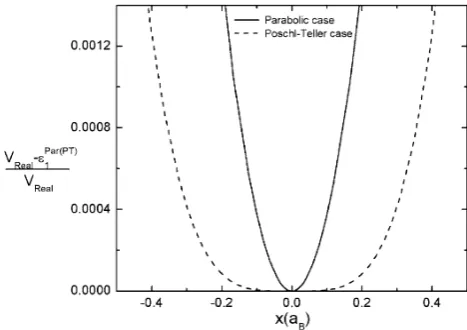
Let us define relative error for one-dimensional energy as ratio VRealðxÞ ePar1 ðPTÞðxÞ
=VRealðxÞ; where VRealðxÞ is exact calculated energy of CC in one-dimensional quantum well, ePar
1 ðxÞ a1þb21x2 is interpolated Taylor series of adiabatic approximated energy of CC and ePT
1 ðxÞ ¼a1 kðk1Þ
c2ðchðx=cÞÞ2þ kðk1Þ
c2 is the Po¨schl-Teller approximated energy of CC, respectively. This estimation approach can be used as a useful tool for designing objects for practical applications from theoretically modeled samples. According to Fig.9, at utilization of the adiabatic approximation the magnitude of the error comprises 10-4what demonstrates the high accu-racy one attains at implementation of this approximation.
References
1. S. Fafard et al., Phys. Rev. B 50, 8086 (1994). doi:10.1103/ PhysRevB.50.8086
2. M. Grundmann et al., Phys. Rev. Lett. 74, 4043 (1995). doi: 10.1103/PhysRevLett.74.4043
3. S. Lee et al., Phys. Rev. B 61, R2405 (2000). doi:10.1103/ PhysRevB.61.R2405
4. A. Wojs et al., Phys. Rev. B 54, 5604 (2001). doi:10.1103/ PhysRevB.54.5604
5. A. Lorke et al., Phys. Rev. Lett.84, 2223 (2000). doi:10.1103/ PhysRevLett.84.2223
6. L.C. Lew Yan Voon et al., J. Phys. Condens. Matter.14, 13667 (2002). doi:10.1088/0953-8984/14/49/321
7. K. Dvoyan, in Proceedings of Semiconductor Micro- and
Nanoelectronics the Fifth National Conference Aghveran,
Armenia, September 16–18 (2005), pp. 169–172
8. C. Trallero-Herrero et al., Phys. Rev. E. Stat. Nonlin. Soft Matter Phys. 64, 056237–056241 (2001). doi:10.1103/PhysRevE.64. 056237
9. A. Chanchapanyan, in Proceedings of the Fifth International
Conference ‘‘Semiconductor Micro- and Nanoelectronics’’
(2005), p. 189
10. D. Leonard et al., Phys. Rev. B50, 11687 (1994). doi:10.1103/ PhysRevB.50.11687
11. P. Harrison, Quantum Wells, Wires and Dots: Theoretical and
Computational Physics(Wiley Ltd, NY, 2005)
12. S. Flu¨gge, Practical Quantum Mecannics (Springer, Berlin, 1971)
13. Al.L. Efros, A.L. Efros, Sov. Phys. Semicond.16, 772 (1982) 14. H.A. Sarkisyan, Mod. Phys. Lett. 18, 443 (2004). doi:10.1142/
S0217984904007062 Jn;N;N0 ¼
Z 1
0
h2ðxÞ þh1ðxÞ ðh1ðxÞh2ðxÞÞ 2pn sin
h2ðxÞþh1ðxÞ h1ðxÞh2ðxÞ2pn
h2ðxÞ h1ðxÞ
chk x
c C12F1 u;v; 1 2;1ch
2 x c
þ
þC2 1ch2 x c
1
2
2F1 uþ 1 2;vþ
1 2;
3 2;1ch
2 x c
#
chk x
c C32F1 u;v; 1 2;1ch
2 x c
þ
þC4 1ch2 x c
1
2
2F1 uþ 1 2;vþ
1 2;
3 2;1ch
2 x c
#
dx
2
[image:8.595.52.286.521.686.2]