EOQ Model with Volume Agility, Variable Demand Rate,
Weibull Deterioration Rate and Inflation
S.R. Singh
Department of Mathematics D.N. (P.G) College Meerut 250001, Uttar Pradesh,
India
Vandana Gupta
Research scholar Banasthali University
Preety Gupta
Research scholar D.N. (P.G) College Meerut 250001, Uttar Pradesh,
India
ABSTRACT
The main objective of this paper is to develop a Supply chain model of a volume agile manufacturing process for the deteriorating items. It is assumed that an EOQ model in which inventory is depleted not only by demand also by deterioration. In this study, a model for the producer by assuming stock dependent demand rate is developed. It is assumed that the deterioration rate follows the Weibull distribution. The unit production cost which is treated to be a function of the finite production rate which is treated to be a decision variable. This whole study is studied in the inflationary environment. The mathematical expression for the total cost is derived and it is minimized. The solution procedure is illustrated with the help of numerical example.
Keywords
Volume agility, Stock dependent demand, inflation and Weibull deterioration rate.
1.
INTRODUCTION
In the past, inventory models with stock dependent demand had received little attention from researchers. However, stock dependent demand plays an important role in the inventory models. In the supermarkets it is observed that the demand rate is usually influenced by the amount in the stock. Levin et al. (1972) pointed out “at times, the presence of inventory has a motivational effect on the people around it”. It is commonly believed that large piles of goods displayed in a supermarket will lead the customers to buy more. This requires consideration of the demand to be a function of the on-hand inventory. As a result, many papers appeared in literature to deal with inventory models using some forms of functional dependencies between the demand rate and on-hand inventory. Gupta and Vrat (1986) had assumed demand rate to be a function of the initial stock. Mondal and Phaujder (1989) considered demand rate to be linear and non linear functions of on hand inventory. Dutta and Pal (1991) extended the above models by allowing deterioration effects and shortages, which are completely backlogged, for finite as well as for infinite time horizon. Chang and Lin (2010) discussed a partial backlogging inventory model for non-instantaneous deteriorating items with stock-dependent consumption rate under inflation. Singh et al. (2011) described a deterministic two warehouse inventory model for deteriorating items with stock dependent demand and shortages under the conditions of permissible delay. Singh et al. (2013) discussed a three
stage supply chain model with two warehouse, imperfect production, variable demand rate and inflation.
need of volume agility in the corresponding models to make it more realistic due to present business situation.
It is observed that the prices of everything going up over the years. Inflation is a rise in the general level of prices of goods and services in an economy over a period of time. Inflation can also be described as a decline in the real value of money, a loss of purchasing power in the medium of exchange. So it is more realistic to consider the inflation in our model. In this paper most of the factors which effect the inventory management in reality are considered. Deterioration rate is not always constant therefore the Weibull deterioration rate is very realistic concept. In this paper most of the factors which effect the inventory management are considered.
In all of the above mentioned models, the influence of the slump on the demand was not discussed. In this article, an attempt has been made to develop an EOQ model with volume agility, Weibull deterioration rate, and variable demand rate under inflation. The rest of this paper is organized as follows. Section 2 describes the assumptions and notations used throughout this paper. The mathematical model and the minimum total relevant cost are given in Section 3. Illustrative examples, which explain the applications of the theoretical results as well as their numerical verifications, are given in Section 4. Sensitivity analyses are carried out with respect to the different parameters of the system in Section 5, while concluding remarks and suggestions for future research are provided in Section 6.
2.
ASSUMPTIONS AND NOTATIONS
The mathematical modeling in this study is developed on the basis of the following assumptions and notations:
2.1
Assumptions
Replenishment rate is infinite and lead time is zero. Deteriorating rate follows the Weibull distribution. The production cost per unit item is a function of
the production rate.
The production rate is considered to be a decision variable.
Demand rate is stock dependent. Inflation is also considered.
2.2
Notations
Ip1(t) the inventory level at time t during the time interval [0, tp].
Ip2(t) the inventory level at time t during the time interval [tp, T].
H the planning horizon. T the replenishment cycle
m the replenishment number in the planning horizon H
C1p the ordering cost per order C2p the purchasing cost per unit
C the holding cost per unit per unit time
P the production rate per unit time η(P) the production cost per unit item a+bI(t) the demand rate at time t, where a > 0 ,
and b is the stock dependent consumption rate parameter
αβ tβ-1
the two parameter Weibull distribution deterioration rate(unit/unit time). where 0 < α << 1 is called the scale parameter , β > 0 is the shape parameter.
R the net discount rate of inflation
Im the maximum inventory level for each cycle
TC (m,P) the present value of the total relevant inventory cost in the planning horizon H
3.
MATHEMATICAL FORMULATION
AND SOLUTION
The planning horizon H is divided into m equal parts of length T= H/m. The jth replenishment is made at time jT (j = 0,1,2,3….m). The maximum inventory level for each cycle is Im. During the time interval [jT , jT+tp] (j= 0,1,2,3….m-1) the inventory level increases due to production and decreases due to deterioration and demand. During the time interval [ jT+ tp , (j+1)T] (j= 0,1,2,3….m-1), the inventory level gradually reduces due to demand and deterioration.
The inventory level at time t during the time interval [0, tp] is governed by the following differential equation:
1 1
1 1
( )
( ) [ ( )],
p
p p
dI t
t I t P a bI t
dt
0 t tp (1)
With the boundary condition
1(0) 0
p
I . The solution of eq. (1) can be represented by
1 2 1( ) ( )
1 2
t bt p
t bt
I t e p a t
, 0 t tp (2)
Owing to stock dependent demand and deterioration, the inventory level at time t during the time interval [tp, T] is governed by the following differential equation:
2 1
2 2
( )
( ) [ ( )],
p
p p
dI t
t I t a bI t
dt
tp t T (3)
With the boundary condition
2( ) 0
p
I T . The solution of eq.
(3) can be represented by
1 1
2 2 2
( )
1 ( )
( )
2
t bt p
T t
T t
I t ae
b T t
,
t
p
t
T
(4)Ip2(0) = Im = 1 2
1
2
T
bT
a T
(5)The total relevant inventory cost involves following four factors.
3.1
Ordering cost
The present value of the ordering cost in the entire time horizon H is
/
1 1 /
0
1
RH m RH
m RjT
p p p RH m
j
e
e
OC
C
e
C
e
(6)3.2
Purchasing cost
The present value of the Purchasing cost in the entire time horizon H is
1 2 m 0 1 2 2 / I 1
1 2 1
m RjT
p p
j
RH
p RH m
PC C e
T bT e
aC T e
(7)3.3
Holding cost
The present value of the holding cost in the entire time horizon H is
1
3 1 2
0 0
( )
( )
p p t T mRt Rt RjT
p p p p
j t
HC
C
I
t e
dt
I
t e
dt e
2 3 4
2 3 2 1 2 1 3 2 3 4
2 3 2 8
( 1)( 2) ( 1) 2 3
1
2 2
( )
2 ( 1)
2( 1)
( )
2( 1)
( ) ( )
6 8
p p p
p p p p p p p p p p
t t b bt
R b R
p
t t b R
bt
t t
b R t T T
bt C
b R t
b R T b R bT
a t 1 2 3 / ( 1)
( 1)( 2) ( 3) 2 1
1 1
RH RH m
T
T T b R b
e e (8)
3.4
Production cost
We consider a self-manufacturing system in which the items are manufactured in a machine and the market demand is filled by these manufactured items. Demand is less than the production and Production cost per unit is
(P) g sP
P
The production cost is based on the following factors:
1. The material cost
per unit item is fixed.2. As the production rate increases, some costs like labor and energy costs are equally distributed over a large number of units. Hence the per-unit production cost g
P
decreases as
the production rate (P) increases.
3. The third term (sP), associated with tool/die costs, is proportional to the production rate.
Therefore present value of the production cost in the entire time horizon H is
1 0 0 2 /
( )
1
2
1
p t m Rt RjT j RH pp RH m
g
P
sP
Pe
dt e
P
Rt
g
e
P
sP
t
P
e
(9)Hence, the Present value of the average total cost of the producer in the entire time horizon H is
( , )
( )
(3.6)
(3.7)
(3.8)
(3.9)
p p p
TC P m
OC
PC
HC
P
equ
equ
equ
equ
(10)Now equation (3.10) can be minimized but as it is difficult to solve the problem by deriving a closed equation of the solution of equation (3.10), Matlab Software has been used to determine optimal value of m and P and hence the optimal total cost can be evaluated.
4.
NUMERICAL EXAMPLE
The preceding theory can be illustrated by the following numerical example:
If C1p= $600/order , C2p = $6 /unit , C3p = $3 /unit/month , R= 0.2, α = 0.05 , β = 2, a = 60 units/month , b = 0.04 , μ = 0.01 , g = 4000 , s = 0.001 , H = 48month , tp = 4month. The software Mathematica5.2 is used to derive the optimal solution. The optimal value of total cost is obtained as $22654.2, production rate (p*) is as 187.765 units/month and no of cycles (m*)is as 10.753.
5.
SENSITIVITY ANALYSIS
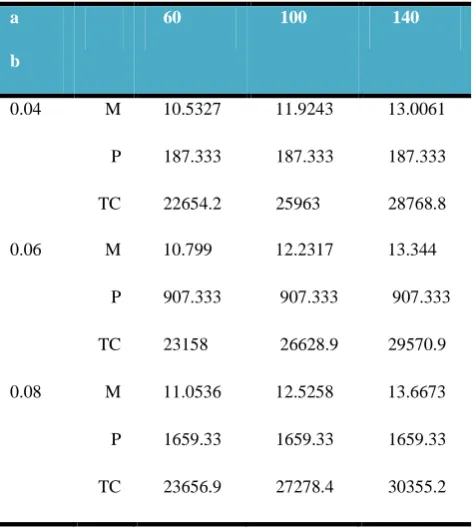
The sensitivity of the optimal solution has been analyzed for various system parameters through Table 1 and Table 2.
Table 1. Effect of deterioration rate and shape parameter on decision policy
β
α
2.0 2.5 3.0
0.05 M 10.5327* 12.0169 13.5448
P 187.333* 3381.33 9254
TC 22654.2* 25027.3 28176.7
0.10 M 11.9594 13.6373 15.3424
P 4134 10522 22267.3
TC 25608.5 29093.8 33983.4
0.15 M 12.9488 14.7489 16.5771
P 8080.67 17662.7 35280.7
TC 28059.1 32536.8 39074.5
Table 2. Effect of initial demand and stock dependent consumption rate on decision policy
a
b
60 100 140
0.04 M 10.5327 11.9243 13.0061
P 187.333 187.333 187.333
TC 22654.2 25963 28768.8
0.06 M 10.799 12.2317 13.344
P 907.333 907.333 907.333
TC 23158 26628.9 29570.9
0.08 M 11.0536 12.5258 13.6673
P 1659.33 1659.33 1659.33
TC 23656.9 27278.4 30355.2
[image:4.595.50.287.151.417.2] [image:4.595.49.287.493.757.2]6.
FIGURES
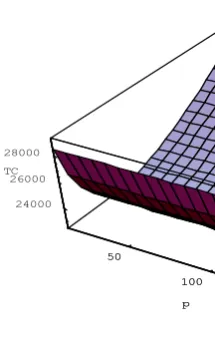
Inventory modal and the convexity of the total cost is represented by figure 1. and figure 2
.
Inventory level
Im
Ip1(t) ……..
Ip2(t)
Time
[image:5.595.58.498.202.379.2]0 t
pT
T+ t
p2T
(m-1)T+ t
pH=mT
Fig 1: The graphic representation of inventory model
50
100
150
200 p
10 15
20
m 24000
26000 28000
TC
50
100
150
200 p
[image:5.595.294.402.479.651.2]7.
CONCLUSION
In this model, an inventory model has been proposed with stock dependent demand, Weibull deterioration rate in the environment of inflation and volume agility. Volume agility has become an important factor because customers require increasingly customized products that answer their unique needs. The greater the uncertainties in supply and demand, it is essential to emphasized the importance of a long term strategic relationship between the producer and the customer. The purpose of the proposed study is to give a dimension to the production system of the producer. Here production rate is assumed as a decision variable and it is found that, what should be the production rate according to a model. Numerical example has been solved which gives the optimal values of total cost, Production rate and no of cycles. With the help of sensitivity analysis, the effect of deterioration rate and demand rate on the production rate, no of cycles and total cost can be analyzed.
Finally, the proposed model can be extended in several ways. For example, this model can be extended with fuzzy parameters.
8.
ACKNOWLEDGMENTS
The first author would like to express his thanks to University Grants Commission India for providing financial help in the form of MRP. We also thank the anonymous referees for their positive reviews.
9.
REFERENCES
[1] Chang, J.H. and Lin, F.W. 2010. A partial backlogging inventory model for non-instantaneous deteriorating items with stock-dependent consumption rate under inflation. Yugoslav Journal of Operation Research, 20(1), 35-54.
[2] Datta, T.K. and Pal, A.K. 1991. Effects of inflation and time value of money on an inventory model with linear time dependent demand rate and shortages. European Journal of Operation Research, 52(3), 326-333.
[3] Padmanabhan, G. and Vrat, P. 1990. An EOQ model for items with stock dependent consumption rate and exponential decay. Engineering Costs and Production Economics, 18(3), 241-246.
[4] Hong, J.D., Sandrapaty, R.R. and Hayya, J.C. 1990. A production policy for linearly increasing demand and finite uniform production rate. Computers Industrial Engg., 18(2), 119-127.
[5] Khouja, M. and Mehrez, A. 1994. An economic production lot size model with variable production rate and imperfect quality. Journal of operational Research
Society, 45(12), 1405-1417.
[6] Khouja, M. 1995. The economic production lot size model under volume flexibility. Computers and operations Research, 22(5), 515-523.
[7] Khouja, M. 1997.The scheduling of economic lot size on volume flexibility production system. International Journal of Production Economics, 48(1), 73-86.
[8] Khouja, M. and Mehrez, A. 2005. A production model for a flexible production system and products with short selling season. Journal of Applied Mathematics and Decision Sciences, 2005(4), 213-223.
[9] Moon, I., Gallego, G. and Simchi-Levi, D. 1991.
Controllable production rate in a family production context. International Journal of production Research, 29(12), 2459-2470.
[10]Mandal, B.N. and Phaujdar, S. 1989. An Inventory model for deteriorating items and stock-dependent consumption rate. Journal of the Operations Research Society, 40(5), 483-488.
[11]Misra, R.B. 1975. Optimum production lot size model for a system with deteriorating inventory. International Journal of Production Research, 13(5), 459-505.
[12] Sana, S. and Chaudhuri, K.S. 2003. On a volume flexible stock dependent inventory model. Advance Modeling and Optimization, 5(3), 197-210.
[13]Sana, S. and Chaudhuri, K.S. 2004. On a volume flexible production policy for a deteriorating item with time dependent demand and shortage. Advanced Modeling and Optimization, 6(1), 57-73.
[14]Sana, S.S., Goyal, S.K. and Chaudhuri, K.S. 2007.On a volume flexible inventory model for items with an imperfect production system. International Journal of Operational Rerearch, 2(1), 64-80.
[15]Singh, S.R. and Urvashi. 2010. Supply chain models with imperfect production process and volume flexibility under inflation. IUP journal of Supply Chain Management, 7(1&2), 61-76.
[16]Singh, S.R., Kumari, R. and Kumar, N. 2011. A deterministic two warehouse inventory model for deteriorating items with stock dependent demand and shortages under the conditions of permissible delay. International Journal of Mathematical Modelling and Numerical Optimisation, 2(4), 357-375.