Journal of Chemical and Pharmaceutical Research, 2015, 7(1):459-466
Research Article
ISSN : 0975-7384
CODEN(USA) : JCPRC5
Structural, optical and electrical properties of ZnO: Al thin films synthesized
by low cost spray pyrolysis for optoelectronic applications
C. Rameshkumar
1and R. Subalakshmi
21
Department of Physics, Sathyabama University, Chennai, Tamilnadu, India
2Department of Physics, University of Madras, Chennai, Tamilnadu, India
________________________________________________________________________________
ABSTRACT
Undoped and aluminum-doped ZnO thin films are prepared by ultrasonic spray pyrolysis at 400 °C on glass substrates were investigated. In this preparation Zinc acetate dihydrate is used as precursor, methoxyethanol is used as solvent and mono-ethanolamine is used as stabilizer. The dopant solution is taken at the atomic percentage of 1 to 5. The electrical and optical properties of ZnO films were investigated when Al is doping on ZnO. The optical properties of Al doped ZnO thin films were investigated using a UV-VIS spectrophotometer and the optical parameters have been calculated by spectroscopic ellipsometry. By using X-ray diffraction (XRD) and atomic force microscopy (AFM), the crystallographic properties and surface morphology of the films were characterized. The X-ray diffraction results show that the pure ZnO thin films had that thin films have polycrystalline nature and possess typical hexagonal wurtzite structure. It is compared to pure ZnO thin film, the grain size in the Al-doped thin film is increases. They are well crystallized and the grain size is (e = 0.13 µm) for Al-doped ZnO and (e = 0.1 µm) for undoped ZnO. From the previous reports, grain size of the ZnO thin film also increases with the increasing annealing temperature. A 2 at.-% of Al doped with the thin film a minimum resistivity of 3.3×10⁻³Ω-cm was obtained and carrier concentration as high as 5.52×1019 cm−3. The optical transmittance spectra of the films showed a very good transmittance, between 85% and 95%, within the visible wavelength region. For pure ZnO, the value of bandgap is 3.229 eV and it increases to 3.29 eV in 1at.-% of Al doped ZnO. The bandgap value decreases,
when 2 at.-% of Al doped in ZnO film. The increase in bandgap can be explained by the Burstein –Moss effect.
Key words: Thin film, Spray Pyrolysis, Optoelectronic devices, Electrical properties, SEM
________________________________________________________________________________
INTRODUCTION
chemical vapor deposition (CVD)(12), have been utilized for the growth of ZnO films on distinct substrates. Among these methods Spray pyrolysis, is an astonishing method for the deposition of thin films of metallic oxides. For turning ZnO to an electronic material, doping is the very useful way. Many dopants are taken from rare earth elements and group I and V. From those materials, doping with Al elements can conclude in fascinating structural, optical and electrical properties.
In this work, to upgrade the optoelectronic properties of ZnO thin film, spray pyrolysis is used. Zinc acetate dihydrate, 2 Methoxy ethanol and Monoethanolamine were used as the precursor, solvent and stabilizer respectively. Undoped and aluminium doped zinc oxide (ZnO) thin films have been prepared on glass substrates by spray pyrolysis technique.We have investigated the influence of doping concentrations ranging from 0 to 5 at.-%on structural, optical, and electrical properties of ZnO thin films. This Al content region is ideal for good achievement of n-type ZnO.
EXPERIMENTAL SECTION
By spray pyrolysis (SP) technique, Al-doped zinc oxide (AZO) thin films have been prepared of zinc acetate and aluminium nitrate. Zinc acetate dihydrate (Zn(CH2COO)2·2H2O) (ZAD) is used as starting material,
2-methoxyethanol (CH3O (CH2)2OH) (2-ME) is used as solvent and monoethanolamine ((HOCH2CH2) NH2) (MEA)
is used as a stabilizer. The dopant source was aluminum nitrate [Al(NO3)2·9H2O]. Zinc acetate dihydrate
(Zn(CH3COO)2 2H2O) was first dissolved in a mixture of 2-methoxyethanol and MEA solution. The molar ratio of
dopant in the starting solution was varied to give a [Al/Zn] ratio of 1-5 at.-%. The molar ratio of MEA to zinc acetate was maintained at 1.0 and the concentration of zinc acetate was 0.6 M/L. The resultant solution was stirred at 60 o C for 2 h to yield a clear and homogeneous solution, which perform as the coating solution after cooling to room temperature. Finally the solution was allowed to age for 24 h at room temperature under constant agitation. The uncoated quartz substrates were carefully cleaned with distilled water, acetone and ethanol in sequence. Then they were rinsed with distilled water and lastly dried with N2 (99.99999%) gas.
The spray solution was prepared from a 0.1M solution of zinc acetate dihydrate dissolved in mixture of 3:1 isopropyl alcohol and de-ionized water. A small amount of acetic acid was added to increase the solubility of zinc acetate. The films were deposited by spraying 50 ml of the solution through a glass nozzle onto heated glass substrate kept at about 400º C. A PID temperature controller controlled planar heater was used to heat the glass substrates. The compressed air was used as a carrier gas and spray rate of the solution was maintained at 5ml/min. The nozzle to substrate distance was 28 cm and the nozzle oscillated to and from with constant frequency if 30 cycles/min.
Thickness and refractive index of the films are measured by an Ellipsometer (Holmarc opto mechatronics) using DPSS laser (532 nm) beam. The optical absorption–transmission studies were carried out using UV-Vis spectrophotometer (Shimadzu, model UV-1800, Japan) in the wavelength range 300–1100 nm with 0.01 nm resolutions. The structural characterization of the films was made by X – ray powder diffraction (XRD) at room temperature using Rigaku MiniFlex 600 X – ray diffractometer (Cu-Kα radiation). Resistivity and Hall measurement of the Al doped ZnO thin films are measured by van der Pauw method using Keithley 236 source measure unit. For electrical characterization, high conducting silver paste (Ag) was used to make ohmic contacts on both sides of the ZnO thin films. The contacts were properly heated and allowed to dry.
RESULTS AND DISCUSSION
Structural Properties:
______________________________________________________________________________
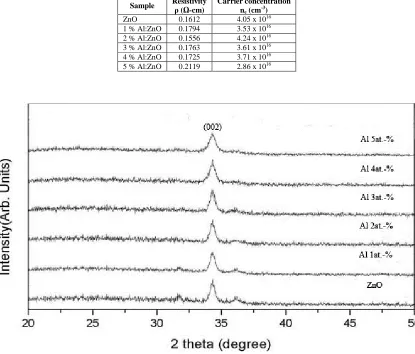
well as Al incorporation into ZnO lattice. The (002) peak appears with maximum intensity in undoped and Al-doped ZnO films indicating preferred orientation of the crystals along c-axis that is perpendicular to the substrate. The other peaks corresponding to (100), (101), (102), (110), and (103) are present with low relative intensities.
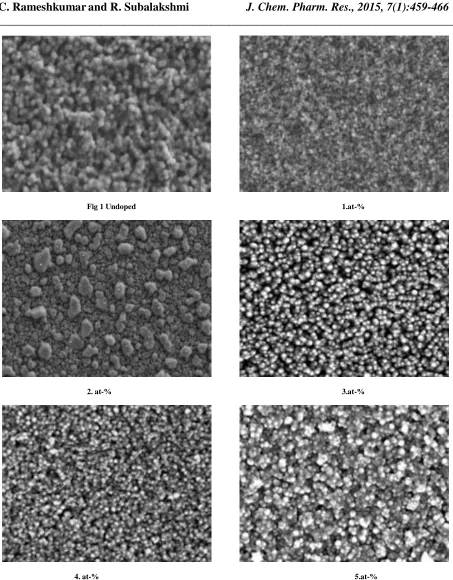
The surface morphology of ZnO thin films prepared from solution containing 0, 1, 2, 3, 4 and 5 at.% aluminum as dopant are shown in figure (2). The concentration of aluminum drastically varies the surface morphology of the film and it shows from the SEM image. Uneven surface and dense microstructure are observed in figure (2) for the undoped ZnO film.
In the 1 at.% doped film shows a porous microstructure and the spherical crystalline particle size, which is approximately 30 nm. When the doping concentration is increases to 2 at.%, particle size decreases and the film becomes denser. The surface morphology of 3 at.% doped film is similar to that of 2 at.% doped film. But when the doping level increases 4 at.% the particle size increases. The change of particle size is due to a high difference in ionic radius between zinc (0.074 nm) and aluminum (0.057 nm). . It is compared to pure ZnO thin film, the grain size in the Al-doped thin film is increases. They are well crystallized and the grain size is (e = 0.13 µm) for Al-doped ZnO and (e = 0.1 µm) for undoped ZnO. From the previous reports, grain size of the ZnO thin film also increases with the increasing annealing temperature.
Optical Properties:
The optical transmission was measured by a UV-Vis spectrophotometer. The UV-visible absorption spectra of the Al doped ZnO thin films are shown in Fig. (3) and transmittance spectra are shown in Fig. (4). The fluctuation in the spectra is principally due to the interference effect owing to the reflection at interfaces. Sharp fundamental absorption edges are observed in all the spectra corresponding to the ZnO, AZO films in the range of 0–5 at.-%. These films have a high transmittance about 90% in visible regions and a high absorption near 100% in UV regions.
A blue shift in the optical band edge was observed both in optical absorption as well as in transmittance spectra, with Al doping. As shown in Fig (4), the optical transmittance of the films initially increases with increasing Al doping up to 4-5 at.-% and transmittance increases more than 80 % in the visible region. Further increase in Al doping leads to decrease in transmittance. The improvement of transmittance and blue shift in the optical spectra of Al doped ZnO thin films may be due to the presence of Al2O3 and Zn-O-Al phases in the thin films, and/or
formation of nano-structured films due to Al doping. The decrease in transmittance of the films grown from high atomic percentage of Al may be due to the degradation in the crystallinity of the thin films.
The fundamental absorption which corresponds to the electron excitation from valance band to conduction band is usually used to determine the value of optical band gap. As direct bandgap semiconductor, ZnO has absorption co-efficient (α) obeying the following relation for high photons energies (hγ).
α(hγ) = c(hγ-Eg)1/2
Here c is constant and γ is the photon frequency. The absorption coefficient α is defined as .
I =I0exp (-αt)
Where I and I0 are intensities of transmitted and incident light respectively and t is the film thickness. Considering
interfaces related to the film and the film thickness in practical experiments, the transmittance (T) and reflectivity R of the film obey the following relation.
T = (1-R)2exp (-αt)
Thus α could be calculated from the above relation.
movement of the band gap is explained by the cause of the Burstein-Moss shift12,13, an energy band widening (blue shift) effect resulting from the increase of the Fermi level in the conduction band of degenerate semiconductors.
Electrical Properties
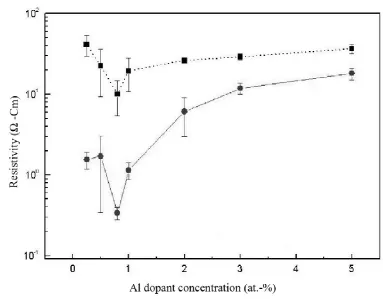
The electrical properties were investigated by Hall effect measurements. The figure (5) shows how the electrical resistivity(ρ), Hall mobility (µH) and carrier concentration (ne) of Al doped ZnO films are related to the Al content
ranging from 0 to 5 at.-%. The resistivity is about 70.7 Ω cm for the undoped ZnO film. By introduction of Al in ZnO, the electrical resistivity is greatly reduced. For example, the resistivity is about 1.45 X10⁻³Ω cm at 1 at.-% Al, and then decreases to 8.21 X 10⁻⁴Ω cm at 4 at.-% Al, which is the minimum value obtained for AZO films, six orders of magnitude lower than that of undoped samples. As the Al content is up to 5 at.-%, the film resistivity is 3.03X10⁻³ Ω cm. The resistivity of the Al doped ZnO thin film is related to the Al-doping concentration. The electrical resistivity (ρ) is proportional to the reciprocal of the product of the carrier concentration (ne) and Hall
mobility (µH).
The carrier concentration of Al doped ZnO thin film is shown in figure (6). The electron concentration of undoped ZnO film is about 3.6 X1015 cm−3, which could be enhanced drastically by the Al incorporation. As the Al content increases from 1 to 5 at.-%, the electron concentration first increases and then decreases. The electron concentration reached a maximum value of 6.2 X1020 cm−3 in 4at.-% Al. It is noted that the electron concentrations are always more than 1020 cm−3 in the 1–5 at.-% doping content range. The above behavior of electron concentration suggests that not all the Al atoms in the film contribute to donor dopants.
Sample Resistivity ρ (Ω-cm) Carrier concentration ne (cm-3)
ZnO 0.1612 4.05 x 10¹⁶
1 % Al:ZnO 0.1794 3.53 x 10¹⁶
2 % Al:ZnO 0.1556 4.24 x 10¹⁶
3 % Al:ZnO 0.1763 3.61 x 10¹⁶
4 % Al:ZnO 0.1725 3.71 x 10¹⁶
[image:4.595.91.506.345.699.2]5 % Al:ZnO 0.2119 2.86 x 10¹⁶
______________________________________________________________________________
Fig 2. Absorption spectra of the spray pyrolysis Al doped ZnO thin films
[image:5.595.94.466.424.709.2]
Fig 1 Undoped 1.at-%
2. at-% 3.at-%
4. at-% 5.at-%
______________________________________________________________________________
[image:7.595.96.479.109.408.2]Fig. 5. Resistivity of the spray pyrolysis Al-doped ZnO thin films as a function of the Al impurity concentration
CONCLUSION
Aluminium doped ZnO thin films with hexagonal wurtzite type polycrystalline structure and good optical quality have been prepared on glass substrates by spray pyrolysis in a range of Al content from 0 to 5 at.-%. The Al doped ZnO films were systematically examined for having a comprehensive knowledge of their behaviors. The growth rate of ZnO films is monotonically reduced with increasing Al content. The structural analysis confirmed the prepared films to be ZnO. From the above studies The crystalline quality of the grown thin films gets degraded as the Al doping is increased. The transmittance of the film prepared from spray solutions with Al atomic percentage up to around 5% was improved from that of undoped ZnO films. All the films exhibit high transmittance (91% - 95%) in the range of 400 nm to 800 nm, thus making the films suitable for optoelectronic devices, for instance as window layers in solar cells. The film has the strong emission band at 383 nm and also a broad emission peak centred at 550 nm visible regions.From the above results, we considered that these films are potentially attractive to be applied as transparent conductors in thin film solar cells. In addition to that the recent success in creating p-type conductivity in ZnO makes it very promising for use in ultraviolet UV and blue optoelectronic devices such as light-emitting diodes LEDs and laser diodes LDs. Al doped ZnO thin films are examined commonly as an optimal n-type layer for the hetero structure device design.
REFERENCES
[1] D. Bao, H. Gu, and A. Kunag, “Thin solid films, 1998, 312, 37-39.
[2]G. Srinivasan, N. Gopalakrishnan, Y. S. Yu, R. Kesavamoorthy, and J. Kumar, Superlattices and
Microstructures, 2008, 43, 112–119.
[3] C. J. Brinker, G. C. Frye, A. J. Hurd, and C. S. Ashley, Thin Solid Films, 1991, 201, 97–108. [4] S. Eisermann, J. Sann, A. Polity, and B. K. Meyer, Thin Solid Films, 2009, 517, 5805–5807.
[5] M. Rusop, K. Uma, T. Soga, and T. Jimbo, Materials Science and Engineering B, 2006, 127, 150–153.
[6] A. L. Mercado, C. E. Allmond, J. G. Hoekstra, and J. M. FitzGerald, Applied Physics A, vol. 81, no. 3, 2005, pp. 591–599.
[7] D. C. Look, D. C. Reynolds, C. W. Litton, R. L. Jones, D. B.Eason, and G. Cantwell, Applied Physics Letters, 2002, 81, 1830–1832.
[8] D. Perednis and L. J. Gauckler, 2005, 14, 103–111. [9] M. Krunks and E. Mellikov, 1995, 270, 33–36.
[10] O. Vigil, F. Cruz, A. Morales-Acevedo, G. Contreras-Puente, L.Vaillant, and G. Santana, Materials Chemistry
and Physics, 2001, 68, 249–252.