
STUDY OF BEHAVIOR OF SURGE ARRESTER UNDER LIGHTNING STRIKE
DZULHAIDI BIN ALI
A project report submitted in partial fulfillment of the requirement for the award of the
Degree of Master of Electrical Engineering
Faculty of Electrical and Electronics Engineering Universiti Tun Hussein Onn Malaysia
ABSTRACT
Surge arrester is one of the important component in the electrical system network either it is in a low voltage system or high voltage system. The purpose of surge arrester is generally to limit or suppress the overvoltage due to lightning phenomena or switching activities of in network. In this project, the design of model surge arrester and we simulate it using computer software named Alternative Transient Program (ATP) is most popular to study the transient time. By using this software, the behavior of surge arrester during the lightning can be identified and this behavior can be seen from this simulation. Two types of different metal oxide varistor (MOV) used in constructing this surge arrester for simulation. Each of type will be execute in two models of surge arresters which named by IEEE Model and Pincetti-Gianettoni Model. With three-tier device voltage of 50 kV, 100 kV and 200 kV with the setting 1.2 / 50 μs were injected to
vii
ABSTRAK
CONTENTS
TITLE i
DECLARATION ii
DEDICATION iv
ACKNOWLEDGEMENT v
ABSTRACT ABSTRAK
vi vii
CONTENTS viii
LIST OF TABLES xi
LIST OF FIGURES xii
LIST OF SYMBOLS AND ABBREVIATIONS xiv
CHAPTER 1 INTRODUCTION
1.1 Project Overview 1
1.2 Objectives of Project 2
1.3 Scopes of Project 2
1.4 1.5 1.6
Problem Statement Organization of Report Conclusion
2 3 4
CHAPTER 2 SURGE ARRESTER CHARACTERISTICS: A
REVIEW
2.1 History of Arrester Technology 2.1.1 Simple Rod Gap
2.1.2 Electrolytic Arrester 2.1.3 Oxide Film Arrester
2.1.4 Gapped Silicon Carbide Surge Arrester
ix
2.2 Metal Oxide Surge Arrester
2.2.1 IEEE Model of Surge Arrester 2.2.2 The Pinceti-Gianettoni Model Surge Arrester
11 12 15
2.3 Lightning on Overview 16
2.4 Model Mathematics for Surge Arrester 18 2.5 Model Construction for Surge Arrester 18
CHAPTER 3 ATP SURGE ARRESTER MODEL FOR
SIMULATION
3.1 Introduction 21
3.2
3.3
Flow Chart of Project
3.2.1 Preparation Model of Surge Arrester in ATP Software
3.2.1.1 IEEE Model Circuit in ATP Software 3.2.1.2 Pinceti-Gianettoni Model Circuit in ATP Software
3.2.2 Calculation of Parameter in the IEEE Model of Surge Arrester
3.2.3 Calculation of Parameter in the Pinceti-Gianettoni Model of Surge Arrester
3.2.4 Setting of Lightning Impulse Waveform 3.2.5 V-I Characteristic Curve for MOV 3.2.6 Simulation of the Modeling Circuit Conclusion 21 24 24 25 25 26 26 27 31 32
CHAPTER 4 RESULT, ANALYSIS AND DISCUSSION
4.1 Introduction 34
4.2 Output from Simulation Model 4.2.1 IEEE Model for MOV Type 1 4.2.2 IEEE Model for MOV Type 2
4.2.3 Pinceti-Gianettoni Model for MOV Type 1 4.2.4 Pinceti-Gianettoni for MOV Type 2
39 41 4.3 Comparisons between IEEE Model and
Pinceti-Gianettoni Model
44
4.4 Conclusion 45
CHAPTER 5 CONCLUSION AND RECOMMENDATION
5.1 Introduction 47
5.2 Conclusion 47
5.3 Recommendation 48
REFERENCES 49
xi
LIST OF TABLES
3.1 The characteristic of MOV for Type 1 28 3.2 The characteristic of MOV for Type 2 30 4.1 Summary of all simulation for Type 1 and Type 2
MOV
LIST OF FIGURES
2.1 Early power system lightning arrester 6
2.2 Horned Gapped Arrester 7
2.3 Electrolytic Arrester 8
2.4 Pellet Type Oxide Film Arrester 1915 9 2.5 First Silicon Carbide Surge Arrester 10 2.6 Schematic representation of the magnitude of
voltages and overvoltage versus duration of their appearance.
12
2.7 IEEE Model of surge arrester 13
2.8 Non-linear characteristic for A0 and A1. The voltage is in p.u. referred to the Ur8/20
13
2.9 Pinceti-Gianettoni Model for surge arrester 14 2.10 Diagram showing lightning strike 16 2.11 Standard waveform for lightning 17 2.12 Construction of Surge Arrester for Porcelain
Housing
19
3.1 Flow chart of Project 22
3.2 The blocks diagram for modeling circuit in ATP 23 3.3 IEEE Model circuit draw in ATP software 23 3.4 Pinceti-Gianettoni Model circuit draw in ATP
software
24
3.5 Circuit to identify the Lightning Impulse Waveform 25 3.6 Standard Lightning Waveform with 50 kV peak
value
26
3.7 Type 1 of MOV for V10 125 kV 29
3.8 Type 2 of MOV for V10 248 kV 30
3.9 The complete IEEE model circuit in ATP software 31 3.10 The complete Pinceti-Gianettoni Model in ATP
software
xiii
4.1 Output Waveform for peak of Input is 50 kV 34 4.2 Output waveform for peak of Input is 100 kV 34 4.3 Output waveform for peak of Input is 200 kV 35 4.4 Output waveform for peak of Input is 50 kV 36 4.5 Output waveform for peak of Input is 100 kV 37 4.6 Output waveform for peak of Input is 200 kV 38 4.7 Output waveform for peak of Input is 50 kV 38 4.8 Output waveform for peak of Input is 100 kV 39 4.9 Output waveform for peak of Input is 200 kV 40 4.10 Output waveform for peak of Input is 50 kV 41 4.11 Output waveform for peak of Input is 100 kV 42 4.12 Output waveform for peak of Input is 200 kV 42
LIST OF SYMBOLS AND ABBREVIATIONS
A - Ampere
kA - Kilo Ampere
V - Volt
kV - Kilo Volt
Vm - Maximum Voltage
Vr - Rated Voltage
Vn - Normal Voltage
F - Frequency
𝝮 - Ohm
M 𝝮 - Mega Ohm
µs - Micro Second
ms - Mili Second
µH - Micro Henry
pF - Pico Farad
p.u. - Per Unit
m - Meter
U - Voltage
I - Current
R - Resistor
L - Inductance
C - Capacitor
T - Time
Tsta - Time Start Tsto - Time Stop
m² - Meter Square
CHAPTER 1
INTRODUCTION
1.1 Project Overview
In recent years, using metal oxide (ZnO) arresters is a common and prevalent affair for transformers, capacitance banks etc protection against impulse of overvoltage. Therefore, correct and accurate investigation of ZnO arresters behavior in power networks requires correct simulation for the existing transient state software. Several papers have been presented under arresters modeling title [3, 4, 5, and 6] each has concerned different parameters in simulation process.
presented to overcome such problem inspired by this model (Kim at el., 1996; Pinceti and Giannettoni, 1999).
In this study, the residual voltage of the arrester of qualitative and quantitative aspects is under consider as well as the discharged energy value, unlike other papers just have investigated the maximum value of impulse caused residual voltage.
1.2 Objectives of this project
a) To design surge arrester model using Alternative Transient Program, ATP.
b) To study the behavior of surge arrester when lightning strike.
c) To compare the output voltage between IEEE Model and Pinceti-Gianettoni Model.
1.3 Scopes of this project
a) Simulation only under lightning condition using Alternative Transient Program, ATP.
b) Simulation only with using two type of metal oxide varistor.
1.3 Problem Statement
3
overhead distribution lines, it is not necessary that a stroke contact the line to produce overvoltage dangerous to equipment. This is so because "induced voltages" caused by the collapse of the electrostatic field with a nearby stroke may reach values as high as 300 kV.
Surge arrester is the one way to resolve overvoltage due to the lightning strike. This because the special characteristic material used in the surge arrester called metal oxide surge arrester (MOSA).
1.5 Organization of Report
This report is divided into five main chapters which will explain the structure of the project. Brief description of each chapter as follows:
Chapter 1: This chapter explains the general introduction of the metal oxide (ZnO) used as a surge arrester and the research has been previously done. This chapter also includes the objectives, scopes, and problem statement of this project.
Chapter 2: Chapter two entitle literature review gives minutely explanations of the history, types of surge arrester and modelling circuit of surge arrester. Actually nowadays studying in surge arrester is easier with due to modelling circuits and many infrastructures that are available.
Chapter 3: In this chapter, is the explanation the method for constructing this project. For simulation, this project is using of the Alternative Transients Program (ATP) where this software is most familiar in transient power analysis.
Chapter 5: This is the closing chapter of this project. In this chapter, it will cover the conclusion and recommendations that has been stated. From this recommendation, it can be use for the further studies on the surge arrester.
1.6 Conclusion
CHAPTER 2
SURGE ARRESTER CHARACTERISTICS: A REVIEW
2.1 History of Arrester Technology
The earliest roots of lightning protection of power systems dates back to the middle of the 18th century from 1890 to 1930 will be covered in this part of the history of lightning protection of power systems. During this era, lightning protection of electrical equipment divides into many subcategories, such as communications, electronics, radio towers, railroad (DC), and the one discussed herein, power systems. Protection of the telegraph gave birth to the gapped device first called an arrester. It wasn’t until the 1890’s that power lines were added to the utility poles crisscrossing the country and
immediately needed arresters that could protect them from lightning also. The fundamental difference however is that telegraph lines were not energized 100% of the time as are power lines and the designs of the pre 1890 arrester used to protect the telegraph lines just did not meet the needs of power systems.
2.1.1 Simple Rod Gap
follow current and it remained a significant challenge to the arrester designers for this entire era. They quickly learned that the only way to interrupt this power follow current once it flashed over was to turn off the AC power or insert a resistance into the circuit. The early means of inserting resistance in series with the gap was to change the size of the gap. In Figure 2.1, the arrester inventor, Sperry, ran the ground lead of the arrester through a magnetic solenoid. If the gap sparked over from lightning and was followed by power system current, it would pulse the solenoid, which in turn would allow the gap to snap open. The added distance in the gap increased the length of the arc, which is a common means of increasing the arc resistance. This increase in resistance resulted in interruption of the arc when the voltage crossed zero. It would appear that the Sperry arrester would be a maintenance issue in that it needed to be reset after a strike: something more was needed.
7
[image:17.612.174.482.256.507.2]The second method of increasing the series resistance of the gap was to use a linear resistor; however, as the system voltages increased this also became a problem. A third design that can still be seen protecting insulators today was the Horned Gapped Arrester. Figure 2.2 shows an 1896 version of this arrester type. The principal behind this type of arrester is that as the arc burns, the magnetic field pushes the arc out toward the ends of the electrodes. Since the gap size increases from the bottom to the top, the length of the arc increases, which in turn increases its resistance. This action limits the current to levels that can lead to extinguishment at voltage zero.
Figure 2.2: Horned Gapped Arrester [7]
2.1.2 Electrolytic Arrester
In 1908 the new arrester type called electrolytic arrester was introduced and was the first
design to use a nonlinear current-limiting resistance element to limit follow current and
allow arc interruption. The design of electrolytic arrester consisted of a sphere gap in
per Figure 2.3. The aluminum electrodes were formed into cells by electrolytic ally
depositing a non conducting film of aluminum hydroxide thick enough to withstand the
applied voltage.
A lightning surge would momentarily puncture the non conducting aluminum
hydroxide film. However, the follow current from the system caused the punctured hole
to heal itself by the same electrolytic mechanism used to initially coat the aluminum
electrodes. The main disadvantage of the electrolytic arrester was the electrolyte itself
caused deterioration of the film. The electrolytic arrester, therefore, had to be recharged
daily by connecting it to the power system.
[image:18.612.242.414.400.667.2]For the higher voltage systems, the chemical arrester, as it was known, had the answer to the series resistance issue. Arrester designers had learned that the perfect arrester would have a resistance in series with the gap that had non-linear characteristics. This means that at higher voltages and currents it would have lower resistance. This variable resistance made it possible for the arrester to conduct high lightning currents, and after the event it was also able to assist the gap to interrupt the follow current.
9
[image:19.612.179.478.111.374.2]2.1.3 Oxide Film Arrester
Figure 2.4: Pellet Type Oxide Film Arrester 1915 [7]
This new pellet type arrester had the excellent voltage and current characteristics of the aluminum cell arrester and then without a liquid dielectric as per shown in Figure 2.4. Also in this arrester had an additional advantage of lower cost and was better suited for line protection proportionate to electrolytic arrester. However, this type of arrester has some weakness such as it have a limited lifetime due to damage to the oxide film during each surge. This damage was not repairable as in the liquid oxide film arrester and it clearly more work was needed in the industry.
2.1.4 Gapped Silicon Carbide Surge Arrester
conductivity and comparatively low specific resistance in the silicon carbide family.” He goes on to state that “these properties greatly enhance the effectiveness, durability, stability and simplicity of surge arresters.” Thus began the long history of the Silicon
Carbide (SiC) family of arresters shown in Figure 2.5. This type of arrester remained in production into the 1990’s in the US and is still in production in other parts of the world.
[image:20.612.194.457.257.549.2]As design engineering manager of the surge arrester business at Cooper Power Systems; this author personally shut down the last US based production line of this product in 1994.
Figure 2.5: First Silicon Carbide Surge Arrester [7]
11
2.2 Metal Oxide Surge Arrester
Metal oxide surge arresters (MOSA) are widely used as protective devices against switching and lightning pulse overvoltage occur in electrical power system. Nowadays, several types of surge arresters are available such as gapped silicon carbide, gapped or non gapped metal oxide. All type of surge arrester is operating at similar manner which mean surge arrester is high impedances at normal operating voltages and become low impedances when surge conditions. An ideal arrester must conduct electric current at a certain voltage above rated voltage, hold the voltage with little change for the duration of overvoltage and substantially cease conduction at very nearly the same voltage at which conduction started. In the other word, surge arrester constitutes an indispensable aid to insulation coordination in the power electrical systems.
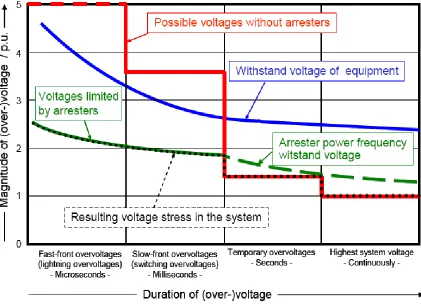
Figure 2.6 explained the magnitude of voltages and overvoltage in the electrical power system. Where the X axis (time) is divided into several section for fast-front overvoltage cause by lightning, in microsecond range, slow-front overvoltage by switching in millisecond range then temporary overvoltage and highest system voltage. The overvoltage can possible reached over the withstand voltage of equipment insulation especially for lightning overvoltage then the equipment insulation cannot withstand the occurring dielectric stresses.
Figure 2.6: Schematic representation of the magnitude of voltages and overvolatages versus duration of their appearance. [8]
The non linear characteristic (V-I characteristic) of MOSA is the important factor why it is selected in the surge arrester construction. The physical construction of metal oxide surge arresters consists of metal oxide disc inside a porcelain or polymer insulator. By adding the metal oxide disc in series mean the voltages value is also increased. For the higher energy ratings can be achieved with using larger diameter of metal oxide disc or parallel columns of disc.
2.2.1 IEEE Model of Surge Arrester
13
[image:23.612.215.485.117.244.2]filter is negligible thus A0 and A1 are essentially in parallel and characterize the static behavior of the MOSA.
Figure 2.7: IEEE model of surge arrester [1]
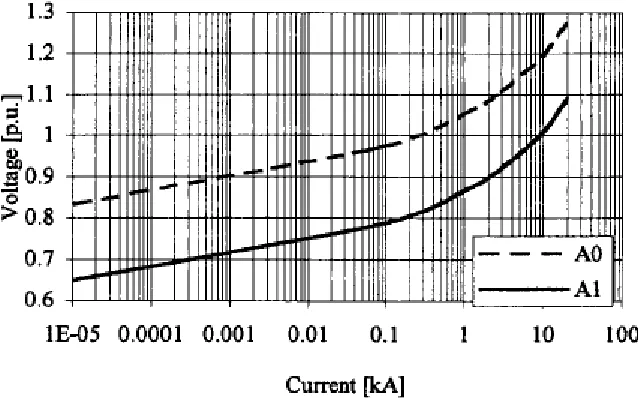
For the fast rising surge current, the impedance of the filter become more significant, indeed the inductance L1 derives more current into the non-linear branch A0. Since A0 has a higher voltage for a given current than A1, the model generates a higher voltage between input terminals, what matches the dynamic characteristics of MOSA.
Figure 2.8: Non-linear characteristic for A0 and A1. The voltage is in p.u. referred to the Ur8/20 [9]
The inductance L0 represents the inductance associated with the magnetic fields in the immediate vicinity of the arrester. The resistor R0 is used to avoid the numerical oscillations when running the model with a digital program. While the capacitor C0 represents the external capacitance associated to the height of the arrester. The values of C0, L0, R0, L1 and R1 can be determined by follow a given formulas (1) to (5) and all the components is related to the physical dimensions of the arrester. [1]
(2.1)
(2.2)
(2.3)
(2.4)
(2.5)
15
n is the number of parallel columns of MO in the arrester
The component of L1 is the most influence on the result of the arrester analysis. However the initial value of L1 is given by the physical dimensions of the surge arrester, it should be to be adjusted with try and error procedure to match the residual voltages for lightning discharge currents published in the manufacturer’s catalogue.
[image:25.612.193.466.261.375.2]2.2.2 The Pinceti-Gianettoni Model Surge Arrester
Figure 2.9: Pinceti-Gianettoni Model for surge arrester [2]
From Figure 2.9, is proposed the Pinceti-Gianettoni Model for surge arrester [2]. Actually this model is based on the IEEE Model but with some modification of eliminated the capacitance, C. This capacitance is eliminated so the effects on behavior model can be negligible. This capacitance is replaced by high resistance (about 1M𝝮) at the input terminal and the function of this resistor only to avoid the numerical troubles. The operating principle is quite similar to that of IEEE Model surge arrester.
Where the entire component is this model can be calculated following this equation: [2]
(2.7)
Uris the rated voltage.
Ur1/T2 is the residual voltage at 10kA fast front current surge (1/T2µs). The decrease time is not explicitly written because different manufactures may use different values. This
fact does not cause any trouble, since the peak value of the residual voltage appears on
the rising front of the impulse.
Ur8/T2 is the residual voltage at 10kA current surge with 8/20 µs shape. R0 is 1M𝝮 is introduced to avoid numerical instabilities.
Refer to formula (6) and (7), this Pinceti-Gianettoni Model is not depending on physical dimensions and it only depend on electrical data by given from manufacturers.
2.3 Lightning on Overview
Lightning is a physical phenomenon that occurs when the clouds acquire charge or become polarized, so that the electric fields of considerable strength are created within the cloud and between the cloud and adjacent masses such as earth and other clouds, [12]. When these fields become excessive, to the extent that the dielectric (the air) of intervening space can no longer support the electrical stress, a breakdown or lightning flash occurs; this is usually a high-current discharge. This situation can be depicted in Figure 2.10.
Also lightning is the main reason for outages in transmission and distribution lines [12]. The lightning problem is classified as a transient event. When lightning strikes a power line, it is like closing a “big switch” between a large current source and the power line circuit. The sudden closing of this “big switch” causes an abrupt change
17
[image:27.612.291.403.137.339.2]event alters the conditions of the power line circuit, as a result, produce an electrical transient. The lightning waveform can be defined in Figure 2.11.
Figure 2.10: Diagram showing lightning strike [12]
Figure 2.11: Standard waveform for lightning [12]
[image:27.612.122.533.414.549.2]close dart leaders can make as significant a contribution as return strokes in inducing voltages and currents on power systems [9].
2.4 Model Mathematics for Surge Arrester
The V-I characteristic of a surge arrester has several exponential segments, where each segment can be approximated by
(2.8)
Where q is the exponent, q is the multiplier for the segment and Vref is the arbitrary reference voltage that normalizes the equation and prevents numerical overflow during exponentiation.
The first segment can be approximated by a linear relationship to avoid numerical underflow and speed the simulation. At this first segment the resistance is should be very high since the surge arrester should have a little effect on the steady-state solution of the network. At normal steady-state operation currents of surge arrester should be less than 0.1 A. At the second segment is defined by the parameters p, q and Vmin, which is the minimum voltage for segment. The accuracy of the surge arrester model can be enhance with multiple segment are typically used since the exponent decreases as the current level increases.
2. Model Construction for Surge Arrester
Before construct model of surge arrester, the some data must be obtained from the manufacturer of surge arrester. The data is:
19
At the factory, the manufacturer is tested all single disc of metal oxide with a current pulse and record their reference voltage. A typical test pulse current has a peak 10 kA with an 8/20 µs waveform has been used during their testing. The peak voltage from result testing of this typical pulse current is called reference voltage V10, the voltage at 10 kA for a single column of surge arrester. The V-I characteristic curve of metal oxide curve is often use the value of V10 as the 1 per-unit (p.u.) value. The voltage from V-I characteristic curve can be determine with multiply the p.u. metal oxide by the V10 for that rating.
The selection of reference voltage proportional to the arrester rating V10, number of parallel columns of discs and voltage versus current (V-I) characteristic in p.u. of the reference voltage is the next step. Surge arrester V-I characteristic choose is depends upon the type of transient being simulated since current waveform with faster rise times will result in higher peak voltages. Manufacturer of surge arrester often publish several curves such as:
a) The 8/20 µs characteristic applies for typical lightning surge simulations. b) The front wave (FOW) characteristic applies for transients with current. c) The 36/90 µs characteristic applies to switching surge simulations. d) The 1 ms characteristic applies to low frequency phenomena.
For each test waveform, manufacturers may supply minimum and maximum curves. The maximum curve is generally used since it results in the highest overvoltage and the most conservative equipment insulation requirements. The minimum curves are used to determine the highest energy levels absorbed by the surge arrester.
CHAPTER 3
ATP SURGE ARRESTER MODEL FOR SIMULATION
3.1 Introduction
This chapter will explain about surge arrester model for simulation using computer program called Analysis Transient Program (ATP). Whore this program is very similar for studying in transient analysis and the result is must faster.
The entire parameters for modeling circuit either IEEE Model or Pinceti-Gianettoni Model will be identified in this chapter. All these parameters will be calculated using the formula as explained in the previous chapter.
Also this chapter will explain the differences of the input lightning waveform between 50 kV to 200 kV. So to make it simple, three different inputs lightning waveform is selected for this project which is 50 kV, 100 kV and 200 kV.
The type of metal oxide varistor or surge arrester is selected from two type of surge arrester called Type 1 and Type 2. It is to understand the effect of lightning impulse waveform when it is injected into these modeling circuits.
The entire output waveform for all simulation will be recorded for analysis and further discussion in the next chapter.
This sub chapter will explain the simulation step by step from beginning until the output waveform can be recorded. Figure 3.2 shows the flow chart of this project. This flow chart is important because of it is the standard of procedure to complete this project.
23
Figure 3.1: Flow chart of Project START
PREPARE THE MODELING CIRCUIT IN ATP SOFTWARE
CALCULATE THE PARAMETER OF R0, R1, L0, L1, C AND R
SETTING THE LIGHTNING IMPULSE WAVEFORM
IDENTIFY TYPE OF METAL OXIDE VARISTOR
SIMULATE CIRCUIT MODEL IN ATP SOFTWARE
RIGHT
RECORD THE OUTPUT WAVEFORM
END YES
3.2.1 Preparation Model of Surge Arrester in ATP Software
[image:34.612.105.573.216.297.2]This project is divided by three sections, where the first section is the Input Section, second section is the Modeling Circuit (IEEE Model or Pinceti-Gianettoni Model) and the last section is the Output Section. Figure 3.2 is shows that the blocks diagram for preparing the modeling circuit for surge arrester in the ATP software.
Figure 3.2: The blocks diagram for modeling circuit in ATP
3.2.1.1 IEEE Model Circuit in ATP Software
Figure 3.3: IEEE Model circuit draw in ATP software Input (Lightning
Impulse Waveform)
Model of Surge Arrester
[image:34.612.145.523.435.596.2]REFERENCES
[1] IEEE Working Group 3.4.11. Modeling of metal oxide surge arresters. IEEE Transactions on Power Delivery. 1992, vol. 7, iss. 1, pp. 302{309.ISSN 0885-8977. DOI: 10.1109/61.108922.
[2] PINCETI, P. and M. GIANNETTONI. A simplified model for zinc oxide surge arresters. IEEE Transactions on Power Delivery. 1999, vol. 14, iss. 2, pp. 393{398. ISSN 0885-8977. DOI: 10.1109/61.754079.
[3] Gupta, T.K., 1990. Application of Zinc Oxide Varistors. Am. Ceramic J. Soc., 73: 1817-1840.
[4] Ahmad, Z., 1994. Effect of Dry Band on Performance of UHV Surge Arrester and Leakage Current Monitoring Using New Developed Model. Proceedings of the 4th International Conference on Properties and Applications of Dielectric Materials, pp: 880-883.
[5] Daniel, W.D., 1985. Zinc-oxide Arrester Model for Fast Surges, EMTP Newsletter, 5(1).
[6] Ravinda, P.S. and T.V.P Singh, 2002. Influence of Pollution on the Performance of Metal Oxide Surge Arresters, Canadian Conference on Electrical and Computer Engineering, pp: 224-229.
[7] Jonathan J Woodworth, History of Arrester on Power Systems 1890-1930, ArrestersWorks.com 2011.
[8] Volker Hinrichsen, 2011, Metal-Oxide Surge Arresters in High Voltage Power Systems – Fundamentals, Berlin and Darmstadt.
Bonamy, P. Laroche and A. Bondiou-Clergerie, "New Insights into Lightning Processes from Triggered-Lightning Experiments in Florida and Alabama," Journal of Geophysical Research, vol. 103, no. D12, pp. 14,117-14,130, June 27, 1998.
[10] Alternative Transient Program Rule Book (ATPRB), 1997. Can/Am EMTP User Group, USA.
[11] Siemens AG Power Transmission and Distribution, www.siemens.com/arrester-download
[12] http://download.schneiderlectric.com/files?p_File_Id=303175615&p_File_Name =ECT 179.pdf
[13] Trin Saengsuwan and Wichet Thipprasert, The Lightning Arrester Modeling Using ATP-EMTP, 2008
[14] M. A. Uman, “All About Lightning”. Toronto: Dover, 1986, pp. 1-158.
[15] Alternative Transient Program Rule Book (ATPRB), 1997. Can/Am EMTP User Group,USA.
[16] M. A. Uman, “All About Lightning”. Toronto: Dover, 1986, pp. 1-158.
[17] J.P. Mackevich, "Proper Lightning Arrester Application Improves Distribution System Reliability" presented at the IIE 2nd Int. Conf. Advances in Power System Control, Operation and Management, Hong Kong, December, 1993. [18] J.A. Martinez and D.W. Durbak, Parameter Determination for Modeling
Systems Transients – Part V: Surge Arresters, IEEE Transections on Power Delivery, Vol. 20, No. 3, July 2005
[19] Pramuk Unahalekhaka, Simplified Modeling of Metal Oxide Surge Arresters, Authors. Published, 2014
[20] Shehab Abdulwadood ALI, Design of Lightning Arresters for Electrical Power Systems Protection, 2013
![Figure 2.1: Early power system lightning arrester [7]](https://thumb-us.123doks.com/thumbv2/123dok_us/8762598.894722/16.612.232.462.340.622/figure-early-power-system-lightning-arrester.webp)
![Figure 2.2: Horned Gapped Arrester [7]](https://thumb-us.123doks.com/thumbv2/123dok_us/8762598.894722/17.612.174.482.256.507/figure-horned-gapped-arrester.webp)
![Figure 2.3: Electrolytic Arrester [7]](https://thumb-us.123doks.com/thumbv2/123dok_us/8762598.894722/18.612.242.414.400.667/figure-electrolytic-arrester.webp)
![Figure 2.4: Pellet Type Oxide Film Arrester 1915 [7]](https://thumb-us.123doks.com/thumbv2/123dok_us/8762598.894722/19.612.179.478.111.374/figure-pellet-type-oxide-film-arrester.webp)
![Figure 2.5: First Silicon Carbide Surge Arrester [7]](https://thumb-us.123doks.com/thumbv2/123dok_us/8762598.894722/20.612.194.457.257.549/figure-first-silicon-carbide-surge-arrester.webp)
![Figure 2.7: IEEE model of surge arrester [1]](https://thumb-us.123doks.com/thumbv2/123dok_us/8762598.894722/23.612.215.485.117.244/figure-ieee-model-of-surge-arrester.webp)
![Figure 2.9: Pinceti-Gianettoni Model for surge arrester [2]](https://thumb-us.123doks.com/thumbv2/123dok_us/8762598.894722/25.612.193.466.261.375/figure-pinceti-gianettoni-model-for-surge-arrester.webp)
![Figure 2.11: Standard waveform for lightning [12]](https://thumb-us.123doks.com/thumbv2/123dok_us/8762598.894722/27.612.291.403.137.339/figure-standard-waveform-for-lightning.webp)
![2 Oxo 2,3 dihydro 1H imidazo[1,2 a]pyridinium iodide](data:image/gif;base64,R0lGODlhAQABAIAAAP///wAAACH5BAEAAAAALAAAAAABAAEAAAICRAEAOw==)