Journal of Chemical and Pharmaceutical Research, 2018, 10(7): 151-155
Research Article
CODEN(USA) : JCPRC5
ISSN : 0975-7384
151
Preliminary Phytochemical Investigations and Immunomodulatory Screening
of Methanolic Extract of Tecoma Stans Leaves
K Sunitha*
University College of Pharmaceutical Sciences, University College, Satavahana University, Karimnagar, Telangana, India
_____________________________________________________________________________
ABSTRACT
Traditional plants are used to treat several ailments. They are rich source of variety of phytoconstituents. In the present investigation, Tecoma stans leaves were extracted with methanol and screened for active group of chemical constituents using primary phytochemical tests. The extract showed positive results for alkaloids. The literature survey revealed that there is no detailed study of chemical constituents using analytical methods such as HPLC, I.R., and LC-MS. So, the present work is aimed to study the detailed chemistry of active principles present in the methanolic crude extract of leaves of T. stans. From LC-MS and HPLC data and previously published reports, it can be assumed that the extract possess Monoterpene alkaloids, which are responsible for immunomodulatory properties.
Keywords: Tecoma stans; HPLC; LC-MS; Methanolic extract; Monoterpene alkaloids; Immunomodulatory
_______________________________________________________________________
INTRODUCTION
In the present medicine, approximately 25% of prescription drugs come from plant extracts. Therefore, the need for extraction and isolation of phytoconstituents has achieved a great importance. Since, ancient times the plants have been used by tribes as folk medicine and traditional medicine. Based on this fact, efforts were made by many of the researchers to extract the active constituents from the plants. But, still they are not placed in a major group of prescription drugs. The study of traditional medicines, used in different parts of the world, by modern pharmacological methods is now a respected research area called ethnopharmacology.
Tecoma stans is a perennial shrub belonging to the family Bignoniaceae, commonly known as yellow trumpet bush, yellow bells, yellow elder. It has sharply toothed, lance-shaped green leaves and bears large, showy, bright golden yellow trumpet-shaped flowers. The chemical constituents reported are monoterpene alkaloids [1-4].
A new phenyl ethanoid, 2-(3, 4-dihydroxy phenyl) ethyl-2-O- [6-deoxy-alpha-L-manno pyranosyl- 4-(3, 4 dihydroxy phenyl) -2-propenoate]-beta-D-glucopyranoside, and a novel monoterpene alkaloid, 5-hydroxy-skytanthine hydrochloride, along with eleven known compounds in the fruits and flowers was established in Tecoma stans [5].
The past reported pharmacological activities are anti-diabetic, antioxidant, antifungal, antimicrobial [6-8].
MATERIALS AND METHODS
Selection and Procurement of Plants
The leaves of Tecoma stans were collected from the surroundings of University College of Pharmaceutical Sciences, Satavahana University, Karimnagar, Telangana, India. The plant parts were authenticated and deposited at the college herbarium.
Preparation of Crude Extracts
152
The air dried leaves of Tecoma stans (2.0 kg) were extracted with 2.5 litres methanol by maceration extraction for seven days. The extracts were concentrated in desiccators.
Chemicals
Chemicals and reagents used in the study were obtained from the following sources.
• Acids, bases, solvents and salts used for the investigation were of analytical grade and were obtained from Rankem Laboratories, Haryana, Merck Company and S.D. Fine chemicals Mumbai and Finar, Ahmadabad, India.
Detection of Phytoconstituents
The extract was tested for phytoconstituents by preliminary tests, separated the constituents by HPLC and identified molecular weight by LC-MS.
Screening of Immunomodulatory Activity Methods
Carbon clearance test
Humoral antibody titre
Delayed type hypersensitivity
METHOD OF EVALUATION Detection of Phytoconstituents i. Test for Carbohydrates ii. Test for Tannins iii. Test for Flavonoids iv. Test for Alkaloids
v. Test for Anthocyanin and Betacyanin vi. Test for Glycosides
vii. Test for Proteins
viii. Test for Steroids and Phytosterols ix. Test for Phenols
Chromatography
a. Thin-layer chromatography (TLC)
Thin-layer chromatography (TLC) is the simplest and cheapest method of detecting plant constituents because the method is easy to run, reproducible and requires little equipment10.
b. Preparative high performance liquid chromatography
For efficient separation of metabolites, good selectivity and sensitivity of detection, together with the capability of providing on-line structural information, hyphenated high performance liquid chromatographic (HPLC) technique11.
HPLC conditions
Column: Hypersil BDS-C18 (150X4.6mm, 5μ) Mobile phase: A: 0.1% TFA in Water (50%) B: 0.1% TFA in ACN (50%)
Flow rate: 1.0ml/min Column temp: 35°C Run time: 40Min Programme (Isocratic) Diluent: MeOH
Sample Preparation: 1.0mg/mL in diluent Vail#: 39
Injection Volume: 10 uL
b. Liquid Chromatography-Mass Spectroscopy (LC-MS) Method: D:\Methods\General-5.lcm
Method Parameters: Column: Hypersil BD S C-18 150 X 4.6 mm, 5 μm
Mobile Phase: A: Acetonitrile
Mobile Phase: B: 5mM Ammonium acetate in water Gradient Time:-0.01 10.0 30.0
153 Sample Preparation: in MeOH: ACN: Water
Filtered sample was used
Screening of immunomodulatory activity Carbon clearance test
The four groups of Swiss albino mice were administered drug for 5 days orally. After 48h of the last dose of the drug, mice were injected with 0.1mlIndian ink via the tail vein. Blood samples were withdrawn at 0min and 15min. A 50μL blood sample was mixed with 4ml, 0.1% Sodium carbonate solution and the absorbance of this solution was determined at 660nm. The phagocytic index K was calculated using the following equation:
K=(Log OD1-Log OD2/15
Where OD1 and OD2 are the optical densities at 0 and 15min respectively. Humoral antibody titre
The antibody titre is a test that detects the presence and measures the amount of antibodies within serum sample. The animals were immunized by injecting 0.1ml of SRBCs suspension, containing 1×10⁸ cells, intraperitoneal on day 0. Blood samples were collected in micro centrifuge tubes from individual animals of all the groups by retro orbital vein puncture on day 7. The blood samples ewer centrifuged and the serum separated. Antibody levels were determined by the Haemagglutinating technique.
Delayed type hypersensitivity
The animals were immunized by injecting 0.1ml of SRBCs suspension, containing 1×10⁸ cells, intraperitoneal on day 0. On day 7, after immunization the thickness of the right hind footpad was measured using a Vernier calliper. The rats were then challenged by injection 1108 sub SRBCs in the left hind footpad. The footpad thickness was measured again after 24h of challenge. The difference between the pre- and post-challenge footpad thickness, expressed in mm was taken as a measure of DTH response 9.
(Left footpad challenged with antigen- Right footpad control) ×100 Left footpad challenged with antigen
RESULT AND DISCUSSION
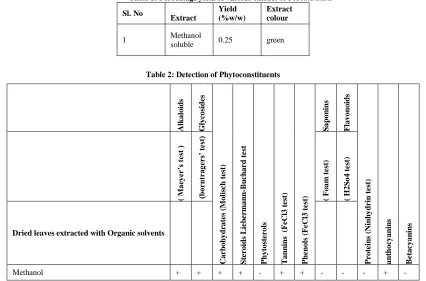
[image:3.612.93.519.425.706.2]Tecoma stans leaves were extracted with methanol and screened for active group of chemical constituents using primary phytochemical tests. The extract showed positive results for alkaloids (Table 1-2).
Table 1: Percentage yield of various extract of Tecoma stans
Sl. No Extract Yield (%w/w) Extract colour
1 Methanol
soluble 0.25 green
Table 2: Detection of Phytoconstituents
A lk a lo id s Gl y co si d es C a rb o h y d ra te s (M o li sc h t est ) S te ro id s L ie b er ma n n -B u ch a rd t est Phy to st er o ls T a n n in s (F eC l3 t est ) Pheno ls (F eC l3 t est ) S a p o n in s Fl a v o n o id s Pr o te in s (N in h y d ri n t est ) a n th o cy a n in s B et a cy a n in s ( M ae ye r’ s test ) ( bo rn tr ag er s’ t est ) ( Fo a m t est ) ( H2 S o 4 t est )
Dried leaves extracted with Organic solvents
Methanol + + + + - + + - - - + -
154 Thin-layer chromatography (TLC)
TLC analysis
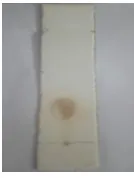
[image:4.612.272.339.140.229.2]• Toluene: Ethyl acetate: Diethyl amine was used in the ratio of 7:2:1, two spots were on TLC(Figure 1).
Figure 1. Antibacterail activities
HPLC analysis
Results of HPLC analysis of Tecoma stans methanolic crude extract of leaves, at 330 nm, shows presence of active constituents as evidenced by the chromatogram obtained at retention time 1.354, 1.511,1.773, 1.943, 23.586 with corresponding retention area 935207, 464057, 883718, 926288, 3688.
LCMS analysis
HPLC coupled with different detection methods e.g. UV, MS provided a preliminary information about the content and nature of constituents found in the active extracts i.e., Monoterpene alkaloids.
By selective ion monitoring in LC/MS or even LC/MSMS, it is possible to achieve the detection of specific target molecules - those, for example, which have already been found to exhibit a particular activity. The recent introduction of other hyphenated techniques such as LC/NMR will render the on-line structure determination of metabolites even more accurate and rapid12.
Screening of immunomodulatory activity
The animals were screened using the haemagglutinating antibody titre to assess humoral immune response and Carbon clearance test to assess scavenging activity. The animals were also evaluated for delayed type hypersensitivity by the difference between the pre and post challenge footpad thickness. They have shown significant immunostimulant properties i.e., immunodulatory activity for all the methods used. The data were analyzed using statistical methods and compared to that of the standard drug, obtained values at a dose of 200mg/kg body weight.
CONCLUSION
The HPLC and LC-MS of the methanolic crude extract of Tecoma stans leaves showed the presence of active constituents i.e., Monoterpene alkaloids. Based on the past literature survey and present study results, it can be assumed that the extract possess Monoterpene alkaloids, which are responsible for stimulant properties. So it has been concluded that the extract of Tecoma stans could be used as a drug to strengthen immunity to fight against various infections.
REFERENCES
[1] Hammouda Y et al., Isolation of Tecostanine: Alkaloids of Tecoma stans Juss., Journal of Medicinal Plants Studies, Annales de Pharmacologic Francaise, 1963, 21, 699-702.
[2] Jones G et al., Stereochemistry and absolute configuration of tecomanine and alkaloid C, an oxygenated skytanthine, two monoterpene alkaloids from Tecoma stans, Journal of the Chemical Society D, 1971, 7, 994-996.
[3] AP Lins et al., Monoterpene alkaloids from Tecoma stans, Phytochemistry, 1993, 34(3), 876-878.
155
[5] Mohamed M et al., Anti-proliferative and antioxidant constituents from Tecoma stans, Z. Naturforsch. 2006, 61, 783-91.
[6] Simpore J et al., Antibacterial activity of alkaloids from Sida acuta. African Journal of Biotechnology, 2006, 5, 195-200.
[7] S Raju et al., Journal of Pharmaceutical and Biomedical Sciences, Tecoma stans (L.) Juss. ex Kunth (Bignoniaceae): Ethnobotany, Phytochemistry and Pharmacology, 2011, 8(7), 1-5
[8] Govindappa M et al., Antimicrobial, Antioxidant activity And Phytochemical screening of Tecoma stans (L.) Juss. Ex kunth, Journal of Phytology, 2011, 3(3), 68-76
[9] Makare N, et al., Immunomodulatory activity of alcoholic extract of Mangifera indica L. in mice, Journal of Ethnopharmacology, 2001, 78(2-3), 133-137
a. Marston, M. Maillard and K. Hostettmann, The role of TLC in the investigations of medicinal plants of Africa, South America and other tropical regions, GIT Laboratory Journal, 1997, 1, 36-39
[10] K. Hostettmann, J-L. Wolfender and S. Rodriguez, Rapid detection and subsequent isolation of bioactive constituents of crude plant extracts, Planta Medica, 1997, 63(1), 2-10