Journal of Chemical and Pharmaceutical Research, 2019, 11(8):80-86
Research Article
CODEN(USA): JCPRC5
ISSN: 0975-7384
80
Labeling and Content Evaluation of Libyan-Made Pharmaceutical
Preparations
Abdussalam AM Amara
*and Nosaiba A Elnatouh
Department of Pharmaceutics, Faculty of Pharmacy, University of Tripoli, Tripoli, Libya
______________________________________________________________________
ABSTRACT
Local-made Pharmaceutical Preparations are products that are marketed throughout the Libyan pharmacies in
Libya. The aim of the present work is to evaluate labeling information and conducting assays to confirm the content
claimed in the labeling. Salicylic acid ointment 10%, salicylic acid ointment 30%, zinc sulphate syrup BP, zinc oxide
ointment, silver nitrate solution 10%, potassium permanganate solution were the products selected randomly for
this study. The results reveal that labeling of such preparation, in general, is a disaster. There is no concern by
formulators towards applying good labeling of prescribed medicines. It is the pharmacist’s responsibility to ensure
that labeling is accurate and according to the standard requirements. The assay studies show that the contents of 4
out of 6 (66.7%) of randomly selected preparations are not conformed of what claimed on the label. This arise a big
question about such preparations in terms of their therapeutic benefits to patients. In conclusion, involvement of the
state quality control is the most important step for more effective and safe Libyan-made pharmaceutical
preparations.
Keywords: Libyan-made pharmaceutical preparations; Labeling studies; Content evaluation; Libya
_____________________________________________________________________________
INTRODUCTION
81
Libya. The manufacturing of Libyan-made preparations goes back to nearly early fifties. The central hospital of Tripoli and pharmacies at other hospitals in the country were doing their drug formulations nearly of all their requirements. When the pharmaceutical industry started to export to Libya, the idea of local preparation was abundant. However, the manufacturing of some of such formulations was carried out to meet the need of some departments, e.g. dermatology department. The pharmacy laboratory of the central hospital use to prepare few items for meeting the demand of the operating theatre as well as the skin department (e.g. Eusol, Tincture iodine, Chlorohexedine in spirit). At Tripoli city, a small unit was founded to cater for the need of the clinics and sub-clinics, including simple external solutions (e.g. gentian violet, mercurochrome, tincture of iodine), some ointments (e.g. kerrolitic, rubificient) and cough syrups. Similar preparations were done in other hospitals at Benghazi and other large cities. These units were closed down when the National Pharmaceutical Industry Co. took over. At mid-nineties, some private manufacturers started to prepare such drug formulations. The Libyan-made topical drug preparations are available on-sale at private pharmacies and prescribed to patients by physicians. The objective of this work is to evaluate the medical assessments of such preparations including label information and conducting assays to confirm the content claimed in the labeling.
MATERIALS AND METHODS
From a survey at pharmacies in Tripoli-Libya, salicylic acid ointment 10%, salicylic acid ointment 30%, zink sulphate syrup, zink oxide ointment, silver nitrate solution 10% and potassium permanganate were selected randomly for label and content analysis studies.
1. Labeling studies: Label information of these preparations were read carefully and checked against the standard labeling of prescribed medicines. Remarks and errors were recorded.
2. Content analysis: The following assay methods were carried out:
Salicylic Acid ointment, 10 and 30%, (BP): 2 g of ointment was dissolved in a mixture of 20 ml of ethanol previously neutralized to phenol red solution and 20 ml of ether (96%). Titration was done with 0.1 M of sodium hydroxide solution using phenol red as indicator, and end-point is recorded (n=3). Each ml of 0.1 M of sodium hydroxide solution is equivalent to 0.01381 g of salicylic acid.
82
Silver Nitrate solution 10%(BP): 5 ml of solution was accurately measured and placed in a conical flask and it was diluted with 20 ml of water. 1 ml of nitric acid and 1 ml of ferric ammonium sulphate were added. This were titrated with 0.02 N ammonium thiocyanate and end-point is recorded (n=3). Each ml of 0.02 N of ammonium thiocyanate is equivalent to 3.397 mg of silver nitrate. Potassium Permanganate solution (International Pharmacopeia): Method of standardization: 0.2 g accurately weighed of sodium oxalate previously dried to constant weight at 110 oC was dissolved in 250 ml of water. A 7 ml of sulfuric acid was added and heated to about 70 oC, and then slowly permanganate solution was added with constant stirring until a pink color is produced. Temperature during the titration was 60°C. End-point is recorded (n=3). Every 6.7 mg of sodium oxalate is equivalent to 1 ml of potassium permanganate solution.
RESULTS AND DISCUSSION
[image:3.612.162.453.434.624.2]Labeling studies: The term "Labeling" refers to all labels and other printed matter affixed to the medicine product container and any package insert. The purpose is to describe medicine and identifies it, contributes to optimal therapeutic outcome, to avoid medication errors, ensuring that patients have clear, legible and concise information, achieves appropriate handling and storage, and allows to trace the product if there are problems with manufacturing, prescribing, or dispensing process. Good labeling of prescribed medicine should include product name, generic name, dosage form, strength, route of administration, total quantity in the package, intended use (warning and direction of use, if necessary), batch number, manufacturing and expiry dates, any special instructions for use, storage, warnings and/or precautions. The preparation of salicylic acid ointment 10% is a standard one and its formula is published in the pharmacopeia. Such preparation should not be given a trade name and should be written as (Salicylic acid), so the printed name (saicylico) on the label is not appropriate (Figure 1).
Figure 1. Labeling information of salicylic acid ointment 10%
83
Figure 2. Composition (A) and ointment color (B) labeling information of salicylic acid ointment 10%
Moreover, salicylic acid is available in varying concentrations or dosage forms and, depending on the intended use, the appropriate statement should be written on the label. The statement written is a general one (Dermatological preparation with Multivalent action). It should be specific according to the exact purpose for use of the preparation. Other remarks include no dosage form mentioned on the label, the expiry date is written (after 3 years from date of manufacturing), but such formulations should be prepared freshly and can be used, usually, within 2 weeks, the BP formula contains wool alcohol which consists of: 60 g acetylated lanolin alcohol, 240 g hard paraffin, 100 g white soft paraffin/yellow soft paraffin, and 100 g liquid paraffin, in this preparation, only liquid paraffin and yellow soft paraffin /white soft paraffin is used, and finally, BP official formula does not exceed 2%. The same remarks were reported for salicylic acid 30%. The concentration 30% and dosage form is ointment; it is not BP and not an official preparation (Figure 3). Labeling of the product zink sulphate syrup (Figure 4) does not show composition, contents of all ingredients, and indication and uses.
[image:4.612.154.454.470.686.2]84
[image:5.612.170.440.331.655.2]Figure 4. Labeling information of zink sulphate syrup
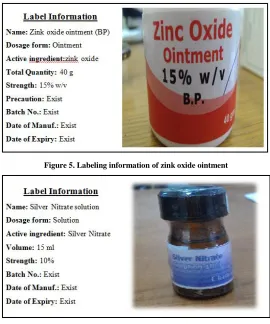
Figure 5 shows the label of Zink Oxide ointment. It was noticed that no indication and uses, no written composition, no possible side effect (it contain cetostostearyl alcohol, may cause local reaction), and no precaution. For silver nitrate solution 10% (Figure 6), no indication and uses (10% is used for local treatment of infected ulcers of the mouth according to USP), but no applicator or brush is exist. There is no precaution, no (for external use only) is written, and no reference (BP, USP, EP).
Figure 5. Labeling information of zink oxide ointment
Figure 6. Labeling information of silver nitrate solution 10%
[image:5.612.173.439.337.488.2]85
[image:6.612.160.451.175.314.2]the strength is (BP 0.2%) which means 200 mg to100 ml so, 1000 mg to 500 ml, therefore, (1 g/500 ml) is the correct strength. The strength as it is written is much diluted. Moreover, the label says (dilute 25 ml in 250 ml of water) which means more dilution. Other remarks are: No caution is written (e.g. stain skin, hair and fabric). The expired date written is after 4 years, but this preparation should be prepared freshly and used within 2 weeks. Uses: it is written as (local antiseptic for fungi infection), but the solution is much diluted, so it may be used as vaginal douche.
Figure 7: Labeling information of Potassium Permanganate
Content Evaluation Studies:
The content evaluation studies are shown in Table 1. From the results of this analysis, out of six the contents (active ingredients) of four preparations are not compatible with what was claimed on the labeling. Namely: salicylic Acid ointment 10%, salicylic Acid ointment 30%, zinksulphate syrup, and potassium permanganate solution. Silver nitrate solution 10% is found compatible with what was claimed on the labeling, but the labeling says the bottle have 15 ml and when measured it was only 9.4 ml. (it might be with this tested bottle only). Although zink oxide ointment is conformed for use, but the content on labeling (15%) which is less than the assay results (19%).
Table 1. Active ingredient assay results
Product Pharmacopeia Limits Labeled
amount
Assay
Result Remark
Salicylic Acid ointment 10% 95 to 105% of the stated amount 10% 38.70% Not conform
Salicylic Acid ointment 30% 95 to 105% of the stated amount 30% 62.40% Not conform
Zinc Sulfate Syrup 90-110% of the labeled amount 50 mg 76% Not conform
Silver Nitrate solution 10% 90 to 110% of the stated amount 10% 99.80% Conform
Zinc Oxide Ointment 18.5 to 21.5 % of ZnO in the
preparation 15% 19% Conform
Potassium Permanganate
solution 99.0 to 100.5% of the labeled amount 5.5972222 94%
[image:6.612.76.536.465.715.2]86
CONCLUSION
This study reveals that Labeling of the Libyan-made pharmaceutical preparations, in general, is a disaster. There is no concern by formulators towards applying good labeling of prescribed medicines. It is the pharmacist’s responsibility to ensure that labeling is accurate and according to the standard requirements. The results of the assay studies show that the contents of 4 out of 6 (66.7%) of randomly selected preparations are not conformed of what claimed on the label. This arise a big question about such preparations in terms of their therapeutic benefits to patients. This study concludes that the involvement of the state quality control is the most important step for more effective and safe local-made preparations.
References
1. M Veronin. J Med Internet Res.2011, 13 (1), 22.
2. P Bakker; H Woerdenbag; V Gooskens; B Naafs; R Kaaij; N Wieringa. Dermatological Preparations for the Tropics,
2nd revised edition, Beta Science Shop, University of Groningen, The Netherlands, 2012. 3. EK Kastrup; JR Boyd. Drug; Facts and comparisons (Lippincott, ed.), New York, 1983, 1643.
4. Local Production for Access to Medical Products: Developing a Framework to Improve Public Health (Policy brief),
2011
5. AA Mustafa; SR Kowalski. Libyan J Med. 2010, 5(1), 5440.
6. KV Assche; AN Giralt; JM Caudron; B Schiavetti; C Pouget; A Tsoumanis; B Meessen; R Ravinetto. BMJ Glob Health. 2018, 3(3), 771.
7. WHO Expert Committee on Specifications for Pharmaceutical Preparations, fifty-second report (WHO Technical
Report Series, No. 1010,
8. A Mills. N Engl J Med, 2014, 7, 370-552.