HelmholtzManakov solitons
Christian, JM, McDonald, GS and ChamorroPosada, P
http://dx.doi.org/10.1103/PhysRevE.74.066612
Title HelmholtzManakov solitons
Authors Christian, JM, McDonald, GS and ChamorroPosada, P
Type Article
URL This version is available at: http://usir.salford.ac.uk/id/eprint/298/ Published Date 2006
USIR is a digital collection of the research output of the University of Salford. Where copyright permits, full text material held in the repository is made freely available online and can be read, downloaded and copied for noncommercial private study or research purposes. Please check the manuscript for any further copyright restrictions.
Helmholtz-Manakov solitons
J. M. Christian, G. S. McDonald and P. Chamorro-Posada †
Joule Physics Laboratory, School of Computing, Science and Engineering,
Institute for Materials Research, University of Salford, Salford M5 4WT, U.K.
†Departmento de Teoría de la Señal y Comunicaciones e Ingeniería Telemática,
Universidad de Valladolid, ETSI Telecomunicación, Campus Miguel Delibes s/n,
47011 Valladolid, Spain.
Accepted in Physical Review E, 21st September 2006
ABSTRACT
A novel spatial soliton-bearing wave equation is introduced, the Helmholtz-Manakov
(H-M) equation, for describing the evolution of broad multi-component self-trapped
beams in Kerr-type media. By omitting the slowly-varying envelope approximation,
the H-M equation can describe accurately vector solitons propagating and interacting
at arbitrarily large angles with respect to the reference direction. The H-M equation
is solved using Hirota’s method, yielding four new classes of Helmholtz soliton that
are vector generalizations of their scalar counterparts. General and particular forms
of the three invariants of the H-M system are also reported.
PACS numbers: 42.65.Tg (optical solitons), 42.79.Ta (optical computers),
I. INTRODUCTION
Vector solitons are well known in Optics [1,2]. They are multi-component,
localized structures that can become dominant modes of a system when linear
broad-ening effects are offset by non-linearity. During pulse propagation, on the one hand,
vector solitons can arise when dispersion is balanced by self- and cross-phase
modula-tion. Spatial soliton beams, on the other, can result if diffractive spreading is opposed
by medium self- and mutual-focusing. Many years ago, Manakov [3] proposed a
vec-tor extension of the scalar Non-Linear Schrödinger (NLS) equation [4] to describe
multi-component pulse/beam evolution in the presence of positive Kerr non-linearity.
Using inverse-scattering theory, he was able to derive an exact analytical
2-component sech-type soliton solution.
In birefringent optical fibres, vector solitons play a central role in describing
polarization-division multiplexing (PDM) configurations, where light coupled into the
fibre is polarized along two transverse orthogonal axes [5]. Over sufficiently long
distances, birefringence can average out stochastically to zero, and the model
captur-ing evolution is the (temporal) Manakov equation [6]. In spatial contexts,
multi-component solutions for a defocusing (negative) Kerr non-linearity have been
re-ported [7]. These new solutions have a more complicated (topological) structure than
their more familiar sech-type counterparts in the focusing regime [3]. Manakov-like
solitons, comprising two orthogonal transverse field components, have been observed
in birefringent Kerr-type planar waveguides [8]. Multi-component spatial solitons in
( )2
χ [9] and χ( )3 -like [10] photorefractive media have also received attention, and
new types of structures such as multi-hump [11] and holographic [12] solitons have
Recently, it has been shown that collisions between Manakov solitons are
ine-lastic, and that there is a redistribution of energy between the interacting components
[13]. Such an intrinsic effect has no analogue in scalar (i.e. NLS) theory, where the
energy and momentum of each constituent soliton is preserved [4]. It has been
sug-gested [14] that this unique property of the Manakov system could provide the basis
for optical computing with solitons [15]. The energy-exchange process was found to
depend critically upon the angle between the interacting beams. It is therefore
desir-able to have a model capdesir-able of capturing arbitrary angles.
The main interest in this Article lies with the oblique propagation of
multi-component spatial solitons in Kerr planar waveguides. In this geometry, there is a
longitudinal (reference) and a single effective transverse dimension that, in uniform
media, are physically equivalent. We propose the novel Helmholtz-Manakov
equa-tion as a 2-component generalizaequa-tion of the scalar Non-Linear Helmholtz (NLH)
equation [16]. This model is appropriate for capturing the propagation [17] and
inter-action [18] of broad vector-soliton beams at arbitrary angles with respect to the
refer-ence direction. Here, we present four new families of exact analytical soliton solution
to the H-M equation, and derive the corresponding conservation laws.
II. HELMHOLTZ NON-PARAXIALITY
The NLH and H-M equations provide a full description of oblique (off-axis)
evolution for broad optical beams of moderate intensity [16-18]. Under these
condi-tions, the polarization-scrambling term in Maxwell’s equations can be neglected
[19-21] and this leads to two important simplifications: (i) in uniform media, the
(ii) the electric field may be regarded as being purely transverse (we can ignore the
longitudinal component). For NLH solitons, one typically considers a TE mode
po-larized in the plane of the waveguide [18]. For vector solitons, the electric field can
have two orthogonal polarization components [3]. In this particular context, the H-M
equation is a valid model when birefrigence can be neglected [22]. Alternatively, the
H-M model can describe the interplay between two incoherently-coupled fields
shar-ing the same polarization state where, typically, both are TE modes [18]. This latter
consideration could be extended to the case of N components [23].
The oblique evolution of broad beams context defines the Helmholtz
non-paraxial scenario [16-18], which is physically and mathematically distinct from the
narrow-beam regime considered by other authors. Perturbative narrow-beam
correc-tions to the governing equation [19-21,24], derived from single-parameter
order-of-magnitude analyses of Maxwell’s equations, are both unnecessary (we consider only
broad beams) and invalid (off-axis effects are not quantified solely by a single small
parameter) in Helmholtz non-paraxality. The accurate description of
obliquely-propagating and interacting beams, relative to the reference direction, requires one to
respect the equivalence of the transverse and longitudinal dimensions in uniform
me-dia. This is achieved by avoiding the slowly-varying envelope approximation
(SVEA); NLH and H-M models then arise as natural governing equations [17,18].
In a normalized form, the H-M equation is given by
( )
2 2
†
2 2
1 2 i
κ
ζ
ζ ξ
∂ + ∂ + ∂ ± =
∂
∂ ∂
U U U
where the sign flags a focusing (+) or a defocusing (–) Kerr non-linearity. ±
0 2x w
ξ = and ζ =z LD
0 w
are the scaled transverse and longitudinal coordinates,
normalized to the waist and diffraction length 2 0 2
D
L =kw of a reference
Gaus-sian beam, respectively. The column vector is the dimensionless electric field in U
( )
x z, =E0( )
x z, exp(
ikz)
E U , where k=2πn0 λ, λ is the optical wavelength, is
the linear refractive index at the optical frequency,
0 n
(
)
1 20 0 2 D
E = n k n L and is the
Kerr coefficient.
2
n
(
) (
2)
1
= =
]
2 2 2
0 λ w0 4π n0
kw
κ is the inverse beam-width
parame-ter. In the case of two field components, one has that U , where T denotes
the transpose, and is the Hermitian adjoint of U. A further generalization to N
components then involves including further entries in .
[
A B, T =†
U
U
The restoration of spatial symmetry in the governing equation [17] leads to
several novel features absent from paraxial theory. Firstly, there is no physical
dis-tinction between transverse (x) and longitudinal (z) coordinates and light is allowed to
diffract in both these dimensions. Secondly, inclusion of κ∂ζζ leads to a dispersion
relation that supports both travelling- and standing-wave solutions [18]. This is in
contrast to the NLS [4] and Manakov [3] equations, where the SVEA breaks the
symmetry between not only x and z, but also between +z and –z, (backward-travelling
waves are not supported). Thus, paraxial wave equations are subjected to the physical
limitation of describing beams that are either axial or very nearly axial.
The inherent bi-directionality of NLH-based models leads to angular beam
same beam from different frames of reference, and is a requirement based on
geome-try [16]. The Helmholtz non-paraxial formalism also allows for a well-defined
con-nection between the soliton velocity V in the
(
ξ ζ,)
frame and the propagation angleθ (relative to the z axis) in the unscaled
( )
x z, frame through [16-18]tanθ = 2κV. (2)
Equation (2) verifies that the (purely geometrical) Helmholtz correction may
assume an arbitrarily large value, even for beams with
2 2κV
0
κ . During off-axis
evolu-tion, one can have a regime where 2κV2 ~O
( )
, while simultaneously respectingbecause the beam is always broad. This possibility demonstrates that
de-scriptions based solely upon -type expansions of Maxwell’s equations are
inappro-priate for capturing the angular type of non-paraxiality [19-21,24]. Indeed, the
domi-nant Helmholtz correction to paraxial theory, embodied in Eq. (2), is determined
solely by the beam’s propagation angle and can be of any order irrespective of the size
of .
1
( )
1 Oκ
κ
κ
III. HELMHOLTZ-MANAKOV SOLITONS
A. Solitons in self-focusing Kerr media
For a focusing Kerr medium, the simplest case to consider is that of a vector
beam with two forward-propagating constituent components, each with a symmetric
sech-type profile. The most straightforward method of obtaining such solutions is to
use an ansatz approach to seek the on-axis solution, and then apply a rotational
trans-formation [25] to seek the more general off-axis beam. The resulting bright-bright
(
)
(
)
2
2 2
1 2
, sech exp exp ,
2 2 1 2 1 2 V i V V V
η ξ ζ
i
κη ζ
ξ ζ η ξ ζ
κ κ κ κ + + = − + + +
U C −
(3a)
where,
( )
( )
1 2 cos sin i i e e δ δ α α = C . (3b)
C is a complex column vector obeying C C† =1, while η defines the amplitude and
the transverse velocity. The free parameter
V α determines the strength of the
exci-tation in each component, and δj ( j=1, 2) are the component phases. The choice of
values of α and the δj’s allows a wide variety of soliton states to be constructed.
The second class of vector beam that a focusing Kerr medium can support is
the bright-dark soliton, for which the forward-propagating solution is
(
)
(
)
(
)
2 2 2
0 2
2 2
2
, cos sech
1 2
1 2 2
exp exp ,
1 2 2 2
a W
A B a
W
a
i W
W
ξ ζ
ξ ζ φ
κ
κ χ ζ ζ
ξ i
κ κ κ
+ = + + + + × − + + − (4a)
(
)
0(
2)
2 2
, cos tanh sin
1 2
1 4
exp exp ,
1 2 2 2
a W
B B i
W
i V i
V
ξ ζ
ξ ζ φ φ
κ
κχ ξ ζ ζ
κ κ κ
+ = + + + × − + + − (4b)
This structure comprises a Helmholtz bright soliton [25] in one component, and a
dark-type topological excitation in the other. The tanh component (4b) is generally
grey, and has an intrinsic velocity,
(
)
0 2 2 2
tan
1 2 2 tan
a V
a
φ
κ χ φ
=
This velocity depends upon both the non-paraxial parameter κ and the plane-wave
background intensity χ2 ≡B02. When , the dark component is null and one
recovers the Helmholtz Kerr scalar bright soliton [25]. The net velocity W of the
vec-tor beam (4) is then given by
0 0 B → 0 0 1 2 V V VV κ
W = −
+ . (6)
As in the case of the scalar Helmholtz dark soliton [26], W has the physical
interpreta-tion of velocity summainterpreta-tion in the unscaled reference frame.
B. Solitons in defocusing Kerr media
When seeking a general dark soliton of the defocusing NLH equation [26], an
ansatz approach cannot determine the full solution (geometrical considerations also
have be to made). Similar difficulties arise in the vector case. Thus, Hirota’s method
[27] has been used to solve the defocusing H-M equation. The forward-propagating
dark-bright vector soliton solution is given by
(
)
0(
2)
2 2
, cos tanh sin
1 2
1 4
exp exp ,
2 2
1 2
a W
A A i
W
i V
W
ξ ζ
ξ ζ φ φ
κ
κχ ξ ζ ζ
i κ κ κ + = + + − × − + + − (7a)
(
)
(
)
(
)
2 2 2
0 2
2 2
2
, cos sech
1 2
1 2 2
exp exp .
1 2 2 2
a W
B A a
W a
i W
W
ξ ζ
ξ ζ φ
κ
κ χ
i
ζ ζ
ξ
κ κ κ
+ = − + + − × − + + − (7b)
The grey component (7a) has an intrinsic velocity
(
)
0 1 2
2 2 2
tan
1 2 2 tan
a
a
V φ
κ χ φ
=
− +
where , and the net velocity W is given by Eq. (6). The dark-bright soliton is
constrained by the condition . When the equality is satisfied, the bright
component vanishes and the remaining component (i.e., the primary component)
re-covers an exact non-paraxial dark soliton [26]. 2
0 A
χ≡
2 2
0 cos
A φ ≥a2
The bright-dark and dark-bright solutions are characterized by three velocities,
V, V0 and W, which are associated with the propagation angles tanθ = 2κV ,
0 0
tanθ = 2κV and tan
(
θ θ− 0)
= 2κWκ
[20] (note that any two velocities can be
chosen independently). However, it is important to note that these solutions are not
equivalent. When the dark components have the same parameters (i.e. background
intensities and values of , a and φ), the soliton intensity profiles different slightly
from one another due to their different intrinsic velocities, given by Eqs. (5) and (8),
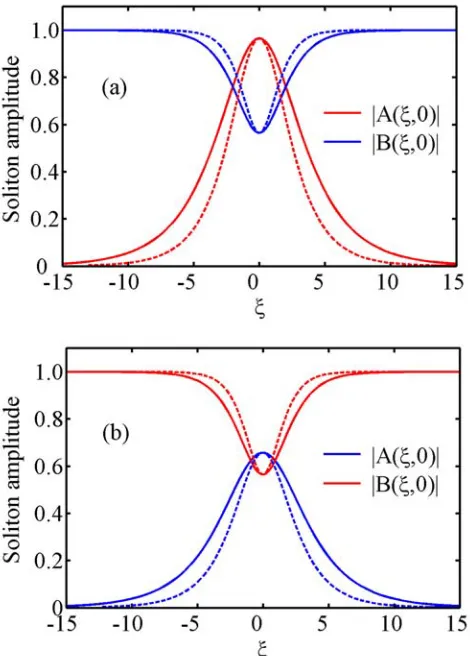
respectively (see Fig. 1). Another distinction between dark-bright and bright-dark
so-lutions is that the primary component (that which can propagate stably when the other
component is not excited) is a dark soliton in the former, and a bright soliton in the
latter.
The secondary component of these mixed-pair (that is, bright-dark and
dark-bright) beams possesses anti-guiding properties, a phenomenon seen also with
Mana-kov solitons [7]. For the dark-bright soliton, the bright (secondary) component,
propagating in the waveguide induced by the dark (primary) component, has an
inten-sity maximum at its centre. The presence of such a maximum in a defocusing
me-dium leads to a lowering of the refractive index at the beam centre, thus weakening
com-petitive process between the non-linear refractive index changes brought about by the
individual dark and bright components. When these processes are balanced precisely,
an equilibrium state is formed and a vector soliton may propagate. These refractive
index changes are reversed for the bright-dark soliton in a focusing medium, but the
underlying physics remains the same.
The (forward-propagating) dark-dark vector soliton of the defocusing H-M
equation has also been found using Hirota’s method
(
)
0 1(
2)
12 1 2 1
, cos tanh sin
1 2
1 4
exp exp ,
2 2
1 2
a W
A A i
W
i V i
V
ξ ζ
ξ ζ φ φ
κ
κχ ξ ζ ζ
κ κ κ + = + + − × − + + − (9a)
(
)
0 2(
2)
22 2 2 2
, cos tanh sin
1 2
1 4
exp exp ,
2 2
1 2
a W
B B i
W
i V
V
ξ ζ
ξ ζ φ φ
κ
i
κχ ξ ζ ζ
κ κ κ + = + + − × − + + − 2 0 (9b)
where is the total (incoherent) intensity of the vector beam. The
ex-pressions for the intrinsic velocities are
2 2
0
A B
χ ≡ +
(
)
0 1 2
2 2 2
tan
1 2 2 tan
j j j a a V φ
κ χ φ
=
− +
, (10)
where j=1, 2, and there is a dependence not only on the non-paraxial parameter κ
but also on χ2. The soliton parameters are connected by the implicit relationship
that removes a degree of freedom from the system. The
two components necessarily have the same net velocity W, but their plane-wave back-2 2
0 1
A φ B2 2
0 2
grounds may travel in different directions. Note that Eq. (9) for the dark-dark soliton
is formally identical to Eq. (8) for the dark-bright solution.
Paraxial solitons of the NLS [4] and Manakov [3] equations can have
arbitrar-ily large values of phase angle φ π< 2. In contrast, H-M solitons possess a
maxi-mum “greyness” denoted by φmax. For the defocusing non-linearity, φmax is defined
by
2
max 2
1 4 tan
2 a
κχ φ
κ
−
= , (11)
where 2 for the dark-bright soliton, and 0
A
χ ≡ 2 2
0
2 2
0
A B
χ ≡ + in the dark-dark case. A
similar expression can be derived for the bright-dark solution (4). This limit
corre-sponds to a physical constraint on the largest intrinsic velocity that a dark soliton may
possess, depending on the background intensity. When φ →φmax, the intrinsic
veloc-ity diverges and the dark component propagates in a direction perpendicular to that of
the background plane wave, θ0 → ±π 2 [26].
IV. CONSERVED QUANTITIES
Knowledge of the invariants is of fundamental importance. They are also
use-ful tools for testing the integrity of any numerical scheme used in computer
simula-tions [28]. The H-M equation (1) may be regarded as the Euler-Lagrange equation of
motion corresponding to a Lagrangian density L, from which one defines a pair of
ca-nonically-conjugate momentum variables, π and π :
(
)
( )
† † † 2
† † 1 1 †
, ,
2 2
i
L κ
ζ ζ ζ ζ ξ ξ
∂ ∂ ∂ ∂ ∂ ∂
= − − − +
∂ ∂ ∂ ∂ ∂ ∂
U U U U U U
U U U U U U
2 (12a)
† 2 L i ζ κ ζ ∂ ∂ ≡ = − +
∂U ∂ U
π , †
2 L i ζ κ ζ ∂ ≡ = − ∂ ∂U U
π ∂
U
, (12b)
and . It is then straightforward to calculate the conserved quantities [29].
The fundamental quantity is the energy-flow E, which arises from invariance of L
un-der a global phase transformation. The second conserved quantity is the linear
mo-mentum M of the system, found from invariance under an infinitesimal translation in
ζ ≡ ∂ζ
U
ξ. The third conserved quantity is the Hamiltonian H, derived from consideration of
translations in the evolution variable, ζ .
†
† †
E dξ iκ
ζ ζ +∞ −∞ ∂ ∂ = − ∂ − ∂
∫
U U U U U U , (13)
† † †
† ,
2 i
M dξ κ
ξ ξ ζ ξ ξ ζ
+∞ −∞ ∂ ∂ ∂ ∂ ∂ ∂ = − − + ∂ ∂ ∂ ∂ ∂ ∂
∫
U U U U U U U U (14)
( )
† † 2
† 1
2 2
H dξ κ
ξ ξ ζ ζ
+∞ −∞ ∂ ∂ ∂ ∂ = − − ∂ ∂ ∂ ∂
∫
U U U U 1 U U . (15)Equations (13)-(15) also apply to the scalar NLH equation, by allowing one of the
field components to be null. For bright-bright H-M solitons, it is found that:
E=2η 1 2+ κη2 , (16a)
2 2
2 3 4
3 1 2
M V V κη η κ + =
+ , (16b)
2 2 2 3 4 1 2
3 1 2
H
V
η κη η κη
κ κ κ
+
= + −
+ . (16c)
These results are exactly the same as for the scalar bright Helmholtz soliton [25]. As
expected they reduce to their paraxial counterparts in the multiple limit ,
and [1,2]. It is interesting to note that
0
κ →
2 0
κη → κV2→0 ∂H M V∂ = (as in the
compo-nent, the invariant integrals (13)-(15) can be strongly divergent. A renormalization
procedure is thus necessary to remove such infinities.
V. CONCLUSION
In this Article, we have considered broad multi-component spatial beams in
uniform planar waveguides, placing particular emphasis on the inherent spatial
sym-metry of such systems. The novel Helmholtz-Manakov equation, which generalizes
our earlier work on scalar beams [16-18,25,26,30], has been introduced and its
2-component solutions (localized, mutually-trapped structures) have been derived using
Hirota’s method. The new solutions uncover explicit physical dependencies of novel
quantitative and qualitative features. In a following publication, we will present the
results of a perturbative analysis, which has tested and verified the stability properties
of each new soliton family.
We expect the H-M equation and its soliton solutions to be relevant in other
optical contexts, such as photorefractives [9,10], multi-hump [11] and holographic
[12] solitons. It is also likely to provide a key analytical platform in the
understand-ing of vector-soliton interactions (both co- and counter-propagatunderstand-ing scenarios) at
arbi-trarily large angles [18]. We expect new doors of investigation to be opened by lifting
the angular restrictions of current paraxial models. This has particular importance, for
example, in the field of optical computing [14,15]; it may also find application in
op-tical contexts involving feedback [31]. Helmholtz generalizations offer broad
physi-cal insight into a wide variety of angular geometries by taking full account of the role
ACKNOWLEDGEMENTS
The authors would like to acknowledge financial support from EPSRC
FIGURE CAPTIONS
FIG. 1 (color on-line). Characteristic angular beam-broadening effects associated
with Helmholtz solitons for (a) bright-dark, and (b) dark-bright cases. Solid line:
( )
,0A ξ ; dashed line: B
( )
ξ,04 10
κ = −
. Dotted lines correspond to paraxial solutions. For a
non-paraxial parameter , a transverse velocity of V ≈70.71 yields a physical
propagation angle θ =45° so that 2κV2=O
( )
0.5 a
1 and one has a strongly non-paraxial
regime. Other solution parameters are = , φ π= 6, B0 =1 [in (a)] and
[in (b)].
FIGURE 1
J. M. Christian et al.
___________________________________________________________________________________
[1] Y. S. Kivshar, Opt. Quant. Elect. 30, 517 (1998).
[2] Y. S. Kivshar and B. Luther-Davies, Phys. Rep. 298, 81 (1998).
[3] S. V. Manakov, Sov. Phys. JETP 38, 248, (1974).
[4] V. E. Zakharov and A. B. Shabat, Sov. Phys. JETP 34, 62 (1972); 37, 823
(1973).
[5] C. R. Menyuk, J. Opt. Soc. Am. B 5, 392 (1988); IEEE J. Quantum Electron.
QE-23, 174 (1987); Opt. Lett. 12, 614 (1987).
[6] J. Yang, Phys. Rev. E 65, 036606 (2002); 64, 026607 (2001).
[7] A. P. Sheppard and Y. S. Kivshar, Phys. Rev. E 55, 4773 (1997).
[8] J. U. Kang, G. I. Stegeman, J. S. Aitchison, and N. N. Akhmediev, Phys. Rev.
Lett. 76, 3699 (1996); J. U. Kang, G. I. Stegeman and J. S. Aitchison, Opt. Lett.
21, 189 (1996).
[9] C. Hou and L. Wang, Optik 115, 405 (2004); D. N. Christodoulides, S. R.
Singh, M. I. Carvalho, and M. Segev, Appl. Phys. Lett. 68 1763 (1996); Z.
Chen, M. Segev, T. Coskun, and D. N. Christodoulides, Opt. Lett. 21, 1426
(1996).
[10] C. Hou, Z. Zhou and X. Sun, Optical Materials 27, 63 (2004).
[11] E. A. Ostrovskaya and Y. S. Kivshar, J. Opt. B: Quant. Semiclass. Opt. 1, 77
(1999); E. A. Ostrovskaya, Y. S. Kivshar, D. V. Skryabin, and W. J. Firth, Phys.
Rev. Lett. 83, 296 (1999).
[12] J. R. Salgueiro, A. A. Sukhorukov, and Y. S. Kivshar, Opt. Lett. 28, 1457
(2003); O. Cohen et al., Opt. Lett. 27, 2031 (2002).
[13] R. Radhakrishnan, M. Lakshmanan and J. Hietarinta, Phys. Rev. E 56, 2213
[15] K. Steiglitz, Phys. Rev. E 63, 016608 (2003); M. H. Jakubowski, K. Steiglitz,
and R. Squier, Phys. Rev. E 58, 6752 (1998).
[16] P. Chamorro-Posada, G. S. McDonald, and G. H. C. New, J. Mod. Opt. 45, 1111
(1998).
[17] P. Chamorro-Posada, G. S. McDonald, and G. H. C. New, J. Opt. Soc. Am. B
19, 1216 (2002).
[18] P. Chamorro-Posada and G. S. McDonald, “Spatial Kerr soliton collisions at
ar-bitrary angles,” to be published in Phys. Rev. E.
[19] M. Lax, W. H. Louisell and W. B. McKnight, Phys. Rev. A 11, 1365 (1975).
[20] S. Chi and Q. Guo, Opt. Lett. 20, 1598 (1995).
[21] A. Ciattoni, P. Di Porto, B. Crosignani, and A. Yariv, J. Opt. Soc. Am. B 17, 809
(2000).
[22] V. Boucher, R. Barille and G. Rivoire, J. Opt. Soc. Am. B 20, 1666 (2003); L.
Friedrich et al., Opt. Commun. 186, 335 (2000).
[23] M. Soljačić et al., Phys. Rev. Lett. 90, 254102 (2003); F. T. Hioe, Phys. Rev.
Lett. 82, 1152 (1999).
[24] B. Crosignani, A. Yariv, and S. Mookherjea, Opt. Lett. 29, 1254 (2004); A.
Ciat-toni, B. Crosignani, S. Mookherjea, and A. Yariv, Opt. Lett. 30, 516 (2005); A.
Ciattoni, B. Crosignani, P. Di Porto, J. Scheuer and A. Yariv, Opt. Express 14,
5517 (2006).
[25] P. Chamorro-Posada, G. S. McDonald, and G. H. C. New, J. Mod. Opt. 47, 1877
(2000).
[26] P. Chamorro-Posada and G. S. McDonald, Opt. Lett. 28, 825 (2003).
[28] P. Chamorro-Posada, G. S. McDonald, and G. H. C. New, Opt. Commun. 192, 1
(2001).
[29] H. Goldstein, Classical Mechanics, 2nd Ed. (Addison Wesley, Philippines,
1980), Chap. 12, p. 588.
[30] J. M. Christian, G. S. McDonald and P. Chamorro-Posada, “Helmholtz solitons
in power-law media,” submitted to J. Opt. Soc. Am. B.