INVESTIGATE WELDING PARAMETER OPTIMIZATION FOR WELD BEAD SURFACE QUALITY USING MIG TECHNOLOGY
GARY ANAK JOHN
A project report submitted in partial fulfillment of the requirement for the award of the
Degree of Master in Mechanical Engineering
Faculty of Mechanical and Manufacturing Engineering University Tun Hussein Onn Malaysia
ABSTRACT
Investigation of MIG welding parameter optimization for surface quality is very important to improve the technology of MIG 3D welding application. Weld bead size and shape are one of important considerations for design and manufacturing engineers. These welding parameters affecting the arc and welding bath should be estimated and their changing conditions during process must be known before in order to obtain optimum results, in this case the quality surface of overlap weld beads. The process parameters such as welding voltage, welding travel speed and wire feet rate were studied. The experiments were conducted based on a Three-factor, three-level and L9 using Taguchi method.
Taguchi methods applied to improve the quality of welding bead. Carbon steel plate AISI 1015 is used as the work piece material for carrying out the experimentation to optimize the surface quality and hardness value. Taguchi orthogonal array is designed with three levels of welding parameters with the help of software Minitab 16. Nine run experiments of single beads and nine runs for overlap weld beads are performed, surface quality and hardness is calculated using the minitap 16 software.
vi
ABSTRAK
Kajian kimpalan MIG dalam pengoptimuman parameter proses kimpalan untuk kualiti permukaan adalah sangat penting dalam memperbaiki dan meningkatkan teknologi kimpalan MIG khususnya dalam bidang kimpalan 3D. Saiz kumai dan bentuk kumai adalah pertimbangan yang penting untuk rekabentuk dan pembuatan kejuruteraan. Parameter proses kimpalan yang memberi kesan kepada arka dan kumai harus dianggarkan dan perubahan keadaan semasa proses juga perlu diketahui. Usaha sekarang adalah untuk mendapatkan hasil yang optimum untuk kualiti permukaan kumai bertindih kimpalan. Parameter proses kimpalan seperti voltan, kelajuan kimpalan dan kadar kemasukan wayar telah dikaji. Kajian ini telah dijalankan berdasarkan tiga faktor, tiga peringkat dan L9 menggunakan kaedah Taguchi.
Kaedah Taguchi digunakan dalam kajian untuk meningkatkan kualiti kumai. Plat keluli karbon AISI 1015 digunakan sebagai bahan benda kerja bagi menjalankan ujikaji dalam pengoptimuman kualiti permukaan dan nilai kekerasan. Pelbagai ortogon Taguchi direka untuk tiga tahap parameter kimpalan dengan bantuan perisian Minitab 16. Sembilan ujikaji dilakukan dalam kumai lurus sementara sembilan lagi untuk kumai bertindih kimpalan. Kualiti permukaan dan kekerasan dikira menggunakan perisian MINITAB 16.
Kekasaran permukaan dianggap sebagai ciri kualiti dengan konsep "yang
lebih kecil-lebih baik" dan kekerasan kumai "yang lebih besar-lebih baik. Kaedah
Taguchi adalah kaedah yang baik untuk pengoptimuman pelbagai parameter input
CONTENTS
TITLE i
DECLARATION ii
DEDICATION iii
ACKNOWLEDGEMENT iv
ABSTRACT v
CONTENTS vii
LIST OF TABLES xi
LIST OF FIGURES xiv
CHAPTER 1 INTRODUCTION 1
1.1 Metal Inert Gas welding (MIG) 1
1.2 Background of the study 2
1.3 Problem Statement 3
1.4 Research Objectives 4
1.5 Scope of Study 4
1.6 Dissertation Summary 4
CHAPTER 2 LITERATURE REVIEW 6
2.1 3-D Welding 6
2.2 Welding Parameter 7
2.3 Weld Bead Geometry 11
viii
CHAPTER 3 METHODOLOGY 15
3.1 Introduction 15
3.2 Research methodology 17
3.3 Design of Experiment (DOE) 17
3.4 Conduct Experiment and Data Collection 18
3.5 Data Validation and Optimization 19
3.6 Project Sample 20
3.6 Validation of the Sample 21
3.7 Laboratory Testing 22
3.7.1 Surface Roughness Test 22
3.7.3 Hardness Test 24
3.8 Data Analysis and Interpretation 26
3.9 Summary 28
CHAPTER 4 EXPERIMENTAL SETUP 29
4.1 Based Metal 29
4.2 MIG Welding Machine 31
4.3 Customized semi-automated MIG welding 33
4.4 Welding Input Parameter Sample Setup 38
4.5 Inspection for Validation 40
4.6 Summary 40
CHAPTER 5 RESULT AND DISCUSSION 41
5.1 Surface Roughness and Hardness of Single
Weld Bead 41
5.1.1 Graph Input Parameter Versus Surface Roughness 44 and Hardness Rockwell For Single Weld Bead
Analysis
5.1.3 Taguchi Analysis by Minitab software for Means 53 of Surface Roughness and Hardness Rockwell for
Single Bead Welding
5.1.3.1 Surface Roughness Of Single Weld Bead 53 5.1.3.2 Hardness of Single Weld Bead 57 5.2 Surface Roughness and Hardness of Overlap Weld Bead 60 5.2.1 Graph Input Parameter versus Surface Roughness 64
and Hardness Rockwell for Overlap Weld Bead Analysis
5.2.2 Overlap Weld Bead Sample Surface Visual 68 Observation
5.2.3 Taguchi Analysis by Minitab software for Means 73 of Surface Roughness and Hardness Rockwell for Overlap Weld Bead
5.2.3.1 Vertical Direction Surface Roughness of 73 Overlap Weld Bead Sample
5.2.3.2 Longitudinal Direction Surface Roughness 77 of Overlap Weld Bead Sample
5.2.3.3 Surface Roughness Of Overall Direction 80 Overlap Weld Bead Sample
5.2.3.4 Hardness Value of Overlap Welding Bead 83
5.3 Summary and Discussion of the Result 86
CHAPTER 6 CONCLUSION AND RECOMMENDATIONS 89
6.1 Novelty of the Research 89
6.1.1 Develop the Overlapping model 89
6.2 Conclusion 91
6.3 Recommendation 92
REFERENCES 93
APPENDIX I 97
x
APPENDIX III 105
LIST OF TABLES
TABLE NO. TITLE PAGE
2.1 Effect on measured variable 9
3.1 Welding parameters and their level 18
3.2 Taguchi design L9(3**3) for input value parameter setting 18 of single bead
3.3 Taguchi design L9(3**3) for input value parameter setting of 19 overlap welding bead
3.5 Prepared Data Table of Surface roughness Ra and Hardness 26 Rockwell A for single weld bead
3.6 Prepared Data Table of Surface roughness Ra and Hardness 27 Rockwell A for overlap weld bead
4.1 Composition of carbon steel plate AISI 1015 (Budinski,1999) 29 4.2 Properties of carbon steel plate AISI 1015 (Budinski,1999) 29 4.3 Specification of MIG welding machine (Ltd, 2012) 31 4.4 Specification composition of wire ER70S-6 32
4.5 Constant parameter 38
4.6 Input Parameter and range 39
4.7 Defined parameter 39
4.8 Input parameter setting for welding process for single and 39 overlap weld bead samples
xii
5.3 Surface roughness Ra and Hardness Rockwell scale A 43 Result
5.4 Response table for signal to noise ratios of surface 53 roughness
5.5 Response table for means 54
5.6 Optimum factor value for single weld bead surface 56 roughness
5.7 Response Table for Signal to Noise Ratios of Hardness 57 Single weld bead
5.8 Response table for Means of single weld bead hardness 57 5.9 Input parameter’s rank in impact on hardness of single 58
weld bead
5.10 Optimum input parameter value for hardness of single 60 bead weld bead
5.11 Constant parameters which were considered in overlapping 61 weld bead
5.12 Input variables for 9Runs, 3Levels and 3 Factors 61 5.13 Surface Roughness RA for vertical and longitudinal 63
direction of weld bead and Hardness Rockwell A scale results
5.14 Response table for Signal to Noise Ratios of vertical 73 direction surface roughness for overlap weld bead
5.15 Response table for Means of vertical direction surface 74 roughness for overlap welding bead
5.16 Optimum parameter value for vertical direction surface 76
roughness of overlap welding bead
5.17 Response Table for Signal to Noise Ratios of Longitudinal 77 direction Surface Roughness for overlap weld bead
5.18 Response Table for Means of Longitudinal direction Surface 77 Roughness for overlap welding bead
5.19 Optimum factor value for longitudinal direction surface roughness 79 of overlap welding bead
roughness for overlap weld bead
5.21 Response table for Means of overall surface roughness for overlap 80 weld bead
5.22 Optimum factor value for overall surface roughness of overlap 83 welding bead
5.23 Response Table for Signal to Noise Ratios of Hardness Overlap 83 Welding Bead.
xiv
LIST OF FIGURES
FIGURE NO. TITLE PAGE
2.1 Square box formation by 3D formation (Dr P M Dickens) 7
2.2 Simple overlapping parabolic pattern 11
2.3 Multi bead profile in the initial model 11
2.4 Sketch of overlapping model by yong Cao et al 12
3.1 Single weld bead sample 21
3.2 Overlap weld bead sample 21
3.3 TWI Welding Gauge (Cambridge Gauge) (GAU/0002) 22
3.4 Vertical and longitudinal surface roughness measurement 23 direction
3.5 Trail of surface roughness indenter on the weld bead peak 23
3.6 Mitutoyo SJ-400 machine 24
3.7 Wilson Rockwell hardness tester machine using Rockwell A scale 25 3.8 Hardness test indenter point on the weld bead peak 25 4.1 Based metal cleaned by wire brush grinder 30
4.2 Based metal of the weldment sample 30
4.3 Uni-Arc MIG-200A welding machine 31
4.4 Travel car used in the customized semi-automated MIG welding 33
4.5 Torch mounted at control car arm 33
4.6 Torch position and angle 34
4.7 Torch angle and nozzle to plate distance 34
4.8 Welding process on the based metal for single weld bead sample 35
4.9 Three runs for every sample 35
4.10 Overlap welding bead sample 36
4.11 Torch angle for 1st run of overlap weld bead sample 36 4.12 Overlapping weld bead torch angle from end view of work angle 37
4.13 Torch push technique 37
5.1 Single bead welding for nine (9) samples 42
5.2 Comparison of wire speed rate and response at the voltage 18.7V 45 for single weld bead
5.3 Comparison of wire speed rate and response at the voltage 19.8V 46 for single weld bead
5.4 Comparison of wire speed rate and response at the voltage 20.9V 47 for single weld bead
5.5 Sample A 48
5.6 Sample B 48
5.7 Sample C 49
5.8 Sample D 49
5.9 Sample E 50
5.10 Sample F 50
.
5.11 Sample G 51
5.12 Sample H 52
xvi
5.14 Main effect plot for S/N ratios of surface roughness single 55 weld bead
5.15 Main effect plot for means of surface roughness single weld bead 55 5.16 Main Effect Plot for S/N ratios of Hardness Single Bead Welding 59
Surface
5.17 Main Effect Plot for Means of Hardness Single Bead Welding 59 Surface
5.18 Overlapping welding bead for 9 samples runs 62
5.19 Surface roughness reading direction 63
5.20 Comparison of wire speed rate, surface roughness and hardness 65 with the voltage at 18V for overlap weld bead
5.21 Comparison of wire speed rate, surface roughness and hardness 66 with the voltage at 19.8V for overlap weld bead
5.22 Comparison of wire speed rate, surface roughness and hardness 67 with the voltage at 20.9V for overlap weld bead
5.23 Sample 1 68
5.24 Sample 2 69
5.25 Sample 3 69
5.26 Sample 4 70
5.27 Sample 5 70
5.28 Sample 6 71
5.29 Sample 7 71
5.30 Sample 8 72
5.31 Sample 9 72
5.32 Main Effect Plot for S/N ratios of Surface Roughness 75 Vertical direction Surface Roughness for overlap welding bead 5.33 Main Effect Plot for Means of Surface Roughness Vertical 75
direction Surface Roughness for overlap welding bead
surface roughness for overlap welding bead
5.35 Main effect plot for Means of longitudinal direction surface 78 roughness for overlap weld bead
5.36 Main Effect Plot for S/N ratios of Surface Roughness for 81 overlap welding bead
5.37 Main Effect Plot for Means of Surface Roughness overall 82 direction for overlap welding bead
5.38 Main effect plot for S/N ratios of hardness overlap welding bead 85 5.39 Main effect plot for means of hardness overlap welding bead 85 5.34 Single weld bead sample welded using setting of optimization 87
result for surface roughness by Taguchi analysis Minitap 16
5.35 Overlap weld bead sample welded using setting of optimization 88 result for surface roughness by Taguchi analysis Minitap 16
6.1 cross section of weld bead 90
6.2 Scan spacing of overlap bead, where: a. big overlaps bead scan 90 spacing b. small overlaps bead scan spacing c. perfect overlaps bead scan spacing
CHAPTER 1
INTRODUCTION
1.1 Metal Inert Gas welding (MIG)
Metal inert gas welding (MIG) is one of the welding types of gas metal arc welding (GMAW). It is a welding process in which an electric arc forms between a consumable wire electrode and the metal work piece. In this welding process, the heat be will generate through the jumping current of the gap of wire electrode and the work piece metal, causing them to melt, and join. A shielding gas feeds through the welding gun along with the wire electrode. This shielding gas shields the melting metal from contaminants in the atmosphere air.
1.2 Background of the study
In welding process, there are parameters need to be consider in concern to obtain the objective characteristic of weld bead. To develop 3-D welding technology, two characteristics of weld bead need to be improve, surface quality and mechanical strength. The shape and dimensions of the weld bead are very important in the use of 3-D welding as a Rapid Prototyping system, these will determine the strength of wall and shape produced product and this characteristic will influence the quality of the surface finish. To obtain this, optimization parameter in this MIG welding need to be study. These parameters affecting the arc and welding bath should be estimated and their changing conditions during process must be determine in order to obtain optimum results. A perfect arc can be achieved when all the parameters are in conformity. In MIG welding process, there is several important parameters need to concern. These parameters are arc voltage welding current, amperage, travel speed, wire feed speed, torch angle, free wire length, nozzle distance, welding direction, electrode extension, welding position and the flow rate of gas. However, wire electrode diameter and its composition, type of protective gas are the defined parameters before starting welding and cannot be changed during the process (Olabi).
3
1.3 Problem Statement
Surface quality comes together with good mechanical properties is very important aspect in development of 3-D welding technology. This study will focus on overlap weld bead. By obtaining this good surface quality characters mean will save cost and production time of the production welding printing. The good surface quality of welding bead will lead to reduction of finishing process of the product by means the process of the milling process can be skip. The present work aim is to determine the input–output relationships of a MIG welding process. Without the optimization parameter to obtain best surface quality of weld bead, these two aspects will hard to be developed. Investigation in this project is to establish relations between the process parameters (inputs) and responses (outputs) for overlap welding bead in MIG welding process (Y.S. Tarng, 1998). This researcher tried to obtain the optimized weld bead geometry in GTAW by using the modified Taguchi method. The modified Taguchi method allowed the simultaneous consideration of all the weld pool geometry quality characteristics for optimization. In Tarng research, overlap surface roughness were not been determine.
1.4 Research Objectives
There are three (3) objectives in this research. The objectives are:
i. To investigate optimization parameter in MIG welding technology for surface quality of overlap welding beads.
ii. Evaluation the surface quality of overlap weld bead using the Taguchi method.
iii. To propose welding process guidance for having good surface finish of weld bead.
1.5 Scope of Study
There are several scopes of study in this investigation. The scopes are:
i. Study focus on welding parameter of Voltage, travel speed, and wire feed rate.
ii. The carbon steel metal wire feeler ER70S-6 used in this experimental work for investigates the optimization parameter of the overlap and single weld bead surface quality.
iii. Carbon steel plate AISI 1015 with the dimension of 50 X 100 X 5 mm was selected as subtract for as based metal for the samples of weld bead.
iv. Investigation focus on single weld bead and overlap weld bead.
1.6 Dissertation Summary
5
wire feet rate were studied. The experiments were conducted based on a Three-factor, three-level and L9 using Taguchi method.
CHAPTER 2
LITERATURE REVIEW
This chapter is presented the literature review of selected journal, articles, reference book, thesis and online source. Keywords of this study are welding parameter, weld bead geometry and Taguchi optimization.
2.1 3-D Welding
7
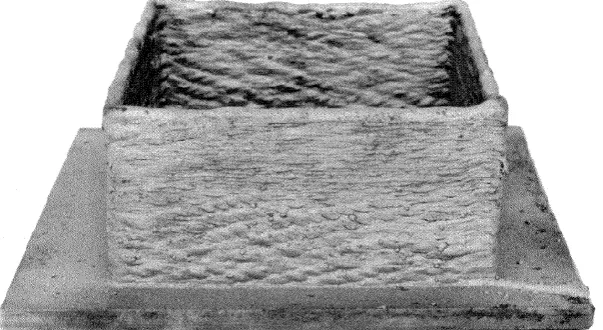
Figure 2.1: Square box formation by 3D formation (Dr P M Dickens)
Metal Inert Gas welding (MIG) offer a lot of advantages compare to other welding method to use in 3-D welding technology. The advantages of MIG welding are:
High quality welds can be produced much faster
Since a flux is not used, there is no chance for the entrapment of slag in the weld metal resulting in high quality welds
The gas shield protects the arc so that there is very little loss of alloying elements. Only minor weld spatter is produced
MIG welding is versatile and can be used with a wide variety of metals and alloys
The MIG process can be operated several ways, including semi and fully automatic
2.2 Welding Parameter
desire characteristic aspect of weld bead. According to Miller, setting the correct parameter is the most important aspect in-order to get proper weld bead. Miller listed several parameters need to concern about, such as material thickness that will determines amperage setting, selection of proper wire size according to amperage, setting of the voltage and setting of the wire feed speed.
Regarding to ugur etc, (Ugur Esme, Melih Bayramoglu, Yugut Kazancoglu, Sueda Ozgun, 2009) in similar research, affecting parameters on the arc and welding bath should be estimated and their changing conditions during process must be known before in order to obtain optimum results; in fact a perfect arc can be achieved when all the parameters are in conformity. These are combined in two groups as first order adjustable and second order adjustable parameters defined before welding process. Former are welding current, arc voltage and welding speed, and later are torch angle, free wire length, nozzle distance, welding direction, position and the flow rate of gas. However, wire electrode diameter and its composition, type of protective gas are the defined parameters before starting welding and cannot be changed during the process.
A common problem that has faced the manufacturer is the control of the process input parameters to obtain a good welded joint with the required bead geometry and weld quality with minimal detrimental residual stresses and distortion. It has been necessary to determine the weld input parameters for every new welded product to obtain a welded joint with the required specifications
(Olabi). There are
four primary methods of metal transfer in GMAW, called globular, short-circuiting, spray, and pulsed-spray, each of which has distinct properties and corresponding advantages and limitations (Radaj, 1992).9
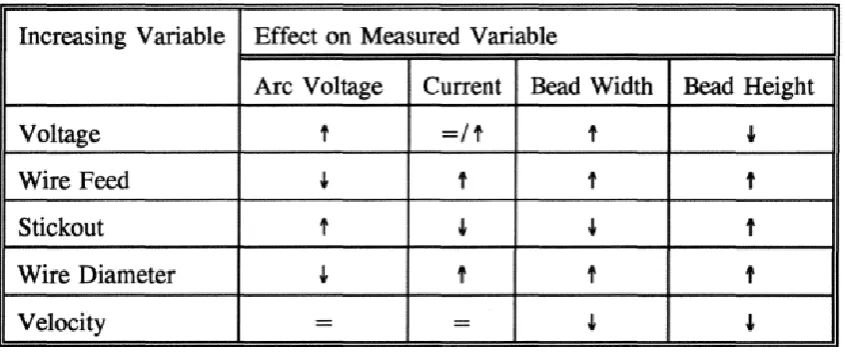
Table 2.1: Effect on measured variable (Dr P M Dickens).
Voltage determines height and width of bead. There is a relationship between arc voltage and arc length. A short arc decreases voltage and yields a narrow, "ropey" bead. A longer arc (more voltage) produces a flatter, wider bead. Too much arc length produces a very flat bead and a possibility of an undercut (Miller Electric Mfg Co. , 2013)
There are several types of metal transfer modes in MIG welding. There are globular, short-circuiting, spray and pulse-spray metal transfer mode. In Globular mode, it produces high heat, a poor weld surface, and spatter. Welding speeds of up to 110 mm/s (250 in/min) allowing will high deposition rate in short-circuiting mode. The lower current than that is for the globular method. Lower current also makes the heat input for the short-arc variation considerably reduced, making it possible to weld thinner materials while decreasing the amount of distortion and residual stress in the weld area. Globular and short-circuiting metal transfer modes can only be used on ferrous metals. Short-circuiting metal transfer provides better weld quality and fewer spatters than the globular variation. To maintaining a stable arc, the setting of weld process parameters such as volts, amps and wire feed rate within a relatively narrow band is critical, generally between 100 to 200 amperes at 17 to 22 volts for most applications. The disadvantages of using short-arc transfer mode will lead to lack of fusion and insufficient penetration when welding thicker materials. This is due to the lower arc energy and rapidly freezing weld pool.
shielding gas. In MIG welding process, the weld electrode metal is rapidly passed along the stable electric arc from the electrode to the work piece, essentially eliminating spatter and resulting in a high-quality weld finish. Vaporized spray transfer mode in welding process requires higher voltage and current than short circuit transfer. This transfer mode commonly used only on work pieces of thicknesses above about 6.4 mm. Apart of that, the large weld pool in this mode often limit to weld the flat and horizontal welding positions and sometimes also used for vertical-down welds. The last metal transfer modes in MIG welding is pulse-spray mode. This mode is based on the principles of pulse-spray transfer but uses a pulsing current to melt the filler wire and allow one small molten droplet to fall with each pulse. During the welding process, the pulses allow the average current to be lower, decreasing the overall heat input. The lower heat input decreasing the size of the weld pool and heat-affected zone. This makes it possible to weld thin work pieces and provides a stable arc and no spatter, since no short-circuiting takes place.
The selection of shielding gas in MIG welding affected the welding bead. Referring to mig_handbook by Welding Guns Of Australia PTY LTD Pty Ltd there are four types of shielding gas of MIG welding process can be selected by depending on what purpose and type of material to be weld. Selection of shielding gas also affects the characteristic of weld bead. Pure inert gases such as argon and helium are only used for nonferrous welding. If the gas being used to weld steel, argon do not provide adequate weld penetration and can cause an erratic arc and while with helium it will encourage spatter (Ltd, 2012). Pure carbon dioxide allows for deep penetration welds but encourages oxide formation, which adversely affect the mechanical properties of the weld. Spatter is unavoidable and welding thin materials is difficult. As a result, argon and carbon dioxide are frequently mixed in a 75%/25% to 90%/10% mixture. Generally, in short circuit GMAW, higher carbon dioxide content increases the weld heat and energy when all other weld parameters (volts, current, electrode type and diameter) are held the same. As the carbon dioxide content increases over 20%, spray transfer GMAW becomes increasingly problematic, especially with smaller electrode diameters.
11
speed. Helium is less dense than air, thus it is less effective at shielding the weld than argon—which is denser than air. It also can lead to arc stability and penetration issues, and increased spatter, due to its much more energetic arc plasma.
2.3 Weld BeadGeometry
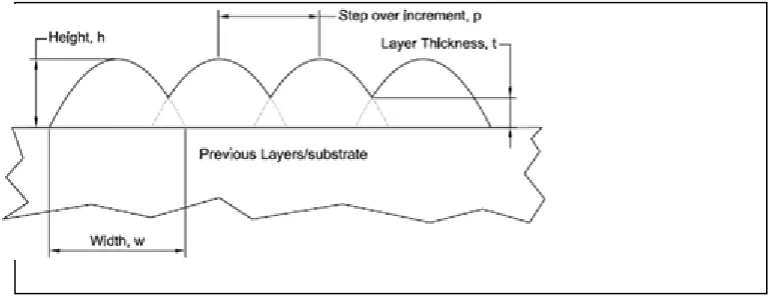
[image:25.595.136.501.321.467.2]Control of weld bead shape is very important as the mechanical properties of welds will affected by the weld bead shape (Connor, 1991). Because of this, it is clear that precise selection of the process parameters is necessary. (S. Suryakumar, K.P. Karunakaran, Alain Bernard, U. Chandrasekhar, N Raghavender, Deepak Sharma, 2011) have been studied the bead profile above the subtrastrate and assumed to be a symmetric parabola of the form y = a + cx2 .
Figure 2.2: Simple overlapping parabolic pattern
[image:25.595.114.499.569.718.2]The researcher also mentioned that a simple overlapping parabolic pattern shown in Figure 2.1 was assumed for the multiple bead deposition.
The distance between the consecutive beads is referred as step over increment (p). In this model, it was assumed that: a) Every bead has same cross-sectional profile. b) The parabolic bead profile is unchanged during the overlapping process. S. Suryakumar et al has comeout with the improved model, as the step over increment decreases, the overlapping volume increases with a commensurate decrease in the volume of the valley. Therefore, the radius of the fillet increases with the decrease in the step over increment.
[image:26.595.135.499.428.529.2]In order to find the parameter optimization, study on the weld bead profile is needed. (Yong Cao, Sheng Zhu, Xiubing Liang, Wanglong Wang, 2011) in their reseach mention that the sectional geometry of single-pass bead and the overlap of the adjacent beads have critical effects on the dimensional accuracy and quality of metalparts and the conclusion is that the edge detection of bead section with Canny operatoris continuous and distinct, and as compared with Gaussian function, logistic function and parabola function, sine function has higher accuracy to fit the measured data, and ‘‘surfacing of equivalent area’’ method shows to be rational and feasible by the experiments.
Figure 2.4: Sketch of overlapping model by yong Cao et al
2.4 Taguchi OptimizationMethod
13
of the weld pool in the TIG welding of S304 stainless steel of 1.5 mm in thickness are greatly improved by using this approach.
In the related research of parameter optimization, H. K. Lee (H. K. Lee, 2006) have used the Taguchi method and regression analysis in order to optimize Nd-YAG laser welding parameters (nozzle type, rotating speed, title angle, focal position, pumping voltage, pulse frequency and pulse width) to seal an iodine-125 radioisotope seed into a titanium capsule. The accurate control of the melted length of the tube end was the most important to obtain a sound sealed state. It was demonstrated that the laser pulse width and focal position were the laser welding parameters that had the greatest effects on the S/N ratios of the melted length.
Taguchi approach to design of experiments in easy to adopt and apply for users with limited knowledge of statistics, hence gained wide popularity in the engineering and scientific community. This is an engineering methodology for obtaining product and process condition, which are minimally sensitive to the various causes of variation, and which produce high-quality products with low development and manufacturing costs. Signal to noise ratio and orthogonal array are two major tools used in robust design. The S/N ratio characteristics can be divided into three categories when the characteristic is continuous
a) Nominal is the best b) Smaller the better
c) Larger is better characteristics.
15
CHAPTER 3
METHODOLOGY
This section will discuss on the description of the methods, procedures to obtain and how the data was analyzed and interpreted.
3.1 Introduction
Methodology Flow Chart
Start
Design of experiment (DOE)
Conduct Experiment and data collection
Data Validation
and
Optimization
Data Analysis and Interpretation
Result
Conclusion
17
3.2 Research Methodology
The research project work starts with the implementation concept of Design of Experiment (DOE). The preliminary result determines the selected parameter levels selection. After the preliminary results are known, levels of parameter are then entered into robust design Taguchi Method (Minitab 16) to generate the design matrix table. Then the experiments are conducted based on input parameter and level setup.
3.3 Design of Experiment (DOE)
In this project, DOE considers multiple factor interaction effects. The experimental design simplifies the use of DOE by automating the process of designing experiments and analyzing the results. The experiment is carried out by running the complete set of noise factor settings at each combination of control factor settings (at each run). The response data from each run of the noise factors in the outer array are aligned in a row, next to the factors settings for that run of the control factors in the inner array. Taguchi Technique is applied to plan the experiments. The Taguchi method will provide good improvement productivity during this research and development, so that high quality of surface quality can be produced quickly and at low cost. The DOE using Taguchi approach can significantly reduce time required for experimental investigations. In this investigation, in the first stage, Taguchi's orthogonal arrays were used to conduct the experiments to find the contributions ofeach factor and to optimize the parameter settings. Analysis using Taguchi design L9 (3**3) which REPRESENTS:-
L9 9 RUNS 3 3 LEVELS 3 3FACTORS
The following are the 3 Levels which are considered in Taguchi design High
Low
The combination Design of Experiments with optimization of welding control parameters to obtain best results can be achieved in the Taguchi Method and table 3.1 below shows the selected welding parameters and their level.
Table 3.1 Welding parameters and their level.
Welding parameters Level 1 Level 2 Level 3
Voltage (V) 18.7 19.8 20.9
Travel Speed(mm/min) 247.5 312.5 377.5
Wire Feed Rate(m/min) 8.5 9.9 11.3
3.4 Conduct Experiment and Data Collection
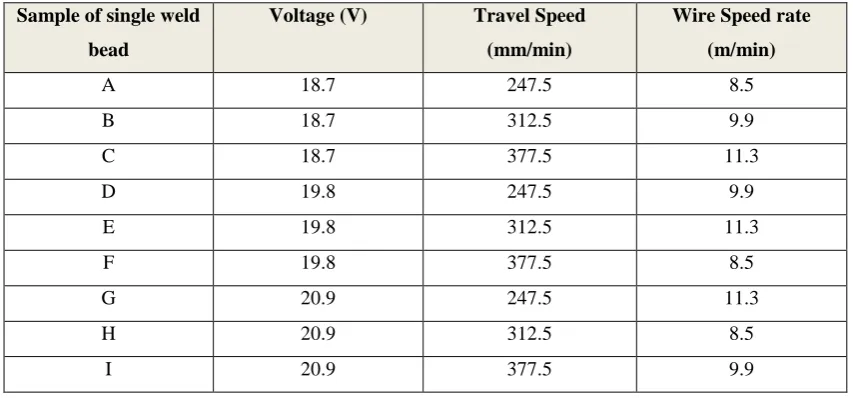
[image:32.595.106.533.516.715.2]Nine set of specimen of welded AISI 1015 work piece with different set of combination of parameter had been carried out. The distorted specimen due to other effects had not been considered in the experiment, as the condition was not the result from any of the specified parameters that had made up. There are 9 runs of single weld bead and another 9 runs for overlap weld bead are conducted base on L9 3 Level Taguchi Orthogonal Array.
Table 3.2: Taguchi design L9(3**3) for input value parameter setting of single bead
Sample of single weld bead
Voltage (V) Travel Speed (mm/min)
Wire Speed rate (m/min)
A 18.7 247.5 8.5
B 18.7 312.5 9.9
C 18.7 377.5 11.3
D 19.8 247.5 9.9
E 19.8 312.5 11.3
F 19.8 377.5 8.5
G 20.9 247.5 11.3
H 20.9 312.5 8.5
19
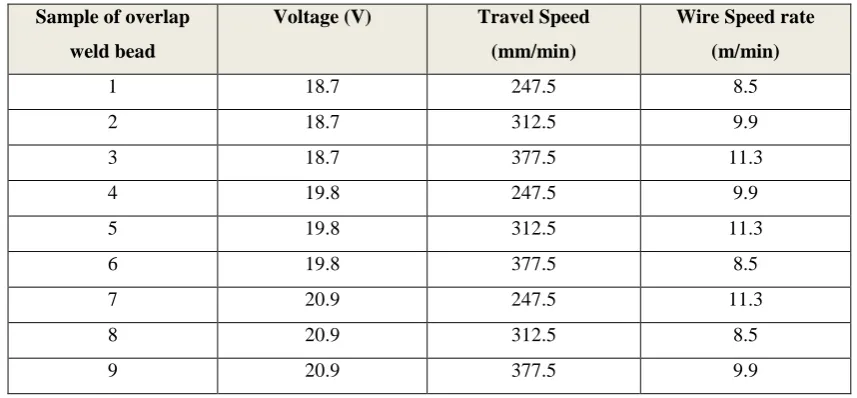
Table 3.3: Taguchi design L9(3**3) for input value parameter setting of overlap welding bead
Sample of overlap weld bead
Voltage (V) Travel Speed (mm/min)
Wire Speed rate (m/min)
1 18.7 247.5 8.5
2 18.7 312.5 9.9
3 18.7 377.5 11.3
4 19.8 247.5 9.9
5 19.8 312.5 11.3
6 19.8 377.5 8.5
7 20.9 247.5 11.3
8 20.9 312.5 8.5
9 20.9 377.5 9.9
While the hardness of the welded bead surface was using Hardness Rockwell A (HRA). The surface roughness of the welded bead surface that showed highest reading of HRA value was the most preferable criteria. The data was collected were the surface roughness and the hardness of the welded bead surface. Each test specimen will be conducted surface roughness test and hardness test. Test data will be collected and recorded for results observation and data validation and optimization.
3.5 Data Validation and Optimization
identify the significance of each factor. In statistical significance testing, the p-value is the probability of obtaining a test statistic at least as extreme as the one that was actually observed, assuming that the null hypothesis is true. The p-value must turn to be less than a certain significance level 0.05. If the P value above this level, the data must be recollect again by using difference approach in the same experiment. In this study would be the method of surface roughness and hardness value.
Optimization of control parameters to obtain best results for surface roughness and highest value of hardness is achieved by using the Taguchi Method. In Taguchi method, there are 3 Signal-to-Noise ratios of common interest for optimization. There are 3 Signal-to-Noise ratios of common interest for optimization
i. Smaller-The-Better:
n = -10 Log10 [mean of sum of squares of measured data]
ii. Larger-The-Better:
n = -10 Log10 [mean of sum squares of reciprocal of measured data]
iii. Nominal-The-Best:
n = 10 Log10 square of mean variance
3.6 Project Sample
21
[image:35.595.151.490.77.491.2]Figure 3.1: Single weld bead sample
Figure 3.2: Overlap weld bead sample
3.6.1 Validation of the Sample
takenin this validation process. To measure the height of the bead, weld gauge were placed on the flat surface of based metal or subtract and weld gauge pointer point the on top of the pitch of the weld bead.
All the welding samples were follow the inspection criteria of American Welding Society where:
i. No incomplete joint penetration in groove welds, except as permitted for partial joint penetration groove welds.
ii. No cracks or incomplete fusion.
[image:36.595.216.422.283.431.2]iii. Undercut shall not exceed the less than 10% of the substrate (base metal) thickness or 1/32 in. (0.8 mm).
Figure 3.3: TWI Welding Gauge (Cambridge Gauge) (GAU/0002)
3.7 Laboratory Testing
3.7.1 Surface Roughness Test
23
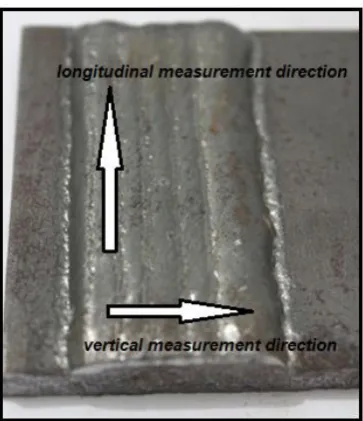
Figure 3.4: Vertical and longitudinal surface roughness measurement direction
Surface roughness measurement on single weld bead were done by measured the surface roughness of the single weld bead peak as show in Figure 3.5
Figure 3.5: Trail of surface roughness indenter on the weld bead peak.
[image:37.595.158.478.402.564.2]arithmetical mean value for a randomly sampled area. Mean center line roughness (Ra) is defined in the annexes of JIS B 0031 and JIS B 0061. A portion stretching over a reference length in the direction in which the average line extends is cut out from the roughness curve.
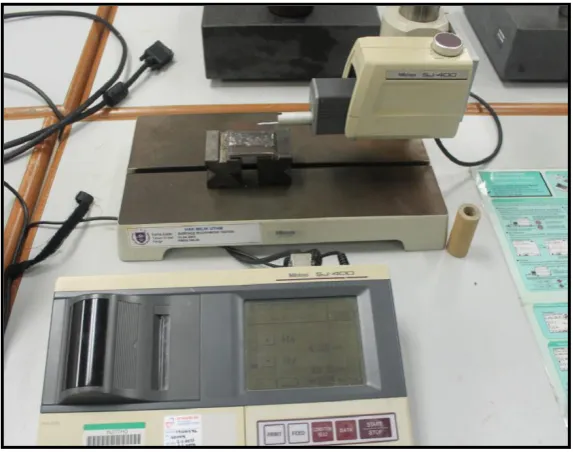
[image:38.595.149.436.283.509.2]In this lab testing, samples of single and overlap weld beads were inspected using Mitutoyo SJ-400 surface roughness machine. Data are measured at the top pitch of the weld bead. All data are measured 3 times for each sample at the 3 different pitches. The machine is set to follow JIS 1994 standard (Misumi Corporation, 2014). Figure 3.7 shows the machine for the roughness test.
Figure 3.6: Mitutoyo SJ-400 machine
3.7.2 Hardness Test
93
References
Heat effects of welding- temperature field, residual stress and diistortion1992
http://millerwelds.com/resources/improving-your-skills/mig/. http://millerwelds.com2013
11111
A. Bendell, j. Disney, W.A. Pridmore1989Taguchi Methods : Application in World IndustryUKIFS Publication
A. Tradia, F.Roger, E. Guyot2010Optimal parameter for pulsed gas tungsten arc welding in partially and fully penetrated weld poolsInternational Journal of Thermal
Sciences491197-1208
Ajit Hooda1*, A. D. (2012). OPTIMIZATION OF MIG WELDING PROCESS PARAMETERS TO PREDICT MAXIMUM YIELD STRENGTH IN AISI 1040.
C.E. Bull, K.A. Stacey, R. Calcraft1993On line weld monitoring using ultrasonic. Nondestructive Testing35 (2) 57–64.
Dongjie Li, Shanping Lu, Wenchao Dong, Dianzhiong Li, Yiyi Li20126 Study of the law between the weld pool shape variations with the welding parameters under two TIG processesMaterials Procssing Technology128-136
Engineering Materials: Properties and Selection1999Prentice Hall
Global versus cluster-wise regression analyses for prediction of bead geometry in MIG welding processJournal of Materials Processing Technology 189 (2007) 352– 3662006
Global versus cluster-wise regression analyses for prediction of bead geometry in MIG welding process2006
Global versus cluster-wise regression analyses for prediction of bead geometry in MIG welding process2007
http://www.lincolnelectric.com/en-us/Consumables/Pages/product.aspx?product=Products_Consumable_CutLengthCo nsumables-Lincoln-LincolnER70S-6(LincolnElectric)2013
Huijun Wang, Radovan KovacevicVariable Polarity GTAW in Rapd Prototyping of Aluminum Parts369-376Texas
Investigation of the overlapping parameters2005Rapid Prototyping Journal
MECHANICAL AND MICROSTRUCTURAL INVESTIGATION2008Ghulam Ishaq Khan Institute of Engineering Sciences and Technology
mig_handbook2012Ltd, Welding Guns Of Australia PTY LTD Pty
Miller Electric Mfg Co. 2013http://millerwelds.com/resources/improving-your-skills/mig/miller
Modern Welding Technology1989Englewood NJPrentice-Hall
Optimization of different welding processes using statistical and numerical approaches-A reference guide
OPTIMIZATION OF MIG WELDING PROCESS PARAMETERS TO PREDICT MAXIMUM YIELD STRENGTH IN AISI 10402012Int. J. Mech. Eng. & Rob. Res. 2012
Optimization of Nd:YAG laser welding parameters for sealing small titanum tube ends2006material science and engineering
Optimization of the weld bead geometry in gas tungsten arc welding by the Taguchi method1998Int. J. Adv. Manuf. Technol.14 549–554.
RAPID PROTOTYPING USING 3-D WELDING
S. Suryakumar, K.P. Karunakaran, Alain Bernard, U. Chandrasekhar, N Raghavender, Deepak Sharma2011Weld bead modeling and process optimization in Hybrid layerd
ManufacturingComputer Aided Design43331-334
S.C. Juang, Y.S. Tang2002Process parameter selection for optimizing the weld pool geometry in the Tungsten Inert Gas welding of stainless steelJournal of Materials Processing Technology12233-37
S.C. Juang, Y.S. Tarng, H.R. Lii1998A comparison between the backpropagation and counter-propagation networks in the modeling of the TIG welding process75 54–62.
Taguchi Method for Optimization of Cutting Parameter in Turning Operation2010Proc. of Int. Conf. on Advance in Mechanical Engineering
Taguchi Methods: A Hand-on Approach1993MAAddison Wesley
The Haynes Welding Manual: Gas, Arc, MIG, TIG, Plasma Welding and Cutting. (n.d.). Hynes Manuals.
TIG Handbook for GTAW
Ugur Esme, Melih Bayramoglu, Yugut Kazancoglu, Sueda Ozgun2009OPTIMIZATION OF WELD BEAD GEOMETRY IN TIG WELDING PROCESS USING GREY RELATION ANALYSIS AND TAGUCHI METHODMaterials and technology143-149
95
Welding Handbook-welding processes1991American welding Society
X.M. Zeng, J. Lucas, M.T.C. Fang1993Use of neural networks for parameter prediction and quality inspection in tungsten inert gas welding15 (2) 87–95
Xinhong Xiong, Haiou Zhangb, Guilan Wang2009Metal direct prototyping by using hybrid plasma deposition and millingMATERIALS PROCESSING TECHNOLOGY209124-130 Y.M. Zhang, R. Kovacevic, L. Li199636 (7) 799–816.
Y.S. Tarng, H.L. Tsai, S.S. Yeh1989Modeling, optimization and classification of weld quality in TIG weldingInternational Journal of Machine Tools & Manufacture39 (9)1427– 14381427-1438