
2552
COPY-MOVE FORGERY DETECTION: A SURVEY ON TIME
COMPLEXITY ISSUES AND SOLUTIONS
1,a
SITI FADZLUN MD SALLEH, 2 MOHD FOAD ROHANI, 3 MOHD AIZAINI MAAROF
1,2,3
Information and Assurance Research Group, Computer Science Department, Faculty of Computing, Universiti Teknologi Malaysia, UTM Skudai, 81310 Johor, Malaysia
a
Information Security Department, Faculty of Computer Science & Information Technology, Universiti Tun Hussein Onn Malaysia (UTHM), Johor, Malaysia
E-mail: 1 [email protected], 2 [email protected], 3 [email protected]
ABSTRACT
As the image processing especially image editing software evolve, more image manipulations were possible to be done, thus authentication of image become a very crucial task. Copy-move forgery detection (CMFD), a popular research focus in digital image forensic, is used to authenticate an image by detecting malicious copy-move tampering in an image. Copy-move forgery occurs when a region in an image is copied and paste into the same image. There were many survey and review papers discussed about CMFD robustness and accuracy yet less attention was given to performance and time complexity. In this paper, we attempts to highlight the key factors contribute to the time complexity issue. Before that, the CMFD processes were first explained for better understanding. The trends of tackling those issues are then explored. Finally, numbers of proposed solutions will be outlined to conclude this paper.
Keywords: Copy-Move Forgery, Digital Image Forensic, Duplicated Region Detection, Block Matching, Time Complexity.
1. INTRODUCTION
Copy-move forgery detection (CMFD) has become a popular research topic in digital image forensic. CMFD techniques are used to authenticate an image by detecting and locating malicious copy-move tampering, if exist in an image. Copy-copy-move forgery occurs when a region in an image is copied and paste into the same image. Two major ways an image could be changed in this forgery are concealing an object in an image or duplicating object from an image [1, 2]. The fact that the forged region comes from the same image plus additional retouching done before being pasted makes the detection a very challenging task. Existence of some geometrical transformation such as rotation and scaling with post-processing alteration such as blurring, jpeg compression and noise adding in the duplicated region increase the difficulty of forgery detection.
Image with some post-processing attacks may cause many methods to reduce in detection rate, but not fail completely. However, geometric transforms such as scaling, translation or rotation can cause total failure to detect any forgery [3]. Robust copy-move forgery detection, which
invariant to geometric transformation and combined manipulations is highly needed. Unfortunately, since research progresses towards developing more robust methods of CMFD, the algorithms being proposed have higher and higher complexity. Complex computation adopted to get a high accurate and robust feature vector may result in high accurate detection, but it leads to high computation and detection time.
2553 1.1 Scenario in Copy-Move Forgery
Copy-move forgery was initially
highlighted by Fridrich in 2003 [4]. In their paper, copy-move forgery was described as just a plain copy-move forgery, where it is only involve translation or copied of a region in an image pasted to another region in the same image. The possibility that some signal processing attacks such as JPEG compression, noise or blurring adopted in the forged image were also considered in detection process.
As the image processing especially image editing software evolve, more manipulations were possible to be done. Forgery is no longer limited to plain copy and then move, instead involve geometrical transform such as rotation, scaling, flipping, affine transform and etc. before region were pasted to another region in an image. These manipulations were done to adapt and looks coherent with the remaining of the image. Not only that, these manipulations was combined with signal processing attacks or named as post-processing attacks to smoothen any noticeable traces and to make it difficult for forgery to be detected. More post-processing attacks also were taken into consideration such as bright adjustment, color enhancement and in-painting attacks. Earlier researches which handle plain copy-move with JPEG compression, noise or blurring were extended
to be able to handle those complicated
manipulations.
Another scenario in CMFD that should be considered is categories of an image. Images and duplicated region may come in small, medium or large in size. Content of image also impacts the detection rate. For example, keypoint-based methods are known as scale invariant and robust to compression and rotation, unfortunately it face with low detection accuracy when involves with featureless or homogeneous region such as walls and grassland, repetitive objects such as building blocks and small structure of duplicated region.
Copy-move forgery or region duplication could also be done in multiple copies within an image. As such, CMFD must be developed with a deep consideration so it would be able to handle the cases which involves not only plain copy-move, but also with the existence of geometrical transform, post-processing attack, the combination of all the above and with possible multiple copied regions!
The best or desired copy-move forgery detection is a system which robust enough to handle all the above mentioned scenarios. Unfortunately, with the long list of system’s requirements to be met, it has created another issue, which is time complexity.
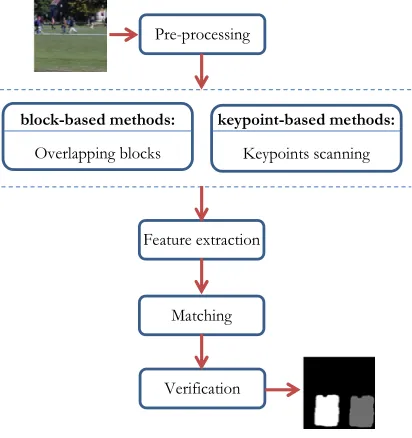
1.2 Copy-Move Forgery Detection Process Before the issues exist in CMFD are elaborated, it is important to understand the CMFD processes. There are two options in detecting copy-move forgeries; 1) block-based method 2) keypoint-based method. The general workflow of copy-move forgery detection [5] is illustrated in figure 1. It consists of several phases which are pre-processing, blocks tiling or keypoint scanning, feature extraction, matching and verification.
Pre-processing
block-based methods:
Overlapping blocks
keypoint-based methods:
Keypoints scanning
Feature extraction
Matching
[image:2.612.316.522.307.526.2]Verification
Figure 1: General Copy-Move Forgery Detection Process
Detection process starts once image which suspected to be containing copy-move forgery is input to the system. Image then optionally pre-processed to reduce feature dimension, e.g. by converting color image to grayscale, or applying Gaussian pyramid decomposition, Discrete Wavelet Transform (DWT) or Principal Component Analysis (PCA).
2554 without dividing it into blocks. Numbers of keypoints extracted are depended on the feature descriptor used. This brings to the next process which is feature extraction process.
In feature extraction process, raw features of each blocks or keypoints are computed to bring significant value or characteristic using feature descriptor. A good feature extractor or feature descriptor should be able to extract the best or robust features for forgery detection. Computed features are then stored in respective feature vector for matching purpose.
In matching process, the arrays of feature set will be compared between each other to find similar features. Two feature sets with high similarity is a sign for a duplicated region. The process did not stop here since usually upon completion of block matching, a lot of similar blocks can be seen exist in the image. This is where verification process took place.
Verification is a filtering process,
proposed to reduce the possibility of false matches in the detection image. The final output of this process is the detection map which shows duplicated image region in the image.
CMFD pipeline seem a very smooth processes, however, in actual situation it is very difficult to determine the real duplicated region in the image. To date, CMFD still incapable of accurately detect duplicated region when exist geometric transformation and post-processing manipulation. Accuracy of detection rate may reduce for image with some post-processing attacks, but not fail completely. However, duplicated region which involves geometric transforms such as scaling, translation or rotation can cause total failure to be detected [3].
2. TIME COMPLEXITY IN COPY-MOVE
FORGERY DETECTION
Robust copy-move forgery detection, which invariant to geometric transformation and post-processing manipulation is highly needed. Unfortunately, robust methods of CMFD lead to higher complexity and processing time.
Many factors contribute to this problem including the image size, block size, huge number of overlapping blocks, large feature vector
dimension, method used in feature extraction and method used in block matching process [6].
2.1 Image Size, Block Size and Overlapping Blocks (F1)
The first main process in CMFD for block-based method is to divide image into several overlapping blocks of size BxB. It is very important to determine the suitable block size to be used since it will directly impact the detection accuracy as well as computational time. If bigger block size is initiated, number of overlapping blocks will be decreased, hence lower computational time is achieved. This however may lead to missing accuracy in detecting small duplicated region. On the other hand, smaller block size may improves detection accuracy yet produce high computational time due to increasing number of overlapping blocks to be processed.
Overlapping blocks, A for image size of MxN and block size is BxB is calculated as;
A = (M-B+1)(N-B+1) (1)
For instance, if image size is 3000x2300 and block size is defined as 16x16, total overlapping blocks are (3000-16+1)(2300-16+1) = 6,820,725. And if block size 8x8 is chosen, there will be (3000-8+1)(2300-8+1) = 6,862,949 number of overlapping blocks. This indeed is a very huge number of overlapping blocks to be processed.
As image size is also one of the variable, with current trend where better quality image equivalent to bigger image size, this will leads to tremendous number of overlapping blocks to be processed to get a high accuracy detection result.
2.2 Method Used In Feature Extraction (F2) In feature extraction process raw features of each blocks or keypoints are computed to bring significant value or characteristic using feature descriptor. A good feature extractor or feature descriptor should be able to extract the best or robust features for forgery detection. This is a very important step in CMFD processes since the output will determine the accuracy of detection result.
2555
Table 1: Overview of CMFD Methods Robustness and Complexity
Author Feature Extraction Duplicated
Matching Technique
Robustness to Geometric Transform
Robustness to post-processing Com plexi ty Rota tion Scali ng Affi ne JPE G Nois e Blur ring
Fridrich, 2003, [4] Discrete Cosine Transform (DCT) Lexicographical sorting small High
Popescu, 2004, [7] PCA Lexicographical
sorting
Low
Weiqi, 2006, [8] Seven characteristics features
Lexicographical sorting
Low
Guohui, 2007, [9] DWT -SVD Lexicographical
sorting
Low
Mahdian, 2007, [10] Blur moment KD-tree High
Xiao Bing, 2008, [11] Singular value decomposition (SVD) Lexicographical sorting Low
Bayram, 2009, [12] Fourier Melin Transform (FMT) Counting Bloom filters small small Very High Lin, 2009, [13] Average intensity
function
Radix sort Low
Wang, 2009, [14] Junwen, 2009, [15] Liu, 2011, [16]
Hu moments, circle blocks
Lexicographical sorting
High
Ryu, 2010, [17] Zernike moments Lexicographical
sorting
High
Bashar, 2010, [18] DWT & KPCA Lexicographical
sorting
Very
High Amerini, 2011,
2013, [19, 20]
Scale Invariant Features Transform (SIFT) Second Nearest neighbor (2NN) High Shivakumar, 2011, [21]
Speeded Up Robust Features (SURF)
KD-Tree High
Li, 2013, [22] Local Binary Pattern (LBP)
Lexicographical sorting
High
Li, 2013, [23] Polar Cosine Transform (PCT)
ANN & LSH Very
High
Guo, 2013, [24] Adaptive non-maximal
suppression and DAISY descriptor
Euclidean Distance & 2NN
High
Chen, 2013, [25] Harris corner points and step sector statistics
Best-bin-first algorithm
High
Akbarpour Sekeh, 2013, [6]
Archimedean Spiral Sequential
block clustering
High
Lynch, 2013, [26] Average gray value Expanding
block algorithm
Low
Davarzani, 2013, [27]
Multiresolution Local Binary Patterns (MLBP)
K-d Tree High
Zhao, 2013, [28] DCT & SVD Lexicographical
sorting
Low
Li, 2014, [29] Polar Harmonic
Transform (PHT)
Lexicographical sorting
Very
high Thajeel, 2015, [30] Completed Robust Local
Binary Pattern (CRLBP)
Lexicographical sorting
High
Emam, 2015, [31] Polar Complex Exponential Transform (PCET)
ANN & LSH High
Lee, 2015, [32, 33] Histogram of orientated gradients & Gabor magnitude Lexicographical sorting small small Low
2556 5) keypoint-based method [5]. Each of the approaches has advantages and disadvantages. Details of the capabilities and weakness of these feature extractors could be found in many comprehensive survey and review papers done earlier by many researchers [5, 35-40], thus will not be discussed in this paper.
Table 1 show an overview of some CMFD methods robustness and complexity which have been proposed in the past. From the table, we could see that methods which able to handle more geometrical transform manipulations involved
higher complexity level. By taking into
consideration that the duplicated region might went through some geometrical transform before being pasted, many methods have tried to increase chance
of detection after rotation and scaling.
Unfortunately, a robust feature sets involves complex computation and leads to longer detection time.
2.3 Large Feature Vector Dimension (F3) Feature vector dimension is a length of feature set produce during feature extraction process. Some feature vector basically stores blocks’ pixel values, which depend on block size, e.g. 16x16 = 256, while others depend on block or image content respectively, with extra important value after computation. Some feature set exist in only one feature matrix but many stores as many feature matrices with different method of computation and criterion, thus leads to increasing number of feature vector’s dimension. Large feature vector dimension may effect in high computational time during feature extractions process itself as well as next process in the pipeline which is matching process.
Feature extraction method plays a
significant role in determining the size of feature set. To have a robust feature sets it usually involves large feature vector dimension together with complex computational process. Similar to block-size, feature vector dimension usually also directly impact the detection accuracy as well as computational time. Robust feature set usually available in large feature vector dimension, unfortunately, large feature vector dimension leads to higher computational time and longer matchings process
2.4 Method Used in Block Matching (F4) In matching process, comparison is done between each feature sets to find the duplicate
region. Region is suspected to be duplicated if high similarity found between two feature sets. This straightforward method, which called as exhaustive search was very inefficient, since its computes and compares the distance from one feature set to all others. The time complexity of this method is O(MN) for an image of size MxN.
To expedite the matching process, [4] introduced lexicographical sorting. Lexicographical sorting was done to the array which consists of rows storing the feature vector of blocks. By using this lexicographical sorting, the matching rows are easily search by finding for the two consecutive rows that are identical through all rows in the sorted matrix. Lexicographical sorting has become a common step in matching process and used by many previous researchers in their works [7-9, 14, 17, 18, 27-29, 41].
Nevertheless, it was observed that matching process still contributes to high computational time in overall CMFD process. Computational time in matching process may rely on many factors including the image size, block size, huge number of overlapping blocks, large feature vector dimension, method used in feature extraction and method used in block matching process [6]. This has motivated many researchers to propose many matching scheme which could improves time complexity yet produce a high accurate detection result.
3. EXISTING SOLUTIONS
A lot have been done by previous researchers to overcome time complexity issue. These approaches generally could be grouped into five main categories, which are decreasing number of instance blocks, enhance feature extraction algorithm and reducing feature vector dimension,
adopting alternative computation formula,
improving block matching algorithm and
implementing parallel processing scheme. Table 2 summarizes the existing solutions to this time complexity issue grouped by the five main categories, and the time complexity factors which were tackled by the solutions. The explanations on each solution are given in next sub-sections.
2557
Table 2: Solutions to Time Complexity Issues
Solutions / Method Authors Time complexity factors
F1 F2 F3 F4
1. Decreasing Number of Instance Blocks
Implementing key-point based method Hailing et al., 2008 [42], Bo et al., 2010 [43], Xunyu and Siwei, 2010 [44], Shivakumar and Baboo, 2011 [21], Amerini et al., 2011 [19].
Divide image to non-overlapping block Wang et al., 2011 [45]
Image Resizing Xiuli et al., 2016 [34]
2. Enhance Feature Extraction Algorithm and Reducing Feature Vector Dimension Converting a coloured image to
grayscale
Fridrich et al., 2003 [4], Yang and Huang, 2009 [46], Zhao and Guo, 2013 [28], Li et al., 2014 [29],
Adopting PCA/PCT Popescu and Farid, 2004 [7], Mahdian & Saic, 2007 [10], Al-Qershi and Khoo [47]
7 characteristics features Weiqi et al., 2006 [8]
Using low frequency subband of Wavelet Transform/ improved DWT
Li et al., 2007 [9], Myna et al., 2007 [48], Zhang et al., 2008 [49] Zimba and Xingming, 2011 [50] Yang et al., 2013 [51], Zimba, 2014 [52]
Using SVD Zhao and Guo, 2013 [28], Yang & Huang, 2009 [46],
Zhang and Wang [53]
Adopting Gaussian pyramid decomposition and truncate features
Wang et al., 2009 [14], Junwen et al., 2009 [15], Liu
et al., 2011 [16]. Adopting low-pass filtering during
pre-processing
Li et. al., 2013 [22], Li et al., 2014 [29], Emam et al., 2015 [31].
Adopting improved DCT Huang et al., 2011 [54]. Cao et al., 2012 [41]
3. Adopting alternative computation formula Using approximate nearest neighbour searching, free from dimensionality
Yuenan Li, 2013 [23]
Using Manhattan distance instead of Euclidean distance
Zulkurnain, 2015 [3], Ashwini et al., 2016 [55]
Using fast Walsh-Hadamard Transform (FWHT)
Yang et al., 2013 [51]
4. Improving Block Matching Algorithm
Adopting lexicographical sorting Fridrich et al., 2003 [4], Popescu and Farid, 2004 [7], Weiqi et al., 2006 [8], Li et al., 2007 [9], Wang et al., 2009 [14], Cao et al., 2012 [41], Bashar et al., 2010 [18], Ryu et al., 2010 [17], Davarzani et al., 2013 [27], Zhao and Guo, 2013 [28], Li et al., 2014 [29]
Using k–d tree algorithm Mahdian & Saic [10], Zhang and Wang [53], Davarzani et al., 2013 [27].
Using Counting bloom filters Bayram et al., 2009 [12].
Implementing an ANN searching using means of LSH
Yuenan Li, 2014 [23], Emam et al., 2015 [31].
K-means clustering LSH Al-Qershi and Khoo [47]
Using Radix sort Lin et al., 2009 [13], M. Zimba, 2014 [52], Sridevi et
al., 2012 [56]
Using Efficient subwindow search (ESS)
Zhang et al., 2010 [57],
Implementing coarse-to-fine approach Sekeh et. al., 2011 [1]
Using expanding block Lynch et. al., 2013 [26]
Clustering by similar color textures Xiuli et al., 2016 [34]
Multi-hop jump (MHJ) algorithm Yang et al., 2013 [51]
5. Implementing Parallel Processing Scheme Utilising Parallel algorithm in CPU
environment
Sridevi et al., 2012 [58]
Utilising task parallelism in GPU (Graphics Processing Units)
2558 solutions to reduce number of instance blocks. Instead of dividing image into blocks, keypoint-based method scan whole image and detect high entropy point without dividing the image into blocks [19, 21, 42-44]. Working with keypoint- based feature however has several weaknesses especially when dealing with small size tampered regions. The main drawback of keypoint-based feature descriptor compared with block-based descriptors is its sensitive to homogenous region, little structure and repetitive object. Inability to detect homogenous region and little structure will result in missed detection (false negative) while showing repetitive structure as tampered region increase false positive result.
In block-based method, some researcher chose to divide image to non-overlapping block instead of overlapping blocks [45]. Using example of formula in (1) for an overlapping blocks, total overlapping blocks to be processed are 6,820,725. In contrast, for non-overlapping blocks, D is calculated as;
D = MxN /B2 (2)
For the same example, total number of non-overlapping blocks are 3000x2300/162 = 26,953. Numbers of block to be processed were extremely reduced, nonetheless, it might affected the accuracy level. Some previous works [34] also suggested in image resizing during preprocessing step to improve computational efficiency. Nonetheless this process may change some pixels’ values and impact the detection result.
3.2 Enhance Feature Extraction Algorithm and Reducing Feature Vector Dimension
The dimension reduction could lower the computation complexity in feature extraction and expedite the sorting and matching processes. Since the features were extracted during feature extraction process, to resolve large feature dimension, enhancements were needed to be done to the feature extraction algorithm itself. As such the solutions were not only to reduce the large feature dimension but also to enhance the method used in feature extraction process.
The basic process in reducing feature vector dimension is by converting a colored image to grayscale before further analysis [4, 28, 29, 46, 51]. This is a popular step done by many researchers during preprocessing stage and usually the first step in CMFD workflow.
Principal Component Analysis (PCA) is a method for simplifying a multidimensional dataset to lower dimension for analysis or visualization. It was first introduced in CMFD domain by [7] to
yield a reduced dimension representation.
Compared to DCT [4] which has feature dimension of 256 for 16x16 block size, PCA reduced feature dimension to half of the original size for 8x8 block size. PCA was then used as a tool to reduce the feature vector size which was extracted from the image blocks by many other authors [10, 47].
In 2006, [8] used only seven
characteristics features for each block to be computed in feature extraction process. The computations involve average of red, green, and blue components as well as summations of 2 equal parts of four directions. With this lower computational complexity was achieved and it was more robust against various types of post-processing manipulations, such as noise adding, blurring, lossy compressing and a combination of these operations.
Other than PCA, Discrete Wavelet Transform (DWT) also has been widely used as method to reduce the dimension of image representation. Li et al. [9] and Myna et al. [48] reduced the image dimension by taking only the low frequency sub-band of DWT before the Singular Value Decomposition (SVD) is applied to the fixed-sized overlapping blocks. With this approach, feature size is reduced ¼ of its original
size. Not only the experimental results
demonstrated that the proposed approach decrease computational complexity, but it also localize the duplicated regions accurately even when the image was highly compressed or edge processed. Works by [49, 51] could be seen utilizing DWT for the same reason.
2559 [46, 53] used SVD not only to extract unique feature vectors of image blocks, but also to reduce blocks features dimension and increase resistance of noise. Before applying SVD, proposed method by Yang & Huang transformed image to grayscale and further down sampled image to lower resolution of 128x128. Only the first component of the sv-vector for each block is chosen to be used for matching process. With this sorting complexity and memory space was reduced dramatically. In 2013, after applying 2D-DCT to each block to generate the quantized coefficient, [28] used SVD to extract only the largest singular value from each quantized block to reduce the feature dimension. With this approach, feature size also was reduced ¼ of its original size.
[image:8.612.118.272.454.571.2][14-16] proposed adopting Gaussian pyramid decomposition to reduce the image size. Sub-image in low frequency which produced by this process is chosen to reduce the complexity of the detection algorithm and help to improve the detection result when there are some post-processing operation such as JPEG compression and noise contamination. In his works, image is first reduced in dimension by Gaussian pyramid, before the blocks’ features were extracted. Figure 2 gives the illustration about Gaussian pyramid decomposition used by [16].
Figure 2: The illustration of Gaussian pyramid decomposition from [16]
Hu moment was applied to the fixed sized overlapping blocks of low-frequency image in [14, 16] while in [15] mean of image pixel value in each circle region were calculated and adopted as features. Apart of that, to further reduce the computational complexity, only the first four moments and four features of the circle block were used as the feature for above works respectively.
Apart of that, low-pass filtering also adopted during pre-processing stage by few researcher to improve the detection performances, especially in the case of signal processing attacks. By adopting low-pass filtering, high frequency disturbances or smooth image modification were alleviated thus giving a better detection result [60]. Li et al. utilized Gaussian low-pass filter in both works [22, 29] and followed by other researchers [31] for the same purpose.
Improved DCT-based feature extraction was used by [54]. In order to reduce the feature dimension, higher frequency coefficients were truncated. Consideration was made due to the nature of DCT where the energy of transformed coefficients is focused on the lower frequency coefficients which located at the first several values. Almost similar to [54], [41] applied DCT coefficients for each block, before represented it as a circle block and only four features are extracted to reduce the dimension of each block.
In summary, most of the solutions were done by adding pre-processing or post processing steps in feature extraction algorithm. These include
grayscale conversion, Gaussian pyramid
decomposition, applying PCA, DWT or SVD, feature truncation or selection of dedicated features as well as improved DCT. Pre-processing steps were done to reduce time complexity during feature extraction process, while post-processing steps were done to ease matching process. Many hybrid feature extractors were also proposed in order to get the high robustness with reduced time complexity in feature extraction and matching process.
3.3 Adopting Alternative Computation Formula Lower computation complexity also could be achieved by adopting less complex formula. Yang et al. [51] adopting fast version of Walsh– Hadamard transform (FWHT) during features extraction process. The fact that FWHT only use addition and subtraction makes the computations simpler and runs more efficiently.
2560 The above two computations were only some example of many other fast or simpler computation adopted by many researcher during CMFD process to reduce computation time. This is a popular option since it can save computation time with just a slight reduction in the accuracy of the calculation.
3.4 Improving Block Matching Algorithm In matching process, more options had been proposed to reduce the processing time. Instead of using exhaustive search to compute the distance from the block to all others, [4] introduced lexicographical sorting in matching process. By using this lexicographical sorting, the matching rows are easily search by finding for the two consecutive rows that are identical through all rows in the sorted matrix. Lexicographical sorting has become a common step in matching process and used by many previous researchers in their works [7-9, 14, 17, 18, 27-29, 41].
Some hierarchical structures also have been proposed to enhance the neighboring blocks searching efficiency. One of a commonly used structure is the k–d tree (k-dimensional space). Mahdian and Saic [10] proposed k-d tree representation in their works where the feature extraction used were moment feature and PCA. Zhang and Wang [53] in their works used SVD together with k-d tree resulted in lower computational complexity and was more robust to various post image processing except jpeg compression compared to [4, 7, 8].
Davarzani et al. [27] utilized both
lexicographical sorting and KD-tree in their proposed method. Lexicographical order was first used in sorting the feature vectors while k-d tree were implement to determine duplicated image blocks in the block matching step to achieve more time reduction and accuracy in the matching process. This method however, is still time consuming for forgery detection in high resolution images compared to DCT and SIFT.
Bayram [12] used Counting bloom filters in their matching process to improve the time efficiency. This proposed method works by comparing the hashes of features instead of the
features themselves. Time efficiency was
considerably improved with the expense of a slight reduction in the robustness.
An approximate nearest neighbor (ANN) searching using means of locality-sensitive hashing (LSH) was adopted in the proposed work by Yuenan Li [23] and later followed by [31]. LSH is one of the most effective tool for approximate
nearest neighbor searching, and has been
successfully applied in a number of areas such as information retrieval and large-scale database indexing. Approximate nearest neighbor searching is accomplished in LSH by hashing the vectors using a set of hash functions and picking up those with identical hash values. Experiment result demonstrated a higher degree of robustness against post-processing operations, faster running time and free from dimensionality. LSH also has been adopted in [47] where Al-Qershi and Khoo proposed k-means clustering and LSH method to match the blocks based on Zernike moments. Processing time was said to reduce to 10% with enhancement to detection accuracy
Radix sort was proposed by Lin et al. [13] to sort the feature vectors instead of lexicographic sorting. Apart of that feature dimension of each block was earlier reduced by representing it in 9-dimensional feature vector in spatial domain. Employing the radix sort improves the detection time efficiently with slight reduction in the robustness. Radix-sort however only permits integer value as feature vector elements and this has limits its feasibility to other type of feature vector [6]. Some researcher which also employ Radix-sort were [52, 58].
Efficient subwindow search (ESS) is one of the most efficient methods based on subwindow search to accomplish the localization work. In proposed method by [57], a voting method was adopted before ESS was applied to find the potential source-target region pair. The proposed methods was claim to reduce the time complexity from best reported O(PlogP) to O(P), where P is the number of pixels in the image for the simple pure translation cases. The experiments done however did not show the comparison table between ealier method and the proposed method.
2561 that the proposed model is more cost-effective than lexicographically-based sorting for small block size. Almost similar to [1], expanding block was suggested by Lynch et al. [26] where blocks are grouped and sorted together according to their dominant features before the matching process took place. This approach however produced high number of false positive result and slower compared to DCT and statistical which using sliding block.
Yang et al. [51] proposed multi-hop jump (MHJ) algorithm to ignore some of the “unnecessary testing blocks” (UTB) to make the range matching more efficient, Experimental results demonstrated that the proposed method is able to accurately detect the copy-move forgery with significant reduction in the processing time compared with other methods. This proposed method however is weak in detecting images which undergone geometrical transformation attacks.
In the recent years, some enhancement were done involving clustering by similar color
textures, proposed by Xiuli et al. [34].
Computational expense was much decreased using this method, with promising results in robustness against various attacks.
From exhaustive search to lexicographic sorting, followed by kD-tree, counting bloom filters, ANN, radix sort, ESS, coarse-to-fine and latest is clustering technique. The research work is actively on going. In short, more options were explored to reduce the search space in order to minimize the block comparison process as well as improve the time complexity.
3.5 Implementing Parallel Processing Scheme The most recent trends in resolving performance issue is exploiting task parallelism. In CMFD, [58] introduced parallel algorithm in CPU environment to decrease the execution time. Overlapping blocks and sorting operations are proposed to be done in parallel. The result reported that the parallel version performs task faster and very well suited for real time applications. Since the images used in the experiment were grayscale images with small block size defined, future works may explore in color images, or high resolution images. It was also observed that this method is only caters for plain copy-move, without taking into consideration other types of manipulations, i.e. geometrical transformation or post-processing
attacks. Nevertheless, this research has open up more options in resolving time complexity issue.
Task parallelism was extended to be used in GPU (Graphics Processing Units) by [59]. In their works, feature vectors were computed based on integral images and radix sort was adopted. Computation of feature vector in GPU shows significant speedup of over 230 times, while the overall process speedup was reduced 12 times compared to CPU version. As the main purpose of this research is to speedup detection process, no conclusive results are shown regarding robustness to geometric or post-processing manipulation. Another works were done by [3] to improve CMFD performance and compare the detection of duplicated region using counting bloom filters and radix sort. He used DCT as feature extraction in this study. Result shown that feature extraction done in GPU-based scheme was 5 times faster than the multi-threaded CPU while counting bloom filters was 18 times faster that radix sort in detecting duplicate region. Overall, the scheme achieved 84% detection rate since DCT is not invariance to geometrical transformation.
It was observed that all these few initial works on utilizing task parallelism is only cater for simple feature extraction process with less computation works. It is also not robust to geometrical distortion. Nevertheless, these seem to give a good sign to this area and open up many more research works to be explored.
4. DISCUSSION
Robust copy-move forgery detection, which invariant to geometric transformation and
combined manipulations is highly needed.
Unfortunately, since research progresses towards developing more robust methods of CMFD, the algorithms being proposed have higher and higher complexity. Literature shows that it is a very challenging task to get the best balance between accuracy and time complexity.
2562 Previous works has shown that many efforts have been done to overcome time complexity issue such as decreasing number of
instance blocks, enhance feature extraction
algorithm, reducing feature vector dimension, improving block matching algorithm, adopting less complex formula and implementing parallel processing scheme.
Implementing keypoint-based algorithm could be considered as major success since it capable in detecting copy-move forgery even with existence of geometrical transform manipulation in
timely manner. Nevertheless keypoint-based
algorithm suffer from miss detection issue if the image consist of homogenous region, little structure and repetitive object.
As a result, more and more research was done to resolve time complexity issue within block-based method. In order to reduce feature vector dimension and enhance feature extraction process, many researchers proposed to adopt preprocessing or post processing task. These include grayscale conversion, Gaussian pyramid decomposition, applying PCA and DWT as well as improved DCT. Many hybrid feature extractors were also proposed in order to get the high robustness with reduced time complexity in feature extraction and matching process.
Time complexity also could be reduced by adopting less complex formula in computation. With a slight reduction in the accuracy of the calculation, this option could effectively reduce the computation time.
In matching process, more solutions were explored to increase matching efficiency. Apart of using lexicographical sorting, now more options are available such as K-d tree, counting bloom filters, ANN, Radix sort and many more.
Not only limited to software enhancement, solutions were also extended to hardware environment where CPU and GPU parallel processing were also feasible and given promising result.
With current positive trend, there still many work to be done to improve the efficiency of detection process. Robust feature set usually consist of huge feature set. Having a small yet robust feature set surely will improve time complexity issue in feature extraction as well as matching
process. As such it is recommended for future feature extractor to include pre and post-processing task within the feature extraction process to achieve this goal.
Within the matching process, it was observed that block clustering could reduce the
block matching search space, thus could
significantly improve the time complexity. With that, researcher may propose more alternative clustering solutions in matching process.
Current CPU and GPU parallel scheme were only done to simple feature extraction algorithm, as such there were no evidence on the efficiency of these solutions should a complex feature extraction is implemented. It is highly recommended if these solutions could be adopted to handle geometric transform manipulation.
Apart of parallel processing, future works should consider multilayer processing. Multilayer processing perhaps could be applied during feature extraction process as well as matching process.
5. CONCLUSION
In this survey we highlighted few scenarios in copy-move forgery based on types of manipulations and image categories. A brief explanation on copy-move forgery detection workflow is given to provide better understanding on how the time complexity issue could exist in CMFD pipeline. Four main factors that contribute to this issue were identified and describe accordingly. Furthermore existing solutions proposed by previous researcher were elaborated and classified to five categories to determine the effectiveness in existing CMFD process. Overall discussion on the issues and solutions was done. Some possible future enhancements were proposed includes enhancement to feature extraction algorithm, adopting block clustering in matching process, utilizing the advancement of parallel processing scheme as well as multilayer processing. It is hope that other researchers will gain from this paper by producing a fast and accurate CMFD method.
ACKNOWLEDGMENTS
The authors would like to thank the Malaysia Ministry of Higher Education (MOHE) and Universiti Tun Hussein Onn Malaysia (UTHM) for sponsoring the research studies and also to
2563 providing the necessary facilities for the preparation of the paper. The reviewers’ comments and suggestions in improving the paper are highly appreciated.
REFRENCES:
[1] M. A. Sekeh, M. A. Maarof, M. F. Rohani,
and M. Motiei, "Efficient Image Block Matching Algorithm with Two Layer Feature Extraction," in Information Technology in Asia (CITA 11), 2011 7th International Conference on, 2011, pp. 1-5.
[2] M. A. Sekeh, M. A. Maarof, M. F. Rohani,
and M. Motiei, "Spiral Unique Sequence: A New Rotation Invariant Feature for Small-size Image Block Matching," in Signal and Image Processing Applications (ICSIPA), 2011 IEEE International Conference on 2011, pp. 535-540.
[3] A. U. Zulkurnain, "Graphics Processing Unit Based Parallel Copy Move Image Forgery Detection Scheme," Master of Computer Science (Information Security),
Faculty of Computing, Universiti
Teknologi Malaysia, Malaysia, 2015.
[4] J. Fridrich, D. Soukal, and J. Lukas,
"Detection of Copy-Move Forgery in Digital Images," presented at the Proc. Of Digital Forensic Research Workshop, 2003.
[5] V. Christlein, C. Riess, J. Jordan, C. Riess,
and E. Angelopoulou, "An Evaluation of Popular Copy-Move Forgery Detection
Approaches," IEEE Transactions on
Information Forensics and Security, vol. 7, pp. 1841-1854, 2012.
[6] M. Akbarpour Sekeh, "Enhanced
Copy-paste Image Forgery Detection based on Archimedean Spiral and Coarse-To-Fine
Approach," Doctor of Philosophy
(Computer Science), Faculty of
Computing, Universiti Teknologi
Malaysia, Johor, Malaysia, 2013.
[7] A. C. Popescu and H. Farid, "Exposing Digital Forgeries by Detecting Duplicated Image Regions," Dept. Comput. Sci., Dartmouth College, Tech. Rep. TR2004-515, 2004.
[8] L. Weiqi, H. Jiwu, and Q. Guoping,
"Robust Detection of Region-Duplication Forgery in Digital Image," in Pattern Recognition, 2006. ICPR 2006. 18th
International Conference on, 2006, pp. 746-749.
[9] L. Guohui, W. Qiong, D. Tu, and S.
Shaojie, "A Sorted Neighborhood
Approach for Detecting Duplicated
Regions in Image Forgeries Based on DWT and SVD," in Multimedia and Expo, 2007 IEEE International Conference on, 2007, pp. 1750-1753.
[10] B. Mahdian and S. Saic, "Detection of copy–move forgery using a method based on blur moment invariants," Forensic Science International, vol. 171, pp. 180-189, 9/13/ 2007.
[11] K. Xiao Bing and W. Sheng Min,
"Identifying Tampered Regions Using Singular Value Decomposition in Digital Image Forensics," in Computer Science and Software Engineering, 2008 International Conference on, 2008, pp. 926-930.
[12] S. Bayram, H. T. Sencar, and N. Memon, "An Efficient and Robust Method for
Detecting Copy-move Forgery," in
Acoustics, Speech and Signal Processing, 2009. ICASSP 2009. IEEE International Conference on, 2009, pp. 1053-1056.
[13] H.-J. Lin, C.-W. Wang, and Y.-T. Kao,
"Fast Copy-Move Forgery Detection," WSEAS Transactions on Signal Processing, vol. 5, pp. 188-197, 2009.
[14] J. Wang, G. Liu, Z. Zhang, Y. Dai, and Z.
Wang, "Fast and Robust Forensics for Image Region-Duplication Forgery," Acta Automatica Sinica, vol. 35, pp. 1488-1495, 2009.
[15] W. Junwen, L. Guangjie, L. Hongyuan, D.
Yuewei, and W. Zhiquan, "Detection of Image Region Duplication Forgery Using Model with Circle Block," in Multimedia Information Networking and Security, 2009. MINES '09. International Conference on, 2009, pp. 25-29.
[16] G. Liu, J. Wang, S. Lian, and Z. Wang, "A passive image authentication scheme for detecting region-duplication forgery with
rotation," Journal of Network and
Computer Applications, vol. 34, pp. 1557-1565, 9// 2011.
[17] S.-J. Ryu, M.-J. Lee, and H.-K. Lee,
2564 [18] M. Bashar, K. Noda, N. Ohnishi, and K.
Mori, "Exploring Duplicated Regions in Natural Images," Image Processing, IEEE Transactions on, vol. PP, pp. 1-1, 2010. [19] I. Amerini, L. Ballan, R. Caldelli, A. Del
Bimbo, and G. Serra, "A SIFT-Based Forensic Method for Copy-Move Attack Detection and Transformation Recovery," Information Forensics and Security, IEEE Transactions on, vol. 6, pp. 1099-1110, 2011.
[20] I. Amerini, L. Ballan, R. Caldelli, A. Del Bimbo, L. Del Tongo, and G. Serra,
"Copy-move forgery detection and
localization by means of robust clustering with J-Linkage," Signal Processing: Image Communication, vol. 28, pp. 659-669, 7// 2013.
[21] B. Shivakumar and L. D. S. S. Baboo,
"Detection of Region Duplication Forgery in Digital Images Using SURF," IJCSI International Journal of Computer Science Issues, vol. 8, 2011.
[22] L. Li, S. Li, H. Zhu, S.-C. Chu, J. F. Roddick, and J.-S. Pan, "An Efficient Scheme for Detecting Copy-move Forged Images by Local Binary Patterns," Journal of Information Hiding and Multimedia Signal Processing, vol. 4, pp. 46-56, 2013.
[23] Y. Li, "Image copy-move forgery
detection based on polar cosine transform
and approximate nearest neighbor
searching," Forensic Science
International, vol. 224, pp. 59-67, 1/10/ 2013.
[24] J.-M. Guo, Y.-F. Liu, and Z.-J. Wu,
"Duplication forgery detection using
improved DAISY descriptor," Expert
Systems with Applications, vol. 40, pp. 707-714, 2/1/ 2013.
[25] L. Chen, W. Lu, J. Ni, W. Sun, and J. Huang, "Region duplication detection based on Harris corner points and step sector statistics," Journal of Visual
Communication and Image
Representation, vol. 24, pp. 244-254, 4// 2013.
[26] G. Lynch, F. Y. Shih, and H.-Y. M. Liao,
"An efficient expanding block algorithm for image copy-move forgery detection," Information Sciences, vol. 239, pp. 253-265, 8/1/ 2013.
[27] R. Davarzani, K. Yaghmaie, S. Mozaffari,
and M. Tapak, "Copy-move forgery detection using multiresolution local
binary patterns," Forensic Science
International, vol. 231, pp. 61-72, 9/10/ 2013.
[28] J. Zhao and J. Guo, "Passive forensics for copy-move image forgery using a method
based on DCT and SVD," Forensic
Science International, vol. 233, pp. 158-166, 12/10/ 2013.
[29] L. Li, S. Li, H. Zhu, and X. Wu,
"Detecting copy-move forgery under affine transforms for image forensics," Computers & Electrical Engineering, vol. 40, pp. 1951-1962, 8// 2014.
[30] S. A.-N. Thajeel and G. Sulong, "A Novel
Approach for Detection of Copy Move Forgery using Completed Robust Local Binary Pattern," 2015.
[31] M. Emam, Q. Han, and X. Niu, "PCET based copy-move forgery detection in images under geometric transforms," Multimedia Tools and Applications, pp. 1-15, 2015/09/29 2015.
[32] J.-C. Lee, C.-P. Chang, and W.-K. Chen, "Detection of copy–move image forgery using histogram of orientated gradients," Information Sciences, 2015.
[33] J.-C. Lee, "Copy-move image forgery
detection based on Gabor magnitude," Journal of Visual Communication and Image Representation, vol. 31, pp. 320-334, 8// 2015.
[34] X. Bi, C.-M. Pun, and X.-C. Yuan,
"Multi-Level Dense Descriptor and Hierarchical Feature Matching for Copy–Move Forgery Detection," Information Sciences, vol. 345, pp. 226-242, 6/1/ 2016.
[35] O. M. Al-Qershi and B. E. Khoo, "Passive
detection of copy-move forgery in digital images: State-of-the-art," Forensic Science International, vol. 231, pp. 284-295, 9/10/ 2013.
[36] S. A. Thajeel, "State of The Art of Copy-Move Forgery Detection Techniques: A Review," 2013.
[37] W. N. Nathalie Diane, S. Xingming, and
F. K. Moise, "A Survey of Partition-Based
Techniques for Copy-Move Forgery
Detection," The Scientific World Journal, vol. 2014, p. 13, 2014.
[38] M. A. Qureshi and M. Deriche, "A
2565 [39] G. K. Birajdar and V. H. Mankar, "Digital
image forgery detection using passive
techniques: A survey," Digital
Investigation, vol. 10, pp. 226-245, 10// 2013.
[40] H. Farid, "Image Forgery Detection," IEEE Signal Processing Magazine, vol. 26, pp. 16-25, 2009.
[41] Y. Cao, T. Gao, L. Fan, and Q. Yang, "A robust detection algorithm for copy-move forgery in digital images," Forensic Science International, vol. 214, pp. 33-43, 1/10/ 2012.
[42] H. Hailing, G. Weiqiang, and Z. Yu,
"Detection of Copy-Move Forgery in Digital Images Using SIFT Algorithm," in Computational Intelligence and Industrial Application, 2008. PACIIA '08. Pacific-Asia Workshop on, 2008, pp. 272-276.
[43] X. Bo, W. Junwen, L. Guangjie, and D.
Yuewei, "Image Copy-Move Forgery Detection Based on SURF," presented at the Proceedings of the 2010 International Conference on Multimedia Information Networking and Security, 2010.
[44] P. Xunyu and L. Siwei, "Detecting Image Region Duplication Using SIFT features," in Acoustics Speech and Signal Processing (ICASSP), 2010 IEEE International Conference on, 2010, pp. 1706-1709. [45] W. Xiaofeng, Z. Xiaoni, L. Zhen, and W.
Shangping, "A DWT-DCT Based Passive
Forensics Method for Copy-Move
Attacks," in International Conference on Multimedia Information Networking and Security (MINES), 2011 Third, 2011, pp. 304-308.
[46] Q.-C. Yang and C.-L. Huang,
"Copy-Move Forgery Detection in Digital
Image," in Advances in Multimedia
Information Processing - PCM 2009. vol. 5879, P. Muneesawang, F. Wu, I. Kumazawa, A. Roeksabutr, M. Liao, and X. Tang, Eds., ed: Springer Berlin Heidelberg, 2009, pp. 816-825.
[47] O. M. Al-Qershi and B. E. Khoo, "Copy-Move Forgery Detection Using on Locality Sensitive Hashing and k-means Clustering," in Information Science and Applications (ICISA) 2016, K. J. Kim and N. Joukov, Eds., ed Singapore: Springer Singapore, 2016, pp. 663-672.
[48] A. N. Myna, M. G. Venkateshmurthy, and
C. G. Patil, "Detection of Region Duplication Forgery in Digital Images
Using Wavelets and Log-Polar Mapping," in Conference on Computational Intelligence and Multimedia Applications, 2007. International Conference on, 2007, pp. 371-377.
[49] Z. Jing, F. Zhanlei, and S. Yuting, "A new approach for detecting Copy-Move forgery in digital images," in 2008 11th IEEE Singapore International Conference on Communication Systems, 2008, pp. 362-366.
[50] M. Zimba and S. Xingming, "DWT-PCA
(EVD) Based Copy-move Image Forgery Detection," International Journal of Digital Content Technology and its Applications, vol. 5, pp. 251-258, 2011.
[51] Y. Bin, S. Xingming, C. Xianyi, J. Zhang,
and L. Xu, "An Efficient Forensic Method for Copy--move Forgery Detection Based on DWT-FWHT," Radioengineering, vol. 22, 2013.
[52] M. Zimba, "DWT-SATS Based Detection
of Image Region Cloning," 2014.
[53] T. Zhang and R.-d. Wang, "Copy-Move
Forgery Detection Based on SVD in Digital Image," in Image and Signal Processing, 2009. CISP '09. 2nd International Congress on, 2009, pp. 1-5. [54] Y. Huang, W. Lu, W. Sun, and D. Long,
"Improved DCT-based detection of copy-move forgery in images," Forensic Science International, vol. 206, pp. 178-184, 3/20/ 2011.
[55] B. K. Mishra, V. A. Bharadi, B. Nemade, A. V. Malviya, and S. A. Ladhake, "Pixel Based Image Forensic Technique for Copy-move Forgery Detection Using Auto Color Correlogram," Procedia Computer Science
Proceedings of International Conference on Communication, Computing and Virtualization (ICCCV) 2016, vol. 79, pp. 383-390, 2016/01/01 2016.
[56] M. Sridevi, C. Mala, and S. Sanyam,
"Comparative Study of Image Forgery and Copy-Move Techniques," in Advances in Computer Science, Engineering & Applications. vol. 166, D. C. Wyld, J. Zizka, and D. Nagamalai, Eds., ed: Springer Berlin Heidelberg, 2012, pp. 715-723.
[57] C. Zhang, X. Guo, and X. Cao,
"Duplication Localization and
2566 6297, G. Qiu, K. Lam, H. Kiya, X.-Y. Xue, C. C. J. Kuo, and M. Lew, Eds., ed: Springer Berlin Heidelberg, 2010, pp. 578-589.
[58] M. Sridevi, C. Mala, and S. Sandeep,
"Copy–Move Image Forgery Detection in A Parallel Environment," 2012.
[59] J. Singh and B. Raman, "A High
Performance Copy-Move Image Forgery
Detection Scheme on GPU," in
Proceedings of the International Conference on Soft Computing for Problem Solving (SocProS 2011) December 20-22, 2011. vol. 131, K. Deep, A. Nagar, M. Pant, and J. C. Bansal, Eds., ed: Springer India, 2012, pp. 239-246.
[60] Y. Heng, Q. Tong, T. Zhenjun, Z. Yan,


![Figure 2: The illustration of Gaussian pyramid decomposition from [16]](https://thumb-us.123doks.com/thumbv2/123dok_us/8906834.957218/8.612.118.272.454.571/figure-illustration-gaussian-pyramid-decomposition.webp)
