associated with implementing knowledge
management strategies in construction
organisations
Mohd Zin, IN and Egbu, CO
Title A literature review on the challenges associated with implementing knowledge management strategies in construction organisations
Authors Mohd Zin, IN and Egbu, CO
Type Conference or Workshop Item
URL This version is available at: http://usir.salford.ac.uk/12819/
Published Date 2009
USIR is a digital collection of the research output of the University of Salford. Where copyright permits, full text material held in the repository is made freely available online and can be read, downloaded and copied for noncommercial private study or research purposes. Please check the manuscript for any further copyright restrictions.
A LITERATURE REVIEW ON THE CHALLENGES
ASSOCIATED WITH IMPLEMENTING KNOWLEDGE
MANAGEMENT STRATEGIES IN CONSTRUCTION
ORGANISATIONS
Ida Nianti Mohd Zin1 and Charles Egbu
Research Institute of the Built and Human Environment, School of Built Environment, the University of Salford, Greater Manchester, M5 4WT, UK
The significance of knowledge management (KM) in any organisation is increasingly being realised. As a result, KM is increasingly being incorporated in the management agenda and in organisational strategic choices. KM is becoming an important tool in staying ahead in the competition between organisations. A review of the literature indicates that the construction industry has begun to realise the importance of KM. However, many construction firms are facing challenges to do with collating, assimilating and exploiting relevant information and experiences. Even if knowledge is captured, getting people to contribute and utilise stored knowledge assets is a challenge. With these come further challenges, which are precipitated either because people are not aware of the involved KM technologies or are not cognisant of the benefits of such KM initiatives. However, if these challenges are effectively addressed, organisations stand to derive a lot of benefits. Part of addressing these challenges is the development and implementation of a holistic and effective knowledge strategy. This paper reviews KM strategies together with the impact of such strategies on construction organisations. It concludes that aligning a KM strategy with the wider organisational strategy is vital. It recommends that effective
communication of a KM strategy within the organisation is important as part of an effective implementation of a KM strategy. In addition, a balanced view is needed in considering the issues of finance, culture, technology and people issues in the development and implementation of an effective strategy.
Keywords: competition, culture, knowledge management, strategy.
INTRODUCTION
In recent years, most organisations have realised the importance of considering knowledge management (KM) concepts in ensuring organisational survival and competitive edge in a continuously changing environment (Martensson 2000). KM has been accepted as a necessity in the management agenda and in organisational strategic choices as knowledge is seen as one of the organisation‟s most important resources. As pointed out by Drucker (1995), “knowledge is the only meaningful economic resource”. Knowledge can also be seen as a key source of advantage (Quintas et al., 1997). Since knowledge is recognised as being important to organisations, it needs to be utilised to maximum advantage by organisations in possession of such knowledge.
Knowledge has been used as a tool for organisations to place themselves above the competition. As such, organisations have gone to great lengths to procure and manage state-of-the-art resources and in turn guard these resources to prevent other
organisations from plagiarising them. These involve extensive innovativeness and improvisations with the aim of cost and time savings in order to beat the competition (Egbu et al., 1999). However, in the construction industry, such lofty aims are not so easily implemented due to the nature of modern construction practices and technology which are more complex. KM is largely seen as a challenge in the construction
organisation. Hence, KM in construction needs a more in-depth study to identify the root cause of the challenge and to come up with a more resilient strategy in managing knowledge (Mohamed and Anumba 2004).
This paper is based on a thorough review of extensive literature of an on-going PhD study and is in its literature review stage. The aim of this paper is to explore the relevant literature on the challenges in the development and implementation of a holistic and effective knowledge strategy together with the impact of such strategies on construction organisations.
LITERATURE REVIEW
Main concepts of KM
In understanding KM, it is important to have a working understanding of the differences between data, information and knowledge.'Data' and 'information' is commonly misunderstood to be synonymous with knowledge. Many do not realise that there are subtle differences in their meanings (Nonaka and Takeuchi 1995). Data becomes information if one adds context, categories or calculations. Information has little value and will not become knowledge until it is processed by the human mind (Ash 1998). Information turns into knowledge if humans add their experience, judgement, values and beliefs to use it for comparison, decision-making and conversations (Davenport and Prusak 1998).
According to Davenport and Prusak (1998), “Knowledge is a fluid mix of framed experiences, values, contextual information, and expert insight that provides a framework for evaluating and incorporating new experiences and information. It originates and is applied in the minds of knowers”. Knowledge can be tacit or explicit (Nonaka and Takeuchi 1995). Tacit knowledge is information understood but not expressed in writing. Explicit knowledge is knowledge that has been or can be articulated, codified and stored in certain media. It can be readily transmitted to others. The most common forms of explicit knowledge are manuals, documents and procedures.
enabling knowledge to be celebrated and exploited to create value for the organisation.
KNOWLEDGE MANAGEMENT STRATEGIES AND THE
CONSTRUCTION INDUSTRY
The construction industry is a knowledge-based industry; it is diverse, being made up of different professionals providing a range of services for clients, customers and the wider community (Egbu and Robinson 2005). Construction organisations have many reasons to practise sound KM initiatives. The construction industry faces several problems in managing knowledge due to its characteristics. It usually maintains some characteristics in the operation determined by their properties such as the high
physical labour-intensity, the obvious function of human factors, the low entry
threshold for staff, increased turnover of subcontract labour besides its short term and temporary project-based nature with considerable fragmentation. Hence, most of the knowledge of the industry is generated in projects during the process to deliver a custom-built facility in accordance with the client‟s requirements and business objectives (Tan et al., 2005).
In the construction industry, KM strategies are particularly important for the following reasons:
Projects are inter-related thus it is crucial that good practices within the project environment be adhered to and kept accessible to ensure smooth project transition. The unique characteristics of individual projects prevent the adoption of a standard set of practices applicable to all projects. From the KM perspective, it is these unique characteristics comprising procedures, processes and technologies that contribute the most value.
Each day on the construction site brings forth a new problem and a new solution. The management of these unique problems and their solutions form tacit
knowledge confined to the minds of only those who experienced them. The persons in possession of these tacit knowledge will prove valuable to the industry as they help prevent „reinvention of the wheel‟ and repetition of similar mistakes. This knowledge also becomes the basis for innovation, overall improvement and sustaining competitive advantage (Tan et al., 2005)
The very nature of construction witnesses continual changes in job location and transfer of line workers amongst construction companies. It is for these reasons that practical experience and tacit knowledge becomes critical and hence, should be transformed as the organisation‟s knowledge assets. The management of this tacit knowledge via proper documentation and record-keeping is crucial for future employee training and cost-cutting exercises options.
Traditionally, the construction industry has low productivity and poor performance despite its importance in the national economy (Egbu et al., 1999). Effective KM has a role to play in improving performance.
RESEARCH QUESTIONS
This research aims to answer a few pertinent questions: what are the perceptions of construction organisations on KM and whether the size of organisations impacts these perceptions; how are KM strategies perceived to affect organisational performance; what are the challenges faced by construction organisations in setting up and
implementing KM strategies; how ready are these construction organisations in setting up and implementing KM strategies; what are the main benefits of KM strategies; and how do organisational structures, cultures and HR practices influence the
implementation of KM strategies?
To answer those questions, the following research objectives are proposed:
To critically review the literature and document the perceptions of construction organisations (small, medium and large) on formal and informal approaches to KM.
To appraise and document the different formal and informal approaches employed by construction organisations for KM.
To explore and document the main challenges that face construction organisations in the „setting-up‟ and implementation of formal and informal approaches to KM
To specifically explore the readiness of organisations to „set-up‟ and implement formal and informal approaches to KM.
To investigate the significance (importance and benefits) of formal and informal approaches to KM in organisations.
To specifically investigate the degree of influence that organisational structures, culture and human resource management practices play in the implementation of formal and informal approaches of KM.
To develop and validate a conceptual model that encapsulates the key factors that impact upon the successful implementation of formal and informal approaches to KM in organisations.
To develop an appropriate training material (for CPD purposes) that would help improve awareness and understanding of the challenges and significance of formal and informal approaches to KM in construction organisation.
However, due to the limited scope present, this paper will only address the challenges faced by the construction industry in developing and implementing KM strategies and the impact these challenges have on this industry.
CHALLENGES IN IMPLEMENTING KNOWLEDGE
MANAGEMENT STRATEGIES IN CONSTRUCTION
ORGANISATIONS
organisations need to overcome these through an effective KM strategy. The three principal barriers are: an unsupportive culture, poor communications structure and time constraints. Robinson et al. (2001) have carried out KM research in large construction organisations in the UK where they examined the perceptions and barriers in implementing KM strategies. Some of the challenges found were; organisational culture, lack of standard work processes, time constraint, employee resistance, poor IT infrastructure, insufficient money, long term organisational commitment, lack of understanding of KM and conflicting priorities on the demand for resources.
Egbu (2004) also conducted a study on KM issues in three empirical studies
conducted in construction organisations in the UK. In this study, he investigated the incoherent and lack of ownership of knowledge vision in the industry. There was a prevalent lack of appreciation of knowledge as an important asset. Organisations in the industry do not promote an information-sharing culture and there was a lack of appropriate methods and tools for measuring and valuing knowledge. In addition, there were inadequate standardised processes in place. There was evidence of inflexible organisational structures, time constraints and enormous pressure on key staff (knowledge “experts”). There was an endemic reluctance to, or fear of, the use and application of IT tools for KM (technophobia). Some members of the industry only see the “knowledge is power syndrome” and not the “law of increasing returns” associated with knowledge creation whereby shared knowledge stays with the giver while enriching the receiver Egbu (2004). Overall, there was a lack of a clear purpose or shared language and meaning of KM in the industry.
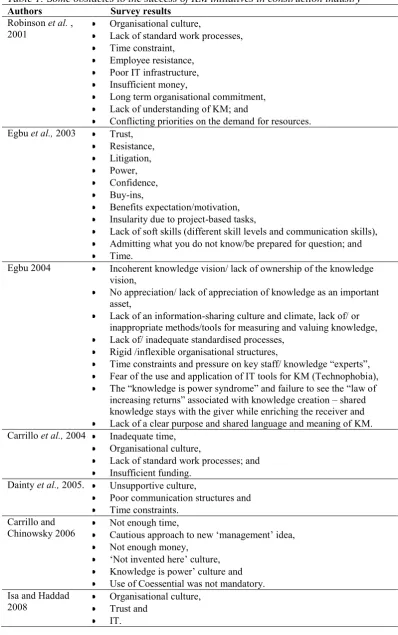
While some companies have implemented KM projects, not all have succeeded; most were partial successes or outright failures. Table 1 reveals some obstacles to success in such initiatives.
Judging by the wide-ranging studies conducted above, the key issues associated with the development and implementation of KM strategies are critical. In implementing KM strategy, the construction organisation needs to be aware of the challenges that may inhibit the successful implementation of KM initiatives. Key issues affecting KM strategies identified are finance, culture, technology and people.
Finance Issues
Critical financial management is necessary in ensuring organisations allocate the right resources to the right purposes in support of KM strategies. This presents a major challenge even equipped with ample funds in the budget as unscrupulous management of the finances may set back funds set aside for training, maintenance and other KM-related activities. To successfully implement KM requires adequate funding but this poses another challenge as top management often resists increased budget al.location for administrative purposes. The budget needs to address resources, outside expertise, technology, and subscriptions (access to additional information sources). A research done by Egbu et al. (2004) highlights that KM specialists are unlikely to get the resources they need until they can provide justification in terms of returns in
Table 1: Some obstacles to the success of KM initiatives in construction industry
Authors Survey results
Robinson et al. ,
2001 Organisational culture, Lack of standard work processes,
Time constraint,
Employee resistance,
Poor IT infrastructure,
Insufficient money,
Long term organisational commitment,
Lack of understanding of KM; and
Conflicting priorities on the demand for resources. Egbu et al., 2003 Trust,
Resistance,
Litigation,
Power,
Confidence,
Buy-ins,
Benefits expectation/motivation,
Insularity due to project-based tasks,
Lack of soft skills (different skill levels and communication skills),
Admitting what you do not know/be prepared for question; and
Time.
Egbu 2004 Incoherent knowledge vision/ lack of ownership of the knowledge vision,
No appreciation/ lack of appreciation of knowledge as an important asset,
Lack of an information-sharing culture and climate, lack of/ or inappropriate methods/tools for measuring and valuing knowledge,
Lack of/ inadequate standardised processes,
Rigid /inflexible organisational structures,
Time constraints and pressure on key staff/ knowledge “experts”,
Fear of the use and application of IT tools for KM (Technophobia),
The “knowledge is power syndrome” and failure to see the “law of increasing returns” associated with knowledge creation – shared knowledge stays with the giver while enriching the receiver and
Lack of a clear purpose and shared language and meaning of KM. Carrillo et al., 2004 Inadequate time,
Organisational culture,
Lack of standard work processes; and
Insufficient funding. Dainty et al., 2005. Unsupportive culture,
Poor communication structures and
Time constraints. Carrillo and
Chinowsky 2006 Not enough time, Cautious approach to new „management‟ idea,
Not enough money,
„Not invented here‟ culture,
Knowledge is power‟ culture and
Use of Coessential was not mandatory. Isa and Haddad
2008 Organisational culture, Trust and
Culture Issues
Knowledge sharing is considered the core „driver‟ of KM, but there is a common belief that people are reluctant to share knowledge. It is argued that the organisation culture itself does not support openness and the sharing of expertise. According to Bollinger and Smith (2001), an inconsistent or non-existent culture of sharing may be present in many facets of an organisation leading to poor knowledge transfer and lack of workplace openness and trust. Team members may be reluctant to share knowledge for fear of peer criticism or top management recriminations. Support of group efforts is only possible through mutual respect, trust and goals (Bollinger and Smith 2001). An arguably effective way of overcoming this reluctance towards knowledge sharing is through the reward system but a major constraint is it is difficult to measure. In some organisations, the reward system as a source of career advancement is implemented based on extent of personal background knowledge and individual effort. Once a reward system has been instituted, the quantity of knowledge share is likely to increase, but the quality may decrease (Scheraga 1998).
Technology Issues
Technology is a key enabler for the implementation of KM. The technology element explores whether the organisation has the appropriate software, hardware and
expertise needed as a strategy for sharing feasible information in the right
environment. However, it requires the management of some major elements like motivation and willingness to share information (Goh 2002). The subjective elements inherent in these tools negate their ability to fully capture the complexity of context and the richness of knowledge. Clearly, there is a need to rethink the approach in designing and developing information systems (Al-Hawamdeh 2002).
People Issues
Human resource management in construction organisations remains a critical challenge especially in ensuring a ready supply and retention of highly skilled employees (Dainty et al. 2002).This is becoming increasingly difficult, further compounded by the pull factor from rival construction organisations in an improving economy, the demanding pace of construction operations and the high employee turnover. Employee turnover represents a critical problem to an organisation in terms of loss of talent, additional recruitment and training costs (Loi et al., 2006). The company places a high value on experienced and knowledgeable staff, if they leave the organisations the tacit knowledge in their possession is lost by the organisation. This “brain drain” phenomenon could be avoided if the organisation realises the importance of managing knowledge through formal approaches to KM and take steps towards its implementation. Workers are also prone to producing low quality work and lose talent over time. In a demand-driven market environment, it is imperative that HR departments recruit the right people for the right jobs and provide continuous training to ensure improved performance. According to Pathirage et al. (2007), managing construction knowledge workers with softer human resource policies based on empowerment and commitment is important, specifically when it comes to the professional service firms within the construction industry who invest heavily in knowledge-based services
IMPLICATION FOR KM STRATEGIES
These issues have profound implications for the development and implementation of KM strategies in construction organisations.
Construction organisations must adapt and change parallel to the rapid changes in technology and in view of the impact from globalisation demands. It is the role of the KM strategy in construction organisation to strengthen the construction market and mould the industry to suit demands placed on it.
At the beginning, the most suitable part in construction organisation to implement KM strategy is in visioning and strategy. A strong vision prevents organisations from losing sight of their corporate objectives, helping the success of KM to become more quantifiable and measurable.
The Construction Task Force (1998) advocated that the industry needs to radically shift its culture in order to achieve its full potential. A culture change is recognised as an important aspect of KM development, in line with changing global business environments. In implementing the KM programmes introduced by knowledge managers, they have to face various hurdles along the way. The main challenge remains people-related as attitudes and habits are the most difficult factors to change (Dainty et al., 2005).
To encourage knowledge sharing among team members, the development of knowledge-sharing proficiencies is needed; brokered by a team wielding specialist knowledge skills. This team will educate people across the organisation on the meaning of knowledge sharing. One management tool is motivation which may be either intrinsic (intangible nature) or extrinsic (tangible form for their knowledge sharing efforts). Assigning a job of specific interest to an employee develops intrinsic motivation and needs to be encouraged. Rewarding and recognising people with knowledge-sharing behaviours are additional tools to encourage knowledge sharing. Rewarding can be planned, explicit, and purposeful. It is necessary for the manager‟s job function to include knowledge performance objectives to facilitate knowledge sharing among employees. Managers must entrench a knowledge sharing culture among employees and make it a natural behaviour.
Knowledge sharing among employees should be in line with the organisational strategic objectives and is very much influenced by the nature of business of the organisation. Organisations in the construction industry must acknowledge that an effective KM strategy is multi-pronged; addressing culture, technology, finance and people as well as communication issues. The success of a KM strategy requires continuous dissemination of information, active engagement of staff to share
knowledge and appropriate training so that they can be exploited. Organisations also need to introduce corresponding measures such as material, spirit and emotional encouragement to help organisations set up an environment of knowledge sharing. While technology is not the most important aspect of KM, it does play a crucial role in facilitating communication and collaboration among knowledge workers in an
It is vital that the KM strategy is aligned with the wider organisational strategy and effective communication of a KM strategy within the organisation is important as part of an effective implementation of a KM strategy. These are not so easily achievable given constraints posed by the need for motivation at various levels: teams, business units, departments and offices. Another constraint, also intangible, is in the form of variable levels and quality of employee contribution impacting annual employee performance review (Robinson et al., 2001). To ensure the success of KM initiatives within an organisation, it requires integration of various perspectives namely support of top management, HR management, organisational structure, technology, culture and augmented by motivation and leadership throughout the ranks
CONCLUSION AND FURTHER RESEARCH
Developing a KM strategy requires a well-balanced approach incorporating all the key issues present in the KM environment. The basic aim of KM strategy is to enhance organisational performance, capitalising on individual or group interactions. It is not the all-in-one cure to prevailing organisational ailments. KM is one of the most promising issues of the newly emerging knowledge era. For it to succeed, it must be fully understood and readily accepted. KM strategies can dictate the survival of construction organisations in the global competition, hence they need to have proper planning and overcome any problem or difficulty in order for the KM strategies to be implemented smoothly. KM requires a major shift in organisational culture and a commitment at all levels of a firm to make it work. A strong technological infrastructure, customised for the needs of each organisation, provides the tools necessary for ensuring the success of KM efforts. Simultaneously, a KM strategy needs to consider communication networks and address people issues which have been identified as the major hurdles faced by KM. When KM is introduced properly, with concurrent efforts to manage change in the organisation; great things are
achieved enabling organisations to be more competitive.
This paper has highlighted the key issues and challenges associated with the implementation of KM strategy together with the impact of such strategies on construction organisations. This paper could serve as a basis for future studies but further work needs to be done to establish approaches in managing knowledge in construction organisations. The succeeding stages of this ongoing study involve developing a conceptual framework and conducting a pilot study. Findings from the study should positively inform the proposed main study.
REFERENCES
Al-Hawamdeh, S (2002) Knowledge management: re-thinking information management and
facing the challenge of managing tacit knowledge, Information Research, 8(1).
Ash, J (1998) Managing knowledge gives power. Communication World, 15(3), 23-26.
Bhatt, G D (2001) Knowledge management in organisation examining the interaction between
technology, techniques and people. Journal of Knowledge Management, 5(1), 68-75.
Bollinger, S A and Smith, R D (2001) Managing organisational knowledge as a strategic
asset, Journal of Knowledge Management, 5(1), 8-18.
Carrillo, P and Chinowsky, P (2006) Exploiting knowledge management: the engineering and
construction, Journal of Management in Engineering.
Construction Task Force (1998) Rethinking construction. DETR (department of the environment, transport and the regions), London.
Dainty, A R J, Qin, J and Carrillo, P.M (2005). HRM strategies for promoting knowledge sharing within construction project organisations: a case study. In: Abdul Samad
Kazi, Knowledge management in the construction industry: a socio-technical
perspective. Idea Group Inc. PA.
Dainty, A R J, Bryman, A and Price, A (2002) Empowerment within the UK construction
sector, Leadership and Organisation Development Journal, 23(6), 333-42.
Davenport, T H and Prusak, L (1998) Working knowledge: how organisations manage what
they know. Harvard Business School Press, Boston.
Davenport, T H, Long, D and Beers. M C (1998) Successful knowledge management projects,
Sloan Management Review. 39(2), 43-57.
Drucker, P E (1995) The information executives truly needs. Harvard Business Review,
Jan-Feb, 54-62.
Egbu, C O (2004) Managing knowledge and intellectual capital for improved organisational innovations in the construction industry: an examination of critical success factor,
Engineering, Construction and Architectural Management, 11(5), 301-315. Egbu, C O and Robinson, H S (2005) Construction as a knowledge-based industry: In
Anumba, C J, Egbu, C O and Carrillo, P M (eds) Knowledge management in
construction, Blackwell Publishing.
Egbu, C O, Kurul, E, Quintas, P, Hutchinson, V, Anumba, C, Al-Ghassani, A and Ruikar, K (2003) Report on the knowledge management user requirement workshop. Held on 6 December 2002, London, UK. www.knowledgemanagement.uk.net. Accessed on 20/04/09
Egbu, C O, Sturgesand, J and Bates, B (1999) learning from the knowledge management and tran organisational innovations in diverse project management environments. In:
Hugehes, W.P (Ed), Proceedings 15th Annual ARCOM, Liverpool, Liverpool John
Moore‟s University.
Goh, S C (2002) Managing effective knowledge transfer: an integrative framework and some
practice implications. Journal of Knowledge Management, 6(1), 23-30.
Isa R A and Haddad, J (2008) perceptions of the impacts of organisational culture and
information technology on knowledge sharing in construction. Construction
Innovation, 8(3), 182-201.
Loi, R., Hang-yue, N and Foley, S (2006) Linking employees‟ justice perceptions to organisational commitment and intention to leave: The mediating role of perceived
organisational support. Journal of Occupational and Organisational Psychology, 79,
101-120.
Martensson , M (2000) A critical review of knowledge management as a management tool.
Journal of Knowledge Management, 4(3), 204-216.
Mohamed, S F and Anumba, C J (2004) towards a framework for integrating knowledge
management processes into site management practices. 20th ARCOM Annual
Conference, Herriot-Watt University, 1-3 September, 45-54.
Nonaka, I and Takeuchi, H (1995) The Knowledge Creating Company, New York, Oxford:
University Press.
Pathirage, C P, Amaratunga, D G and Haigh, R.P (2007) tacit knowledge and organisational
performance: construction industry perspective. Journal of Knowledge Management,
Quintas P, Lefrere, P and Jones, G (1997) Knowledge management: a strategic agenda. Long Range Planning, 30(3), 385-391.
Robinson, H S, Carrillo, P M, Anumba, C J and AlGhassani, A.M (2001) Perception and barriers in implementing knowledge management strategies in large construction
organisations. RICS, Foundation Construction and Building Research Conference,
(COBRA), Glasgow Caledonian University, 451-460.
Scheraga, D (1998) Knowledge management competitive advantages becomes a key issue,
Chemical Market Reporter, 254(17), 3-27.
Tan, H C, Carrillo, P M, Anumba, C J, Kamara, J M, Udeaja, C.E and Bouchlaghem, A D (2005) Towards a Methodology for Live Capture and Reuse of Project Knowledge in
Construction, Proceeding of International Conference on Construction and Real
Estate Management, Penang Malaysia, 809-815.
Wunram, M, Thoben, K D and Weber, F (2001) Toward pragmatic approaches for knowledge
management in engineering theory and industrial applications. In: ICED2001, 13th