International Journal of Emerging Technology and Advanced Engineering
Website: www.ijetae.com (ISSN 2250-2459,ISO 9001:2008 Certified Journal, Volume 3, Issue 7, July 2013)
566
FPGA Implementation of Quad Processor Core Architecture for
Concurrent Computing
K. Raja Sekhar
1, V. Prasanth
21M.Tech In Embedded Systems, Pragati Engg. College, Surampalem, Kakinada. 2M.Tech, Assoc.Prof. Hod In Ece, Pragati Engg. College, Surampalem, Kakinada.
Abstract— The Embedded multiprocessor core is a design philosophy that has become a mainstream in Scientific and
engineering applications. Increasing performance and
gate capacity of recent FPGA devices permit complex logic systems to be implemented on a single programmable device. The Embedded multiprocessors face a new problem with thread safety [5]. It is caused by the shared memory, when thread safety is violated the processors can access the same value at the same time. Basically the processor performance can be increased by adopting clock scaling technique [4] and micro architectural enhancements. Therefore, Designed a new Architecture called Embedded Concurrent Computing (ECC). This is implemented on the FPGA chip using VHDL. The Embedded Concurrent Computing (ECC) architecture performs a simultaneous use of both parallel and distributed
computing. The full architecture of an embedded
multiprocessor core designed for realistic to perform arithmetic, logical, shifting and bit manipulate operations. The proposed embedded quad processor core contains Homogeneous Embedded RISC processors[3],[7] added with pipelined processing units, multibus organization and I/o ports along with the other functional elements required to implement embedded SoC solutions. The designed Quad core performance issues like area, speed and power dissipation and propagation delay are analyzed at 90nm process technology using Xilinx tool.
Keywords— MPSoC, multiprocessor, architecture, Embedded system design, Fpga, ECC.
I. INTRODUCTION
Quad core consists of four connected processors that are capable of communicating. This can be done on a single chip where the processors are connected typically by either a bus or a NoC. Alternatively, the multiprocessor system can be in more than one chip, typically connected by some type of bus, and each chip can then be a multiprocessor system. A third option is a multiprocessor system working with more than one computer connected by a network, in which each computer can contain more than one chip, and each chip can contain more than one processor. Most modern supercomputers are built this way.
A parallel system is presented with more than one task, known as threads. It is important to spread the workload over the entire processor, keeping the difference in idle time as low as possible.
To do this, it is important to coordinate the work and workload between the processors. Here, it is especially crucial to consider whether or not some processors are special-purpose IP cores. To keep a system with N processors effective, it has to work with N or more threads so that each processor constantly has something to do. Furthermore, it is necessary for the processors to be able to communicate with each other, usually via a shared memory, where values that other processors can use are stored. This introduces the new problem of thread safety. When thread safety is violated, two processors (working threads) access the same value at the same time. Consider the following code:
A=A+1
When two processors P1 and P2 execute this code, a number of different
Out comes may arise due to the fact that the code will be split into three parts.
L1: get A; L2: add 1 to A; L3: store A;
It could be that P1 will first execute L1, L2 and L3 and afterward P2 will execute L1, L2 and L3. It could also be that P1 will first execute L1 followed by P2 executing L1 and L2, giving another result. Therefore, some methods for restricting access to shared resources are necessary. These methods are known as Thread safety or synchronization. Moreover, it is necessary for each processor to have some private memory, where the processor does not have to think about thread safety to speed up the processor. As an example, each processor needs to have a private stack. The benefits of having a Multiprocessor are as follows:
1. Faster calculations are made possible. 2. A more responsive system is created.
3. Different processors can be utilized for different tasks.
International Journal of Emerging Technology and Advanced Engineering
Website: www.ijetae.com (ISSN 2250-2459,ISO 9001:2008 Certified Journal, Volume 3, Issue 7, July 2013)
567 The Researchers proposes two alternative micro architectures that exploit multiple threads of control. i.e.
simultaneous multithreading (SMT) and chip
multiprocessors (CMP).Chip multiprocessors (CMPs) use relatively simple single-thread processor cores that exploit only moderate amounts of parallelism within any one thread, while executing multiple threads in parallel across
multiple processor cores .Wide-issue superscalar
processors exploit instruction- level parallelism (ILP) by executing multiple instructions from a single program in a single cycle. Multiprocessors (MP) exploit thread-level parallelism (TLP) by executing different threads in parallel on different processors.
II. QUAD CORE ARCHITECTURE
The multiprocessor architecture is completely designed after implementing towards the embedded concurrent processor. The concurrent processor focuses more on the interaction between tasks, correct sequencing of the interactions or communication between the tasks, and the coordination of access to their resources to input and output devices are the key concerns during the design of concurrent computing system. For this the concurrent components like SIMD array, mapping and local memories are added to each processor as shown in Fig.i.
Fig.I: Designed QUAD CORE Architecture
These modules independently work as a Embedded multi processor core that involves the both parallel and distributed concurrent strategy.
III. DESIGN
The proposed quad core executes the multiple tasks. These multi tasks may be implemented by the Height tree evaluation technique and reordering of instruction Execution is necessary for this proposed architecture. The Clock is the heart beat of any processor. The processor executes one instruction within one clock period.The quad
core is responsible for many concurrent computing
operations and it consists of three main modules. These are Core processor, Embedded RISC Processor, I/O Ports. Generic RISC Processor are called scalar RISC Processor because they are designed to issue one instruction per cycle, similar to the base scalar processor.
International Journal of Emerging Technology and Advanced Engineering
Website: www.ijetae.com (ISSN 2250-2459,ISO 9001:2008 Certified Journal, Volume 3, Issue 7, July 2013)
568 The concept of parallel computing and distributed Processor Core mainly consists of SIMD array, mapping, and local memories.
Local memories (or) Duplicate memories: The most important thing in multiprocessor mapping is the boundaries and data flow of concurrent processors. Local memories are important and make a design flexible and have a high throughput for both parallel and distributed strategies and are too efficient for concurrent Architecture.
SIMD array: This SIMD array supports the
multidimensional array of data. This allows the simultaneous use of multiple processors for solving a task. An SIMD array is a synchronous array of Processing Elements under the supervision of one control unit and all P.E’s receive the same instruction broadcast from the control unit, but operate on different data sets from distinct data streams. SIMD array usually loads data into its local memories before starting the computation. All these are working together as a single processor that involves both the parallel and distributed concurrent strategy.
RISC Processors (RISC): In the present work, the design of an 8-bit data width Embedded Reduced Instruction Set Computer (RISC) processor is presented. It was developed with simplicity and implementation efficiency in mind. It has a complete instruction set, program and data memories, general purpose registers and a simple Arithmetical Logical Unit (ALU) for basic operations. In this design, most instructions are of uniform length and similar structure. Arithmetic operations are restricted to CPU registers. The Instruction cycle consists of three stages namely fetches, decode and execute. Many numbers of RISC processors give the highest performance per unit area for parallel codes. A larger number of RISC processor cores allow a fine-grained ability to perform dynamic voltage scaling and power down. The RISC processor core with a simple architecture is easier to design and functionally verify. This processor is an economic element that is easy to shut down in the face of catastrophic defects and easier to reconfigure in the face of large parametric variation.
IV. FPGAIMPLEMENTATION
Modern FPGAs are large enough to implement Multi-Processor Systems-on-Chip (MPSoCs). Commercial FPGA companies also provide system design tools. To aid our design decisions, we devise a design methodology adapted to the specific challenges we are facing. Our methodology for deriving a digital logic Implementation of the required functionalities encompasses three steps, each of which comprises a set of choices. The criteria we employ to evaluate the final set of choices are complexity and scalability. We define the complexity of a unit by two metrics: the maximum operating frequency and resource usage. Lower complexity is better; that is, the unit has a higher frequency and consumes less resource. We define scalability as the ability of the unit to expand in a chosen dimension with a minimal increase in complexity.
To determine complexity and scalability, we examine the FPGA mapping of the design. In the first step, we start by choosing a particular architectural technique that provides a certain subset of the required functionalities.
International Journal of Emerging Technology and Advanced Engineering
Website: www.ijetae.com (ISSN 2250-2459,ISO 9001:2008 Certified Journal, Volume 3, Issue 7, July 2013)
[image:4.612.349.539.110.326.2]569 Fig. II: Flow Chart for Implementation of Quad Core Processor.
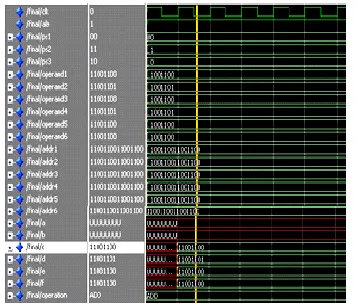
Fig.III:Simulation results of Quad Core Processor main module
The above figure gives the results of designed quad core which is simulated by using model sim simulator and verifying the parallel and distributed computing which show that the desinge dprocessor exhibits the concurrent results under the quad processorplatform.
Fig. IV: Floor Planning Diagram.
Floor planning diagram of implemented design represents the total modules in the system and their internal connections of I/O ports as shown in the Fig.iv.
V. CONCLUSION
The designed quad processor core is very efficient and powerful core, which is analyzed by using Xilinx software and simulation by using model sim simulator. Although the quad processor core was based on well-proven superscalar architectural techniques, including register renaming and parallel execution, these techniques were originally devised
for fine-grained parallelism among instructions. The
designed quad core implementation using FPGA which is very advantageous to the architecture . because it uses the parallel processing and pipielinig techniques are easily implemented in FPGA.The concurrent operation of quad processor gives the high speed and takes less power.
REFERENCES
[1] Tai-Hua, Lu, Chung-Ho Chen, KuenJong Lee. “Effective Hybrid Test Program Development for Software-Based Self-Testing of Quad Cores” ,IEEE Manuscript received April 03, 2012, revised August 14, 2012, first published December 18, 2012.
[2] Gohringer, D., Hubner, M.Perschke, T., Becker. J. “New Dimensions for Quad core Architectures Demand Heterogeneity”, Infrastructure and Performance through reconfigurability The EMPSoC Approach”. In Proc of FPL 2010, PP.495-498, Sept 2010. [3] Lysaght, P. Blodget, B. Mason, J.Young, B.Bridgford. “Invited
[image:4.612.81.260.426.578.2]International Journal of Emerging Technology and Advanced Engineering
Website: www.ijetae.com (ISSN 2250-2459,ISO 9001:2008 Certified Journal, Volume 3, Issue 7, July 2013)
570
[4] D. Tullsen, S. Eggers, and H. Levy, “Simultaneous Multithreading: Maximizing On- Chip Parallelism,” Proc. 22nd Ann. Int’l Symp. Computer Architecture, ACM Press, New York,1995, pp. 392-403.
[5] J. lo, S. Eggers, J. Emer, H. Levy, R. Sstamm, and D. Tullsen.”Converting thread level parallelism into instruction-level parallelism via simultaneous multithreading”. ACM Transactions on Computer Systems, 15(2), pp. 323-354, August 1997.
[6] Lance, Hammond, Basem, Ku.umen “ANayfeh,KunleOlukotun.ASingle-Chip multiprocessor. IEEE Computer”, vol. 30, no. 9, pp. 79--85, September1997.