Spatial solitarywave optical memory
Mcdonald, GS and Firth, WJ
http://dx.doi.org/10.1364/JOSAB.7.001328
Title
Spatial solitarywave optical memory
Authors
Mcdonald, GS and Firth, WJ
Type
Article
URL
This version is available at: http://usir.salford.ac.uk/18355/
Published Date
1990
USIR is a digital collection of the research output of the University of Salford. Where copyright
permits, full text material held in the repository is made freely available online and can be read,
downloaded and copied for noncommercial private study or research purposes. Please check the
manuscript for any further copyright restrictions.
1328 J. Opt. Soc. Am. B/Vol. 7, No. 7/July 1990
Spatial solitary-wave optical memory
G. S. McDonald and W J. Firth
Department of Physics and Applied Physics, Strathclyde University, Glasgow Scotland G4 ONG, UK
Received October 17, 1989; accepted January 26, 1990
We consider some features of spatial solitary-wave switching in a unidirectional ring cavity that is partially filled with a fast and saturably self-focusing nonlinear medium. Large (part-beam switched) solitary arrays are considered. It is found that prescribed binary patterns may be encoded in the duration of a single cavity transit and subsequently remain stable over thousands of transits. Beam interrupt allows pixels to be switched off in fewer than ten cavity transits. Pixel instabilities on an unpixelated beam are shown to arise from spatial solitary attractive forces and intensity gradients.
INTRODUCTION
Recent research concerning all-optical switching has mainly involved the Kerr effect in nonlinear interferome-ters and in nonlinear couplers.'13 Switching of solitonlike
pulses in both the nonlinear interferometer and the non-linear coupler has only recently been considered.4` In
these cases low energy, high contrast, and stable switch-ing have suggested solitons as the natural bits for optical information processing. Here we investigate the suit-ability of spatial (bright) solitary waves as pixels in a trans-verse binary array.
In this study we closely follow the scheme and notation of Ref. 9. The model is that of an externally pumped pas-sive nonlinear optical ring resonator in which a wide range of spontaneously occurring spatial structures has been studied. It is of fundamental interest to examine the possibilities of control and, ultimately, utilization of these structures. Our spatial solitary waves are directly analogous to those in the temporal domain of single-mode optical fibers and arise when frequency sweeps owing to self-focusing and diffraction balance. In some specific experimental arrangements, stable self-trapped soliton beams have already been realized for the ultrafast non-linearity of CS2, both in a three-dimensional cell'0 and
in a planar waveguide"l and also in glass waveguides.'2
Qualitatively similar structures may also occur in atomic vapors and liquid-crystal film devices.
To achieve memory we may need to spatially modulate the medium or the input light or both. Medium pixela-tion leads to rather involved considerapixela-tions, as can be illustrated by particular examples cited from the physics of nonlinear interference filters, where both analytic'3
and experimental'4 research has been performed. In
light of this, we shall examine pixelation through spatial modulation of only the pump field. Our work, therefore, broadly continues on from publications that dealt with bistable arrays induced in a nonlinear Fabry-Perot reso-nator.'5 Those studies modeled the specific physics of InSb talons in which diffusive coupling has been seen to
be the dominant transverse effect.'
6Here we study the
case of dominantly diffractive coupling and seek to estab-lish device prospects and limitations for this kind of inter-pixel cross talk.
Neglecting diffraction permits much analytic progress to be made, whereas its inclusion results in a relatively intractable system for which full numerical simulations are necessary. It is hoped that, in the self-focusing case, the attracting nonlinear basis (solitary waves) will sim-plify the spatial complexity to consideration of only these (natural) nonlinear modes. A study of two-beam coupling has been performed on a similar system by considering a single, low Fresnel number in the self-defocusing regime.7
Here we present results from a two-beam coupling investi-gation with a self-focusing nonlinearity and in a model that neglects saturable absorption. This generalizes the earlier results17 and provides a necessary underpinning for our array studies.
THEORY
The complex field G(x, z), during its nth transit through the medium, may be described by a nonlinear Schrodinger-type evolution equation:
2i - + az p a 2 + f(IGnI2)G, = 0.
p X (1)
We consider a medium whose response is much faster than the cavity transit time, which thus permits adiabatic elimination of the polarization from the Bloch equations. Planar waveguide geometry reduces the diffractive Laplac-ian to an operator in one CartesLaplac-ian dimension. Cavity boundary conditions complete a full transverse, and in-deed infinite-dimension, generalization of the map that was considered by Ikeda":
Gn+l(x, 0) = A(x) + R exp(i(Do)G(x,p). (2)
The pump field, denoted A(x), is sufficiently detuned from two-level atom resonance to furnish a purely disper-sive nonlinearity, f(IGnl2) = -1/(1 + 2Gn12
), though here we do not consider the extreme Kerr limit. The scaling of the propagation and transverse dimensions (see Fig. 1) is such that we deal with an effective medium length, p = oLl/A, whereas our (beam) Fresnel number, F =
no (&1/2)2/(AL), is scaled into y = n 2/(47rF). Parameters (O, A, and a0 are the cavity mistuning, pump detuning,
and medium linear absorption coefficient, respectively. 0740-3224/90/071328-08$02.00 X 1990 Optical Society of America
Vol. 7, No. 7/July 1990/J. Opt. Soc. Am. B 1329
x
_ DX
R
1 00%
H NL MEDIUM H2
a L --- >
- - -- - - L - -
-H,
Fig. 1. Schematic representation of our optical resonator, whici is partially filled with a nonlinear medium. The laser beam(s enters through Ml, which, like M2, has an intensity reflectivity o R = 0.9. Output through M2is monitored.
We normally allow for the medium to fill only part of th( cavity; we perform linear lossless propagation in the re mainder. In the simulations presented, an integration is first made to the output mirror M2to permit data col
lection before completion of the resonator circuit. Th beam path drawn in Fig. 1 corresponds to the x = 0 axis Since we use plane mirrors, beams may circulate in thi cavity on both sides of this axis. In all cases p = 2'q an (Do = 0.4X, where q = +1 (a self-focusing medium). Ou chosen value of (Do permits a wide bistable loop and avoid Ikeda-type instabilities. Integrations within the mediun are performed by using the efficient split-step Fourie operator method.'9
may arise, for example, owing to beam multiplexing. The key problem is determining under which values of separa-tion and relative phase of the pumps the left-hand beam can be independently switched.
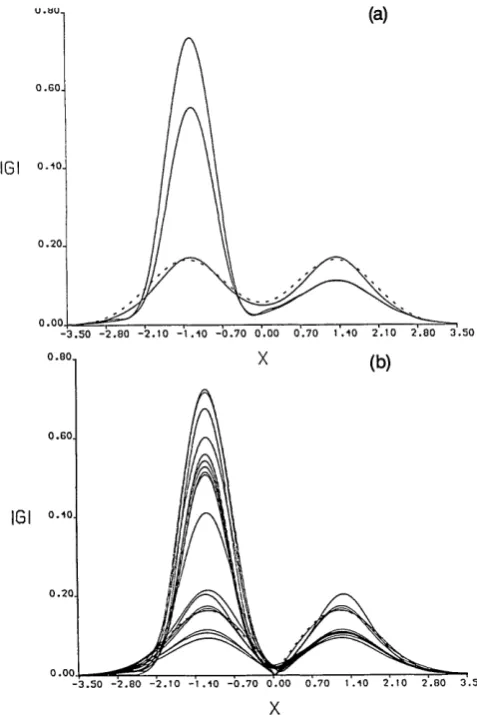
Figure 2 gives examples of simulations in the self-focusing case. The dashed curves are the prescribed hold beams, whereas the resonator output profiles are drawn solid. For X0 = 2.0 and AD = 0.0, we found that switch-ing of the left-hand beam also triggers the right-hand beam, after which the beams are in phase with each other and coalesce in the final plot. However, for X0 = 2.25, the left-hand beam can be selectively addressed. In Fig. 2(a) output before, during, and after the address pulse is shown for the latter case. During address the left-hand beam lies outside the bistable region. After removal of the switch it relaxes to a point on the upper branch. *) A slight drop in amplitude of the right-hand beam oc-curs because of the finite amount of cross talk from the switched-on beam, which experienced a phase change on transition to the upper branch of approximately ir rad. For X0 = 2.00 and AM = 7r, Fig. 2(b), the relative beam phase again causes a degree of mutual annihilation, this
I
a
1
lr
KI3
TWO-BEAM COUPLING NUMERICAL EXPERIMENTS
To investigate parallel operation of two all-optical switches, we choose to use a low Fresnel number (F = 1) and hence stay just within the whole-beam switching regime.2 0 Here the (natural) solitary-wave width is of the order of a pump beam width. The form of A(x, t), in this case, is
A(x,t) = a0o exp[-(x - xi)2
]
+ a0 2(t) exp[-(x + xl)2
+ iAcF]. (3) Hold-beam separation will be measured in units of in-tensity, full width at half-maximum, so we define XO = (2/ln 2)"'2x,. Temporally, both beams are at a working point aH, while a02(t) encompasses an additional square
pulse of amplitude as - aH on the left-hand beam. These amplitudes are parameterized around the peak input am-plitudes for switching up and down (aA and av, respec-tively) and are given as
aH= av + cH(aA - av), as = csaH. (4)
In this system, parameter values CH = 0.75 and.cs = 1.5
supply safe hold points, free from overshoot and under-shoot switching, and necessitate only modest amplitude and duration of address. An overall phase difference A) between the pump beams is also included. Such a factor
IGI
(a)
X (b)
-3.50 -2.80 -2.10 -1.40 -0.70 0.00 0.70 1.10 2.10 2.80 3.50 X
Fig. 2. = +1. (a) Spatial profiles before, during, and after the left-hand site has been addressed. Also shown (dashed curve) is the input, A(x). This full width at half-maximum (intensity) sepa-ration of hold beams, XO = 2.25, is required for independent
switching to be maintained when AF) = 0.0. (b) Pixel indepen-dence atXO = 2.0 is achieved through an overall phase differential
(Ay = 7r). Here some intermediate profiles are also given.
D A
~~~~~~~~~~~~...
... . ... .. _ : X 1 8\ V.G. S. McDonald and W J. Firth
[image:3.561.25.260.61.219.2] [image:3.561.285.524.315.673.2]1330 J. Opt. Soc. Am. B/Vol. 7, No. 7/July 1990
time reducing peak beam amplitude before switching. This restraint, in conjunction with the intermediate destructive phase barrier, halts the switching wave and permits independent switching down to an impressive
XO = 1.25.
In Fig. 2(b) intermediate profiles (every fifth round trip) are given that show typical temporal dynamics for these simulations. One can see that instantaneous, and hence abrupt, initialization of the hold beams results in a significant overshoot from the (lower-branch) equilibrium point and that transient switching up and relaxation oscillations occur on a time scale of two or more plot pe-riods. The time taken for these processes may be at-tributed to the whole-beam nature of the solutions and should be kept in mind when part-beam arrays are consid-ered below. In particular, the conventional wisdom that fast switching occurs only in the whole-beam regime2 0
should be challenged.
The corresponding investigations for the self-defocusing nonlinearity have produced less encouraging results and an additional instability.2
'
OPTICAL SOLITARY-WAVE MEMORY ARRAYS
As we have seen, the interaction of adjacent input Gauss-ian beams is rather complex and sensitive to the relative phase of these pump fields. For extension to a large num-ber of pixels, an attractive strategy is to attempt to use the spontaneous solitary-wave structures observed in switching a single, and thus implicitly coherent, broad input beam.92
' Each peak, which we will henceforth term a soliton, suggests itself as a natural pixel, and our
5.0
3.0
21
.0-goal is to establish criteria under which information can be encoded in the ring cavity system in terms of the num-ber and location of spatial solitons. The first point to note is that the soliton structures observed in sponta-neous switching are analogous to bit strings of the form ... 11111..., while the lower branch (no-soliton) state cor-responds to ... 00000.... So far, then, we still have only a two-state memory; to store information we have to ex-amine ways of creating and maintaining subsets of the m solitons that fill the switched-on portion of the beam.
Two strategies suggest themselves: One is to attempt to create different numbers of solitons by spatially selec-tive address pulses and to examine their stability against coalescence and collapse. If we could create any number 0,1, ... ,m of such solitons in a given system, we can
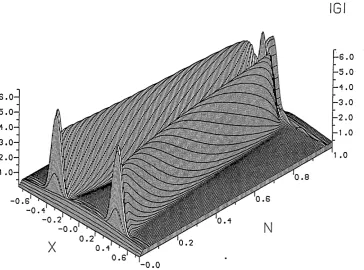
clearly store any of the first m integers or equivalent infor-mation. Figure 3 shows what happens when two solitons are created on a broad Gaussian pedestal. They drift to-ward each other and eventually coalesce, emitting (non-soliton) radiation transversely. That this is not inevitable is shown in Fig. 4, where two solitons on a plane-wave background appear to be stable. A detailed account of these studies will be given elsewhere.
The second, more promising, strategy is to assign sig-nificance to the positions, not just to the number, of solitons present, just as in the binary representation of numbers. An m-soliton beam can then represent 2" binary numbers. We must be sure, however, that the soli-tons do not drift around, since this would corrupt the in-formation stored. If we view the soliton as a pair of switching waves, it is clear that a spatial modulation of the hold beam may stabilize their position. To this end, our
IGI
6.0
-5.0 -4.0 3.0 -2.0 -1 .0
-0.0
Fig. 3. Spatial motion due to (unbalanced) nonlinear index differentials. Two solitons are symmetrically induced on an F = 800 beam. Subsequent evolution displays a migration of these waves toward the beam center and ultimate coalescence. N is in units of 1000 cavity transits, IGJ axis 10-1.
[image:4.561.102.467.443.713.2]Vol. 7, No. 7/July 1990/J. Opt. Soc. Am. B 1331
§ -.
i
-0.6 -0.1
I . I
-0.2 0.0 0.2
. .. ,
§
0.1
0.6
X CONTOUR HEIGHT 10 3
Fig. 4. For a separation identical to that used in Fig. 3, a
(spa-tially) periodic plane-wave simulation is performed. Soliton-soliton coupling is increased here (F = 50), and no significant migration is observed. N is in multiples of 1000 transits.
.~~~Aup
-- A - - - - -Adow
-1.00 -0.75 -0.50 -0.25 0.00 0.25 0.50 0.75 1.00
X
Fig. 5. Our sinusoidally modulated hold beam with respect
to the appropriate upswitching and downswitching ampli-tudes (M = 0.08). Encoding of binary patterns on the circu-lating beam is attained by temporally abrupt superimposition of the addressing Gaussians (here shown in the configuration
1101001110101110101).
hold beam is a sinusoidally modulated Gaussian, Eq. (5). Such a beam may be easily produced experimentally by interference techniques.
A(x) = Ao(1 + M cos kmx)exp(-x2). (5)
The modulation depth is given by M, which may assume either sign depending on whether a finite odd or even number of pixel sites is desired. The density of the trans-verse array scales with the spatial pixelation frequency,
km. The most obvious initial constraint on array size is
the requirement that pixel locations must be such that the local hold-beam amplitude lies between the appropriate bistable switch points, denoted Aup and Adown in Fig. 5.
These switch levels are higher than those calculated for the smooth beam, since finite M entails additional inten-sity gradients; the determination of these levels necessi-tated not only a preliminary switching study of the full set
{F, AO, M, km} but also consideration of address character-istics. A and peak (Gaussian) address amplitude, As, are parameterized, in a manner similar to that for the two-beam case, as
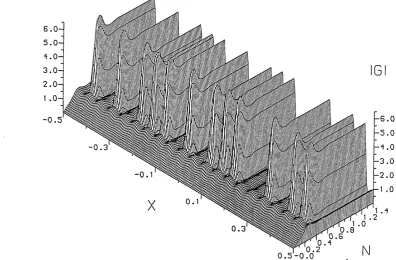
Ao = Adown + CH(AUP - Adwn), As = CsAo. (6) To avoid overshoot and critical slowing down, the global maximum of the hold beam is chosen to be approximately 70% into the working range, requiring that CH ' 0.7. Also shown in Fig. 5 are the address Gaussians, in the configu-ration 1101001110101110101, which are incorporated into A(x) for a switch duration T (cavity transits). It is now clear that the address beams need to be sufficiently well resolved to avoid induced switching in adjacent sites and, with hindsight, we shall present results here for which XO is kept fixed at 4.0. The choice of Cs depends strongly on that of T, because there is a distinct trade-off between switch power and duration. The subtleties of this and other scalings that involve the temporal switching dy-namics have been the subject of an extensive study.2 2 In particular, switch-on time has been seen to be a simple and controllable function of address specifications. It has been found that the criterion of performance between the two switch points is not sufficient-marginally stable end pixels can disrupt the stability of the whole array. Unad-dressed end pixels seem to permit a buffering of the array from the edge instabilities and allow the hold-beam modu-lation effectively to tile the central portion of the beam in which the solitons sit.
In the following simulations the hold beam is ramped into position during the first 20 round trips and then held
X CONTOUR HEIGHT 10
Fig. 6. Simulation shown in Fig. 4 is repeated with an addi-tional (central) induced soliton. Coalescence is at approximately 800 transits.
A(X)
l 0.0 1 . ,
G. S. McDonald and W J. Firth
[image:5.561.24.257.61.283.2] [image:5.561.25.267.341.528.2] [image:5.561.290.527.485.712.2]1332 J. Opt. Soc. Am. B/Vol. 7, No. 7/July 1990
6.0- 5.0- 1.0-
:3.0- 2I
.0-(a)
6.0
5.0
1.0-
3.0-
2I
.0-G. S. McDonald and W J. Firth
IGI
6.0
-5.0
1.0
3.0 2.0 1 .0
0.5-0 .0
IGI
-6.0
-5.0
-1.0
-3.0
-2.0
-1 .0
0.5-0.0
(b)
[image:6.561.64.510.56.749.2]Vol. 7, No. 7/July 1990/J. Opt. Soc. Am. B 1333
X
Fig. 8. Overlay of resonator outputs over a period of 2600-3000 cavity transits. In this simulation the hold beam was allowed 30 transits for initialization, and then a full 1111111111111111111 was encoded in the subsequent 5 transits.
X
IGI
-1.00 -0.50 0.00 0.50 1.00
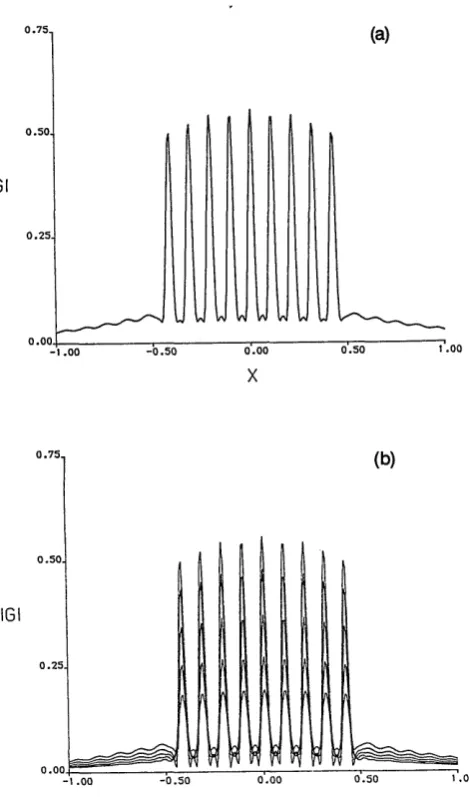
Fig. 9. (a) Overlay of output profiles 800-850 transits after
encoding of the string 111111111 on a F = 800 spot. (b) Beam interrupt, implementing reset during eight subsequent transits.
at the operational point for a further 10 trips before the address is implemented.
Spatial Soliton Interaction Forces
The robust particle nature of solitons and (elastic) multi-soliton collisions invokes the concept of interaction forces, which act between each two solitonic centroids and are derived from their own (nonlinear) potentials. Some for-malism has been developed for these forces under certain simplifying assumptions, with resultant restricted appli-cability. Numerical and analytic studies concerning op-tical soliton interaction have been done mostly in the temporal domain by using or referring to the exact two-soliton solution of the nonlinear Schrodinger equation.2 3 For (resolved) equal-amplitude constituents, the inter-action force decreases approximately exponentially with increasing separation while depending sinusoidally on relative phase.24 The interaction forces between two soli-tary pulses may be minimized through a number of techniques, such as using unequal amplitudes,2 5 having relative phases2 6-28 or higher order effects,2 9 and
impos-ing an initial (continuous) phase envelope over the tempo-ral domain.30
For our soliton switching, one would expect some quali-tative similarities, but here the system is greatly more complicated; it encompasses some of the above effects but also includes host-beam intensity gradients and pixelation (leading to asymmetries and unequal amplitudes), a bi-stable phase envelope over each pixel, the damping effect of the map, and saturation of the nonlinearity.
To illustrate the existence of interaction forces in the case of diffractive solitons, a periodic plane-wave simu-lation has been performed. Here a periodic zone in x is considered, within which the backgrounding beam has a plane, rather than Gaussian, spatial distribution. In Fig. 4 an impressive independence was seen between two well-separated solitons. If this integration is repeated but, this time, with an additional (central) soliton, we ob-tain the results shown in Fig. 6. This corresponds to the first 1000 transits and shows the outer solitons ac-celerating toward the central one and coalescing after 800 transits. This effect is due solely to the presence of an additional soliton and hence to reduced soliton separa-tion. Coalescence distance may be controlled through specifying the initial separation.
Large Arrays of Soliton Pixels
Instabilities have imposed upper bounds on spatial pixela-tion frequencies, which can be used for the array sce-narios. When these instabilities occur, their onset time has been found to scale roughly as
Vi.
This upper bound on stable km has been compared with results from an earlier stability analysis,3" and its value seems to remain fixed near the low-spatial-frequency edge of the plane-wave modulational instability band calculated for the maximum bistable output intensity. The most (modula-tionally) unstable spatial frequencies are far greater than any upper bound imposed on km through array stability. The simplest step toward interpretation of this observa-tion is in the context of an induced modulaobserva-tional instabil-ity-energy balance.21Soliton switching on finite beams has been extended out to a 19-bit array, for which F = 3565 and km = 124.4
[image:7.561.27.267.61.248.2] [image:7.561.28.263.319.718.2]1334 J. Opt. Soc. Am. B/Vol. 7, No. 7/July 1990
6 5
3 2
-0.5 D.0
.0 .0 .0 2.0 .0
Fig. 10. Encoding of a periodic zone within an infinite-dimensional pattern recurs indefinitely in both directions of X. N is in units of N
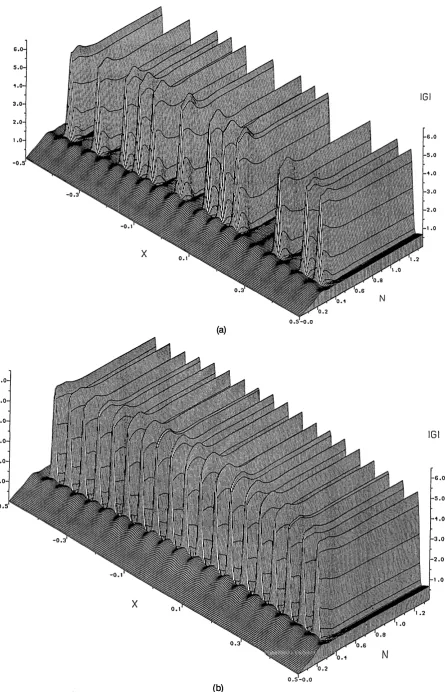
were used. For preservation of numerical accuracy, any further extension would require a prohibitive leap in com-putational requirements. Figure 7(a) shows hold-beam initialization and subsequent encoding of a quasi-random pattern in five cavity transits, while Fig. 7(b) shows en-coding of a full binary string in a single cavity transit. The necessity of using such a large array prompts a few selective trial simulations for multiples of 1000 round trips. The adopted limit was 3000 round trips, and some results are presented in Fig. 8. This shows the final reso-nator output where the fullest 19-bit address had been en-coded and is presented in overlay format for the final 400 cavity transits. This integrity of information storage can also be reproduced when highly asymmetric patterns are chosen.
Wiping the Memory
Attempts to switch off bistable elements often involve a mechanism similar to beam interrupt. This has been performed for diffusively coupled arrays,3 2 and we have implemented it here. In Fig. 9(a) the string 111111111 is shown stored on a spot of size F = 800. The process of successfully switching off this pattern, over a period of eight cavity transits, is shown in Fig. 9(b). For this AO was set to zero, and the pattern was allowed to circu-late around the cavity, thus experiencing periodic (linear) loss at input and output mirrors. Even in this relatively high-finesse cavity (R = 0.9), switch-off by this method requires fewer than ten transit times. The loss is
suffi-ciently rapid to permit a clean witch-off, during which
the soliton amplitudes simply drop without any notice-able lateral motion, soliton-soliton interaction, or noisy interference with the adjacent lower branch field. Beam
ol.o
°
2
N
binary array. Spatial periodicity ensures that this quasi-random transits, IGI axis x 10-1.
interrupt was performed at the end of most switching simulations, and similar results were seen for all pixel con-figurations and system parameters used.
This simple, total-wipe strategy is, of course, not ideal. One would like to be able to write a 0 to any pixel site without affecting any other pixels. It is expected that the above results will be equally applicable to local interrupt, but we have found that this operation may be more ef-fectively accomplished through phase-encoded address beams. This phased switching, in fact, gives nearly ideal switching performance, as will be reported elsewhere.
Soliton Addressing in the Limit as F X
In the limit F oo, locally, the Gaussian beam becomes planar. To simulate this, and thus to consider the ulti-mate extension of the foregoing results to essentially an infinite-dimensional pixel array, soliton switching was performed in a periodic plane-wave configuration. In this simulation the narrow address beams, which encode the information, inject a wide and continuous range of fre-quencies, which permits rapid trapping of diffractive waves into the soliton pixel structures. For finite soliton width, we require finite F in the calculations, so that its role is now only that of specifying the size of a spatial observa-tional window.
In Fig. 10 encoding of a (periodic) zone with a quasi-random string is shown. Necessary address parameters for quick encoding are close to those used on the F = 3565 spot, indicating that an arbitrarily high number of pixels
is possible. Noto that spatial periodicity ensures that this
quasi-random pattern recurs indefinitely in both direc-tions of X, and thus we are simulating a periodic bit pat-tern in an infinite-dimensional binary array.
[image:8.561.67.464.62.322.2]Vol. 7, No. 7/July 1990/J. Opt. Soc. Am. B 1335
SUMMARY
Transverse effects permit and constrain information stor-age in bistable optical systems. Here we have examined, for the first time to our knowledge, diffractively coupled arrays of bistable elements or pixels. Spatial (bright) soli-tons have an innate appeal as natural pixels, and we have shown that it is possible to devise a soliton memory in which a soliton may be present or absent at each pixel site, giving maximum information capacity. We have reported some results on two-beam interaction and soliton-soliton interactions in a ring cavity containing a self-focusing medium that underpins the array simulations.
It is not sufficient that information can be retained in a memory; it must also be possible to write to and read from this memory. The latter is trivial in our case, be-cause the transmitted beam gives a continuous readout. We have shown that soliton pixels can be turned on rapidly by appropriate address pulses and cleanly wiped by beam interrupt.
ACKNOWLEDGMENTS
This work was supported in part under a Twinning con-tract of the European Community. G. S. McDonald is grateful for support from the University of Strathclyde and the U. K. Science and Engineering Research Council.
REFERENCES
1. S. M. Jensen, IEEE J. Quantum Electron. QE-18,1580 (1982). 2. S. R. Friberg, A. M. Weiner, Y Silberberg, B. G. Sfez, and
P. S. Smith, Opt. Lett. 13, 904 (1988).
3. P. Li Kam Wa, J. E. Sitch, N. J. Mason, J. S. Roberts, and P. N. Robson, Electron. Lett. 21, 26 (1985).
4. N. J. Doran and D. Wood, J. Opt. Soc. Am. B 4, 1843 (1987). 5. N. J. Doran and D. Wood, Opt. Lett. 13, 56 (1988).
6. K. J. Blow, N. J. Doran, and B. K. Nayar, Opt. Lett. 14, 754 (1989).
7. S. Trillo, S. Wabnitz, E. M. Wright, and G. I. Stegeman, Opt. Lett. 13, 672 (1988).
8. S. Trillo, S. Wabnitz, E. M. Wright, and G. I. Stegeman, Opt. Commun. 70, 166 (1989).
9. H. Adachihara, D. W McLaughlin, J. V Moloney, and A. C. Newell, J. Math. Phys. 29, 63 (1988).
10. A. Barthelemy, S. Maneuf, and C. Froehly, Opt. Commun. 55, 201 (1985).
11. S. Maneuf, R. Descilly, and C. Froehly, Opt. Commun. 65, 193 (1988).
12. J. S. Aitchison, A. M. Weiner, Y. Silberberg, M. K. Oliver, J. L. Jackel, D. E. Leaird, E. M. Vogel, and P.W E. Smith, Opt. Lett. 15, 471 (1990).
13. E. Abraham, C. Godsalve, and B. S. Wherrett, J. Phys. 49, 43 (1988).
14. A. K. Kar, R. M. Harris, G. S. Buller, S. D. Smith, and A. C. Walker, J. Phys. 49, 443 (1988).
15. W J. Firth and I. Galbraith, IEEE J. Quantum Electron.
QE-21, 1399 (1985).
16. D. J. Hagan, H. A. Mackenzie, H. A. Al-Attar, and W J. Firth, Opt. Lett. 10, 187 (1985).
17. K. Tai, J. V. Moloney, and H. M. Gibbs, Opt. Lett. 7, 429 (1982).
18. K. Ikeda, Opt. Commun. 30, 257 (1979).
19. R. H. Hardin and F. D. Tappert, SIAM Rev. 15, 423 (1973). 20. J. V Moloney and H. M. Gibbs, Phys. Rev. Lett. 48, 1607
(1982).
21. G. S. McDonald and W J. Firth, 'All-optical switching in a nonlinear resonator," J. Mod. Opt. (to be published). 22. G. S. McDonald, "Spatial solitary wave optical memory,"
Ph.D. dissertation (Strathclyde University, Glasgow, 1989). 23. V. E. Zakharov and A. B. Shabat, Soy. Phys. JETP 34, 62
(1972).
24. J. P. Gordon, Opt. Lett. 8, 596 (1983).
25. P. L. Chu and C. Desem, Electron. Lett. 21, 1133 (1985). 26. B. Hermansson and D. Yerick, Electron. Lett. 19, 570 (1983). 27. E. Shiojiri and Y Fujii, Appl. Opt. 24, 358 (1985).
28. D. Anderson and M. Lisak, Opt. Lett. 11, 174 (1986). 29. P. L. Chu and C. Desem, Electron. Lett. 21, 228 (1985). 30. E. M. Dianov, Z. S. Mikonova, and V N. Serkin, Sov. J.
Quan-tum Electron. 16, 1148 (1986).
31. D. W McLaughlin, J. V Moloney, and A. C. Newell, Phys. Rev. Lett. 7, 681 (1985).
32. I. Galbraith, "Diffractive and diffusive phenomena in opti-cally bistable devices," Ph.D. dissertation (Heriot-Watt Uni-versity, Edinburgh, 1985).